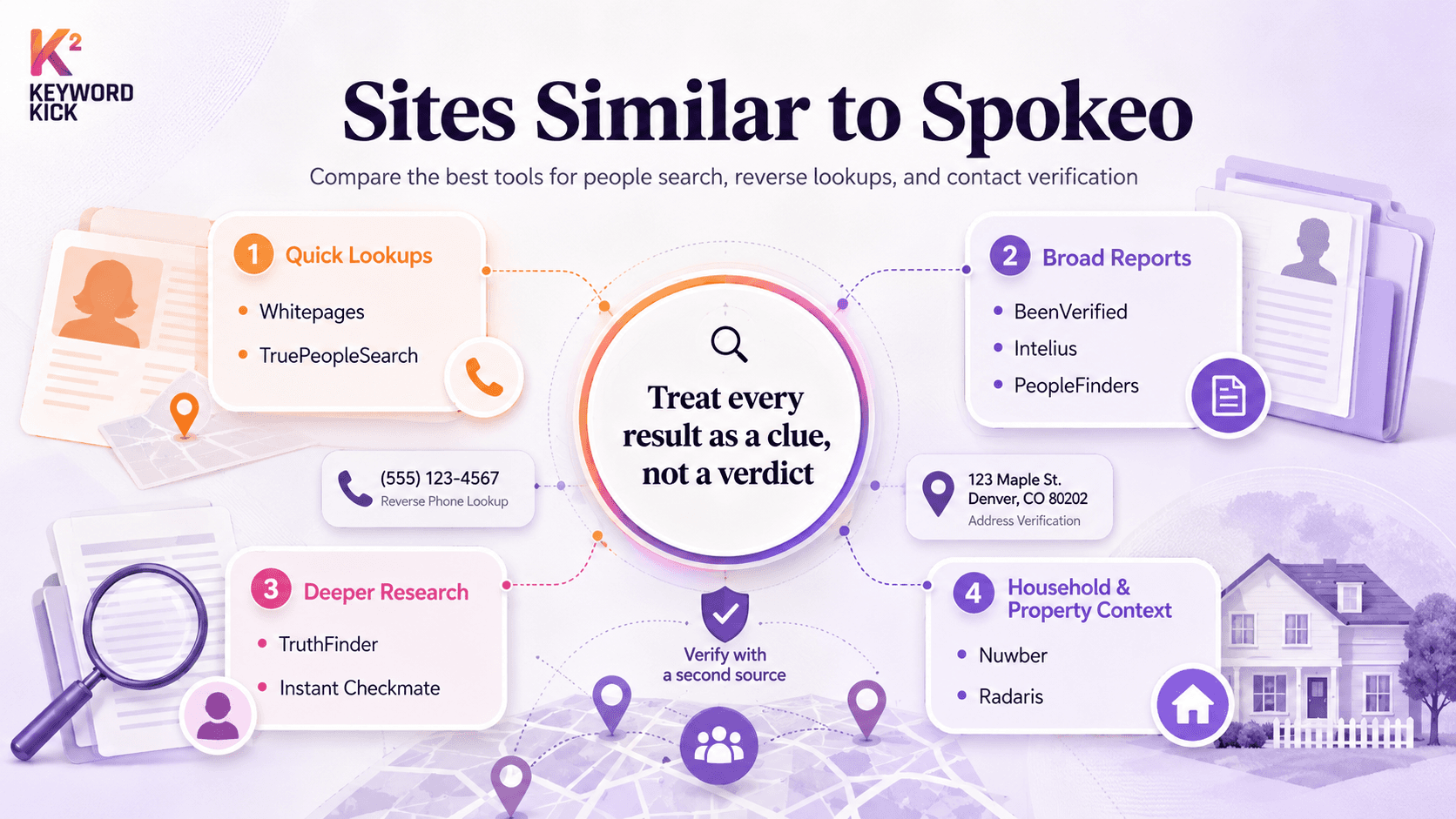
You need to find an old friend, verify a business contact, or work out who keeps calling from an unfamiliar number. Spokeo is often the first tab people open, but it's rarely the only one worth checking. The people-search market is crowded, and the tools aren't interchangeable. Some are better for a fast phone or address lookup. Others are built for broader report-style research. A few are useful mainly because they expose what data brokers already know about you.
If you're comparing sites similar to Spokeo, the practical question isn't which one has the longest feature list. It's which one fits the job without wasting time, overselling certainty, or creating legal risk. I'd rather use a weaker free tool first and confirm with a second source than jump straight into a paid subscription that buries the useful detail under marketing copy.
That matters because people-search tools are messy by nature. They aggregate public records, brokered data, and web traces. Records get merged. Old addresses linger. Relatives become “possible associates.” You have to treat every result as a lead, not a verdict.
For personal lookups, reverse searches, and basic contact verification, this guide covers the strongest options beyond Spokeo. If your use case leans toward business identity or contact discovery, a specialized email and phone number search workflow may be the better fit than a consumer people-search report.
1. Whitepages
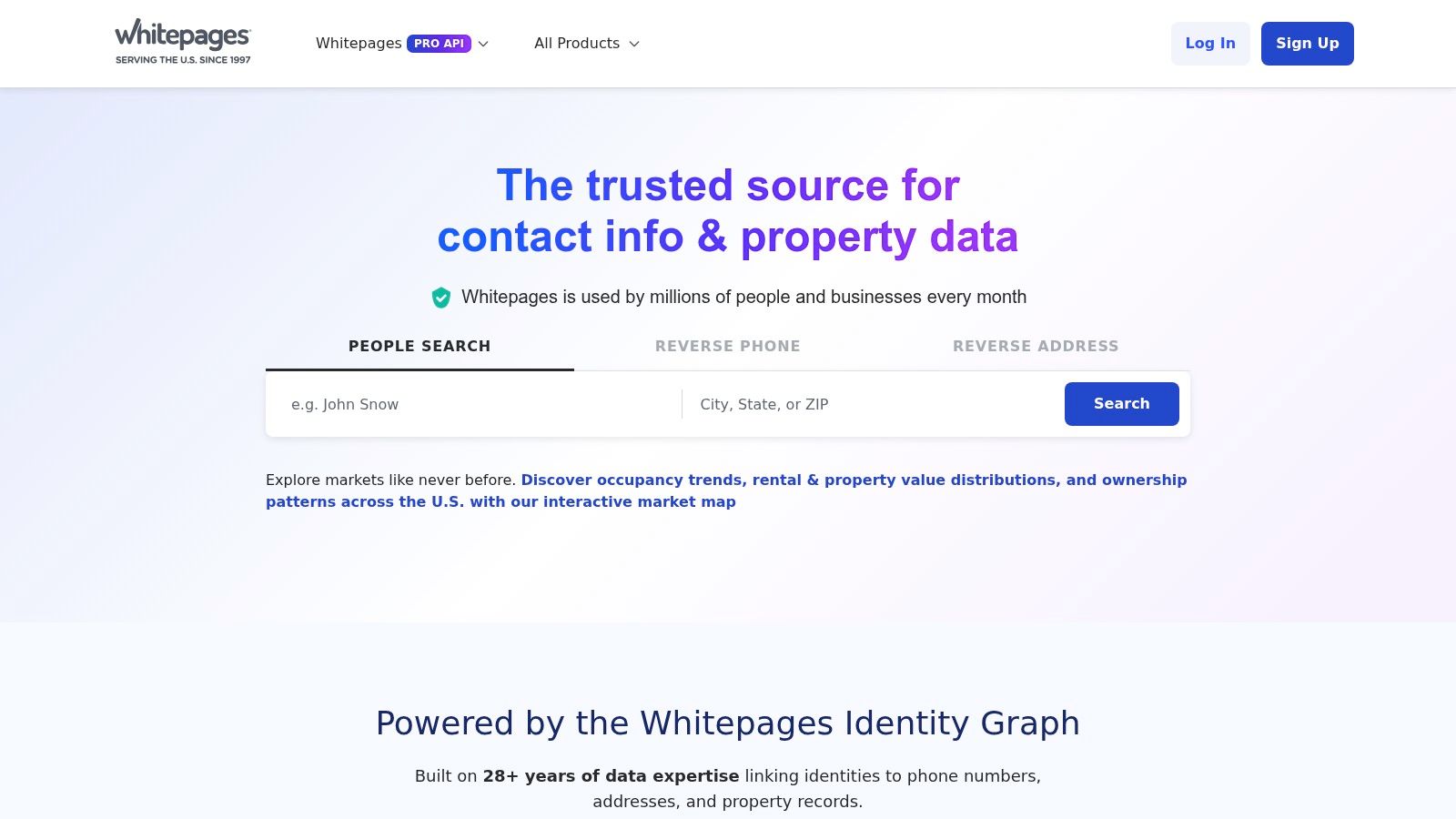
Whitepages is the old reliable option. When I need a quick read on a U.S. phone number, a current address, or whether a person likely still lives at a known location, it's one of the first tools I check. It usually works best as an opening move, not as the final answer.
It also has real scale. In the people-search market, Whitepages.com led comparable competitors with 18 million monthly visits in September 2025, and its authority score was listed as 72 in the same competitor analysis from Semrush competitor data for Spokeo alternatives. That doesn't make every record right, but it does tell you Whitepages remains a default destination for mainstream lookups.
Where Whitepages works best
Whitepages is strongest for practical, everyday searches:
Best use case: Current phone numbers, current addresses, and basic address history.
Data accuracy: Usually solid on core contact details, weaker when you need deep context or older records cleaned up.
Pricing model: Free previews with paid layers for more complete information.
Privacy and legal considerations: U.S.-centric data broker. It's fine for personal research, but it isn't for regulated screening decisions.
Whitepages also reflects the self-service nature of this market. Its bounce rate was recorded at 45.57% in the same Semrush market snapshot of Whitepages and similar sites, which fits how people use it. They search, grab a number or address, and leave.
Practical rule: Use Whitepages first when you want a fast hit. If the result matters, verify it with a second tool before you act on it.
If you work in marketing or lead research, there's a parallel here with competitor analysis workflows. Big visibility doesn't always mean complete coverage. It often just means a tool is very good at serving the most common intent.
For international lookups, Whitepages falls off quickly. It's built around U.S. data, and that limitation matters.
2. BeenVerified
BeenVerified is a generalist. That's its strength. It pulls together people, phone, email, address, social, and property signals into one place, then packages them into a report that's easier to scan than what you get from simpler directory-style tools.
If you run occasional searches, the paywall can feel annoying. If you run repeated searches, the membership model starts to make more sense. BeenVerified is built for people who want one account, saved reports, mobile access, and fewer tab-hopping sessions.
Four-pillar take
Best use case: Recurring personal lookups where you want a broad report, not just a phone or address hit.
Data accuracy: Good enough for pattern-finding, but you still need to manually verify anything sensitive or consequential.
Pricing model: Membership-first. Better for repeat users than one-off searchers.
Privacy and legal considerations: Consumer research only. Don't use it for employment, tenant, credit, or insurance decisions.
The practical upside is convenience. BeenVerified often surfaces relatives, possible associates, old addresses, and linked contact points in a format that's easier for non-specialists to use. The practical downside is that “more data” can create false confidence. A polished report still contains stale or merged records sometimes.
I like BeenVerified when the question is broad. “What public-facing trail does this person leave across common consumer records?” I don't like it when the question is narrow and high-stakes. “Is this one exact record definitely tied to this one exact person?” That's where you need corroboration.
A BeenVerified report is a working draft, not a final judgment.
Another trade-off is speed versus transparency. You usually won't know whether the full report is worth paying for until you're already inside the funnel. That's common across sites similar to Spokeo, but BeenVerified leans into the subscription path more than free-first tools do.
3. TruthFinder
TruthFinder is what people move to when a lightweight directory result isn't enough. It's more report-oriented, more historical, and generally more useful when you're trying to understand context around a person instead of just finding a number.
That doesn't mean it's cleaner. In fact, deeper reports often create more ambiguity because they bring in older addresses, associates, and court-related references that need careful reading. TruthFinder can be helpful, but it rewards patience.
Where it earns its place
Best use case: Deeper personal research where address history, possible associates, and older public-record context matter.
Data accuracy: Better for building a timeline than for proving a single point without further confirmation.
Pricing model: Subscription-led, with extras and monitoring-style upsells depending on the plan.
Privacy and legal considerations: Not FCRA-compliant for regulated decisions. Treat court or corrections data carefully and verify at the source when possible.
TruthFinder is strongest when you're building a profile from multiple clues. A phone number connects to an address. That address connects to a household. The household surfaces related names. That chain can be useful. It can also send you in the wrong direction if the original record was off.
One reason I don't treat any report-style service as gospel is simple. Domain trust matters online, and record trust matters in investigations. The same skepticism people use when they check domain trust signals should apply here. Ask where the data likely came from, how old it may be, and what would count as confirmation.
If you only need one reverse phone search, TruthFinder is overkill. If you need context and don't mind sorting signal from noise, it can be worth the friction.
4. Intelius
Intelius sits in the middle of this category. It's established, familiar, and broad enough for most consumer lookup tasks. It doesn't feel as stripped down as a free directory, and it doesn't always feel as aggressively theatrical as some deeper-dive report products.
That middle ground is useful. Intelius is often a reasonable second check when another service gives you partial information and you want to see whether names, addresses, relatives, or property ties line up.
Practical fit
Best use case: General people search with a bit more depth than a basic directory.
Data accuracy: Mixed in the way most aggregators are mixed. Good for triangulation, not sole-source certainty.
Pricing model: Membership and bundled report access, with details sometimes appearing late in the purchase flow.
Privacy and legal considerations: Consumer use only. It isn't the right tool for hiring or tenancy screening.
What Intelius does well is present common identity signals in one place without demanding that every search become a full investigative project. If I'm checking whether a name is plausibly tied to an address and whether household connections are consistent, Intelius can get me there fast enough.
Where it falls short is the same place many Spokeo alternatives do. It may show enough to be suggestive, but not enough to be definitive. Common names are a problem. Multi-occupant addresses are a problem. Outdated move histories are a problem.
That's why the best use of Intelius is comparative. Don't ask, “Is Intelius right?” Ask, “Does Intelius agree with the other independent clues I already have?” That shift in mindset prevents a lot of bad assumptions.
5. PeopleFinders
PeopleFinders has been around long enough that many investigators and privacy professionals know exactly what role it plays. It's not flashy. It's useful for core identity context. If you need historical addresses, possible relatives, or a quick reverse-phone check, it's often competent without trying to oversell itself.
For many users, that's enough.
Best for straightforward background context
Best use case: Core contact verification and address-history checks.
Data accuracy: Often serviceable on the basics. Less dependable when records become more layered or older.
Pricing model: Free discovery layer, fuller records behind a paywall.
Privacy and legal considerations: Published opt-out process matters here. Like other consumer people-search tools, it still raises obvious privacy concerns for listed individuals.
PeopleFinders is the sort of tool I'd use when I want to answer a practical question quickly. Did this person likely live here? Does this number appear attached to this name? Do the reported relatives make sense? Those are narrow, useful questions. The tool does better with those than with broad character judgments.
If the output starts sounding like a biography, slow down. These services are better at linking records than explaining a person.
I also give PeopleFinders credit for being relatively understandable to average users. That matters. Some sites bury the useful detail under scare language or vague “premium” framing. PeopleFinders is still commercial, but it usually stays closer to the core lookup task.
6. Instant Checkmate
Instant Checkmate is one of the better-known report-style alternatives to Spokeo. People usually land here because they want more than a phone number or an address. They want criminal and court references, associates, and broader personal context in one place.
That can be useful. It can also encourage overreach if you forget what kind of product this is.
Where it helps and where it doesn't
Best use case: Deep consumer-level lookups when you want more than a directory hit.
Data accuracy: Broad enough to generate leads, but anything serious needs direct confirmation from original public records.
Pricing model: Subscription access, usually best for repeated searches rather than occasional curiosity.
Privacy and legal considerations: Not for employment or tenant decisions. Also be mindful of how much personal information these reports expose.
Instant Checkmate's appeal is obvious. It tries to deliver a fuller narrative around a person. The issue is that fuller narratives can create cleaner stories than the underlying records justify. One common problem in these systems is record adjacency. A correct address, a partially correct age range, and a wrong associate can still look convincing on-screen.
For that reason, I treat Instant Checkmate as a lead generator. It's useful for surfacing places to verify, not for making conclusions on its own. That's the same mindset good researchers bring to SEO tool stacks and data validation. One dashboard can accelerate work, but no serious operator confuses aggregation with ground truth.
If you're doing one casual lookup, Instant Checkmate may feel expensive and heavy. If you're cross-checking multiple names in a short period, the model makes more sense.
7. PeopleLooker
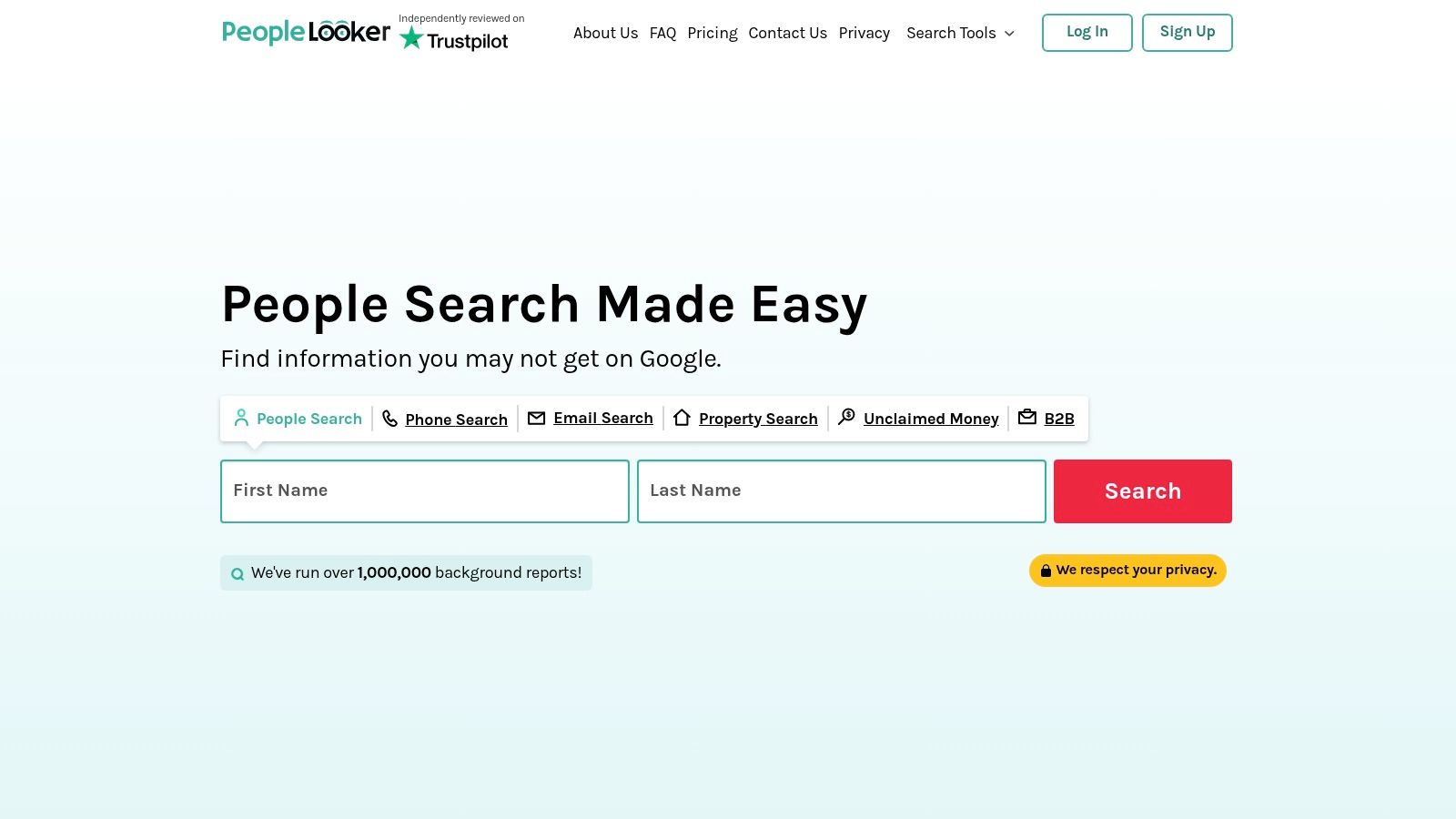
PeopleLooker is the “keep it simple” option in this category. It doesn't try to feel like an enterprise investigation platform. It aims to make people, phone, email, and address lookups easy for ordinary users who want a recurring, low-friction membership.
That makes it appealing for casual use. It also means expectations need to stay realistic.
Four-pillar read
Best use case: Light, ongoing lookups for personal research.
Data accuracy: Fine for broad orientation, less reliable when you need high-confidence matching.
Pricing model: Membership-focused and generally easier to understand than some rivals.
Privacy and legal considerations: Same consumer-only boundary as the rest of this class. Opt-out awareness still matters if your own data appears there.
PeopleLooker is one of the easier sites similar to Spokeo for beginners because the interface doesn't fight you. You search, scan, save, and move on. For people who don't do this often, that matters more than endless feature claims.
The downside is familiar. Simpler UX doesn't fix messy source data. If you search a common name, you can still get blended records, stale addresses, or weakly inferred connections. So PeopleLooker works best when you already have one anchor point, such as a phone number, city, or prior address, and you're using it to narrow possibilities.
I wouldn't use PeopleLooker as my only source on an important question. I would use it as a fast first or second pass when convenience matters more than depth.
8. Nuwber
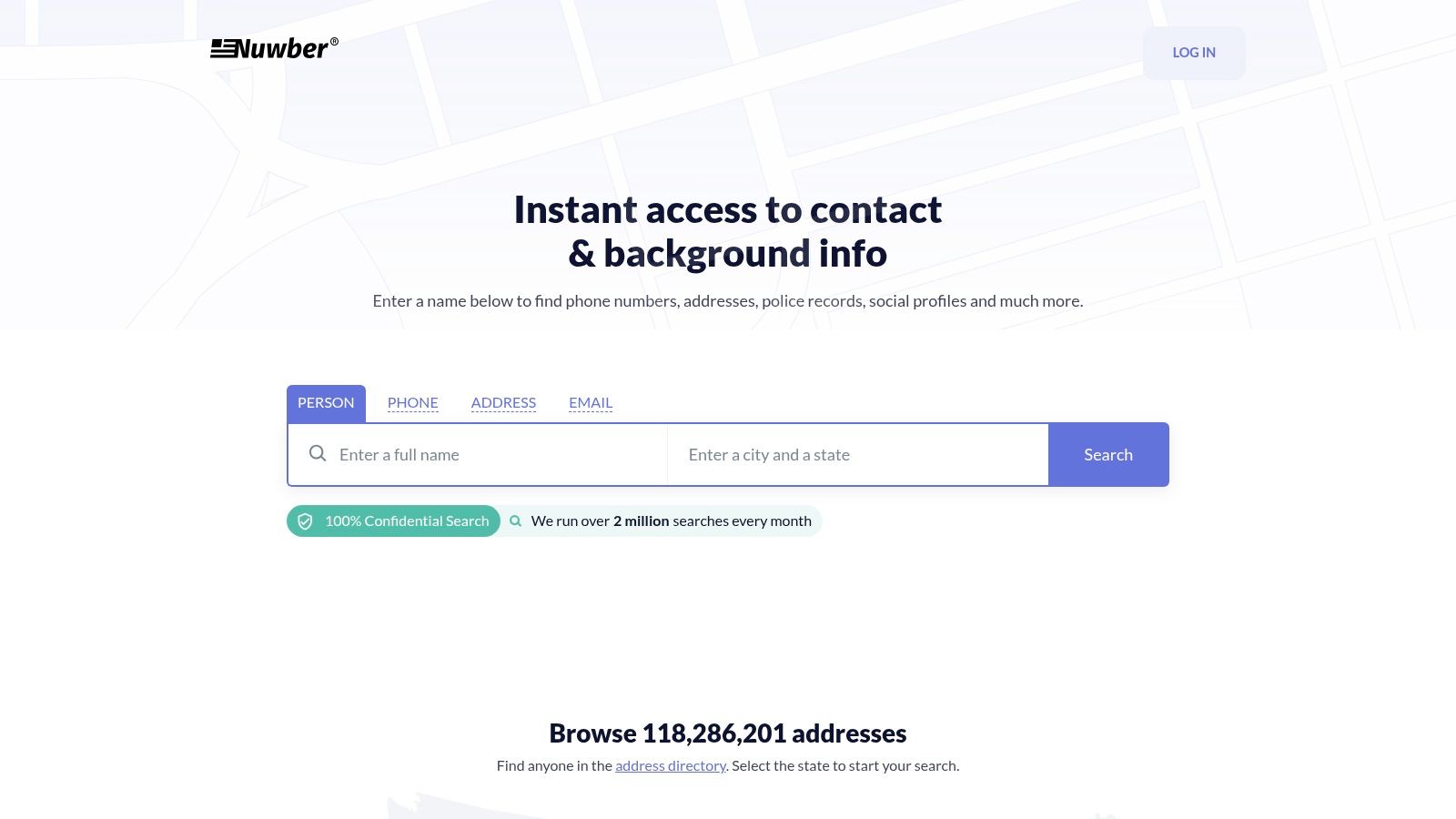
Nuwber tends to stand out when you care about household and neighbor context. A lot of people-search tools show names and addresses. Nuwber is often more useful when the primary question is, “Who else seems tied to this address?” That's helpful in skip tracing, neighborhood context checks, and one-off identity verification.
It's not elegant, but it can be effective.
Why people use it
Best use case: One-off verifications tied to an address, household, or nearby residents.
Data accuracy: Better as a clue-mapping tool than as a precise identity authority.
Pricing model: Limited visibility before checkout, which some users won't like.
Privacy and legal considerations: Includes opt-out pathways, but the service still illustrates how exposed household-level data can become.
Nuwber can surface useful relational hints. If several names cluster around a property and one of them matches the person you're researching, that may help. If the household composition looks wrong, that may also tell you the record is stale or merged.
Household data is often directionally useful, not legally meaningful.
That's the key with Nuwber. It gives you context, not certainty. It's strongest when you pair it with a second source and ask whether the same address web appears there too. If yes, confidence goes up. If not, don't force the fit.
For privacy-conscious users, Nuwber is also a reminder to search your own name and addresses periodically. If a tool like this maps your household cleanly, other people can likely see that too.
9. Radaris
Radaris is useful when the person search starts overlapping with property or business records. It often feels less like a pure people-search directory and more like a cross-reference engine for public-facing traces. That makes it different from many alternatives that focus mainly on phone and address identity.
If your target has property ownership links, business mentions, or a wider public web footprint, Radaris can produce helpful connections.
Where Radaris is strongest
Best use case: Connecting a person to properties, business records, and public web mentions.
Data accuracy: Uneven with common names, stronger when you already have a city, property, or business clue to anchor the search.
Pricing model: Some paths lead to paid reports or outside report flows.
Privacy and legal considerations: Published opt-out process is important because property-linked profiles can expose more context than many users expect.
Radaris is especially useful when a name alone isn't enough. Add a city, an address, or a business name, and the search becomes more practical. That's when it can help separate one John Smith from another.
What I wouldn't do is rely on Radaris for a clean one-step answer. It's better at surfacing possible connections than resolving all ambiguity. But if you're trying to move from “I know the address” to “Who likely owns or is tied to it,” Radaris has a legitimate place in the toolkit.
For many users, that makes it one of the more interesting sites similar to Spokeo because it pushes beyond simple contact lookups.
10. TruePeopleSearch
TruePeopleSearch is the free starting point a lot of experienced users keep in rotation. If all you need is a fast people, phone, or address lookup without immediately hitting a payment wall, it's hard to ignore.
Free doesn't mean harmless, though. It just means the trade-offs are different.
Why it's often the first tab
Best use case: No-cost first-pass searches on U.S. names, numbers, and addresses.
Data accuracy: Surprisingly useful for basic contact and address clues, but not something to trust blindly.
Pricing model: Free access on-site, which makes it ideal for triage.
Privacy and legal considerations: Strong reminder that your own information may already be widely exposed. Opt-out is worth doing.
TruePeopleSearch works best when you need a quick answer to a simple question. Does this number appear linked to a name? Does this person appear tied to this address? Are there associated names worth checking next? It can answer those without forcing a subscription decision first.
That's why many OSINT-minded users treat it as a front-end filter. Run the free search, see whether the core identity signals look plausible, then decide whether a paid tool is worth opening. This saves money and keeps you from buying reports on dead ends.
The limitation is depth. If you need detailed court context, more layered historical records, or a broader aggregation of related identifiers, TruePeopleSearch won't replace a paid report tool. It's the first pass, not the whole process.
Top 10 Spokeo-Like People-Search Sites Comparison
Service | Core features | Quality (★) | Price / Value (💰) | Target audience (👥) | Unique selling point (✨/🏆) |
|---|---|---|---|---|---|
Whitepages | People, reverse phone/address, address history | ★★★ | 💰 Free basic; low-cost Premium app | 👥 Casual lookup & contact checks | ✨ Longstanding U.S. directory; opt-out/listing tools 🏆 |
BeenVerified | Aggregated public records, social & property, monitoring | ★★★ | 💰 Membership with monitoring | 👥 Recurring searchers & investigators | ✨ All-in-one reports + alerts |
TruthFinder | Deep people reports, historical & court/corrections data | ★★★★ | 💰 Subscription (auto-renews) | 👥 Users needing deeper background context | 🏆 In-depth historical & legal records |
Intelius | People, reverse lookups, background-style reports | ★★★ | 💰 Bundled memberships; pricing in checkout | 👥 Frequent searchers & researchers | ✨ Large coverage; online cancellation |
PeopleFinders | People, reverse phone, background-style reports | ★★★ | 💰 Paywalled reports; opt-out published | 👥 Quick identity/address verification | ✨ Reliable core contact checks |
Instant Checkmate | Report-style lookups, criminal/court emphasis | ★★★★ | 💰 Subscription (auto-renews) | 👥 Users seeking criminal/court details | 🏆 Strong emphasis on criminal/court records |
PeopleLooker | People, reverse phone/address/email; saved history | ★★★ | 💰 Low-cost monthly membership | 👥 Budget-minded casual researchers | ✨ Clean UI & simple memberships |
Nuwber | People, reverse phone/address, household linkages | ★★★ | 💰 Paywall; pricing opaque | 👥 One-off verifications, neighbor/household context | ✨ Fast previews + household links |
Radaris | People + property/business profiles, web mentions | ★★★ | 💰 Mix of free previews and paid reports | 👥 Researchers linking people to property/business | ✨ Good at property ties & public web traces |
TruePeopleSearch | Free people, reverse phone/address lookups | ★★★ | 💰 Free (no paid deep reports) | 👥 OSINT starters & no-cost quick checks | 🏆 Free, fast first-pass searches |
Your Next Steps: Choosing and Using These Tools Wisely
The right Spokeo alternative depends on the question you're trying to answer. If you want a quick, free phone or address check, TruePeopleSearch is a practical place to start. If you want a broader consumer report with more surrounding context, BeenVerified, Intelius, or PeopleLooker can be easier to work with. If you need more historical depth, TruthFinder and Instant Checkmate are better fits. If the search is really about household mapping or property ties, Nuwber and Radaris become more useful than generic people directories.
Whitepages still matters because it's a fast first stop and a well-established one. In the broader market of people-search competitors, it remained the traffic leader in September 2025, according to the earlier Semrush competitor review of Spokeo and related sites. For business and enterprise identity resolution, the toolset shifts. Pipl is described as operating with more than 5 billion trusted identity profiles and 28 billion unique identifiers, while RocketReach targets over 700 million professionals, and G2 cited Apollo.io as the best overall Spokeo Business alternative for agency and team use in 2026 in this OSINT-focused review of Spokeo alternatives. Those aren't direct substitutes for casual people search, but they matter if your real need is professional identity or contact discovery rather than consumer records.
The bigger point is this. Don't confuse accessible data with verified truth. These tools are aggregators. They're good at finding leads, patterns, and likely links. They are not good enough to justify certainty by themselves.
Critical legal and ethical considerations
None of the consumer-level tools in this list are appropriate for employment screening, tenant screening, credit decisions, or insurance decisions. That line matters. Cross it and you can create legal exposure for yourself or your business. If your use case is regulated, use an FCRA-compliant screening provider instead.
Privacy matters too. These services work because personal data is widely collected, bundled, and sold. If you find your own information on any of them, use the site's opt-out process. Then check again later. Data often reappears as brokers refresh their records.
Use these platforms the way experienced researchers do. Start narrow. Verify with a second source. Treat every result as a clue. And stop the moment curiosity turns into a decision that should be governed by law, consent, or direct documentation.
If you work in SEO, research, or competitive intelligence, Keyword Kick helps you do with search data what good investigators do with people data. Pull scattered signals into one place, verify what matters, and turn noise into clear next actions. For agencies and in-house teams that want rankings, backlinks, audits, and competitor insights in one workflow, it's worth a close look.