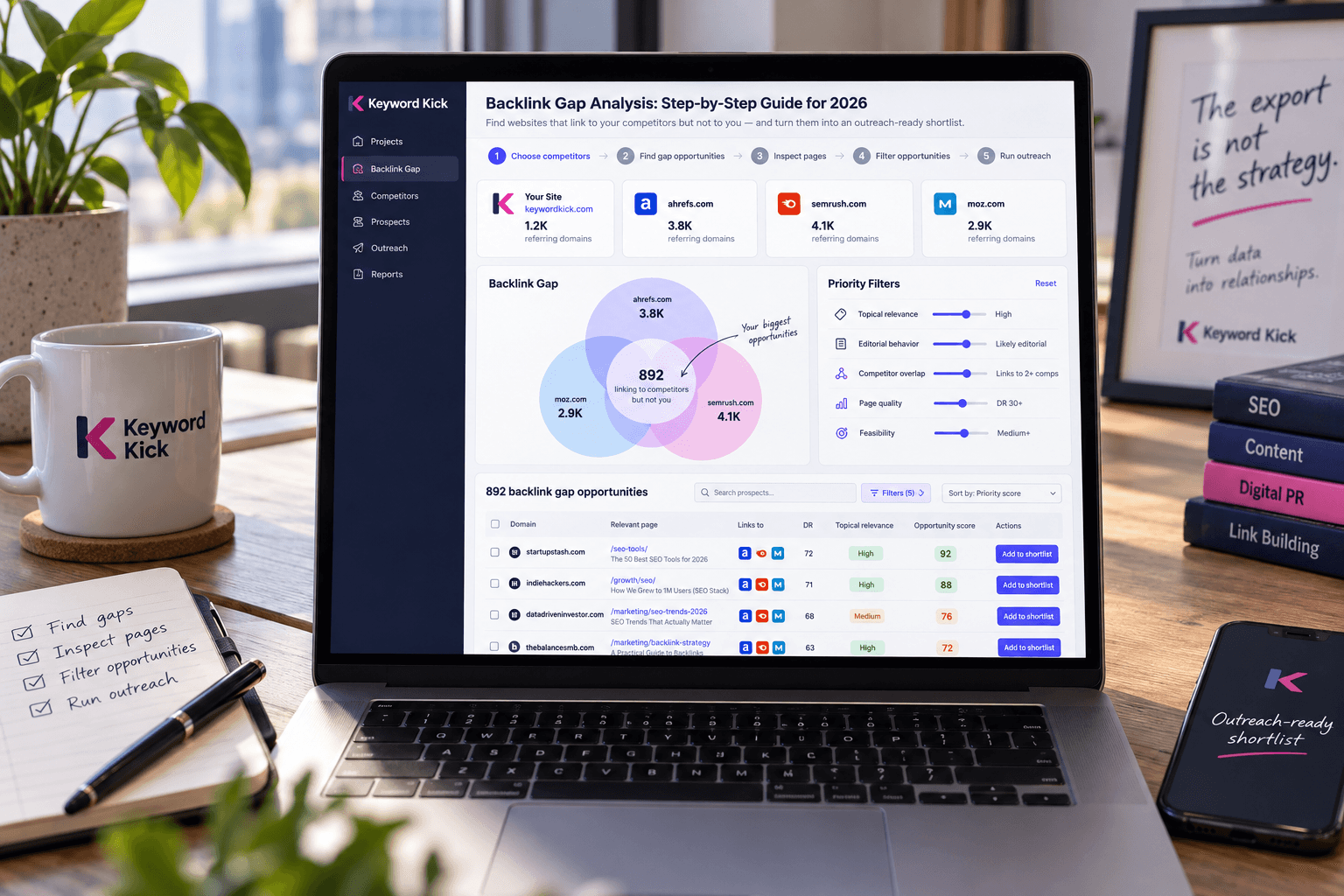
The most popular advice on competitive backlink analysis is also the most misleading. You're told to export a rival's links, sort by authority, and copy the list. That approach wastes weeks. A competitor's raw total tells you almost nothing about which links helped, which ones are junk, and which ones would create risk if you chased them. A few editorial links from strong, relevant pages usually matter more than hundreds of weak placements. Your job isn't to replicate a profile. It's to clean the data, score what's real, reject what's risky, and build a short list you can win.
Pull Clean Backlink Data for Your Competitor Set
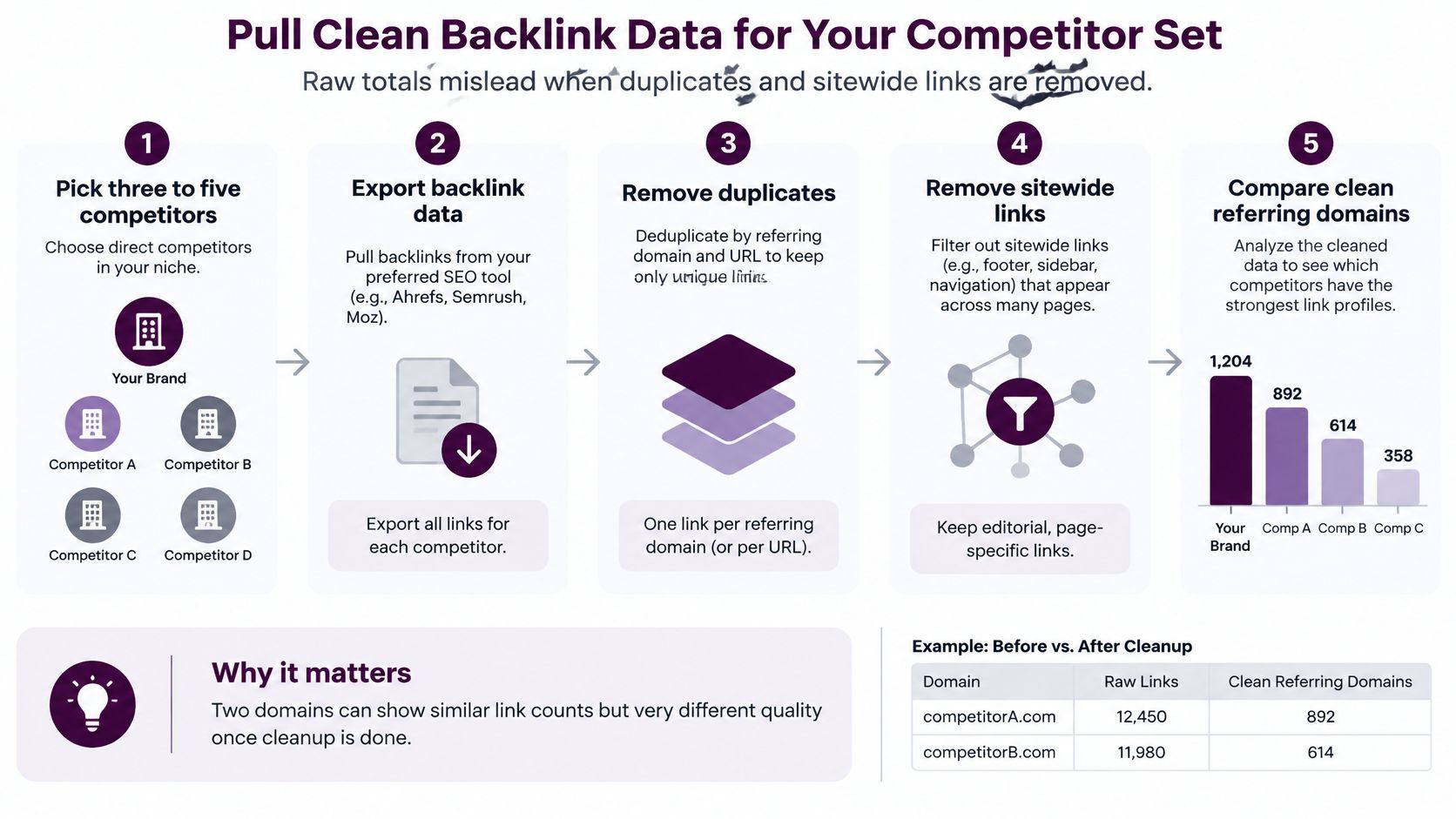
Two domains can show similar backlink totals and have completely different profiles underneath. One may earn citations from hundreds of independent sites. The other may owe most of its count to a single footer link repeated across a network. If you compare them before cleanup, you'll chase the wrong target and set a benchmark nobody should aim for.
Start with a controlled set, not the biggest brands you can name. Pick three to five direct competitors that rank for the same query class and serve the same market as you. A national player with a decade of press coverage isn't a useful model for a regional business, even if you sell similar products.
The Six-Step Cleanup
- Enter each domain and export. To start a backlink analysis, you enter your domain name and scan the entire backlink profile, then repeat the process for each competitor. Export linking pages and referring domains for all of them, including your own site.
- Normalize every row. Standardize the export by domain, URL, link attribute, first-seen date, and target page. Without consistent fields, you'll count the same placement twice under slightly different URLs.
- Separate link attributes. Tag each link as followed, sponsored, or nofollow before you compare totals. A rival with many sponsored placements isn't playing the same game as one earning editorial citations.
- Deduplicate referring domains. Collapse multiple links from one domain into a single domain record. This is the unit that matters for gap analysis, not total backlinks.
- Strip sitewide patterns. Remove or flag footer, navigation, forum, and syndicated links. One template placement can inflate a profile by thousands of rows while adding little competitive insight.
- Tag and save the baseline. Classify each referring domain by topical relevance, geographic market, and editorial context, then save the cleaned file with a date. Every later audit should compare like with like against this file.
You can analyze your backlink profile to pull the starting data, and structured backlink reports make the normalization step faster because the fields arrive in a consistent format. The tool doesn't do the judgment for you, though. You still decide which competitors belong in the set and which patterns count as sitewide noise.
Practical rule: If a number changes dramatically after deduplication, the original number was never worth reporting.
Why the Baseline Matters
A clean baseline protects you from the most common analytical trap, confusing correlation with causation. Strong pages attract links because they already rank, carry a known brand, or receive heavy promotion. The Ahrefs backlink growth study of 10,000 US keywords with 2,000 to 5,000 monthly searches found that most top-ranking pages acquired followed links from new referring domains at roughly 5% to 14.5% monthly growth, although the study could not establish causality between link growth and rankings.
Treat that range as directional, segmented by industry and page type. Don't promise a client or a manager that matching it will produce a ranking. Report your confidence level alongside the number, and validate later against qualified referring domains, rankings, and organic conversions.
Monthly reuse checklist
- Same competitors: Keep the set stable unless the search results change.
- Same fields: Export domain, URL, attribute, first-seen date, and target page every time.
- Same cleanup: Deduplicate and strip sitewide links before any comparison.
- Same tags: Apply relevance, geography, and context labels consistently.
- Dated file: Save each baseline so growth claims can be checked.
The baseline is only as good as the cleanup step. Skip it, and every conclusion after this point inherits the error.
Score Each Link by Real Value, Not Raw Count
Link value was never meant to be counted evenly. In the original PageRank work from Stanford, documented in January 1998, hyperlinks were treated like academic citations, and each linking page transferred authority according to its own PageRank divided by the number of outgoing links it contained. A page linked by other important pages became more important. A page with many weak links did not automatically win.
That principle still shapes how you should score a competitor profile. A smaller set of links from authoritative, well-connected pages can carry more structural value than a much larger set of low-authority links. When you sort rivals by raw totals, you reward the second profile and learn nothing useful.
What Strong and Weak Signals Look Like
| Criterion | Strong signal | Weak signal |
|---|---|---|
| Topical relevance | Linking page covers your topic | Unrelated or generic site |
| Source page quality | Indexed, real traffic, editorial content | Thin, unindexed or link-farm page |
| Link placement | Inside body copy with editorial context | Footer, sidebar or sitewide |
| Geographic fit | Audience in your market | Audience in an unrelated market |
| Authority metric | Strong provider score confirmed by traffic | High score with no traffic behind it |
| Editorial reason | Plausible reason to cite your asset | Only a directory or listing link |
Use the table as a scoring sheet, not a checklist you complete mechanically. Topical relevance and editorial reason should outweigh the authority metric in most cases, because a powerful site with no plausible reason to cite you isn't a prospect. It's a name on a spreadsheet.
How to Weigh Provider Scores
Every backlink in our system receives a quality score based on domain authority, page relevance, link placement, and spam indicators. That kind of score helps you sort thousands of rows quickly. It doesn't replace opening the page.
If you're unsure how much weight an authority number deserves, it's worth understanding what DA backlinks actually mean before you rank prospects by that figure alone. A high score on a page with no traffic and no indexation is a weak signal dressed up as a strong one. Check whether the page is indexed, whether it earns real visits, and whether a human editor clearly chose to include the link.
Say a regional news site links to two competitors' original research in the body of a reported story. That single placement beats four hundred directory listings, even if a few directories show higher scores. The news page has an audience in your market, an editorial reason to cite data, and a placement readers see. The directories have none of that.
Placement deserves more attention than most audits give it. A link inside body copy, surrounded by relevant text, signals an editorial decision. A footer or sidebar link signals a template. I'd score the first highly and discount the second almost to zero for prospecting purposes, whatever the domain metric says.
Geography works the same way. A modest site read by buyers in your city can be worth more than a larger site whose audience will never purchase from you. Relevance isn't only topical. It's also commercial.
For a fuller treatment of these judgments, the backlink best practices from Keyword Kick cover how quality signals interact. Apply them consistently across every competitor so scores stay comparable.
Build the Shortlist and Discard the Rest
Score each cleaned referring domain across the six criteria, then keep the top 20 prospects per competitor ranked by combined score. Discard the rest, and record a stated reason for each discard, such as no traffic, wrong market, or no editorial reason. That record matters. It stops a colleague from re-adding rejected domains next month and forcing you to redo the same judgment.
A shortlist of twenty scored prospects is a work plan. A list of two thousand unsorted domains is a storage problem.
Find Link Gaps Where Rivals Win and You Don't
A competitor link gap is a domain that links to two or more of your competitors but not to you. In the third step of backlink analysis, you run a competitor link gap analysis to find domains linking to rivals but not to you. Our Competitor Link Gap feature finds those domains filtered by authority and relevance, so you're not staring at every overlapping directory on the web.
That filtered overlap is your strongest prospect signal. A site that cited two rivals on the same topic has already shown it covers your subject and links out to sources like yours. A site linking to only one competitor may reflect a personal relationship, a partnership, or a one-off event you can't reproduce.

Read the Gap as a Network
A gap list alone doesn't tell you how a competitor built its profile. For that, separate incoming links from outgoing links. A 2003 review in the Journal of Computer-Mediated Communication described indegree centrality as the number of hyperlinks a site receives from other sites and outdegree centrality as the number of links originating from that site.
Indegree helps quantify a domain's external visibility and authority. Outdegree reveals its linking behavior, partnership patterns, and site architecture. When you read both together, you stop treating a profile as an inventory and start reading it as a network, which is where the useful patterns live.
Concentration is the pattern I'd check first. If one competitor's incoming links come mostly from three partner sites, copying that structure is hard and probably pointless without the same partnerships. If its citations spread across many independent editorial sites, you have a realistic model, because each of those sites made its own decision to link.
Cluster by Destination Topic
Group gap domains by the topic of the page they link to, then find subjects where at least two competitors earn editorial citations. Topic clusters tell you what kind of asset earns the link, which a flat domain list never does.
Say a software competitor appears in a university research roundup alongside another rival. That tells you the roundup accepts outside datasets on that subject. Your pitch isn't "link to us too." It's a dataset of your own, formatted for the same kind of roundup.
Local gaps deserve the same clustering treatment, since a handful of nearby editorial sources often matter more than national names you won't win. If your market is local, it helps to prioritize your local link building so geographic fit shapes the list before authority does.
A gap domain is a signal to investigate, not a promise that the site will link to you.
Sort Prospects Into Three Buckets
- Quick outreach: The site links to multiple rivals, covers your topic, and you already have an asset that fits. Pitch now.
- Asset-led pitch: The fit is strong but you lack the data, tool, or expert contribution the site tends to cite. Build first, pitch second.
- Skip: The overlap exists but the audience, geography, or editorial reason doesn't. Record why and move on.
This output is what makes the analysis operational. Each bucket has a different next action, a different owner, and a different timeline. Without the buckets, teams pitch everything in list order and burn their best prospects on weak, generic emails.
Filter Out Risky Links Before You Copy Them
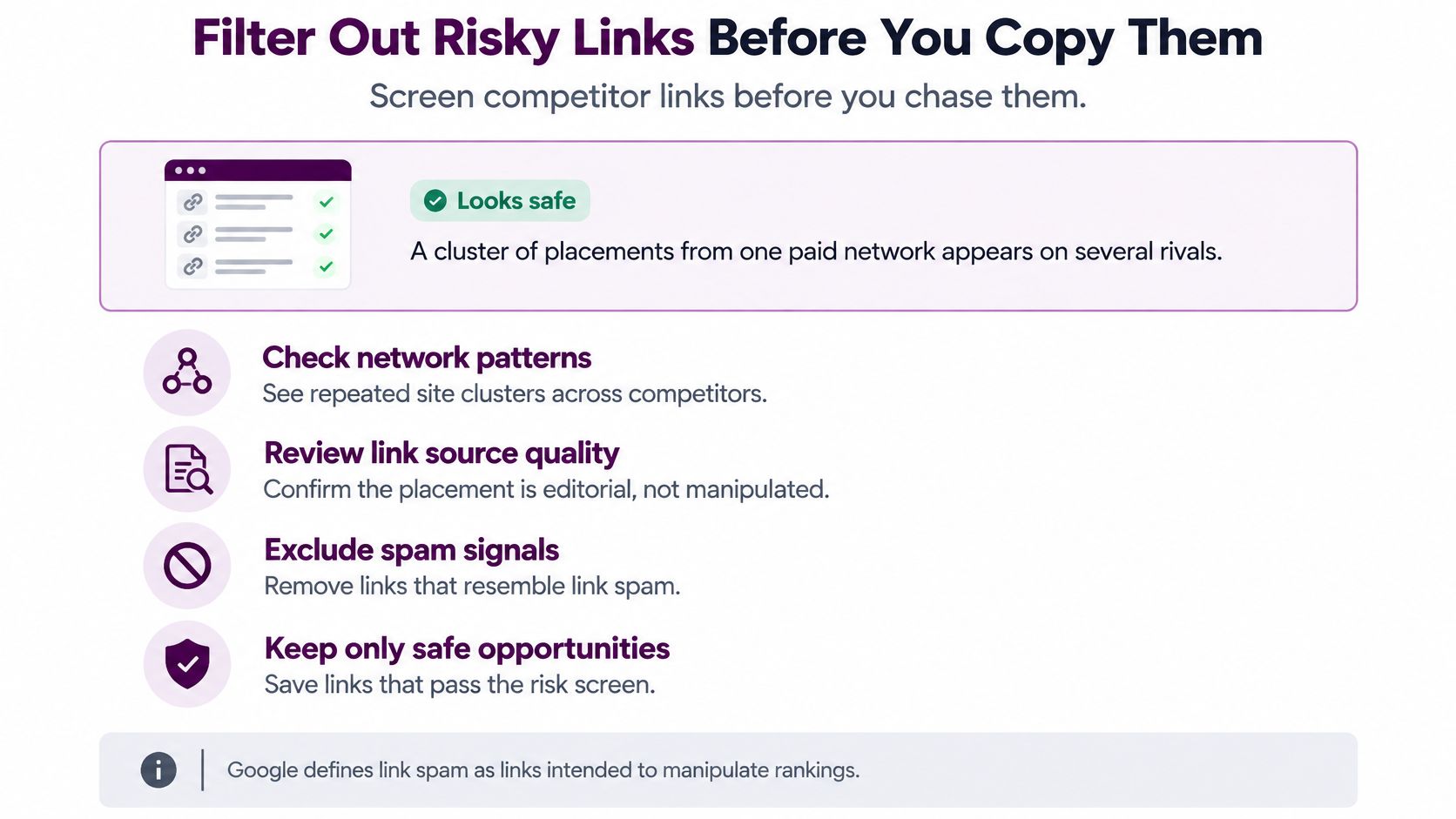
Some competitor links look safe precisely because several rivals have them. Say you find the same cluster of placements appearing across three competitors, all from sites with thin articles and identical outbound patterns. That repetition doesn't validate the cluster. It suggests one paid network sold placements to everyone in your niche.
Copying that pattern copies the risk. We flag potentially harmful backlinks from spammy, irrelevant, or penalized domains, but the manual judgment still matters, because a network often looks ordinary domain by domain and obvious only as a group.
What Counts as Link Spam
Google's link spam documentation defines link spam as creating links primarily to manipulate rankings, and it lists buying or selling links, exchanging goods or services for links, excessive link exchanges, and automated link creation as examples. Reproducing a suspicious pattern can create algorithmic or manual-action exposure. The fact that a competitor hasn't been caught yet isn't evidence that the tactic is safe.
Attributes matter here too. Ignoring rel=sponsored or rel=nofollow requirements can make an otherwise legitimate partnership noncompliant. If money, goods, or services changed hands, check that the placement carries the correct attribute before you treat it as a model.
Screen Before You Score
Flag every candidate for paid, reciprocal, automated, and mass-placement patterns before you spend time scoring it. Look at the surrounding text and the outbound-link pattern on the source page. Editorial pages link to a small number of relevant sources. Commercial link inventories link to whoever paid, across unrelated industries.
Reject any domain with a thin, irrelevant, or obviously commercial link inventory, whatever its authority score says. When you find a cluster from one paid network, exclude it as a network rather than debating each site individually. Site-by-site debate is how risky domains sneak back onto a shortlist.
Score the survivors on topical relevance, source-page quality, contextual placement, geographic usefulness, uniqueness, and acquisition plausibility. Don't treat a domain-authority score as causal evidence. Combine provider metrics with indexation, topical fit, traffic, and editorial scrutiny.
Keep expectations grounded while you do this. One published campaign reported 36 backlinks from 32 websites after 515 emails, about a 7.0% backlink-per-email yield, but that's a single case study, not a universal benchmark. Judge the risk pattern first. Yield only matters for prospects worth contacting.
Run This Checklist on the Shortlist
- Flag: Mark paid, reciprocal, automated, or mass-placement signals on every candidate.
- Score: Rate relevance, page quality, placement, geography, uniqueness, and plausibility.
- Reject: Drop thin, irrelevant, or commercial inventories, and exclude paid networks as a group.
- Map: Connect each survivor to a specific asset, data point, tool, or expert contribution.
- Record: Write a decision and a reason for every domain, kept or dropped.
A smaller shortlist that survives this screen is worth more than a long one that hasn't been checked. Measure qualified placements afterward, not outreach volume.
Track Progress Monthly and Read the Benchmarks
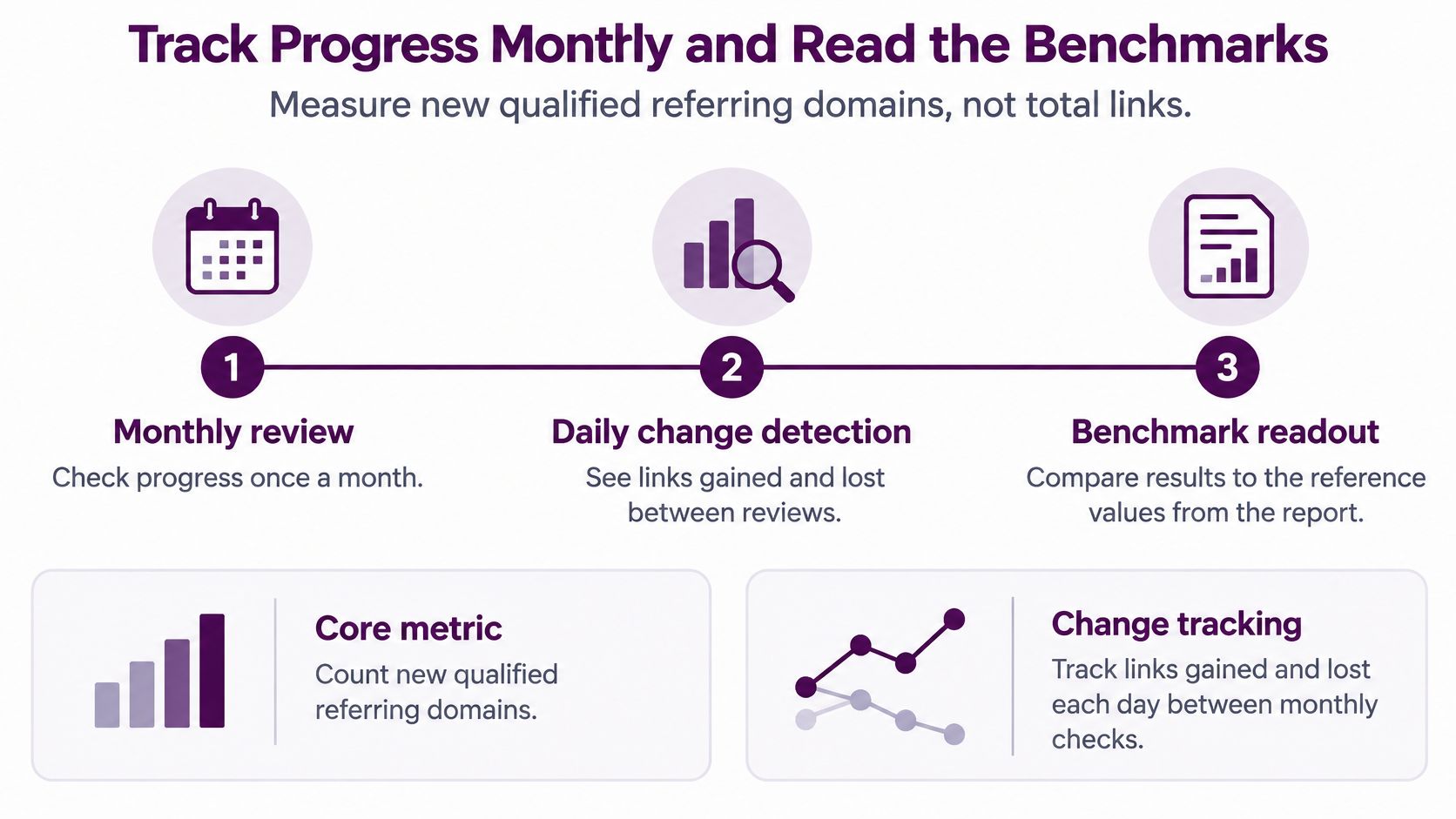
Review your profile monthly and count new qualified referring domains, not total links. Totals move for reasons that have nothing to do with your work, including sitewide changes on someone else's template. New referring domains that passed your quality and risk screens measure the thing you're trying to grow.
Between reviews, daily change detection tracks every backlink gained and lost over time, so a lost editorial link doesn't sit unnoticed for a month. You can track changes in your backlink profile on that cadence and still reserve judgment for the monthly readout, when noise settles into a pattern.
Reference Values and Their Caveats
| Metric | Reference value | Caveat |
|---|---|---|
| New referring domains per month, top-ranking pages | 5% to 14.5% growth | Directional Ahrefs study, not causal, segment by industry |
| Backlinks per outreach email | About 7.0% | Single campaign of 515 emails |
| Unique referring domains per outreach email | About 6.2% | Single campaign, not a universal benchmark |
| Ranking vs backlink correlation | Low-to-mid 0.20s | Correlation only, not proof of cause |
| Brand mentions vs AI Overview visibility | 0.664 for mentions, 0.218 for backlinks | Correlation only, based on third-party reporting |
Read the growth range as a directional band for top-ranking pages in one study, segmented by industry and page type before you compare yourself against it. A new page in a quiet niche won't grow like an established page in a press-heavy market, and that's fine. The outreach yields come from a single campaign, so use them to sanity-check your own numbers, not to forecast results.
The correlation row deserves the most discipline. A correlation in the low-to-mid 0.20s means links alone rarely explain a ranking. Content quality, brand strength, and promotion all sit in the same picture, and strong pages attract links because they already perform.
Add a Brand Mention Layer
Links aren't the only authority signal worth tracking anymore. Third-party reporting in a Tools8020 SEO statistics roundup citing an Ahrefs analysis of 75,000 brands found that web brand mentions correlated more strongly with Google AI Overview visibility than backlinks, with correlation coefficients of 0.664 versus 0.218. That doesn't prove mentions cause AI visibility. Established brands earn both more mentions and more links because they're already prominent.
Still, the practical question is worth asking each month: should you pursue a backlink, an unlinked mention, a citation in a trusted source, or broader demand generation? Track unlinked mentions by market and topic, note whether competitors appear in AI-generated answers, and check whether mentions bring referral traffic, branded searches, or conversions.
Reporting habit: State your confidence level next to every benchmark, and say plainly when a number shows correlation rather than cause.
Validate each change after several months, not several days. Compare new qualified referring domains, rankings, and organic conversions against the period before the change. Backlinks remain one component of a broader authority system that includes reputation, entity recognition, and answer-engine visibility. Track them that way, and your monthly report will tell the truth instead of flattering the work.
Confirm Your First Audit Plan This Week
Start with one decision before you touch any data: is the goal more links, more mentions, or both? That answer shapes which competitors you pick, which prospects you keep, and which number you report at the end of the month. Teams that skip this decision end up measuring everything and improving nothing in particular.
A Five-Day Schedule
Day one is for setup. Write down the three to five direct competitors, the query class and market they share with you, and the goal you just chose. Keep it to one page. If you can't explain why a competitor belongs in the set, it doesn't.
Day two is for the export and cleanup. Pull linking pages and referring domains for each domain, normalize the fields, deduplicate, and strip sitewide patterns. Save the file with its date. This dated baseline is what every future claim about growth gets measured against, so don't overwrite it later.
Day three is for scoring. Run the top links through the six quality criteria and build a shortlist of about twenty prospects per competitor. Rank by combined score, and let topical relevance and editorial reason break ties against raw authority.
Day four is for the risk screen. Flag paid, reciprocal, automated, and mass-placement patterns, drop anything that fails with a stated reason, and exclude paid networks as a group. Map each survivor to a specific asset, data point, tool, or expert contribution you can offer.
Day five is for the calendar. Book a monthly review that tracks new referring domains, outreach placements, and one brand-mention check by market and topic. Assign an owner to each number. A review without an owner becomes a report nobody acts on.
Tools and the One Number to Watch
A spreadsheet handles this schedule fine for a small competitor set. If you'd rather run the steps in one place, our backlink analysis includes a complete backlink profile analysis with competitor link gap detection, which covers the export, scoring, and gap steps without manual file merging.
Whichever route you take, watch one number first: new qualified referring domains per month. Compare it against a benchmark segmented by your industry and page type, not a universal target pulled from someone else's study. If that number rises steadily and the domains behind it passed your quality and risk screens, the audit is doing its job. Everything else is supporting detail.
Run your first competitive backlink analysis this week with Keyword Kick, where complete backlink profile analysis, competitor link gap detection, quality scoring, and daily change detection sit in one workspace. Enter your domain, add your three to five closest search competitors, and build the clean baseline and scored shortlist described above without stitching together exports by hand.