
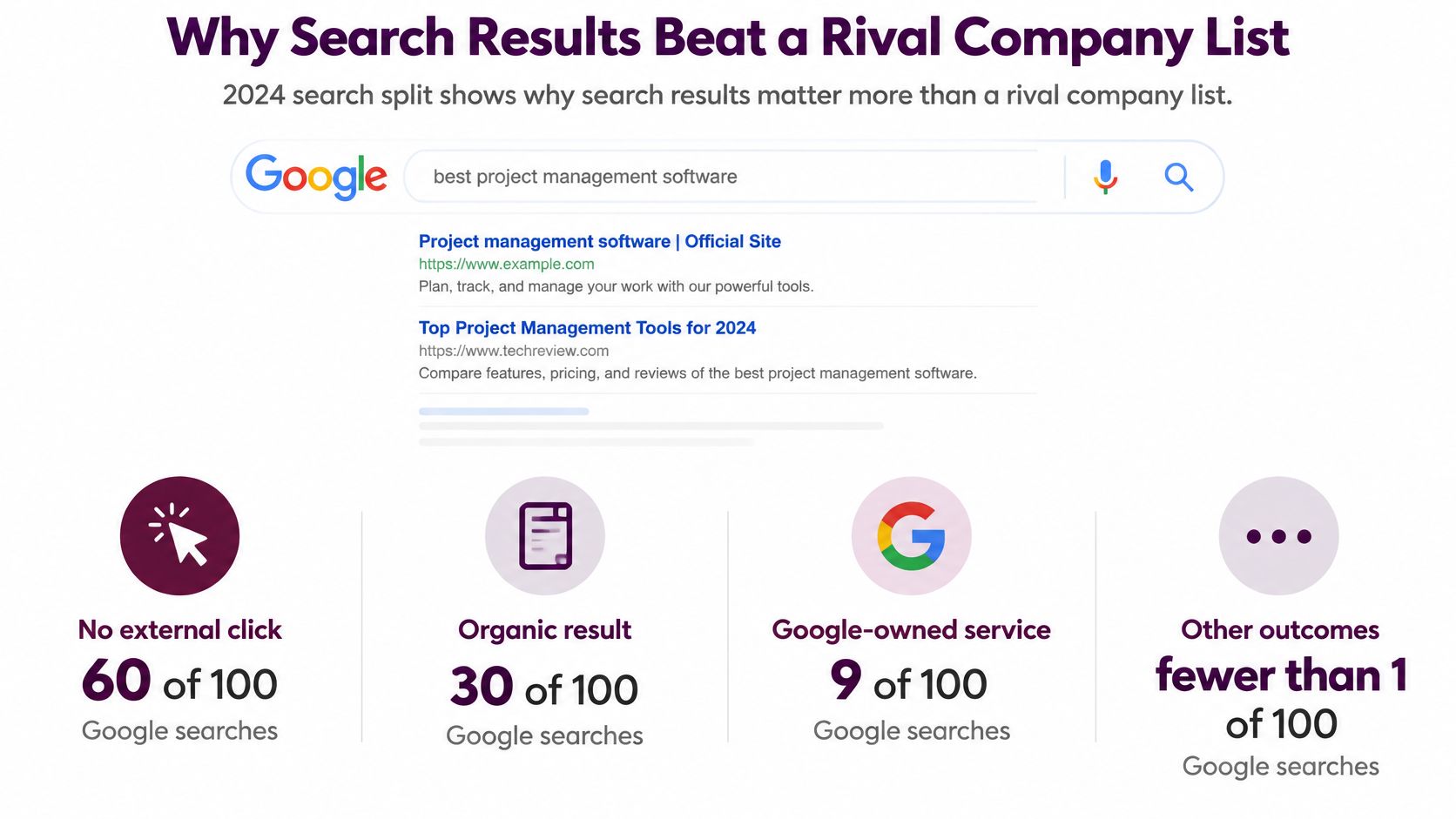
About 60 out of every 100 Google searches produced no click to an external website in a 2024 analysis reported by Commanders Act. That changes how to do competitor analysis in digital marketing: your benchmark can't be just rival websites and estimated traffic. You need to measure what customers see, which gaps are worth closing, and how confident you are that the work will pay off.
Why Search Results Beat a Rival Company List
Your sales team's competitor list is useful context, not your search benchmark. A search competitor is whoever appears during the journeys your customers use, even if that business never sells a competing product.
Say you sell running shoes and search for best running shoes for flat feet. A review publisher, a marketplace, a YouTube video, and a brand buying guide may all compete for that attention. The footwear company you treat as your closest rival might not appear at all.
Two operating rules follow:
- Start with customer queries. Choose competitors based on shared search visibility, not just similar products.
- Separate visibility from visits. A map listing, featured answer, video, or shopping result can influence a decision without sending anyone to your website.
Where Google Searches End Up
A 2024 analysis of search outcomes gives this approximate benchmark. Treat it as context for what to monitor, not a forecast for your own channel mix.
| Outcome | Share of searches | What to record |
|---|---|---|
| No click to an external website | The clear majority | Whether a SERP feature answered the query |
| Organic result | Roughly a third | Ranking URL, intent, and content format |
| Google-owned service | A small minority | Maps, YouTube, Shopping, or another Google property |
| Paid advertisement | A very small fraction | Ad presence only, not the main visibility score |
For each priority query, log the appearing domains, their result types, the device, the country, and the capture date. Distinguish a standard organic listing from ownership of a prominent feature, because those are different competitive positions and they deserve different confidence levels. A buying guide holding a stable top spot on your core term is a real threat. A forum thread drifting in and out of the results is noise until it settles.
That log becomes your baseline. Every gap you price later, by likely click value and the effort to close it, starts here.
Do not stop at desktop. Mobile searches are more likely to remain inside Google services, so a desktop-only review can miss the experience your customers receive.
For service businesses, connect that benchmark to the inquiry journey. Wojo Media's resource on Google lead generation for service businesses is a useful companion when deciding which search appearances should lead toward a call or a form submission.
Track movement, not just incumbents. An emerging rival climbing into prominent positions can deserve more attention than an established leader whose visibility has not changed.
How to Run the Analysis From Goals to Control
A useful analysis changes a decision. Before opening an SEO tool, write down which decision your team needs to make, such as which existing pages deserve the next optimization cycle.
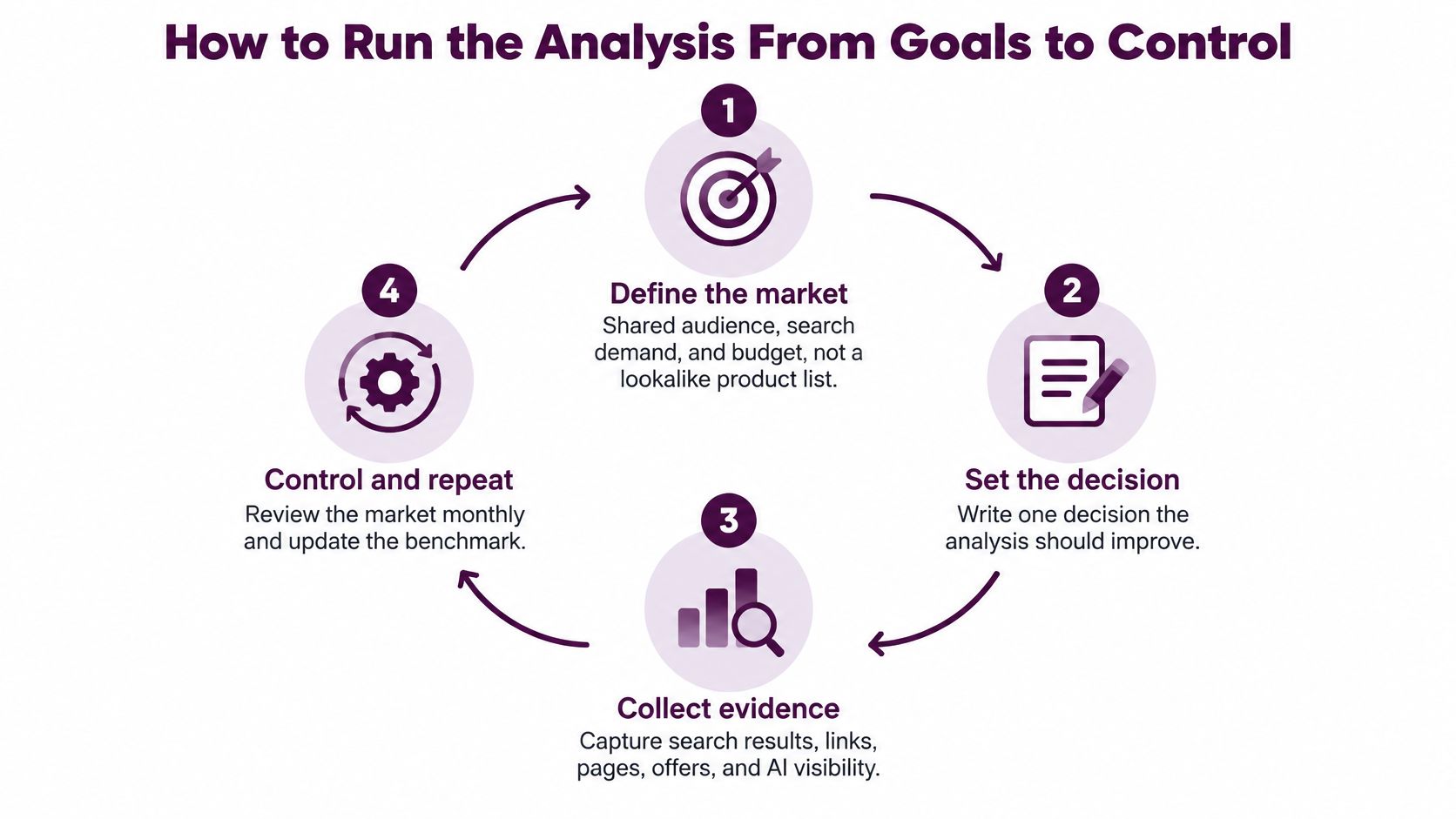
The Klipio competitor-analysis framework recommends defining competitors through audience, demand, and budget overlap, then connecting monitoring to campaign decisions. Its SOSTAC planning loop keeps the work tied to execution rather than a presentation nobody revisits.
Build a Repeatable Working Loop
Define the market and decision. Specify the customer, geography, offer, and acquisition constraints. An agency targeting enterprise procurement teams shouldn't use a self-service consumer product as its main messaging benchmark because both sell software.
Choose a comparable peer set. Start with domains that repeatedly overlap your non-brand queries. Keep an aspirational global brand in a separate watchlist if you can't normalize its geography, branded demand, or resources against yours.
Capture consistent commercial fields. Record positioning, public pricing, offer structure, organic coverage, paid presence, social themes, landing pages, email capture, and customer-review patterns. Leave unavailable information marked unavailable rather than guessing.
Map queries to intent. Tag informational, commercial, navigational, and transactional needs. Add device and country, then identify the page or format that currently satisfies each need.
Create an opportunity register. Each candidate needs evidence, the customer problem, expected business impact, implementation effort, an owner, and a validation metric. Write the proposed change precisely enough that someone can estimate and deliver it.
Run SOSTAC through to control. Document Situation, Objectives, Strategy, Tactics, Action, and Control. Put fast-moving observations into tactical reviews and reserve broader positioning or budget changes for strategic review.
What to Review and How Often
| Signal | Review every | Feed into |
|---|---|---|
| Ads, rankings, and messaging | Weekly | Tactical changes and the opportunity register |
| Positioning, pricing, and strategic shifts | Monthly or quarterly | Strategy and budget decisions |
Give the register an owner who can reject weak recommendations. Otherwise, every competitor launch becomes an urgent request and the team keeps abandoning work before it can be evaluated.
A paid-media manager might flag a new competitor offer while the content lead identifies an unanswered buying question. Those observations belong in the same system, but they don't automatically justify the same response. One may require a landing-page test; the other may need a product explanation.
Practical rule: Copy the customer problem worth solving, not the visible tactic.
A persistent ad doesn't prove profitability. A frequent newsletter doesn't reveal retention. Before copying either, ask which segment it serves, where it sits in the funnel, and whether your economics support it.
Compare Links, Pages and Offers on the Same Fields
A screenshot collection shows what competitors published. A comparable evidence sheet helps you decide what to change.
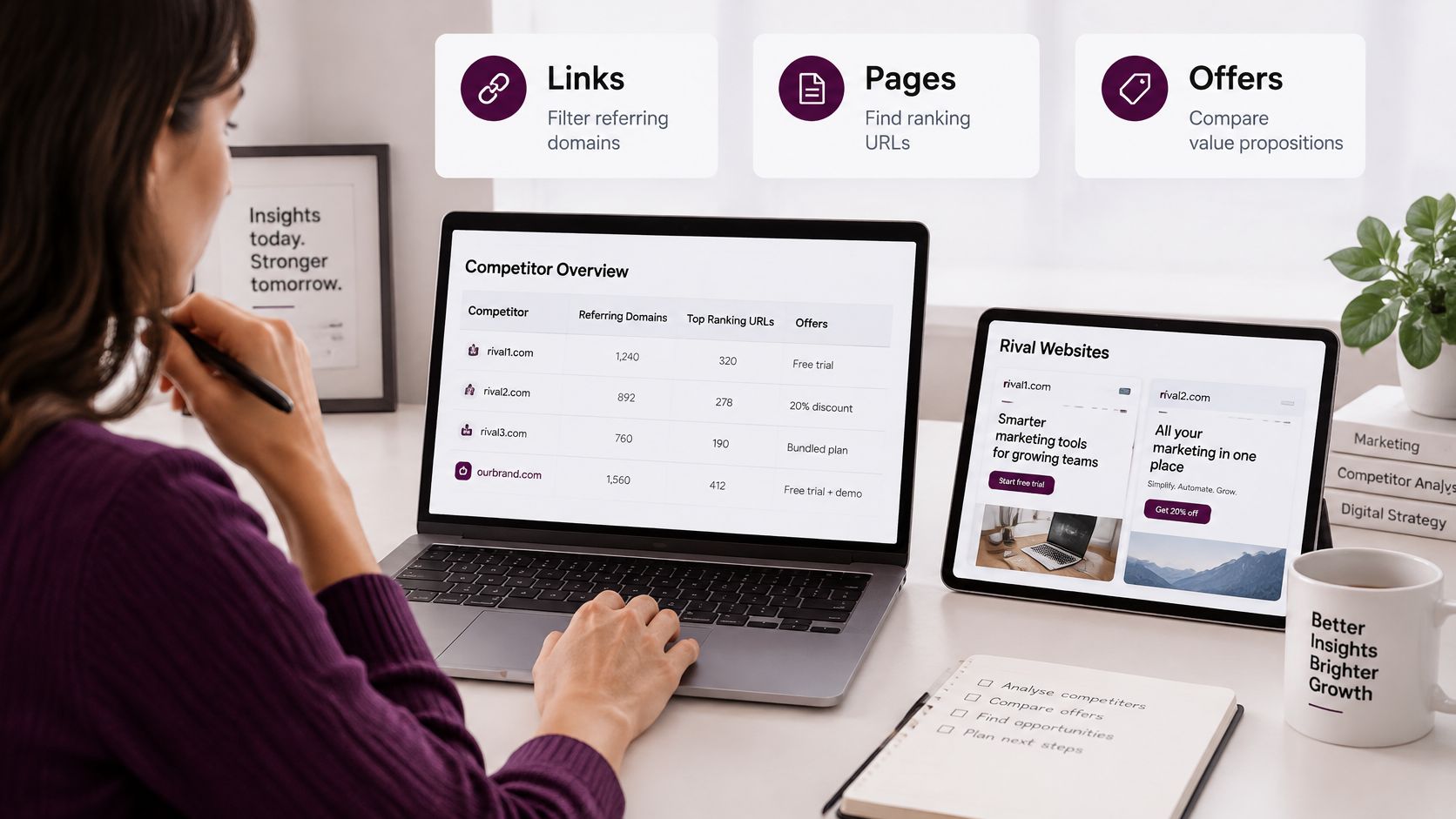
Use a row for each rival's page against the same target need. The Drive Research competitive-analysis guide supports comparing website, product, pricing, and marketing evidence consistently rather than building isolated competitor profiles.
Evidence Fields for Each Rival
| Evidence field | Source | Confidence |
|---|---|---|
| Referring domains to the rival's ranking URL, filtered by topical relevance | Backlink index | Estimate |
| Indexation and template type | Crawl or site check | Observed |
| Internal links from money pages | Crawl | Observed |
| Content depth against the intent | Page review | Judgment |
| Mobile experience issues such as intrusive interstitials | Manual check | Observed |
| Published price, proof, guarantee, and conversion path | Landing page | Observed |
| Traffic and ad-spend estimates | Third-party tools | Directional |
| Impressions, clicks, position, CTR, and conversion rate | Search Console and analytics | First-party |
For links, inspect the ranking URL before the whole domain. Identify relevant referring sites that support the competing page, then assess whether earning comparable coverage is realistic. Use this workflow to find competitors' backlink gaps, but don't turn every missing domain into an outreach target.
A short page with relevant editorial links may be a tougher competitor than a long page on a site with a large but unrelated link profile. Raw domain counts don't explain that distinction.
For page quality, compare the actual answer against the intent. Check indexability, template suitability, internal links from commercially important pages, and mobile usability. More words won't fix a category page that needs better filters or a buying guide that never explains its selection criteria.
Separate Public Evidence From Inference
Record only the offer a customer can verify: published price, supporting proof, guarantee terms, form requirements, and the route to conversion. A visible testimonial is observable; its effect on conversion rate isn't.
Before editing your own page, save its baseline in Search Console, analytics, and the ad platform where relevant. Include impressions, clicks, average position, click-through rate, conversion rate, cost per click, and the search features you're targeting.
Use a matched, unchanged page set where possible to help distinguish your intervention from broader demand or search changes. Benchmark against the peer-set median, not only the largest brand.
End with distinct outputs:
- Gaps: Missing evidence, functionality, content, or authority tied to an editable page.
- Trends: Repeated changes in competitor formats, offers, or search coverage.
- Opportunities: Specific interventions you can deliver and evaluate.
If the obstacle is authority and comparable links aren't feasible, don't commission a rewrite as though copy alone will close the gap.
Score Keyword and Content Gaps by Click Value
Organic Click Share by Position
A first-page ranking isn't a single prize. A 2025 compilation from Foursets reported approximately 39.8% of clicks for the first organic result, 18.7% for the second, and 10.2% for the third, with the top three capturing about 68.7% on results pages without major features such as map packs or rich results.
| Position | Approx. click share | How to treat the gap |
|---|---|---|
| 1 | 39.8% | Large incremental gain even from position 2 |
| 2 | 18.7% | Still a high-value slot inside the top three |
| 3 | 10.2% | Often a better target than a deep page-two climb |
| Top 3 combined | 68.7% | Compare your share of these slots with the peer set |
| Move from 10 to 3 versus 30 to 20 | Not equal value | Prefer the move into striking distance of the top three |
These are reference values, not guaranteed yields. Brand familiarity, device, query type, and search layout can change the available clicks substantially.
Consider a hypothetical buying-guide query where your existing page ranks below the leading results. A peer's guide answers the same need but includes a clear comparison table, better product-selection explanations, and stronger internal links. If your page already earns relevant impressions and has comparable authority, improving it is a more defensible candidate than creating an unrelated guide from scratch.
Estimate incremental click opportunity, not total keyword volume. Compare the clicks your current position might attract with a realistic target position, then discount the opportunity when prominent features reduce external click potential. Don't apply an organic CTR benchmark mechanically to every search.
Diagnose Before Assigning Work
For each query, capture your rank and each peer's rank, estimated demand, intent, search features, landing page, content depth, internal-link support, and backlink evidence. Compare ownership of leading positions across a fixed keyword set rather than comparing unrelated ranking totals.
Classify the cause before writing the brief:
- Quick win: An existing, relevant page is within reach and has a fixable disadvantage.
- Content opportunity: Competitors satisfy a topic, question, or format your site doesn't cover. The Keyword Kick content gap analysis guide provides a workflow for organizing these missing areas.
- Technical issue: Crawling, indexation, canonicalization, or rendering prevents the intended page from competing properly.
- Authority problem: Relevant endorsements and link support appear materially stronger for the competing page.
A gap can have several causes. Name the primary constraint so that the content team doesn't receive an engineering problem disguised as a writing assignment.
Price the Opportunity and Its Uncertainty
Use a transparent prioritization model:
Opportunity = business value × probability of beating the rival × strategic fit ÷ implementation effort
Business value should reflect qualified demand and a credible path to revenue. Strategic fit asks whether the query attracts your desired customers. Effort includes review, design, engineering, internal linking, and promotion, not just drafting.
Keep evidence confidence beside the score. Mark confidence high when the gap is publicly observable, repeatable, and supported by your own performance. Mark it lower when the case depends on estimated competitor traffic or an untested assumption about intent.
A high opportunity score with weak evidence is a test candidate, not a production commitment.
Segment the shortlist by brand versus non-brand, country, device, and funnel stage. A healthy overall ranking average can conceal weak coverage where buyers compare products.
Check Whether Rivals Show Up in AI Answers
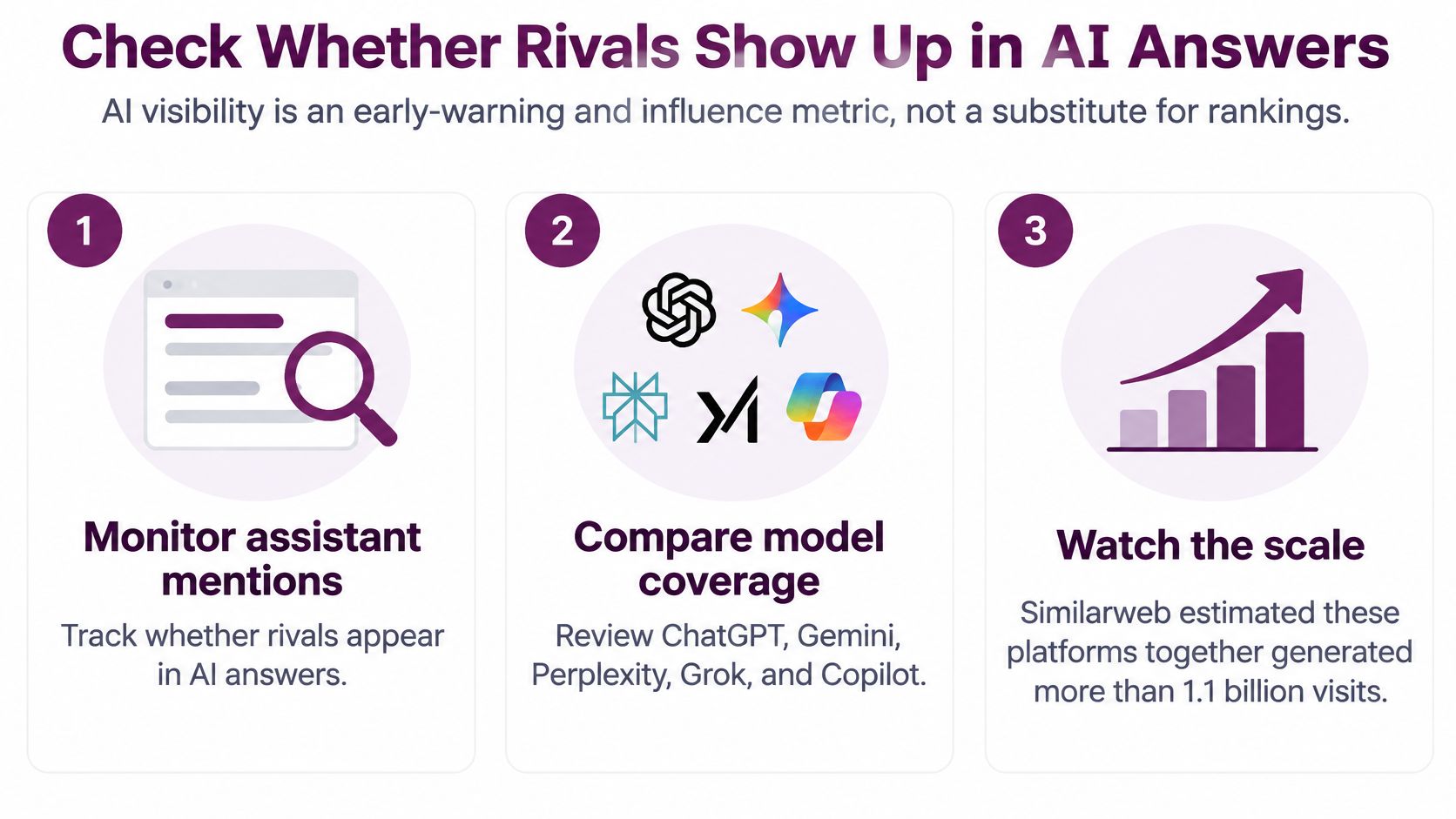
Similarweb estimated that ChatGPT, Gemini, Perplexity, Grok, and Copilot generated more than 1.1 billion referral visits in June 2025. Impressive in absolute terms, yet AI referrals still account for a small share of traffic on most sites. Read AI visibility as an early-warning and influence signal: a rival cited repeatedly for your money queries is gaining assisted exposure before your rank tracker shows any movement.
Platform totals describe scope, not opportunity. A billion visits across five assistants says nothing about what one competitor earns from a single citation. Score each appearance the same way you priced keyword gaps: what a referred visit is worth, how often the citation repeats, and what it costs to build a stronger source.
Make Prompt Sampling Repeatable
Build a manageable prompt set from real customer questions: category discovery, product comparisons, buying constraints, and branded questions. Keep branded and non-branded results separate, because assistants handle the two differently and blending them hides where a rival is winning.
Log every run:
- Version the prompts. Preserve exact wording and label additions, so a changed prompt doesn't masquerade as changed visibility.
- Record the environment. Capture the assistant, available model information, date, and relevant location or personalization context.
- Classify the appearance. Distinguish a recommendation, neutral mention, direct citation, and unsupported assertion.
- Inspect the cited page. Record its domain, page type, relevance, and whether it supports the answer.
- Repeat the check. Compare across assistants and repeat runs before treating an appearance as a durable pattern.
Use this workflow to monitor your brand in AI answers without turning an isolated response into a market-share claim. A mention carries less weight than a citation, and a citation carries less weight than a cited page that holds up.
Decide Whether the Signal Deserves Investment
Connect identifiable AI-referred sessions to engaged visits, lead quality, and assisted conversions where your tracking permits. Last-click reporting understates journeys in which someone discovers a brand through an assistant and returns through another channel.
There is no universal citation-quality score you can safely substitute for judgment. Define your own criteria around accuracy, relevance, recommendation strength, and repeatability, then apply them the same way every run. Consistency matters more than precision here.
Fund work when repeated citations reveal a source format you can beat: original data, a transparent comparison, or a definitive explanation. Prefer a page that also serves an established organic need, so the asset earns its keep even if AI referrals stay small.
Wait when the evidence is a fleeting mention or an answer your team cannot reproduce. An expensive asset built to chase one citation is a poor trade when that citation disappears on the next run.
Tips That Separate Signal From Copycat Moves
The useful output is decision confidence, not the name of the rival with the largest estimated traffic figure. You need enough evidence to choose an action, not an impressive-looking dashboard.
A Search Engine Land comparison of AI-search findings reported Microsoft's claim that Copilot-assisted journeys were 33% shorter, with high-intent conversion rates 76% higher than traditional search experiences. Those channel-specific findings aren't a benchmark for your website's conversion rate or a reason to shift budget without testing.
Apply an Evidence Gate
Before commissioning work, challenge the recommendation:
- Separate brand demand from category demand. A famous competitor's branded traffic doesn't establish the opportunity for your educational content. Compare the customer needs you can both serve.
- Express uncertainty clearly. Give third-party estimates plausible ranges or qualitative confidence labels. Don't invent numerical confidence intervals when the tool doesn't disclose its error.
- Check timing and instrumentation. Seasonality, consent changes, analytics implementation, and reporting delays can resemble strategic shifts.
- Require corroboration. A third-party chart should prompt investigation. Pair it with observable pages, repeated search checks, customer feedback, or your own performance before committing substantial resources.
Don't confuse agreement between tools with independent confirmation. They may use similar inputs, and their headline totals may conceal different definitions.
Sometimes the strongest recommendation is to leave the page alone until the evidence improves.
Prefer Reversible Tests
Smaller teams should favor changes they can validate and reverse: clarify a title, improve a comparison, repair an indexing issue, or strengthen a relevant internal-link path. Rebuilding a global brand's publishing footprint is a different investment decision.
For a test, define the success condition before launch and allow enough observation for the page's traffic pattern. If the sample is too sparse to distinguish improvement from normal fluctuation, report an inconclusive result rather than declaring a win.
Keep a strict admission rule for the register: name the query, page, gap type, and metric that would prove the recommendation right. If you can't, the idea needs investigation rather than a delivery date.
Turn Gaps Into This Week's Action Plan
Freeze the peer set and export the non-brand queries where competitors hold prominent positions and your existing pages are plausible challengers. For a manageable first-week exercise, choose at most five gaps that survive the effort and evidence checks.
The example below is hypothetical. Its search demand, positions, time estimate, and review window illustrate a completed register, not expected performance.
Opportunity Register Template
| Register field | Example entry |
|---|---|
| Target query and segment | best running shoes for flat feet, non-brand, mobile, US |
| Rival in the top-three slot | Review site at position 3 |
| Your current position | 12 |
| Gap type | Quick win |
| Evidence | Search Console impressions and a dated SERP snapshot |
| Expected impact | Higher click share on a hypothetical 2,000-search query |
| Effort and owner | Two hours, content lead |
| Validation metric | Impressions and CTR in Search Console after four weeks |
Assign an owner and primary validation metric before scheduling each change. Use indexed status for an indexation fix; use qualified clicks or click-through rate for a search-snippet change, while monitoring lead quality as a guardrail.
Park authority projects that lack an achievable acquisition plan. Keep weak AI-citation signals in observation rather than forcing them into the delivery queue.
In Keyword Kick, add competitor domains to a project to track their rankings, content strategy, backlink activity, and visibility alongside your own. Our keyword, content, and backlink gap analyses identify where rivals succeed and you don't, while side-by-side rankings, visibility share, daily ranking movement, and significant-change alerts keep the selected peer set under review.
The immediate decision is which gaps ship this week and which require strategic review, not how much more analysis you can collect.
Keyword Kick brings rank tracking, backlink analysis, site audits, keyword research, and competitor analysis into one workspace so your team can act on its chosen gaps. Once your shortlist has owners and validation metrics, visit Keyword Kick and choose Get Started or Talk to Sales to set up the competitive workspace around that plan.