

You've polished the product page. The images look sharp, the price is competitive, and the call to action is exactly where it should be. Yet the URL sits below stronger competitors, while shoppers find answers about materials, sizing, compatibility, or delivery somewhere else.
That situation is common because product descriptions SEO is often treated as a copywriting exercise. The harder problem is structural: deciding which information belongs in persuasive prose, which belongs in scannable specifications, and which should also be exposed through structured data. Search engines and shoppers need the same product facts, but they don't consume them in the same way.
Shotfarm's survey of 1,500 consumers found that 95% considered online product descriptions important or very important, including 78% who called them very important and 17% who called them important, as reported in this ecommerce SEO research summary. Strong descriptions therefore do more than add keywords. They reduce uncertainty, clarify intent, and give search systems clean information to interpret.
Why Most Product Descriptions Fail at SEO
A retailer launches a waterproof jacket with a polished opening paragraph, three attractive bullets, lifestyle photography, and a prominent purchase button. The copy repeats “waterproof jacket,” yet the page gains little visibility.
A competing page looks less refined but explains who the jacket suits, lists its waterproof rating, insulation, fit, and pocket design, and aligns its visible product facts with structured markup. It answers more of the questions shoppers ask before buying. Information architecture determines whether those details are useful to shoppers and discoverable in search, including AI Overviews and People Also Ask.
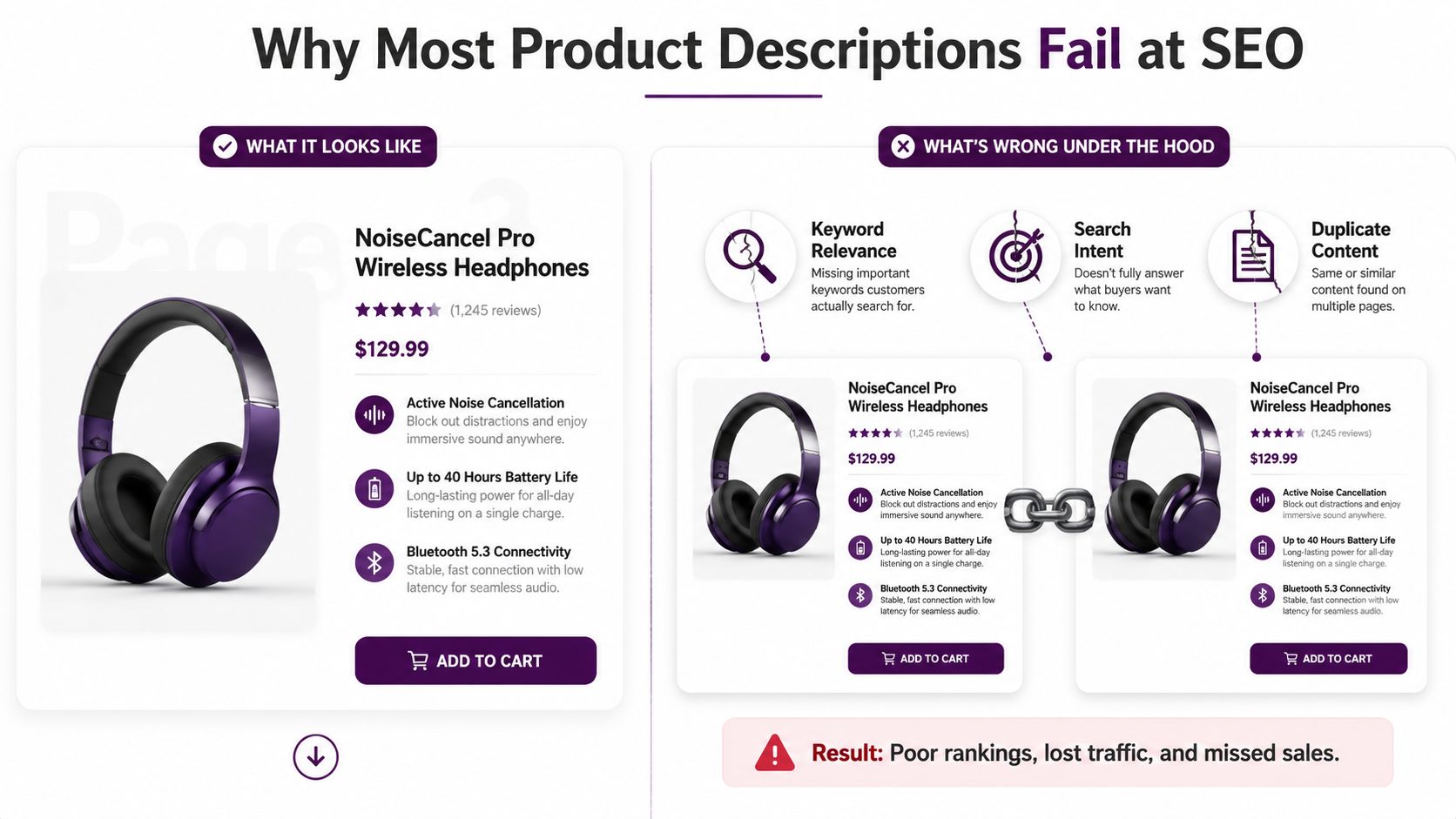
Keyword coverage must reflect real queries
A paragraph can repeat the primary keyword while leaving out the modifiers that signal purchase intent. “Waterproof jacket” gives little guidance about whether the shopper needs clothing for cycling, hiking, winter commuting, broad shoulders, or packable travel.
Product-page language should reflect those decisions. Search Console queries, autocomplete suggestions, internal site search, and People Also Ask questions expose the details shoppers actively seek. Repeated questions about wide-foot fit or device compatibility should receive a deliberate, easy-to-find answer on the page.
Give prose, specifications, and schema separate jobs
Persuasive prose explains the product's best use case and connects features with outcomes. Bullet specifications make dimensions, materials, fit, compatibility, and care instructions easy to scan. Schema markup exposes eligible details in a machine-readable format, provided it accurately matches visible page content.
That separation affects search visibility as well as conversion. A shopper looking for sleeve length should find it in a specification, not buried in a narrative paragraph. A search system should be able to identify availability and product attributes from clear, consistent data rather than infer them from vague wording. The page should also place its strongest buyer context in prose, where it can answer broader questions that may surface in AI Overviews or People Also Ask.
For every detail, choose its clearest location:
Persuasive prose establishes use case, context, and buyer relevance.
Bullet specifications present factual attributes for fast comparison.
Schema markup communicates eligible product data to search systems.
Practical rule: If a detail affects the purchase decision, give it a visible, scannable place instead of hiding it inside a decorative paragraph.
Researching Keywords for Product Pages
Product-page keyword research starts with the product's buying decisions, not with the broadest category term. “Running shoes” may describe a market, but it doesn't tell you whether a specific URL should target road running, trail use, stability, wide feet, waterproofing, or lightweight training.
Build the product attribute vocabulary
Start with the product feed, PIM, customer-service tickets, reviews, returns data, and internal site search. Extract the words shoppers use for:
Use case: commuting, hiking, studio training, travel, gifting.
Physical attributes: wide fit, cropped length, insulated lining, USB-C, leather exterior.
Compatibility: device models, operating systems, furniture sizes, replacement parts.
Objections: difficult cleaning, poor battery life, narrow fit, installation complexity.
Logistics: delivery context, care requirements, included accessories, warranty terms.
Then compare that vocabulary with real search behavior. Filter Ahrefs or Semrush results by modifiers and page intent rather than collecting every related phrase. Use autocomplete to find common combinations, and inspect People Also Ask results for questions that could become specification bullets or objection-handling copy.
Map queries to URLs
A product page should own a defined group of closely related queries. Create a matrix with the product URL, primary phrase, secondary attributes, question-based queries, and the page element that will answer each one.
Keyword Example | Intent Type | Page Element Target | Priority |
|---|---|---|---|
waterproof hiking boots for wide feet | Transactional | Opening benefit and fit section | High |
women's leather hiking boots | Commercial | Title, opener, and material specification | High |
how to clean leather hiking boots | Informational with product relevance | Care bullets or supporting FAQ | Medium |
hiking boot ankle support | Attribute research | Feature-to-benefit paragraph | Medium |
Prioritize a phrase when it matches the SKU, appears in several evidence sources, and represents a meaningful buying decision. Don't force a high-volume category term onto a product that only partially satisfies the intent. Relevance beats reach when the page exists to convert a specific shopper.
Use first-party data as the tie-breaker
Search Console can reveal queries a product page already receives impressions for, including unexpected attribute combinations. Internal search logs show what visitors want after arriving on the site. If a page receives impressions for “wide fit” but the visible copy never addresses fit, that's a content gap with direct evidence behind it.
The Keyword Kick guide to keyword research is useful for formalizing the broader research process, but product URLs need an additional filter: every target query must connect to a verifiable product attribute or use case. Never add a claim just because a keyword tool suggests it.
Writing Descriptions That Satisfy Search Intent and Buyers
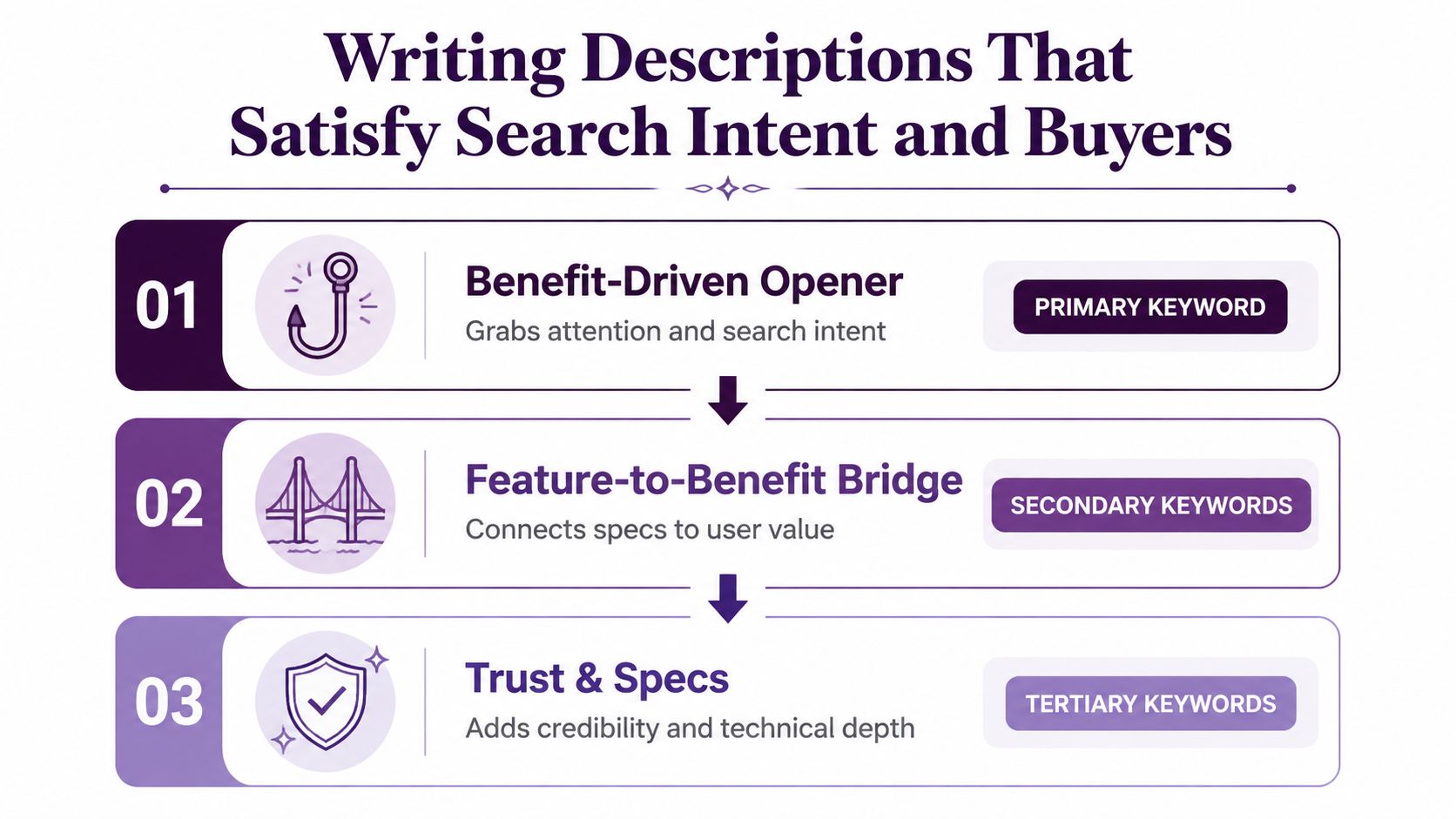
Product descriptions work best when each detail has a clear job. Use persuasive prose to establish relevance, bullet specs to make facts scannable, and structured data to label information search systems can interpret. This division matters for shoppers comparing products, and it also gives AI Overviews and People Also Ask clearer material to extract.
Start with a benefit-driven opener
Open by naming the product, its best-fit user, and the outcome it supports. A weak version says:
“This waterproof jacket is made from durable fabric and has multiple pockets.”
A stronger version says:
“Built for wet commutes and changeable trail weather, this waterproof jacket keeps rain out without turning everyday movement into a bulky exercise.”
The second version still needs factual support. It gives search intent and buyer context immediate prominence, while a generic manufacturer paragraph often leaves both unstated.
Use the main phrase naturally, then connect features to benefits. “Waterproof hiking boots” identifies the product. “Waterproof hiking boots with a wide toe box help keep feet drier and reduce pressure on longer walks” explains why the attribute matters. Keep the prose focused on decisions that affect purchase.
Put factual attributes in a spec block
Place precise, verifiable details in bullets where shoppers can scan them quickly:
Material: Full-grain leather upper with textile lining.
Fit: Wide toe box, available in the listed sizes.
Compatibility: Designed for the specified device models.
Dimensions: Product measurements, packaging measurements, or both, clearly labeled.
Care: Cleaning method, drying restrictions, and storage guidance.
This format also clarifies what belongs in prose and what belongs in the specification layer. Dimensions, compatibility, and care instructions usually need concise labels. The surrounding paragraph should explain practical relevance, such as whether a fit supports longer walks or whether a component affects setup.
Pages lose clarity when dimensions sit inside dense prose, compatibility appears only in an image, or a color variation is absent from visible text. Those choices make comparison harder for shoppers and give search features less text to extract reliably.
Many practitioners place most product descriptions in the 300 to 500 word range, while treating meta descriptions separately at about 155 to 160 characters on desktop and around 120 characters on mobile. Use that range as a starting point rather than a quota. Write enough to answer the product's real questions, then remove repeated claims.
Handle objections with specific answers
The final layer addresses concerns that can delay purchase. Footwear pages may need fit and break-in guidance. Furniture pages may need assembly and doorway-access details. Electronics pages often need compatibility information and a clear list of included cables.
A practical objection block might answer:
Will it fit? Explain the fit model, measurements, and how shoppers should compare them.
How does it perform in the intended environment? State the conditions the product is designed for, without promising unsupported outcomes.
What happens after purchase? Clarify care, included components, warranty, or return information where applicable.
Use schema to reinforce eligible factual information, while keeping the same facts visible on the page. Schema can label product details for search systems, but it cannot answer a shopper's question when the relevant content is hidden or missing. Use step-by-step description templates as a drafting reference, then adapt the structure to the attributes and objections that define your category.
Technical SEO and Structured Data for Product Pages
Excellent copy wastes search potential when technical signals conflict. Search engines need to identify the product URL, availability, price, and review information associated with that item. Structured data clarifies those facts when it matches what shoppers can see, while a clear division between prose, bullet specifications, and markup helps search systems interpret the page for standard results, AI Overviews, and People Also Ask.
Annotate the facts that matter
Review the relevant Product and Offer properties for each product page:
skuandgtin, when the business has reliable identifiers.offers, including price, currency, availability, and applicable offer details.aggregateRatingandreview, only when qualifying review information appears on the page.hasMerchantReturnPolicy, when return terms are available and accurately represented.Product name, image, description, and brand, aligned with visible content.
Keep explanations that help a shopper decide in the prose. Put scannable measurements, compatibility details, and other fixed attributes in bullet specifications. Use schema markup to label supported facts for search systems. This structure reduces ambiguity and keeps important information accessible even when a search feature extracts only part of the page.
A basic implementation may include a name, image, and description. A stronger one includes reliable identifiers, offer status, review data, and return policy details that the page supports.
Schema Property | Rich Result Eligibility | Priority |
|---|---|---|
| Price and availability details | High |
| Review summary eligibility | High |
| Individual review information | Medium |
| Product identification context | High |
| Global product identification context | High when available |
| Return-policy information | Medium |
These properties do not guarantee a rich result. Google determines eligibility, and invalid or misleading markup can weaken trust. The schema markup learning resource explains the implementation layer, but validation still requires comparing the JSON-LD with the rendered page.
Control variants and canonical signals
Color and size variants require a deliberate URL decision. Separate indexable URLs can make sense when a variant has its own search purpose, inventory state, and useful content. URLs that differ only through parameters and add no independent value should point to the primary product representation through canonicalization, or share a consolidated experience.
Canonical tags do not repair thin pages. They indicate the preferred version, while internal links, XML sitemaps, redirects, and consistent product relationships reinforce that choice. Limit faceted navigation that creates endless crawl paths, and keep important product URLs discoverable through category and merchandising links.
Avoiding Duplicate Content Across Large Catalogs
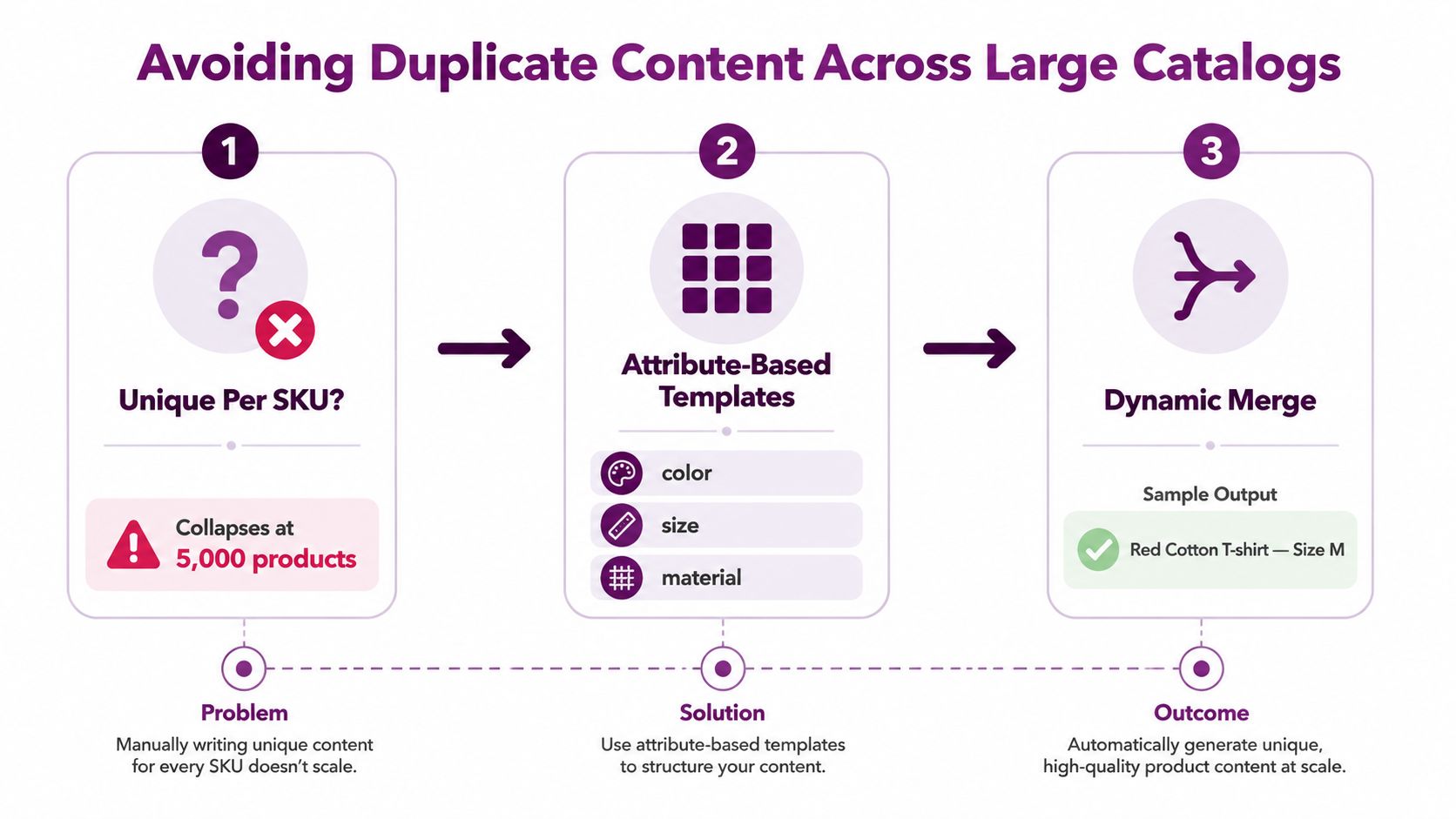
When a catalog contains thousands of products that differ only by color, size, or configuration, forcing unique copy for every SKU creates awkward writing, manufacturing errors, and an unmaintainable review queue. The practical question is whether each indexable page contributes distinct value and matches a distinct search need. That decision also affects how search engines and AI-generated results understand product relationships.
Decide which pages deserve independent treatment
Use search demand, product differentiation, and shopper experience to decide where information belongs.
Keep a page independently valuable when the variant changes the buying decision, use case, material, fit, compatibility, or availability enough to justify its own answer.
Use shared prose with dynamic attributes when the core product remains the same and only factual fields change.
Put stable facts in bullet specifications or schema markup when shoppers and search systems need precise, machine-readable details such as dimensions, identifiers, price, or availability. Prose should explain differences, use cases, and buying implications.
Consolidate or canonicalize when separate URLs add no meaningful content or create near-identical pathways.
Consider noindex carefully for internal utility pages that shoppers need but that do not need to compete in organic search.
This framework supports visibility in AI Overviews and People Also Ask because each page can answer a distinct question, while specifications remain easy to extract and verify. Similar pages may be grouped or receive less visibility when they provide little independent value. Related products do not automatically create a penalty, but the strongest pages must be clearly useful.
Differentiate where the buyer notices
Use a product-specific opening, a clear use-case explanation, and answers to customer questions. Keep shared factual specifications where accuracy requires them, then add context that helps a shopper choose between variants. A color change may need only updated imagery, availability, and attribute data. A compatibility or fit change may justify different prose and a separate search target.
Search Console can reveal page clusters with impressions but weak clicks. Crawling tools can identify repeated titles, descriptions, headings, and thin body content. Review those patterns by template, category, and variant type, then prioritize pages with existing demand or commercial relevance instead of rewriting the catalog blindly.
The scalable unit of uniqueness is often the attribute combination, not the SKU number.
Use duplicate-content auditing guidance to locate repetition across the site. Then connect related variants with deliberate internal links. A red shirt and a blue shirt may share a product family, but each page still needs accurate color, availability, imagery, and any different use context.
Scaling Product Copy with Templates and Automation
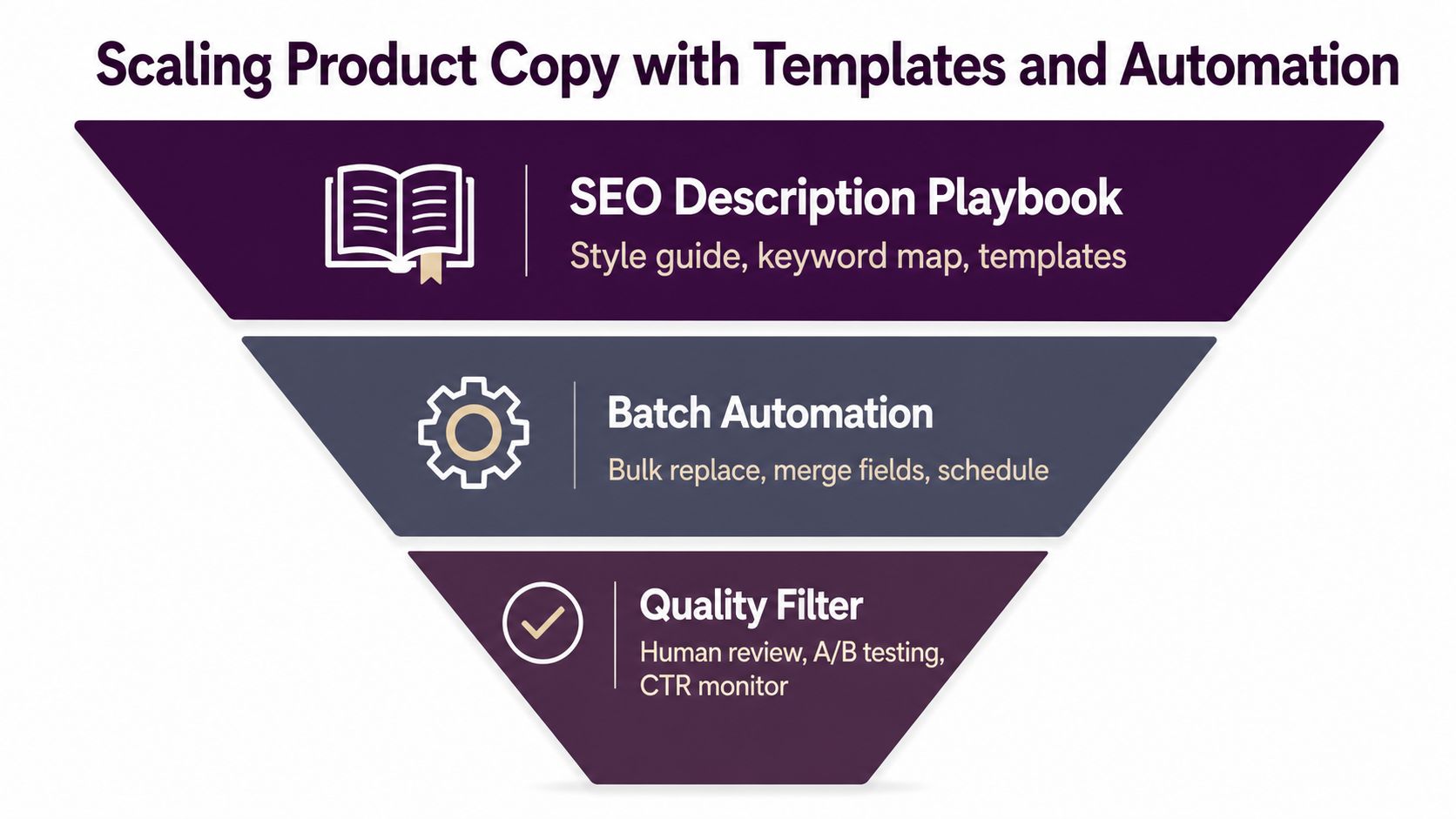
Automation should standardize product-page decisions and preserve editorial judgment. Document the page skeleton first, then assign each detail to prose, bullet specifications, or schema markup. This structure helps search engines and AI Overviews extract the right answer while keeping customer-facing copy useful.
Build three template layers
The fixed layer controls structure. It covers the benefit-led opening, feature-to-benefit bridge, specification block, and objection handling. The dynamic layer pulls verified values from the PIM or product feed, including material, dimensions, compatibility, fit, color, and care instructions. Put concise, repeatable facts in bullets and expose eligible product details through schema so search features can interpret them reliably.
The variable narrative layer creates meaningful differentiation. Draw from approved use cases and category-specific phrasing rather than random synonym rotation. A trail shoe can emphasize grip and terrain, while a commuting shoe can focus on weather protection and everyday comfort, even when both use similar materials.
Add AI with controls
AI can produce first drafts, expand approved attribute combinations, and identify unanswered customer questions. Provide verified product fields and require every factual statement to resolve to a source field or editorial approval. It must not invent certifications, performance claims, materials, compatibility, or delivery promises.
A controlled workflow looks like this:
Prepare clean inputs: Normalize attribute names and flag missing values before generation.
Generate within constraints: Apply category templates, approved claims, tone rules, and prohibited-claim lists.
Review priority pages: Send commercially important products and uncertain outputs to human editors.
Run automated checks: Find repeated phrases, missing fields, unsupported claims, duplicate titles, and schema mismatches.
Monitor outcomes: Compare query coverage, impressions, clicks, and conversion behavior by template group.
Visual merchandising also shapes product understanding. Teams exploring AI model outfit e-commerce should ensure generated visuals and copy reflect verified attributes and a clear customer use case.
Measuring the Impact of Your Product Description Changes
Description work needs a baseline before publication. Export the product URLs, their target queries, impressions, clicks, average position, and click-through rate from Search Console. Record the template version and update date so you can compare groups rather than relying on memory or a single ranking snapshot.
Analytics adds the buyer layer. Use GA4 to examine product-page engagement, scroll behavior, add-to-cart activity, and purchase progression. These signals don't prove that copy caused a change, but they help identify whether visitors are reaching the information that should support a decision.
Use controlled rollouts
Avoid changing copy, internal links, titles, images, pricing, and page speed at the same time if you want to understand the description's contribution. Group comparable products by category or template, update one group, and leave a similar group unchanged where operationally practical. A staged rollout gives search engines time to process the changes and gives your team a cleaner comparison.
Canonical rotation isn't a safe testing shortcut for visible copy. Keep canonical signals stable and use controlled cohorts, documented release dates, and consistent measurement windows instead. Also annotate backlink campaigns, merchandising changes, stock shifts, and technical releases, since each can influence performance independently.
Metric | Data Source | Baseline Period | Post-Update Evaluation | Success Indicator |
|---|---|---|---|---|
Impressions and clicks | Google Search Console | Before copy release | Compare the same query and URL groups after release | Broader relevant visibility and qualified traffic |
Average position | Google Search Console or rank tracker | Recorded by target query | Review movement by template cohort | Improved visibility for mapped intent |
Scroll depth and engagement | GA4 | Existing product-page behavior | Compare updated and unchanged groups | More shoppers reach key information |
Add-to-cart rate | GA4 or ecommerce platform | Product-level baseline | Evaluate by category and template | Stronger product-page progression |
Revenue per session | GA4 or ecommerce platform | Comparable pre-update cohort | Compare post-update cohort performance | Better commercial efficiency |
Review the results over a consistent evaluation window rather than reacting to daily volatility. A page that gains impressions but attracts irrelevant queries needs sharper intent alignment. A page that earns clicks but fails to generate product engagement may need clearer benefits, better specifications, or stronger objection handling.
Keyword Kick provides the connected search and analytics workspace needed to prioritize product-page opportunities, monitor query movement, and compare changes across catalog segments. Visit Keyword Kick to turn Search Console, GA4, rankings, and technical signals into clear actions for your ecommerce catalog.