
You've probably seen it happen in a Google search. Two pages rank near each other, but one listing includes a star rating, price, availability, or a product image. The other shows only a title and description. The richer result occupies more visual space and answers part of the searcher's question before the click.
That difference is where rich snippets matter. But the old advice, “add schema and watch your traffic rise,” is incomplete in 2026. Google has narrowed several rich-result surfaces, especially FAQ and How-To formats, so the practical question isn't only what rich snippets are. It's which structured-data investments still have a realistic chance of producing durable visibility for your page type.
Understanding What Rich Snippets Actually Are
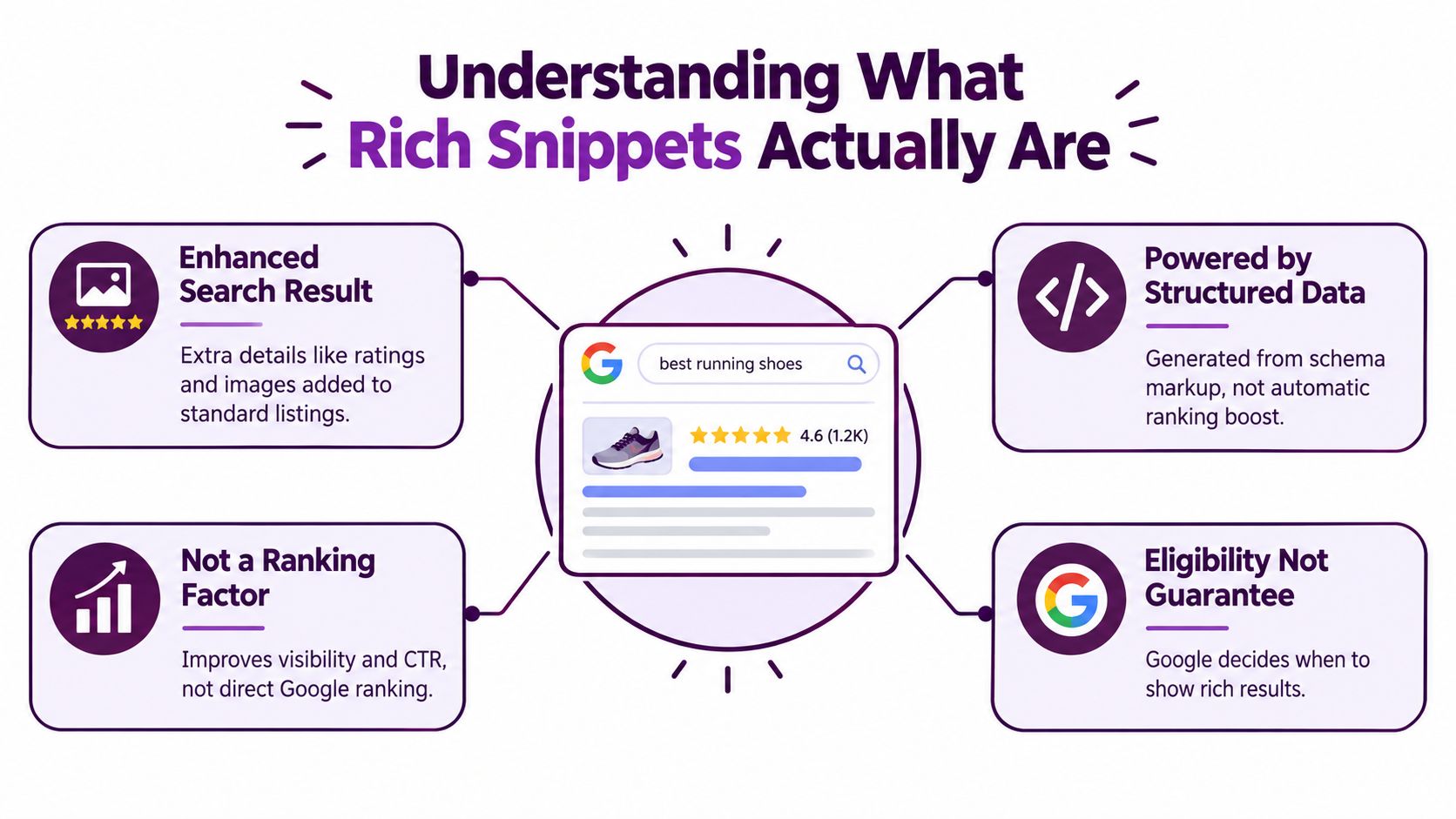
A standard Google result usually contains a page title, URL or breadcrumb, and descriptive text. A rich snippet adds useful page details to that basic presentation, such as ratings, prices, availability, images, dates, or other content-specific information. Google generally derives those details from structured data embedded in the page, although adding markup doesn't force Google to display it.
That distinction matters because rich snippets aren't a special ranking position. They aren't a direct ranking factor, and they don't move a page to the top because a developer added JSON-LD. Structured data helps Google interpret a page and may make the result eligible for an enhanced presentation. Google still decides whether, when, and how that enhancement appears.
Google introduced rich snippets on May 12, 2009, initially using algorithms to surface extra details such as people and reviews in search results. Within just over a year, Google reported that rich snippets appeared in more than twice as many U.S. searches and four times as many searches globally compared with the previous year, as documented in its original rich snippets announcement. The feature began with limited applications, then expanded to recipes, products, events, and other content.
The result is enhanced, not promoted
Suppose a recipe page already ranks for a relevant query. Recipe markup might help Google understand the preparation time, rating, or ingredients and display some of those details. The markup doesn't replace strong content, relevance, crawlability, or authority. It changes the possible presentation of an eligible result, not the underlying quality of the page.
That's why rich snippets belong in the visibility layer of SEO. They can make an existing result clearer and more competitive, but they can't compensate for a page that fails to satisfy the search intent.
Practical rule: Treat schema as a way to communicate page meaning and qualify for search enhancements, not as a shortcut to higher rankings.
The term also overlaps with rich results, which is Google's broader language for enhanced search appearances. If you're comparing result formats, the guide to featured snippets is useful because featured snippets are a different search feature, usually involving a selected answer displayed separately from ordinary organic listings.
For teams that want a wider commercial SEO foundation, structured search presentation is only one part of the work. Improving internal linking, content clarity, technical performance, and conversion paths can help turn your site into a sales asset, rather than treating richer listings as the entire growth strategy.
How Rich Snippets Relate to Structured Data and Rich Results
These three terms describe different layers of the same process:
- Structured data is the machine-readable markup placed on a page.
- Rich results are the enhanced search appearances Google may show.
- Rich snippets is the older, widely used term for additional details displayed within a search listing.
A useful mental model is page, markup, eligibility, and display. Your page contains visible content. You add structured data that accurately describes that content. Google checks whether the markup and page meet its guidelines and whether the result type is eligible. Google may then display a rich result, but there's no guarantee that every eligible page receives the enhancement for every query.
Start with the page, not the schema menu
Choose markup based on what the page represents. A product detail page should describe a product, offers, and relevant product information. A recipe should describe a recipe. An article should identify the article and its authorship details where the implementation supports that purpose.
The common failure is choosing a schema type because an online checklist promises visibility. That approach produces markup that may be technically valid but strategically irrelevant, or worse, markup that describes information users can't see on the page.
A practical implementation sequence looks like this:
- Identify the primary entity: Decide whether the page is mainly about a product, recipe, article, organization, event, or another supported entity.
- Match visible content: Ensure the structured values reflect what users can find on the page.
- Review current eligibility: Check Google's current documentation because supported displays and requirements change.
- Validate the markup: Test syntax and required properties before publishing.
- Measure the result: Look for changes in eligible impressions, click-through rate, and meaningful organic visits.
Schema.org vocabulary can provide the descriptive framework, while Google's documentation determines search-feature eligibility. A practical structured data for SEO guide can help teams understand the vocabulary before they implement it, but it shouldn't replace checking Google's own requirements for the intended rich-result type.
The difference between valid markup and visible enhancement is central. A validator can confirm that your code is readable and complete according to a vocabulary. Google can still decline to show a rich result because the page, query, site, content, or current search policy doesn't qualify.
Major Rich Snippet Types That Still Matter in 2026
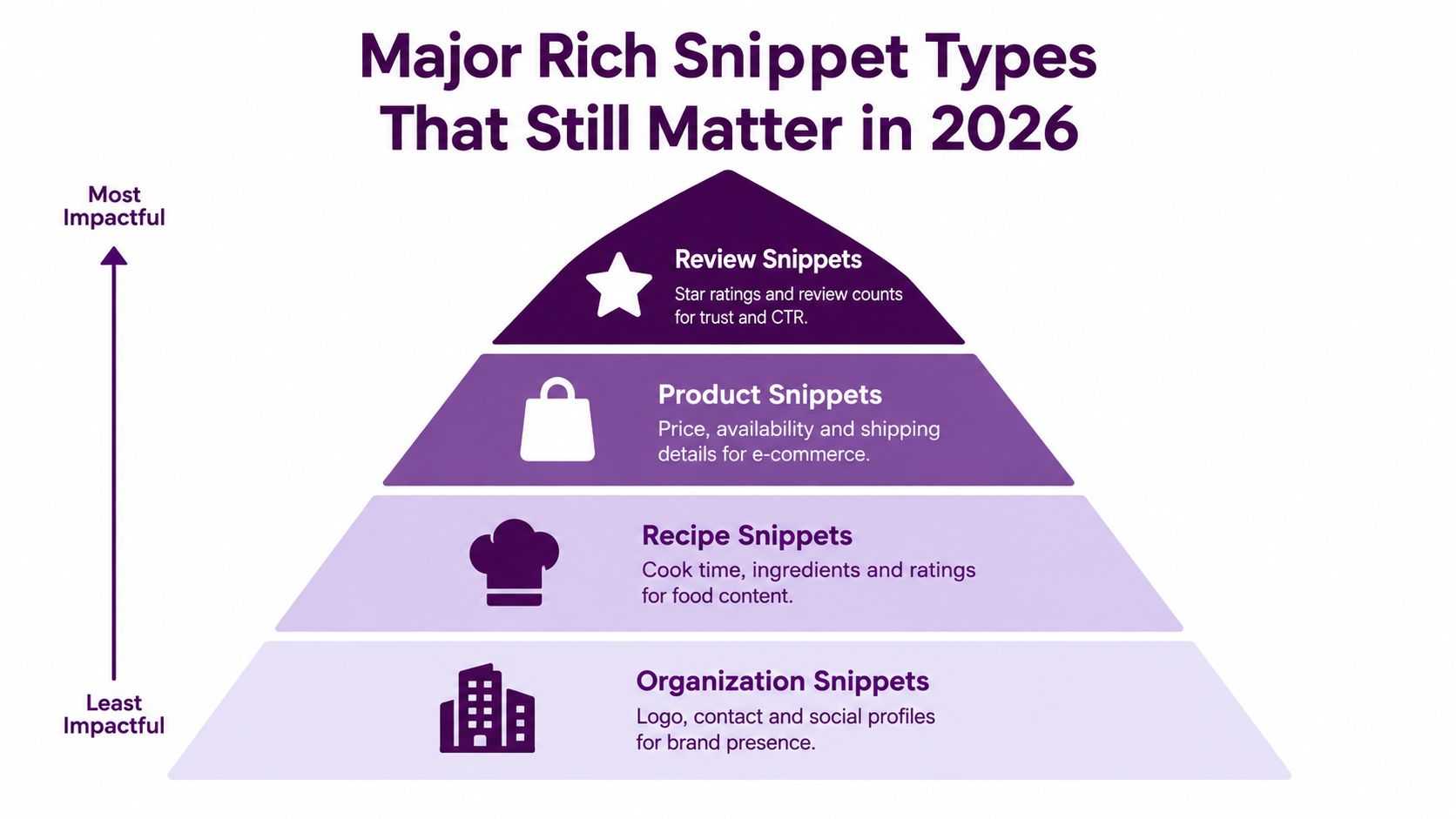
Rich-result strategy now needs prioritization. Older articles often present every schema type as if it offers the same opportunity, but Google's search surfaces aren't static. The strongest candidates are usually formats tied closely to commercial or content entities that users need to evaluate.
Prioritize formats that describe the page's core purpose
| Page type | Potential enhancement | Practical priority |
|---|---|---|
| Review-led pages | Ratings and review details | High where reviews are genuine and visible |
| Product pages | Price, availability, and product information | High for eligible e-commerce pages |
| Recipe pages | Recipe-specific details such as ratings and preparation information | High for relevant food content |
| Organization pages | Brand identity and organizational details | Useful for entity clarity and presence |
| Breadcrumb-enabled pages | Clearer hierarchy in search presentation | Useful across structured site architectures |
Review snippets can help searchers assess credibility before visiting. The markup must represent real review content associated with the page, not decorative ratings added solely to attract attention. Misaligned or unsupported review markup creates implementation risk without creating a durable advantage.
Product snippets remain a logical investment for e-commerce teams because price and availability are decision-making details. Accuracy matters particularly here. If the page shows one price while the markup communicates another, the enhancement can undermine trust and create compliance concerns.
Recipe snippets still fit pages where the recipe is the primary content. They're not a sensible choice for general food articles that mention a dish without presenting a complete recipe experience. Organization and breadcrumb enhancements are less about a dramatic visual takeover and more about helping Google interpret brand and site structure.
Deprioritize legacy FAQ and How-To assumptions
FAQ rich-result visibility has narrowed sharply. Recent 2026 coverage reports that FAQ impressions dropped by nearly half across tracked sites, while another guide notes that eligibility was restricted toward authoritative government and health sites after earlier changes. That makes generic advice to add FAQ schema to every service page increasingly unreliable.
How-To has also lost broad reach. Desktop How-To rich results were removed, while mobile visibility was limited to primary content pages, according to the same recent coverage. These formats may still have a place where a page clearly qualifies, but they shouldn't automatically outrank product, review, recipe, organization, or breadcrumb work in a schema roadmap.
The better question is not, “Which markup can I add?” It's, “Which enhancement matches this page and still has a meaningful route to display?”
Measuring the Real SEO Impact of Rich Snippets
Rich snippets can influence click behavior, but measurement needs to separate eligibility from actual business value. A page may receive an enhanced appearance for some queries, plain listings for others, and no additional exposure at all despite containing valid markup.
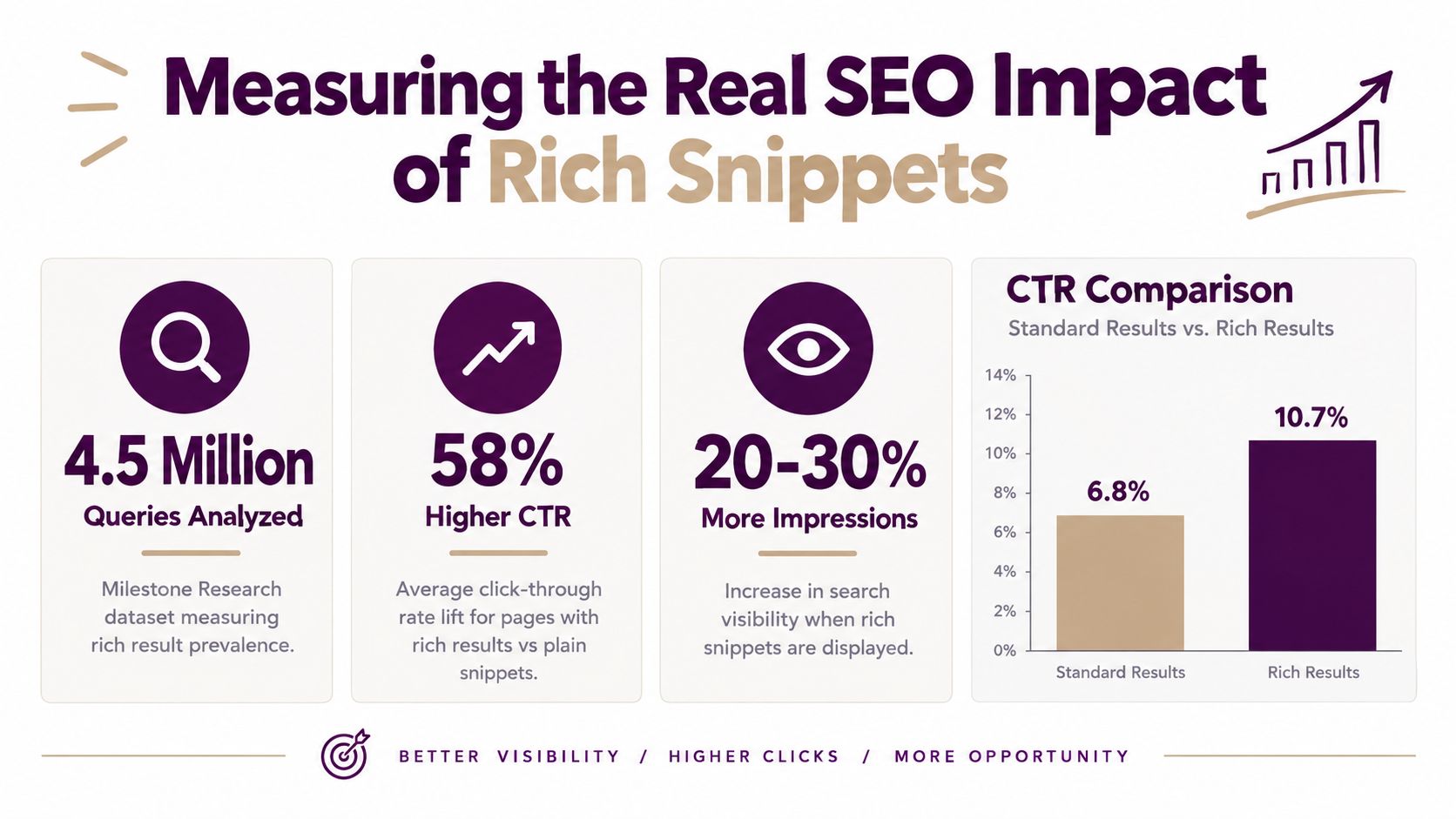
A Milestone Research analysis of 4.5 million queries found that rich results averaged a 58% click-through rate, compared with 41% for standard results, a 17-point absolute difference and roughly a 41% relative increase in clicks. The figures are reported in the Milestone Research analysis of rich snippets and SEO. The same research reported 87% CTR for FAQ rich snippets, with non-branded queries reaching 91%.
Those figures show why enhanced presentation deserves attention. They don't prove that schema alone caused every click, and they don't mean every page will reproduce those results. Query intent, ranking position, brand familiarity, competition, device, and the quality of the underlying listing all affect click behavior.
Use a measurement chain, not a single CTR check
A sound review connects implementation to outcomes:
- Eligibility: Confirm that Google recognizes the intended structured-data type and reports no major errors.
- Impressions: Check whether pages appear for queries where the relevant enhancement could show.
- CTR: Compare click-through behavior for comparable pages and query groups, rather than treating one aggregate number as proof.
- Landing-page engagement: Review whether the additional clicks produce useful visits, not just more sessions.
- Conversions: Track leads, transactions, subscriptions, or other actions tied to the page's purpose.
A CTR increase can be valuable even when rankings stay stable, because the listing earns more attention from the same search demand. But a higher click rate that sends poorly qualified visitors to a weak landing page won't necessarily improve revenue or lead quality.
Rich snippets improve the handoff between search intent and page choice. They don't finish the conversion job.
Segment reporting by page type. Product pages should be evaluated against product pages, recipe pages against recipes, and informational pages against similar informational content. Also separate branded and non-branded queries where possible, since the research cited above shows that FAQ performance differed between those query groups.
For ongoing monitoring, use Search Console alongside a rank tracker and a tool such as this how to monitor SERP features in 2026. The objective is to identify where enhancements appear, where they disappear, and which page groups produce valuable organic actions after the click.
How to Implement Rich Snippets Correctly
Implementation should follow the page's content model, not a race to add every available property. JSON-LD is usually the cleanest format because it keeps structured data separate from the visible HTML while allowing developers or content systems to manage it centrally.

Follow a controlled publishing workflow
- Select the primary type. Map the page to its real purpose. Don't label a service page as a product or add recipe properties to an article that doesn't contain a recipe.
- Add supported properties. Include information that's accurate, visible, and relevant. Required properties help eligibility, while recommended properties can improve completeness where they apply.
- Place the JSON-LD in the page source. Your development team can add it to the head or body as part of the page template. The exact placement matters less than whether Google can access and parse it.
- Run Google's Rich Results Test. Check whether the intended result type is detected and whether the markup contains errors.
- Use Schema Markup Validator for vocabulary checks. This helps identify broader schema syntax and property issues, but it doesn't promise a Google search enhancement.
- Publish and monitor Search Console. Watch enhancement reports, valid items, warnings, and errors after deployment.
- Recheck dynamic fields. E-commerce prices, stock status, ratings, dates, and other changing values must stay aligned with the visible page.
Teams working with service businesses can review implementation guidance on how to mark up home services when the page describes those services. For smaller teams, a create rich snippets workflow can help generate a starting point, but generated code still requires human review against the page and Google's requirements.
Don't mark up hidden, misleading, or unsupported content. Don't use schema as a substitute for writing the information clearly on the page. The safest implementation is narrow, accurate, validated, and tied to a template that developers can maintain when the content changes.
Building a Sustainable Rich Snippet Strategy
A sustainable schema program starts with page purpose and current eligibility, not with a list of markup types copied from an old SEO article. Build an inventory of important page groups, identify the entity each group describes, and assign effort according to the likelihood that Google still supports a useful enhancement for that format.
For most commercial sites, product and review-related markup deserves close attention because it connects directly to comparison and purchase decisions. Recipe markup remains relevant for recipe-focused publishers. Organization and breadcrumb markup can support clearer entity and site-structure interpretation. Article markup may improve machine readability and content understanding, but it shouldn't be treated as a guaranteed rich-result shortcut.
Make schema maintenance part of SEO operations
Assign ownership for structured-data changes. Product teams should know who updates price and availability fields. Editorial teams should keep article, recipe, and review content aligned with markup. Developers should include validation in template releases, especially after migrations, redesigns, or changes to rendering.
FAQ and How-To markup shouldn't disappear from every project automatically, but it should lose its status as a default quick win. The 2026 restrictions mean teams need to confirm eligibility and evaluate opportunity before spending substantial production time on those formats.
Review rich-result performance as part of broader search reporting. Compare impressions, CTR, rankings, landing-page engagement, and conversions by page type. If a markup type produces no meaningful visibility after a reasonable monitoring period, redirect effort toward content quality, internal linking, technical accessibility, or a richer result type with a closer fit to the business.
Keyword Kick can support that operating model by bringing rank tracking, Search Console, SERP feature tracking, technical SEO signals, and prioritized recommendations into one workspace. Use it alongside Google's validation and reporting tools to identify which pages are eligible, which enhancements appear, and what SEO action should come next.
Keyword Kick helps agencies, in-house teams, and consultants connect SERP feature data with rankings, technical audits, Search Console, and prioritized SEO actions. Visit Keyword Kick to see which pages deserve structured-data attention and turn rich-snippet opportunities into a measurable optimization workflow.