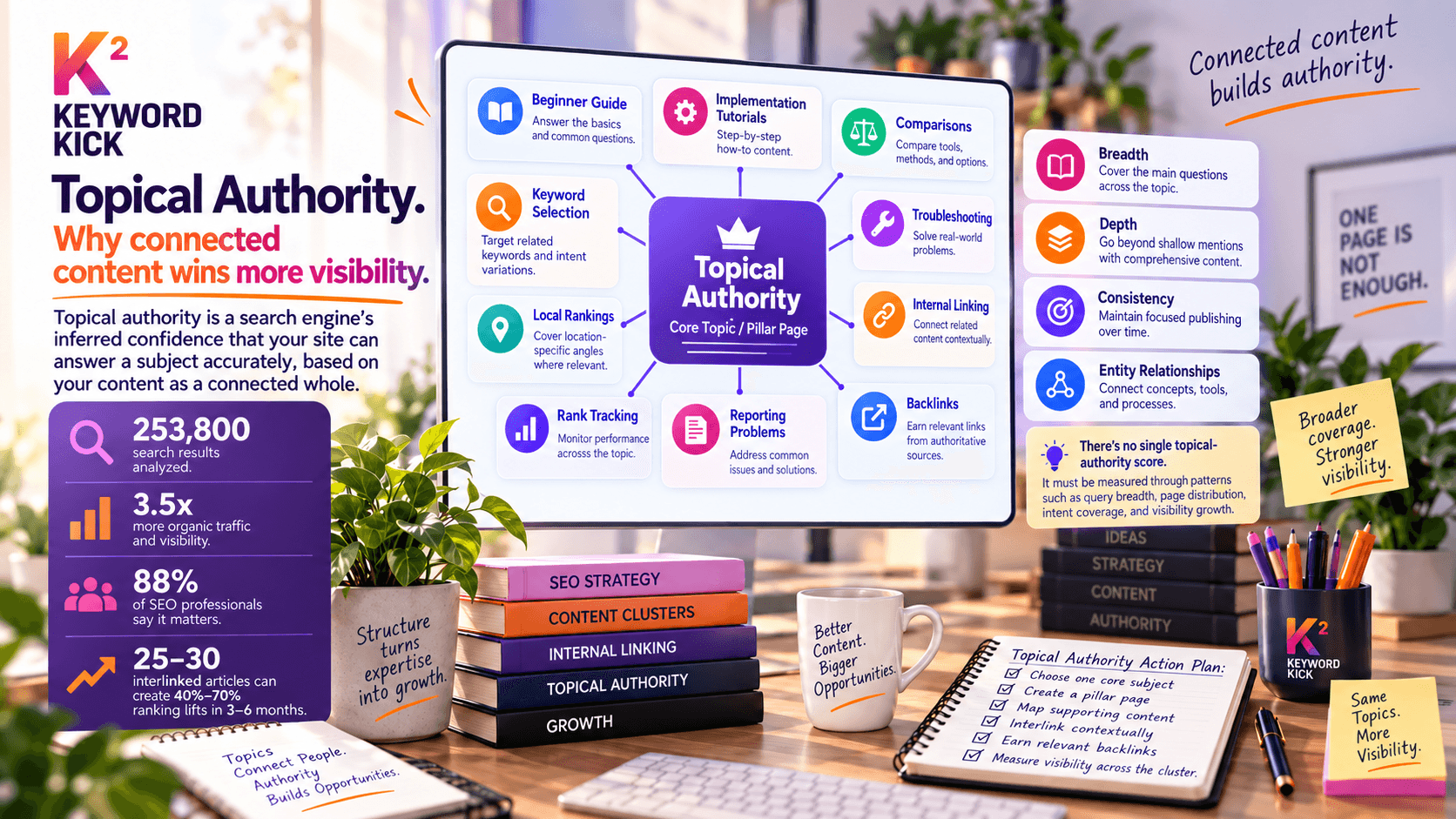
You publish a well-researched article, optimize the title, earn a few relevant links, and wait. A competitor with a similar backlink profile keeps appearing above you, not because every page is better, but because its website answers nearly every important question around the subject. Searchers can move from a beginner guide to an implementation tutorial, a comparison, and a troubleshooting page without leaving the site.
That difference captures the practical meaning of topical authority. Search engines and AI answer systems increasingly evaluate whether a source understands a subject as a connected whole, rather than judging each page in isolation. A 2026 study summarized an analysis of 253,800 search results and reported that page-level topical authority was the largest on-page ranking factor, making the concept more than a fashionable content preference. The study's findings also connected broad subject coverage with faster visibility growth and a structured cluster model with measurable ranking gains.
This guide starts with the basic definition, then moves through content clusters, internal linking, backlinks, measurement, and AI citations. By the end, you'll know how to build authority deliberately and how to judge progress without hunting for a mythical single score.
Introduction Why Topical Authority Decides Who Ranks Now
A marketing team often diagnoses a stubborn ranking problem at the page level. The team rewrites the introduction, adds keywords, improves the metadata, and commissions another article targeting a related phrase. Those actions can help, but they miss a larger question: does the site demonstrate sustained expertise across the topic?
Consider two websites selling SEO software. Both have useful guides and links from relevant publications. Site A publishes one excellent article about rank tracking, then moves on to unrelated marketing subjects. Site B publishes a central rank-tracking guide supported by pages about tracking local rankings, monitoring competitors, interpreting fluctuations, choosing keywords, and fixing reporting problems. Site B gives search engines more evidence about its subject focus, while readers get a connected path through the topic.
That distinction matters because search has moved beyond simple one-page, one-keyword matching. Search engines interpret related concepts, entities, questions, and user intent. AI-powered systems also need sources that explain a subject clearly enough to support synthesized answers. A shallow page may match one query, but a coherent cluster gives a system more reasons to treat the publisher as a reliable source across related queries.
Practical rule: Don't ask only whether a page is optimized. Ask whether the surrounding site makes that page more credible.
The business outcome is broader distribution. A strong cluster can help a brand appear for long-tail searches, earn visibility across multiple result types, and become a more usable source for AI-generated answers. It also creates a better experience for visitors who need more than a single definition before they make a decision.
You won't build topical authority by publishing random articles at high speed. You'll build it by selecting a focused subject, mapping its important questions, creating useful pages, connecting them logically, and maintaining consistent expertise signals. The process is systematic, and it can start with the content already on your site.
What Topical Authority Really Means in Modern SEO
Topical authority is the search engine's inferred confidence that a site can answer a subject accurately. It isn't a badge assigned to a domain, and it isn't created because a page repeats a target phrase. It emerges from the relationships among pages, the subjects they cover, the links connecting them, and the consistency of the site's overall focus.
A useful analogy is a library. One excellent book about gardening proves that an author can explain gardening. A library containing books on soil, seeds, pruning, pests, seasonal planning, tools, and troubleshooting offers a much stronger information environment. The library doesn't need every book in existence, but its collection should cover the questions a visitor is likely to ask.
A website works in a similar way. A single article can be authoritative at the page level, while a connected collection can demonstrate authority around a wider topic. Keyword Graph's explanation of topical authority describes it as a network-level property that develops through coverage, coherent internal linking, and query-dependent relevance. That framing helps prevent a common mistake, treating authority as a site-wide number that applies equally to every subject.
The concepts people often confuse
Domain authority is generally a third-party metric intended to estimate link-based strength. Topical authority is about relevance and expertise within a subject. A site can have many powerful links yet lack convincing coverage in a particular knowledge area.
E-E-A-T, meaning experience, expertise, authoritativeness, and trust, is a quality framework used to think about content credibility. Topical authority can support those signals, but the two concepts aren't interchangeable. Named expertise, firsthand knowledge, transparent sourcing, and editorial care strengthen a page, while topical authority describes the broader pattern across related content.
Content volume is also different. Publishing dozens of shallow pages doesn't create a useful library. Breadth must be paired with depth, clear intent matching, accurate explanations, and connections that help both readers and crawlers understand how the pages relate.
The four practical components
Breadth: Cover the main questions, adjacent problems, use cases, and relevant variations around the core subject.
Depth: Give important subtopics enough space to be useful, rather than mentioning them in passing.
Consistency: Reinforce the same expertise through ongoing quality, stable editorial standards, and focused publishing.
Entity relationships: Connect people, products, processes, tools, and concepts in ways that reflect how the subject works.
For a more detailed look at semantic relationships and related concepts in SEO, you can read Magnitude Marketing analysis. The central lesson is simple: topical authority belongs to a connected system of evidence, not to an isolated article or a vanity metric.
Why Topical Authority Matters for Visibility and SERP Features
Searchers rarely stop at one question. Someone researching an SEO audit may begin with a definition, continue to a checklist, compare software, and then look for help interpreting technical errors. A site that addresses these connected needs can meet the same audience at several points in the journey, rather than relying on one page to carry every opportunity.
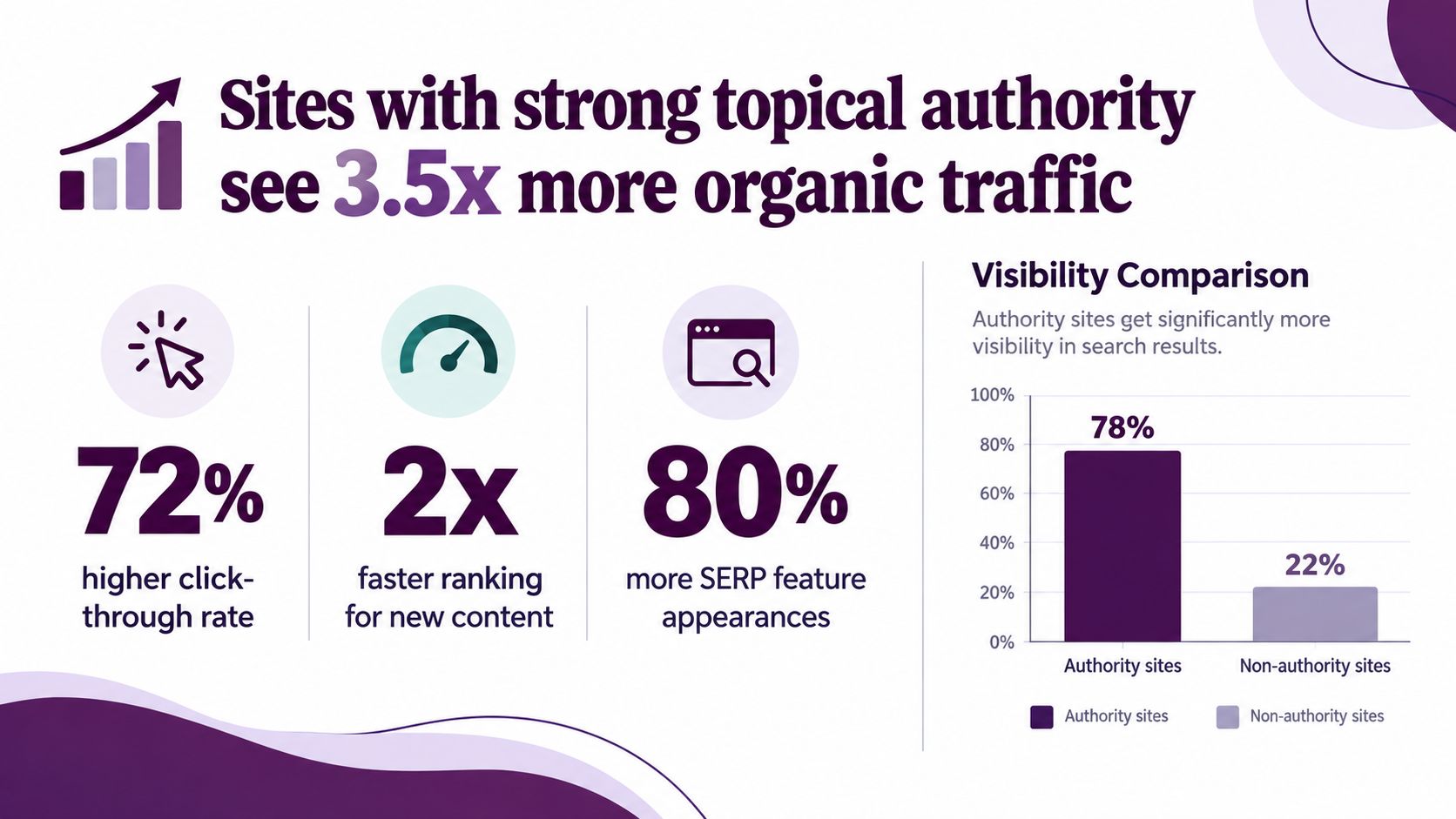
A 2026 topical-authority impact study reviewed 253,800 search results and reported that high-authority pages reached 5,000 pageviews about 20 days faster than low-authority pages. The study summary presents coherent subject coverage as a factor that can accelerate visibility growth. The study also reported that 88% of SEO professionals considered topical authority very important to their 2026 strategy.
These findings do not guarantee the same outcome for every cluster. They clarify why topical coverage functions as a distribution strategy. One page may win a single query, while a connected group of pages creates more chances to appear for related questions, specific long-tail searches, and different stages of intent.
Why shallow pages face pressure
A page with many links can still rank well when it satisfies a clear query. Links do not, by themselves, show whether the publisher understands the surrounding subject. If competing pages provide stronger context, clearer relationships, and better coverage of user intent, a single shallow resource becomes easier to replace.
The pressure is greater in SERP features and AI-generated answers. These surfaces often select concise definitions, comparisons, direct explanations, and procedural passages. A publisher writing from several angles has more opportunities to provide the exact passage a system needs, while a thin site may have only one broad article with no supporting evidence.
Search visibility isn't only about winning one result. It's about becoming discoverable wherever the audience asks a related question.
The practical decision is strategic. Before commissioning another article or starting a link campaign, inspect the existing cluster for gaps. The missing piece might be a page for an overlooked intent, a clearer explanation of an adjacent concept, or internal links that make relationships between resources obvious. Depth creates more distribution surfaces, and structure helps those surfaces reinforce one another.
How to Build Topical Authority With Content Clusters
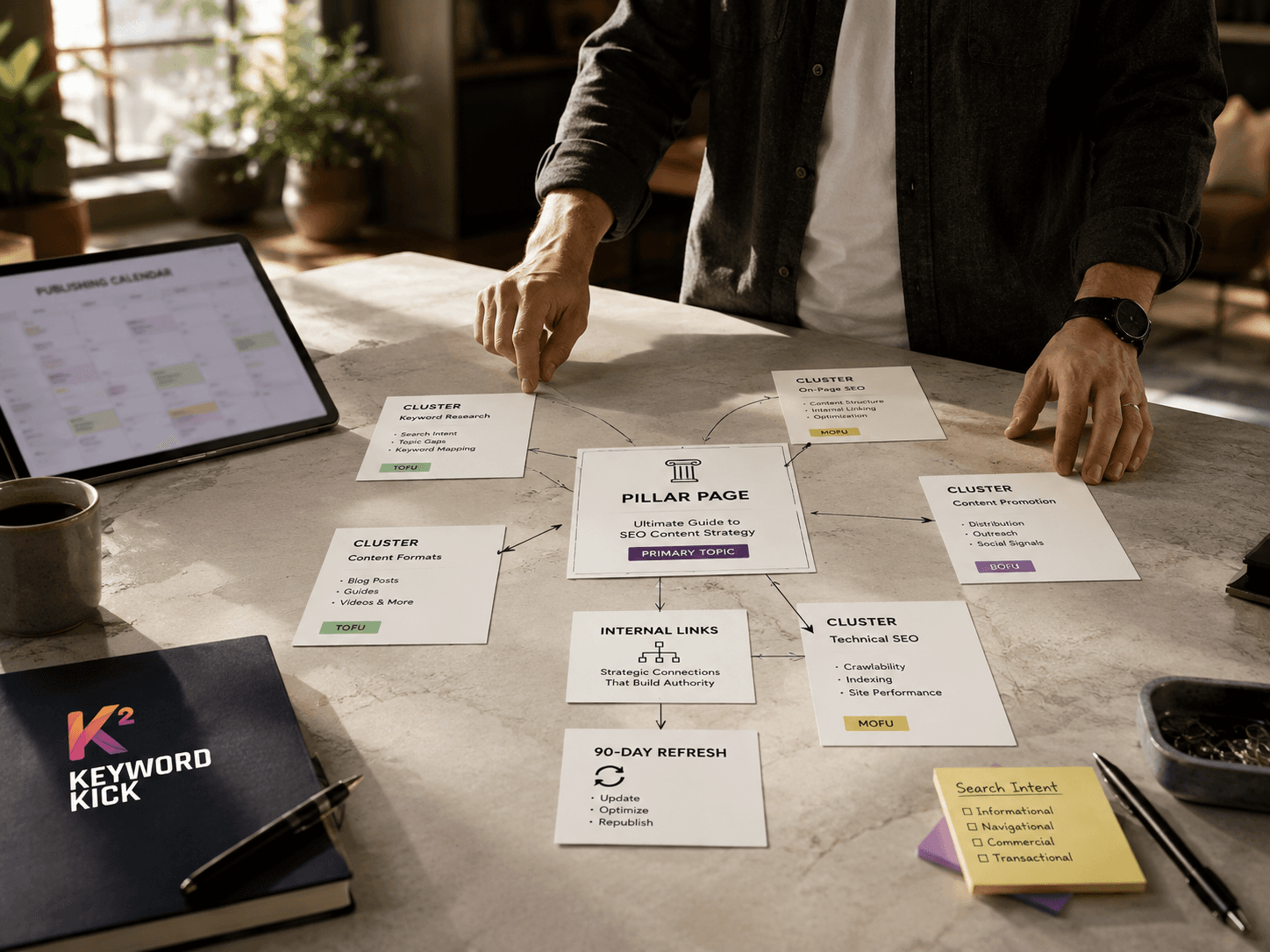
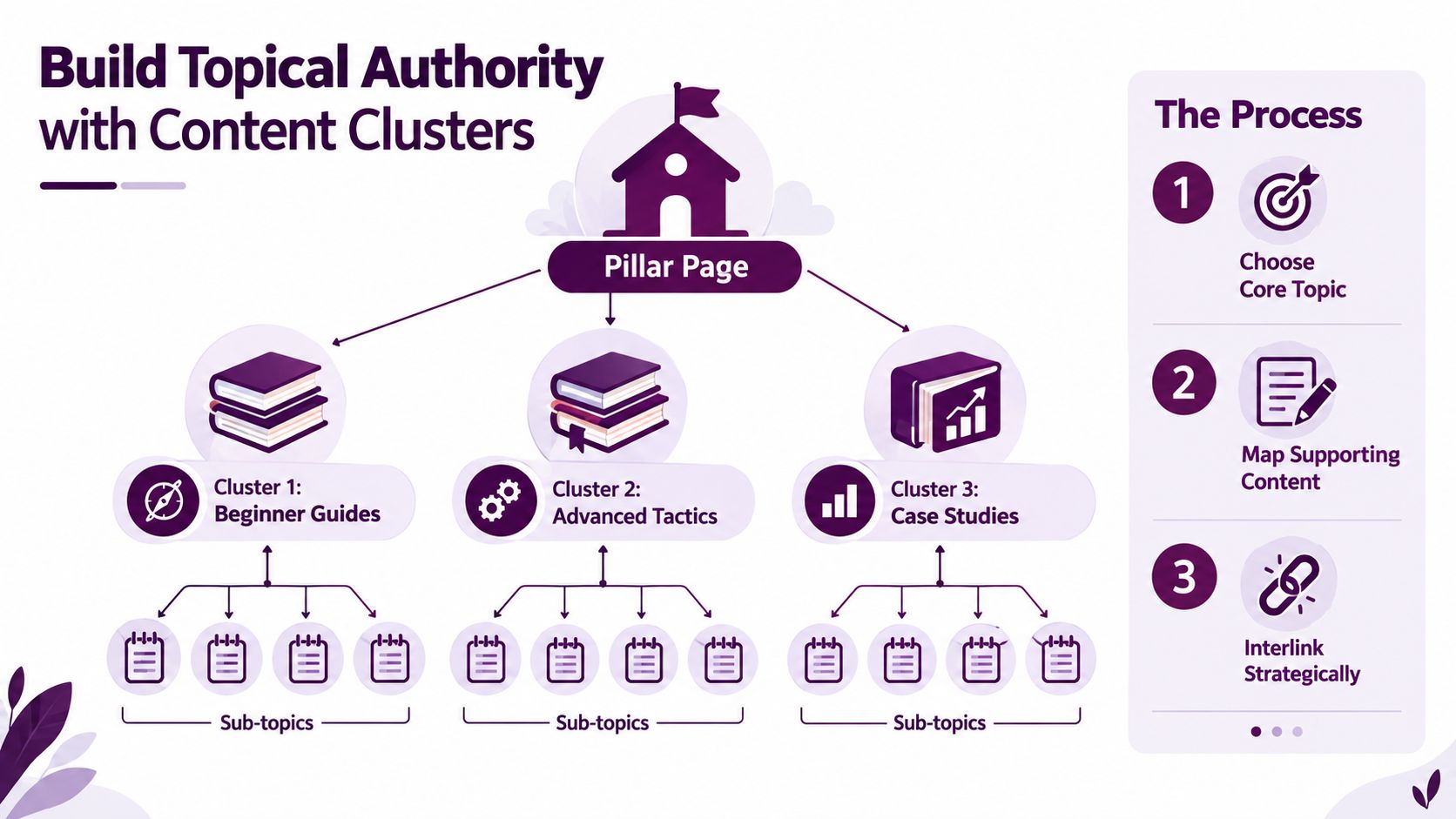
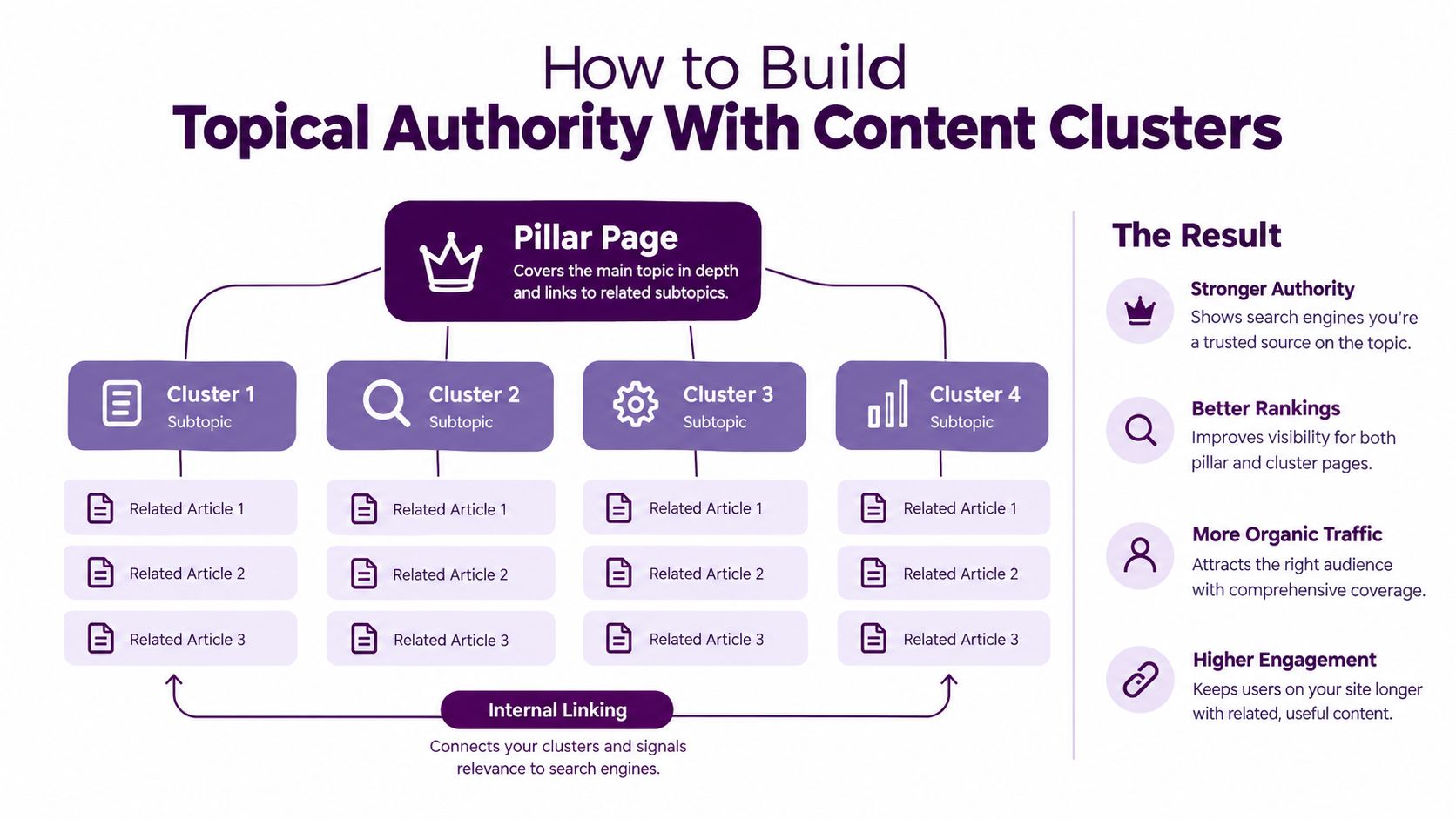
A content cluster gives a subject an organized home. One pillar page introduces the main idea, while supporting pages answer the specific questions readers ask before, during, and after making a decision. This structure moves SEO away from assigning one keyword to one isolated article. It connects related questions, entities, and user needs so search engines and AI systems can identify the site's expertise and find passages suitable for long-tail results or citations.
Choose a core topic you can own
Start with a subject that connects to your expertise, products, services, and audience problems. A broad phrase may attract attention, but it can exceed your team's ability to produce distinctive coverage. “SEO” is usually too expansive for a focused cluster. “SEO content audits for SaaS websites” sets a clearer boundary and gives the editorial team a defined audience.
Define the audience and desired outcome before collecting keywords. Ask what readers need to understand, compare, implement, troubleshoot, or buy. Those answers keep the cluster tied to business relevance rather than turning it into a list of disconnected search terms. They also reveal the formats your distribution strategy needs, from introductory explanations to decision-support pages and practical procedures.
Build the pillar around the main decision
The pillar page should explain the subject clearly and direct readers to deeper resources. It establishes the central concepts and helps visitors choose the next useful page. It does not need to answer every question in full. A pillar that tries to contain every detail becomes difficult to scan and leaves fewer reasons to visit the supporting pages.
Map supporting content across several intent types:
Foundational guides answer definitions and beginner questions.
Implementation pages explain processes, workflows, and tools.
Advanced resources address edge cases, analysis, and strategic decisions.
Comparison pages help readers evaluate alternatives.
Troubleshooting content handles errors, obstacles, and declining performance.
Include semantic variants in the map, but do not use them to justify duplicate pages. If two proposed articles answer the same underlying question, combine them or assign each a clearly different purpose. A step-by-step content map example shows how to turn this planning logic into an editorial structure.
Reach useful cluster depth
A study associated 25 to 30 interlinked articles in a single cluster with a tipping point linked to 40% to 70% keyword ranking lifts within 3 to 6 months. Its implementation guidance connects the concept with a practical architecture. Treat the figures as a benchmark, not a promise. Results depend on topic selection, page quality, competition, and how well each resource satisfies its intent.
Depth supports distribution because every distinct page can address another long-tail query, clarify a related concept, or provide a passage an AI answer may use. A shallow, link-heavy page has fewer relevant entry points and less supporting context. The number of articles matters less than whether the cluster forms a useful body of knowledge.
Each page should resolve a distinct need, present relevant evidence, and fit the broader subject. Publishing filler to reach a target creates overlapping pages, weakens reader confidence, and gives search systems little additional information.
Maintain the network
Review the cluster as a system. Add missing questions when user research and search data reveal them. Refresh pages as the subject changes. Connect commercial pages with relevant educational resources, and keep the pillar accurate enough to guide readers through the collection.
A strong cluster grows through breadth plus consistency. It does not need to launch in one campaign. Set a clear boundary, cover deliberate intent categories, and apply enough editorial discipline that every new page strengthens the same knowledge area.
Strengthening Authority Through Internal Linking and Backlink Signals
A cluster only works when its pages can be understood as a network. Internal links provide that structure. They help readers discover the next relevant resource and give crawlers context about how pages relate to the central subject.
Use the pillar page as a clear hub, but don't stop there. Supporting articles should link back when the pillar provides useful context, and they should link sideways when another cluster page answers a related question. Context matters more than forcing a fixed number of links into every article.
Use links to explain relationships
A practical pattern looks like this:
Pillar to cluster: Link from a broad explanation to the detailed guide that expands it.
Cluster to pillar: Link back when readers may need the broader framework or next step.
Cluster to cluster: Connect pages that share an audience problem, such as a technical audit guide and a reporting workflow.
Contextual anchor text: Describe the destination accurately instead of using vague phrases.
Orphaned pages weaken the network because they sit outside the path readers and crawlers use to understand the topic. Cannibalization creates the opposite problem. Several pages may compete for the same intent, dividing signals and making it unclear which resource deserves visibility.
Treat backlinks as contextual evidence
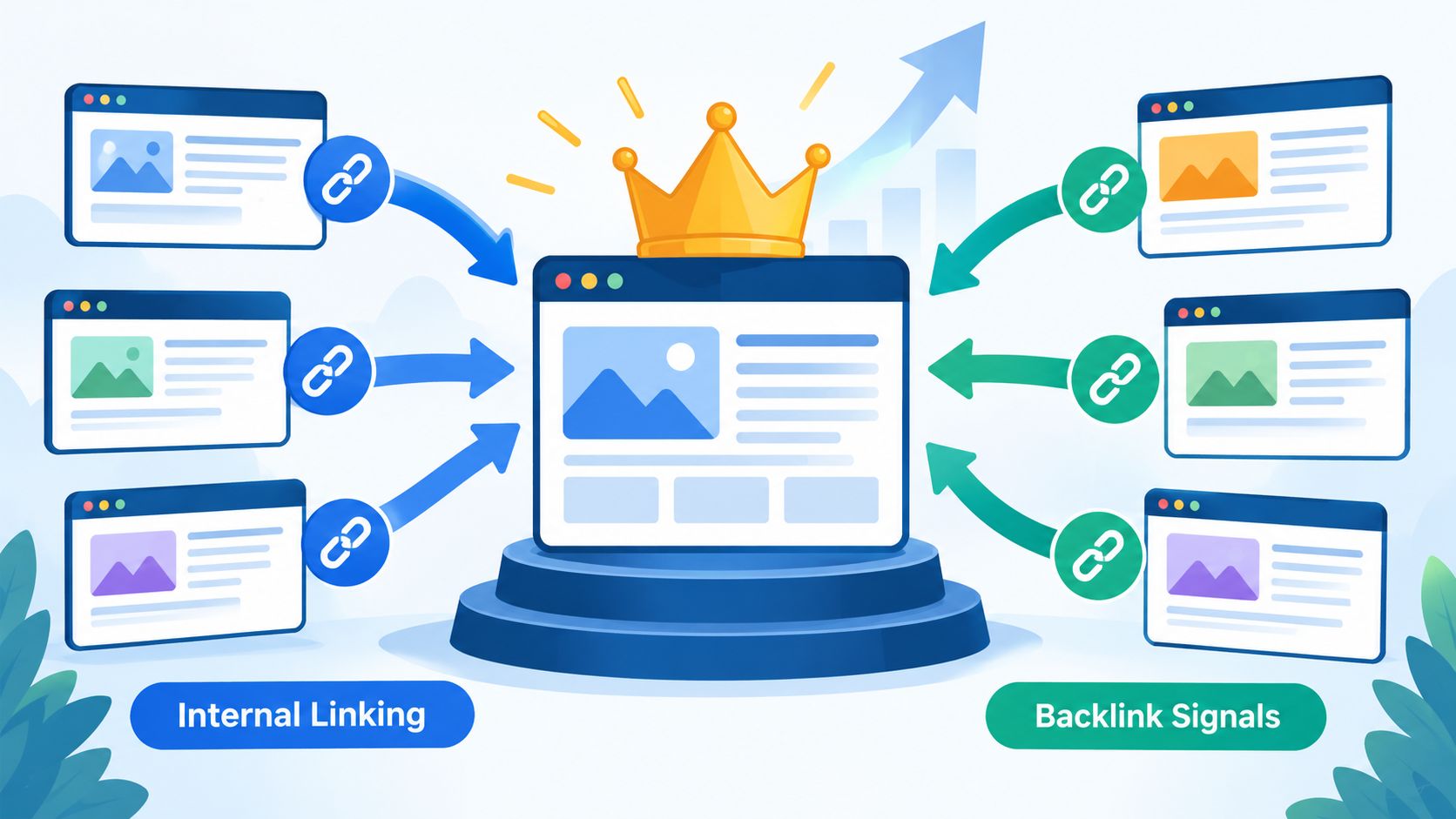
External links can reinforce authority, but topical fit matters. A link from a relevant publication that discusses the same subject gives clearer context than an unrelated link acquired only for raw metric value. Search engines can evaluate the surrounding entity neighborhood and the thematic coherence of links pointing into a cluster, so your outreach should focus on genuine relevance.
That doesn't mean every backlink must use exact-match anchor text. Natural wording and a useful editorial context are more sustainable. Prioritize pages that deserve references because they contain original analysis, practical frameworks, or information other publishers need to cite. For a broader review of link quality and acquisition principles, use this 2026 backlink strategy guide.
The strongest signal comes from alignment. Internal links show how your own knowledge fits together, while relevant backlinks show that the wider web finds parts of that knowledge useful. Neither replaces content.
How to Measure and Audit Topical Authority Without a Single Score
Topical authority isn't exposed as one score in Google Search Console or major SEO tools. Search Engine Land's discussion of the concept emphasizes that authority must be inferred from patterns, such as multiple pages ranking for related queries and impressions rising across a subject area.
That changes the audit question. Don't ask, “What is our authority score?” Ask, “What evidence shows that our site is becoming a stronger source for this topic?”
Track patterns across the cluster
Create a topic-level view of performance rather than reviewing pages one by one. Look for:
Query breadth: Are more related searches bringing impressions to the cluster?
Page distribution: Do several relevant pages rank, or does one article carry the entire subject?
Intent coverage: Are informational, commercial, comparison, and troubleshooting needs represented?
Visibility movement: Are impressions and rankings improving across connected pages?
New-page traction: Do newly published resources begin to gain visibility within the same subject area?
A page can lose a position while the cluster improves overall. Conversely, one ranking article can hide weakness if no supporting pages attract impressions. Review both the aggregate pattern and the individual URLs.
Audit thematic distance and gaps
Industry analysis identifies practical components such as site focus, page-to-site thematic distance, and topical embeddings. Fahlout's topical-authority research uses these ideas to describe how closely pages match a domain's central theme and how concentrated the site remains within a knowledge vertical.
Apply that logic during an audit:
Identify the topics producing meaningful impressions.
Group related queries and pages into clusters.
Compare existing coverage with the questions customers ask.
Find pages that sit far from the site's core theme or lack supporting links.
Decide whether to expand, consolidate, redirect, or refresh.
For teams managing multiple sites or large content libraries, Keyword Kick can bring Google Search Console, rank tracking, backlink data, technical audits, and competitor context into one workspace. Its K² AI Agent can turn those connected signals into prioritized recommendations, such as which page to update first or where a cluster has a linking gap. Use the SEO content audit guide to shape the review process.
The result is a diagnostic system, not a vanity number. Authority is progressing when related pages become more visible together, coverage gaps shrink, and the site demonstrates a clearer subject focus over time.
Real Examples and Your Actionable Checklist to Get Started
A focused SEO software site might start with a pillar on rank tracking, then cover local monitoring, competitor tracking, keyword selection, reporting, volatility analysis, and troubleshooting. An ecommerce team could organize a product-category cluster around selection, use, maintenance, comparisons, and common problems. In both cases, the goal is distribution: one subject connects distinct search intents, helping the site reach long-tail queries and giving AI systems more relevant pages to cite than a shallow, link-heavy article can provide.
Use this checklist to begin:
Choose one core subject tied to your expertise and commercial priorities.
Define the audience's questions across learning, implementation, comparison, and troubleshooting intent.
Create a pillar page that organizes the subject and directs readers to deeper resources.
Map supporting pages while removing duplicate or cannibalizing ideas.
Publish useful coverage consistently, with clear authorship and editorial standards.
Interlink contextually, connecting pillar, cluster, and relevant commercial pages.
Earn topical backlinks by creating resources worth citing.
Audit the cluster regularly for gaps, orphaned pages, outdated information, and weak query coverage.
Measure distribution, including impressions, related ranking pages, long-tail discovery, and AI visibility where you can observe it.
A practical example makes the sequence easier to apply. If the core subject is rank tracking, begin by mapping the audiences, questions, and commercial decisions around it. Build the pillar, publish distinct supporting guides, connect each page where the relationship is useful, then review which topics attract impressions but lack adequate coverage. That evidence should determine the next page, update, consolidation, or redirect.
Treat topical authority as an ongoing distribution strategy for traditional search and AI-first discovery. Start with one cluster this week, then use Search Console and rank tracking to decide what deserves the next investment.
Keyword Kick connects Google Search Console, GA4, rank tracking, backlinks, technical audits, and competitor data in one workspace. Visit Keyword Kick to organize content gaps, cannibalization, and internal-linking opportunities into prioritized SEO actions.