
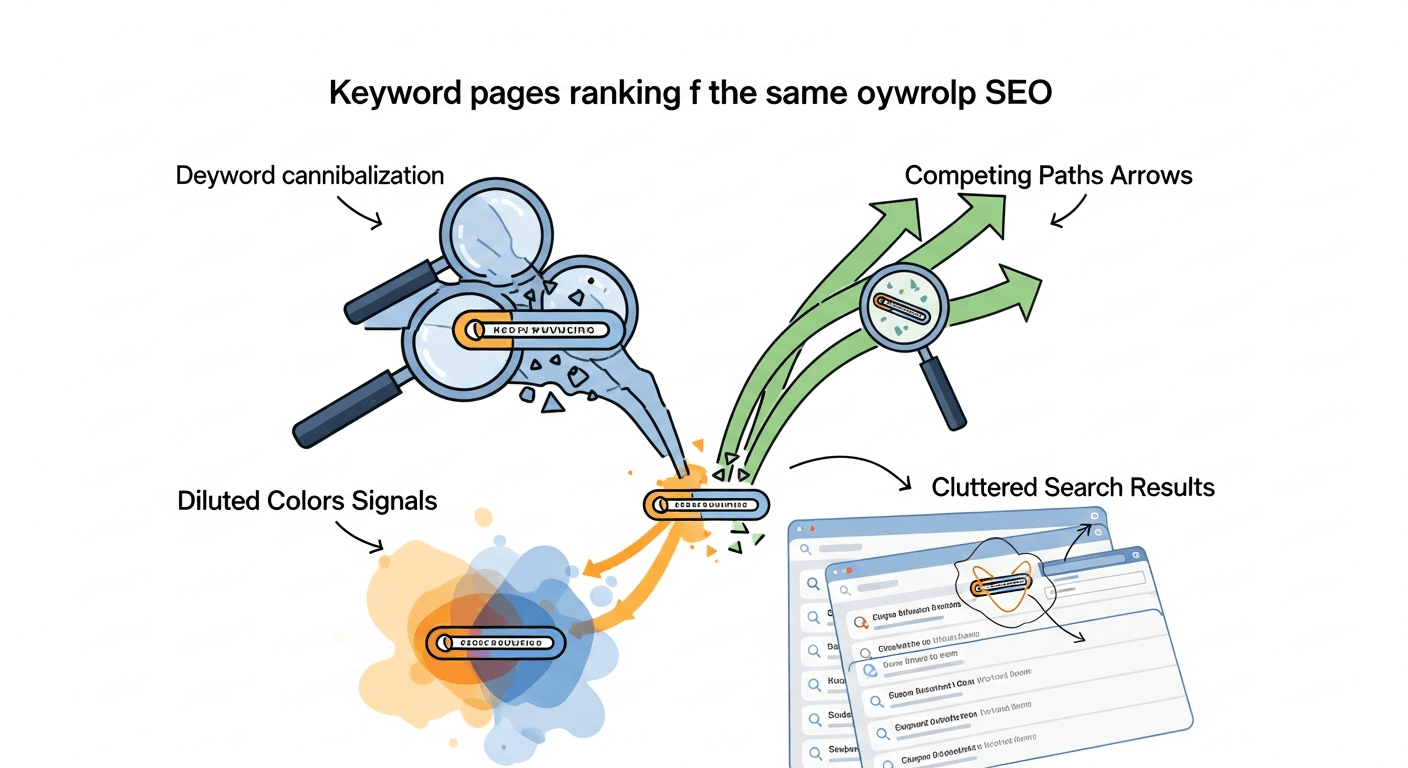
Seeing unexplained ranking drops and confusing analytics signals can be one of the most frustrating experiences for an SEO team. When you’ve ruled out technical issues, a common and often overlooked culprit is multiple pages ranking for the same keyword. This phenomenon—often described as keyword overlap SEO or seo content overlap—creates internal competition that reduces clarity for search engines and dilutes your ability to rank a single page decisively.
How multiple pages ranking same keyword creates SEO ranking dilution
When more than one URL on your domain targets the same query or intent, search engines receive mixed signals about which page is the authoritative result. This leads to seo ranking dilution, where link equity, relevance signals, and user engagement are split across pages rather than concentrated on one winner.
Common mechanisms that cause ranking dilution include:
Link equity split — Backlinks and internal links that could strengthen a single page are spread across multiple pages targeting the same keyword.
Reduced user signals — Click-through rate (CTR), dwell time, and other engagement metrics are divided, making it harder for the algorithm to identify the best page.
Confused intent — If pages answer slightly different intents for the same keyword, search engines may fluctuate which page to show based on minor query variations.
Indexation ambiguity — Without clear canonicalization, search engines may index and rank multiple copies or near-duplicates, amplifying overlap.
Left unaddressed, this dynamic can cause persistent ranking volatility and apparent ranking drops without technical issues.
Identifying keyword overlap SEO and seo content overlap
Detecting overlap requires a structured audit that combines search result observation, content review, and analytics. Look for patterns rather than isolated instances—keyword overlap often appears systematically across categories, product pages, or blog posts.
Key indicators to watch for:
Two or more pages appearing in SERPs for the same query or closely related queries.
Similar or duplicated title tags, meta descriptions, or H1 headings that target identical keywords.
Thin or shallow content that addresses the same subtopics across multiple pages.
Unclear internal linking where several pages are linked for the same anchor text.
Ranking drops without technical issues—no crawl errors, no indexation problems, but organic traffic declines.
Use the following ordered audit process to expose overlap:
Compile a keyword-to-URL map for important commercial and informational keywords.
Sort and group URLs by primary keyword and search intent.
Identify clusters where two or more URLs target the same keyword or intent.
Evaluate content similarity, title/H1 duplication, and internal linking patterns within each cluster.
Prioritize clusters that show the largest traffic or ranking instability for remediation.
Practical fixes: consolidation, canonicalization, and content differentiation
Addressing multiple pages ranking for the same keyword is usually a blend of technical fixes and editorial strategy. The goal is to concentrate authority on the strongest, most relevant page and ensure every other page either serves a distinct intent or is removed/redirected.
Actionable remediation options:
Merge content — Combine overlapping pages into a single comprehensive page that covers the full scope of the keyword intent. Then implement a 301 redirect from the old URLs to the consolidated page.
Set canonical tags — Where pages must remain separate for UX reasons but target the same keyword, use rel="canonical" to indicate the preferred URL to search engines.
Use 301 redirects selectively — Redirect inferior or thin pages to the authoritative page when merging content or consolidating topic coverage.
Differentiate intent — Re-optimize pages to serve unique intents (e.g., “buy” vs “compare” vs “learn”) and adjust title tags and H1s accordingly.
Noindex low-value pages — For pages that are useful internally but not intended to rank, apply noindex tags to remove them from SERPs and eliminate competition.
Optimize internal linking — Use internal links and descriptive anchor text to funnel authority to the chosen canonical page.
Each action should be executed with a rollback plan and careful monitoring to avoid unintended traffic loss.
Step-by-step workflow to resolve keyword overlap SEO
Follow this practical, sequential workflow to remove overlap while preserving rankings and traffic:
Inventory and prioritize — Create a list of overlapping clusters and prioritize by traffic value and volatility.
Assess the strongest URL — Choose the page with the best link profile, highest conversions, or most comprehensive content as the canonical target.
Plan the editorial approach — Decide whether to merge, differentiate, canonicalize, noindex, or redirect for each duplicate page.
Implement changes — Apply redirects, canonical tags, content merges, or noindex directives as planned.
Update internal links and sitemaps — Ensure site navigation and XML sitemap reflect the consolidated structure.
Monitor performance — Track rankings, organic traffic, and engagement for the affected keywords and pages over a defined observation window.
Iterate — If rankings drop or user signals worsen, review content quality, on-page targeting, and backlink distribution to adjust tactics.
Preserving rankings and avoiding pitfalls when fixing seo ranking dilution
Fixes can improve clarity, but careless implementation can cause short-term drops. The following precautions help protect existing performance:
Preserve backlinks — When consolidating content, implement 301 redirects from deprecated pages to the chosen canonical page to pass link signals.
Keep users in mind — Don’t sacrifice usability for technical cleanup. Ensure the final page satisfies user intent and conversion flows.
Stagger large changes — Roll out consolidations in batches rather than all at once to isolate impacts and reduce risk.
Document changes — Maintain a log of URLs changed, dates, and rationale to support analysis if ranking volatility occurs.
Measure multiple KPIs — Monitor organic sessions, impressions, CTR, and conversions, not just position, to evaluate success.
Important: ranking drops without technical issues often point to content or competitive problems—if you’ve ruled out crawl and index errors, investigate keyword overlap and content duplication as a likely source.
Conclusion and next steps: stop seo content overlap from undermining growth
Multiple pages ranking for the same keyword is a common and remediable cause of poor organic performance. By systematically auditing your site, consolidating or differentiating content, and applying canonicalization and redirects where appropriate, you can restore clarity for search engines and concentrate authority on pages that should rank.
If you’re facing unexplained ranking drops without technical issues or persistent keyword overlap SEO, start with a targeted inventory and the step-by-step workflow above. For teams looking to automate detection, remember that Keyword Kick is an SEO analytics SaaS designed to help detect keyword cannibalization and surface seo content overlap so you can prioritize fixes efficiently.
Ready to remove internal competition and recover lost ranking potential? Begin an audit today, prioritize the highest-impact clusters, and apply the consolidation and canonicalization strategies outlined here. Consistent, measured remediation will reduce seo ranking dilution and improve long-term visibility.