Your phone rings less than it should. Store traffic is uneven. Sales asks why a competitor shows up in Google Maps for searches you should own. Meanwhile, your team is juggling a website, a Google Business Profile, review requests, location pages, analytics, and a handful of directories that may or may not still list the right phone number.
That's local search marketing in practice.
It isn't one tactic. It's a connected system that decides whether a nearby customer finds you, trusts you, and chooses you. When teams treat it like a checklist, they usually get partial results. When they understand how the pieces reinforce each other, they can prioritize the work that drives visibility and revenue.
Why Local Search Is Your Biggest Opportunity
A customer needs a roofer, a dentist, a bakery, or a last-minute gift. They pull out a phone, type a service plus a place name, or just add “near me,” and make a decision quickly. That moment is where local search marketing wins or loses business.

The scale is too large to treat as secondary. Almost half of all Google searches, 46%, have local intent, and 76% of those “near me” searchers visit a business within 24 hours, with 28% resulting in a purchase according to local SEO statistics compiled by Sixth City Marketing. That's why local search marketing isn't a branding exercise. It captures buyers close to action.
High intent changes the math
Many marketing channels create awareness. Local search often captures demand that already exists. The person searching isn't casually browsing. They're trying to solve a problem nearby, often today.
That changes how you should think about priorities:
Speed matters more than polish: If your hours, phone number, or service area are wrong, a prospect won't wait for clarification.
Visibility beats cleverness: A smart campaign won't help if you don't appear in the map results and branded searches.
Trust signals decide close calls: Reviews, accurate business details, and strong location pages often break ties between similar providers.
Practical rule: If a customer is ready to buy locally, your first job is to be findable. Your second is to remove doubt.
For service businesses, trades, and multi-location brands, this is the origin of much frustration. You may have solid operations and a decent website, yet still miss local visibility because the underlying local signals are weak or inconsistent. If you work in a field where map visibility drives leads, this contractor guide to Google ranking is a useful reality check on why good businesses sometimes don't surface.
Why teams underinvest anyway
Local search feels deceptively simple. Claim the profile, add photos, get reviews. Done. That's the trap.
In practice, local visibility depends on many small signals lining up. The businesses that win aren't always the biggest brands. They're often the ones that maintain cleaner data, better relevance, and fewer friction points. If you want a broader benchmark view, these local SEO statistics help frame just how much discovery now happens through local intent queries.
The Three Pillars of Local Search Visibility
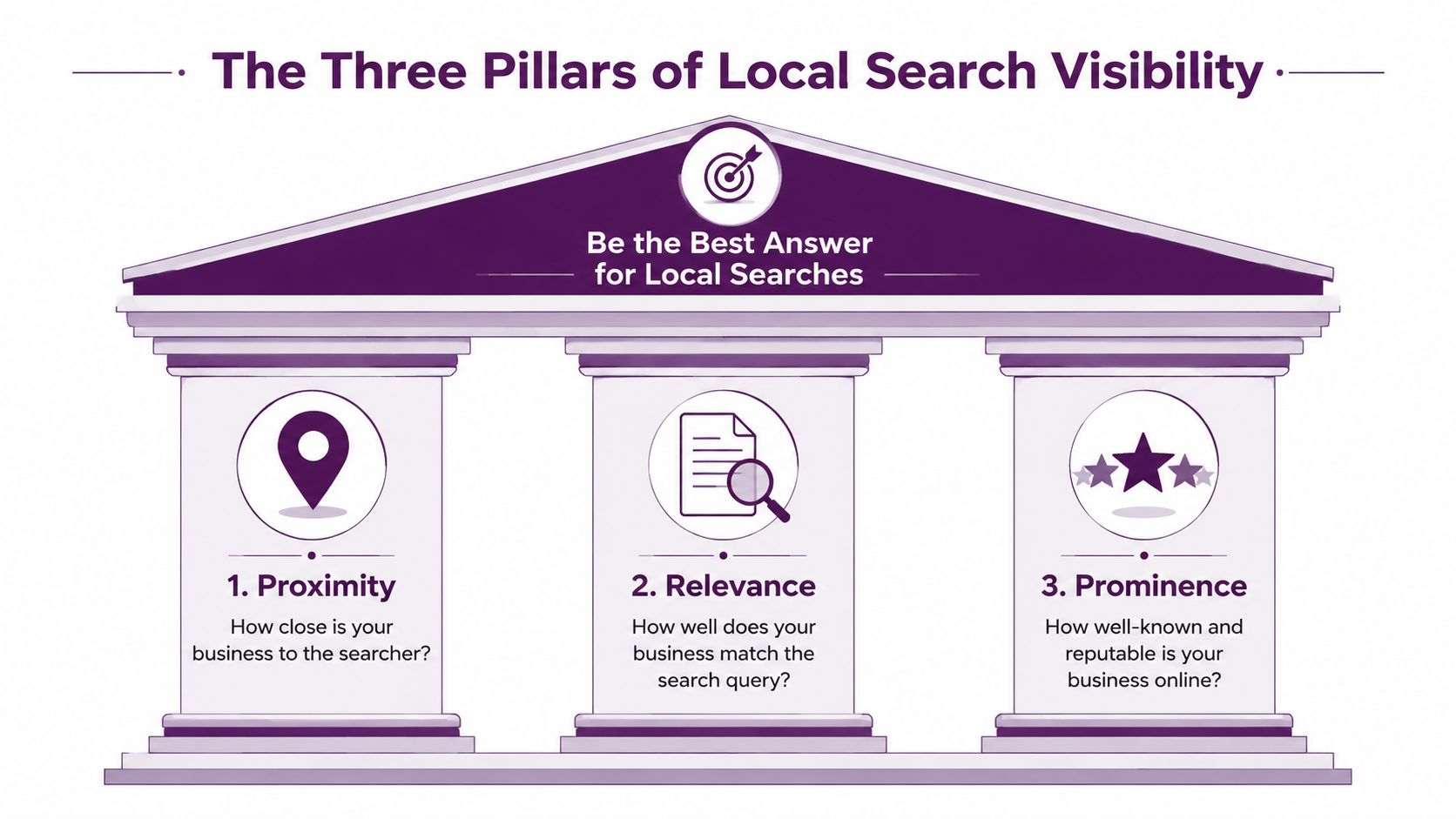
Google's local results make more sense when you stop treating them like a mystery and start treating them like a recommendation engine. Think of Google as a librarian helping someone find the best nearby answer. The librarian wants three things: the answer should be close enough, clearly relevant, and credible enough to recommend.
Those are the three pillars.
Proximity
Proximity is the simplest pillar and the one you control the least. It asks how close your business is to the searcher or to the location implied in the query.
If someone searches “emergency plumber near me,” Google prefers options that are physically plausible. You can't optimize your way into being closer than you are. What you can do is make your service areas, addresses, and local pages clear enough that Google doesn't misunderstand your footprint.
Relevance
Relevance is where most businesses leave money on the table. It's Google's attempt to answer, “Does this business match what the user wants?”
A law firm might be near the searcher, but if the profile, category choices, page titles, service pages, and on-site copy all read like a general practice while the user wants a personal injury attorney, relevance weakens. Google needs strong clues.
That means your website and profile should clearly describe:
Primary services: Not just broad categories, but what you want to rank for
Locations served: Cities, neighborhoods, and service areas that align with buyer searches
Supporting context: Photos, FAQs, service descriptions, and location-specific content
For teams that need a clean definition of the discipline itself, this local SEO glossary entry is a useful baseline.
Prominence
Prominence is reputation translated into search signals. Google looks for evidence that your business is known, trusted, and talked about.
That evidence can come from reviews, local links, citations, press mentions, and the overall authority of your web presence. This is why two similar businesses in the same area can rank differently even when their sites look equally polished. One may have stronger external validation.
Google doesn't rank the business with the nicest homepage. It ranks the business it can verify and trust.
How the pillars work together
A lot of local SEO advice fails because it isolates tactics. But Google doesn't evaluate signals in isolation. A polished profile without supporting citations creates doubt. Great reviews with weak service-page relevance create ambiguity. Strong content with poor local proximity signals won't overcome geography.
The better mental model is a three-legged stool. If one leg is short, the whole thing wobbles. Local search marketing works when proximity, relevance, and prominence support each other at the same time.
Foundations of Local SEO GBP Citations and Reviews
Most local campaigns don't fail because of advanced strategy. They fail because the basics are sloppy. If the foundation is weak, every later tactic costs more and produces less.
Three elements do most of the heavy lifting early on: your Google Business Profile, your citations, and your reviews.
Google Business Profile is the control center
Your Google Business Profile, or GBP, is the operating system of local visibility. It feeds Google key facts about your business and often becomes the first impression before a visitor ever reaches your site.
The practical job here isn't just to claim the profile. It's to make it complete and unambiguous. Categories, business description, services, hours, photos, service areas, and landing page selection all shape whether Google understands what you do and where you should appear.
The single most important action is this: make the profile match reality exactly.
If your storefront hours, service area, business name, or primary category are fuzzy, everything downstream gets harder. That's one reason this topic keeps surfacing in field-specific playbooks like this guide to local SEO for contractors. The same pattern applies well beyond contractors. Google rewards operational clarity.
Citations are trust receipts
Citations sound boring, which is why people neglect them. But they matter because they act like trust receipts scattered across the web. Every time your business name, address, and phone number appear on a credible platform, search engines get another chance to confirm that your business is real and consistent.
Citation accuracy is a direct ranking factor. Search engines cross-reference your Name, Address, and Phone data across the web, and inconsistent information damages trust. Research also notes that 41% of local SEO growth comes from Google Business Profile optimization, which serves as the authoritative source for all other citations according to Moz's guide to local ranking factors.
That finding matters because it clarifies the sequence. Don't start with random directory submissions. Start by treating GBP as the source of truth, then align everything else to it.
What good citation work looks like
Standardize core business data: Use the same business name, address, and phone format everywhere.
Fix high-visibility listings first: Prioritize platforms customers use and the main data providers your niche depends on.
Keep vertical relevance in mind: Industry directories often carry more signal than generic sites no one visits.
Operational advice: Citation cleanup is not glamorous, but it removes friction from every other local effort.
For teams that need a working process, a local SEO implementation checklist can help keep the cleanup disciplined instead of reactive.
Reviews shape both ranking and conversion
Reviews affect prominence, but they also affect human behavior. A strong review profile gives searchers enough confidence to click, call, or ask for directions. A weak or stale profile makes them hesitate, even if you technically rank.
The mistake isn't just failing to ask for reviews. It's treating reviews as a campaign instead of an operating habit. Businesses get better results when they build review requests into the actual customer journey: after a completed service, after a successful delivery, after a closed support interaction.
The one action that matters most
Respond consistently.
Not because every response changes rankings directly, but because responses show that the business is active, accountable, and paying attention. Future customers read them. So does your team. Patterns in review text can also reveal operational issues that affect local performance, such as location confusion, phone response delays, or service inconsistency.
A practical review system usually includes:
A reliable trigger after a positive customer moment
A simple request path with as little friction as possible
A response standard so nobody ignores feedback for weeks
If your local strategy is underperforming, don't assume you need more content or more links first. Often you need a cleaner GBP, tighter citation control, and a review process that runs every week without anyone having to remember it.
Advanced Strategies to Dominate Local SERPs
Once the basics are stable, local search marketing becomes less about fixing and more about expanding. At this point, you stop trying to merely “show up” and start building a moat around the searches your competitors haven't claimed well.

Build pages for real local demand
Generic service pages rarely capture the full market. The better play is to create local assets that reflect how people search and how markets differ by neighborhood, suburb, or service need.
That can include:
City-service pages: Useful when search behavior is clearly location-modified
Neighborhood content: Strong for urban markets where districts matter
Use-case pages: Helpful when local buyers search by problem, urgency, or specialty
The demand itself is often more specific than the top results suggest. A 2025 Ahrefs report noted that 40% of local searches target hyper-specific intents that generic top listings do not meet, as summarized in Hibu's local search marketing overview. That's the opening. If competitors all have one broad “services” page, you can win with narrower pages that answer narrower intent.
Use local links like signals, not trophies
Local link building works best when it reflects genuine community presence. Sponsoring a local event, supporting a nonprofit, speaking at a chamber event, partnering with nearby organizations, or being featured by local press can strengthen prominence in a way generic backlinks don't.
The trade-off is time. Local links usually require more relationship work than directory submissions. But they also tend to send stronger local context. A mention from a city publication or neighborhood association often says more about your place in the market than a low-value listing on a broad directory.
The best local links don't look like SEO tactics. They look like a business that actually participates in its market.
Layer paid visibility on top of organic strength
Organic local visibility and paid local ads aren't substitutes. They solve different problems.
Paid placements help when you need immediate coverage for priority services, seasonal pushes, or high-margin geographies. Organic local SEO builds durable visibility that compounds over time. The strongest local programs use both, but in the right order. If your profile, landing pages, and review signals are weak, ads can buy traffic but won't fix conversion friction.
Consider this:
Organic local SEO earns ongoing discovery
Paid local ads let you concentrate attention where speed matters
Together they improve coverage across the full local results page
This walkthrough gives a solid visual overview of how advanced local SEO tactics fit together in practice:
Mine overlooked segments before competitors do
The best local gains often come from segments the market ignores. Social listening, customer service transcripts, on-site search, sales-call notes, and GBP questions can all expose demand patterns your keyword tools don't fully surface.
If customers keep asking about weekend availability, emergency service, financing, specific neighborhoods, or niche service combinations, that's not noise. That's content direction. The advanced move is to turn repeated local questions into pages, FAQs, and profile updates before competitors realize those queries exist.
A lot of “advanced” local SEO is simply better listening.
Measuring What Matters in Local Search Marketing
Local search marketing gets messy when teams track what's visible instead of what's valuable. Impressions can look healthy while calls stay flat. Rankings can improve while bad location pages fail to convert. A map listing can attract attention without producing real customers.
Good measurement starts by separating vanity metrics from business metrics.
Start with action signals
For most local businesses, the clearest indicators aren't abstract. They're actions that suggest buying intent.
KPI | What It Measures | Where to Find It | Why It Matters |
|---|---|---|---|
Google Business Profile calls | Calls initiated from your profile | Google Business Profile insights | Shows whether local visibility is turning into direct contact |
Direction requests | People asking how to reach a location | Google Business Profile insights | Strong signal of in-person intent |
Website clicks from profile | Visits from local searchers who want more detail | Google Business Profile insights | Connects map visibility to site engagement |
Local landing page conversions | Form fills, booked calls, purchases, or lead events on location pages | Google Analytics 4 | Shows whether local traffic produces outcomes |
Query performance by location intent | Which local searches trigger impressions and clicks | Google Search Console | Helps you see where relevance is strong or weak |
Conversion quality by landing page | Whether some cities or service pages bring better leads than others | Google Analytics 4 and CRM | Prevents you from optimizing for traffic that doesn't close |
Review velocity and response activity | Whether your reputation is current and managed | Google Business Profile and review platforms | Indicates trust and operational consistency |
What to ignore, or at least demote
Don't let broad visibility metrics dominate reporting. A rise in impressions can be good, but it's incomplete without evidence that people took the next step.
Three examples come up often:
Map views without actions: Interesting, but not enough
Rank screenshots for one ZIP code: Easy to celebrate, easy to misread
Traffic growth to weak pages: More visits don't help if the page doesn't convert
If a KPI doesn't help you decide what to improve next, it belongs lower in the dashboard.
Tie channels together
The strongest reporting setup connects three layers.
Google Business Profile tells you how people interact with the listing itself. Google Analytics 4 shows what they do after reaching the site. Google Search Console shows which local queries and pages are earning search visibility.
That combination helps answer practical questions:
Are profile interactions increasing?
Which location pages convert?
Which service-plus-city queries are underperforming?
Are branded searches hiding weak non-branded visibility?
Are some locations getting traffic but poor lead quality?
A useful local report should help a marketing manager choose the next action. If the report only says “performance is up,” it isn't finished.
Your Local Search Implementation Roadmap
If you're starting from scratch, don't do everything at once. Local search marketing improves fastest when work is sequenced. The order matters because some tasks create the conditions for everything else.
First stabilize your source of truth
Start with your Google Business Profile and your core business data. Make sure the business name, address, phone number, hours, categories, services, and landing pages reflect reality.
Then audit the places where your business is already mentioned online. Fix inconsistencies before you chase expansion. Bad data spreads fast and lingers for months.
Next make your website support local intent
A lot of teams stop at the profile. That's a mistake. Your site has to confirm the same story your profile tells.
Focus on:
Location pages that deserve to exist: One page per legitimate market or office, not thin duplicates
Service clarity: Separate major services so relevance is obvious
Conversion paths: Calls, forms, booking, and contact options that work on mobile
Review and trust reinforcement: Testimonials, local proof, and clear credentials
Then build momentum with recurring signals
Once the basics are stable, move into a repeatable cadence:
Request and respond to reviews weekly
Publish local content tied to real buyer questions
Earn local mentions and links through partnerships and community activity
Review performance monthly and adjust weak pages
The biggest implementation mistake isn't laziness. It's fragmentation. One person manages reviews, another edits the site, someone else owns analytics, and nobody sees the whole system. That's where local programs stall.
A May 2025 SEMrush study showed that 65% of local SEO failures stem from unintegrated data silos, and agencies using AI-driven platforms that unify analytics, search console, and rank tracking can achieve up to 2x faster ranking gains according to Nozzle's writeup on underused local SEO strategies.
That aligns with what many teams experience in practice. The problem usually isn't a lack of tasks. It's a lack of prioritization. When search data, site issues, rankings, and conversion behavior live in separate tools, teams spend too much time diagnosing and not enough time fixing.
Local SEO breaks down when every signal lives in a different dashboard and no one can tell which issue matters first.
The roadmap is simple. Clean the data. Strengthen the site. Build recurring trust signals. Measure outcomes. Then repeat based on evidence, not guesswork.
Conclusion From Local Search to Local Leader
Local search marketing works best when you stop treating it like scattered maintenance and start treating it like a system. The businesses that win don't just collect listings, ask for a few reviews, and hope for the best. They align proximity, relevance, and prominence so Google can understand them and customers can trust them.
That's the significant shift.
A strong Google Business Profile without citation consistency leaves doubt. Good reviews without relevant location pages leave gaps. Content without measurement turns into busywork. The work compounds when the parts support each other.
If you need a practical place to start, start with accuracy. Fix your core business data, tighten your profile, and make sure your website clearly reflects what you sell and where you sell it. That step is rarely flashy, but it enables almost everything that follows.
Local leadership doesn't come from gaming the algorithm. It comes from being the clearest, most credible answer for nearby customers at the moment they're ready to act.
If your local search data is spread across GA4, Google Search Console, rank trackers, backlink tools, and technical audits, Keyword Kick can help you turn that clutter into a clear action plan. It brings your search signals into one workspace and helps teams see what to fix first, which pages deserve attention, and where local visibility is being lost.