
You're probably here because the current setup is starting to creak.
The agency sends reports. Rankings move a little. Technical recommendations pile up in tickets. Content gets published, but it doesn't always match what sales hears on calls or what product is shipping next quarter. Nobody is quite sure whether SEO is a growth lever, a maintenance function, or a recurring expense that sounds important in planning meetings and becomes optional when priorities tighten.
That's the point where the in-house question gets serious.
Building an internal SEO team isn't just a staffing decision. It changes who owns search visibility, how fast work gets implemented, and whether SEO sits at the edge of marketing or inside the business where product, engineering, content, and revenue decisions happen. For companies that depend on organic discovery, that difference compounds over time.
What In-House SEO Means for Your Business
In-house SEO means your company stops treating search as an outsourced checklist and starts treating it as an internal operating capability.
That sounds abstract until you see where organizations get stuck. The issue usually isn't effort. It's distance. An external partner can be smart, responsive, and well-intentioned, but they still don't sit inside product reviews, hear objections from sales every day, or understand which template change will trigger engineering resistance. Internal teams do.
Search deserves that proximity. According to Ahrefs' SEO statistics roundup, 68% of online experiences begin with a search engine, Google accounts for about 89.85% of global search traffic, and the global SEO services market is estimated at $83.98 billion in 2026 with a projection of $148.86 billion by 2030. Those numbers explain why brands increasingly build internal capability instead of relying only on rented execution.
Ownership changes the quality of decisions
An in-house team doesn't just optimize pages. It shapes decisions upstream.
That includes:
Product launches: SEO input can influence naming, page structure, internal linking, and launch timing before teams create avoidable problems.
Content planning: Internal SEO can steer subject matter experts, not just brief freelance writers after strategy is already set.
Engineering prioritization: A team with internal relationships can frame trade-offs in terms leadership already understands.
Measurement: Finance, marketing, and leadership can align on what counts as impact before reporting turns into debate.
Practical rule: If SEO is important enough to review every month, it's important enough to own operationally.
It's less about agency replacement, more about growth control
Some companies still need agencies. Many should keep one in a supporting role. The key shift is control.
When you build internally, you're saying organic visibility isn't a campaign. It's part of how the company acquires demand, protects branded search, supports launches, and reduces dependence on paid channels over time. That's a different posture from buying deliverables.
Smaller teams can still think this way. If you're earlier in maturity, this SEO for small businesses playbook is a useful reference for how search work becomes operational instead of ad hoc.
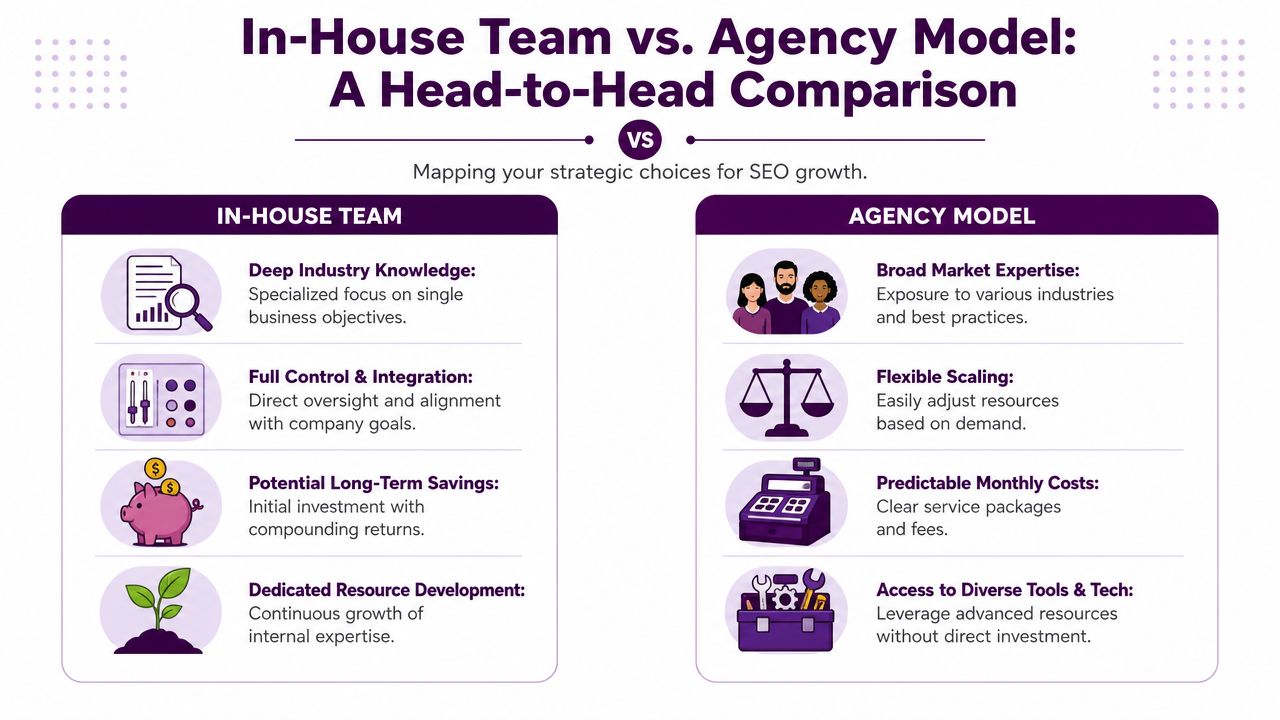
In-House Team vs Agency Model A Head-to-Head Comparison
The cleanest way to compare the two models is to stop asking which is “better” and start asking which one matches the work in front of you.
If your SEO program mainly needs periodic audits, content briefs, and external support, an agency can be a good fit. If your roadmap depends on recurring engineering changes, close coordination with content and product, and fast iteration, the in-house model usually wins.
The business trade-offs that actually matter
Factor | In-House Team | SEO Agency |
|---|---|---|
Cost | Higher commitment, but knowledge stays inside the business | Predictable retainer structure, easier to start |
Speed | Faster feedback loops with product, content, and engineering | Slower when requests move through account layers |
Expertise | Deep knowledge of one business, one site, one buyer journey | Broad pattern recognition across many clients |
Integration | Can join planning, sprint cycles, and launch reviews | Often operates through meetings, documents, and deliverables |
Accountability | Closer connection to pipeline, revenue, and internal priorities | Stronger around scope delivery than internal business ownership |
Cost isn't just what you pay
A lot of CMOs compare salary against retainer and stop there. That's too narrow.
An internal hire costs more than base compensation. There's recruiting, onboarding, management time, tooling, and the slower productivity curve of a new employee learning the business. But agencies also have hidden costs. Recommendations can stall. Context gets lost. Good ideas arrive too late to affect roadmap decisions. Work gets re-explained every quarter because the account team changed.
The less mature your SEO motion is, the more an agency can help you stand up process. The more integrated your search program needs to be, the more expensive distance becomes.
Speed and agility are where in-house teams usually pull ahead
Agencies can move quickly inside their own lane. They're often slower when your lane depends on everyone else.
An internal SEO lead can sit with product marketing, challenge a page template before development starts, and rewrite a brief after hearing new sales objections. That kind of adjustment rarely makes it into a neat monthly deliverable, but it's often where the greatest value is.
The companies that get the most from SEO don't just publish faster. They change direction faster when search demand, product priorities, or SERP layout changes.
Expertise cuts both ways
Agencies usually bring stronger exposure across industries, site types, and edge cases. That breadth matters. They've seen migrations go wrong, content programs stall, and reporting frameworks fail.
Internal teams bring a different kind of expertise. They know the margin profile of product lines, the politics of engineering prioritization, the compliance constraints, and which commercial terms are important. In many businesses, that context is more valuable than a perfect audit.
Accountability is the final separator
Agencies are accountable to a scope. In-house teams are accountable to outcomes.
That distinction sounds subtle until quarterly planning starts. A retained partner can deliver recommendations exactly as contracted and still leave the business unsatisfied. An internal lead usually doesn't get that luxury. They have to work through blockers, negotiate trade-offs, and keep pushing until something ships.
That's why many mature companies use a blended model. Internal ownership. External specialist support when needed.
The Tipping Point When to Build Your In-House SEO Team
The right moment to build doesn't arrive with a dramatic signal. It shows up as repeated operational friction.
The common pattern is this. SEO has already proved it matters, but the current structure can't convert that importance into execution. Recommendations stack up. Product and content teams want more guidance. Leadership asks harder revenue questions. The agency relationship starts feeling useful but insufficient.
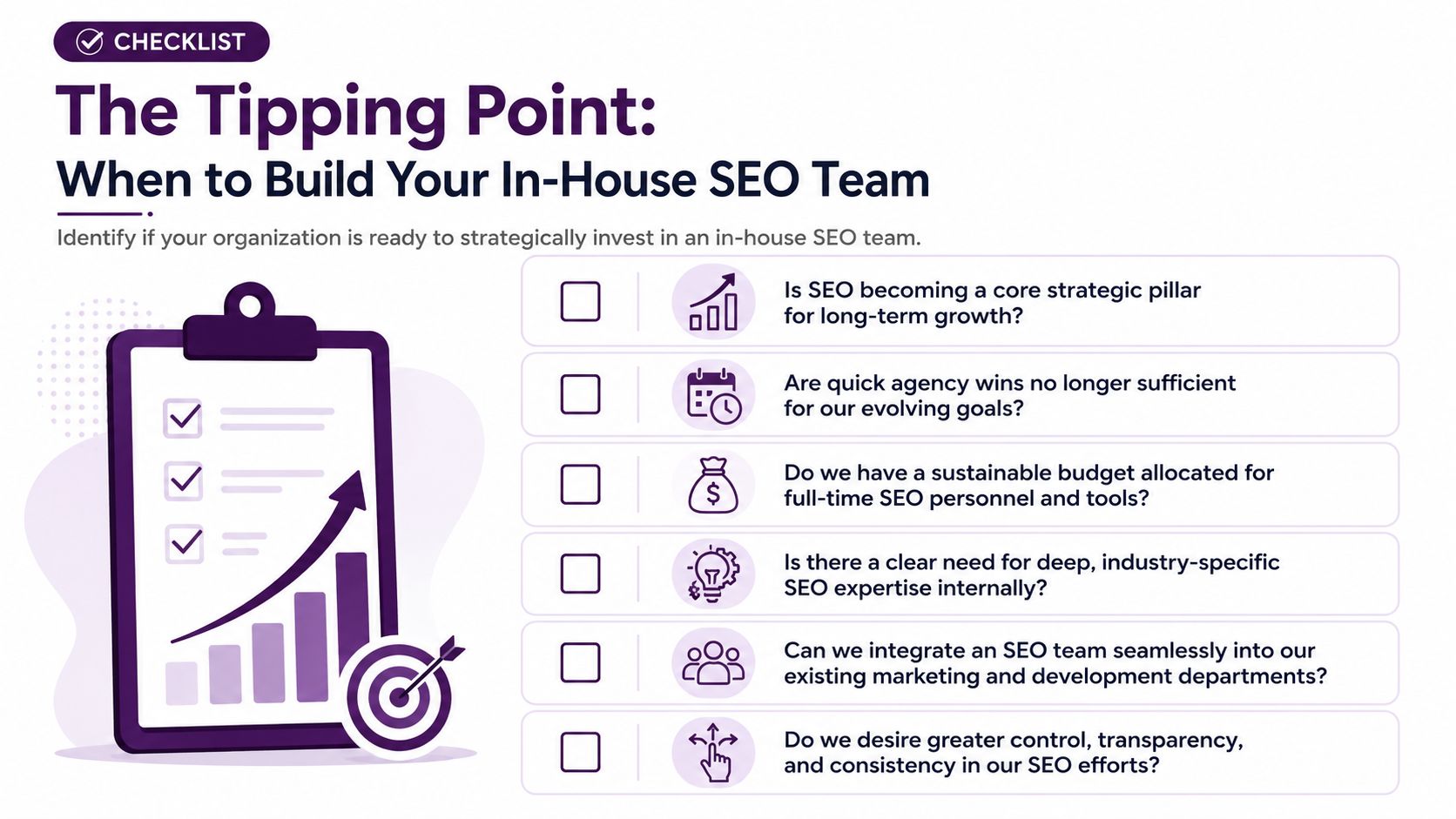
The signals worth paying attention to
Ask yourself these questions:
Is SEO now tied to company strategy? If search affects category visibility, product discovery, or a meaningful share of new demand, it needs direct ownership.
Does the work require weekly cross-functional coordination? If SEO success depends on engineering, UX, product marketing, and editorial alignment, a quarterly agency cadence won't be enough.
Are recommendations going unimplemented? That usually means the problem isn't strategy quality. It's internal advocacy and workflow integration.
Do you need business-specific judgment every day? Generic best practice is helpful. It won't answer whether a faceted navigation change is worth the engineering trade-off for your commercial model.
Is leadership asking for revenue logic, not SEO activity? That's when a dedicated operator becomes far more valuable than outsourced reporting.
Build the case before you build the team
The strongest internal SEO hires usually land after a company sees proof, not promise.
A smart approach is to test a small version of an initiative first. The Growth Memo guidance on building an SEO business case argues for a “visible line from organic traffic to revenue” and recommends shipping a manual MVP to create live proof of concept before requesting major engineering support. That advice is unusually practical. It reduces politics because you're not asking stakeholders to believe. You're asking them to react to evidence.
A useful decision framework
If you can answer “yes” to most of these, the timing is probably right:
Organic growth needs an owner. Not a vendor manager. An owner.
Roadmap dependency is increasing. SEO work now touches templates, taxonomy, internal linking, or core content systems.
You need faster iteration. Waiting for the next reporting cycle costs too much.
Leadership wants commercial accountability. They expect SEO to connect to pipeline or revenue logic.
You're prepared to support the role internally. Hiring without access, authority, and cross-functional backing is how good SEO people fail in good companies.
An in-house team becomes viable when the cost of not integrating SEO exceeds the cost of building the capability.
Assembling Your A-Team Roles and Hiring Priorities
The first hire matters more than the org chart.
Most companies don't need a narrow specialist first. They need someone who can diagnose the site, set direction, speak to executives, brief content, work with engineers, and know when a technical issue is important. In other words, they need a T-shaped operator.
That profile is easy to praise and hard to hire. It also matters for execution. A 2025 in-house SEO study referenced by iPullRank found that 68% of in-house SEOs stall because they lack the ability to pivot between technical audits and content strategy within the same quarter, leading to a 40% drop in project completion rates. Whether you're hiring one person or building a small function, that's the capability gap to solve first.
Hire one person who can carry the program
The best first hire is often an SEO Manager or Head of SEO, depending on company size. Title matters less than scope.
Look for someone who can:
Audit with judgment: They should know the difference between a real blocker and a report that looks alarming but won't change outcomes.
Prioritize ruthlessly: You want a person who can say no to low-impact fixes.
Write and communicate clearly: Internal SEO lives or dies on briefs, tickets, memos, and stakeholder conversations.
Translate across teams: They must be credible with content, engineering, analytics, and leadership.
Operate without perfect conditions: In-house environments are messy. Good operators still move work forward.
A weak first hire often sounds polished but stays abstract. They know terminology, but they can't describe how they got a change shipped, how they handled resistance, or how they decided what not to do.
A strong in-house SEO hire should be able to explain one technical project, one content decision, and one stakeholder conflict in plain business language.
When to add specialists
After the first operator proves where constraints sit, specialist hires become easier to justify.
Technical SEO specialist
Bring this role in when templates, rendering, crawling, indexation, or site architecture issues are shaping performance. This person should be comfortable working with developers and product managers, not just running crawls and exporting findings.
Good interview prompt: ask how they would prioritize a backlog when every issue is labeled “high priority” by a tool.
SEO content strategist
Hire this role when topic authority, content decay, editorial planning, and intent alignment become the main opportunity. The strongest candidates can work from SERP analysis through outline creation and content refresh strategy without turning every keyword into a separate page.
Ask how they decide whether to create, merge, refresh, or delete content.
Digital PR or authority-focused role
This role matters when your site has solid technical health and decent content depth, but struggles to compete on trust and authority for tougher queries. It's less useful when core on-site fundamentals are still weak.
Ask for examples of how they earned relevance, not just links.
Hiring mistakes that slow teams down
Three mistakes show up repeatedly:
Over-hiring specialists too early: You end up with expertise silos and nobody tying the work together.
Hiring only for technical depth: The person finds issues but can't build momentum across the organization.
Treating SEO as content support only: That usually leaves the role underpowered and reactive.
The early team should look more like a compact revenue function than a loose collection of channel tasks.
The Operating System Processes KPIs and Tooling
A good in-house SEO team needs an operating system. Without one, work gets trapped in audits, dashboards, and Slack threads.
The strongest programs run on three things. A planning cadence the business respects. KPIs that leadership can connect to commercial outcomes. Tooling that reduces time spent stitching together data from disconnected systems.
Processes that keep SEO from becoming a ticket queue
A workable operating model usually includes:
A recurring technical review: Not a constant flood of issues. A disciplined review of what affects crawlability, indexation, templates, internal links, page experience, and content discoverability.
A content workflow tied to intent: Research, brief, draft, review, publish, refresh. If SEO only appears at the keyword stage, quality drops.
A roadmap meeting with real stakeholders: Product, engineering, content, and analytics need shared visibility into what's being requested and why.
A reporting rhythm for executives: Monthly or quarterly, depending on the business. The key is that reporting translates activity into business relevance.
One practical content discipline still gets neglected by internal teams under pressure: avoiding over-optimization when scaling production. If your editors need a concise reference, StoryCV's keyword stuffing advice is a useful reminder that content should match intent and readability, not chase awkward repetition.
KPIs that belong in the boardroom
Most SEO dashboards are too detailed for leadership and too shallow for operators. Separate them.
For the executive layer, use metrics that answer commercial questions:
Organic contribution to pipeline or revenue
Non-branded visibility for strategic categories
Share of SERP presence for priority topics
Performance of conversion-focused pages
Implementation progress on high-impact initiatives
For the working team, track supporting indicators such as indexing health, content refresh status, template issues, internal linking improvements, and page-level opportunity sets.
If you need a framework for organizing those conversations and tying them back to the right stakeholders, this guide on what an SEO platform is and how data-driven teams use one is a practical reference.
Engineering buy-in is a reporting problem as much as a prioritization problem
A lot of SEO leaders assume engineering pushback means developers don't care. Usually, they care. They just don't accept the framing.
A 2025 analysis cited by Search Engine Journal found that in-house SEOs who framed recommendations around risk of revenue loss secured 3x more engineering buy-in than those using traffic growth arguments. That tracks with what works in practice. “This may increase traffic” is easy to defer. “If this template suppresses discovery for high-intent pages, we're exposing revenue” gets attention.
Report SEO like an operator. State the issue, the business risk, the decision needed, the owner, and the expected timeframe.
Tooling should reduce ambiguity
The wrong stack creates noise. The right one shortens the path from question to action.
At minimum, the team needs analytics, search performance data, rank tracking, site audit capability, project management, and a place to document decisions. More important than the category list is whether the stack helps answer practical questions quickly. Why did visibility drop? Which page group should be refreshed first? What technical issue is worth a sprint ticket?
If your tools can't support that level of prioritization, the team will spend too much time collecting evidence and not enough time acting on it.
Your First 90 Days Onboarding and Proving Value
The first quarter sets the tone for everything that follows.
A new in-house SEO leader doesn't need to prove brilliance in the first few weeks. They need to prove judgment. That means learning the business fast, finding what's blocked, shipping something useful, and creating a reporting pattern leadership trusts.
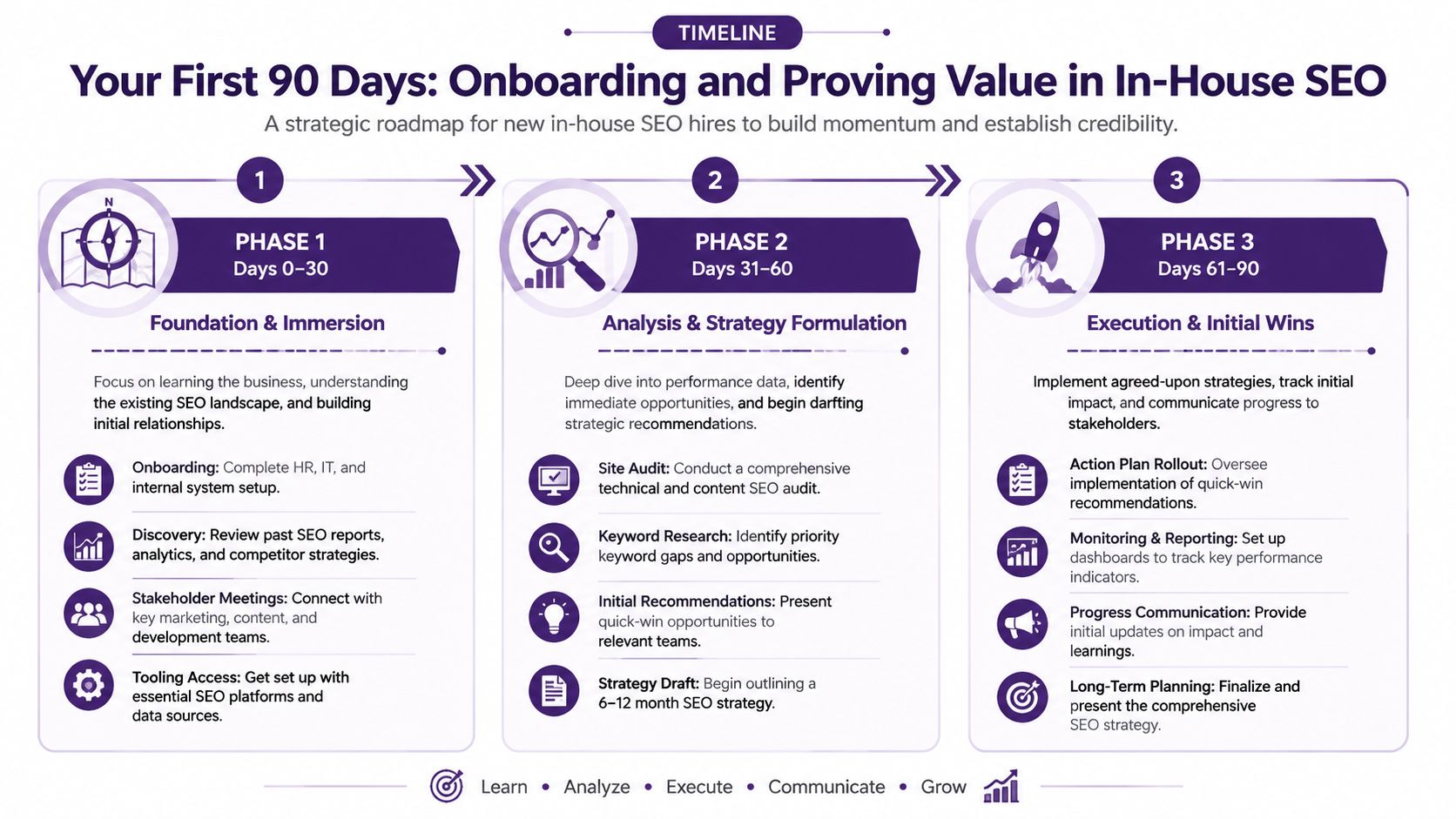
Days 1 through 30
Start with access, context, and interviews.
Review analytics, search performance, prior audits, active roadmaps, content workflows, and any unresolved technical tickets. Meet leaders across content, product, engineering, lifecycle, and sales. Ask where organic search already helps and where they think it fails.
A modern audit also needs a wider lens. According to SEO Sherpa's SEO statistics roundup, in 2025, about 58–60% of Google searches were zero-click. That changes the audit brief immediately. A new hire needs to assess not only rankings and landing pages, but also visibility in SERP features, snippets, and answer formats.
Days 31 through 60
This is the window for quick wins and strategic direction.
The best quick wins are visible, low-friction, and business-relevant. That might mean improving title and metadata on conversion pages, fixing internal links to key commercial templates, refreshing content that already sits near the top of search results, or resolving indexation issues on high-value page sets.
At the same time, the hire should draft a medium-term roadmap. Not a giant wish list. A prioritized plan with clear owners, dependencies, and expected business rationale.
Days 61 through 90
By this stage, the new lead should have one larger initiative moving and a reporting cadence in place.
That report should be simple enough for non-specialists to follow. It should show what changed, why it mattered, what got blocked, and what decisions are needed next. This resource on how to explain SEO metrics to non-technical clients is also useful internally because executives often need the same clarity clients do.
Early credibility comes from shipping one meaningful improvement and explaining it well, not from producing the most detailed audit in company history.
Conclusion Building for the Long Term
Building an in-house SEO team is a decision to own a growth channel instead of supervising it from a distance.
That ownership pays off when the team is embedded where decisions happen. It fails when leadership hires for SEO but doesn't create access, authority, or accountability. The most common mistakes are predictable: approving headcount without executive backing, treating SEO like a service desk for isolated requests, and reporting activity without linking it to business impact.
The companies that get this right don't expect SEO to work by magic. They give it structure. They hire people who can think across content, technical performance, and business trade-offs. They ask for commercial logic, not vanity metrics. They make room for SEO in planning, not just reporting.
If you're weighing the move now, the core question isn't whether an agency or an internal team is better in theory. It's whether your business has reached the point where search visibility needs direct operational ownership.
For many companies, that point arrives earlier than leadership expects.
If you want a clearer way to connect rankings, technical issues, backlinks, and organic performance in one place, Keyword Kick is worth a look. It helps in-house teams and agencies turn scattered SEO data into prioritized actions, which is exactly what growing teams need when they're trying to prove value and move faster.