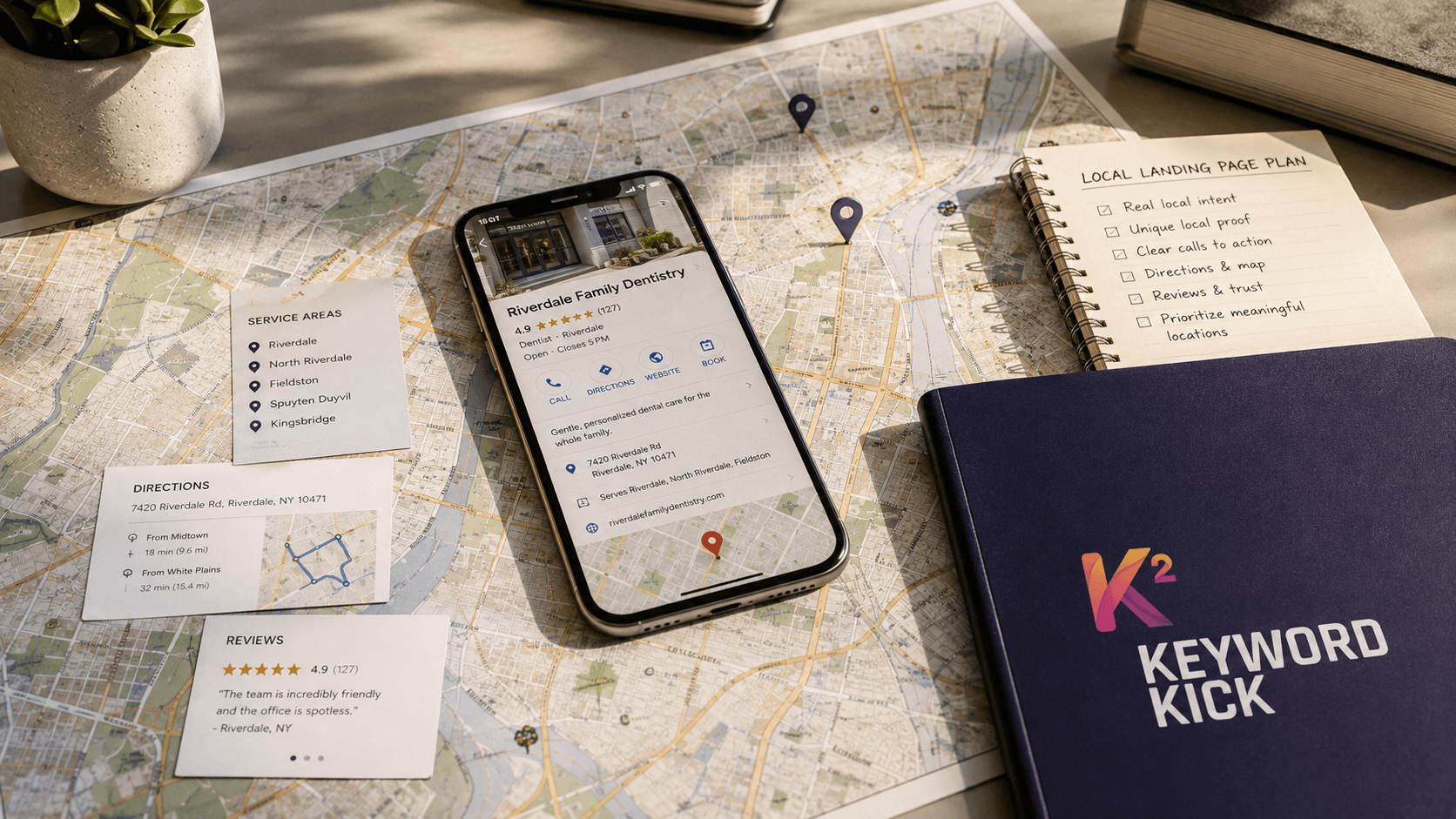
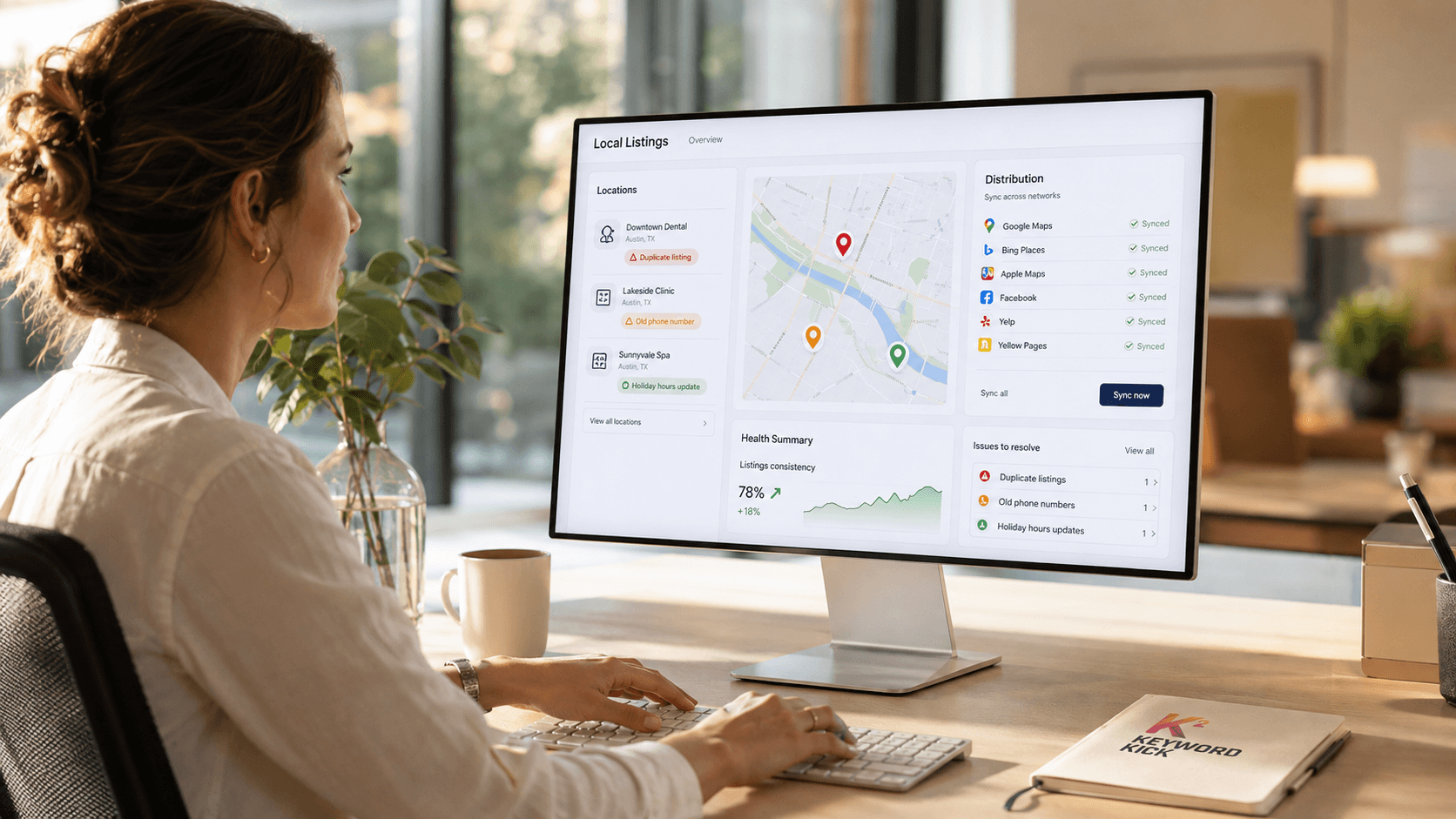
A client calls because Google Maps shows an old phone number. Another location has the right address but the wrong holiday hours. A third appears twice, with one profile collecting reviews and the other sending customers to a closed office. Meanwhile, a competitor with a weaker website keeps winning local discovery.
That's the operational reality behind local listings management. Business information spreads across search engines, maps, review platforms, aggregators, social networks, and industry directories. Keeping one Google Business Profile accurate isn't enough when customers and AI-driven search systems evaluate the broader footprint.
Why Local Listings Management Drives Revenue
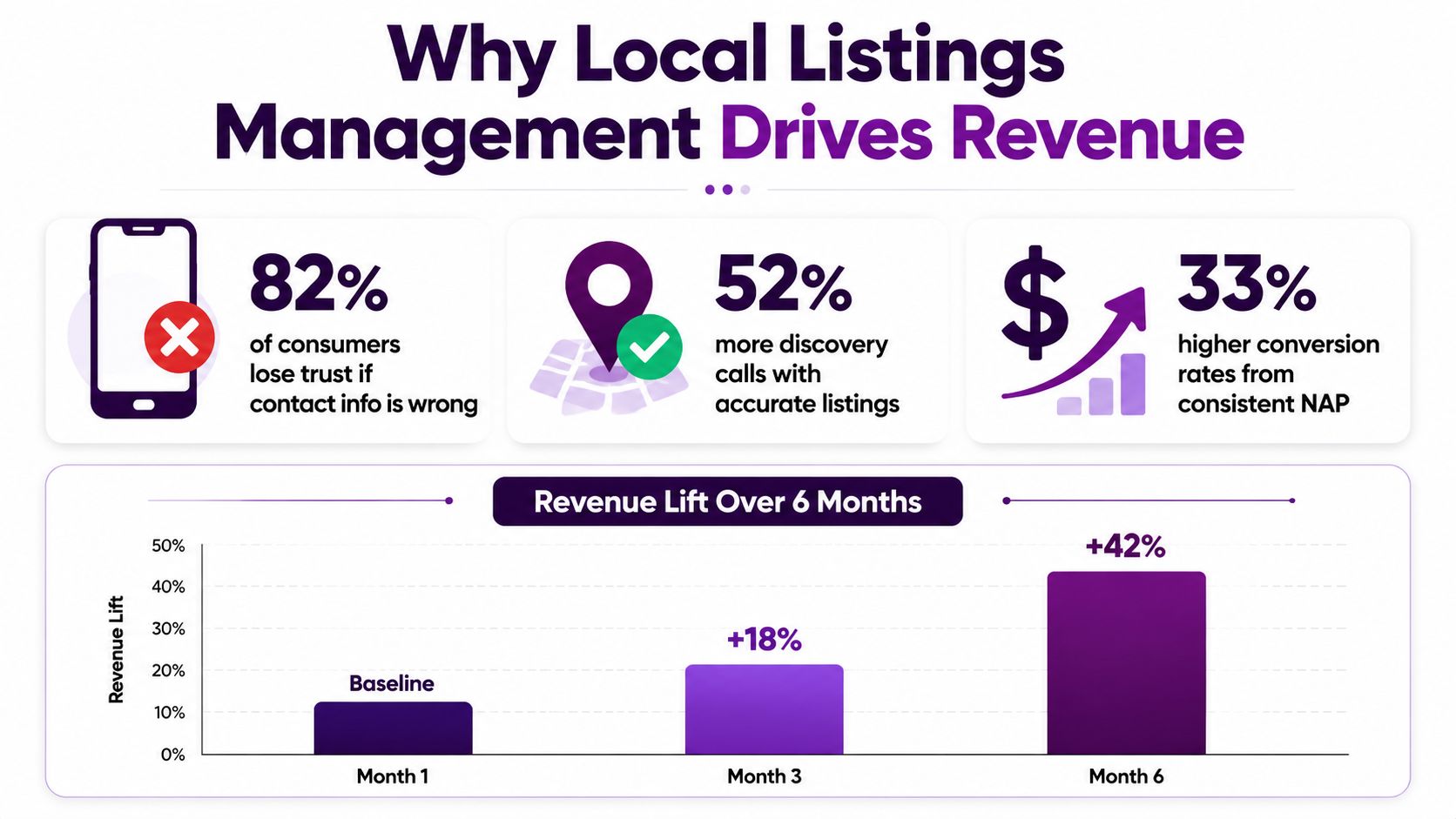
A listing error looks small inside an agency dashboard. To a customer, it can block the next action entirely. A wrong phone number prevents a call, an outdated address creates a wasted trip, and incomplete service details make a competitor appear more suitable. BrightLocal reported that 94% of consumers had used a business information site to find local business details, while 85% had encountered incorrect or incomplete information on business listings during the same period. The report also found that incorrect information would stop 63% of consumers from using a business, and 89% had used one of Google's search functions to find local business information. (BrightLocal consumer trust findings)
The commercial implication is straightforward. Listings management protects the path from discovery to action. It also supports broader work covered in local search marketing, because rankings and content can't compensate for a customer seeing contradictory business information at the moment they're ready to choose.
Breadth creates more discovery opportunities
The strongest available benchmark connects distribution breadth with local performance. A 2025 Moz study found that listings distributed across 10 or more sites delivered an average 80% improvement in local visibility on Google and a 67% increase in consumer actions. When distribution expanded to 30 or more directories, user actions increased by more than 136%. The same study linked profile completeness with a 69% lift in website clicks. (Moz listings management study summary)
These figures shouldn't be treated as a promise for every client. They're a decision signal. A business with a thin, incomplete presence may have more upside from accurate distribution than a business that already dominates its relevant ecosystem. The agency task is to identify where breadth adds value, then maintain the data rather than pursuing directory volume for its own sake.
Quality makes distribution useful
A large citation footprint with conflicting details creates operational noise. A smaller, well-maintained footprint can be more useful than dozens of abandoned profiles. Profile completeness matters because customers need more than a name, address, and phone number. They may need a booking path, service information, accessibility details, or current hours before they contact the business.
The revenue case therefore has two parts: be present where customers search, and make every meaningful profile trustworthy enough to support action. Agencies that report only citation counts miss the outcome. Strong reporting connects listing health to calls, direction requests, website visits, bookings, and other customer actions.
Running a Complete Citation Audit
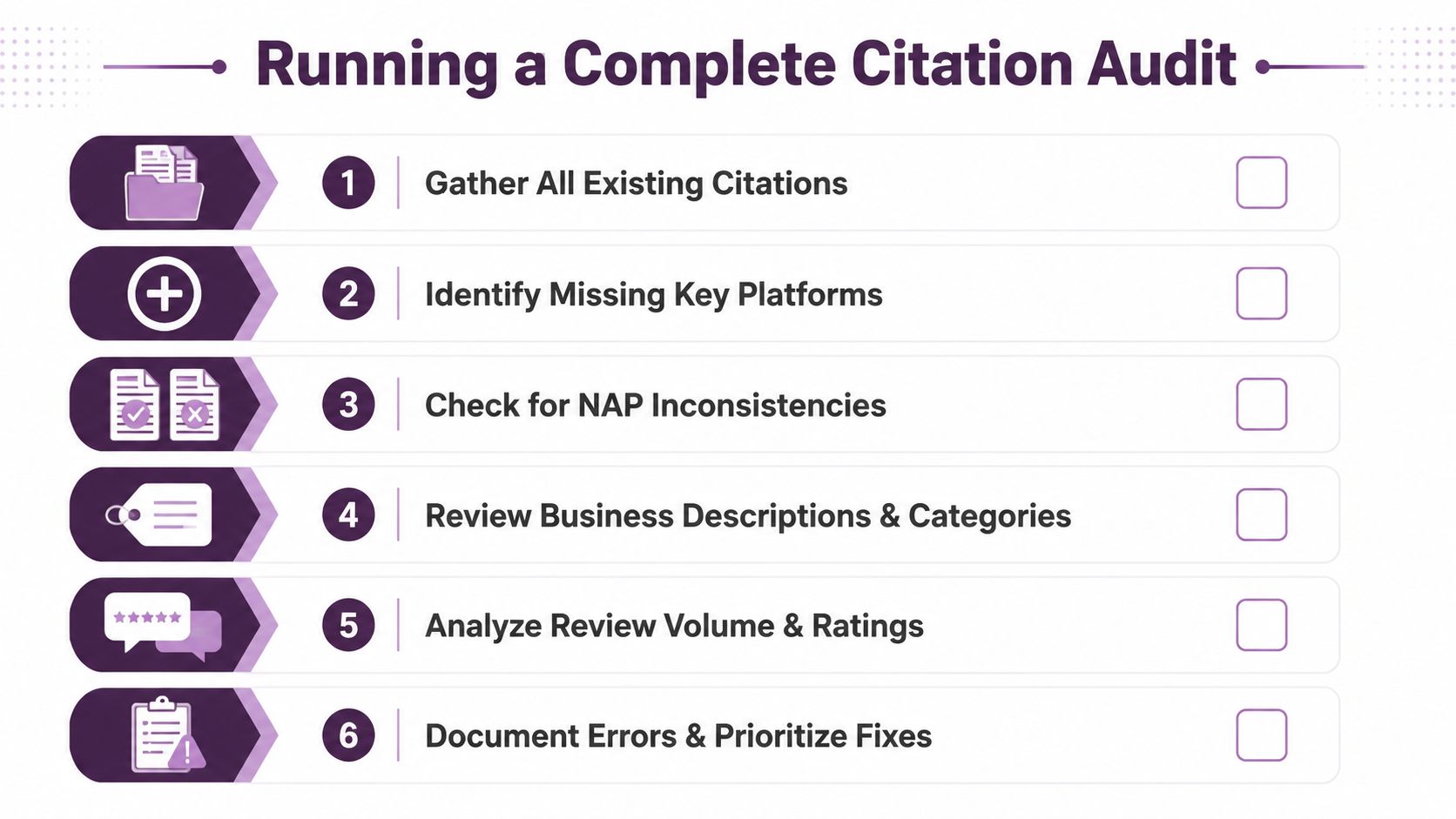
A location can have accurate information on its main profile and still appear incorrectly across search, map, review, and industry platforms. Before editing anything, build an inventory for every branch, practitioner, storefront, and service-area operation. Record which profile is authoritative, where duplicates exist, and which sources may be distributing outdated data.
Start with discovery, not cleanup
Search each location by business name, phone number, address, former brand name, and known variations. Review:
Core platforms: Google Business Profile, Bing Places, and Apple Maps.
Review ecosystems: Yelp and other platforms used by the client's customers.
Industry directories: Healthcare, legal, home services, hospitality, education, and other relevant verticals.
Regional sources: Chambers, local publishers, community directories, and city-focused platforms.
Data distribution sources: Aggregators and publisher networks that may create downstream records.
Create a location-level record with the profile URL, claimed status, business name, address, phone, website, category, hours, review activity, duplicate risk, and last verified date. Manual searches expose useful edge cases for smaller accounts. At scale, use a scanning platform to accelerate discovery, then manually confirm high-impact records and unusual matches.
Treat the spreadsheet or database as an evidence log, not the source of truth. The source of truth should be the client-approved business record. Compare every platform against it, and retain notes showing why a listing was merged, suppressed, corrected, or left unchanged.
Fix duplicates before inconsistencies
Use this sequence: find duplicates first, isolate NAP inconsistencies second, and identify missing high-value citations third. Duplicate records can split reviews and engagement, dilute local signals, and leave search engines uncertain about which profile represents the location. Correcting every field on a duplicate before suppressing it wastes work and may strengthen the wrong record.
After duplicate review, compare the business name, address, and phone number across authoritative listings. Formatting differences do not automatically indicate an error. Separate harmless variation from a different address, tracking number, service area, or operating status. For rebrands and relocations, document the transition so the team does not “correct” an intentional change back to obsolete information.
Prioritize by business impact
Rank findings by customer risk and platform authority:
Immediate risks: Wrong phone, a closed location still marked open, a duplicate Google profile, or an incorrect address.
High-value corrections: Authoritative map and search profiles, major review platforms, and directories used in the client's industry.
Conversion gaps: Missing website, booking link, services, attributes, photos, or current hours.
Coverage opportunities: Relevant niche and regional listings that support discovery or reputation.
A distribution study reported that subscribing to listing distribution improved overall listing accuracy, with the average accuracy score rising from 22% to 60%, an increase of 172%. (Citation distribution research.pdf)) Centralized distribution can improve consistency, but it does not replace audit judgment. Automation pushes records quickly. If the master data is wrong, it spreads that error just as quickly.
Use a local SEO checklist to keep onboarding audits consistent, then schedule manual QA for duplicates, rebrands, relocations, and complex service-area businesses. A one-time cleanup creates a baseline. Ongoing review keeps that baseline usable as platforms, profiles, and search surfaces change.
Claiming and Optimizing Every Profile
Claiming a profile gives the agency control. It doesn't automatically make the profile useful. Verification can fail because the client no longer controls an old email address, a postcard goes to an outdated location, a phone route isn't staffed, or a platform interprets a service-area business differently from a storefront.
Create an access register before verification begins. Store the platform, account owner, verification status, recovery contact, location ID, and escalation owner. Don't let credentials live in a former employee's inbox or inside an undocumented client account. Multi-location work needs clear ownership, because one missed verification can hold up an otherwise complete rollout.
Build the profile around search intent
Start with the approved business name, accurate address or service area, primary phone, website, hours, and categories. Then complete the fields that answer practical customer questions:
Restaurants: Menu URL, ordering and pickup options, reservation link, payment methods, dietary information, accessibility details, and current hours.
Healthcare practices: Appointment link, accepted services, accessibility information, practitioner details where supported, payment information, and holiday hours.
Professional services: Consultation or appointment path, service descriptions, service areas, credentials where appropriate, and contact preferences.
Attributes such as accessibility, pickup options, payment methods, appointment links, sustainability indicators, and real-time hours are increasingly surfaced across search and map experiences, according to current market coverage of local listings software. (Local listings management market coverage) Prioritize attributes that answer a real customer question. Don't fill a field with a guess just to make the completion indicator look better.
Write for humans and machine interpretation
A strong description states what the business does, who it serves, where it operates, and what action a customer can take. Use plain language and specific services instead of keyword strings. Keep the core facts aligned across platforms, while adapting length and formatting to each publisher's rules.
Categories deserve careful review because they shape relevance. Choose the most precise primary category available, then add secondary categories only when they represent genuine services. A medical practice shouldn't add every adjacent specialty, and a contractor shouldn't select broad categories that obscure its main work.
The relationship between GBP and local search signals is easier to understand when you evaluate the profile as one part of a wider local entity, rather than as an isolated page. (GBP and local search signals) That same principle applies to secondary platforms, including less obvious sources covered in business listings on Yahoo. Claim the profile, complete the useful fields, and establish a review process for edits that platforms or the public may introduce later.
Choosing the Right Listing Management Tools
The best tool is the one that fits the agency's operating model. A platform that works for a handful of locations may become restrictive when clients need custom fields, location-level approvals, API access, or white-label reporting. Conversely, an enterprise system can create unnecessary cost and process overhead for a small portfolio.
Evaluate tools against the failure points that consume agency time:
Dashboard usability: Can a manager filter by client, region, location, error type, and status?
Duplicate suppression: Does the platform identify likely duplicates, support suppression workflows, and show what happened after submission?
Publisher coverage: Does its network include the directories that matter for each client's vertical and geography?
Reporting: Can the agency export client-ready reports without manually rebuilding every chart?
Integrations: Can the data connect with rank tracking, reputation tools, analytics, and internal reporting?
Commercial fit: Does the pricing model scale predictably by location, client, user, or feature?
Compare platforms by operational use
Tool | Best For | Multi-Location Support | Duplicate Suppression | White-Label Reporting |
|---|---|---|---|---|
BrightLocal | Agencies needing local SEO research, audits, and reporting | Strong for agency workflows, depending on plan and setup | Useful audit and monitoring workflows, with manual judgment still required | Strong agency reporting orientation |
Yext | Brands needing structured data distribution across a broad publisher network | Strong enterprise and multi-location management | Strong workflow potential for suppression and data control | Available through agency and enterprise workflows |
Moz Local | Businesses prioritizing core listing distribution and data consistency | Suitable for distributed location management | Supports listing cleanup workflows, with platform-specific limitations | Reporting depends on account configuration |
Whitespark | Agencies focused on citation discovery, cleanup, and local search research | Better suited to research-led workflows than centralized enterprise operations | Strong citation-finding and cleanup support, with human review | Useful exports and reporting, depending on service |
Semrush Listing Management | Teams already using Semrush for broader SEO operations | Designed for centralized location distribution | Supports monitoring and correction workflows | Fits broader Semrush reporting environments |
Treat this table as a starting framework, not a permanent ranking. Publisher relationships, pricing, feature limits, and interface behavior change. Run a pilot with a messy client account, not a clean demo account. Test duplicate handling, approval workflows, update latency, export quality, and the effort required to explain unresolved issues to a client.
A distribution platform reduces repetitive edits. It doesn't replace an agency's QA process. The critical question is whether the tool makes exceptions visible, assigns ownership, and preserves an audit trail when a publisher rejects or alters an update.
Managing Listings in the AI Search Era
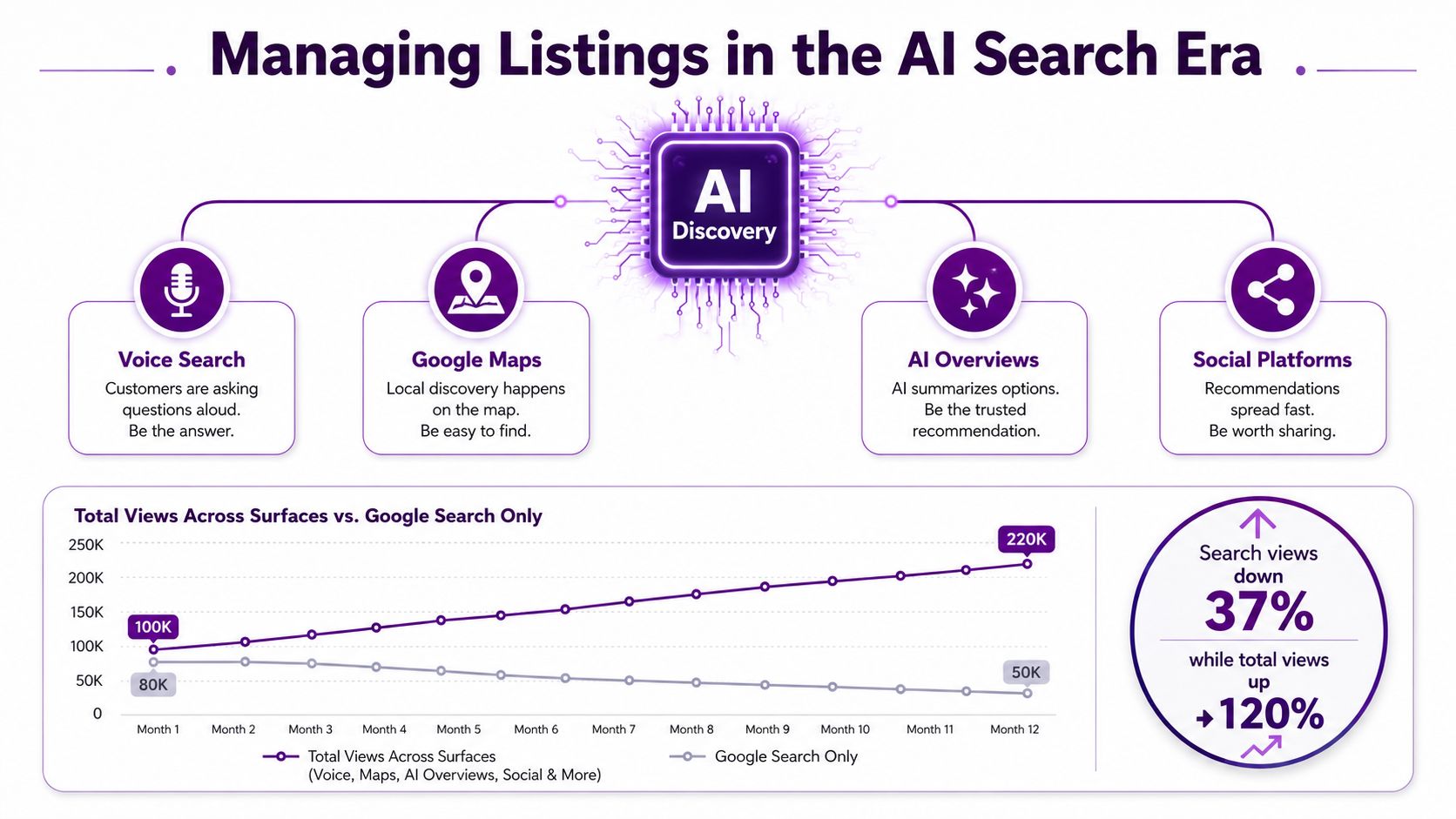
Local discovery no longer happens in one clean funnel. A customer may see a business in Google Search, check Maps for directions, consult Yelp for reviews, ask an AI assistant for options, and visit an industry directory before calling. Agencies that optimize only the most familiar surface leave gaps in the evidence those systems use to understand the business.
BrightLocal's Q1 2026 consumer data illustrates the fragmentation. Search views dipped 3.7%, yet total views across Search and Maps rose 8.3% year over year, while clicks rose 7.4%. (BrightLocal 2026 local search analysis) The lesson isn't that Google Search stopped mattering. It's that a Search-only report can hide activity moving through Maps and other discovery paths.
Use a source hierarchy, not one universal record
LLMs use the web as a secondary discovery layer and can draw broader reputation signals from platforms such as Yelp and industry-specific sites. That doesn't mean every channel should contain a radically different business identity. It means agencies need a controlled way to handle channel-specific fields.
Keep these elements stable everywhere:
Official business identity and location.
Primary contact routes.
Operating status and core hours.
Website and appointment destinations.
Main categories and services.
Allow channel-specific optimization for fields such as menu links, booking formats, service taxonomies, accessibility attributes, or platform-specific descriptions. Document the reason for every intentional variation. Without that record, a future update can “correct” a useful adaptation and reintroduce confusion.
Prioritize sources by influence and volatility
Give human attention to platforms that combine high customer use, strong reputation influence, and frequent data changes. Automate stable distribution for lower-priority publishers, then sample those records during scheduled audits. Escalate conflicts when two authoritative sources disagree, when a duplicate appears, or when an AI-facing platform repeatedly surfaces incorrect information.
Broader coverage only helps when the agency knows which sources deserve trust, which need monitoring, and which can safely run through syndication.
The operational shift is from “How many listings do we have?” to “Which sources support discovery, confidence, and conversion for this client?” That framework keeps agencies from spending equal effort on every directory while still protecting the wider data ecosystem.
Building an Ongoing Maintenance Cadence
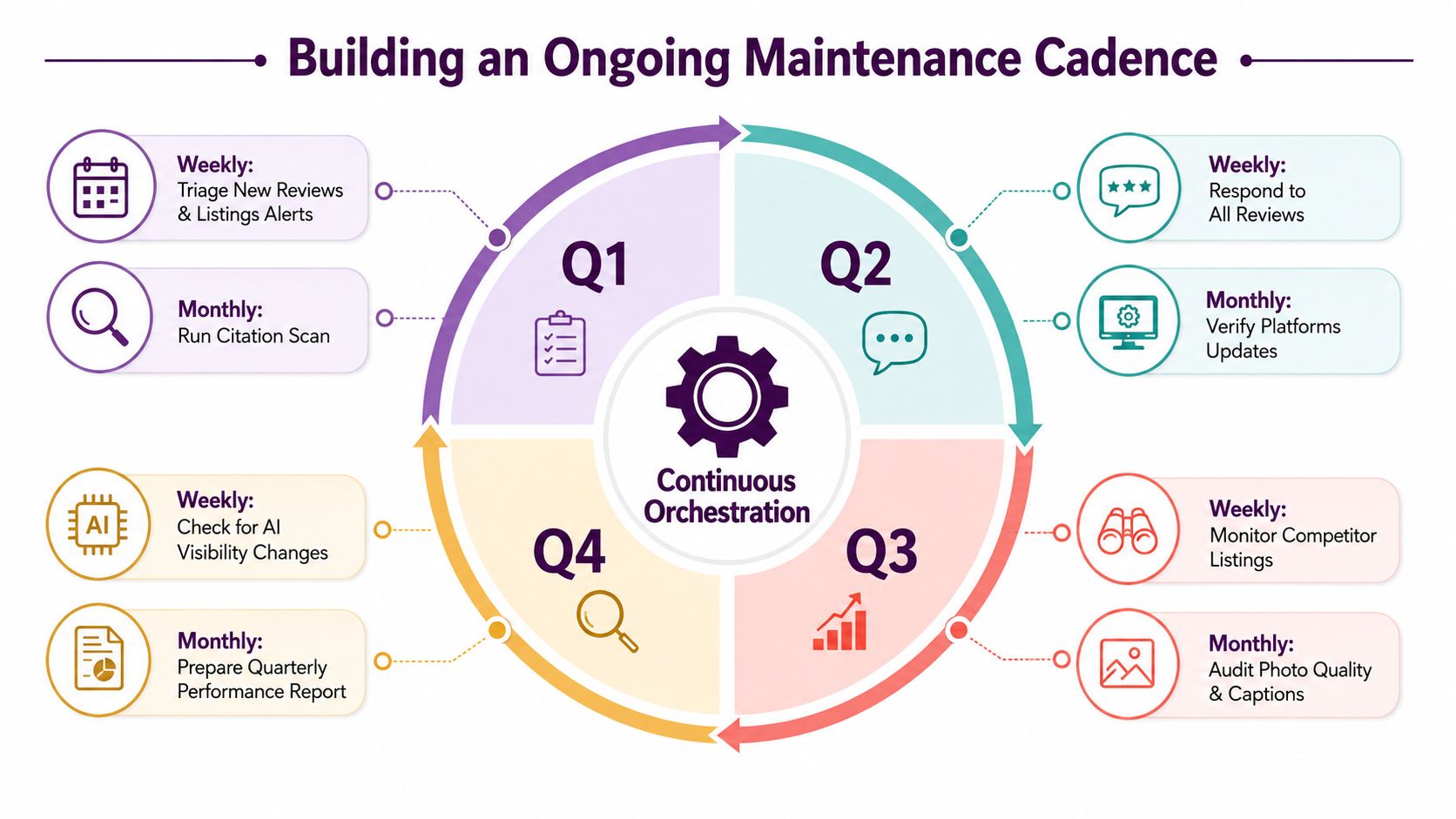
A cleaned listing can become inaccurate after a rebrand, holiday-hours change, ownership transition, new service, platform edit, or duplicate creation. At scale, agencies need a maintenance cadence that separates routine verification from incidents requiring immediate intervention. The operating model should support continuous data orchestration across search, map, review, and AI-driven discovery surfaces.
Weekly triage catches customer-facing problems
Review alerts, publisher notifications, suggested edits, new duplicates, and client-submitted changes every week. Route a wrong phone number, incorrect open status, or location-level suspension to an urgent queue. A missing secondary attribute or low-priority directory correction can wait for the standard workflow.
Assign each issue to a location and an owner. Record the source, detected value, approved value, action taken, publisher response, and next verification date. This record prevents a common agency failure: someone “fixes” an issue in a chat thread, but no one confirms whether the platform accepted the change.
Monthly QA measures health
Run a citation scan each month for priority locations. Review:
Accuracy score: The proportion of checked fields matching the approved record.
NAP consistency: Whether name, address, and phone values align across priority sources.
Duplicate status: New suspected duplicates, suppressions submitted, and unresolved records.
Profile completeness: Completion of relevant fields, rather than generic platform indicators.
Consumer actions: Calls, direction requests, website clicks, bookings, or other tracked actions when the platform provides them.
Earlier distribution research reported a substantial accuracy improvement after centralized syndication, but distribution alone is not the client outcome. Report which records were corrected, which errors remain, and how listing actions relate to customer behavior.
Quarterly and annual reviews protect the retainer
Every quarter, reassess platform relevance, industry coverage, competitor changes, photos, categories, services, and location priorities. Check whether human effort still goes to sources that influence customers. At the annual strategy review, revisit the source hierarchy, reporting goals, access controls, and escalation policy.
Inactive listings can drift. The Moz listings management study found that inactive local listings were inaccurate about 8% of the time, while audits of businesses left unmanaged for five years often uncovered 15 to 25 NAP inconsistencies. These findings support continuous reconciliation, not equal attention across every platform. Set the cadence according to business risk, source volatility, and customer impact.
Common Mistakes That Undermine Local Visibility
The most expensive mistake is treating every directory as equally important. Agencies then spend hours correcting low-impact profiles while an industry platform, map service, or major review source carries an outdated phone number. Prioritization beats raw citation volume.
A second failure is ignoring niche sources. A professional practice, restaurant, home service company, and healthcare provider don't share the same discovery ecosystem. Industry relevance often matters more than adding another generic directory, especially when customers use specialist platforms to compare providers.
Duplicate suppression cannot be postponed
Mergers, relocations, rebrands, and phone changes create duplicate risk. Leaving old profiles live can split reviews, confuse customers, and give search systems conflicting entity signals. Suppress or merge duplicates before broad distribution, then verify that the surviving profile contains the approved record.
Review response also belongs in the operating model. Listings management controls the facts customers see, while reputation workflows address what customers say. Neglecting reviews leaves a complete profile looking inactive or untrustworthy, even when the NAP data is correct.
The set-and-forget model fails because business data changes and platforms accept edits. Build an escalation policy, maintain a source-of-truth record, and schedule audits around business risk. The agencies that retain clients are the ones that show what changed, what remains exposed, and why the next maintenance cycle matters.
Keyword Kick helps agencies turn fragmented SEO and local visibility signals into prioritized actions through its K² AI Agent, reporting workspace, audits, and competitive analysis tools. Use Keyword Kick to connect listing-related performance questions with broader search data, identify what needs attention first, and give clients a clearer account of ongoing growth work.