

You've got a meeting in ten minutes, the team is asking why competitors keep showing up everywhere, and someone drops the acronym SOV into the conversation like everyone should already know it. In marketing, that usually means share of voice, but in other fields it can mean something completely different. That's why a context-first answer matters, especially when the same three letters can point to language structure, construction paperwork, control valves, or brand visibility.
If you're trying to figure out what does SOV mean and you need the marketing version fast, the useful answer is this, SOV is a visibility metric. It helps you see how much of the conversation, attention, or search presence your brand owns compared with competitors. If you want a broader view of how competitive analysis fits into SEO planning, this guide on competitive intelligence for SEO gives a useful strategic backdrop.
Why SOV is Important for Your Marketing Strategy
A brand can spend money all month and still feel invisible. Ads run, posts go live, search rankings move a little, but the competitor down the street keeps appearing more often in feeds, search results, and conversations. A quick scenario makes the point clear. If your team publishes steadily but buyers keep noticing someone else first, Share of Voice shows whether your activity is turning into real presence.
In business, SOV is most often shorthand for share of voice, a measure of a brand's visibility relative to competitors, and Cambridge defines the abbreviation that way in its dictionary entry for SOV (Cambridge Dictionary). The concept matters because it turns a fuzzy question, “Are we being seen?”, into something teams can track over time. When visibility is low, the answer is not always “spend more.” Sometimes the problem is message clarity, channel mix, or weak competitive positioning.
A second reason SOV matters is that it gives teams a shared language. Media buyers, SEO leads, and brand marketers often look at separate dashboards, but SOV gives them one competitive frame. That makes it easier to decide whether a brand should push paid search harder, improve organic coverage, or raise awareness through PR and social. If you are working through that kind of diagnostic, a practical starting point is to compare your brand with competitors in the same category and ask where attention is leaking. A close look at competitive intelligence for SEO helps teams turn that comparison into a clearer plan.
For marketers in smaller markets, like teams working in digital marketing in New Zealand, this matters even more because share gains are easier to spot when you know exactly where the market is crowded. SOV does not replace sales data, but it does show whether your brand is building the kind of visibility that can support growth later. In other words, it is a leading signal, not a vanity metric.
Practical rule: if your brand is everywhere you publish but still missing from the places buyers look first, your SOV is probably weaker than your activity suggests.
Understanding SOV Across Industries
The fastest way to answer what does SOV mean is to ask, “Which industry are we in?” The acronym changes meaning depending on context, and that's why searchers often get mixed results. Merriam-Webster's entry for SOV shows that the abbreviation can point to several unrelated terms, while marketing and construction each use it for a very specific business meaning (Merriam-Webster).
Start with the field, not the acronym
In linguistics, SOV means subject–object–verb, a sentence order where the subject comes first, the object second, and the verb last. It is one of the six logically possible basic orders for transitive clauses, and about 45% of the world's languages use it, making it the most common sentence pattern globally (Subject–object–verb word order). That's why “Sam apples ate” makes sense as an illustration of structure, even though English doesn't normally use that pattern.
In control and instrumentation, SOV usually means solenoid operated valve, an electromechanical pilot valve that moves air through an actuator line (Tango Valve). In plain terms, it's the part that helps an air signal become a switching action. In construction finance, SOV means schedule of values, an itemized breakdown of contract work that supports billing and progress certification (Raken).

Use a simple decision tree
If the conversation is about grammar, you're in linguistics. If it's about valves or shutdown systems, it's instrumentation. If it's about invoices, retention, and line items, it's construction finance. If it's about visibility, impressions, mentions, or search presence, it's marketing.
That last meaning is the one most care about because it connects directly to competitive visibility. A marketer doesn't need the valve definition to plan a search campaign, and a project manager doesn't need the linguistic one to approve a pay application. Context saves time, and it prevents teams from talking past each other when the acronym appears in dashboards, vendor calls, or reports.
Core Concept of Share of Voice in Marketing
Share of Voice is the share of category attention your brand owns compared with competitors. In practice, that attention can come from ads, organic search, mentions, impressions, or other visibility signals, depending on the channel you're measuring. The point is not just to count activity, but to understand how much of the available spotlight belongs to your brand.
At a basic level, SOV answers a simple question, “When customers scan the market, how often do they encounter us versus someone else?” That's why the metric matters across paid and organic channels. A brand can have strong creative and still lose share if the market is louder, more visible, or more consistent.
Break the metric into parts
SOV is easiest to understand when you separate it into visibility inputs and competitive context. Visibility inputs can include brand mentions, ad impressions, search visibility, or media coverage. Competitive context is the total market activity around the same audience or keyword set. Without that comparison, a brand might think it's growing just because volume is up, even if competitors are growing faster.
A useful SOV model always defines the category first. If you don't know what market you're measuring, the percentage won't mean much.
The metric also helps teams avoid confusing raw reach with market presence. A campaign can generate plenty of impressions in isolation, but if competitors are winning the same audience more consistently, your share may still be small. That's why SOV works best as a comparative measure, not a standalone vanity number.
In marketing meetings, this distinction matters because SOV helps you compare channels that don't behave the same way. Paid search, PR, social, and SEO each produce different signals, but all of them contribute to whether your brand feels present in the category. When teams combine those signals thoughtfully, they get a cleaner view of mindshare and competitive strength.
How SOV Differs from Similar Metrics
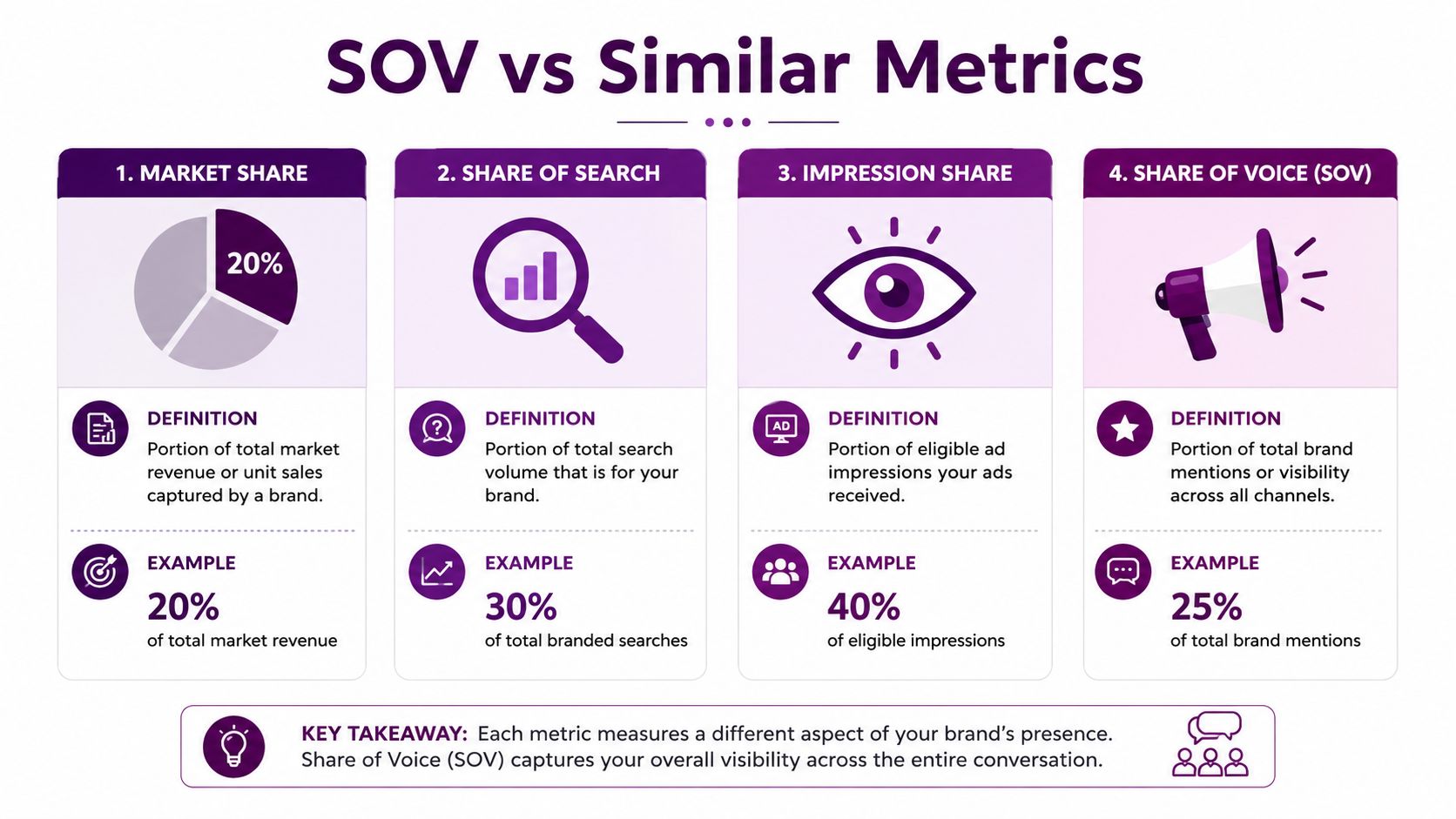
Marketers often lump SOV together with other visibility metrics, but they answer different questions. Market share is about actual sales. Share of search is about branded query demand. Impression share is about how often ads appear when they were eligible to show. Share of Voice is broader, because it tracks overall brand visibility relative to rivals.
That distinction matters because the wrong metric can send a team in the wrong direction. If leadership wants to know whether revenue is growing, market share is the right lens. If SEO wants to know whether demand for branded queries is rising, share of search is more useful. If paid media wants to know whether ads are winning auction opportunities, impression share is the better fit.
Compare the metrics by business question
Use SOV when the question is about mindshare and competitive presence. Use market share when the question is about commercial outcomes. Use share of search when the question is about brand demand created by search behavior. Use impression share when the question is about paid visibility inside a limited auction environment.
This is also why SOV can feel more strategic than narrow channel metrics. It connects different forms of visibility without pretending they're identical. A brand can improve its paid presence while still losing organic ground, or gain mentions in social while staying weak in search. SOV helps expose those imbalances.
A practical way to think about it is this. Market share tells you who is winning business today. SOV tells you who is winning attention today. Those are related, but they're not interchangeable. Teams that understand the difference can choose the right battle to fight in each channel.
Measuring SOV Effectively
A team can only trust SOV when the measurement rules stay the same from report to report. If one group tracks ad spend and another group tracks mentions, the numbers look related but they are answering different questions. Start by naming the channel, then choose the formula that matches the signal you want to follow.
For paid visibility, a standard formula is (Brand Ad Spend ÷ Total Market Ad Spend) × 100. If one brand accounts for 40% of total advertising in a market, its SOV is 40%. That works because it turns a crowded market into a clear competitive ratio, which is easier to compare than a loose impression of activity.
Formulas for Calculating Share of Voice
Metric | Formula |
|---|---|
Ad spend SOV | (Brand Ad Spend ÷ Total Market Ad Spend) × 100 |
Organic visibility SOV | Your Organic Impressions ÷ Competitor Organic Impressions Total × 100 |
For organic visibility, teams often use impression data or another comparable visibility signal across a fixed keyword set. The exact input depends on the tools and reporting structure you use, but the logic stays the same, your share is your slice of the total.
A simple analogy helps here. If the market is a shelf of equal-sized boxes, SOV shows how much shelf space your brand occupies in that channel, while the formula tells you how that space was measured.
Build a repeatable workflow
Start with the channel you care about most, then pull the relevant report on a regular schedule. In paid media, that often means campaign-level visibility reports. In SEO, it usually means ranking and impression data tied to your priority queries. A well-run review looks for movement over time, not one-off spikes, because one strong week can hide a weak trend.
If you want a practical framework for the reporting side, this guide to measuring SEO performance pairs well with a SOV process because it keeps visibility tied to outcomes. For teams comparing tool stacks, an AI-powered marketing tools list can also help narrow down what to use for data collection and reporting.
Measurement rule: don't mix channels in one number unless you've defined how each one is weighted. Otherwise, the dashboard will look precise while hiding the full story.
Strategies to Improve Your Share of Voice
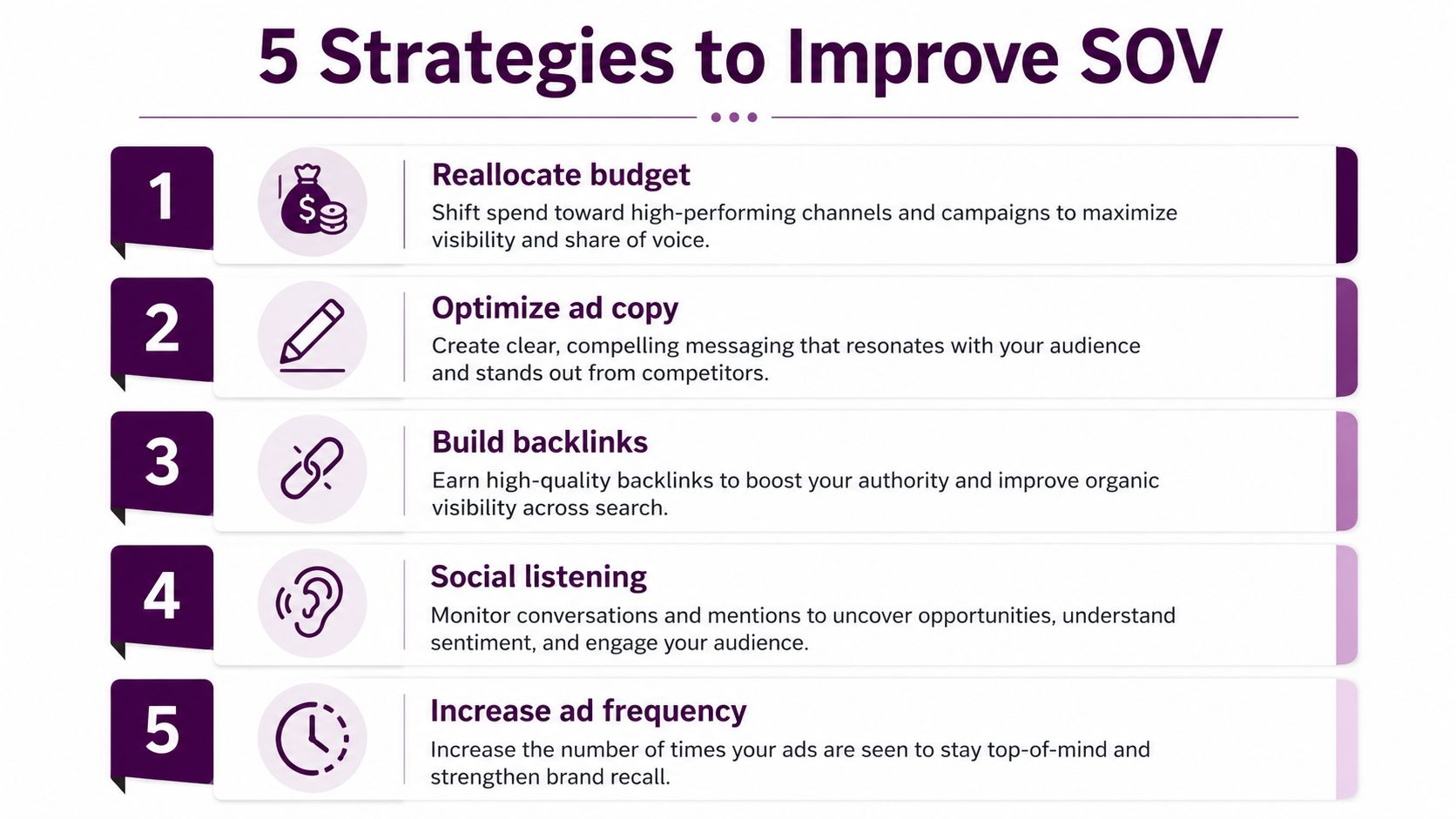
Improving SOV is less about one clever trick and more about disciplined visibility work. The brands that win usually show up more consistently in the places buyers already trust. That means the goal isn't just “be louder,” it's “be harder to miss.”
Reallocate effort toward the highest-value opportunities
The first move is to shift attention toward the keywords, topics, or placements where your brand can realistically gain ground. If competitors dominate a broad term, you may get faster wins by strengthening supporting content, long-tail coverage, or category-specific pages. In paid media, that can also mean concentrating budget where your message is already competitive instead of spreading spend too thin.
Tighten the message in every channel
A lot of teams lose SOV because their copy is generic. Ads that repeat the same promise as everyone else blend into the background, and organic pages that don't answer buyer intent struggle to earn attention. Sharper positioning, clearer headlines, and stronger proof points make your brand easier to recognize across channels.
Build visibility with supporting assets
Backlinks, expert content, and social proof all contribute to presence. In SEO, links can strengthen the pages that deserve more visibility. In PR and social, topic relevance matters more than empty volume. The best campaigns connect those efforts so one channel supports the next.
Sync paid and organic work
When paid search and organic content reinforce the same themes, the brand tends to look more established. Buyers see you in ads, then again in organic results, then again in commentary or social conversation. That repetition doesn't guarantee conversion, but it does raise familiarity.
A useful way to prioritize improvement is to ask which channel is closest to your audience's decision point. If buyers search before they buy, search visibility matters most. If they compare brands in public conversations, mentions and social presence matter more. SOV grows when your channel mix matches real buying behavior.
Using Keyword Kick to Track SOV Progress
A strong SOV process needs one place where the team can see visibility, competitors, and movement together. That's where a workspace built around rank tracking, search data, and competitor monitoring becomes useful. It keeps the team from treating paid, organic, and backlink signals like separate stories.
Start by connecting the reports that matter most to your category. Then set competitor tracking around the brands you lose business to, not just the ones you admire. The point is to watch changes early, because visibility gaps are easier to fix before they become habits.
If you want the rank-side workflow, the rank tracking feature overview is the cleanest place to see how a monitoring setup fits into day-to-day SEO work. Once tracking is live, use trend lines to spot whether your visibility is improving steadily or slipping in a specific cluster of terms.
The best SOV dashboard doesn't just show numbers. It shows where the next decision should happen.
Conclusion and Next Steps
SOV means different things in different industries, but in marketing it usually means Share of Voice, the clearest shorthand for competitive visibility. If you understand the context, measure consistently, and compare yourself against the right rivals, the acronym stops being confusing and starts becoming useful. The next step is simple, audit your current visibility, choose the right metric for each channel, and tighten the actions that can move share most quickly.
Keyword Kick helps teams bring rank tracking, competitor context, and SEO signals into one place so you can see where your visibility is growing and where it's leaking. If you're ready to turn SOV from a vague idea into a working metric, visit Keyword Kick and build a clearer tracking workflow for your team.