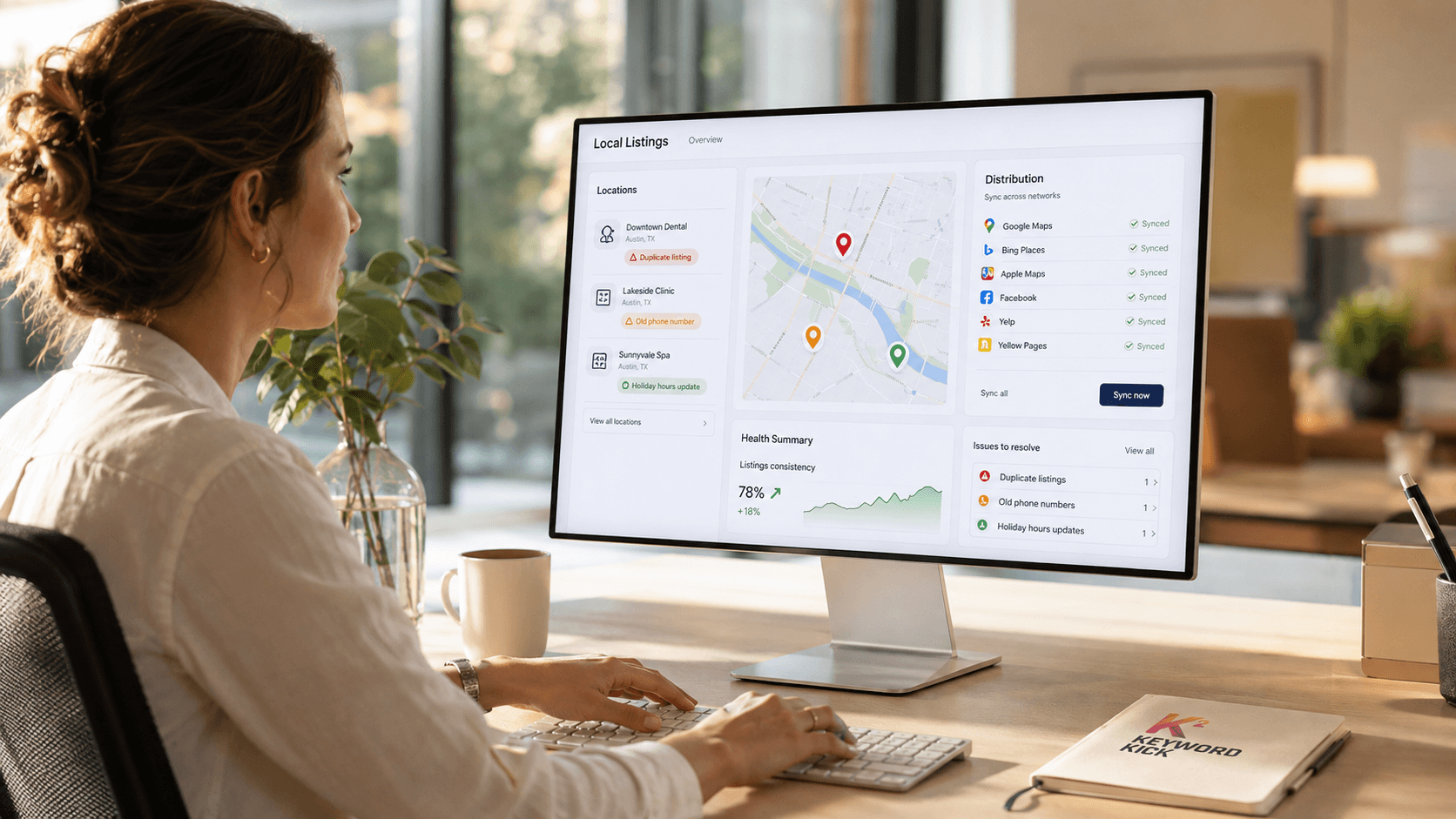
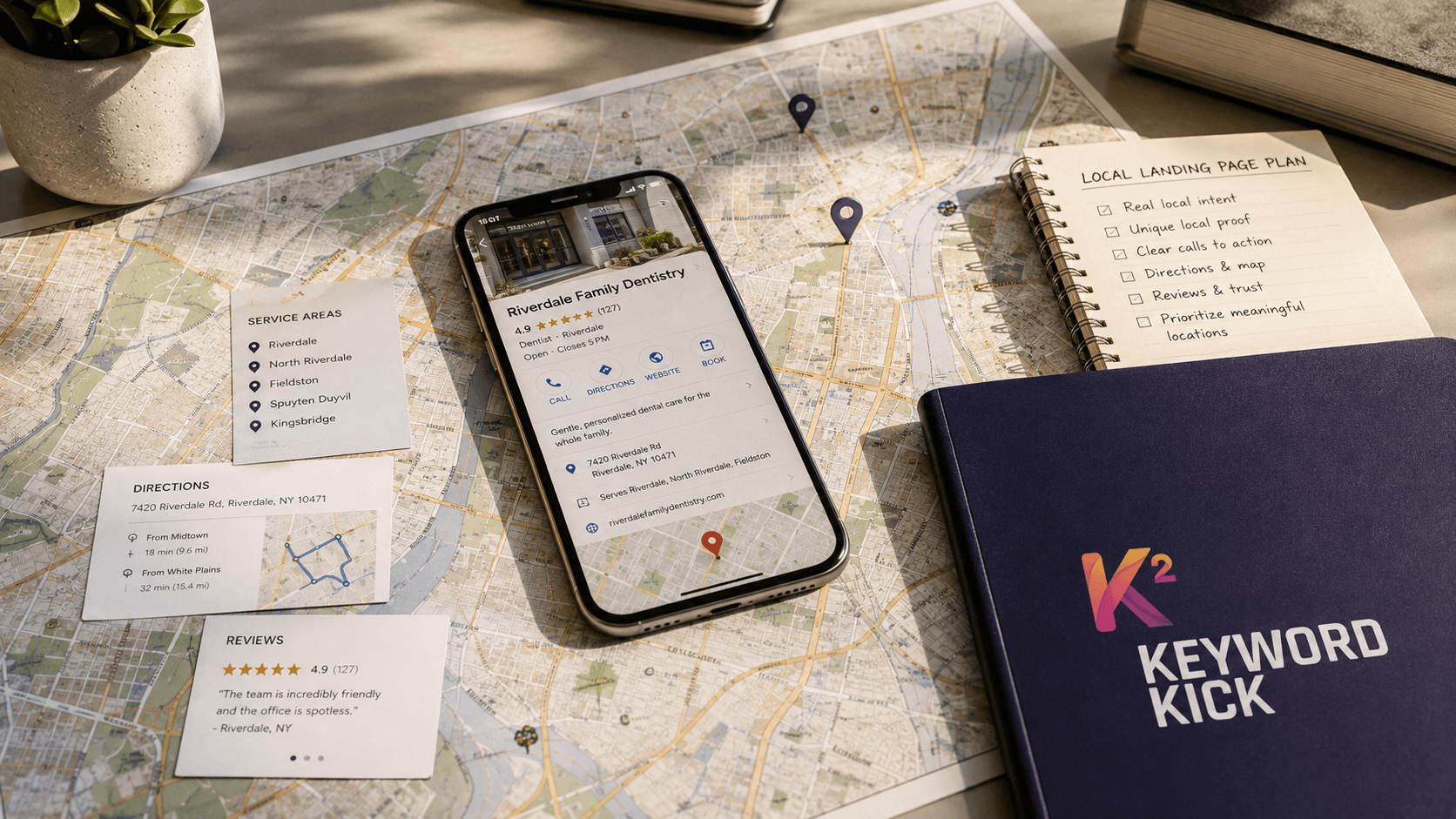
The most popular advice about location landing pages is also the easiest to misuse: create one page for every city, suburb, and ZIP code you can name. That approach confuses geographic coverage with search visibility. A page earns its place when it satisfies real local intent, proves that the business serves the area, and gives visitors a reason to call, request directions, book, or submit a form.
Local demand is substantial. One widely cited industry summary reports that 46% of Google searches have local intent, while 88% of consumers who complete a local search visit or call a business within 24 hours. The same summary associates localized pages with about a 78% increase in local organic traffic within six months, and says businesses with optimized local pages connected to a Google Business Profile receive 70% more direction requests and 50% more phone calls. These figures come from the industry summary on local landing pages, but they don't make every possible city page worthwhile.
The practical question is narrower and more useful: Can this location page rank for a meaningful query and convert a customer without pretending to be more local than it is? The answer determines whether you should build a page, improve an existing one, merge it with another page, or leave the geography uncovered.
Why More Location Pages Does Not Mean More Traffic
More URLs don't automatically create more demand. A brand can publish hundreds of pages that contain the same headline, service list, testimonials, images, and calls to action, with only the city name changed. Search engines may crawl those URLs, but crawling isn't the same as indexing, ranking, or sending qualified visitors.
The volume-first model usually starts with a coverage spreadsheet. A marketer lists every target city, assigns each one a URL, and measures success by the number of pages published. That metric looks productive, yet it ignores whether the locations have distinct search intent, local proof, useful service differences, or a realistic chance to compete.
Near-duplicate pages create several problems. They can compete for the same service-area queries, make internal linking less deliberate, and leave search engines with little reason to choose one URL over another. If several pages target overlapping phrases and offer nearly identical content, review the principles in this guide to fix keyword cannibalization before adding more URLs.
Intent beats geographic coverage
A dedicated page is easier to defend when the location represents a real branch, a meaningful service area, or a market with clear customer demand. Search Console queries, Google Business Profile actions, call records, paid-search geography, competitor quality, and sales data provide stronger prioritization signals than a list of postal areas.
The distinction matters because service-plus-city searches are often high-intent queries. A person searching for an emergency plumber in a named city isn't asking for general education. They want confirmation that the business serves that place, offers the required service, and can respond.
A smaller set of materially unique pages can outperform a large collection of interchangeable pages because each URL has a clearer purpose. BrightLocal recommends making more than half of a location page unique, and its location page guidance presents a 40% to 60% uniqueness range as a practical benchmark for supporting a separate URL.
Metric | Volume-First, 500+ templated pages | Intent-First, 50 to 100 unique pages |
|---|---|---|
Primary success measure | Geographic coverage | Qualified demand and conversions |
Content model | Shared template with swapped place names | Location-specific services, proof, and context |
Indexation risk | High when pages offer little distinct value | Lower when every URL has a clear purpose |
Internal linking | Large directory with weak prioritization | Deliberate hubs and contextual links |
Optimization workload | Many pages with shallow updates | Fewer pages with meaningful refreshes |
Business value | Vanity coverage can hide weak leads | Stronger alignment between query and action |
A practical audit decision
Classify every existing page using three tests:
Local reality: Is there a branch, team, service record, or genuine coverage area behind the URL?
Search intent: Do users search for the service in that location, and does the page answer that intent directly?
Distinct value: Can the page show local information that another location page cannot truthfully provide?
Keep pages that pass all three tests. Consolidate pages that serve the same market or offer no distinct value. Remove or prevent indexation for pages created only to capture variations of a keyword. The objective isn't to own every geographic phrase. It's to maintain a set of pages that deserve visibility.
Building Location Pages That Actually Rank
A strong location page behaves like both a local reference point and a conversion page. It should tell search engines what the business is, where it operates, and which services it provides. It should tell a visitor the same things quickly, then make the next action obvious.
Start with the page's real-world identity. Use a dedicated URL for each genuine location or defensible service area, then give the page a unique title tag, meta description, and city-and-service H1. The page shouldn't imply a storefront if the business only travels to customers, and it shouldn't list services that the local team doesn't provide.
The page anatomy
A useful page sequence looks like this:
Hero and contact details: State the service and location plainly. Put the business name, address, phone number, hours, and primary CTA where visitors can find them without hunting. Keep NAP information as crawlable text, not as text inside an image.
Location-specific services: Explain what the local team does, how availability works, and which service needs are common in that market. Don't copy a national service description and append a city name.
Access and coverage: Add parking, transit, entrance, appointment, or service-area details when they're relevant. Nearby landmarks can help visitors orient themselves, but only include details that help someone reach or choose the business.
Local proof: Use authentic staff photographs, completed work from the area, location-specific project examples, and reviews from customers served by that branch. A generic testimonial carousel doesn't establish local relevance.
Localized FAQs: Answer questions that differ by location, such as coverage boundaries, access restrictions, appointment timing, emergency availability, or services offered at that branch.
Conversion path: Offer a focused action, such as calling, booking, requesting a quote, or getting directions. On mobile, click-to-call and map access should require minimal effort.
The page doesn't need a different sentence in every block. It does need enough substantive variation to show that the location has been researched and served. Use BrightLocal's 40% to 60% uniqueness benchmark as a quality check, not as permission to pad a page with awkward local references.
Structured data and media
Use LocalBusiness schema that matches the visible page. Relevant properties can include the location's name, address, telephone number, geo coordinates, opening hours, area served, and map URL. The schema should describe that branch or service-area business, not a headquarters with different hours and contact details.
Structured data can clarify relationships for search engines, but it isn't a substitute for useful content or a guarantee of enhanced results. Validate the markup, keep it consistent with the page, and remove fields you can't support.
Images also need local relevance. A real exterior, team member, vehicle, or completed project is more useful than a stock photograph. Use descriptive alt text that identifies what the image shows and its location when that context is accurate. Compress files, serve appropriate dimensions, and lazy-load images that sit below the initial viewport so visual assets don't obstruct the page's first useful interaction.
The best reusable template standardizes structure, not substance. It can enforce NAP placement, schema fields, CTA components, mobile behavior, and metadata requirements while leaving local services, proof, FAQs, and imagery different.
Technical Architecture for Multi-Location Sites
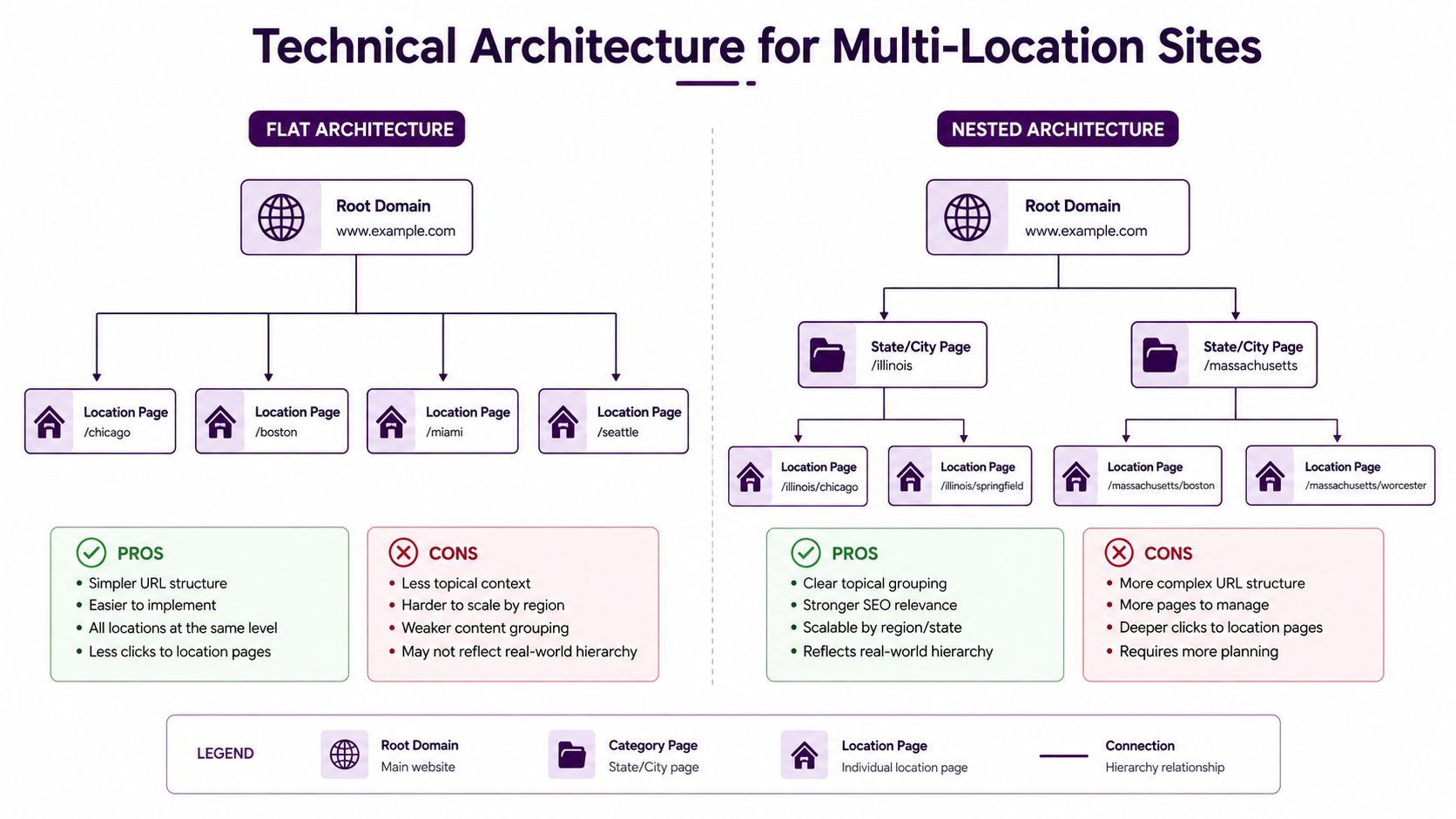
Architecture determines whether location pages are easy to discover, easy to interpret, and easy to maintain. A simple structure often works well for a domestic business, while a larger international organization may need clearer geographic grouping. Neither option wins by default.
A flat pattern might use /locations/chicago and /locations/boston. A nested pattern might use /locations/illinois/chicago and /locations/massachusetts/boston. Flat URLs are easier to manage and keep short. Nested URLs can express state or regional relationships, support navigational hubs, and help teams organize a large inventory. Choose the structure that reflects how users browse and how the CMS can reliably generate, update, and redirect pages.
URL and canonical decisions
Use one permanent URL per real location. Don't create multiple versions for a city, neighborhood, ZIP code, and service combination unless each URL serves a distinct purpose and contains enough unique value to justify it.
Canonical tags should point to the preferred version of a page, not automatically to a national location hub because several pages share service-area language. Shared boilerplate doesn't make two pages identical, and a canonical tag shouldn't erase a legitimate local page. Conversely, canonicalizing every near-duplicate variation to itself won't solve a thin-content problem.
Subdirectories are generally simpler to connect to a main site's internal links, analytics, and governance. Subdomains can be appropriate for separate operational systems or independently managed country sites, but they introduce more separation in reporting, authority flow, and technical maintenance. Make that choice for organizational and technical reasons, not because a subdomain is expected to create a ranking shortcut.
Indexation controls
Don't let the sitemap become a dumping ground for every generated URL. Segment XML sitemaps by meaningful location groups or tiers, include only canonical URLs that you want indexed, and monitor submitted versus indexed pages in Google Search Console.
Robots.txt can control crawling of patterns that should never be accessed, but it doesn't replace an indexation strategy. A noindex directive is more appropriate for a page that users may need but that shouldn't appear in search. Use either control deliberately, and avoid blocking URLs you need search engines to revisit in order to see directives or canonical signals.
Hreflang belongs in the international version of this conversation. Each translated or country-specific location page needs reciprocal, accurate language and regional references. An incorrect x-default, missing return annotation, or mixed country targeting can cause the wrong version to appear, especially when several pages share translated templates.
Technical rule: Architecture should make the valuable pages easy to reach and the low-value pages difficult to generate.
Internal link depth, server response time, and rendering reliability affect discovery and re-crawling. A site with thousands of URLs needs a clear location hub, direct links to priority pages, stable templates, and a CMS that doesn't produce broken or empty pages during updates. Scale only after the publishing system can preserve those controls.
Internal Linking and Siloing Strategies
A location page with no meaningful internal links is functionally isolated. It may exist in an XML sitemap, but a sitemap doesn't provide the same navigational context as links from relevant service and regional pages.
The most reliable pattern is a hub-and-spoke model. A service page such as plumbing links to relevant city pages. A regional hub groups nearby locations. Each location page links back to the service and region, then points to related services or neighboring locations where that helps users.
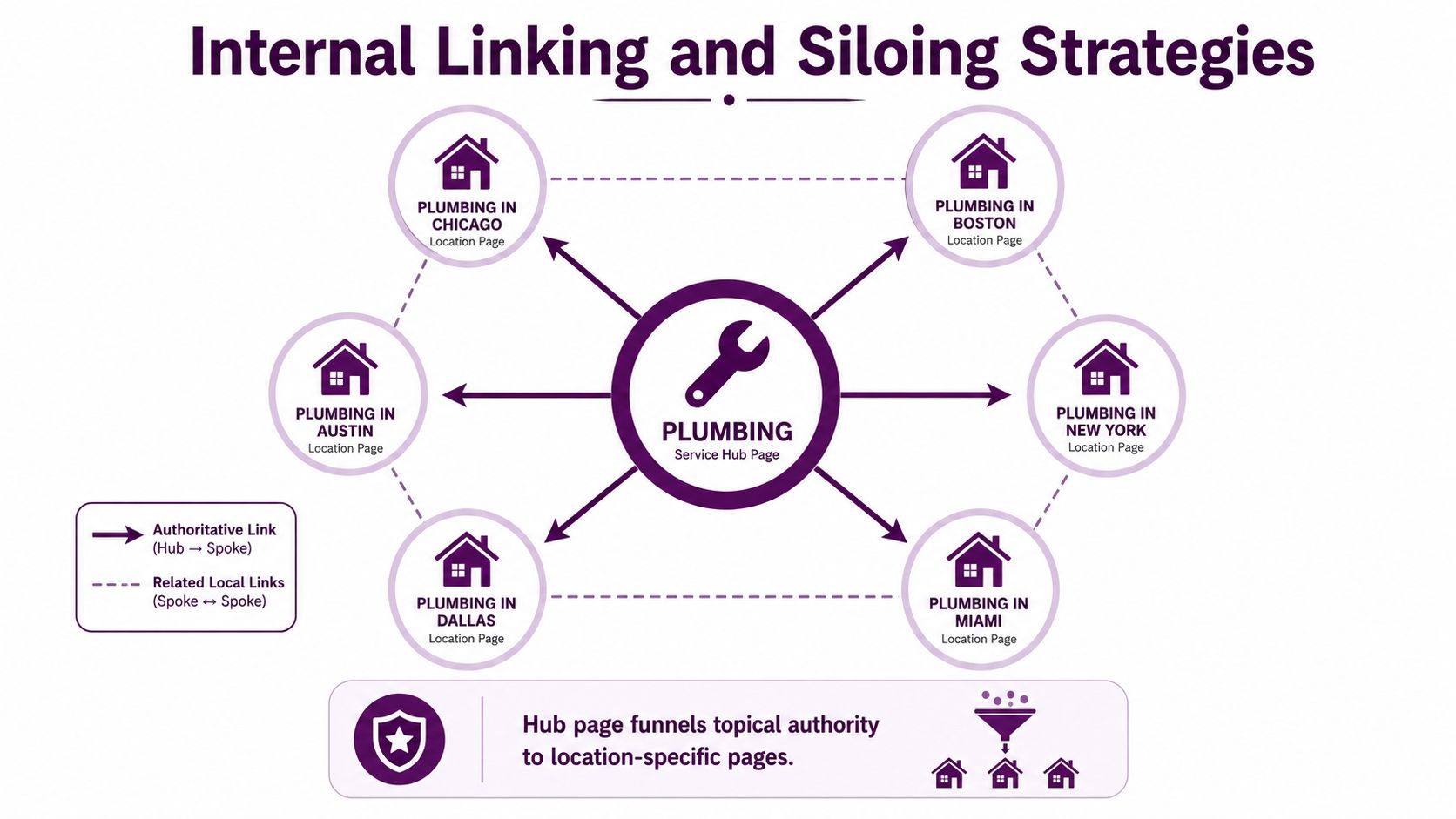
Build links around user decisions
A location finder should do more than offer a dropdown. Give it crawlable links to each indexable location, organized in a way that helps customers choose a branch or service area. State-level aggregation pages can support national brands, while regional hubs can help service businesses show coverage without creating a page for every nearby place.
Breadcrumbs clarify hierarchy and improve navigation, but they shouldn't be the only internal links. Contextual links within service descriptions, FAQs, and project examples carry more meaning because the surrounding text explains why the destination matters.
For example, a regional HVAC page might link to heating installation in Chicago, emergency repair in Evanston, and maintenance in Oak Park. Those links should reflect actual services and availability. A footer containing every city on the site may technically expose the URLs, but it provides little prioritization and can make the site look mechanically generated.
Avoid artificial silos
Siloing is useful when it reflects the business. It becomes counterproductive when it prevents related pages from linking naturally. A customer comparing nearby branches may need links between locations. A visitor on a commercial plumbing page may need a direct path to a local emergency service page, even if those URLs sit in different folders.
Use descriptive anchor text, but don't force exact-match phrases into every link. Link from the pages that already have topical and geographic relevance, keep important locations close to the main navigation path, and remove orphan URLs from the indexable set.
A practical internal linking strategy should balance authority flow with user movement. The strongest architecture helps someone answer three questions quickly: which service is available, where is it available, and what should I do next?
Audit question: If a location page disappeared today, which important page would notice the loss?
If the answer is “none,” the URL probably isn't receiving enough contextual support to justify its role.
Local Citations and Reviews Integration
A repeated NAP block doesn't make a page local. It confirms identity, but it doesn't show that the branch has customers, staff, projects, or community relevance. Trust signals need to belong to the location being presented.
Use review content carefully. A dynamic feed filtered by branch can surface authentic customer feedback, while a manually selected testimonial section can highlight experiences that match the services offered there. Either method should make the review's location clear without copying the same carousel across every URL.
Give each branch its own proof
Useful location-level evidence includes:
Customer reviews: Display reviews from customers served by that branch or service area, with the source and context visible.
Project examples: Show work completed locally, with a concise description of the service and area.
People and operations: Name local staff when appropriate, and explain local hours, availability, or appointment procedures.
Community references: Mention genuine partnerships, memberships, events, or local involvement. Avoid lists of nearby organizations added only to insert place names.
Visual evidence: Use real premises, vehicles, teams, and completed work rather than interchangeable stock images.
Review schema requires particular care. Only mark up reviews that are visible on the page and eligible under the relevant structured-data guidelines. If a location has few reviews, don't manufacture an impressive-looking aggregate block or import reviews from another branch. Thin evidence is better than misleading evidence because it preserves trust and gives the team a clear reason to build authentic local proof.
Treat citations as an identity system
Most citation work happens off the website, through business profiles, directories, associations, and other third-party references. The location page should still act as the canonical explanation of the branch's name, address, phone number, hours, services, and map.
Keep those details synchronized. A location-specific page can link to the correct profile and map, mention local partnerships naturally, and provide directions that match the actual entrance. It shouldn't replicate a national citation paragraph or display a review widget that mixes branches.
Signal Type | Implementation Method | Uniqueness Potential | Technical Complexity |
|---|---|---|---|
Branch reviews | Filter a verified feed by location or curate visible reviews with context | High | Medium |
Local projects | Add original photos and descriptions of work in the area | High | Low to medium |
Staff information | Identify local team members and responsibilities | High | Low |
Business profile link | Connect the page to the matching location profile | Medium | Low |
Community references | Cite genuine local relationships and participation | Medium to high | Low |
Aggregate ratings | Use only eligible, visible, location-specific data | Medium | Medium |
The standard is simple: a visitor should be able to tell why this proof belongs on this page.
Measuring Location Page Performance Beyond Rankings
A rank for “service plus city” is a visibility signal, not a business outcome. It can hide differences between neighborhoods, map results, devices, and service areas. A page can rank acceptably and generate weak leads, while another page with modest visibility may produce valuable calls.
Measure the path from discovery to action at page and location level. That means connecting organic queries with business profile interactions, page engagement, and lead records rather than treating every location as an identical unit.
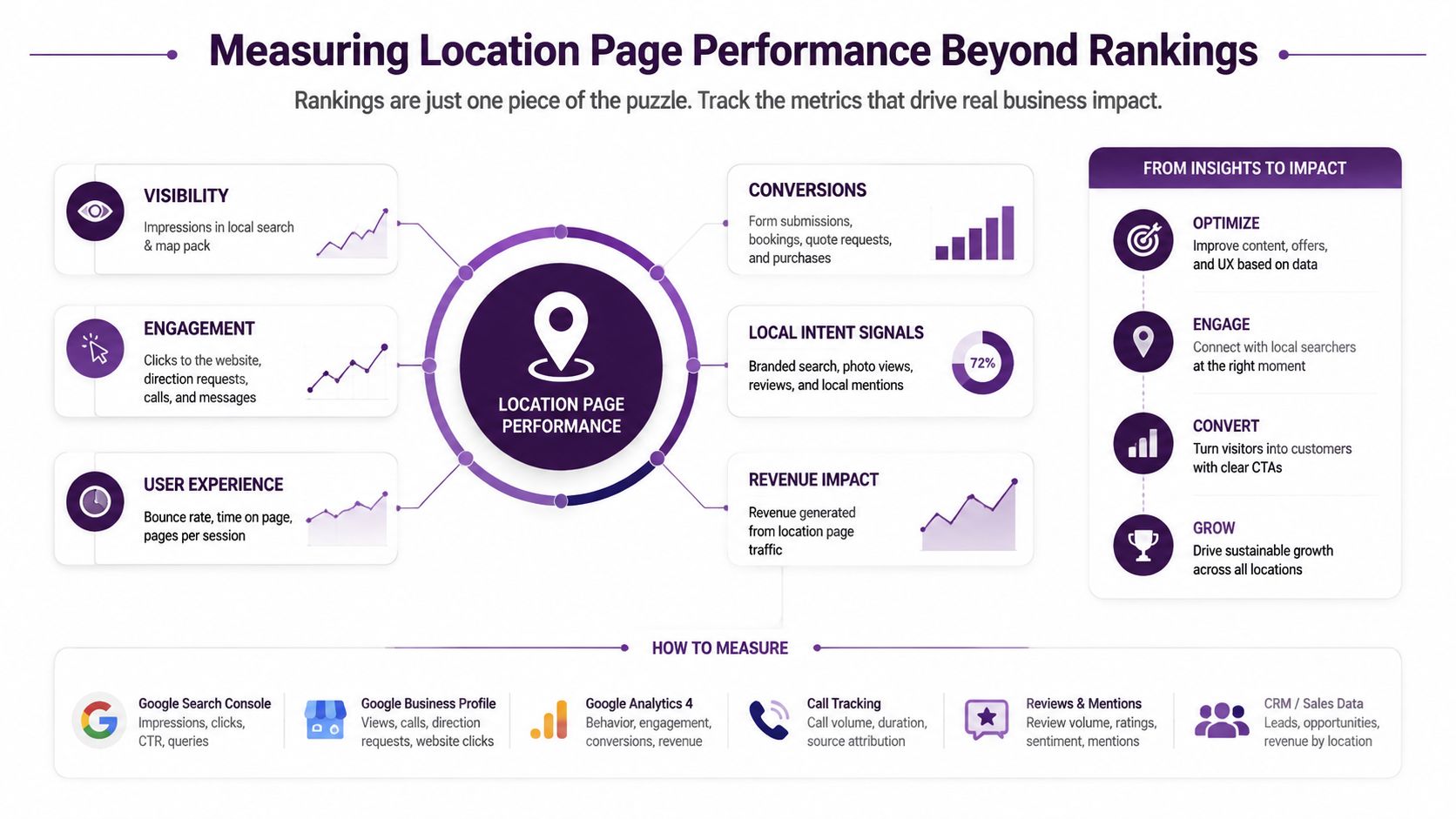
The measurement stack
Use Google Search Console to filter queries and pages, then look for local service intent, impressions, clicks, and changes after meaningful updates. Avoid treating every impression as demand. A page may appear for broad informational searches that have little connection to the location's commercial offer.
In GA4, define events for the actions that matter to the business:
Calls: Track click-to-call interactions and connect them with call-tracking records where possible.
Directions: Track clicks on map and directions links, then compare them with location profile actions.
Forms: Add a location identifier to submissions so leads don't disappear into a national total.
Bookings: Pass the location through the booking flow, including cases where the visitor converts on another page.
Qualified outcomes: Connect leads to sales or accepted appointments when the CRM supports that handoff.
A dashboard should show page-level organic queries, conversion actions, business profile actions, and geo-grid visibility. Geo-grid checks reveal whether a branch performs consistently across its catchment area or only near its physical address. That distinction matters because a single rank check can hide meaningful geographic variation.
Diagnose the constraint
Separate content problems from authority and operational problems. If a page has relevant queries, strong engagement, and weak visibility across the grid, investigate competitors, local prominence, links, and profile strength. If it receives visibility but few calls or forms, review the offer, CTA, service clarity, mobile experience, and trust signals.
Attribution also needs restraint. A visitor may land on a location page, return later through branded search, and convert on a booking page. Use assisted-conversion views and location-aware CRM records rather than assigning every outcome to the final URL.
A practical SEO measurement guide can help establish consistent reporting, but the operating principle is more important than the dashboard design: compare each location with its own opportunity, service capacity, and business outcome. A competitive metro and a smaller service area shouldn't share a simplistic traffic target.
Common Pitfalls and When to Automate
The recurring failures in multi-location audits aren't mysterious. Teams publish pages before they have local evidence, generate URLs for places they don't serve, and let templates fill the index with pages that look different only in their headings.
The risk rises when a site uses location pages as doorway pages, directing users from many near-identical URLs to the same destination without offering distinct local value. Poor canonical choices can also collapse legitimate location equity into one URL, while inconsistent names, addresses, and phone numbers create confusion across the page and business profiles.
Seven mistakes that deserve attention
City-name substitution: The copy changes the place name but not the service explanation, proof, imagery, or FAQs.
Coverage without operations: The page targets a city the business can't serve reliably or doesn't serve.
Orphaned locations: The URL appears in a sitemap but has no useful internal links from service, regional, or finder pages.
Canonical misfires: Every location points to a hub, or every self-canonical page remains too thin to provide distinct value.
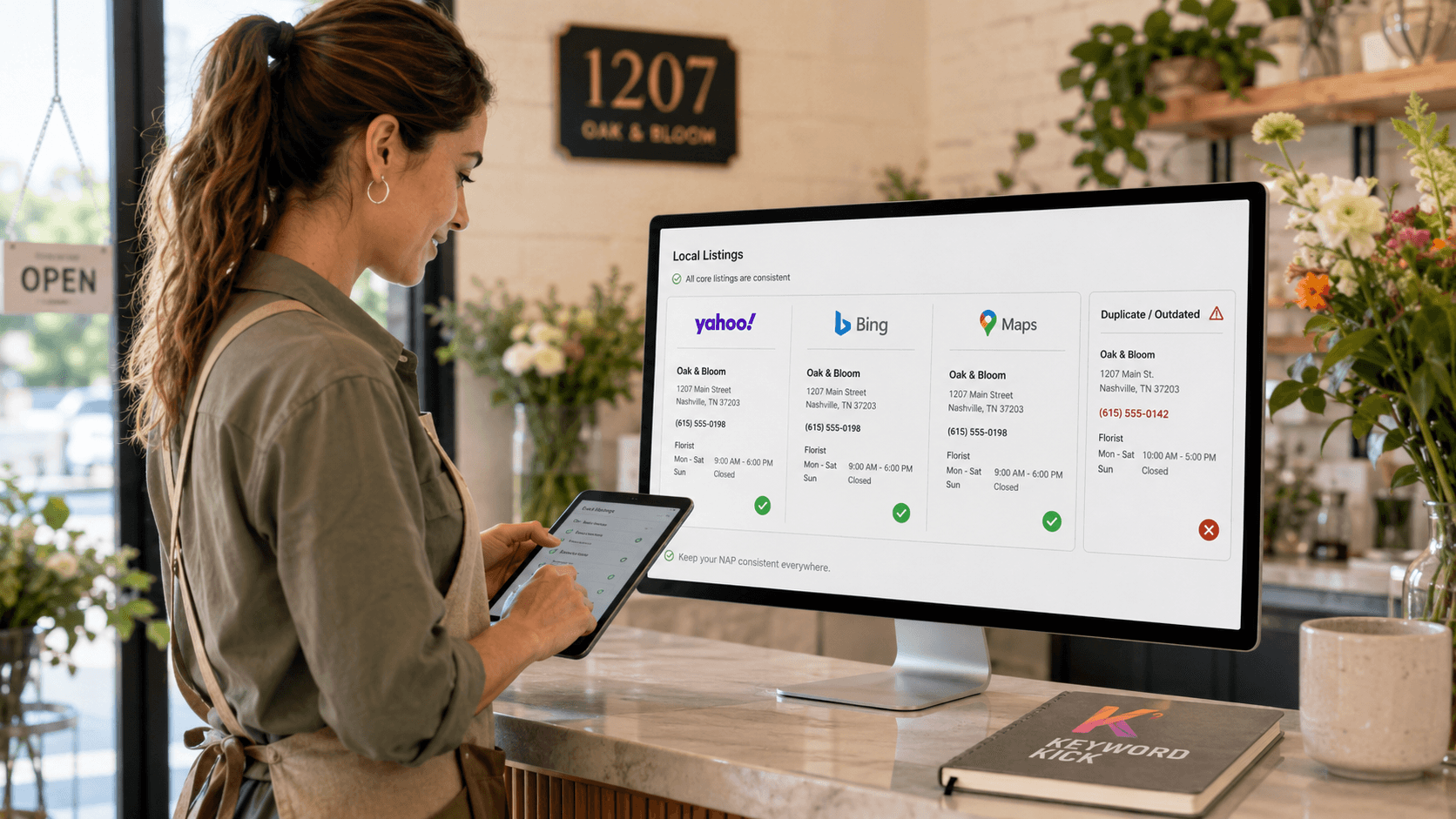
NAP inconsistency: The page, business profile, directory listings, and contact systems show conflicting details.
Unsupported schema: Markup lists services, hours, reviews, or locations that the visible page can't verify.
Conversion blindness: The team reports rankings and page counts but doesn't know which URLs drive calls, directions, forms, or qualified leads.
Automation is defensible when the source system contains verified local attributes, such as accurate hours, staff, inventory, service availability, images, and customer records. A template can assemble those fields efficiently, but it shouldn't publish an indexable page when the data is missing.
Factor | Template, Scale | Handcraft, Quality |
|---|---|---|
Local data availability | Strong structured data for each branch | Research available for priority markets |
Content uniqueness | Verified facts can vary materially | Strategy and narrative can be deeply localized |
Conversion potential | Many operationally real locations | Fewer high-value locations with clear demand |
Crawl impact | Large URL inventory needs strict controls | Smaller inventory is easier to govern |
CMS readiness | Stable fields, validation, and QA | Editorial workflow supports detailed pages |
Best use | Genuine networks with repeatable local attributes | Competitive metros and strategically important areas |
A useful scoring process rates each candidate on local evidence, intent strength, conversion potential, and maintenance cost. Build when the combined case is strong. Consolidate when two pages serve the same audience with the same offer. Leave a page unpublished when the only justification is that a city exists.
The right scale is the largest page set your team can keep truthful, useful, crawlable, and measurable.
Quality and scale aren't opposites, but scale must follow operational truth. A business with hundreds of genuine branches may automate page assembly responsibly. A service-area company with limited local proof may get better results by handcrafting a smaller group of markets and improving those assets until they earn demand.
Keyword Kick helps agencies, in-house teams, and consultants connect rankings, Google Search Console, GA4, technical audits, backlinks, and competitor data so they can prioritize the location pages that need action. Visit Keyword Kick to identify cannibalization, technical issues, content gaps, and location-level opportunities before you publish another page.