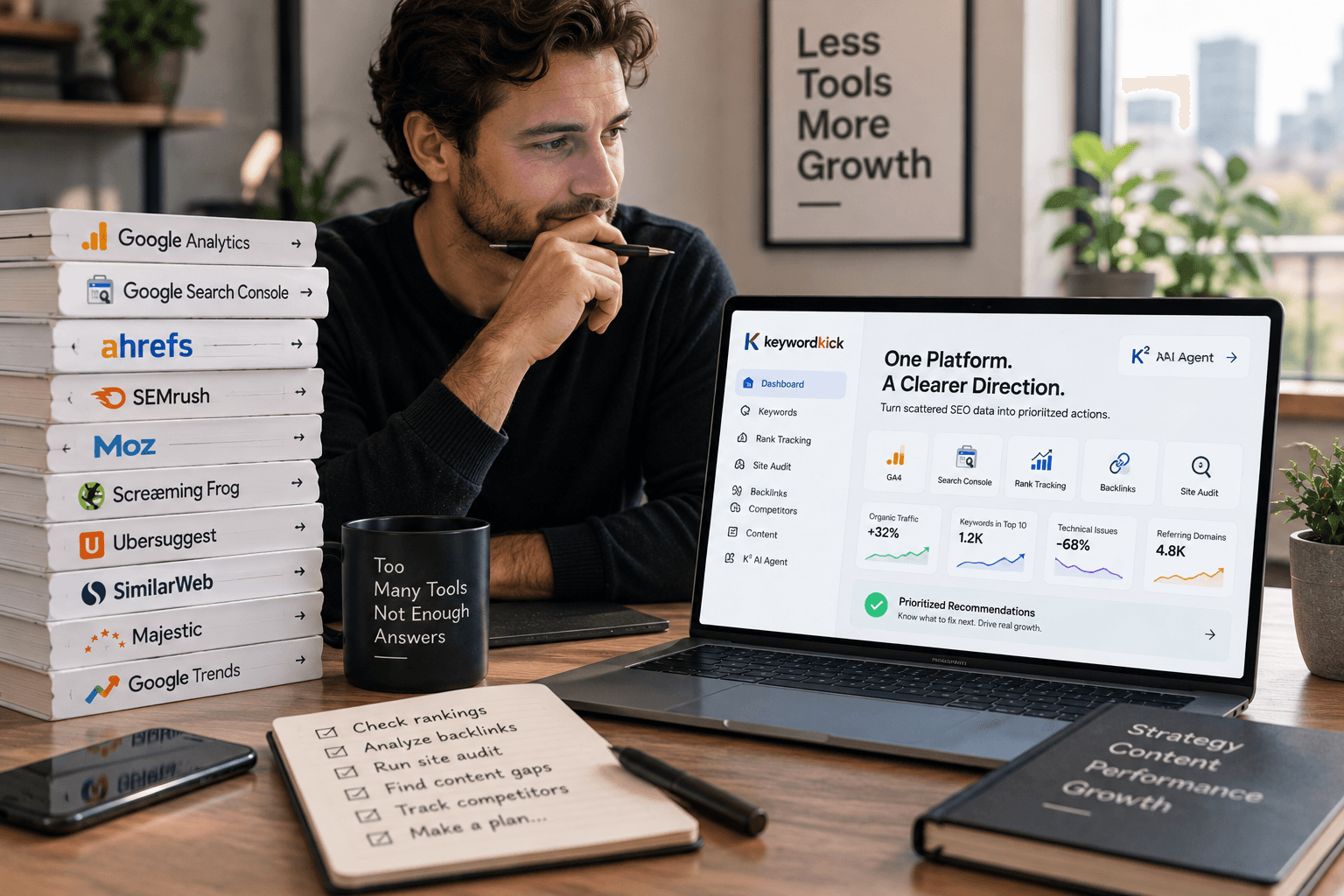
Monday starts with good intentions. Then the tabs multiply.
Your agency account lead is checking rankings in one dashboard, backlinks in another, Google Search Console in a third, and a technical crawl export in a spreadsheet that nobody has renamed properly. Across the hall, an in-house SEO manager is trying to explain why traffic dipped, which pages deserve updates first, and whether the dev team should fix schema issues or crawl waste before the next sprint. Both people are doing real SEO work. Both are also wasting time stitching together evidence before they can act.
That's the moment an AI-powered SEO platform starts to make sense.
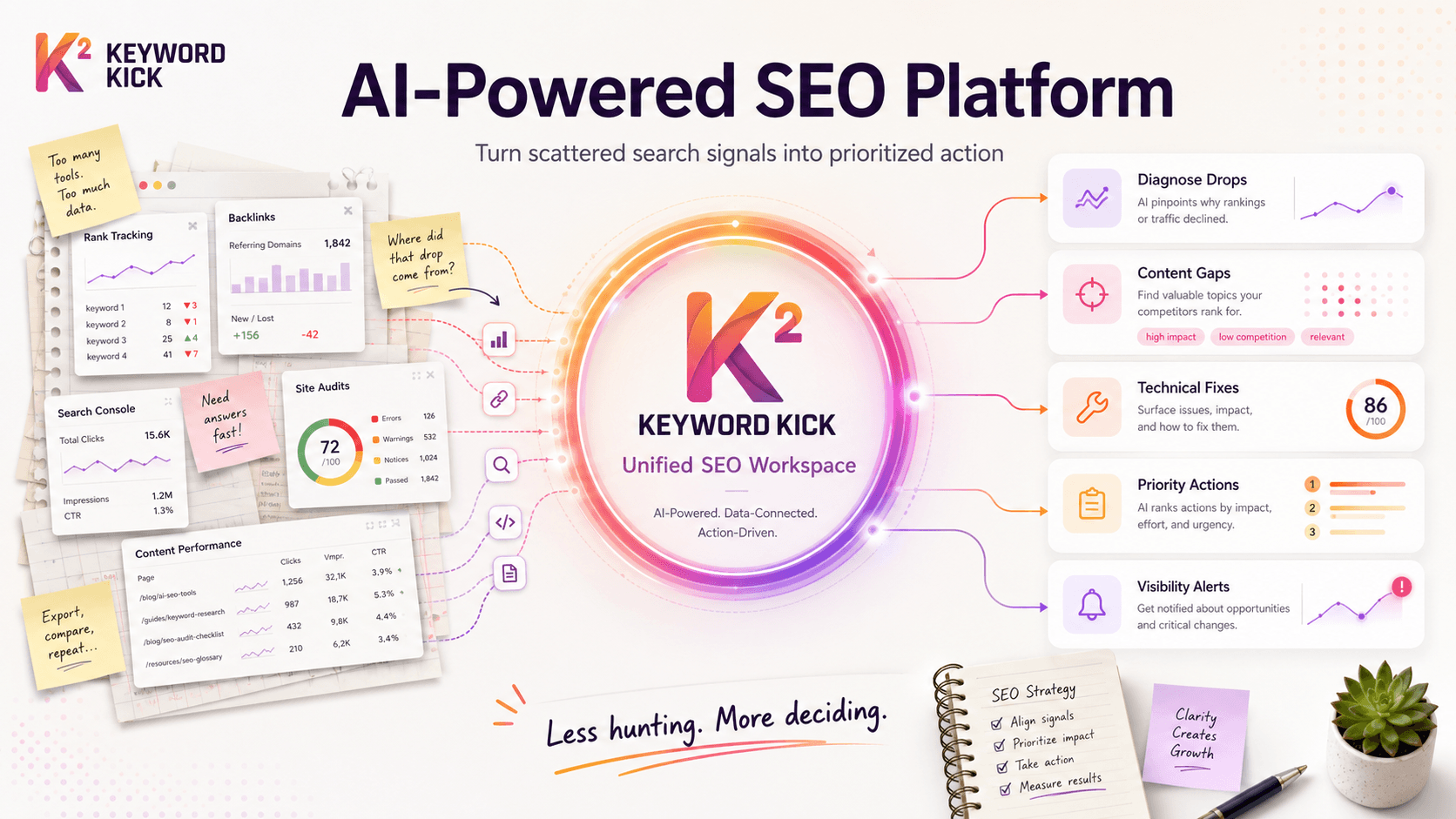
Instead of acting like another reporting layer, it works more like a central operating system for search. It pulls in signals from rank tracking, analytics, site audits, content performance, and competitive monitoring, then turns that mess into ordered tasks. The practical appeal is simple. Less hunting. More deciding.
The shift also fits a broader change in marketing operations. Teams aren't just trying to rank pages anymore. They're trying to understand visibility across classic search results, AI-generated answers, and content journeys that don't always end in a click. If you want a wider view of where marketing teams are adapting, this guide for marketers on 2026 trends gives useful context.
An AI-powered SEO platform won't replace judgment. It won't know your margins, political constraints, or brand nuance unless you teach it. What it can do is remove the repetitive analysis that keeps experienced practitioners trapped in diagnostic mode.
Introduction to AI-Powered SEO Platforms
A good way to understand these platforms is to start with the problem they solve.
An agency usually has multiple clients, each with different goals, reporting expectations, and technical setups. One client wants local visibility. Another wants category pages fixed. A third wants proof that content updates led to pipeline impact. An in-house team faces a different version of the same problem. They need one source of truth that content, SEO, analytics, and development teams can all trust.
That pressure is why the market is moving quickly. The global AI-powered SEO software market is projected to reach USD 32.6 billion by 2035, up from USD 3.98 billion in 2025, at a 23.4% CAGR, according to Market.us research on the AI-powered SEO software market.
What makes the shift feel so different
Traditional SEO tools usually answer narrow questions.
One tool tells you rankings. Another tracks links. Another crawls templates. Another helps with briefs. The SEO lead still has to interpret the pattern across all of them. An AI-powered SEO platform tries to do the opposite. It combines those streams and asks a more useful question: what should we do next?
Practical rule: If your team spends more time reconciling tools than shipping fixes, your SEO stack has become a bottleneck.
That changes the daily workflow in small but important ways:
Fewer disconnected exports: Teams stop copying data from one place to another just to compare rank drops with indexing changes.
Clearer prioritization: The platform can surface pages, queries, or technical issues that deserve attention first.
Better handoffs: Content teams, account managers, and developers can work from the same evidence instead of separate interpretations.
Why this matters beyond convenience
Search visibility now depends on more than a blue link. Teams need to monitor how content appears across featured elements, answer-style results, and conversational interfaces. That's why the platform category is increasingly connected to broader content operations too. If your work spans publishing systems as well as optimization, this overview of Benefits of AI content management helps frame how AI supports the workflow before and after SEO decisions are made.
For a grounding point, it also helps to understand the wider category. This guide to what an SEO platform is gives a useful baseline before you evaluate AI-specific capabilities.
Understanding AI-Powered SEO Platform Essentials
The easiest analogy is the cockpit.
A pilot still decides where the plane should go. The copilot and instruments reduce workload, monitor conditions, and catch problems early. An AI-powered SEO platform plays a similar role. It doesn't own strategy. It supports strategy by watching more variables than a person can track comfortably in real time.
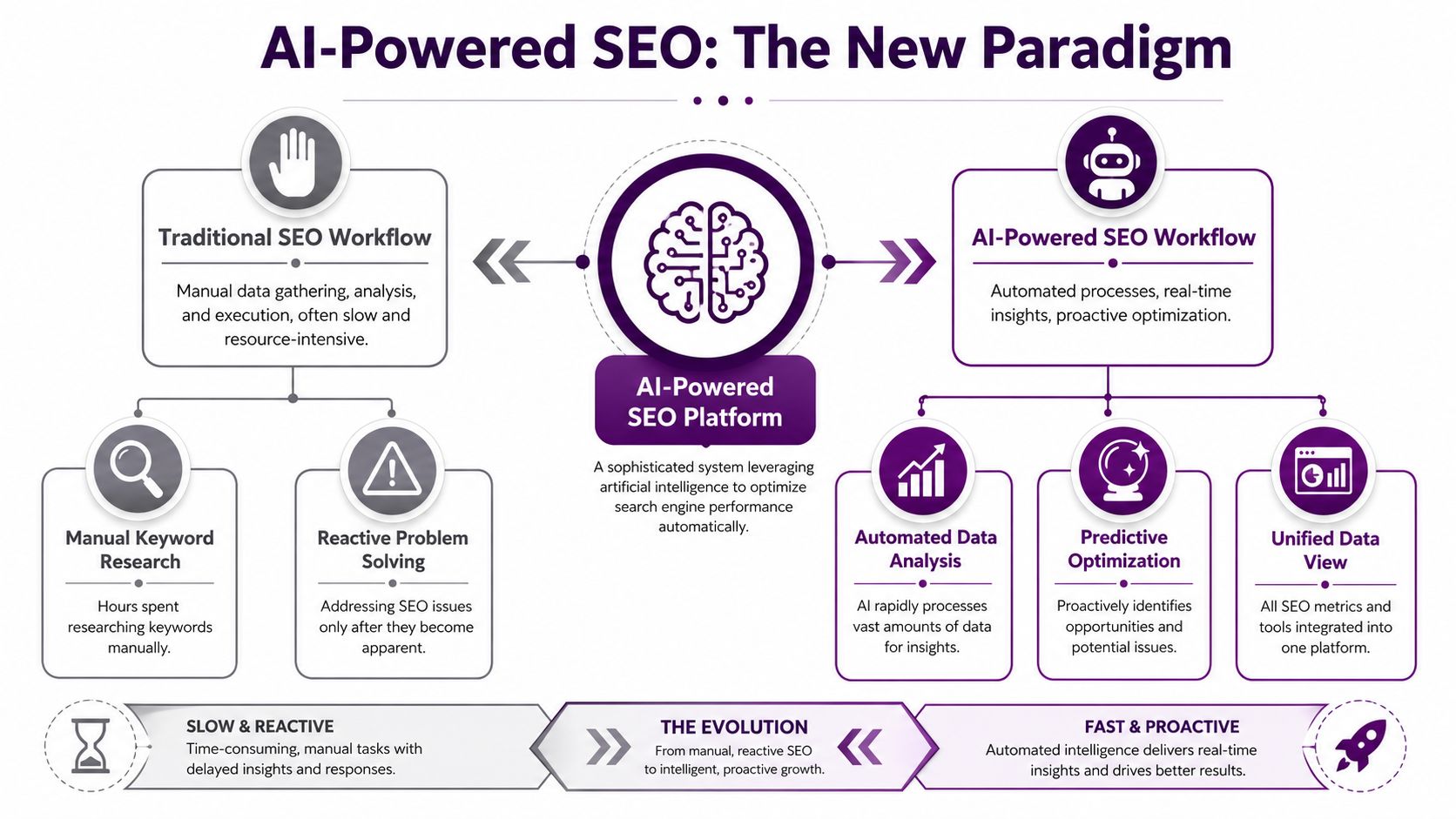
Manual SEO versus AI-assisted SEO
Manual SEO often follows a slow loop. You collect data, compare reports, notice a change late, diagnose the cause, then create a task list. The work is valid, but the delay hurts. By the time someone identifies the issue, rankings may have slipped, pages may have dropped from visibility features, or competitors may have filled the gap.
AI-assisted platforms shorten that loop.
They ingest ranking shifts, content signals, audit results, and analytics patterns into one workspace. Then they flag anomalies and suggest next actions. Instead of asking an analyst to inspect every dashboard, the system can point to likely causes such as page overlap, weak intent match, or technical blocking.
The engine under the hood
One core capability is Natural Language Processing, which modern AI SEO software uses to analyze top-ranking pages and classify keyword intent. That same layer supports predictive analytics that estimate ranking potential and traffic based on semantic coverage, as explained in Stackmatix's overview of AI SEO software.
That matters because search intent is where many teams get confused. They still think in keyword lists when they should think in jobs the searcher is trying to complete. If someone searches for “best project management tool for agencies,” the winning page probably needs comparison structure, buying criteria, and commercial clarity. A platform using NLP can detect that pattern faster than a manual spreadsheet review.
A ranking report tells you where you stand. An AI platform should tell you why you stand there.
What the platform should actually do
When practitioners say they want “AI for SEO,” they often mean several different needs at once. A capable platform should help with tasks like these:
Watch the SERP continuously so sudden losses or gains don't sit unnoticed.
Connect cause and effect by mapping performance changes to page edits, releases, or technical events.
Group opportunities intelligently such as pages with similar intent gaps or clusters with weak internal support.
Answer natural-language questions like why nonbrand traffic fell or which URLs have the strongest recovery potential.
One option in this category is Keyword Kick, which connects GA4, Google Search Console, rank tracking, backlinks, and technical SEO signals into one workspace so users can ask practical questions and get prioritized actions.
The real mindset change
The biggest shift isn't automation by itself. It's the move from reactive SEO to monitored SEO.
Instead of waiting for monthly review meetings, teams can work from a living queue of issues and opportunities. That's why agencies can scale account oversight better, and in-house teams can spend less time defending decisions and more time implementing them.
Key Features and Benefits
Features matter only if they change the way work gets done. A bloated SEO tool can still leave a team buried in exports. A strong AI-powered SEO platform should reduce friction, improve decision speed, and make outcomes easier to explain.
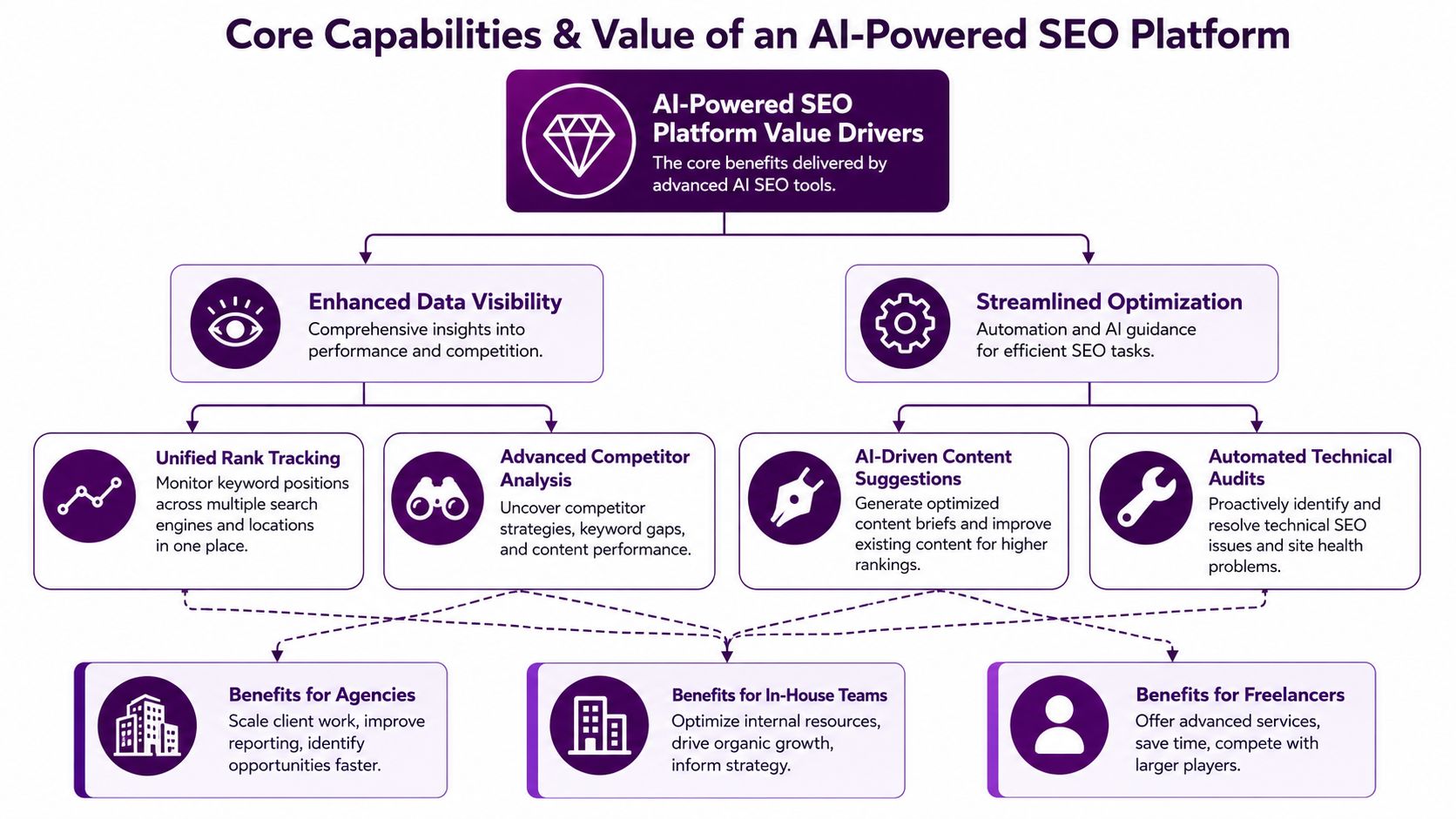
Six capabilities that actually matter
Unified rank tracking with trust checks
Rank tracking isn't useful if the numbers feel questionable. Reliable platforms need ways to verify what they report against observed reality. That's why experienced teams care about data validation, not just pretty charts.
A practical example is regional tracking. If your ecommerce brand sells nationally but has strong local demand pockets, you need to know whether rank movement reflects true local visibility or a reporting artifact.
AI-guided content gap analysis
In this context, many teams see immediate value.
The platform reviews top-ranking pages, compares coverage, classifies likely intent, and points out missing subtopics or weak page structure. That can save hours during briefing and refresh work. It also helps agencies standardize quality across different writers and accounts.
If your team is trying to align optimization with publishing speed, this resource on how to Streamline your content marketing is useful context for the content production side of the equation.
Automated technical audits
Technical SEO often creates the most hidden backlog because issues pile up unnoticed. Crawling inefficiencies, redirect chains, rendering trouble, orphaned pages, and metadata conflicts usually don't scream for attention until performance slips.
A strong platform should surface those issues in business language. Not just “discovered 174 warnings,” but “these template-level issues likely affect indexation, page quality signals, or crawl priority.”
Competitor monitoring that stays current
Competitor review often occurs only when traffic drops or leadership asks uncomfortable questions. AI-assisted monitoring makes this less episodic. It can flag competitor content expansion, topic encroachment, or SERP layout changes while the shift is still manageable.
Benefits by team type
The same feature produces different value depending on who uses it.
Team type | Main benefit |
|---|---|
Agencies | Faster account diagnosis and easier client communication |
In-house teams | Better prioritization across SEO, content, and dev resources |
Freelancers and consultants | Broader service delivery without adding tool sprawl |
Why these features matter together
The important thing isn't that a platform has many modules. It's that the modules inform each other.
For example, NLP-based analysis can show that a page misses the intent pattern common in top results. Technical crawling can confirm the page is accessible and indexable. Analytics can show whether users engage once they land. Combined, the recommendation becomes sharper than any single tool's suggestion.
Good AI SEO software doesn't just collect signals. It connects them into one recommendation path.
There's also an operational standard worth checking during evaluation. Effective platforms should maintain 99.9% uptime and support a first response time of one hour or less, according to Stackmatix's AI SEO software guidance. That's not glamorous, but it matters when a reporting workflow, migration, or urgent visibility issue depends on current data.
Evaluating Platforms and Demonstrating ROI
Choosing a platform gets messy when demos look similar. Every vendor promises automation, insights, and better rankings. The useful question is narrower: can this tool produce reliable decisions and help you prove financial value?
How to evaluate the platform itself
Start with reliability before you get excited about AI features.
An AI layer built on shaky data only helps you make mistakes faster. Platforms should validate SERP parity by comparing reported rankings against known benchmarks for 100 terms, split between 50 head terms and 50 long-tail terms, across your priority regions, as detailed by Iriscale's guidance on evaluating AI SEO tools.
That benchmark matters because teams often overtrust dashboards. If the rank layer is off, then the recommended priorities may also be off.
Look for these evaluation criteria:
Data reliability: Verify SERP parity and compare crawl findings with server-side realities and indexation evidence.
Attribution logic: Check whether the platform can connect performance changes to specific page edits or releases.
Support and responsiveness: When data breaks or integrations fail, you need answers quickly.
Visibility tracking beyond basic rankings: Ask how the platform handles AI features, citations, and blended search visibility.
Workflow fit: The platform should match how your content, dev, and reporting teams already operate.
How to think about ROI without oversimplifying it
ROI in SEO used to center on rankings, sessions, and conversions from organic clicks. That still matters, but AI-influenced search adds a second layer. Some visibility now happens without a traditional click, which means your measurement model has to mature.
The basic business case is still strong. Implementing AI-powered SEO tools can increase organic traffic by 49% within six months, and 40% of marketers report a 6 to 10% revenue increase after integrating AI into SEO, according to Seoprofy's AI SEO statistics roundup.
For a practical measurement framework, this guide on how to measure SEO performance helps turn those gains into a reporting model your team can defend.
ROI Metrics for AI-Powered SEO Platforms
Metric | Outcome |
|---|---|
Organic traffic | 49% increase within six months after implementing AI-powered SEO tools |
Revenue impact | 40% of marketers report a 6 to 10% revenue increase after integrating AI into SEO strategies |
The hidden ROI layer most teams miss
The less obvious return comes from workflow compression.
If your strategist no longer spends half a day pulling reports before every client call, that time gets redirected to actions that can improve visibility. If your in-house lead can explain cause and effect faster, engineering requests get approved sooner. If content briefs arrive with intent patterns already mapped, revisions shrink.
The best ROI story usually combines two gains. Better search performance and less operational drag.
This is also where vendor transparency matters. If a platform can't explain why it recommended a page, cluster, or fix, your team will struggle to trust it, and adoption will stall.
Implementing and Migrating to an AI-Powered SEO Platform
Migration fails when teams treat it like a log-in event instead of a workflow change.
The software can be installed quickly. The operating habits cannot. A smooth rollout depends on what data you connect first, what questions you ask early, and how carefully you validate the outputs before the team relies on them.
A practical rollout sequence
Start with a pilot instead of a full-stack switch.
Pick a meaningful slice of the business. That might be a product category, a content hub, or a handful of client accounts. Import ranking, search console, analytics, and crawl data for that slice first. Then ask the platform to identify issues and opportunities your team already understands. This lets you compare recommendations against known reality.
After that, widen the scope gradually:
Connect historical performance sources so trend lines don't begin from zero.
Map ownership by function so content, technical SEO, and link-related tasks each have a clear reviewer.
Set a review rhythm for AI-generated recommendations before they flow into tickets or briefs.
Expand only after early validation shows the platform's priorities make sense.
The reliability check you shouldn't skip
A key technical checkpoint is SERP parity. AI-powered SEO platforms must validate it by comparing tool-reported rankings against known benchmarks for 100 terms across priority regions, according to Iriscale's evaluation framework for AI SEO platforms.
That sounds tedious, but it prevents a common failure. Teams assume the platform is correct, build reports from it, and only later discover regional gaps, delayed updates, or mismatched ranking logic.
Common migration mistakes
These problems show up often:
Turning on everything at once: Too many recommendations can overwhelm the team before trust forms.
Ignoring historical context: A platform may flag a decline that's seasonal or already understood internally.
Skipping human review: AI suggestions need a practitioner to judge business importance and sequencing.
Treating all issues equally: A tidy dashboard isn't the same as a useful one. Prioritize impact, not issue count.
What a healthy adoption pattern looks like
The strongest rollouts usually create one shared routine.
The SEO lead reviews recommendations. The content team converts selected insights into updates. The developer or technical specialist handles the high-impact structural fixes. Then the team checks whether the change corresponds with movement in visibility or conversions.
That's when the platform stops feeling like software and starts acting like part of the operating model.
Use Cases and Quick-Win Playbooks for Agencies and In-House Teams
Most teams don't need a grand transformation first. They need an early win that proves the platform deserves a permanent place in the workflow.
That's why quick-win playbooks matter. They convert platform capabilities into actions that are easy to launch, easy to explain, and easier to defend in a budget meeting.
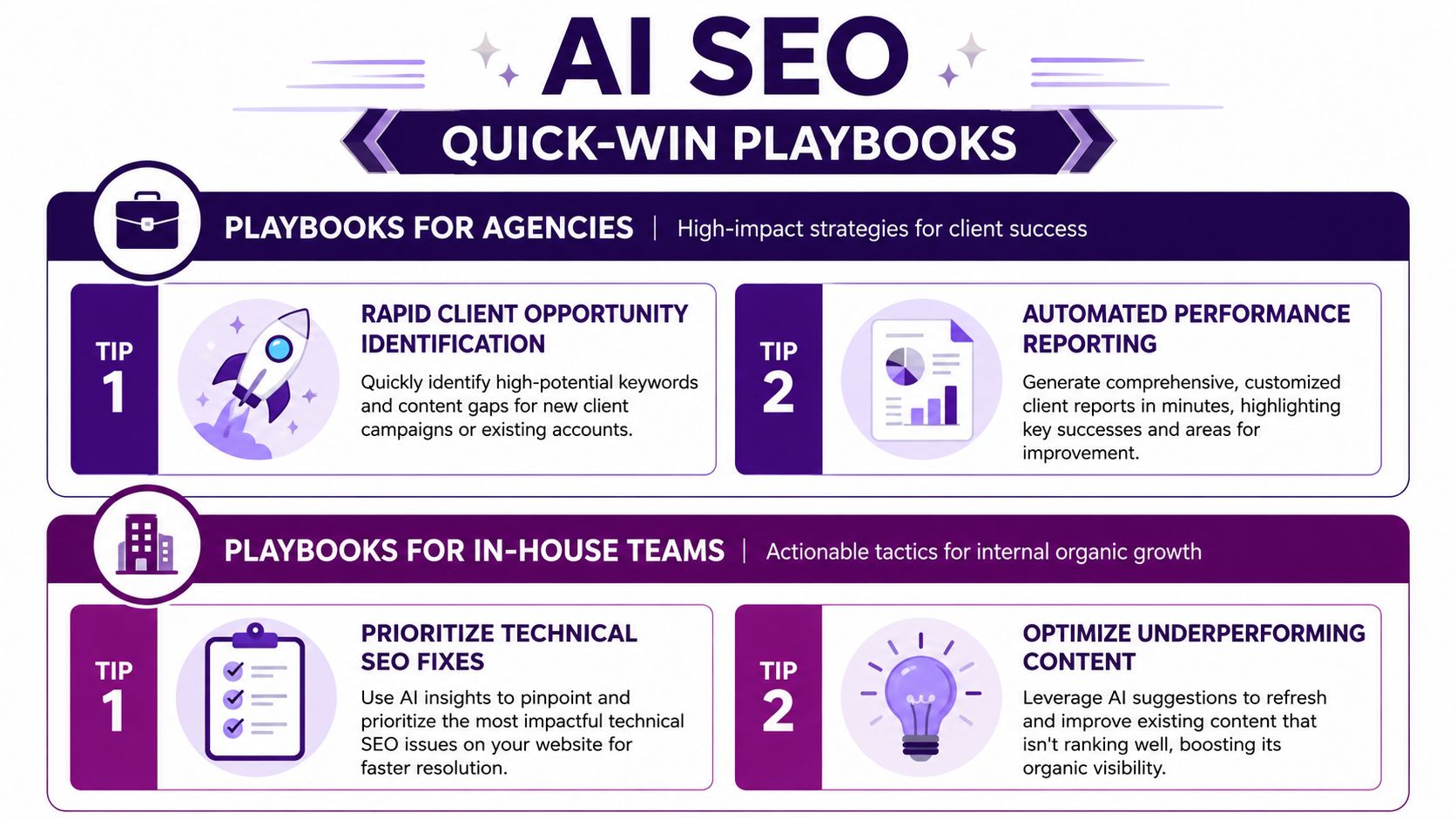
Playbook for agencies
Agencies usually need something repeatable across accounts.
A strong first play is page-two opportunity mining. Use the platform to identify client pages that already rank but haven't broken through. Then sort them by intent alignment, content gaps, internal linking weakness, and technical friction. The goal isn't to rewrite everything. It's to push near-performing assets with the highest chance of movement.
A practical sequence looks like this:
Pull a focused keyword set: Limit the first batch to terms tied to revenue-driving pages or high-priority service pages.
Review the page and SERP together: Check whether the existing page type matches what Google currently rewards.
Refresh only what matters: Update headings, missing entities, internal links, and obvious content gaps before attempting a full rebuild.
Report movement clearly: Show the client which changes were made and how visibility shifted afterward.
This becomes even more persuasive when agencies can tie AI visibility to business outcomes. Recent data cited by AdExchanger's analysis of search without clicks shows AI-crawled sites generate 3.2× more human traffic and 2.7× more form submissions, yet many platforms still don't visualize that correlation well.
Playbook for in-house teams
In-house teams usually benefit from technical prioritization first.
Their bottleneck isn't always finding the problem. It's deciding what deserves developer time. An AI-powered SEO platform can surface the fixes with the strongest likely impact on indexation, page quality, or discoverability, then group them in a way a product or engineering lead can understand.
A useful first sprint often includes:
Template-level crawl review to spot repeated issues across product, category, or article pages.
Schema and sitemap checks so machine-readable signals stay current.
Underperforming content review for pages that have visibility but weak engagement or poor intent match.
Ownership assignment so each recommendation has a person, not just a status label.
If you want more tactical ideas after the first sprint, these SEO quick wins for 2026 traffic pair well with platform-led prioritization.
The hidden value most guides overlook
Quick wins aren't only about ranking improvement.
They also create internal proof. Agencies need client confidence. In-house teams need executive confidence. A visible early result gives the platform social credibility inside the organization, which makes later adoption easier.
Early wins should be chosen for clarity, not complexity. Pick work where the before and after story is easy to show.
That's especially important in the AI search era. Some of your gains may show up as stronger qualified visits or lead actions rather than a simple increase in raw clicks. Teams that learn to explain that shift early will make better budget cases later.
Conclusion and Next Steps
An AI-powered SEO platform earns its place when it does three things well. It centralizes scattered search data, turns analysis into ordered action, and helps you tie visibility work to business results. The strongest teams evaluate reliability first, pilot with a controlled rollout, and use quick wins to build trust across content, SEO, and development.
Don't start with every feature. Start with one focused use case, set clear benchmarks, validate the data, and review the recommendations weekly. That's how you move from dashboard curiosity to operating discipline.
Keyword Kick helps teams do exactly that. If you want one workspace for rank tracking, technical SEO, backlinks, content opportunities, and AI-guided recommendations, explore Keyword Kick and test how a more unified SEO workflow fits your team.