
Collecting more phrases doesn't create better SEO. A large keyword list can just as easily produce duplicated pages, mismatched intent, wasted content budgets, and reports full of rankings that never influence the business.
Strong keyword research connects search intent, SERP evidence, business value, page ownership, achievable competition, and measurement. It tells an agency which client pages deserve attention this week, and it tells an in-house team whether a proposed article supports revenue, retention, or only superficial visibility. Search volume still provides context, but it isn't a strategy. An analysis of approximately 4 million Google search results found that the first organic result received an average 27.6% click-through rate, while the top three results captured 54.4% of clicks (analysis of Google search results). Position and intent determine the value of a keyword.
The workflow below treats keyword research as an operating system for SEO decisions. You'll learn how to classify intent, mine first-party data, find competitive gaps, group related terms, inspect SERP formats, connect keywords to funnel stages, test AI-assisted recommendations, and audit the portfolio over time. Platforms such as Keyword Kick can help agencies and in-house teams bring together Google Search Console, Google Analytics 4, rank tracking, competitor, backlink, audit, and SERP data, so research leads to a prioritized action rather than another abandoned spreadsheet.
If your work also includes Pinterest, you can apply the same principle by learning how to optimize pins with Pin Generator. The phrase matters less than the audience need, the format, and the action you want the visitor to take.
1. Analyze Search Intent to Match Content Strategy
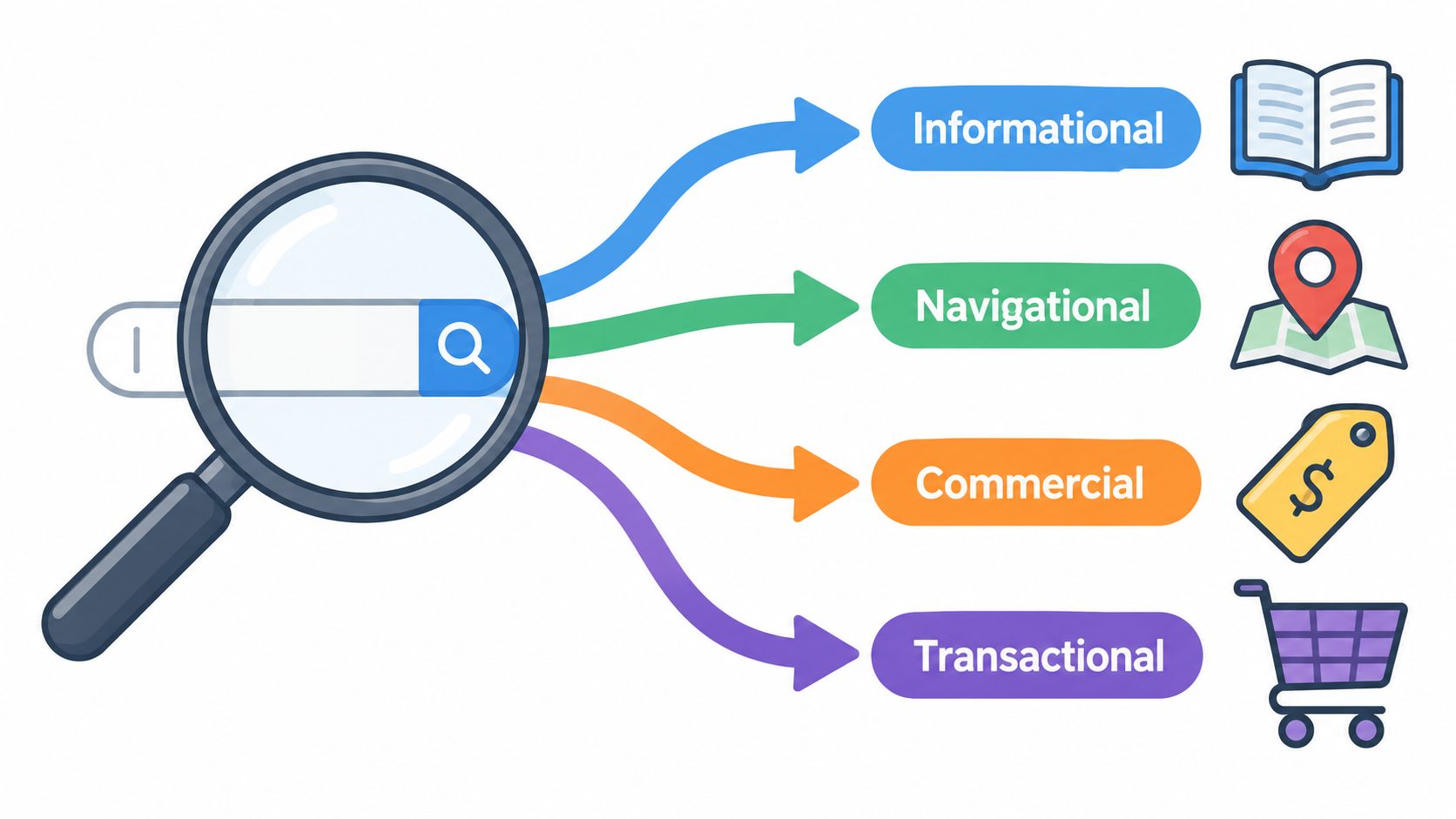
A keyword is incomplete without the reason behind it. Someone searching for “best project management tools” is comparing options, while someone searching for “how to use Asana” needs instruction. A query such as “Asana pricing” may signal commercial evaluation or readiness to buy, whereas “project management tools” could support a category page that helps users compare solutions.
The decision is simple: what page would genuinely satisfy the searcher? Search the term, inspect the leading results, and record the dominant format. If the SERP is filled with comparison pages, a generic definition probably won't compete. If Google returns tutorials, a product-led landing page may be the wrong asset.
Map intent to ownership
Assign each intent group to a page type before creating content.
- Informational queries: Use guides, tutorials, explainers, and troubleshooting content.
- Commercial queries: Use comparisons, reviews, alternatives pages, and buyer's guides.
- Transactional queries: Use product, service, pricing, registration, or category pages.
- Navigational queries: Improve branded pages and make the intended destination easy to find.
Google Search Console can show which queries already bring visibility to each page type. Review those query-page pairs, then compare clicks and conversions in GA4. A tutorial that attracts relevant visitors but never moves them toward a product page may need stronger internal links. A pricing page ranking for informational queries may need clearer answers, or it may indicate that a separate guide deserves ownership of that intent.
Practical rule: Don't ask whether a keyword is valuable until you've decided which page should own the searcher's next step.
Measure the result at the level that matches the intent. Use rankings and impressions for visibility, clicks for SERP appeal, and engaged sessions, leads, sign-ups, or sales for business impact. If the same keyword performs poorly with one format, test a different format rather than repeatedly rewriting the same page.
2. Target Long-Tail Keywords for Quick Wins and Lower Competition
Long-tail research should run as a portfolio of decisions, not a list of isolated low-volume phrases. Approximately 93% of keywords in Ahrefs' U.S. database generate fewer than 10 monthly searches (keyword benchmark from Colorlib). The practical implication is clear: a head-term-only process overlooks much of the search demand available to a site.
Compare “SEO tools” with “SEO platform for agencies.” The first phrase is broad and leaves the audience, need, and page type unclear. The second identifies a target group, a category under consideration, and a likely landing-page purpose. Similar signals appear in “best keyword research for ecommerce,” “how to fix Google Search Console errors,” and “WordPress technical SEO checklist.” Each query gives the content team a defined job.
Build clusters from specific demand
Begin with modifiers that reveal a problem, audience, use case, or comparison:
- Audience modifiers: for agencies, for startups, for ecommerce teams.
- Problem modifiers: fix, troubleshoot, audit, recover, improve.
- Evaluation modifiers: best, alternatives, comparison, versus.
- Task modifiers: how to, template, checklist, examples.
Group phrases only when they share intent and can be answered by one useful asset. A page about fixing Search Console errors can cover closely related questions without producing a thin URL for every variation. Check the live SERP before assigning ownership. An informational “how to” cluster may require a tutorial, while a “software” cluster may call for a product comparison.
Use Keyword Kick's long-tail keyword workflow to find related variations, filter opportunities, and organize terms into topic groups. If those clusters support scaled page creation, follow this programmatic SEO strategy guide to keep expansion structured rather than repetitive.
Score each cluster for relevance, ranking attainability, business value, existing URL coverage, and observed SERP intent. Then measure impressions, clicks, and conversions across the cluster, rather than judging one phrase alone. This turns keyword research into an operating system for page planning and testing.
The trade-off remains practical. Each long-tail term may bring limited traffic, but a well-matched cluster can provide clearer page direction and more attainable targets. Keep a cluster when its combined performance supports a business goal. Split or retire it when the SERP, audience, or results no longer justify one asset.
3. Use Competitor Analysis to Identify Ranking Gaps and Opportunities
A competitor report becomes useful only when it explains which gaps matter to your audience and which gaps your site can realistically close. Treat it as a decision layer in the keyword research operating system, not a list of terms to copy.
Begin with direct competitors serving the same market. Large publishers may rank for related topics without competing for your customers. If a competitor ranks for “keyword research tools comparison” and your site has no relevant page, you may have a missing-topic opportunity. If you rank for “SEO platform” while another domain ranks for “SEO platform for agencies,” the opportunity may be a page for a defined audience or use case, rather than another generic overview.
For each gap, record the reason it exists and the action it suggests:
- Intent: Has the competitor addressed a search need your site ignores?
- Page quality: Is its content clearer, fresher, more complete, or better formatted?
- Authority: Do relevant backlinks help explain its position?
- Business fit: Would the resulting traffic match the audience you serve?
The action depends on the diagnosis. A competing page supported by an original template, calculator, or research asset may require a comparable asset, not a longer article. A thin competitor page ranking while your existing URL sits deep in the results points to a different test: improve intent alignment, strengthen the page, and review internal links before creating a new URL.
Keep a time series of competitor positions and newly published pages. A snapshot can make a temporary advantage look permanent, or hide a competitor's recent entry into the topic. Keyword Kick's competitor and backlink analysis can connect ranking gaps with the pages and authority sources behind them.
Assign each opportunity an owner, target URL, proposed change, and review date. Evaluate the work using share of relevant visibility, target-page movement, and qualified conversions. The number of missing terms imported into a spreadsheet is only an inventory measure. A worthwhile gap is one your team can serve better, connect to a cluster or business goal, and test with a clear success signal.
4. Mine Google Search Console for Untapped Keywords and Low-Hanging Fruit
A guide can rank for a query and still lose the click. Google Search Console helps identify that gap because its Performance report shows the queries, impressions, clicks, and CTR associated with your site (Google Search Console Performance report).
Start with query-page pairs, then segment them by device, country, page type, and average position. A product page with strong impressions and weak CTR may need a clearer value proposition in its title and snippet. A guide with the same pattern may need a more direct title, a tighter introduction, or a format that answers the query sooner. The decision depends on the page's intent, not on impressions alone.
Create an opportunity queue around four checks:
- Visibility already exists: The URL earns impressions or sits near the first page.
- The intent fits: The query belongs on the current page, or it signals a missing page type.
- The click signal is weak: CTR trails comparable queries or pages.
- The change is testable: The team can revise the title, description, structure, or copy without changing the URL.
Assign each opportunity a target URL, proposed change, owner, and review date. Change one meaningful element at a time where practical, then compare CTR, clicks, average position, and conversions across a stable period. Record seasonality, ranking movement, device mix, and SERP changes so a snippet test does not receive credit for an unrelated shift.
Search Console is a validation layer, not a complete keyword database. Rare queries may be omitted for privacy, so combine its findings with live SERP checks and discovery tools. Use those sources to generate possibilities, then use first-party query and conversion data to decide which pages deserve work.
A page with fewer clicks but strong lead quality may outrank a high-impression term in the queue. Keyword Kick connects GSC findings with rank tracking, page audits, and conversion context, helping teams turn an observation into a defined optimization task. The useful output is not a larger spreadsheet. It is a tested change tied to page performance and business value.
5. Implement Keyword Clustering to Organize Related Terms and Reduce Cannibalization
A cluster should answer one operational question: Which URL should own this search need? For example, “keyword research,” “how to do keyword research,” and “best keyword research tools” may fit a pillar page with supporting content, while “SEO for ecommerce” and “ecommerce keyword research” may require a dedicated ecommerce topic. The decision depends on shared intent and the content format searchers receive, not on how many phrases a tool groups together.
Start with a manageable set of terms. Search each variation manually, compare the ranking pages, and record recurring URLs and SERP formats. If Google returns largely the same pages, assign the terms to one cluster and one primary URL. If the results differ sharply, create separate clusters only when the audience, task, or funnel stage also differs. Manual review establishes the rules before automation scales the process across an agency or in-house site.
Assign secondary terms to the page brief, then map supporting pages and their internal links to the main resource. Search volume and difficulty can refine the order of work, but they should not decide ownership. This map becomes part of the SEO operating system: it connects research, content planning, page production, and later performance reviews.
Cannibalization appears when two URLs send mixed signals for the same intent. Check query-page pairs in GSC, ranking history, titles, headings, and backlinks. Then select one remedy:
- Consolidate: Merge overlapping pages when one stronger resource can cover the intent.
- Redirect: Retire the weaker URL when its useful value is fully represented elsewhere.
- Differentiate: Rework each page for a distinct audience, task, or funnel stage.
- Link deliberately: Clarify the relationship between a hub and its supporting pages.
Evaluate the cluster as a group through combined impressions, clicks, and conversions, while tracking whether the intended page holds the ranking. Rank tracking can show whether variations move together or whether several URLs continue competing. Agencies should review the map before approving each content brief. That check prevents a client's publishing schedule from creating avoidable overlap and gives every new page a defined role.
6. Monitor Keyword Difficulty and Track Performance Over Time
Keyword difficulty is a directional estimate, not a final decision. Tools usually assess signals such as the authority and backlink profiles of ranking pages. They may miss your topical relevance, content quality, internal links, brand demand, and the SERP format your page must compete within.
Use difficulty to set the work sequence, then apply business context. A high-difficulty term with weak intent fit rarely deserves immediate investment. A moderately competitive query can be a stronger target when it matches your product, an existing page, and the authority your site has already built. Search volume alone should not determine the choice.
Score each opportunity against five questions:
- Business relevance: Does the query support a product, service, lead, or strategic audience?
- Current visibility: Is an existing page close to useful visibility?
- SERP attainability: Do the ranking pages resemble the resource your team can produce?
- Content effort: Can you make the page clearly more useful for the same intent?
- Conversion evidence: Does GA4 associate this intent with valuable actions?
A page already positioned near the top may produce a better return than a new page aimed at a broad term. Record its baseline rank, landing page, impressions, clicks, qualified sessions, and conversions before changing the title, content, links, or format. Use the earlier analysis of approximately 4 million Google results as context for valuing position changes, not as a reason to pursue every high-volume query.
Use track SEO rankings to monitor page ownership and trend direction. Review brief windows for diagnostics, but judge progress across a longer historical window. A temporary drop may reflect daily volatility. A sustained decline deserves comparison with competitor changes, content edits, technical problems, algorithm updates, and SERP features.
Set a review rule before publishing. For example, reallocate effort when ranking movement improves without qualified traffic, or when clicks rise but conversions do not. Measure ranking movement, organic clicks, qualified sessions, assisted conversions, and direct conversions. Difficulty should guide resource allocation while performance evidence determines whether the strategy continues.
7. Analyze SERP Features to Understand Content Requirements and Ranking Factors
The SERP tells you what Google expects before you write. A query that returns a paragraph featured snippet calls for a concise definition or explanation. A query that surfaces lists or tables calls for structured information. A query dominated by videos, local results, shopping results, or product carousels may require a different asset entirely.
Search your priority terms and record the visible features. Look at the leading pages, the questions in People Also Ask, the wording of titles, and the amount of space given to paid and organic results. Don't assume every feature creates more clicks. Some features answer the query directly, while others help users compare providers or discover a specific source.
Build the page around the observed format
For a query such as “how to make pizza dough,” place a clear process and answer near the top. For “tallest mountains in the world,” a well-structured list or table may serve the need better than several dense paragraphs. For “best laptops,” comparison criteria, product details, and clear evaluation methods matter more than repeating the phrase throughout the copy.
Use People Also Ask questions as research prompts, not as an excuse to add disconnected FAQs. Add only the questions that belong to the same intent and answer them accurately. Structured data can clarify content, but it doesn't guarantee a feature or compensate for weak information.
Track whether your page owns or appears in relevant SERP features, then connect that visibility to clicks and conversions. A feature may improve brand exposure without producing a proportional traffic increase. Keyword Kick's SERP feature monitoring tips can support a recurring review of changing result layouts.
The trade-off is between feature optimization and page usefulness. Format your content for retrieval and scanning, but don't distort the resource to chase a snippet that doesn't support the searcher's next action.
8. Segment Keywords by Business Funnel Stage to Align Content with Customer Journey
Keyword research becomes commercially useful when it explains where a searcher is in the decision process. Awareness queries introduce a problem. Consideration queries compare approaches or providers. Decision queries signal readiness to choose. Retention queries help existing customers use, troubleshoot, or expand a solution.
For a keyword such as “what is keyword research,” an educational guide may be appropriate. “Best keyword research tools” calls for comparison criteria and alternatives. “Buy keyword research tool,” “Keyword Kick pricing,” or “start free trial” suggests a page with product information and a clear next action. A retention query such as “how to use Keyword Kick” belongs in documentation or an advanced customer resource.
Make the funnel measurable
Map each keyword group to a page type and a conversion path. Awareness content should answer the question directly while making a relevant next step visible. Consideration content should help the reader evaluate options objectively. Decision pages need proof, feature clarity, friction reduction, and a direct call to action. Retention content should reduce support effort and create opportunities for deeper product adoption.
Use GA4 to compare the quality of traffic from each stage. Don't judge awareness content only by last-click conversions, because its role may be to introduce the brand before a later branded or decision-stage visit. At the same time, don't use attribution complexity to excuse content that attracts irrelevant visitors. Review assisted conversions, return visits, sign-ups, leads, product engagement, and sales quality together.
A funnel map also exposes content imbalance. A site with many introductory guides but no comparison or decision pages may earn attention without capturing demand. A site with only product pages may lack the topical coverage that helps new buyers understand the problem.
Measure each stage by its job: visibility and engaged visits for awareness, comparison engagement and assisted actions for consideration, conversions for decision, and activation or support outcomes for retention. The right mix depends on the business, audience, sales cycle, and existing content, so fixed percentage formulas are less useful than evidence from your own customer journey.
9. Use AI and Machine Learning to Identify Patterns and Predict Keyword Opportunities
AI can process large keyword sets faster than a human team, but speed isn't the same as accuracy. Use it to surface patterns, cluster related terms, identify possible gaps, and summarize evidence. Keep the final decision with a practitioner who understands the audience, product, SERP, and commercial context.
An AI system might notice that several related queries lead to the same competitor pages, or that your site ranks for many variations without a dedicated comparison page. Those are useful hypotheses. They still need validation in Search Console, GA4, live SERPs, competitor research, and the content inventory.
Treat AI recommendations as testable hypotheses
A sound workflow looks like this:
- Ground the analysis: Give the system validated GSC, GA4, rank, page, and conversion data.
- Ask a decision question: For example, which existing pages deserve optimization first?
- Request evidence: Require the recommendation to identify the queries, URLs, trends, and business signals behind it.
- Check the SERP manually: Confirm that the proposed content type and intent are correct.
- Run the change: Update a defined page or cluster rather than changing the whole site.
- Review accuracy: Compare the recommendation with the observed result and refine future prompts.
Avoid unsupported predictions about future demand, ranking gains, or content length. A model can generate a plausible keyword that nobody uses, misclassify a commercial query as informational, or recommend a page that duplicates an existing asset. Human review protects against those errors.
AI Overviews make this validation more important. A March 2025 study of U.S. adults found that visits containing an AI summary led to a click on a cited source or standard result 8% of the time, compared with 15% when no AI summary appeared (Search Engine Journal coverage of the Pew study). That doesn't mean every AI Overview query lacks value. It means teams should distinguish answerable informational searches from queries where users still need a product, comparison, tool, provider, or original source.
Keyword Kick's K² AI Agent can be used as an analysis layer across connected SEO data. Measure it by recommendation accuracy, time saved, completed actions, and business outcomes, not by the number of generated ideas.
10. Conduct Regular Keyword Audits to Maintain List Accuracy and Remove Underperformers
A keyword list loses value when it stops reflecting the site, the market, or the customer. New competitors publish pages, existing pages change intent, SERPs add features, and business priorities shift. A quarterly audit can identify what deserves more investment, what needs consolidation, and what should leave the active roadmap.
Start with a working record containing the keyword, assigned URL, intent, funnel stage, current visibility, previous visibility, clicks, conversions, business value, and next action. Review the actual query-page relationship in GSC instead of trusting an old rank export. A target phrase may have become irrelevant, while an unexpected query may reveal a better page opportunity.
Decide what stays active
Use clear decisions rather than deleting terms casually:
- Optimize: Keep the URL when the intent fits and the page has a realistic path upward.
- Expand: Add missing subtopics when the page earns visibility for related demand.
- Consolidate: Merge overlapping URLs when they compete for one intent.
- Archive: Remove a term from active production when it no longer supports the audience or business.
- Monitor: Retain strategically important terms whose demand or SERP behavior is changing.
A declining click trend needs investigation before a page is labeled a failure. The cause may be a ranking loss, a competitor improvement, a title problem, seasonality, a technical issue, or more direct SERP answers. Historical data helps separate those explanations. Keyword priorities can shift quickly: an analysis of more than 10 million keywords reported AI Overview coverage rising from 6.49% in January 2025 to nearly 25% in July, then falling below 16% by November (Semrush AI Overviews study). The same study reported commercial-query coverage changing during that period, which reinforces the need to monitor SERP composition rather than treating a keyword list as permanent.
Measure an audit by the actions it creates: improved page ownership, fewer overlapping URLs, stronger CTR, recovered rankings, better conversion alignment, and a cleaner publishing queue. Keyword Kick can centralize rank history, GSC findings, audits, competitors, and SERP features to make those reviews repeatable across client accounts or brand teams.
10-Point Keyword Research Tips Comparison
| Strategy | Implementation Complexity 🔄 | Resource Requirements & Speed ⚡ | Expected Outcomes 📊⭐ | Ideal Use Cases 💡 |
|---|---|---|---|---|
| Analyze Search Intent to Match Content Strategy | 🔄 Moderate, manual intent mapping + SERP review | ⚡ Medium, analyst time + SERP tools; ongoing monitoring | 📊 Better relevance & lower bounce; ⭐ High conversion alignment | 💡 Prioritizing keywords for conversion pages and content planning |
| Leverage Long-Tail Keywords for Quick Wins and Lower Competition | 🔄 Low, focused research and targeted pages | ⚡ Fast per opportunity but needs many pages; low CPC | 📊 Quick ranking gains; ⭐ Medium–High conversion lift | 💡 New sites, niche targeting, fast visibility wins |
| Use Competitor Analysis to Identify Ranking Gaps and Opportunities | 🔄 Moderate, competitor selection + comparative audits | ⚡ Medium, tools + recurring analysis; can yield quick targets | 📊 Reveals high-value gaps; ⭐ High for strategic targeting | 💡 Competitive markets, benchmarking, filling content gaps |
| Mine Google Search Console for Untapped Keywords and Low-Hanging Fruit | 🔄 Low, uses existing verified data; filtering required | ⚡ Very fast, immediate actionable insights; minimal cost | 📊 Quick CTR & title/meta improvements; ⭐ High for existing pages | 💡 Improve underperforming pages; prioritize high-impression low-CTR terms |
| Implement Keyword Clustering to Organize Related Terms and Reduce Cannibalization | 🔄 High, manual grouping or advanced clustering tools | ⚡ Moderate → slow setup; long-term efficiency gains | 📊 Reduced cannibalization & stronger topical authority; ⭐ High | 💡 Large sites, content architecture, internal linking strategies |
| Monitor Keyword Difficulty and Track Performance Over Time | 🔄 Low–Moderate, tool-driven scores + trend tracking | ⚡ Ongoing monitoring; automated alerts speed workflow | 📊 Realistic prioritization & ROI clarity; ⭐ Medium–High for resource allocation | 💡 Prioritizing targets, budgeting, new vs. established domain strategy |
| Analyze SERP Features to Understand Content Requirements and Ranking Factors | 🔄 Moderate, variable by device/location; frequent checks | ⚡ Time-intensive at scale; requires SERP tracking tools | 📊 Improved CTR & format-fit content; ⭐ High for SERP-feature keywords | 💡 Featured snippet, PAA, and rich-result optimization |
| Segment Keywords by Business Funnel Stage to Align Content with Customer Journey | 🔄 Moderate, mapping keywords to funnel stages | ⚡ Ongoing process; needs analytics integration (GA4) | 📊 Better conversion alignment and reporting; ⭐ High for business impact | 💡 Align SEO with revenue goals and client reporting |
| Use AI and Machine Learning to Identify Patterns and Predict Keyword Opportunities | 🔄 Moderate–High, requires quality data and model tuning | ⚡ Very fast and scalable once set up; requires investment | 📊 Scalable pattern detection and predictions; ⭐ High with validation | 💡 Large datasets, agencies, and portfolio-scale research |
| Conduct Regular Keyword Audits to Maintain List Accuracy and Remove Underperformers | 🔄 Moderate, repeatable audit process | ⚡ Periodic effort; faster with automation and rank tracking | 📊 Keeps strategy current; reduces wasted effort; ⭐ Medium–High | 💡 Portfolio maintenance, quarterly health checks, pruning underperformers |
Turn Research Into a Weekly SEO Operating Loop
Keyword research works when it becomes a decision loop. Start with the business outcome, not the keyword tool. Decide whether the priority is qualified leads, product sales, category visibility, customer activation, or authority in a strategic topic. That decision determines which intent and funnel stages deserve attention.
Next, collect evidence from several directions. Use customer language from sales calls, support conversations, onboarding questions, and product feedback. Use GSC to see the queries and pages already producing impressions and clicks. Use GA4 to understand engagement and conversion quality. Use competitor and backlink data to identify gaps, authority patterns, and pages worth studying. Then inspect live SERPs, because a keyword tool can't fully describe the format, features, ads, local results, shopping elements, or AI summaries that influence click potential.
Cluster the evidence by intent and assign each cluster to a page. A page map should state the primary query group, supporting variations, funnel stage, intended format, internal links, current URL, and business action. This prevents an agency from publishing several articles that answer the same question and helps an in-house team explain why a product page, comparison page, or guide belongs in the roadmap.
Score opportunities using business relevance, existing visibility, attainable competition, content effort, SERP click potential, and conversion evidence. Search volume can inform the decision, but it shouldn't overrule a strong first-party signal or a poor intent match. A lower-demand query that reaches a ready buyer may be more useful than a broad informational term that Google answers directly.
Then choose a small set of actions for the week. Optimize a title and description for an impression-rich page with weak CTR. Rewrite a page whose format conflicts with the SERP. Consolidate two URLs competing for the same cluster. Create a comparison page where competitors own a commercially important gap. Improve internal links from an awareness guide to a consideration or decision page. Each action needs a defined URL, hypothesis, owner, and measurement window.
Agencies can make this client-ready with a compact recurring workflow:
- Monday: Review ranking changes, GSC query-page opportunities, technical alerts, and competitor movement.
- During planning: Select priorities by client goal, intent, page ownership, effort, and conversion value.
- During production: Brief content around the observed SERP format and cluster, then connect it to the relevant commercial page.
- During reporting: Show rankings, clicks, CTR, conversions, page progress, and unresolved risks, not just keyword counts.
- During review: Archive stale targets, identify new demand, and document why priorities changed.
In-house teams can use the same loop with a deeper monthly review and a broader quarterly audit. Keep a live list for emerging queries, a stable set of priority terms for trend analysis, and a page map that records ownership. Review AI Overview presence, featured snippets, shopping results, local packs, and other SERP changes by market and device. A drop in clicks doesn't always mean demand disappeared. Searchers may be completing more tasks on the results page, while product research, branded searches, and high-consideration queries may still justify strong investment.
Keyword Kick is one optional workspace for connecting GA4, GSC, rank tracking, backlinks, technical audits, competitor analysis, keyword research, and SERP feature data. Its K² AI Agent can help teams ask data-focused questions such as which pages should be optimized first or why visibility changed, while practitioners retain responsibility for validating the recommendation and implementing the work.
The operating principle is straightforward. Discover demand, classify intent, assign ownership, prioritize by business value, act on the strongest evidence, and measure what changed. Repeat that loop often enough, and keyword research stops being a static list. It becomes the system that guides content, technical SEO, internal linking, competitive response, and weekly marketing decisions.
Keyword Kick brings keyword discovery, intent analysis, clustering, GSC and GA4 insights, rank tracking, competitor research, backlinks, audits, and SERP features into one SEO workspace for agencies, brands, and in-house teams. Use it to turn fragmented search data into prioritized page improvements, then visit Keyword Kick to explore the platform and connect your keyword research workflow.