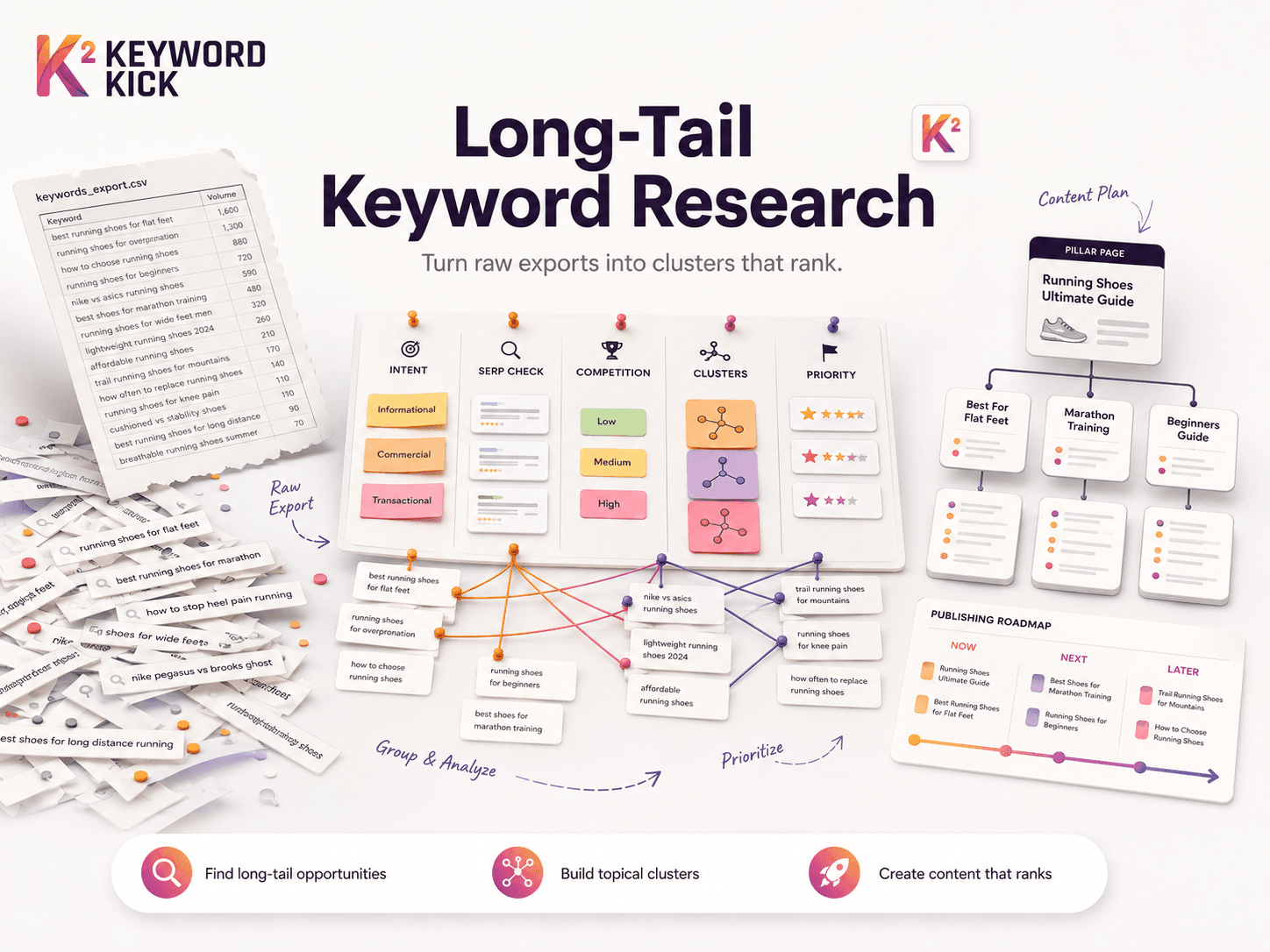
You open a long tail keyword research tool, enter a broad topic, and export a spreadsheet with hundreds or thousands of phrases. At first, that feels productive. Ten minutes later, it becomes obvious that most of the list is noise.
Some terms are too broad. Some are oddly phrased. Some look promising in a tool but make no sense once you search them manually. And some of the best opportunities don't even show meaningful volume.
That's where most keyword research breaks down. The problem usually isn't idea generation. It's turning raw keyword output into a content plan that matches intent, fits your site, and has a realistic path to ranking.
The Problem with Most Keyword Research
Many organizations treat keyword research like data collection. They pull a list, sort by volume, hide anything that looks too small, and start assigning articles. That process creates busywork more often than results.
The biggest mistake is assuming each keyword should justify itself on its own. Long-tail terms rarely look impressive in isolation. But that's the wrong lens.
Long-tail keywords, typically phrases with three or more words, account for approximately 70% of all web search traffic globally, according to Ahrefs' long-tail keyword analysis. That matters because these phrases usually reflect a clearer need. They also tend to be more accessible for newer sites that can't compete for broad head terms.
Why raw exports fail
A keyword tool doesn't know your business model, your content depth, or whether a query deserves a landing page, a comparison post, or a short FAQ section. It only gives you signals.
The main work starts after export:
Cut terms with the wrong intent: If the SERP shows product pages and you're planning a blog post, you're already misaligned.
Combine related phrasing: Five low-volume variants often belong on one page.
Ignore vanity volume: A bigger number doesn't help if the query is vague and the user isn't close to action.
Check fit with site authority: A term can be low difficulty in a tool and still be a bad target if the SERP is packed with strong brands and better content formats.
Practical rule: A keyword list is not a strategy. It's raw material.
A workable long-tail workflow does four things well. It finds ideas beyond obvious tool suggestions. It validates intent manually. It evaluates competition as a portfolio, not just one term at a time. Then it groups and prioritizes the list into clusters you can publish against.
That's what separates useful research from a spreadsheet graveyard.
Beyond the Obvious Uncovering Raw Long-Tail Ideas
The fastest way to get weak keyword ideas is to start and stop with one seed term in one tool. Good long-tail research begins wider. You need language from customers, support tickets, review sites, competitors, forums, and search results themselves.

Start with modifiers, not just topics
Take a core topic and force variation around it. Don't just search "running shoes" or "email marketing software." Expand the phrase with intent-heavy modifiers.
A few patterns consistently surface useful long tails:
Question modifiers: how to, why does, what is, when should
Comparison modifiers: vs, alternative, compare, difference between
Commercial modifiers: best, review, pricing, worth it
Problem modifiers: fix, troubleshoot, not working, slow
Audience modifiers: for beginners, for agencies, for small business, for seniors
Context modifiers: near me, online, with template, without ads
These aren't just tricks to increase word count. They reveal what stage of the journey the user is in and what type of page will likely satisfy them.
Mine places tools underrepresent
Keyword databases are useful, but they flatten nuance. Real people don't speak in neat head terms. They ask messy, specific questions.
That's why I look beyond standard suggestions and pull language from:
Reddit threads
Quora discussions
Niche forums
YouTube comments
Support docs and customer reviews
Google autocomplete and People Also Ask
The "zero-volume long tail" is often ignored by mainstream workflows, even though tools can report 0 searches while real traffic still exists, especially for ideas surfaced from Reddit, niche communities, and LLM-generated question mining, as discussed in this Reddit conversation about long-tail and zero-volume research.
A tool saying "0" doesn't mean nobody searches it. It often means the database hasn't modeled it well.
For a practical primer on how these phrases differ from broad keywords, the guide on long-tail keywords is useful context before you start filtering lists.
Borrow angles from competitors carefully
Competitor research is useful when you treat it as inspiration, not a cloning exercise. You're not looking for every keyword they rank for. You're looking for patterns they haven't covered extensively, or intent slices they missed.
One effective angle is to uncover competitor keyword gaps and then compare those gaps against the questions your audience asks in communities. If both sources point to the same theme, that's usually worth deeper review.
The best raw ideas usually sound like something a customer would actually type, not something an SEO tool generated from a stem word.
Decoding User Intent and SERP Crowds
A keyword list looks promising until you open the SERP and realize Google is ranking a different kind of page than you planned to publish.
That is the point where good long-tail research usually separates from busywork. A phrase can have clear wording, decent volume, and low reported difficulty, then still fail because the searcher wants comparison content, a product page, or a quick answer instead of a general article.
Classify intent before you score the keyword
Start by labeling the query based on the outcome the searcher likely wants. Keep it simple.
Intent type | What the user wants | Common page type |
|---|---|---|
Informational | Learn or solve a problem | Guide, tutorial, FAQ |
Commercial | Compare options before choosing | Comparison, review, category page |
Transactional | Take action now | Product page, service page, signup page |
Navigational | Reach a specific brand or page | Homepage, branded landing page |
This step sounds obvious. It gets skipped all the time.
A junior SEO might see "best CRM for nonprofits" and map it to a broad educational guide. In many SERPs, that query favors comparison pages, list posts, and software directories. If the winning format is commercial investigation, a pure how-to article is the wrong asset even if the phrase looks attractive in a tool.
Read the SERP like a market check
Open the query manually. Then review the first page the way you would review competitors before launching an offer.
Look for patterns in four areas:
Page type: blog posts, landing pages, product pages, forums, videos, or category pages
SERP features: featured snippets, People Also Ask, video blocks, shopping results, local packs, AI overviews
Content angle: beginner vs. expert, cheap vs. premium, local vs. national, broad vs. use-case-specific
Freshness: recently published pages, updated pages, or older evergreen results that still hold position
The goal is not to count blue links. The goal is to identify what Google has already validated for that query.
If every top result is a product category page, publishing a blog post usually creates extra work for little return. If the SERP is crowded with thin forum threads, weak affiliate posts, or outdated articles, that is often a stronger signal than a low difficulty number in a dashboard.
Teams using a keyword research workflow built around real query validation tend to make better page-type decisions because they check intent and SERP format before they start scoring opportunities.
Watch for split intent
Some long-tail phrases look precise but still produce mixed results. That usually means Google has not settled on one dominant interpretation.
For example, "best payroll software for restaurants" can return list posts, software vendor pages, Reddit discussions, and review sites in the same top results. That tells you two things. Searchers are still comparing options, and Google is willing to test multiple content formats.
Treat split intent as a caution flag, not an automatic rejection.
If you have strong authority and a clear angle, a mixed SERP can be an opening. If your site is newer, split intent often means slower rankings because you are competing against several page models at once. In that case, I usually look for a cleaner variant such as "restaurant payroll software comparison" or "payroll software for small restaurants" and test the SERP again.
Check whether the query can actually convert
This is the part basic keyword guides miss. Intent is not just about choosing between informational and transactional. It is about deciding whether the query sits close enough to a business outcome to deserve content resources.
Ask practical questions:
What decision is the searcher trying to make?
What objection or uncertainty shows up in the current results?
Can our page remove that uncertainty better than what ranks now?
Does this query belong on a standalone page, or as a section inside a broader asset?
A phrase can match your product and still be a poor target if the SERP shows low buying urgency, weak topic fit, or a format your site cannot credibly publish.
Use question patterns carefully
Question-led long-tails matter more now because search behavior is more conversational across search engines, communities, and AI interfaces. But a question format does not automatically mean "write an FAQ post."
Compare the phrasing with the actual SERP. A query that starts with "how," "why," or "can" can still lead to product-led pages if the searcher is close to choosing a solution. Search Console is useful here because it shows the exact wording people already use to find your site. Those terms often reveal higher-intent variants that keyword databases understate.
A quick review standard for the team
Before a keyword moves forward, I want five answers:
What is the dominant intent?
Which page format is winning?
Which subtopics repeat across top results?
Where are the weak spots in those results?
Can we publish a page that fits the SERP better than what is already there?
If those answers are fuzzy, the keyword is not validated yet. It is still only a candidate.
Gauging Real Competition and Cumulative Volume
Metrics help. They just shouldn't make decisions on their own.
Teams often overreact to two numbers in a long tail keyword research tool: keyword difficulty and monthly search volume. They treat both as fixed truth. In practice, they're directional.
Use filters to narrow, not to decide
Low difficulty doesn't guarantee an easy win. High difficulty doesn't automatically mean "don't touch." Search volume also needs context. A phrase with modest volume but strong intent and a weak SERP can outperform a broader term that looks better in a dashboard.
That said, filtering still matters because it cuts dead weight fast.
A practical benchmark from ClickRank's long-tail research guidance is to focus on phrases with difficulty scores in the 0 to 30 range and at least 10 monthly searches, then evaluate them as a group rather than one by one. The same source notes that aggregating traffic from 1,000+ of these phrases can outperform a single competitive short-tail keyword and can deliver a 30% higher ROI for new sites.
That changes how you evaluate the list.
Think in portfolios, not single keywords
A good long-tail program doesn't depend on one breakout keyword. It builds traffic through many closely related searches that point to the same page or cluster.
Here's the mindset shift:
Weak evaluation | Better evaluation |
|---|---|
"This keyword only has low volume" | "This keyword belongs to a cluster with shared intent" |
"This one term won't move traffic" | "This page can rank for many variations" |
"The number looks too small" | "The cumulative opportunity may be strong" |
This is why a broad export often feels underwhelming at first. You're looking at fragments. The value appears when you consolidate terms by intent and topic.
For a more integrated view of those metrics inside a broader workflow, a dedicated keyword research feature set helps connect raw keyword ideas with ranking context and page planning.
What not to do
Some filtering habits create false confidence.
Don't discard every tiny term immediately: Very specific phrases often map to high-intent pages or become part of a stronger cluster.
Don't trust difficulty without SERP review: A low score can hide strong incumbent pages.
Don't chase broad terms because they look impressive: Broad traffic often comes with weak alignment and low conversion quality.
Don't compare one long-tail term against one head term in isolation: That's not how long-tail traffic accumulates.
Field note: The wrong question is "Is this one keyword big enough?" The better question is "Does this phrase strengthen a page or cluster with real buying or problem-solving intent?"
When you use metrics as a filter, not a verdict, your shortlist gets sharper fast.
Structuring Your List into Topic Clusters
A validated keyword list still isn't a publishing plan. It becomes usable when you group phrases by shared intent and assign each group to the right page type.
That's where topic clusters do the heavy lifting.
Build around pillars and supporting pages
Think of a cluster as one main topic with supporting subtopics around it.
A pillar page targets the broad subject and gives the topic a central home.
Cluster pages go deeper on specific long-tail angles, questions, comparisons, or use cases.
Internal links connect those pages so search engines and users can move through the subject naturally.
This structure works because it mirrors how users search. They rarely stop at one query. They explore the broader topic, then refine into specifics.
According to Link-Assistant's long-tail methodology overview, practitioners often build clusters around a pillar page with 10 to 20 related long-tail variations, and this approach is associated with a 40% increase in organic traffic retention compared with single-post strategies.
Group by intent first, wording second
Don't cluster purely by phrase similarity. Cluster by what the user is trying to accomplish.
For example, these might belong together:
best project management software for architects
project management tools for architecture firms
architecture project management software reviews
They don't need separate articles if the intent is the same. One strong commercial comparison page can likely cover them.
These usually don't belong together:
what is project management software for architects
best project management software for architects
Same topic. Different stage. Different page.
A simple clustering process
When sorting a spreadsheet, use this order:
Mark the primary intent for each keyword.
Assign a page type such as guide, comparison, service page, or product page.
Combine near-duplicates and close variants.
Name the cluster based on the central user need, not the exact keyword wording.
Choose one primary target phrase and keep the rest as supporting variations.
A cluster should answer one core need well. If the page tries to serve two different intents, split it.
What a clean cluster looks like
A solid cluster has boundaries. You should be able to explain in one sentence why the keywords belong together and what the pillar or supporting page will do.
If you can't, the grouping is probably too loose.
Prioritizing Clusters for Maximum Impact
A clustered keyword list still creates one hard constraint. content capacity. You can map fifty good opportunities and still only have budget, writers, and design support for five this quarter.
That is why cluster prioritization needs to happen at the business level, not the keyword level.
Score clusters by expected return, not just search demand
A cluster with modest volume can outperform a higher-volume topic if it sits closer to revenue and fits what your site can realistically rank for now. I would rather back a cluster that can produce qualified demos in three months than a flashy term that needs a year of link building.
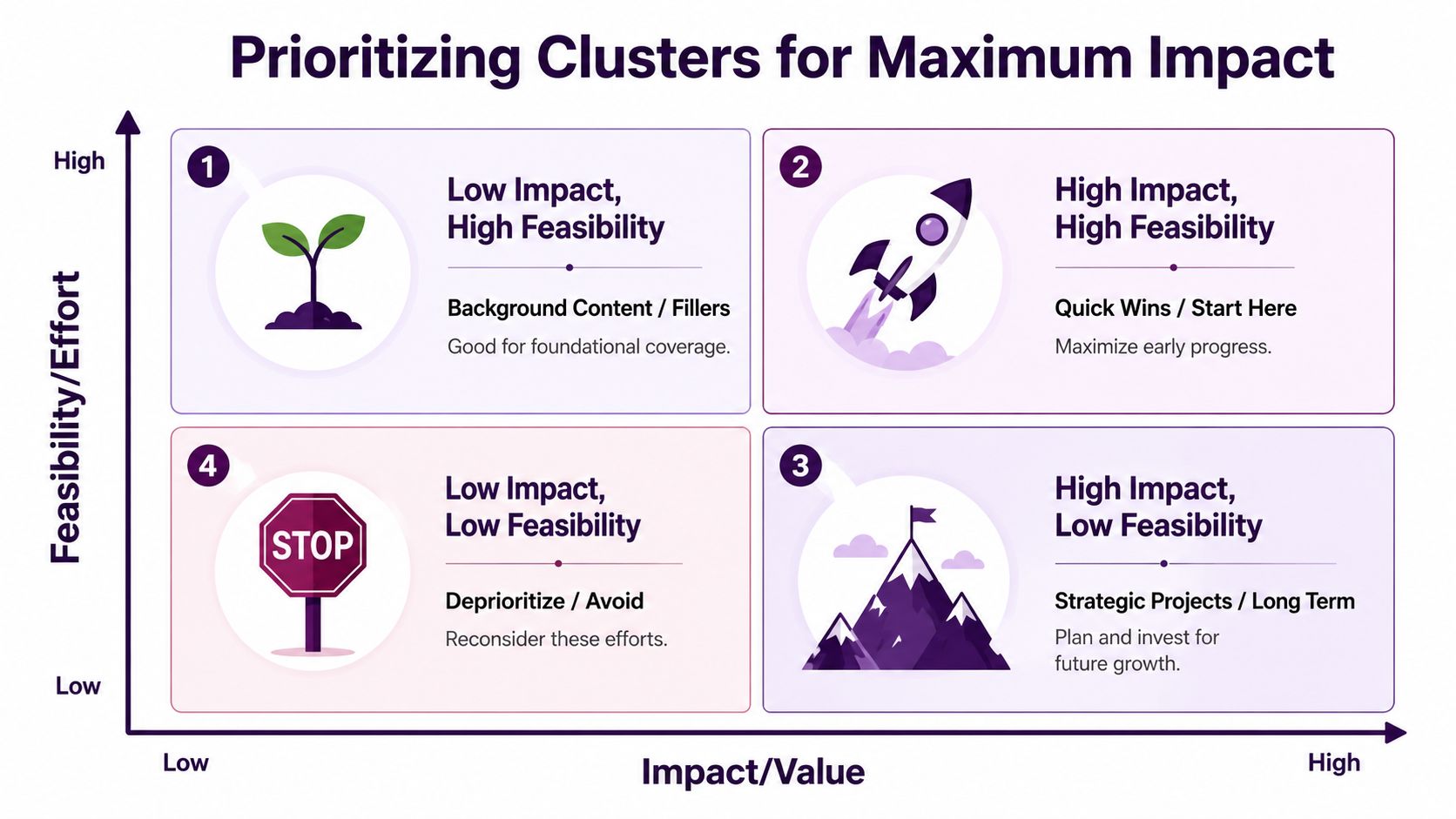
Use a simple scorecard and force a decision on each cluster:
Business value: Will this traffic support pipeline, sales, retention, or product adoption?
Intent quality: Does the cluster attract buyers, evaluators, or early-stage readers with low commercial value?
Asset readiness: Can an existing page be upgraded, or does the team need a net-new page?
Competitive fit: Does the site have enough authority and topical depth to compete?
Cluster support: Will this page be strengthened by nearby supporting content and internal links?
That gives you a better order of operations than sorting by volume or keyword difficulty alone.
Give extra weight to clusters where you already have traction
The fastest gains often come from clusters tied to pages that already rank, but underperform. If a page sits near page one for the main term and already picks up impressions for supporting long-tails, the work is usually clearer and cheaper than building a new asset from scratch.
In practice, I look for three signs:
The page ranks just outside the top results for the main phrase or close variants.
The SERP still looks beatable because competing pages are thin, dated, or loosely matched to intent.
The page can improve with edits, stronger internal links, better subtopic coverage, or tighter targeting.
This is also where a documented AI keyword research workflow for 2026 SEO advantage can help teams speed up scoring and opportunity review without skipping judgment.
A practical matrix
Priority type | What it looks like | Action |
|---|---|---|
Quick wins | Existing rankings, strong fit, moderate effort | Optimize first |
Strategic builds | High-value cluster, no strong page yet | Plan dedicated asset |
Foundation content | Useful support topics, lower immediate value | Fill gaps steadily |
Low-return work | Weak fit or poor business relevance | Defer |
One caution. quick wins are not always the best first move. A second-page cluster with weak commercial value can distract the team from a harder topic that matters far more to revenue. Priority comes from expected return multiplied by ranking feasibility, then filtered by available resources.
Publish the clusters that combine clear intent, business value, and realistic execution. Leave vanity targets in the backlog until the site has earned the right to compete.
Your Next Steps From Research to Ranking
The useful version of long-tail research isn't a one-time brainstorm. It's a repeatable operating system.
Start with raw ideas from tools, competitors, communities, and customer language. Validate those ideas through intent review and manual SERP analysis. Group related phrases into clusters that match a clear page type. Then prioritize those clusters based on value, feasibility, and existing ranking footholds.
That's the difference between collecting keywords and building an SEO pipeline.
If you want to sharpen the research side further, this guide to an AI keyword research workflow for 2026 SEO advantage is a useful follow-on read for teams trying to speed up ideation and validation without losing judgment.
Run this workflow on one topic first. Don't start with your whole site. Pick a single product line, service category, or content theme, and force yourself to go from raw list to prioritized cluster map. Once that process works once, you can repeat it across the rest of the site.
Keyword research gets easier when your data, rankings, content gaps, and technical signals live in one place. Keyword Kick helps agencies and in-house teams turn scattered SEO inputs into prioritized actions, so you can move from raw long-tail ideas to pages worth publishing without spending days stitching reports together.