You publish a detailed guide about SEO audits, then notice an older checklist and a service page appearing for many of the same searches. Google alternates between them. Traffic is scattered, the wrong page sometimes ranks, and nobody on the team can say which URL should own the topic.
That situation raises an important question: what is keyword cannibalization, and when does overlapping visibility indicate a genuine problem? The answer isn't “using the same keyword twice.” The core issue is whether multiple pages compete to satisfy the same search intent, and whether your architecture gives search engines one clear, authoritative answer.
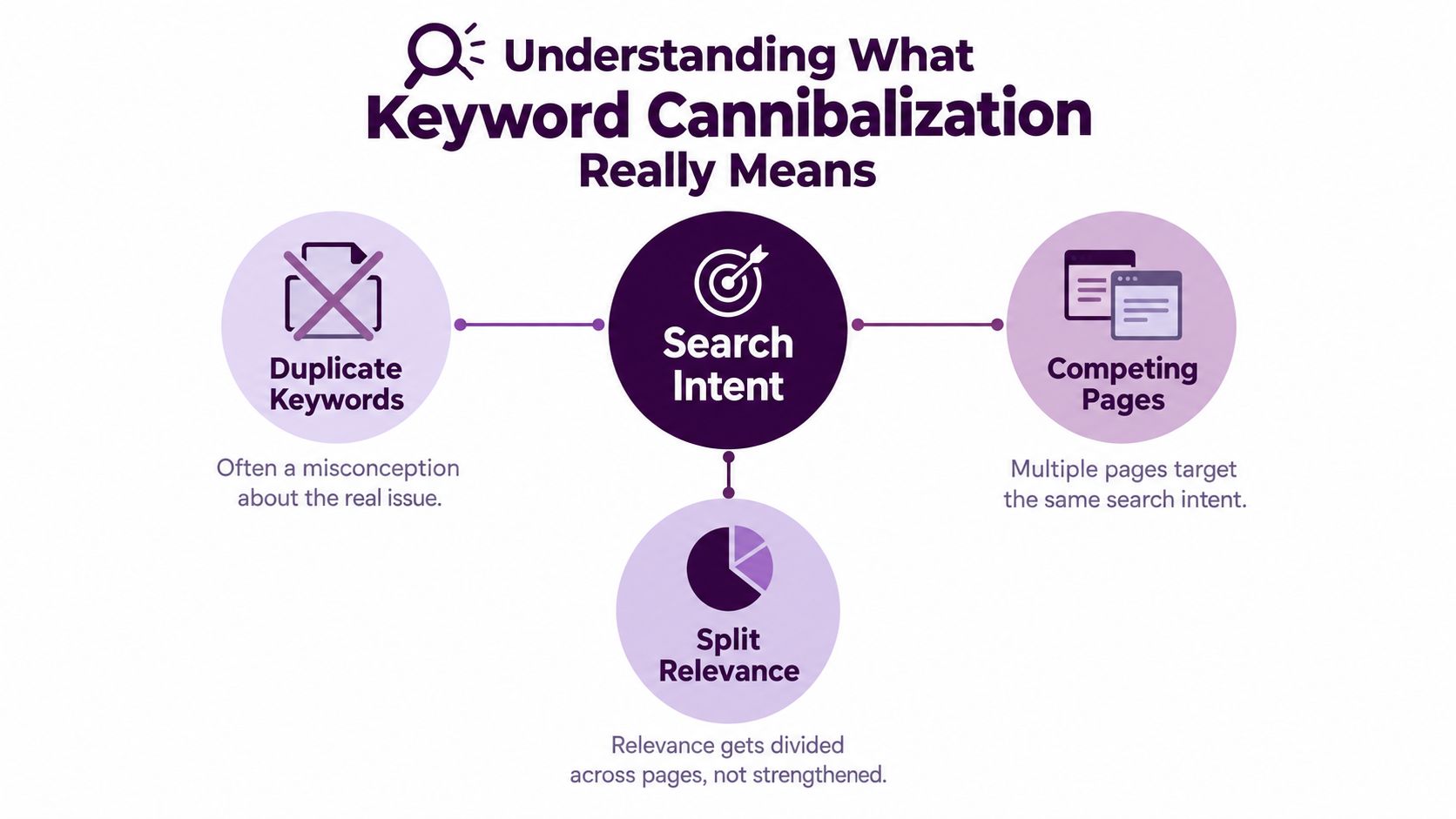
Understanding What Keyword Cannibalization Really Means
Keyword cannibalization happens when two or more URLs on the same website satisfy the same search intent. Search engines must then choose among competing candidates instead of reinforcing one page as the strongest result. Nightwatch's explanation of keyword cannibalization captures the central distinction: duplicate terms alone aren't enough. The pages must also overlap in purpose.
Consider a website with three pages:
- “How to Choose an SEO Audit Tool”
- “The Best SEO Audit Tools”
- “SEO Audit Software Guide”
If all three target the same audience, answer the same buying question, and present similar evaluations, they occupy nearly the same position in the site's content architecture. A search engine sees several plausible answers, but the publisher hasn't clearly identified the primary one.
The confused librarian test
A useful analogy is a librarian helping someone find a book. A visitor asks for the best guide to technical SEO. The librarian searches the catalog and finds three nearly identical books by the same author, each covering the same topic for the same reader. Which one should the librarian recommend?
That's how search-intent overlap works. Your URLs are the books, the query is the visitor's question, and your internal linking and content structure are the catalog information. If the pages serve the same need, search engines may split visibility and ranking signals between them rather than treating one as the definitive resource.
It isn't an SEO penalty
Keyword cannibalization isn't a manual action or an automatic penalty. It's a relevance and architecture problem. Google is trying to select the page that best matches the query, but your site may present multiple candidates with similar signals.
The practical question isn't “Have two URLs used the same phrase?” Ask instead:
Do these pages serve the same searcher, solve the same problem, and deserve the same type of result?
If the answer is yes, consolidation or differentiation may be necessary. If one page is informational and another is transactional, the overlap may be intentional and useful. The diagnosis must come before the fix.
Why Websites Accidentally Create Overlapping Content
Most cannibalization develops without anyone trying to manipulate search results. A mature website adds pages through separate teams, campaigns, product launches, country sites, and editorial projects. Over time, the original content plan becomes difficult to reconstruct.
A content writer may publish “SEO reporting guide” while a product marketer creates “SEO reporting software” and an agency team maintains “SEO reporting services.” Each page can look reasonable in isolation. Together, they may compete for the same commercial investigation intent.
Scale creates memory problems
Teams often lack a reliable record of which URL owns each topic. A spreadsheet may exist, but it isn't connected to the editorial workflow. New briefs then begin with keyword research rather than a review of existing pages.
Common sources of overlap include:
- Decentralized publishing: Different departments create pages for related audiences without sharing briefs or keyword ownership.
- Historical accumulation: Older articles remain live after a newer guide covers the same question more effectively.
- Refreshes without inventory checks: A writer updates a page around a keyword already assigned to another URL.
- Siloed templates: Product, category, location, and blog templates produce pages with similar titles and copy.
- Near-duplicate localization: International markets publish versions that differ too little in purpose or substance.
Commerce sites face a structural challenge
E-commerce catalogs can create overlap through product variations, filters, categories, and regional landing pages. A category page may target a broad commercial term, while a product collection and buying guide use nearly identical language. The problem isn't that every page mentions the product category. The problem arises when several URLs claim the same role in the journey.
Blog libraries develop a similar pattern. A site might publish one article for each season, campaign, or editorial angle, but every article continues to answer the same broad question. New content increases the library while reducing clarity about which page should rank.
This is why mature brands need governance, not just better copy. The site-age overlap data summarized by Link Assistant reports duplicate-keyword overlap rising from 2.19% for sites aged 0–1 years to 13.95% for sites older than 10 years. The reported pattern suggests that overlap accumulates as teams add content, URLs, markets, and templates.
Operational rule: Treat every new URL as an architectural decision, not only as a publishing task.
Before approving a brief, the team should know which existing page owns the core intent, what narrower sub-intent the new page will serve, and how the two URLs will link to each other. Without those decisions, publishing volume eventually creates internal competition.
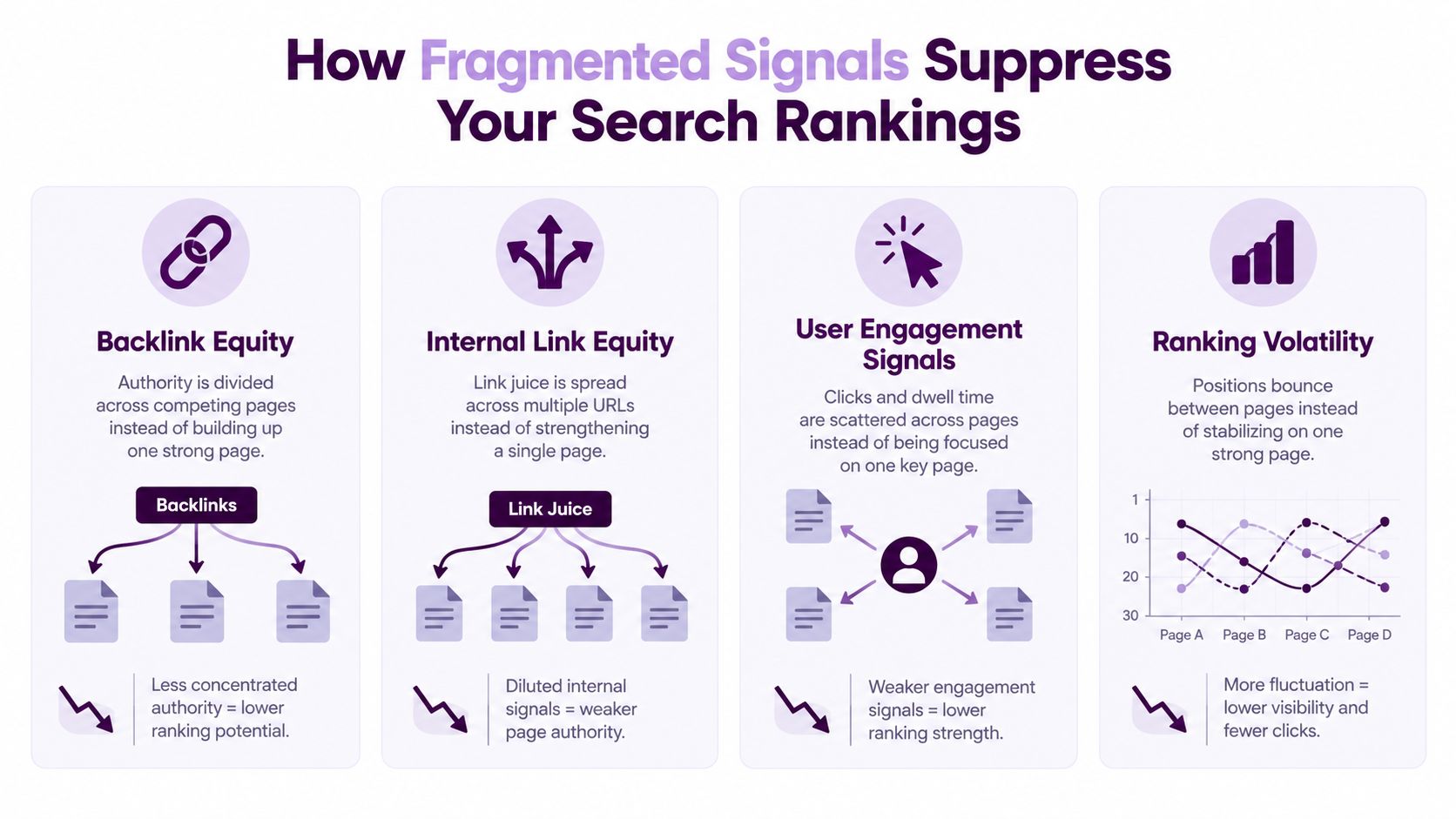
How Fragmented Signals Suppress Your Search Rankings
When multiple URLs target the same intent, the site can distribute its strongest signals across competing pages. Backlinks may point to different articles. Internal links may use inconsistent destinations. User interactions may accumulate on whichever URL happens to rank at a particular moment.
That doesn't mean Google mechanically divides every signal into equal portions. Search systems evaluate many signals together, and multiple pages can rank for legitimate reasons. But when pages are interchangeable, fragmented authority makes it harder for one URL to become the clear answer.
The common symptoms
A mature-site audit often reveals a recognizable pattern:
- Backlink equity is scattered: External sites link to different versions of the same resource.
- Internal links lack a destination hierarchy: Related articles point to several URLs instead of reinforcing one primary page.
- The wrong page ranks: A short article appears for a valuable query while the stronger commercial or in-depth page remains secondary.
- Ranking volatility appears: Search visibility moves between URLs as Google reassesses which candidate best matches the query.
- Maintenance effort multiplies: Editors update several pages that cover the same ground, creating inconsistent information.
Why maturity increases exposure
Content overlap becomes more likely as a site's library expands. The Link Assistant summary reports duplicate-keyword overlap increasing from 2.19% among sites aged 0–1 years to 13.95% among sites older than 10 years. That source frames the pattern as an accumulation problem, not evidence that older websites automatically have poor SEO.
The implication is practical. Large content sites, e-commerce catalogs, and international brands should treat overlap monitoring as routine maintenance. A site can have strong content and solid technical implementation while still weakening its architecture by allowing multiple pages to retain the same role.
Don't confuse symptoms with proof
A ranking swap is a useful clue, but it isn't conclusive evidence. Google may rotate URLs because the query has mixed intent, because different pages answer different variations, or because search results naturally change. The diagnosis becomes stronger when rank movement appears alongside similar titles, overlapping content, split clicks, and no defensible distinction between the pages.
The high-impact objective is signal concentration. Choose a page that deserves to represent the intent, preserve the strongest material, improve its structure, and remove or reposition competing URLs. Small metadata edits won't solve a structural conflict if both pages still answer the same question.
Detecting True Cannibalization on Your Website
Start with evidence from search behavior, not an automated warning alone. A tool may flag several URLs that mention or rank for the same term, but a shared keyword doesn't establish shared intent.
Use a five-part workflow.
Begin with Search Console
Export query and page data from Google Search Console, then group rows by query. Look for queries where multiple URLs receive meaningful impressions or clicks. A single query with several pages isn't automatically harmful, so add context such as ranking history, page type, and conversions.
Next, filter the performance report for the query and open the Pages view. Compare the URLs over time. If a guide, product page, and glossary entry all appear, identify the role each page serves before deciding that they conflict.
Validate with a site search
Run a search such as site:example.com "target query" in Google. This can reveal pages that your internal inventory missed, including older articles, tag archives, landing pages, and regional URLs. Search results aren't a substitute for Search Console data, but they help expose obvious duplication in titles and page purpose.
Compare the content coordinates
For each candidate URL, record:
- Primary query: What search term does the page appear designed to address?
- Intent: Is the visitor learning, comparing, evaluating, navigating, or buying?
- Audience: Is the page for beginners, specialists, enterprise buyers, or a specific market?
- Page role: Is it a pillar, product page, category, glossary entry, or supporting article?
- Preferred action: What should the visitor do after reading?
Pages that differ meaningfully may coexist. Pages that match across nearly every field are stronger consolidation candidates.
Use SEO keyword cannibalization diagnostics to support the investigation, but don't let an automated conflict label replace manual intent review.
Look for the wrong-page symptom
True cannibalization often becomes commercially visible when Google chooses the wrong URL. A broad guide may rank where a product page should appear, or an outdated article may outrank the current resource. This matters more than the number of URLs associated with a query because it shows that the site isn't communicating the desired page hierarchy.
An Ahrefs review of 80 manually checked multi-ranking cases found that only 1.25% needed a fix, according to the Moz summary of the keyword cannibalization research. That finding is a useful warning against treating every multi-URL ranking as an emergency.
When Multiple Rankings Are Actually Beneficial
Two pages can rank for the same query without competing destructively. Broad searches often contain several sub-intents. One person wants an explanation, another wants a comparison, and a third wants to take a commercial action. If your pages clearly serve those different needs, multiple results can give searchers useful paths through your site.
Suppose a software brand ranks with an educational guide and a product page for a broad category query. The guide helps a researcher understand the problem. The product page serves someone evaluating a solution. Those URLs may share terminology, but they aren't necessarily interchangeable.
Read the search result page
The SERP provides evidence about whether a query has mixed intent. Examine the formats Google returns:
- Informational pages: Guides, explainers, tutorials, and definitions.
- Commercial pages: Comparisons, reviews, category pages, and solution pages.
- Transactional pages: Product, pricing, signup, or service pages.
- Navigational results: Brand pages, resource hubs, and category indexes.
If Google consistently shows different formats for the query, preserving distinct pages may make sense. Your task is to align each URL with a specific sub-intent instead of forcing every page toward the broadest phrase.
Diversification can expand visibility
The Ahrefs multiple-rankings study argues that having more than one page in a SERP can expand brand visibility and capture more clicks. That creates an important counterpoint to simplistic advice that every repeated keyword must be eliminated.
Multiple rankings are usually defensible when:
- The pages have different content formats.
- Each page answers a distinct question.
- The titles and headings make the distinction obvious.
- Internal links describe the relationship accurately.
- Search Console data shows that each URL attracts a relevant audience.
- Neither page consistently steals the role intended for the other.
The decision isn't “one keyword, one URL.” It's “one intent, one clear owner,” unless distinct pages provide genuinely different value.
Avoid merging strong pages merely because an audit tool highlights a shared term. A consolidation can remove useful entry points, weaken coverage for a sub-intent, and leave the site with one page that tries to serve too many audiences.
Actionable Fixes to Resolve Content Overlap
Once you've confirmed genuine intent conflict, choose the least disruptive fix that restores clarity. The right action depends on whether the pages are redundant, technically duplicated, or capable of serving separate audiences after a meaningful rewrite.
| Scenario | Recommended Fix | Expected Outcome |
|---|---|---|
| Two pages answer the same question for the same audience | Consolidate the strongest material into one primary URL and 301-redirect the weaker URL | One clearer resource with concentrated relevance and link equity |
| A weak page adds no unique value | Remove it and redirect to the closest useful page | Less redundancy and a cleaner architecture |
| Similar URLs exist for technical or business reasons | Use a canonical pointing to the preferred version, where the pages are genuinely similar | A clearer preferred URL signal |
| Pages share a topic but serve different sub-intents | Rewrite titles, headings, copy, and internal links to differentiate them | Distinct page roles with less intent overlap |
| A blog page competes with a product or category page | Refocus the blog on education and the commercial page on evaluation or action | Better alignment between ranking page and business goal |
Consolidate with a deliberate primary URL
Choose the page with the strongest combination of relevant backlinks, useful content, historical visibility, conversions, and maintainability. Don't choose solely by current ranking. A weaker page may rank today because Google is testing it, while another URL has better assets and a clearer long-term role.
Move unique, valuable sections into the primary page. Preserve useful examples, FAQs, media, and internal references, then review titles, headings, anchor text, and calls to action. Redirect the retired URL with a 301 when the destination closely matches the old page's intent. Conducting a content audit for SEO helps establish which assets should survive before implementation begins.
Differentiate when consolidation would be wasteful
If the pages serve different audiences, rewrite them around unmistakable roles. A beginner's guide should not retain the same headline and structure as an advanced implementation guide. A category page should lead users toward products, while an educational article should answer the underlying question without pretending to be a catalog.
Internal links should reinforce that hierarchy. Link to the primary guide with descriptive language, and link to narrower pages with anchors that reflect their specific subject. Avoid sending mixed signals by using the broad commercial term for every related destination.
Use canonicals carefully
Canonical tags suit near-duplicate or parameter-driven versions that need to remain accessible. They aren't a substitute for merging two directly competing editorial pages. A canonical is a signal to search engines, not a guarantee that a materially different page will be treated as a duplicate.
After implementation, monitor the affected queries and URLs in Search Console. Confirm that the intended page receives impressions, that redirects resolve correctly, and that internal links no longer point visitors toward retired or secondary pages.
Building an Architecture That Prevents Future Issues
Prevention starts before the writer opens a document. Every content brief should define the page's intended query, searcher, format, and role within the site. That creates a decision record the editorial, product, and SEO teams can use when related content is proposed later.
Independent guidance from Ahrefs on keyword cannibalization frames the problem as one of search intent and site architecture. Pages can overlap without true cannibalization when they serve different sub-intents. The durable question is whether to consolidate or differentiate.
Map topics before assigning briefs
Maintain a central inventory containing the URL, primary query, intent, audience, page type, owner, status, and related URLs. Before approving a new brief, search the inventory for an existing page with the same role. If one exists, decide whether the new work should update it, support it, or replace it.
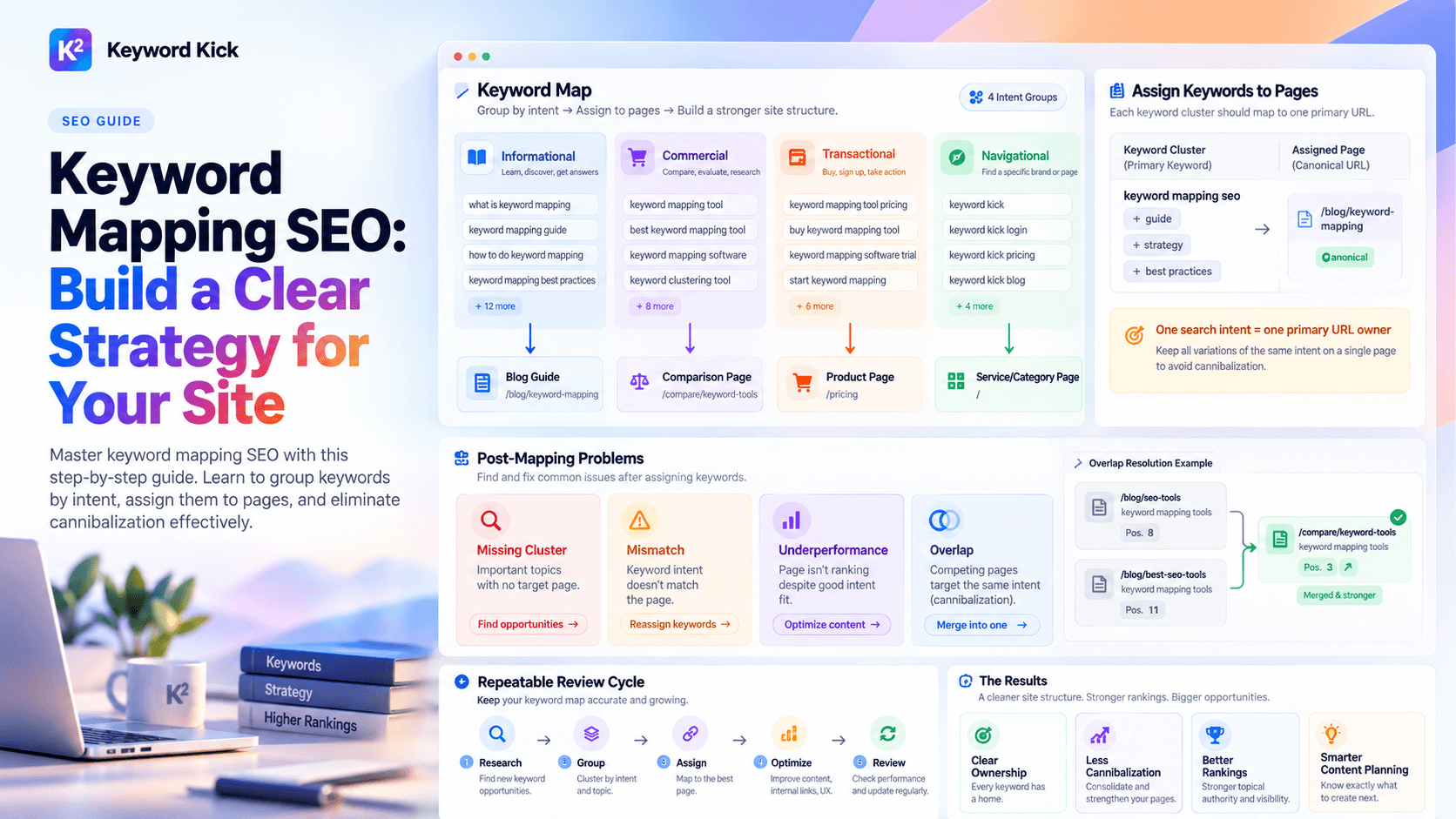
A practical strategy for your site should assign each important intent a clear primary destination. Secondary pages can target subtopics, use narrower language, and link back to the hub without competing for its central query.
Design topic clusters with distinct jobs
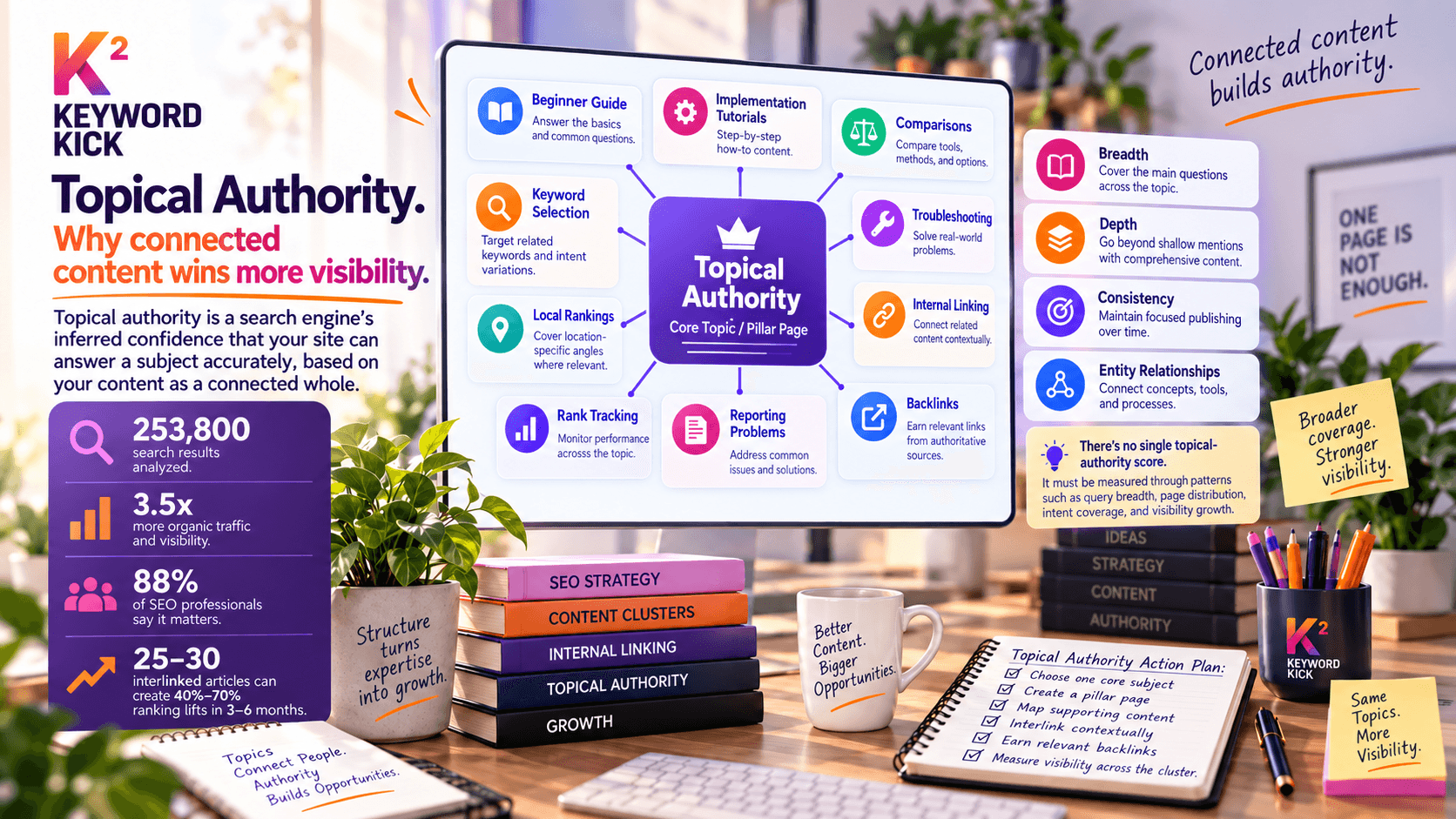
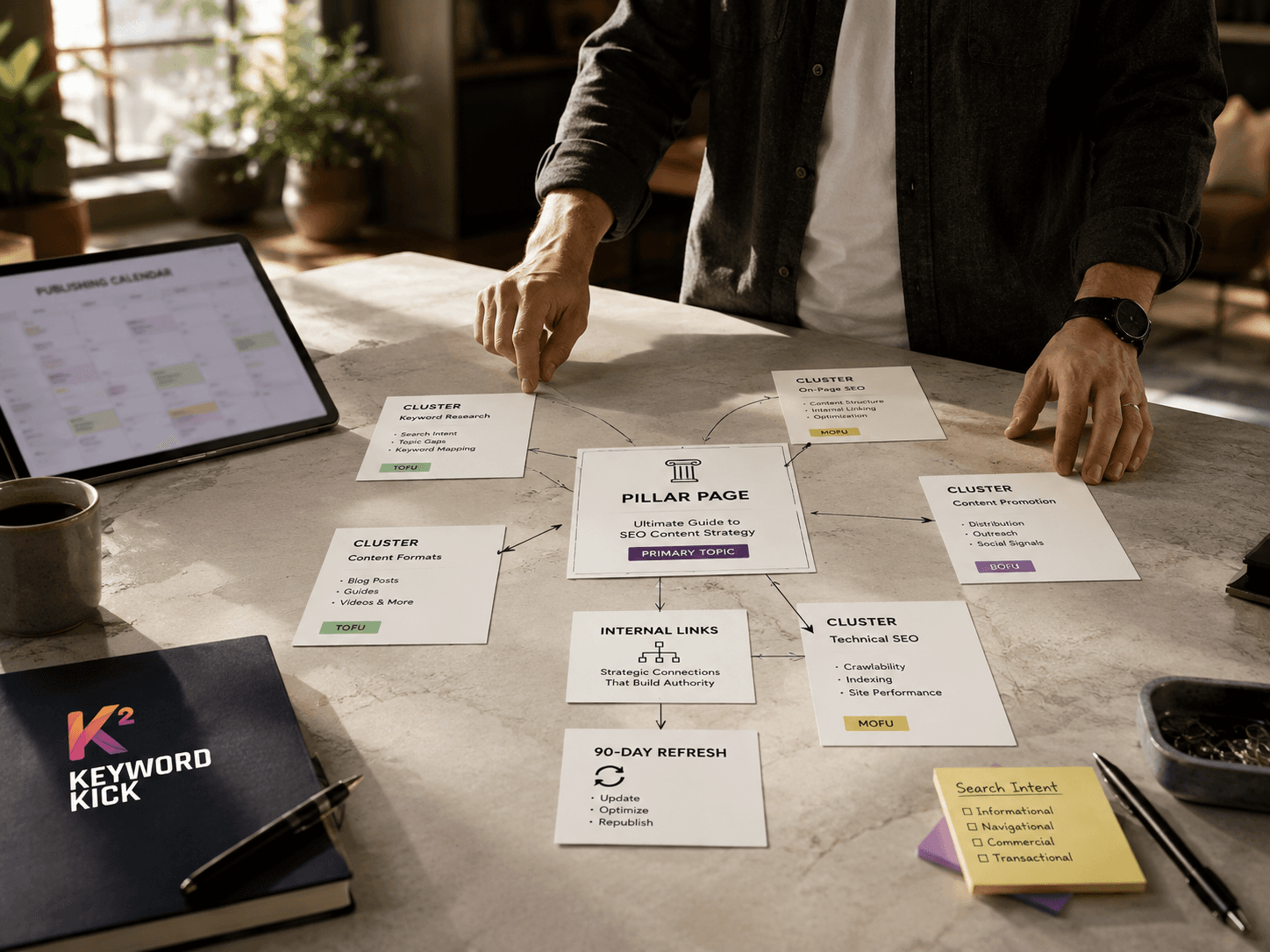
A pillar page should cover the broad subject and guide users to focused cluster pages. Each cluster page needs a reason to exist beyond repeating the pillar. The distinction can come from audience, format, task, stage of the buying journey, or a clearly narrower question.
Editorial governance should require a short pre-publication check:
- Existing page review: Which URL already addresses this subject?
- Intent statement: What exact task will this page help the visitor complete?
- Differentiation proof: How is the page materially different from related URLs?
- Internal-link plan: Which page should receive authority, and which pages should it support?
- Retirement decision: Should an older URL be updated, merged, redirected, or removed?
Monitor the library as an asset
Run historical audits to identify obsolete pages, near-duplicates, and competing templates. Review clusters after major publishing initiatives, migrations, and product launches. Pruning isn't about reducing URLs for its own sake. It's about ensuring every retained page has a defensible purpose.
Search Console should remain part of the operating rhythm. Watch for queries where several URLs appear, then investigate whether the overlap reflects healthy diversification or unclear ownership. A clean architecture doesn't prevent every shared keyword. It gives each page a distinct job and gives the team a repeatable way to resolve ambiguity.
Keyword Kick helps teams investigate this problem by combining Search Console query data with rank tracking, audits, and keyword conflict analysis, including severity-based prioritization across several conflict types. Visit Keyword Kick to identify competing URLs, decide which pages need consolidation or differentiation, and turn fragmented search data into a practical SEO action plan.