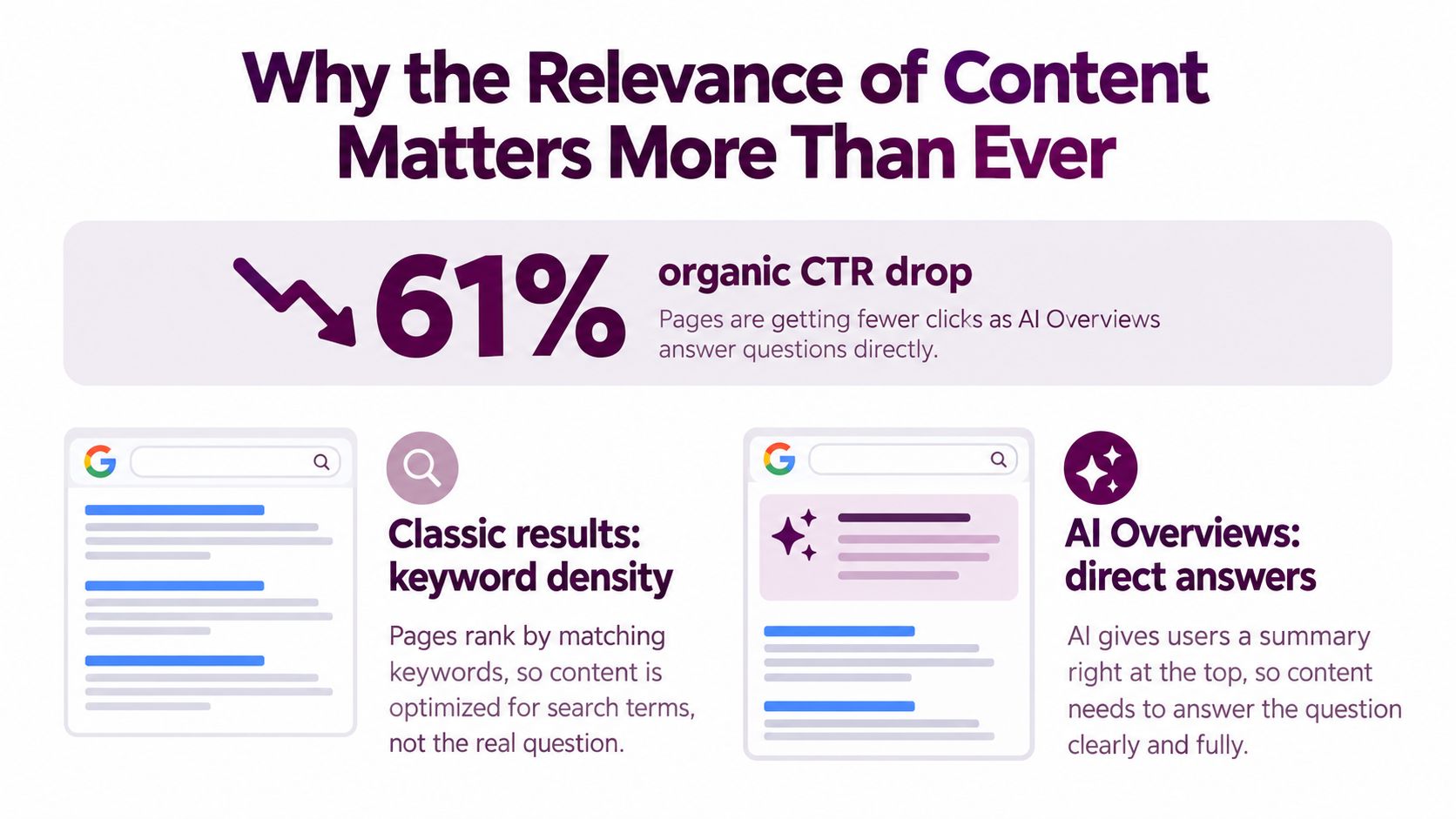
In Google Search, a page can lose 61% of its organic click-through rate when AI Overviews appear, while cited sources can still earn 35% higher organic CTR in Seer Interactive's analysis of 3,119 informational queries across 42 organizations and 25.1 million impressions. That's the clearest sign that relevance of content is no longer a single ranking concept. It's a stack of outcomes, from being retrievable, to being cited, to producing business value after the click.
The old mindset treated relevance as “did we cover the keyword?” That's too shallow now. A page can match the topic, lose the click to a summary, and still fail after the visit if it doesn't answer the user's real task quickly enough. Teams that need help turning this into a measurable workflow often start by pairing content planning with content SEO services so the page structure, intent mapping, and internal linking line up before the first draft goes live.
Why the Relevance of Content Matters More Than Ever
A lot of pages still rank because they are close enough to the query. That tolerance is shrinking. When AI Overviews answer before the click, weak relevance shows up as lost traffic, not just lower positions.
The split is now between being visible and being selected. Seer Interactive's dataset found that organic CTR fell from 1.76% to 0.61% when AI Overviews appeared, while cited sources performed better. The implication is practical, content teams now have to earn attention in two places at once, the classic results page and the answer layer above it.
Practical rule: if a page only works when the user already intends to click, it is not relevant enough for 2026.
A topic match still does not guarantee task fit. A page can be accurate and still fail because it hides the answer, buries the evidence, or leaves the reader without a clear next step. That is why this article scores relevance on three layers, retrieval relevance, AI-citation relevance, and post-click business relevance.
Retrieval, citation, and business value
Retrieval relevance asks whether search systems can connect the page to the query. AI-citation relevance asks whether the page is clear, extractable, and quotable enough to surface in an AI-generated response. Post-click business relevance asks whether the visit leads to something useful, such as a lead, an add-to-cart action, or deeper engagement.
That split matters because a page can win one layer and fail the others. If it ranks but does not convert, the issue is not always traffic volume. Sometimes the page answers the wrong version of the question, or it answers the right one too late.
Teams that manage large content sets often use Keyword Kick on latent semantic indexing as a reference for how related terms and topic coverage support search understanding. Paired with content SEO services, that kind of review helps align page structure, intent mapping, and internal linking before a draft goes live.
The practical shift is simple. Stop asking whether a page is relevant in the abstract. Ask which query, which user task, and which outcome it serves. That is the difference between content that merely exists and content that earns its place in search.
Defining Relevance Beyond Keywords
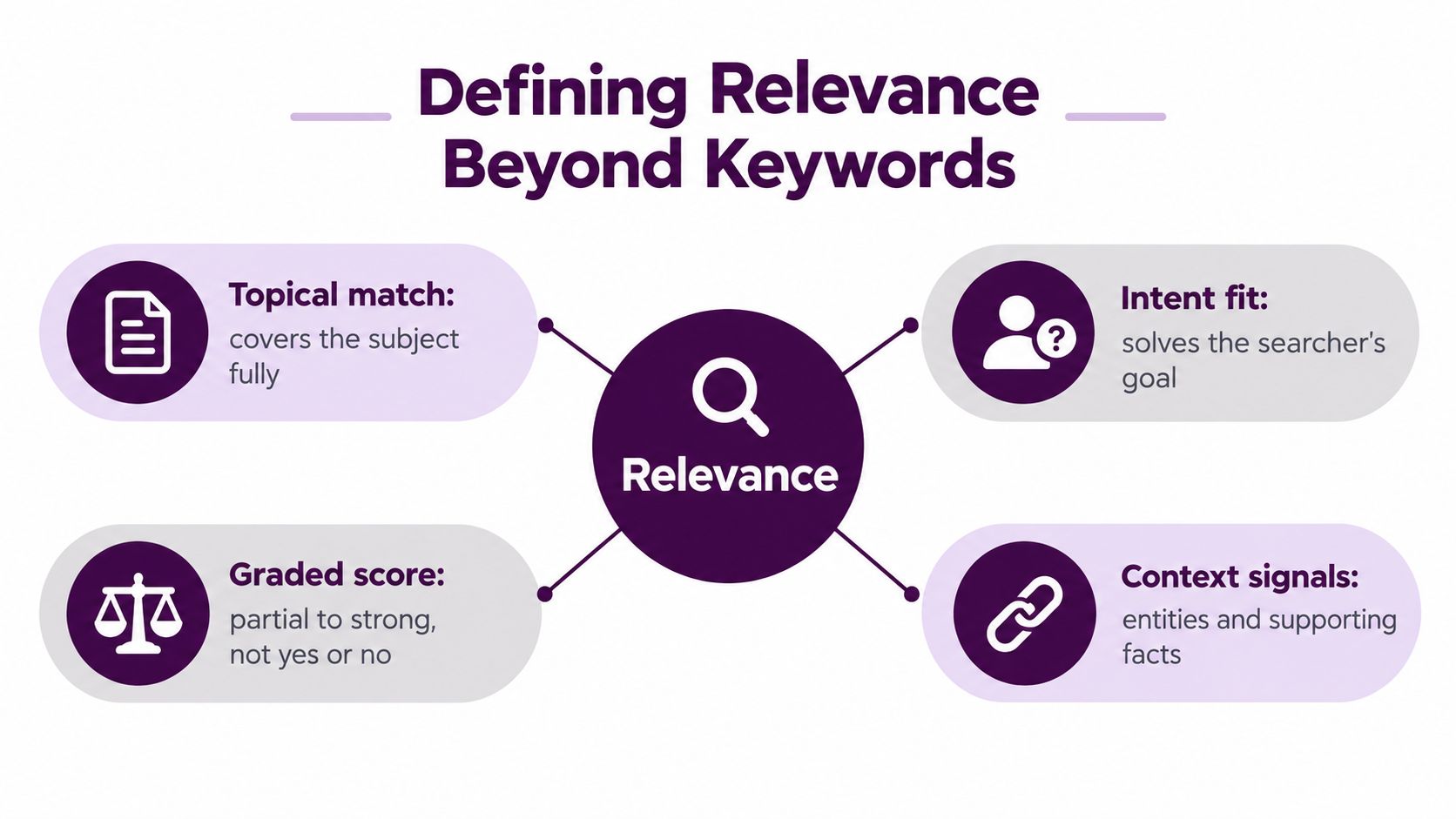
Relevance is a graded judgment, not a yes-or-no checkbox. In information retrieval, that's why evaluation relies on query-document relevance judgments and metrics such as precision, recall, mean average precision, and normalized discounted cumulative gain as described in standard evaluation methods. For SEO, the useful part is nDCG, because it gives more weight to highly relevant results when they appear near the top.
That matters because two pages can contain the same keywords and still serve very different needs. One page may be lexically aligned, meaning it uses the same words as the query. Another may be contextually aligned, meaning it answers the underlying intent. A third may be functionally aligned, meaning it helps the user finish the task.
What to score on the page
A marketer doesn't need to become an information scientist to use this model. The goal is to compare a page against the search job, not the keyword list. That means checking whether the page covers the topic fully, whether it matches the user's goal, and whether it gives enough evidence to be trusted.
A useful approach is to
- Lexical relevance: the wording overlaps with the query.
- Contextual relevance: the page matches the intent behind the query.
- Functional relevance: the page solves the problem or supports the decision.
A page with the right terms but the wrong structure often loses to a cleaner page with weaker wording and stronger intent fit.
That's why intent coverage is more valuable than term repetition. If a query is informational, the page should answer directly. If it's comparison-driven, the page should include trade-offs. If it's transactional, the page should move toward the decision. Content that ignores that distinction may still rank for related phrases, but it won't score well against the user's task.
A simple prioritization rule
Use relevance as an ordering filter. Start with pages that already have demand, then ask whether they answer the exact query well enough to deserve more visibility. The strongest candidates are usually not the longest pages, but the pages where the answer is present and buried. That's where a concise rewrite, a sharper intro, or a stronger evidence block can move the score faster than adding more words.
The rule is straightforward. Optimize the page against the searcher's job, not against the keyword list.
The Four Signal Layers Search Engines Use
Search systems don't read relevance as one signal. They use layers, and the layers don't carry the same weight in every query. A practical model is lexical matching, semantic interpretation, topical authority, and user engagement. Each layer answers a different question about whether the page should rank and whether it deserves attention.
The first layer is lexical. It checks whether the page uses the same terms a searcher used, especially in headings and body copy. That's basic matching, not the whole story. The second layer is semantic, where the system tries to understand meaning and related entities. The third is authority, which reflects whether the site and page have earned trust in the topic area. The fourth is engagement, which reflects whether real users seem to find the page usable and useful.
Nielsen Norman Group's usability study is useful here because it shows how presentation changes perceived value. In a controlled comparison, concise copy achieved 58% higher measured usability, scannable formats produced a 47% usability improvement, and objective, non-promotional copy generated a 27% improvement over promotional copy in the original study. That doesn't mean structure alone guarantees rankings, but it does explain why structure changes whether people keep reading.
What each layer is really testing
| Signal Layer | What It Measures | Where to See It | Typical Fix |
|---|---|---|---|
| Lexical matching | Whether the page uses the query's core terms | Titles, H2s, body text, SERP snippets | Rewrite headings and intro to match the query language |
| Semantic interpretation | Whether the page covers related entities and meaning | Topic breadth, supporting terms, related questions | Expand examples, entities, and related subtopics |
| Topical authority | Whether the site has depth on the subject | Cluster coverage, internal links, competing pages | Build supporting articles and strengthen internal architecture |
| User engagement | Whether people can scan and use the page | Scroll depth, CTR, time on page, exits, conversions | Improve readability, structure, and task flow |
Google's guidance also draws a useful line between content that is merely relevant and content that is helpful, reliable, and people-first in its own documentation. That separation matters because a page can match the query language and still fail on usefulness.
Actionable test: when rankings stall, don't ask “what keyword are we missing?” first. Ask which layer is weakest.
If a page has good terms but poor engagement, the structure is the first place to look. If engagement is solid but authority is thin, the fix is usually cluster building and internal linking. If authority is present but visibility is low, the page may be too vague at the lexical level. For teams building an editorial roadmap, how to build topical authority is the right companion idea, because authority only compounds when the site covers a subject in a deliberate way.
The main takeaway is that search doesn't reward one type of relevance. It rewards layered relevance, and the weak layer usually determines the outcome.
Query Length, Intent, and the AI Overview Effect
An e-commerce category page can rank for a high-intent query and still underperform if the page answers a different version of the question than the searcher is asking. Longer, more specific queries make that mismatch easier to see. A Pew Research-based analysis reported that AI summaries appeared for 53% of searches containing 10 or more words versus 8% for one- or two-word searches, and for 60% of searches beginning with question words, while separate tracking showed AI Overviews moving from 6.5% of tracked queries in January 2025 to nearly 25% in July, then below 16% in November in the reported findings. The practical reading is straightforward. As queries get longer and more explicit, search is more likely to answer before the click, and the share of visible space that reaches a website becomes less stable.
That volatility matters because AI visibility is not fixed by page type alone. It shifts with query structure, question wording, and the current mix of search features. A page that performs well on one intent cluster may lose clicks on another, even when the ranking position looks healthy.
The same pattern shows up in legal search. For teams comparing practice-area content and seo software for lawyers, the page still has to answer the exact service question the searcher is trying to solve. A broad service page can attract the query and still fail to move the user toward contact, consultation, or another next step.
A worked example from the SERP
A category page can look healthy in rank tracking and still fail in revenue terms when the query is captured but the decision is not. Search Console often shows the first warning sign. GA4 then confirms the gap, because visits arrive without meaningful downstream actions.
The SERP usually explains why. If the results page already includes shopping filters, comparison content, or an AI summary, the page cannot behave like a general overview and expect the same result. It needs sharper copy, tighter proof, and more explicit buying guidance. The intro cannot stay broad, the H2s should reflect the buying decision, and a comparison block often does more work than another long paragraph.
When the query is long and specific, the page has to act like a decision aid, not a brochure.
Query length also changes the job of the page. Short discovery queries usually need a concise orientation. Mid-tail research queries need comparisons, evidence, and definitions. Follow-up queries after an AI summary often need specificity, proof, or a next-step path that the summary cannot provide. One page can cover more than one intent, but it cannot serve all of them equally well.
The practical move is to separate query clusters by length and intent, then assign page elements to each cluster. Short queries can be supported by a crisp answer block. Longer questions may need proof, comparisons, or a clearer next action. A page is relevant only when its structure matches the searcher's level of intent.
A Real Example of Relevance Failure and Recovery
A category page can look healthy in rank tracking and still fail in revenue terms. That happens when the page captures the query but not the decision. The pattern is usually visible in Search Console first, then in GA4, where visits arrive without meaningful downstream actions.
The diagnosis starts with the SERP. If the results page already contains shopping filters, comparison content, or an AI summary, the page can't behave like a general overview and expect the same result. It needs sharper copy, tighter proof, and more explicit buying guidance. In the Vietnamese university engagement study, content type and presentation materially affected reactions, comments, and shares, which is a strong reminder that format shapes response, not just topic choice in the 2024 analysis of 5,825 posts.
The audit sequence that actually helps
- Check the SERP features. If the query is crowded with summaries or comparison elements, the page needs a stronger differentiator.
- Map the intent gap. If the intro answers a broad category question while the query is purchase-oriented, rewrite the opening around the buyer's task.
- Add missing structure. Comparison blocks, product criteria, proof points, and internal anchors usually outperform another long paragraph.
- Re-measure after the edit. Keep the window consistent so you can compare impressions, CTR, engagement, and downstream actions.
Teams often overcomplicate the fix at this point. They want to publish a new article when the existing page only needs a better answer architecture. That's rarely the highest-return move.
Recovery rule: if a page is already ranking, edit the page before you create a duplicate.
A platform like Keyword Kick helps here because it brings Search Console, GA4, rank tracking, and competitor context into one workspace, so you can see whether the problem is query mismatch, weak engagement, or a gap versus the pages already winning the SERP. That matters because relevance problems are usually not invisible. They're just spread across too many tools.
The cleanest recovery path is often small but specific. Rewrite the intro so it matches the searcher's decision stage. Add one comparison table or criteria block. Link to the most relevant supporting page. Then measure whether the page starts producing better outcomes, not just more impressions. When that happens, you've repaired relevance instead of merely expanding content.
How to Audit Relevance with Keyword Kick
Relevance audits fail when they stop at ranking position. Google's helpful-content guidance, linked earlier, frames the test as whether a page is useful, reliable, and built for people first, so the audit has to cover query intent, impressions, click-through rate, engagement, conversions, and the next action users take.
Keyword Kick makes that review more practical because it keeps keyword research, rankings, audits, backlinks, and analytics in one workspace. Start by clustering queries by intent and length, then compare the page with the URLs already winning the same SERP. That comparison shows whether the weak point is retrieval relevance, AI-citation relevance, or post-click business relevance. For a more detailed workflow, see Keyword Kick on auditing content.
Three layers to score before you edit
- Retrieval relevance. Check whether the page matches the query cluster and the search result it competes with.
- AI-citation relevance. Check whether the page has a clear answer shape, clean structure, and concise proof that an AI summary can extract.
- Post-click business relevance. Check whether the page helps the visitor take the next action, not just read a definition.
Assign each weak page to an owner after the score is set. Writers can handle copy changes, editors can adjust structure, and SEO leads can manage internal links and measurement. That keeps the work tied to a specific failure mode instead of turning into a general rewrite.
The highest-return fixes are usually structural. If the query is clear but the page reads broadly, tighten the opening so it signals the task sooner. If the headings drift across topics, realign them with the query cluster. If the page explains the topic but does not move the reader, add the proof, internal anchors, or next-step path the page is missing. Schema helps only when the answer shape is already clear.
The goal is not to edit everything at once. It is to identify the first layer that breaks and fix that layer before creating more content. That turns relevance from a subjective review into a repeatable audit process.
Optimization Playbook and Weekly Relevance Checklist
The highest-return relevance fixes usually start with the page already earning impressions. If a page is visible but weak on clicks, the problem is often structure, not volume. Content that can be extracted cleanly and still leads to a useful next step tends to do better than pages that just add more paragraphs.
Use a weekly review to separate retrieval relevance, AI-citation relevance, and post-click business relevance. Start with the pages that have impressions but underperform on clicks, then check whether the intro, headings, proof, and internal links still match the query intent. If the query is being answered, but the page is hard to cite or weak at converting, fix the layer that fails first.
A practical team checklist:
- SERP feature check for AI summaries, comparison blocks, and shopping-style results.
- Intent coverage score for whether the page answers the exact search job.
- Click-through delta versus the last measurement window.
- Engagement quality such as scroll behavior and exit patterns.
- Conversion micro-event like a form start, add-to-cart, or qualified next click.
- AI-overview citation status if the query appears in summaries.
For teams that want a repeatable audit routine, kaip atlikti SEO auditą is a useful checklist-style reference.
The strongest pattern is subtraction. Cut the vague introduction, remove promotional filler, and delete sections that do not serve the query. Then check whether the page is easier to retrieve, easier to cite, and more useful after the click.
Keyword Kick helps teams turn search data into an ordered relevance plan, so pages can be scored by intent, structure, and business outcome instead of gut feel. If you're ready to audit the pages already earning impressions and decide which ones deserve a rewrite, visit Keyword Kick and use it to prioritize the next round of content updates.