You've pulled a competitor backlink report, exported hundreds of referring domains, and now you're staring at a spreadsheet that seems to promise more than it can deliver. Some sites are clearly relevant. Others are directories, press mentions, abandoned blogs, or pages your business could never realistically appear on. The hard part isn't finding the gaps. It's deciding which gaps deserve your time.
A useful backlink gap analysis turns competitor link data into a practical acquisition plan. It shows where competitors have earned attention, then applies judgment around relevance, quality, editorial fit, and feasibility. The result shouldn't be a longer prospect list. It should be a shorter, better-ranked list that an outreach team can act on.
What Is Backlink Gap Analysis and Why It Matters
A marketing team notices that two competitors keep outranking its key service pages. The obvious response is to check how many backlinks those competitors have and try to close the numerical difference. That approach creates a familiar problem: a large export full of domains, but no clear answer about which links matter or why those sites linked in the first place.
Backlink gap analysis identifies websites and pages linking to competitors but not to your site. The method is more useful than a basic backlink check because it compares link sources, not just the size of each profile. Moz describes the process as finding sites and pages that link to competitors but not to you, with comparisons covering up to five competitors and two often recommended for a focused view (Moz's explanation of link gap analysis).

Why the comparison changes the work
Traditional backlink research asks, “Who links to this domain?” Gap analysis asks a sharper question: “Which relevant sites have already linked to businesses like mine, but haven't linked to me?”
That distinction changes link building from broad prospecting into prioritization. A referring domain that links to several competitors has already shown market relevance and a willingness to reference external sites in your category. It still isn't guaranteed to link to you, but it gives you evidence that a conversation may be worthwhile.
The workflow became more practical as third-party SEO platforms made large-scale backlink data accessible. Tools could move beyond inbound-link counts and expose referring-domain intersections, page-level patterns, and comparative filters. That evolution helped establish backlink gap analysis as a standard competitive research method rather than a specialist tactic.
Practical rule: A gap is a research signal, not an automatic outreach target.
The distinction matters because competitors earn links in different ways. One may have received press coverage, published original research, contributed expert commentary, or built a resource that genuinely fills a need. Your analysis should reveal those patterns, not encourage you to copy every URL in an export.
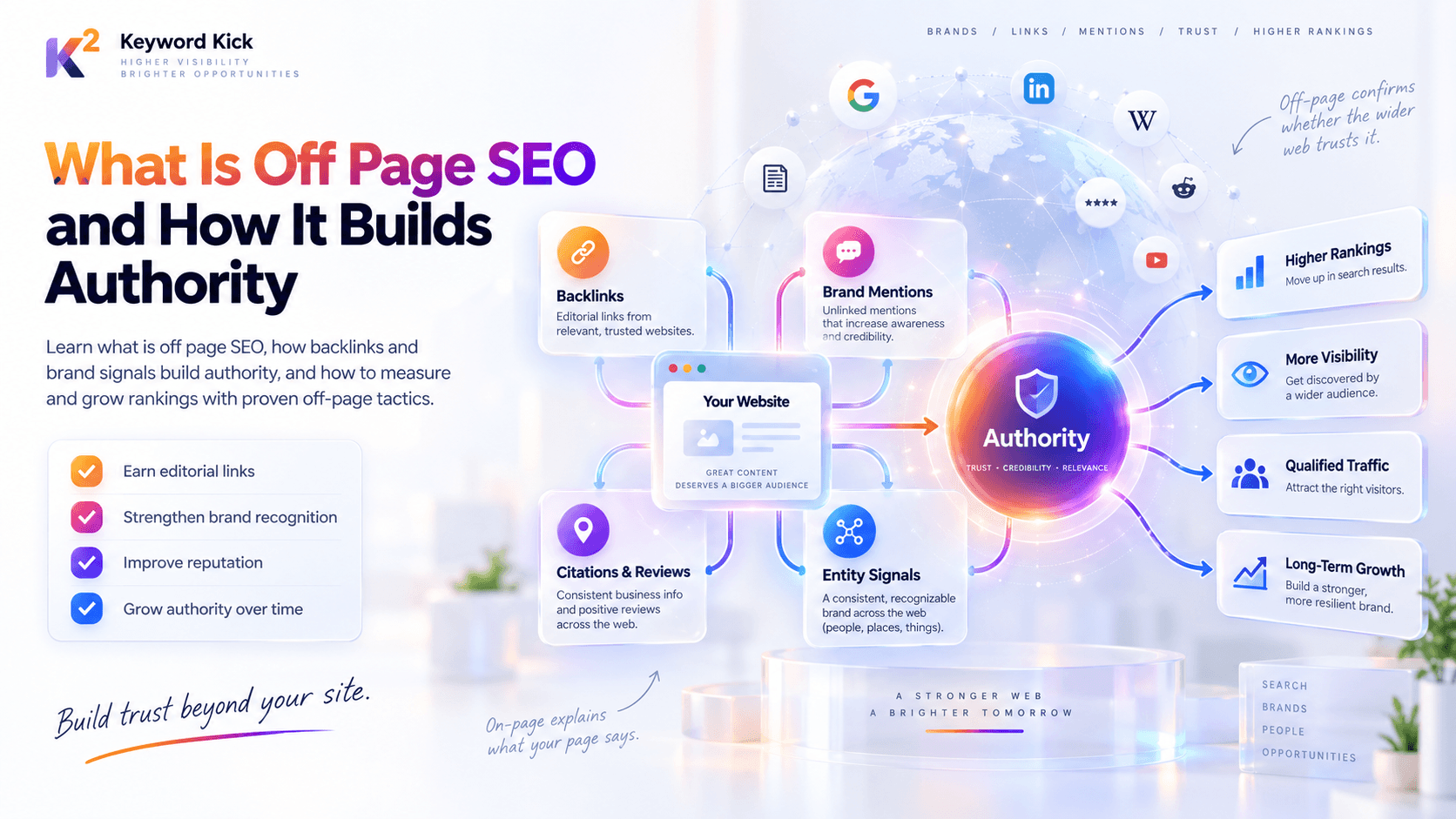
For a current perspective on using competitive intelligence to support gap analysis for 2026 rankings, look for guidance that connects backlink findings with broader search competition. Backlinks also sit within wider off-page work, including brand mentions, digital PR, and relationship building. A useful overview of Keyword Kick off-page SEO can help place the analysis in that larger context.
Choosing the Right Competitors to Analyze
The quality of your output depends more on competitor selection than on the sophistication of your export. Compare your site with the wrong domains and the report will be accurate but commercially useless.
Start with organic competitors, not every business you consider a rival. An organic competitor consistently competes for the same search topics, serves a similar audience, and publishes content that could plausibly attract the same references. A marketplace, national publisher, or global software company might rank for some of your keywords while having a completely different link profile and audience.
Use search overlap as a starting point
Build an initial list from the search results for your priority topics. Look for sites that appear repeatedly across meaningful queries, then inspect whether they compete with the same pages or merely rank for broad informational terms.
A practical selection process looks like this:
- Review shared search visibility: Identify domains appearing for the same commercial and informational themes.
- Check audience similarity: Remove sites that attract a very different buyer, even if their keyword overlap looks impressive.
- Inspect content types: Favor competitors earning links to comparable guides, category pages, studies, or service content.
- Separate direct and indirect rivals: Keep publishers and major reference sites in a separate comparison so they don't distort your primary opportunity set.
- Validate manually: Open several ranking pages and ask whether your company could credibly publish or improve something in that space.
The verified guidance supports comparing three to five true organic competitors before building the difference set (Rhino Rank's backlink gap workflow). That range gives you enough variation to identify repeated patterns without turning the analysis into an unmanageable database.
Don't let authority select your competitors
A high-authority domain can be useful as a benchmark, but it's often a poor prospecting comparator. Large brands may attract links through reputation, news coverage, proprietary data, or partnerships unavailable to a smaller business. If you treat their entire profile as your target, your team may spend time chasing links that aren't replicable.
Compare alternative competitor sets side by side. A narrow set of direct commercial rivals may reveal realistic editorial opportunities. A broader set may show content themes and publishers worth monitoring. Neither is automatically superior. The right set depends on whether you're planning outreach for a specific page, developing a content asset, or mapping a market's link ecosystem.
Use tools for SEO agencies to support competitor discovery, but don't outsource judgment to a metric. Your final competitor set should reflect search overlap, topical similarity, audience fit, and realistic acquisition paths.
Extracting Backlink Profiles and Finding Gaps
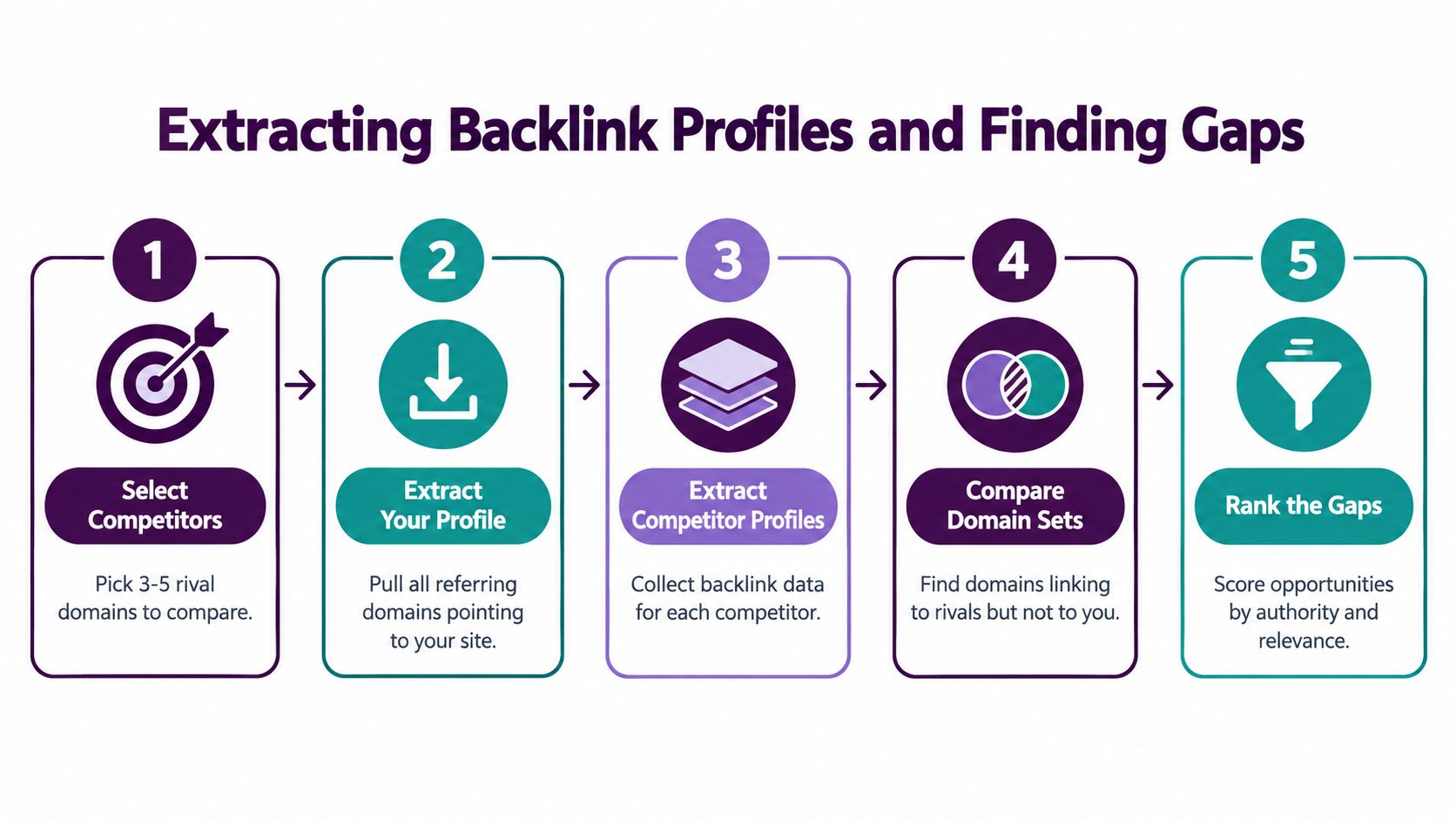
Once the competitor set is stable, treat the analysis as a data comparison followed by a manual investigation. The report identifies the difference set. The linking pages explain whether that difference set is useful.
Step one, establish your baseline
Export the referring domains and important backlink details for your own site first. Record the target URL, linking URL, anchor text, link attribute, and the context in which the link appears. A domain-level view is useful for finding intersections, but page-level information is what helps you understand the acquisition reason.
Before comparing competitors, remove obvious noise from your working data. Watch for duplicate domains, redirected URLs, sitewide placements, broken pages, and links that are technically present but offer little strategic value. If you need a broader review of the information you're collecting, use a resource on how to audit your backlink profile before drawing conclusions.
Step two, collect comparable competitor data
Run the same type of report for each competitor. Consistency matters. If one export includes every historical link and another uses strict live-link filters, your intersection results won't be reliable.
Semrush states that its Backlink Gap tool compares a target site with up to five competitors and surfaces domains linking to those competitors but not the target (Semrush's backlink gap workflow, cited in LinkyJuice's industry overview). Moz provides the same operational ceiling and notes that two competitors can be appropriate for a tighter comparison. Use the broader comparison when you need market-wide patterns, then narrow the list for outreach.
Step three, interpret the difference set
The core calculation is simple:
- Create the set of referring domains linking to each competitor.
- Create the set of referring domains linking to your site.
- Combine competitor sets and remove every domain already linking to you.
- Mark domains appearing across multiple competitor profiles.
- Open the actual linking pages before adding anything to outreach.
The output is not “all backlinks your competitors have.” It's the set of domains that meet the basic competitive condition. That distinction keeps the report focused.
Read the report beyond the headline metric
A referring-domain count won't tell you whether the link sits in a relevant editorial passage, a directory profile, a footer, or a page no longer receiving attention. Review:
- Linking-page purpose: Is it a resource, comparison, article, partner page, or news story?
- Destination page: Did the competitor earn the link to a useful asset or only to a homepage?
- Contextual reason: What did the competitor offer that made the link make sense?
- Link pattern: Does the site link naturally to external resources, or does it show signs of automated placement?
- Replicability: Can your team create an equally useful asset or make a legitimate editorial case?
A domain belongs in your opportunity pool only after the page has survived this inspection. Mathematical difference is the starting point. Human review determines whether the opportunity is real.
Filtering and Prioritizing Missed Link Opportunities
Raw gap data creates a false sense of progress. A spreadsheet can contain hundreds of domains and still produce almost no useful outreach. The filter-and-prioritize stage is where the analysis earns its value.
Use three primary signals first: authority, topical relevance, and competitor overlap. Industry guidance recommends sorting by authority and relevance, checking the intersection view, and building a focused outreach list of roughly 20 to 50 domains (Wix's guidance on SEO gap analysis). Treat that range as a working constraint, not a quota. A smaller list of credible prospects is better than a padded one.
Score the reason to pursue
Authority can help you sort, but it shouldn't decide the list by itself. A relevant site that links to comparable resources may be more useful than a prestigious domain with no meaningful connection to your topic.
Use a decision framework like this:
| Priority Factor | What to Check | Green Light | Red Flag |
|---|---|---|---|
| Topical relevance | Does the site cover your market or a closely related audience? | The page addresses the same problem your resource solves. | Your topic appears only as a passing mention. |
| Editorial behavior | Does the publisher link to external resources naturally? | Contextual links support claims, explanations, or recommended tools. | Links appear in thin lists, footers, or repeated templates. |
| Competitor overlap | How many analyzed competitors receive links from the domain? | Multiple relevant competitors are referenced in useful content. | The domain links to one competitor through a unique sponsorship or relationship. |
| Page quality | Is the linking page maintained, useful, and visible? | The page has clear purpose and current content. | It's abandoned, duplicated, redirected, or filled with unrelated links. |
| Acquisition feasibility | Can you offer a credible reason for inclusion? | Your asset updates, expands, or improves the page. | The link came from unrepeatable news or private access. |
| Risk signals | Does the domain show manipulative patterns? | Natural anchors, coherent topics, and editorial context. | Automated footprints, excessive commercial anchors, or irrelevant placements. |
Use overlap as evidence, not a shortcut
A domain linking to several competitors deserves attention because it has demonstrated relevance across the market. That doesn't mean you should pitch it with a generic request. Inspect the specific pages and determine whether each competitor earned a separate editorial mention or whether one relationship explains all the links.
Page-level review often reveals the most useful distinction. A competitor may have a link to a detailed guide because it contains original examples, while its homepage link may come from a directory or partnership. Those two links share a referring domain but represent completely different acquisition paths.
The strongest prospect is not the domain with the highest metric. It's the domain where relevance and a credible editorial reason meet.
Remove dead ends before outreach
Delete or quarantine domains that are irrelevant, automated, low-quality, non-replicable, or high-risk. Also remove links that point to pages your business can't improve and placements based on relationships you don't share.
For each surviving prospect, capture the target URL, linking page, competitor destination page, overlap count, relevance notes, likely acquisition type, and proposed asset. Add a clear status such as research, ready for outreach, needs content, or do not pursue. That simple classification prevents researchers from handing an unqualified export to copywriters.
The final list should answer four questions for every domain:
- Why is this site relevant?
- Why did it link to the competitor?
- What can we offer that improves the page?
- What makes the request realistic?
If you can't answer those questions, the prospect hasn't passed the filter.
Turning Gaps Into Actual Backlinks
A backlink gap becomes valuable only when you can convert the evidence into a legitimate editorial proposition. The competitor's link tells you that a relationship or content fit exists. It doesn't prove that the publisher wants another link, that your asset is suitable, or that the placement is still available.
Current guidance highlights a major limitation: some apparent gaps come from PR coverage, original research, expert quotes, and product mentions that are difficult to reproduce at scale. Filtering for topical relevance, editorial fit, and acquisition feasibility is therefore more important than maximizing the number of domains in your campaign (SerpX's discussion of backlink gap prioritization).

Match the outreach angle to the link type
Resource pages usually require a genuine improvement to the collection. Explain what your resource adds, where it fits, and why the reader benefits. Don't lead with your company. Lead with the missing subject or outdated reference.
Guest contribution opportunities need a publication-specific idea, not a recycled article pitch. Study the site's existing coverage, propose a narrow topic, and show how your expertise supports the audience. A guest contribution should earn its place through usefulness, not merely create a container for an anchor text.
Directory and association listings can be appropriate when the directory is relevant, maintained, and selective. Confirm that your business fits the listing criteria. Avoid broad directories that accept every submission without editorial standards.
Editorial mentions call for the strongest content fit. If a competitor's guide is cited because it contains original methodology, publish something that offers a distinct contribution before contacting the publisher. Your replacement can't be a thinner version of the same page.
Build the asset before making the request
A common failure occurs when a team finds a gap, sends outreach immediately, and only then discovers that it has nothing worth linking to. Turn recurring gaps into content briefs. The brief should identify the target page, the missing information, the audience need, evidence or examples you can provide, and the exact page on your site that will satisfy it.
Your outreach note should be concise and specific:
- Mention the relevant page.
- Identify one concrete omission, outdated section, or incomplete explanation.
- Explain what your resource contributes.
- Suggest the placement without demanding it.
- Give the editor enough context to decide quickly.
A message to a publisher with an outdated resource should not sound like a message to a journalist who cited a study. The first asks for an update. The second may require new data, expert participation, or a genuinely newsworthy finding. Treating both as generic link insertion requests damages credibility.
For teams comparing external support, Sibley Digital link services provides a useful reference point for evaluating how providers describe prospecting and link acquisition. The important questions remain practical: Can they show the filtering process, explain why each domain fits, and report the final placement context?
Follow up without turning relevance into pressure
A follow-up should add clarity, not repeat the original pitch louder. Revisit the page, confirm that your suggestion still fits, and close the sequence if there's no response. Don't keep contacting editors who have declined or shown no interest.
Use the Keyword Kick outreach playbook to structure research, personalization, and tracking, but keep the central discipline intact. Quality over quantity means fewer messages, stronger reasons, and better documentation of what happened after each pitch.
A useful campaign sheet records the target page, competitor link, proposed resource, outreach angle, contact, date, response, placement status, and follow-up decision. That record helps you identify which gap types convert and which ones repeatedly produce dead ends.
Key Takeaways and Next Steps
A repeatable backlink gap analysis has a clear sequence:
- Define the search battlefield: Select true organic competitors with similar audiences, topics, and content patterns.
- Build comparable profiles: Export referring-domain and page-level data for your site and each competitor.
- Calculate the difference set: Remove domains already linking to you and mark repeated competitor intersections.
- Inspect the evidence: Open the linking pages and identify why each competitor earned the mention.
- Filter aggressively: Remove irrelevant, automated, risky, outdated, and non-replicable opportunities.
- Rank the survivors: Prioritize topical fit, editorial behavior, overlap, page quality, and acquisition feasibility.
- Prepare the offer: Map each prospect to a specific asset, update, contribution, or editorial reason.
- Run focused outreach: Personalize the request, track the result, and improve the process from observed responses.
The three mistakes that undermine most projects are predictable. Teams choose famous domains instead of realistic organic competitors. They sort by authority or link count while ignoring the linking page. They send outreach before creating a resource that meaningfully improves the target page.
Run the analysis as a recurring competitive intelligence process rather than a one-time export. The appropriate cadence depends on your publishing schedule, market activity, and outreach capacity. Each review should compare newly earned competitor links, changed destination pages, emerging content themes, and prospects previously marked as infeasible.
Measure progress with operational indicators, not just total links. Track how many reviewed domains pass your filters, how many receive personalized outreach, which link types earn responses, which assets attract placements, and whether target pages gain relevant referring domains over time. Those signals tell you where the workflow works and where your qualification rules need adjustment.
Keyword Kick can be used as one option for bringing competitor analysis and backlink profile comparisons into a single SEO workspace. Its backlink and competitor features support side-by-side profile review, while the wider platform connects those findings with rankings, audits, and content opportunities. Whether you use it, Semrush, Moz, Ahrefs, or another tool, the principle stays the same: the export is not the strategy. The filtered decision is.
Start with one priority page, choose a defensible competitor set, and produce a small outreach-ready list. Document every exclusion as carefully as every selected prospect. That discipline will show whether your backlink gap analysis is finding genuine opportunities or just generating more data.
Keyword Kick helps agencies, in-house teams, and consultants turn backlink gap data into prioritized SEO actions, with competitor analysis, backlink research, rank tracking, audits, and content insights in one workspace. Visit Keyword Kick to review the platform and apply a more focused workflow to your next backlink gap analysis.