
Off-page SEO is all optimization outside your site, mainly backlinks, brand mentions, and reputation signals, that tells Google your site is trusted and authoritative. It has mattered since Google's 1998 PageRank system turned links into votes of confidence, and one large benchmark still found the top-ranked result has 3.8x more backlinks than positions 2 through 10 on average.
You've probably seen this happen. Two sites publish pages on the same topic. Both are well written. Both match search intent. Both are technically sound. Yet one climbs into the top results while the other stalls.
That gap is usually where off-page SEO starts to matter.
A lot of marketers learn SEO from the inside out. First titles, headers, internal links, and content structure. That's the right place to start. But after on-page basics are in place, rankings often stop being a pure content contest and become a reputation contest.
Introduction to What Off Page SEO Really Means
You publish a page that deserves to rank. It is useful, clear, fast, and closely matched to the search.
Yet a competitor with a page that looks only slightly better, or sometimes no better at all, keeps winning visibility.
That usually happens because Google is judging more than the page itself.
Off-page SEO is the set of signals created outside your website that shape how search engines assess your credibility, authority, and topic relevance. Backlinks are the clearest example, but they are only one part of the system. Reviews, citations, editorial mentions, and entity signals also help search engines judge whether your site is known, trusted, and connected to a subject in a meaningful way.
A useful way to frame it is this: on-page SEO explains what your page says, while off-page SEO helps confirm whether the wider web believes it.
Why the term causes confusion
The phrase "off-page SEO" sounds narrow, so many marketers reduce it to link building. That shortcut misses how search works now.
Links still matter because they remain a strong way to pass authority and show editorial trust. But Google also tries to understand brands as entities, not just pages with URLs. In practice, that means search engines pay attention to the broader authority ecosystem around your site. Who cites you, where your brand appears, how consistently your business is referenced, and whether trusted sources connect your name to a topic.
That is why a smaller number of strong editorial mentions can do more for rankings than a large batch of low-value links. One respected industry publication, a well-earned citation, or repeated brand references from relevant sources can strengthen your authority more than volume-driven link building ever did.
What belongs in that authority ecosystem
Off-page SEO often includes:
- Editorial backlinks from relevant sites that choose to cite your content
- Brand mentions that reinforce recognition, even without a clickable link
- Citations and reviews that support trust and business legitimacy
- Entity signals that help search engines connect your brand to people, products, services, and topics
These signals work together.
A backlink can act like a recommendation. A brand mention can act like recognition. Consistent entity signals can act like identity proof. Search engines combine those clues to estimate whether your site should be treated as a credible source.
Why strong content still needs outside validation
A page can be excellent and still struggle if no one beyond your site seems to vouch for it.
That is the part many teams miss after they finish titles, headers, and content updates. Search engines can read your claims directly. Ranking competitive pages often requires independent confirmation from the rest of the web.
So off-page SEO is not just a stack of links. It is your site's reputation layer. And today, reputation is built less by sheer link volume and more by earning the kinds of mentions and references that real publications, real customers, and real organizations give to brands they trust.
How Off Page SEO Differs from On Page SEO
The simplest way to understand this is with a hiring analogy.
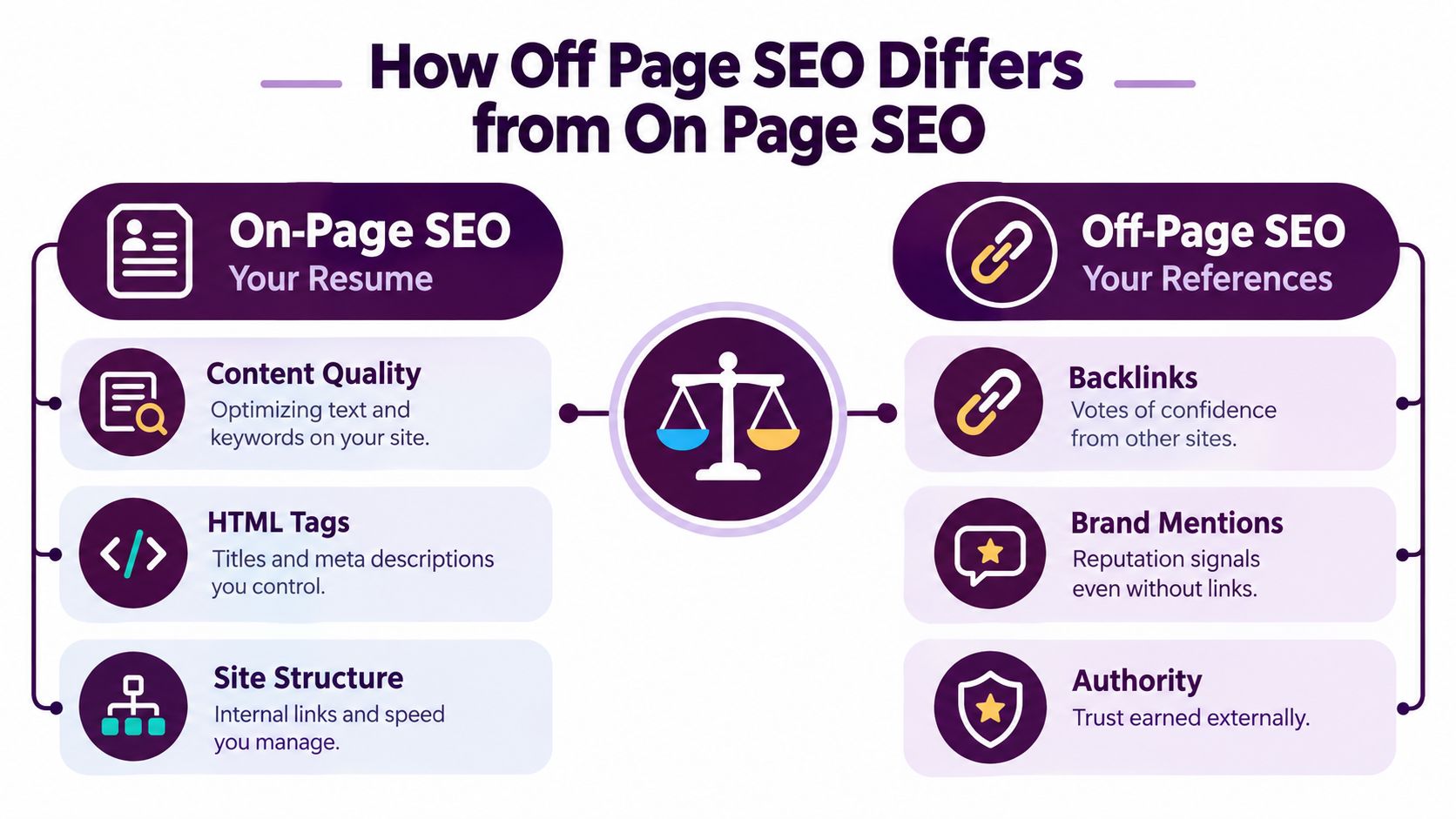
On-page SEO is your resume. Off-page SEO is your references.
Your resume tells people what you can do. Your references tell people whether others trust that claim.
What you control directly
On-page SEO covers the elements on your own site. You write the copy. You choose the title tag. You shape internal links, heading structure, image alt text, and page layout. If something is weak, you can usually fix it yourself.
Off-page SEO works differently. You can influence it, but you don't fully control it. Other sites decide whether to link to you. Journalists decide whether to cite you. Customers decide how they talk about your brand. Local platforms decide how your business information appears.
Why both are required
A great resume with no references raises questions. Strong references for a weak candidate don't solve the problem either.
SEO works the same way:
- On-page SEO helps search engines understand your page
- Off-page SEO helps search engines trust your page
- Technical SEO helps search engines access your page
If one piece is missing, rankings get harder.
Practical rule: On-page SEO earns relevance. Off-page SEO earns authority.
A quick side-by-side view
| Area | On-page SEO | Off-page SEO |
|---|---|---|
| Main focus | Relevance and clarity | Trust and authority |
| Location | On your website | On other sites and platforms |
| Control level | High | Partial |
| Examples | Titles, content, internal links | Backlinks, mentions, citations, reviews |
| Core question | “What is this page about?” | “Why should we trust this page?” |
A smart marketer usually runs into off-page SEO when content quality stops being the bottleneck. You improve the page, but competitors with stronger external authority keep winning.
That's not a sign your content failed. It usually means the market has moved into a tougher stage where reputation matters as much as relevance.
Why Backlinks Remain the Core Authority Signal
A common SEO plateau looks like this. Your page is well written, the search intent is clear, the title is strong, and it still sits below a competitor with content that looks only slightly better.
The missing piece is often external endorsement.
Backlinks still sit at the center of off-page SEO because they do two jobs at once. They act like citations in a research paper, showing that other sites found your page worth referencing. They also give search engines paths to follow as they crawl the web.
Google states in its crawlable links guidance that links help it discover URLs and understand how pages connect. So a strong editorial link can support rankings in two ways. It can strengthen authority and improve discovery.
Why links still matter so much
Search engines have expanded far beyond the early PageRank model, but the core idea still holds. If respected sites keep citing a page, that pattern signals reputation.
That matters because many pages never earn meaningful external references at all. One widely cited industry analysis, referenced in the TechPrevue off-page SEO checklist, found that a large share of pages have no backlinks. In practice, that means the competition is often thinner than it looks. Pages without any real citations rarely build enough authority to win hard searches.
The bigger shift is how Google weighs links now. Volume still exists as a signal, but quality carries more weight. A single mention from a trusted industry publication can do more than dozens of easy links from weak pages.
Not all backlinks pass the same value
Many teams get off track. They measure links like tally marks when search engines evaluate them more like references on a resume.
A backlink can pass more or less value based on four simple factors:
Trust of the referring page
Pages that already earn citations themselves can pass stronger authority.Topical relevance
A link from a page in your subject area helps confirm that your site belongs in that conversation.Editorial context
Links placed naturally inside useful content tend to carry more weight than links dropped into thin directories or footers.Crawlability and uniqueness
Search engines need to access the link, and links from different referring domains usually add more than repeated links from the same place.
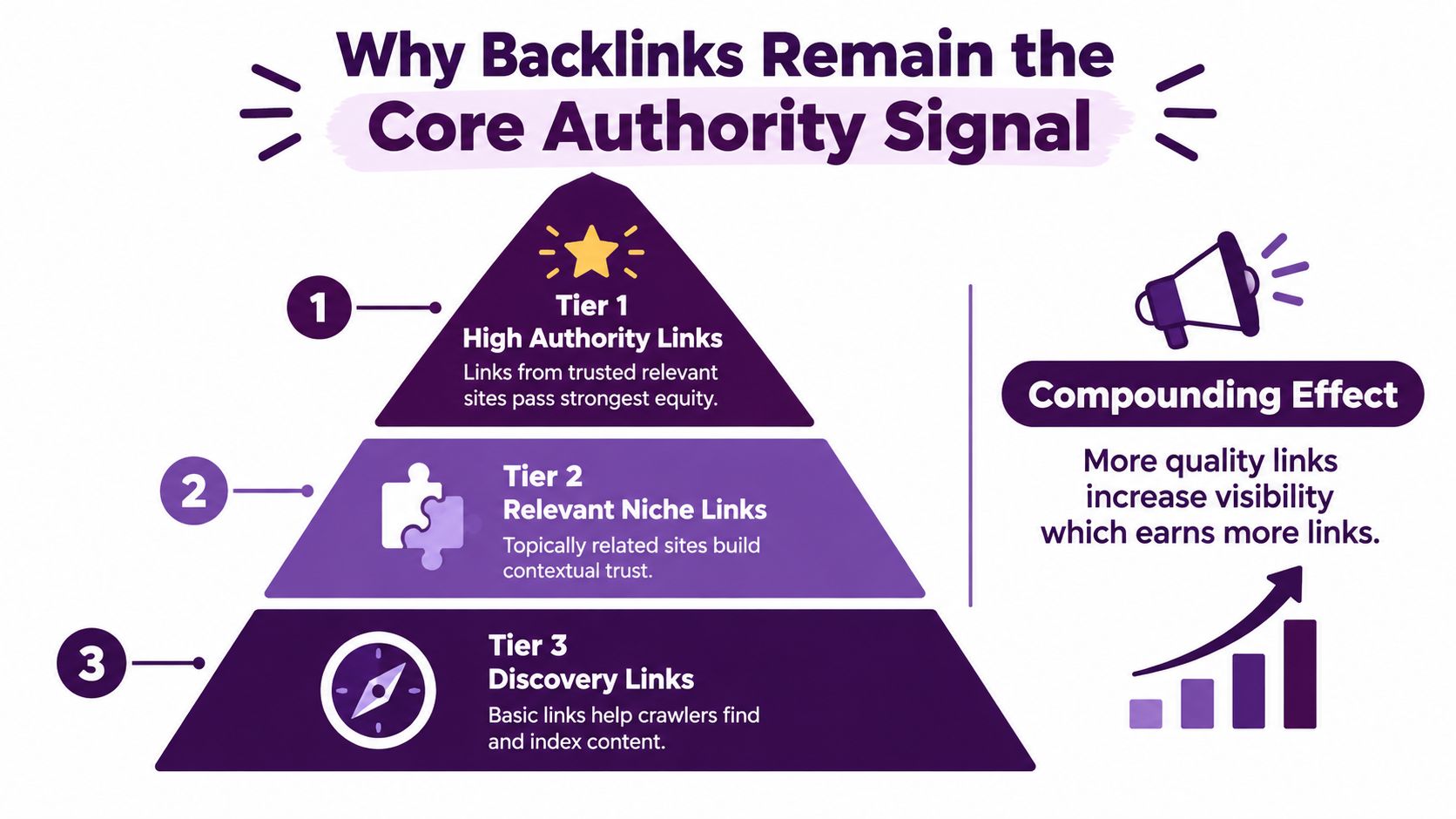
A useful mental model is a newsroom, not a numbers spreadsheet.
- Trusted editorial links carry the most weight because they combine authority, relevance, and human judgment.
- Relevant niche links help reinforce subject expertise and can be very strong in tight verticals.
- Basic discovery links may help crawlers find content, but they usually do little for competitive rankings on their own.
That is why fewer high-quality editorial mentions now outweigh volume link building in many markets.
Why source pages matter
Authority does not come from the link alone. It also comes from the page and site giving the reference.
A mention from a respected publication works like a recommendation from a known expert. A link from an ignored page works more like a business card handed out in an empty room. Both are technically references. Only one changes how others judge credibility.
That is also why off-page SEO works better when you view backlinks as part of a wider authority ecosystem. The link is still the clearest pass-through signal, but its strength depends on the reputation around it. If you want a grounded process for earning stronger placements, this practical link building playbook helps connect strategy to outreach and asset planning. For a closer look at what separates stronger sources from weak ones, this guide to high-quality backlinks is a useful companion.
Beyond Links How Brand Mentions and Entity Signals Shape Authority
Backlinks still matter. But off-page SEO has expanded beyond the old “get more links” playbook.
That shift is one of the biggest reasons marketers ask what is off page SEO and get incomplete answers. They're often taught an older model that stops at guest posts and anchor text.
The authority ecosystem view
A better frame is this: off-page SEO is the external evidence layer around your brand.
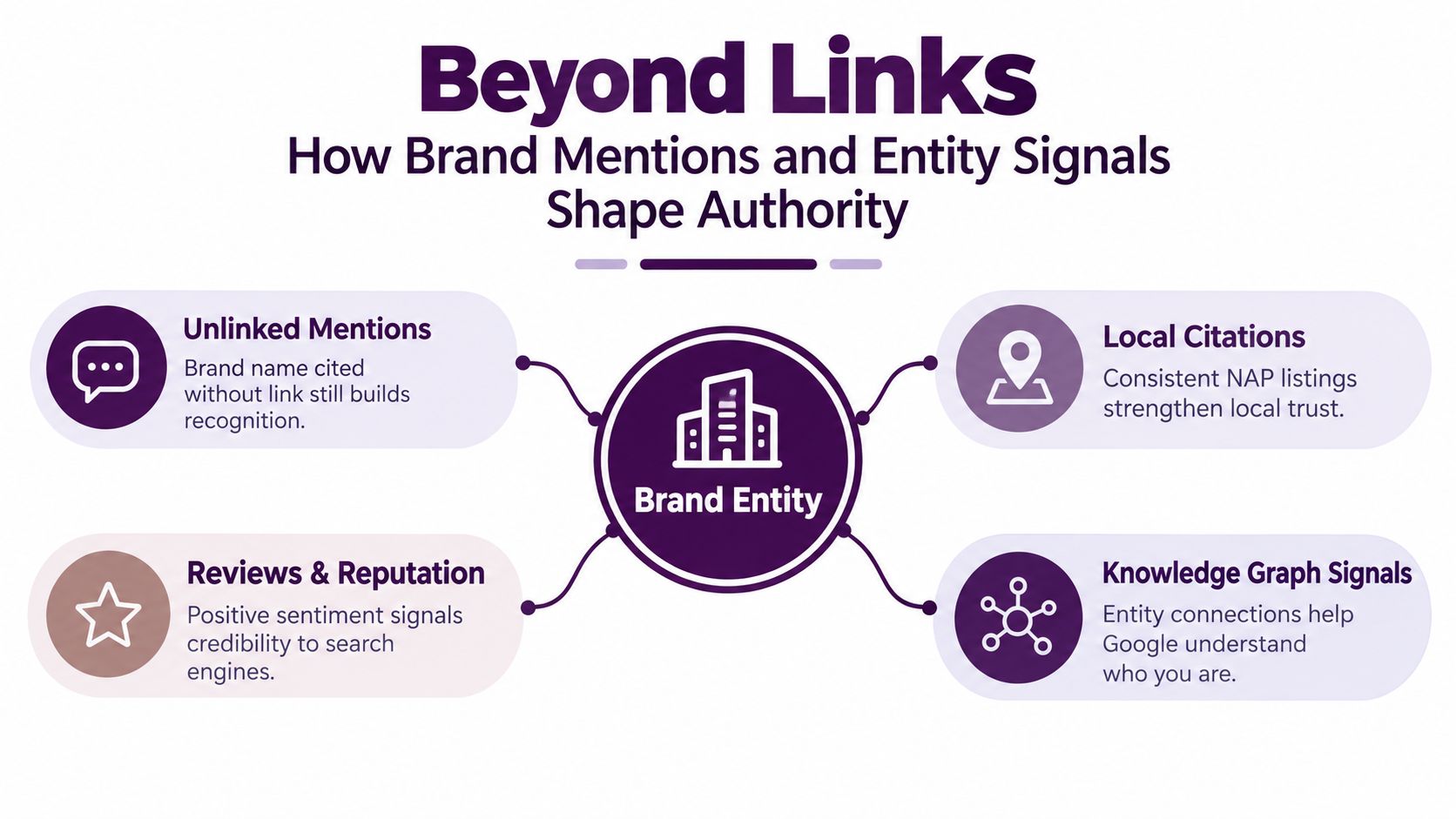
That layer includes links, but it also includes signals that help search engines recognize your business as a known entity with a credible reputation. If people mention your brand across relevant publications, review platforms, directories, and communities, those patterns help reinforce authority even when every mention doesn't include a link.
A recent synthesis described this broader shift by saying links account for about 45% of off-page ranking influence, while brand mentions and entity signals make up the remaining 55%, according to Search Atlas coverage of the evolution of off-page signals.
What counts beyond backlinks
Here are the main signal types worth understanding:
Unlinked mentions
A publication cites your brand name, founder, product, or research without adding a backlink.Local citations
Your business appears in directories and local listings with consistent details.Reviews and reputation
Search engines can learn from the broader sentiment around your brand.Entity associations
Repeated connections between your brand and a topic help search engines understand who you are.
Why this changes strategy
If off-page SEO is an ecosystem, then the goal isn't “build links at all costs.” The goal is to build credible external recognition.
That usually leads to better decisions. Instead of chasing dozens of weak placements, you invest in assets, stories, expertise, and points of view that people want to cite. You show up where your audience and your industry already pay attention.
For teams trying to spot where their brand appears in professional conversations, tools such as a LinkedIn content intelligence platform can support brand visibility analysis alongside SEO tools. And if your brand is already being cited without a link, this guide on turning unlinked mentions into backlinks helps close that gap.
The modern off-page win is often fewer mentions, but stronger ones. Fewer links, but more editorial ones.
Off Page SEO Tactics That Actually Work Today
A lot of off-page advice still sounds like it came from an older search era. Post on any site. Drop links in forums. Trade placements. Scale guest posts. That approach can create activity, but activity isn't the same as authority.
The tactics working now tend to earn stronger editorial signals, not just larger link counts.
Why digital PR stands out
Recent reporting points strongly toward digital PR. One roundup reported that 48.6% of SEO professionals rate digital PR as the most effective tactic, and another report found the average Ahrefs Domain Rating of digital PR coverage in 2024 was 61, with more than 20% of earned links in the DR 70 to 79 band and about 7.83% reaching DR 90+, according to the Reboot digital PR statistics report.
That doesn't mean every brand needs a full PR team. It means the underlying model is winning: create something worth citing, then pitch it to relevant publications and creators who already influence your category.
Comparing Common Off Page SEO Tactics
| Tactic | Authority Impact | Best For |
|---|---|---|
| Digital PR | High | Brands with original data, strong opinions, or useful stories |
| Expert commentary outreach | High | Founders, specialists, agencies, consultants |
| Original research and tools | High | SaaS, publishers, B2B brands |
| Selective guest contributions | Moderate | Building relevance in a tight niche |
| Local citation building | Moderate | Local businesses and multi-location brands |
| Unlinked mention reclamation | Moderate | Established brands already getting talked about |
| Forum spam and low-quality directory blasts | Low | Usually not worth the risk or effort |
| Volume guest posting on weak sites | Low | Rarely the best use of time |
What good tactics have in common
They usually share three traits:
They create something cite-worthy
Data, expert analysis, tools, visual assets, or a strong point of view.They target relevant publishers
Not any site. The right site.They build brand authority as well as links
The mention itself matters, not only the hyperlink.
A practical shortlist for most teams
If you need a cleaner starting point, use this order:
Reclaim what already exists
Find unlinked mentions, press references, partner pages, and outdated citations.Create one strong asset
Publish original research, a benchmark, a tool, or a resource journalists and writers can reference.Run focused outreach
Pitch category publishers, niche newsletters, podcasters, and editors who cover your topic.Support with brand distribution
Strong social and founder distribution won't replace links, but it can increase the chances that the right people discover your asset. Founders building consumer products can borrow ideas from broader growth channels too, such as these app marketing strategies for founders, especially when brand visibility and earned mentions overlap.
The main shift is simple. Off-page SEO works better when you try to earn attention than when you try to manufacture links.
How to Measure Off Page SEO Performance and Authority Growth
Measurement is where many teams drift back into bad habits. They watch total backlink count and assume more means better.
That's too narrow.
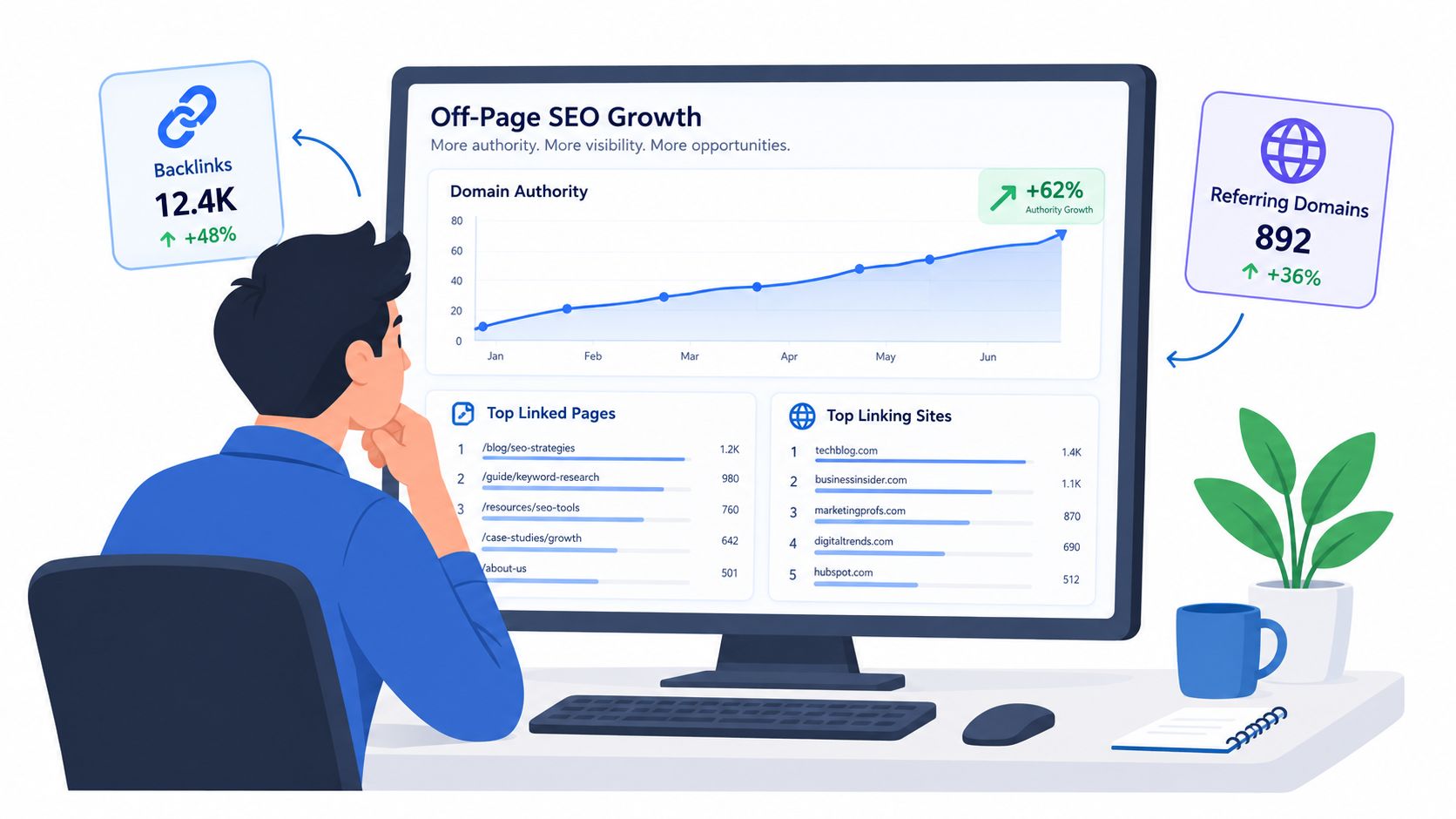
Google Search Console's Links report groups external link data into top linked pages, top linking sites, and top linking text, as described in this explanation of the Search Console backlinks view. Those buckets are useful because they reveal structure, not just volume.
What to check first
Start with the shape of your profile.
Top linked pages
Are links going to your commercial pages, your content assets, or only your homepage?Top linking sites
Are you getting links from a broad set of domains or a narrow cluster?Top linking text
Does your anchor text mix look natural, branded, and varied?
Search Console only shows a sample, not a complete backlink index. So pair it with third-party backlink tools. If you want a broader performance framework that combines visibility data with page-level priorities, this practical guide to measuring SEO performance is useful, and tools like Keyword Kick can unify backlink data with Search Console, rank tracking, and technical signals in one workspace.
What healthy growth looks like
Healthy off-page growth usually looks like this:
| Signal to review | What you want to see |
|---|---|
| Referring domains | Growth from unique, relevant sources |
| Anchor text | Variety, with branded anchors appearing naturally |
| Source quality | Links from pages that are visible, trusted, and topically aligned |
| Linked pages | A mix of homepage, key resources, and strategic content |
| Mention patterns | More citations from relevant industry sources over time |
What can signal risk
Some patterns deserve a closer look:
Too many links from too few domains
That can make a profile look less diverse than the raw count suggests.Repeated exact-match anchors
This can look over-optimized.Most links pointing to low-value pages
You may be earning attention that doesn't support business goals.
A stronger off-page profile is usually more balanced, not just bigger.
One operational detail people miss
Links can influence discovery speed too. If a new page gets cited from pages Google already crawls regularly, that can help search engines find and process the page sooner.
That's why measurement should include both authority and distribution. Ask not only “How many links did we earn?” but also “Did the right pages earn them, from the right sources, with a natural profile?”
Putting Your Off Page SEO Strategy Into Action
If you've been asking what is off page SEO, the simplest answer is this: it's the part of SEO that builds trust outside your website.
For a newer site, that often starts with foundational wins. Clean citations, a few relevant mentions, and a small set of real editorial backlinks. For an established brand, the bigger opportunity is usually sharpening authority. Better digital PR, stronger source assets, and a clearer process for converting mentions into links.
A workable action plan looks like this:
- Audit your current profile by reviewing referring domains, anchors, and top linked pages
- Pick one authority asset that people would cite
- Target relevant publications instead of chasing any placement that will take a link
- Track mentions as well as backlinks so you can see the full authority picture
- Review quality before volume every time you evaluate results
The key mindset shift is that off-page SEO isn't a side task after content is published. It's the reputation layer that helps strong content compete.
Done well, it compounds. Not because you gamed the system, but because more credible people and platforms keep recognizing your work.
Keyword Kick helps teams turn off-page SEO from a scattered checklist into a measurable workflow by combining backlink analysis, rank tracking, Search Console data, and technical signals in one place. If you want clearer answers on which pages need authority, which links matter, and where your visibility is being held back, visit Keyword Kick.