You're probably already seeing the pattern. Your brand gets mentioned in a roundup, a review, a podcast recap, a founder interview, or a Reddit thread. The coverage looks good, the team feels good, and then you check your backlink profile and nothing moved.
That gap is where most brands leak SEO value.
An unlinked mention isn't a cold outreach opportunity. It's a warm asset that hasn't been claimed yet. Someone already decided your brand belonged in the conversation. Your job is to turn that attention into a link when it makes sense, and to do it with a system that doesn't collapse under manual work after the first batch.
A lot of teams treat unlinked brand mentions like a side tactic. They run a few searches, send a few emails, and stop when replies slow down. That approach misses the full opportunity. The win isn't just finding mentions. It's building a repeatable workflow that captures new mentions, scores them correctly, routes the right ones into outreach, and tracks outcomes so the process improves over time.
Why Unlinked Mentions Are Your Hidden SEO Goldmine
If your brand is already earning attention, you're closer to backlinks than you think. Unlinked brand mentions happen when a site names your brand but doesn't include a clickable reference to your site. That means the awareness is there, but the link equity isn't.
That's why link reclamation works. You're not asking a publisher to add something unnatural. You're asking them to complete a reference they already chose to make.
Why these opportunities convert better than cold link pitches
Cold outreach asks for a brand new editorial decision. Reclamation outreach asks for a small edit to existing content. That difference matters.
The mention already proves relevance. The writer already saw your brand as worth naming. In practice, that removes the hardest part of most link building, which is persuading someone that you belong on the page at all.
Practical rule: If the brand mention is accurate, contextually positive, and placed in editorial content, it's usually a better outreach target than a random “resource page” prospect.
There's also a strategic reason to care beyond one link. Unlinked mentions sit inside a broader authority picture. If you're trying to strengthen your site overall, this tactic works best when it supports a larger authority-building plan like these domain authority strategies for 2026, not as a disconnected one-off campaign.
What makes them a hidden asset
Many teams only notice the mention if a stakeholder forwards the article or if the PR team logs it. That leaves a lot on the table. Mentions appear across news sites, blogs, forums, and social discussions, and many never reach the SEO team.
A useful mindset shift is this:
Don't treat mentions as vanity PR They can become backlinks, referral paths, relationship starters, and signals of where your brand is entering the market conversation.
Don't treat every mention as a link request Some mentions are better left alone. The best opportunities are the ones where a link improves the reader experience.
Don't confuse abundance with value A long export of mentions means nothing until you qualify which pages are worth contacting.
Brands often have far more reclaimable mentions than they expect. The hard part isn't scarcity. It's building a disciplined process to find, filter, and act on them without wasting hours on low-value pages.
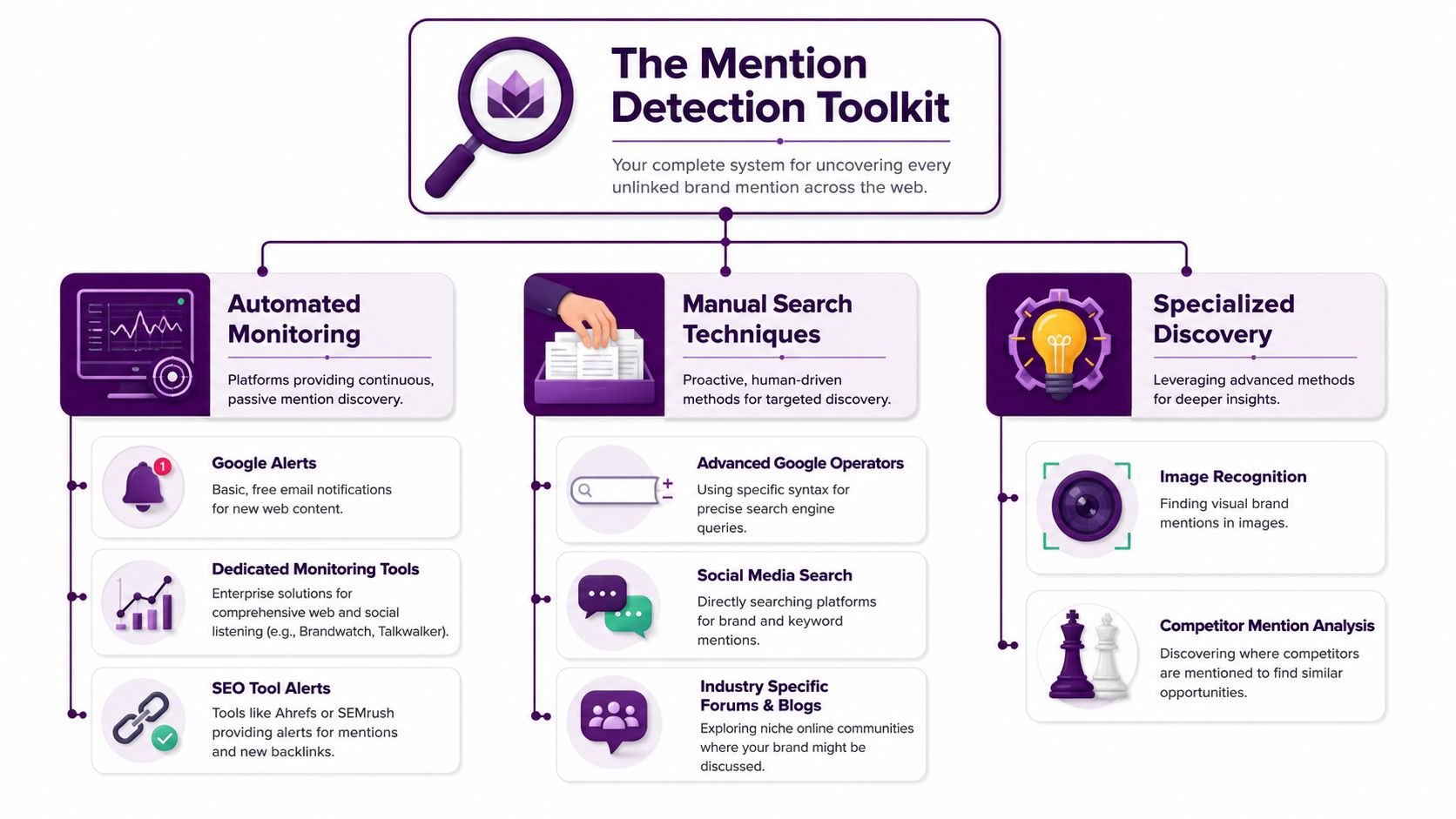
The Mention Detection Toolkit
A typical setup looks fine on paper. There's a Google Alert for the company name, someone checks Ahrefs when they remember, and PR drops the occasional coverage link into Slack. Then the real audit starts, and you find missed mentions on review sites, founder interviews, Reddit threads, partner roundups, and product comparison pages that never reached the SEO team.
That gap is why detection needs a system, not a couple of tools. Good mention tracking pulls from news sites, blogs, forums, podcasts, community platforms, and social networks. Markertion's guide to unlinked brand mentions makes the same point. Coverage improves fast once you stop treating brand monitoring as a single-channel task.
Build a wider term list than your team expects
Exact-match brand tracking misses too much. The working list should include how customers, journalists, creators, and sales prospects refer to you in the wild.
Track these term groups:
Brand variants
One-word version, spaced version, domain version, old brand names, and common misspellings.Product names
This matters even more when the product name gets more search demand or press coverage than the company name.People tied to the brand
Founders, executives, subject matter experts, podcast guests, and anyone who gets quoted often.Nickname language
Abbreviations, shortened references, community slang, and terms users invent for your product.
I usually pull these from sales call transcripts, support tickets, G2 reviews, YouTube comments, and internal Slack messages with customer-facing teams. Those informal versions often show up in forums and social posts before they appear in formal media coverage.
Combine alerts with manual search
Automation gives you consistency. Manual search catches the mentions tools miss.
Use Google Alerts for broad discovery and basic monitoring. Use Ahrefs, Brand24, Mention, or similar tools for web mentions and backlink validation. Then search platform by platform where intent and context matter more than volume. Reddit, LinkedIn, YouTube, and industry forums often surface better reclamation opportunities than generic news alerts because the mention is more specific and the writer is easier to identify.
Search operators help. On X, the -filter:links operator can surface posts that mention your brand without a URL. On Google, combining your brand term with phrases like review, vs, recommended by, customer story, or a founder name often finds pages no alert tool caught.
Before anyone starts outreach, verify whether the page is worth chasing. I like to check the domain and page history first with a backlink checker. It takes a minute and saves a lot of pointless email.
Raw volume is a vanity metric
A spreadsheet with 500 mentions is not progress if 400 of them are junk.
Detection should feed a review layer that strips out pages with little chance of conversion or little SEO value. That is where this process becomes scalable. The goal is not to collect every mention. The goal is to route the right mentions into an outreach queue your team can work through without wasting half the week.
Use a first-pass filter like this:
Filter | What to check | Why it matters |
|---|---|---|
Link status | Is the brand already linked somewhere on the page? | Prevents wasted outreach |
Page type | Editorial article, profile page, directory, forum thread, coupon page | Some page types are much more worth pursuing |
Context | Is the mention central to the topic or just a passing reference? | Stronger context improves link plausibility |
Recency | Is the page still maintained? | Older pages are harder to update |
Brand fit | Does the source actually overlap your market? | Relevance beats random visibility |
One useful extension is competitor monitoring. If competing brands keep appearing in the same conversations, publications, or account lists, those sources belong in your mention pipeline too. For teams that work closely with revenue and account-based programs, this A guide for sales leaders on competitors shows how mention tracking can surface buying-context signals, not just link prospects.
A mention database gets valuable when it helps your team ignore the wrong pages fast, route the right ones into priority buckets, and automate the repetitive collection work without automating bad judgment.
From Mention to Opportunity How to Prioritize Your List
A team pulls 300 unlinked mentions in a week, then wonders why reclamation feels slow and unprofitable. The problem is not discovery. The problem is queue design.
Treat prioritization like revenue ops, not list cleanup. Every mention should answer one question before it reaches outreach: is this page likely to convert into a worthwhile link without burning too much time?
Authority still matters, but it does not lead the process by itself. A relevant article with clear editorial context and a live audience will usually beat a stronger domain where your brand appears once in a vendor roundup or buried quote list. The goal is a queue that produces links your team would pursue again if they had to pay for the hours.
Score the page, not just the domain
Domain metrics are a filter. Page-level context decides whether outreach has a real shot.
Use a simple scoring model your team can apply fast:
Mention URL | Domain Rating (DR) | Page Traffic (Est.) | Relevance (1-5) | Sentiment | Priority Score |
|---|---|---|---|---|---|
example.com/article-a | High | Moderate | 5 | Positive | High |
example.org/post-b | Moderate | Low | 4 | Neutral | Medium |
example.net/page-c | Low | Low | 2 | Positive | Low |
This works because it forces trade-offs into the open. A page on a DR 80 site can still be a poor prospect if the mention is weak, the page gets no traffic, or the article has not been touched in years. A DR 40 industry blog can be a strong target if the article ranks, the mention is central, and the editor still updates posts.
The Fields That Matter
I use five checks to sort mentions into "contact now," "contact later," and "ignore."
Topical relevance
The page should sit close to your category, use case, or customer problem. If the connection is loose, the editor has little reason to add a link.Page visibility
Estimated organic traffic helps separate pages with search value from pages that look good only at the domain level.Strength of the mention
A full paragraph about your product, data, founder, or research gives you a much better outreach angle than a single name drop.Editorial freshness
Maintained pages get edited. Dead archives do not. Check the publish date, last updated date, and whether the site still refreshes similar content.Sentiment and framing
Positive and neutral mentions can work. Complaints, criticism, or awkward comparisons usually belong in the discard pile.
One shortcut saves hours. If the mention is weak on three of those five checks, do not send it to outreach.
For domain quality context, this guide to checking domain trust is useful because it helps teams avoid inflating weak sites based on surface-level metrics.
Build a priority model your team can scale
A spreadsheet score is enough to start. It breaks once volume grows.
The better approach is to assign weighted fields in your CRM, Airtable, or outreach tracker so the queue sorts itself before a human reviews it. For example, relevance and mention strength can carry more weight than raw DR. Freshness can act as a multiplier. Sentiment can act as a hard stop. That setup does two things. It keeps junior team members from chasing shiny domains, and it gives senior team members a smaller list of pages worth personal attention.
A practical setup looks like this:
Tier 1: High relevance, clear mention, live page, reasonable authority
Tier 2: Good fit but weaker traffic or older content
Tier 3: Marginal fit, low visibility, or unclear editorial upside
That structure also makes automation safer. You can auto-enrich traffic and authority fields, flag stale pages, and route likely wins into an outreach queue. You should not automate the final judgment call on context. That is where bad asks start.
Prioritize by effort-to-return, not vanity
Some mentions look great on paper and still waste time. Large publishers often have rigid editorial workflows. User-generated sites may not allow edits. Syndicated pages can send you in circles.
A useful test is this: can the editor plausibly add a link in under two minutes, and does that link improve the page for readers? If the answer is no, lower the score.
That is how mention reclamation becomes a system instead of a scavenger hunt. You stop measuring success by mentions found and start measuring it by pages worth contacting, emails worth sending, and links worth winning.
The Art of the Ask Crafting Outreach That Converts
Most failed unlinked mention campaigns don't fail because the prospect list was weak. They fail because the outreach sounds transactional.

Editors can spot lazy reclamation emails immediately. The note usually says some version of “you mentioned us, please add this link.” That asks the publisher to do work for your benefit. It gives them no reason to care.
Verify context before you write
Teams face challenges. Emerging 2025 data reveals that 42% of unlinked mention outreach attempts fail because teams fail to verify sentiment depth, leading editors to reject requests for neutral or contextually negative mentions. Also, 31% of missed opportunities stem from not monitoring brand variations beyond the company name, like founder names or product nicknames, according to this LinkedIn analysis on unlinked mention wins.
Read the surrounding paragraph. Read the headline. Read the conclusion. Then decide whether the mention supports outreach.
A practical outreach structure
Here's the format that works most often:
Start with the specific article Mention the page title or topic so the email doesn't feel scraped.
Thank them for the mention Keep it brief. Don't flatter.
Explain the reader benefit The link should help readers get context, verify the product, or explore the referenced resource.
Give them the exact destination Don't make them hunt for the right page.
Close without pressure Editors respond better when the ask feels optional and reasonable.
“If it's helpful for your readers, the most relevant page to link is [URL]. It gives context on the product you mentioned.”
That line works because it lowers resistance. You're not telling them they made a mistake. You're giving them a simple enhancement.
Who to contact and how to track it
Contact the author when the page is clearly bylined and current. Contact an editor when the article sits in a publication workflow or the author is hard to reach. For company blogs, content managers often handle updates faster than generic support inboxes.
Your tracking sheet should include:
Mention URL The exact page where the mention appears.
Contact owner Author, editor, content manager, or site contact.
Primary angle Why the link helps their readers.
Status Not started, sent, follow-up queued, replied, added, declined.
Notes Anything unusual about tone, page type, or prior relationship.
What not to do
The biggest outreach mistakes are predictable.
Don't sound entitled The publisher doesn't owe you a link.
Don't ask for homepage links by default Match the destination to the mention.
Don't automate personalization badly If the first sentence feels mass-produced, the email is dead.
Don't push weak opportunities If the mention is marginal, no copy will save it.
Good outreach feels like editorial assistance. Bad outreach feels like unpaid labor.
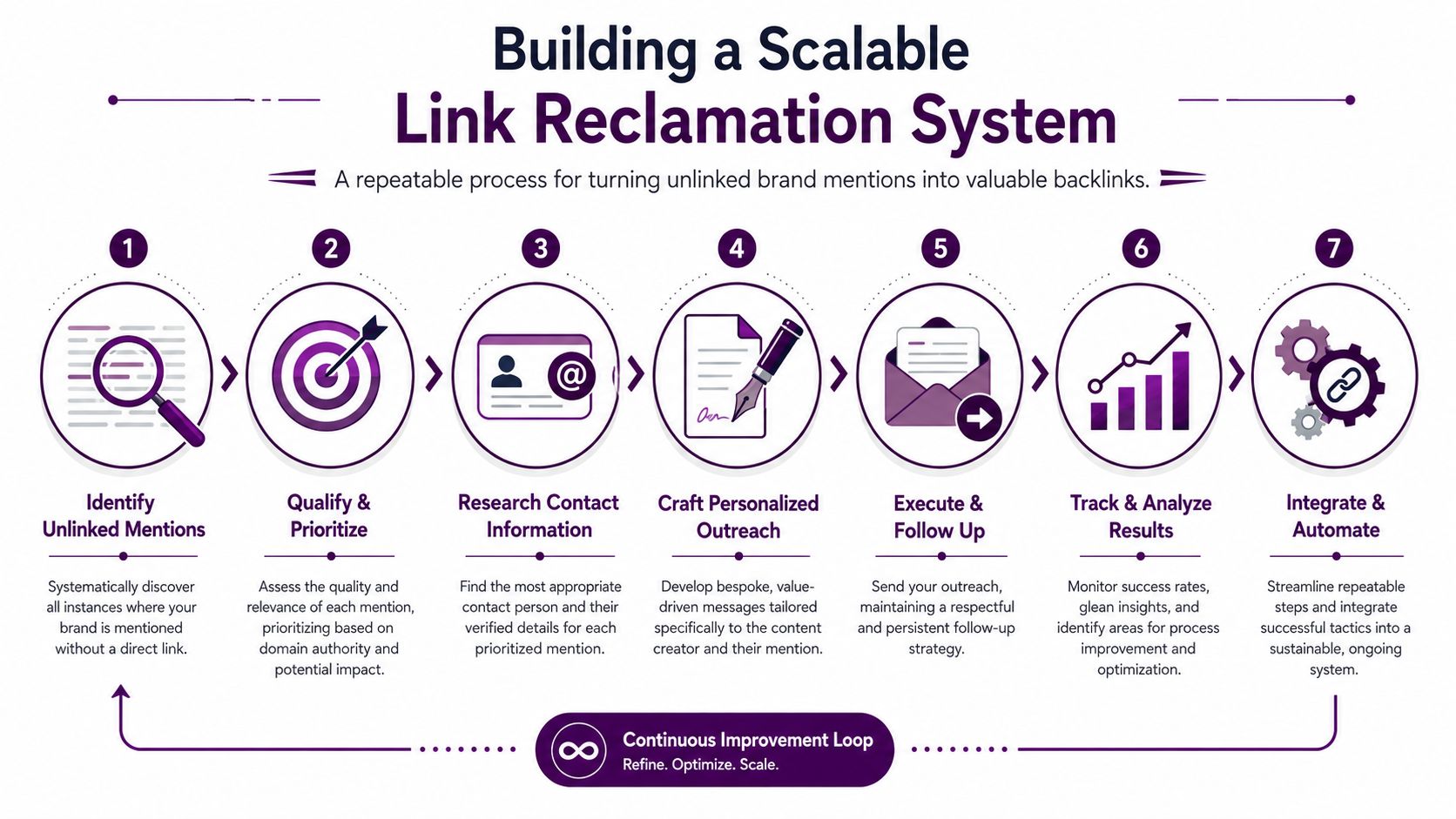
Building a Scalable Link Reclamation System
If you only work mentions when someone on the team happens to notice them, the process never compounds. You need a system that captures mentions, routes them into a queue, and keeps follow-ups moving without relying on memory.
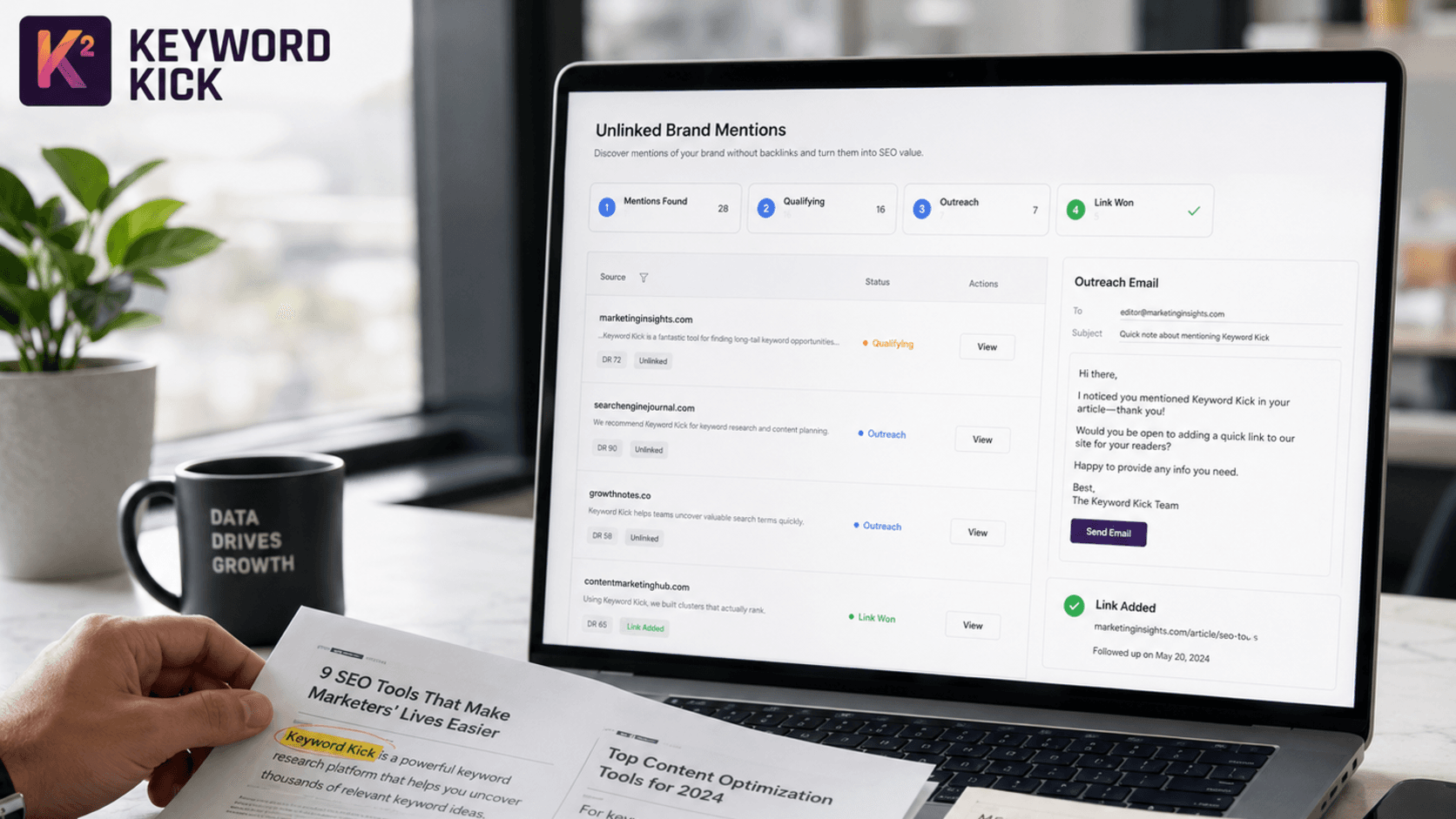
Industry research indicates that securing a backlink from an unlinked brand mention typically requires 6 or more outreach touches before receiving a response. Brands must systematically track each interaction, including the date of outreach, the contact person, and response status, in a dedicated spreadsheet or CRM to optimize their follow-up sequences, based on Vettted's guide to leveraging unlinked mentions.
That one fact changes how you should run the workflow. If you expect one email to do the job, you'll quit too early.
A lean operating model that works
You don't need enterprise software to run this. A sheet or CRM with disciplined fields is enough.
Use these stages:
New mention Detected but not reviewed.
Qualified Passed relevance and quality checks.
Contact found Right person identified.
Outreach sent First message delivered.
Follow-up active Additional touches scheduled and logged.
Won or closed Link added, declined, or archived.
A lot of teams process mentions one by one. Batch work is better. Review new mentions weekly, qualify in one pass, assign owners, and send outreach in blocks. That keeps standards consistent.
What to automate and what to keep manual
Automation helps when it removes admin. It hurts when it replaces judgment.
Automate these parts:
Alert collection Funnel mention alerts into one inbox, sheet, or task board.
Reminder dates Set follow-up prompts so nobody relies on memory.
Status fields Standardize outcomes so reporting stays clean.
Keep these parts manual:
Final qualification Someone needs to read the page.
Message framing The angle depends on the context.
Escalation decisions Some mentions belong with PR or customer support, not SEO.
For broader team context, it helps to connect this workflow to your other link building strategies. Reclamation works best when it sits beside digital PR, resource outreach, partner links, and content-led link acquisition.
Systems don't remove the work. They stop the work from getting lost.
Edge cases that derail teams
A few issues show up constantly.
Duplicate outreach This happens when PR, SEO, and partnerships all contact the same publisher separately. Keep one owner field.
Stale pages Old pages can still be worth testing, but they shouldn't crowd out fresher opportunities.
Sentiment confusion If the mention is mixed or critical, route it out of the SEO queue.
Loose closing rules Decide when a prospect is done. Otherwise weak targets stay open forever.
The strongest systems are boring. They create a steady pipeline, enforce consistent qualification, and make follow-up hard to forget.
FAQ Troubleshooting Your Unlinked Mention Campaign
A publisher mentions your brand, the page looks promising, and then the edge cases start. The article is three years old. The editor asks for payment. The mention is neutral, but the page is weak. These are the decisions that determine whether your system produces links or burns hours.
Should you pursue neutral or negative mentions
Usually, only neutral mentions are worth testing.
A neutral mention can justify outreach when the page is relevant, the brand reference is accurate, and a link would help the reader verify or continue. Negative mentions are different. Asking for a link on a critical page rarely improves the situation and can create unnecessary friction with the publisher.
Correct factual errors if needed. Otherwise, leave it alone and spend time on cleaner wins.
If you would not want that page in your backlink profile during a manual review, do not pitch it.
What if the page is old
Check the site, not just the URL.
Some publishers update evergreen pieces for years. Others publish once and never touch the archive again. Look for recent edits, fresh bylines, active category pages, and signs that editors still maintain old content.
Old-page outreach can drain a team fast. A high-authority mention from an abandoned page often looks better in a spreadsheet than it performs in practice.
What if they ask for payment
Treat it as a paid placement decision.
Do not record it as a reclaimed editorial link. If your policy rules out paid links, close the opportunity and move on. If sponsorships are allowed, hand it to the person who owns media spend or partnerships and label it correctly in reporting.
Clean classification matters. Once paid placements get mixed into reclamation numbers, campaign ROI gets hard to trust.
Is a nofollow link still useful
Sometimes.
A nofollow link can still send qualified traffic, help readers reach the right page, and complete the citation. It does not carry the same SEO value as a standard editorial backlink, but it is not worthless. Judge it by context, page quality, and referral potential.
Is there value in mentions even when you never get the link
Yes. It is a common mistake to think too narrowly about mention value.
Stay Digital Marketers notes in its analysis of brand mention opportunities that 60 to 70% of brand mentions occur without link request intent, and that brands ignoring unlinked mentions as a visibility metric can miss dark social traffic.
That is why a scalable program should not score success on links alone. Some mentions increase branded search, improve recall, trigger private sharing in Slack or email, or open the door to a later relationship with the publisher. Those outcomes matter, especially when you are deciding which mentions deserve repeated follow-up and which should be tracked.
How long should you keep following up
Use a fixed sequence.
For a strong opportunity, send the initial email, follow up once or twice, then close it if there is no response and no sign the page is actively maintained. Logging each touchpoint helps, but the primary gain comes from having the same stopping rule across the team.
Persistence helps. Chasing dead pages for six weeks does not.
What should you measure besides links won
Track the parts of the workflow that explain why results are rising or falling:
Qualified mentions found This shows whether detection and filtering are improving.
Priority coverage This shows whether the best opportunities get worked.
Response rate by page type or publisher This reveals where outreach has the highest return.
Link additions This is the core output, but not the only one.
Non-link outcomes Track referral visits, publisher relationships, corrected brand references, and repeat mention sources.
ROI clarity improves. A good campaign does not just reclaim scattered links. It builds a repeatable process for finding the right mentions, assigning effort based on upside, and learning which opportunities deserve automation support versus manual attention.
If you want a cleaner way to turn mention data, backlink signals, rankings, and site issues into one action plan, Keyword Kick helps you connect the dots without juggling separate SEO tools and spreadsheets. It's built for teams that want prioritized next steps, not more raw data.