You open a backlink tool and get a spreadsheet full of source URLs, anchor text, dates, and authority scores. The export looks precise, but it doesn't answer the questions your business has: Which pages deserve more authority? Which links are worth pursuing? Which lost links affected valuable traffic or conversions?
That's the difference between collecting backlink data and using it. Backlink analysis turns external-link data into decisions about rankings, content, site architecture, outreach, and revenue. The useful output isn't a larger link count. It's a prioritized set of actions that helps important pages earn visibility and commercial results.
Defining Backlink Analysis in Modern SEO
Backlink analysis is the systematic evaluation of the external websites linking to a domain or page. It examines the number of backlinks, the unique referring domains, destination pages, anchor text, link attributes, context, placement, and changes over time. The purpose is to understand how other sites endorse your content and what those endorsements mean for search visibility.
That definition matters because a backlink isn't an isolated vote. A link from a relevant editorial article can support a page in a way that a repeated footer link across hundreds of URLs usually can't. Likewise, a page with many links may still be under-supported if most of those links come from the same small group of domains.
From link counting to link interpretation
Early SEO workflows often treated links as a largely quantitative signal. More links appeared to mean more authority, so teams built reports around totals and broad domain scores. Large-scale ranking research made backlink analysis a mainstream discipline because it showed a strong association between external links and visibility. Moz's study of the top Google results across about 15,000 keywords found that 99.2% of the pages had at least one external link, while 77.8% of individual pages in the top results had at least one external link from another site. The study also reported a .30 correlation between higher rankings and linking root domains (Moz's backlink study).
Those findings established why links matter, but they don't justify treating every link equally. Modern analysis asks more useful questions:
- Does the referring domain operate in the same topic area?
- Does the linking page provide genuine editorial context?
- Is the link pointing to a page that supports a business priority?
- Does the profile rely on diverse domains or repeated placements?
- Has the link remained stable, or has it disappeared?
A practical resource on SEO strategies from TheBestReputation is useful background for placing backlink work within a broader search strategy. Link acquisition only produces durable value when it supports strong content, sound technical foundations, and a clear conversion path.
Practical rule: Treat backlink analysis as a decision system, not a link inventory.
The analyst's job is to connect external endorsement with page-level opportunity. That means separating genuine authority from repetition, evaluating relevance before chasing scores, and identifying where a link can improve a page that matters commercially.
The Core Metrics of a Backlink Profile
A backlink report earns its place in an SEO workflow when each metric supports a decision. Total links show activity, but they cannot reveal whether authority reaches revenue pages, whether several links come from the same site, or whether the profile depends on repetitive placements. Start with the destination page and business priority, then interpret the link metrics around them.
The metrics that deserve attention
Total backlinks count individual links pointing to a site or page. Treat this as a volume measure, not a quality verdict. One domain can produce repeated links through templates, navigation, widgets, or multiple articles. A large total may therefore represent limited external support.
Referring domains count the unique domains linking to the target. This is usually a clearer measure of endorsement breadth. A later analysis summarized by Outrank found ranking correlations of 0.255 for referring domains, 0.250 for followed referring domains, and 0.248 for total backlinks across 1,000,000 U.S. SERPs (the backlink correlation analysis). Correlation does not guarantee rankings, but the comparison supports giving unique sources more weight than raw link totals.
Anchor text distribution records the words used in links. A natural profile commonly combines brand references, URLs, descriptive phrases, and varied wording. A high concentration of commercially exact anchors warrants review, especially when those links come from weak sites or placements that appear controlled.
Follow and nofollow attributes describe how each link is marked. Followed links may contribute to authority signals. Nofollowed links can still send referral traffic, support discovery, generate brand exposure, and contribute to a varied profile. Treat neither attribute as a complete quality assessment.
Authority metrics such as Domain Authority, Domain Rating, and similar scores are third-party estimates. Use them to sort prospects and compare competitors, then inspect relevance and editorial context. A relevant page that reaches the right audience may offer more commercial value than a high-scoring domain with no relationship to the subject.
| Metric | Definition | Strategic Value |
|---|---|---|
| Total backlinks | Individual links pointing to a site or page | Shows volume, but may overstate diversity |
| Referring domains | Unique domains linking to the target | Indicates breadth of external endorsement |
| Anchor text | Visible words used in the link | Helps assess context and over-optimization risk |
| Follow or nofollow | Attributes describing the link relationship | Helps interpret authority and referral value |
| Target page | The URL receiving the link | Connects link support to content and conversion priorities |
| First-seen and last-seen dates | When a tool detected and most recently confirmed a link | Identifies stability, churn, and reclamation opportunities |
| Authority score | A third-party estimate of domain or page strength | Supports prioritization, but does not replace review |
For teams comparing platforms, backlink analysis features can help centralize referring domains, target pages, attributes, context, and link history. The dashboard matters less than whether the dataset supports page-level comparisons and practical outreach decisions.
Keep domain strength separate from page-level support. A powerful domain may have excellent links to its homepage while its product, category, or service pages receive little attention. Those deeper URLs often carry the conversion path. Preserve the destination page in every report, then prioritize links that can strengthen pages tied to pipeline, sales, or other measurable commercial goals.
Why Backlink Analysis Drives SEO Growth
A page can be accurate, technically accessible, and well optimized yet fail to produce enough qualified traffic. The commercial issue is often competitive support. Backlink analysis shows whether the pages tied to revenue goals have the external recognition needed to compete, then connects that gap to practical action.
Start with ranking diagnosis. Compare a valuable page with the pages ranking ahead of it for the same search demand. Broader referring-domain coverage, stronger topical relationships, or more editorial links to comparable content can indicate an authority gap. The missing ingredient may not be another keyword edit. It may be stronger support for that specific URL.
The next benefit is prioritization. A page with weak link support and a clear conversion role deserves a different response from an informational page that already attracts strong references. Use the comparison to decide whether content improvements, internal links, digital PR, or targeted outreach should receive attention first.
Visibility depends on distribution
Competitive link volume explains why a well-written page can stall. A study of 11.8 million Google search results found that the top result averaged 3.8 times more backlinks than positions 2 through 10 (the ranking and backlink analysis). The figure is a competitive signal, not a target to copy. Raw totals become useful only when evaluated against the pages competing for the same demand.
Backlinks can help search engines discover and revisit pages, although crawl behavior also depends on the site's technical setup and internal structure. External references will not fix blocked resources, poor internal linking, duplicate pages, or content that fails to satisfy the query.
The revenue connection becomes clearer at page level:
- An information page with relevant support can attract qualified visitors and direct them toward a related product or service.
- A category page with appropriate references can compete for searches closer to selection and purchase.
- A conversion page may gain authority from reviews, comparisons, partner resources, and industry publications.
- A lost link to a strategic URL can create a focused reclamation task with clearer commercial value than a broad campaign.
Software and subscription teams can pair link analysis with how to fix SaaS SEO mistakes when technical issues or weak conversion paths reduce the return from authority building. Backlinks create an opportunity. The destination page must still meet search intent and make the next action clear.
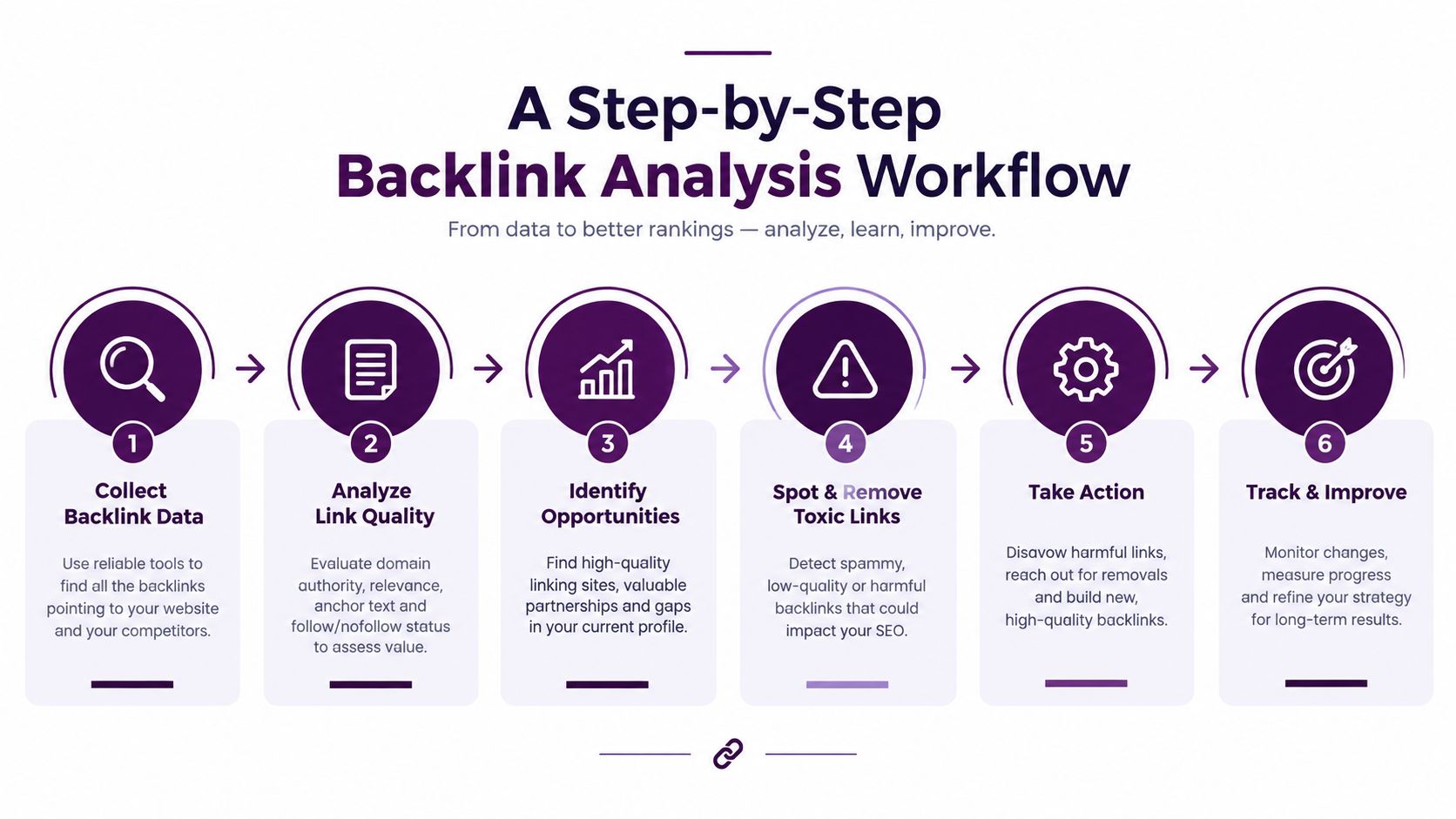
A Step-by-Step Backlink Analysis Workflow
A reliable workflow starts with clean data. Don't begin by judging links one at a time inside a tool. Export the fields you need, normalize the records, then evaluate patterns at domain and page level.
Start with a complete export
Pull backlink data from a crawler such as Ahrefs, Semrush, Majestic, Moz, or another source your team trusts. Include:
- Source URL and referring domain
- Target URL
- Anchor text
- Follow or nofollow status
- First-seen and last-seen dates
- HTTP status and link placement where available
- Estimated authority and traffic fields where available
No index contains every link, and tools may report different discoveries. For important decisions, compare sources or validate the most consequential records manually.
Clean the relationship data
Normalize protocol, subdomain, capitalization, tracking parameters, and trailing slashes so the same destination doesn't appear as several unrelated URLs. Then deduplicate source-to-target pairs. This prevents repeated exports or identical records from inflating the apparent size of the profile.
Group the cleaned data by referring domain and target page. A domain linking to many pages remains one referring-domain relationship, while the page-level grouping shows where that domain's support is concentrated. This distinction exposes sitewide links, templated placements, and authority concentration.
Classify before you score
Review each important referring domain using a consistent set of questions:
- Relevance: Does the site cover a related subject, audience, location, or professional context?
- Editorial fit: Does the link appear within useful content, or is it isolated in a template or directory block?
- Destination value: Does it support a page that matters to visibility, leads, sales, or customer education?
- Stability: Does the link have a meaningful history, or did it appear and disappear quickly?
- Acquisition pattern: Does the placement look earned, contributed, partnered, cited, or potentially manipulative?
Keep first-seen and last-seen dates in the working file. Stable links can support a durability assessment, while recent losses may indicate a removed article, a changed URL, a broken redirect, or a relationship that needs attention.
Segment the profile
Create separate views for:
- Homepage links
- Editorial content links
- Product, service, and category links
- Partner and supplier links
- Directories and citations
- Sitewide or templated links
- New links
- Lost links
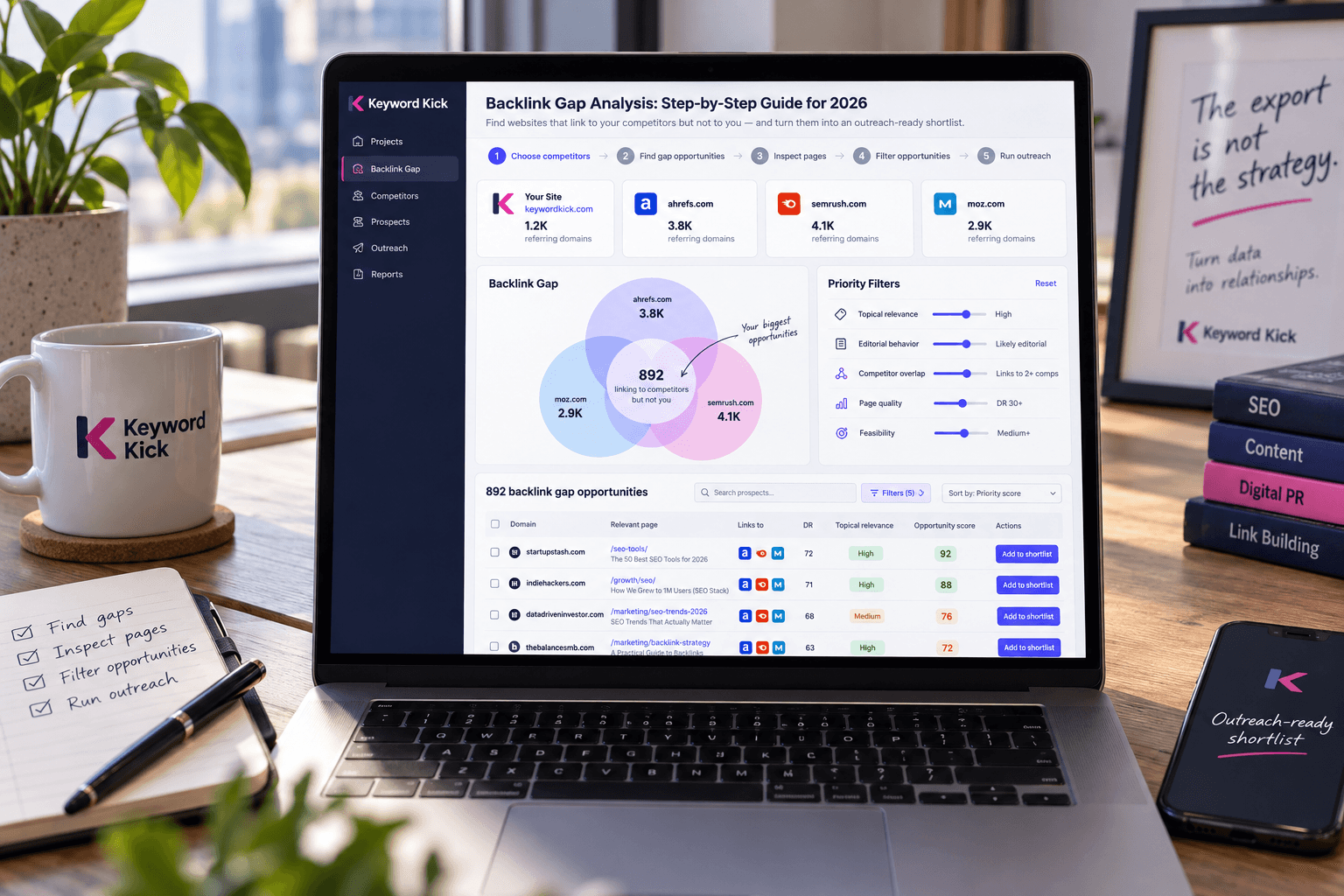
- Competitor-only referring domains
This segmentation turns a messy export into a diagnostic asset. If you need a faster operational routine, these backlink audit tips for agencies can help structure repeatable client reviews without skipping the page-level checks.
Finish by selecting the records that require action. Don't send an outreach list containing every competitor link. Filter for relevance, editorial feasibility, strategic destination, and a realistic reason the publisher would mention your site.
Turning Data into Prioritized SEO Actions
An audit creates value only when someone can act on it. The central question isn't “How many links do we have?” It's “Which pages need support, and what action has the strongest commercial rationale?”
Start with a page-level matrix. For each important URL, record its organic visibility, conversion role, existing referring domains, internal links, recent link gains and losses, and competitor support. You don't need to force every field into a numerical score. A simple priority label can be more honest than a blended authority formula.
Find the pages with commercial potential
Look for three patterns.
High-value page, weak external support. A service, product, or category page may rank below its potential because it has little relevant external endorsement. Pair outreach with improvements to the page itself, then strengthen internal links from related content.
Strong links, weak conversion path. An editorial guide may attract substantial attention but send visitors to a generic destination. Improve calls to action, comparison paths, related products, or internal navigation before pursuing more links to the guide.
Valuable link, damaged destination. A link may point to a redirected, removed, canonicalized, or outdated URL. Reclaiming the link or asking the publisher to update the destination can be more efficient than starting a new acquisition campaign.
Turn patterns into work queues
Map findings to owners:
- Content team: Refresh linkable assets, add evidence, improve topical coverage, and create pages that deserve citation.
- Outreach team: Contact relevant publishers with a specific editorial reason to update or add a reference.
- Technical SEO team: Resolve broken destinations, redirect chains, canonical conflicts, and orphaned pages.
- Architecture team: Connect authoritative pages to strategic commercial URLs through useful internal links.
- Analytics team: Compare linked-page visibility and conversions with the business goals assigned to those URLs.
Competitor gaps can reveal prospects, but they're not instructions to copy every placement. Evaluate whether the linking site fits your audience and whether your page offers something worth citing. A curated list of backlink building sites can support prospecting, but editorial relevance should decide the final shortlist.
Decision filter: If a link doesn't support a strategic page, a credible audience, or a defensible editorial relationship, it probably shouldn't lead your queue.
Prioritize quick wins first. Reclaim lost links, repair valuable destinations, ask partners to update outdated URLs, and improve internal paths from pages that already earn attention. Then invest in new outreach where the page, proposition, and publisher fit are clear.
Common Backlink Analysis Pitfalls to Avoid
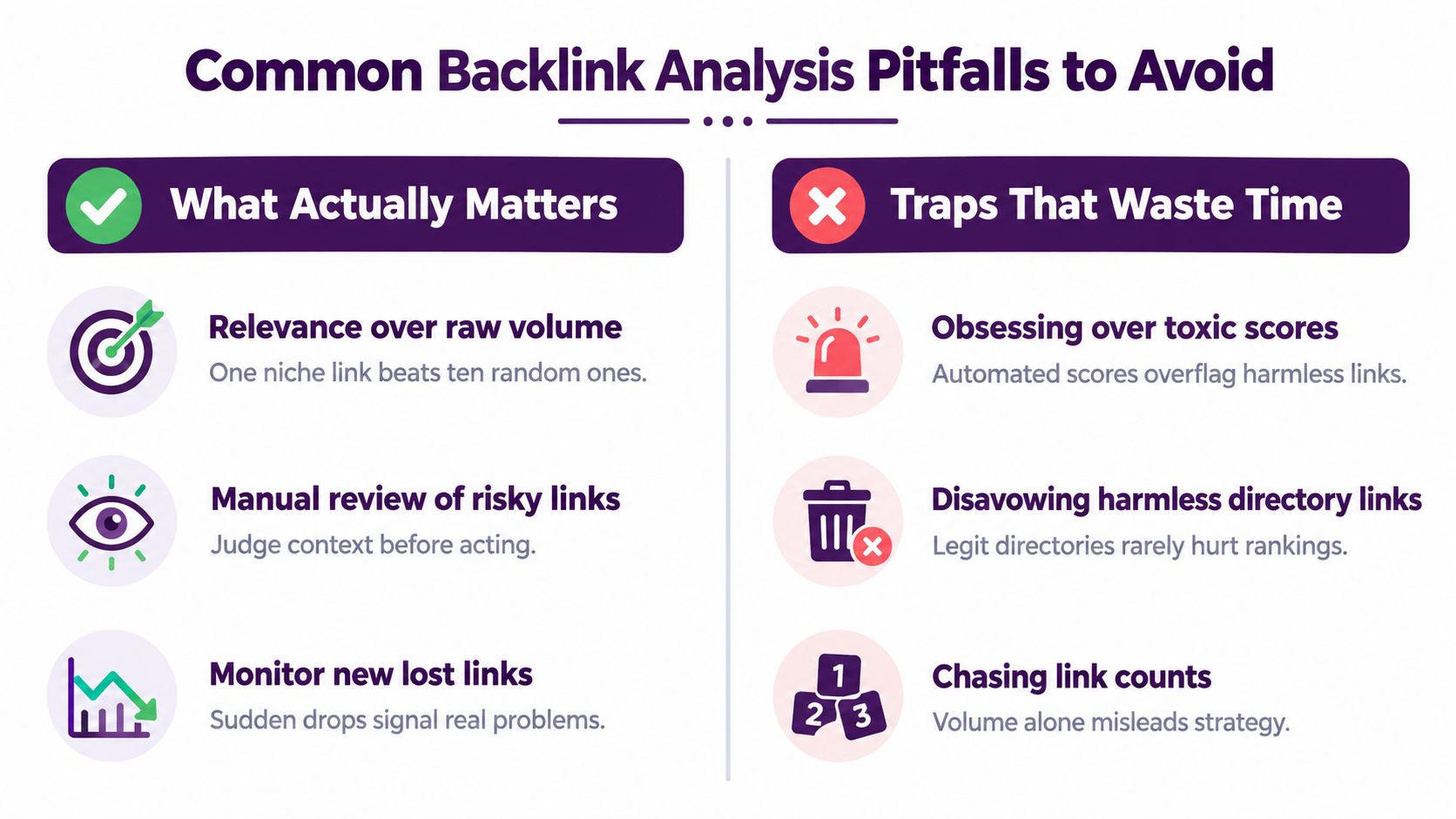
The SEO industry spends too much time turning automated “toxic” scores into emergency work. A warning can help identify a link for review, but it doesn't prove that the link harms visibility. Disavowing harmless directory or partner links without a clear reason can remove useful referral pathways and distract from pages that actually need support.
Raw link volume creates a similar trap. A site can accumulate many backlinks from a narrow set of domains, repeated templates, or sitewide placements. That profile may look impressive in a summary report while offering less acquisition diversity than a smaller set of links from distinct, relevant sources.
Use manual judgment where automation is weakest
Review the surrounding content, the publisher's purpose, the link's placement, the destination page, and the relationship between the two sites. A high authority score doesn't erase poor topical fit, and a modest score doesn't automatically make a relevant editorial mention useless.
The more nuanced question is whether a profile is contextually relevant, editorially earned, and useful for visibility in both classic search and AI-assisted discovery. That perspective is supported by the discussion of changing link-analysis priorities in this backlink analysis guidance, which challenges the emphasis on toxicity labels and raw counts.
Avoid these common mistakes:
- Treating every warning as a penalty: Investigate first, then decide whether the link creates a genuine risk or merely looks unusual to an automated classifier.
- Chasing high authority without relevance: A strong domain can still be the wrong publisher for your audience and page.
- Building links only to the homepage: Commercial growth usually requires support for service, product, category, and high-intent content pages.
- Ignoring lost links: A vanished link to an important URL can deserve faster attention than an unqualified new prospect.
- Reporting activity instead of impact: New links matter less than whether the supported pages gain qualified visibility and assist business outcomes.
Real-World Use Cases for Agencies and In-House Teams
An agency can use competitor backlink analysis to separate a client's genuine opportunities from a competitor's entire link history. The team identifies search competitors, compares the referring domains supporting equivalent pages, removes irrelevant or inaccessible prospects, and groups the remainder by acquisition route, such as editorial citation, partner mention, resource inclusion, or expert contribution. The deliverable becomes an outreach queue tied to specific pages, not a spreadsheet sorted by an authority score.
The agency can then report on actions and outcomes together. A prospect is valuable when it has a credible audience, a realistic editorial fit, and a reason to reference the client's asset. That makes the work easier to explain to stakeholders because every recommended placement connects to a page and a business objective.
An in-house e-commerce team might use the same process before a seasonal campaign. It compares category and product-supporting pages, checks whether important categories receive external references, finds orphaned destinations, and reviews lost links to pages that need visibility. The team can then improve internal linking, refresh category content, repair destinations, and pursue a small set of relevant external opportunities.
The workflow scales because the principle stays consistent: analyze the link relationship, identify the page affected, and assign the next action to a business owner. Keyword Kick brings backlink data together with rankings, competitors, Search Console, Analytics, and technical signals, so teams can assess those relationships in a shared SEO workspace.
Keyword Kick helps agencies and in-house teams analyze referring domains, target pages, new and lost links, and competitor gaps alongside broader search data. Visit Keyword Kick to turn backlink findings into prioritized SEO actions connected to visibility and conversion goals.