
Your team has probably done this before: someone exports competitor keywords, copies a few ranking pages into a spreadsheet, adds backlink counts, and presents the file as a strategy. For a while, the document looks useful. Then priorities change, rankings move, a new competitor appears in search, and nobody knows which observation still matters.
Effective competitor analysis isn't a larger spreadsheet. It's a decision system. You need to know which rivals compete for customers, which domains compete for visibility, what evidence explains their advantage, and which action deserves your team's limited time. The practical approach combines industry structure, firm-level research, keyword and backlink analysis, technical signals, and visibility in AI-generated answers.
Why Most Competitor Analysis Fails Before It Starts
A common assignment sounds simple: “Find our top competitors and tell us what they're doing.” The analyst searches a few important terms, copies the top domains, compares content length and backlinks, and highlights the largest gaps. The result may be accurate, but it rarely answers the question the business needs resolved.
A product team might need to know why qualified visitors aren't converting. An SEO manager might need to decide whether to improve existing pages or publish new ones. A founder might be asking whether an emerging alternative threatens the category. Scraping the same visible rivals won't answer those questions unless the research begins with a Key Intelligence Question, or KIQ.

Start with the decision
Write the decision before opening an SEO tool. A useful KIQ is narrow enough to guide collection and important enough to change what the team does.
Examples include:
- Visibility: Why does a smaller rival appear across valuable commercial queries where the market leader doesn't?
- Content: Which topics do competitors own because their pages answer a specific buyer objection better?
- Conversion: Where does a competing product create a clearer path from comparison to signup?
- Positioning: Which customer segment is poorly served by current category messaging?
- Risk: Is a new substitute attracting the same searcher through a different format or solution?
This framing prevents a frequent mistake, collecting evidence just because it is available. A competitor's publication frequency may matter for a content-capacity question, but it won't explain checkout friction. A backlink gap may look impressive yet have little value if those links don't reach pages serving qualified intent.
Practical rule: Every row in your research file should help answer a KIQ, validate a hypothesis, or support a decision.
Define the competitor set around the question, not around a fixed list of domains. For a commercial SEO project, include direct businesses, sites that rank for the same queries, publishers, marketplaces, comparison sites, and emerging alternatives where relevant. Then record comparable observations over the same market, device, geography, and time period.
The historical case for structured analysis is strong. A survey-based study reported that 82% of respondents used an analytical model for competitive intelligence, while competitor analysis was used by 44%, SWOT by 38%, benchmarking by 36%, competitive-positioning analysis by 26%, and industry analysis by 25% (the survey and its reported methods). The point isn't to use every model. It's to make your observations repeatable and connected to action.
Mapping the Competitive Terrain and Industry Forces
A competitor set built from rankings alone will mislead you fast. Before you compare title tags, referring domains, or AI answers, define the market you are analyzing. The domain outranking you may be a direct business rival, a substitute solving the same job in a different way, or a publisher absorbing the click you wanted. Those are different threats, and they call for different responses.
That distinction matters more now because search competition is split between market competitors and SERP competitors. In many niches, the businesses taking revenue are not the same sites taking visibility. Add AI Overviews and other answer layers, and the gap gets wider. Good competitor analysis starts by deciding which Key Intelligence Question each rival helps answer.
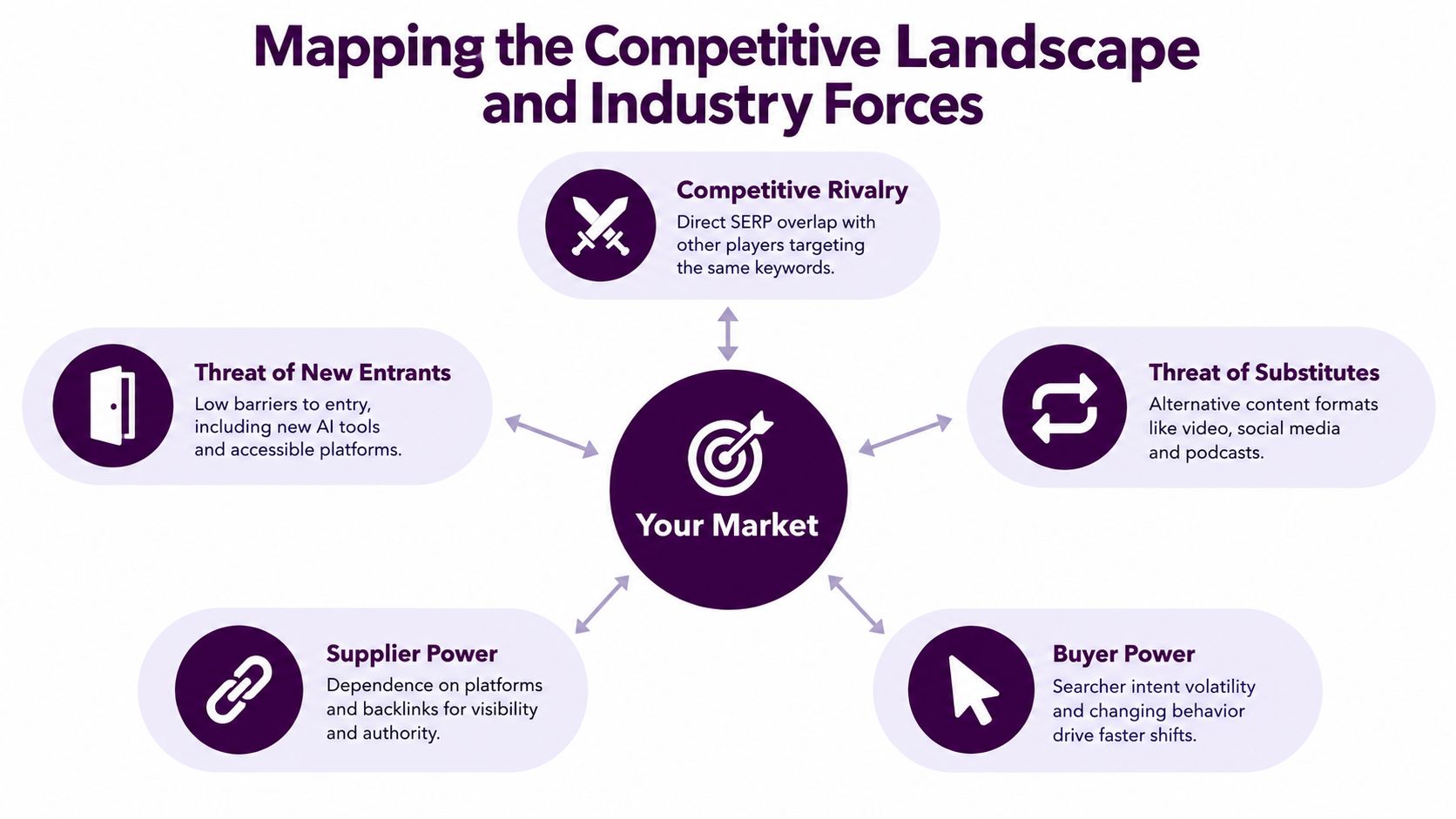
Michael Porter gave teams a structured way to examine industry pressure, first in a 1979 Harvard Business Review article and later in his 1980 book, Competitive Strategy. The Five Forces model covers rivalry, new entrants, substitutes, buyer power, and supplier power. It is still useful because it pushes analysis past feature checklists and toward the economic pressures shaping profitability (the historical account of Porter's framework).
Build the map in layers
Start with boundaries. Define the customer problem, the solutions buyers consider, the geography, the audience, and the intents that matter. Then sort each observed domain into a role.
- Direct competitors sell a similar solution to a similar audience.
- Substitutes help the user reach the same outcome through a different product, service, or format.
- SERP competitors compete for rankings, clicks, or answer visibility without offering the same product.
- Potential entrants can move into the market because technology, distribution, or regulation lowers the barrier.
- Aspirational players set the standard for positioning, content quality, or customer experience.
I use this classification to stop teams from copying the wrong signal. A direct competitor's pricing page may reveal how the market frames value. A publisher dominating informational queries may teach you more about topical authority than commercial strategy. A substitute may matter less for keywords than for messaging, especially if it changes how buyers define the problem.
Apply the Five Forces to search
For competitive rivalry, compare who appears across commercial and informational queries, how concentrated visibility is, how often products or offers change, and where buyer switching looks easy. For new entrants, check startup costs, access to distribution, technical complexity, regulation, and brand loyalty. AI tools may lower the barrier to publishing, while trust and operations still limit who can win commercially.
For substitutes, look beyond product names. Agencies, templates, marketplaces, media formats, and educational content can all intercept the same demand. Buyer power shows up in review patterns, procurement behavior, switching costs, and how easily searchers compare offers. Supplier power includes dependence on platforms, specialist partners, and the sites that pass authority signals.
If you need a working checklist, find actionable competitor signals. For teams building a repeatable intelligence process, master your niche with data-driven SEO.
The output is a competitive terrain map tied to decisions. It should show which rivals matter for each KIQ, where pressure is coming from, and where an apparent ranking gap is really a structural opportunity.
Analyzing Backlinks, Technical Health, and AI Visibility
You can lose a competitor analysis here even if your keyword list is accurate. One rival wins because it earns links to money pages. Another wins because Google can crawl and understand its templates more efficiently. A third barely ranks in classic positions but keeps showing up in AI-generated answers, shaping consideration before the click.
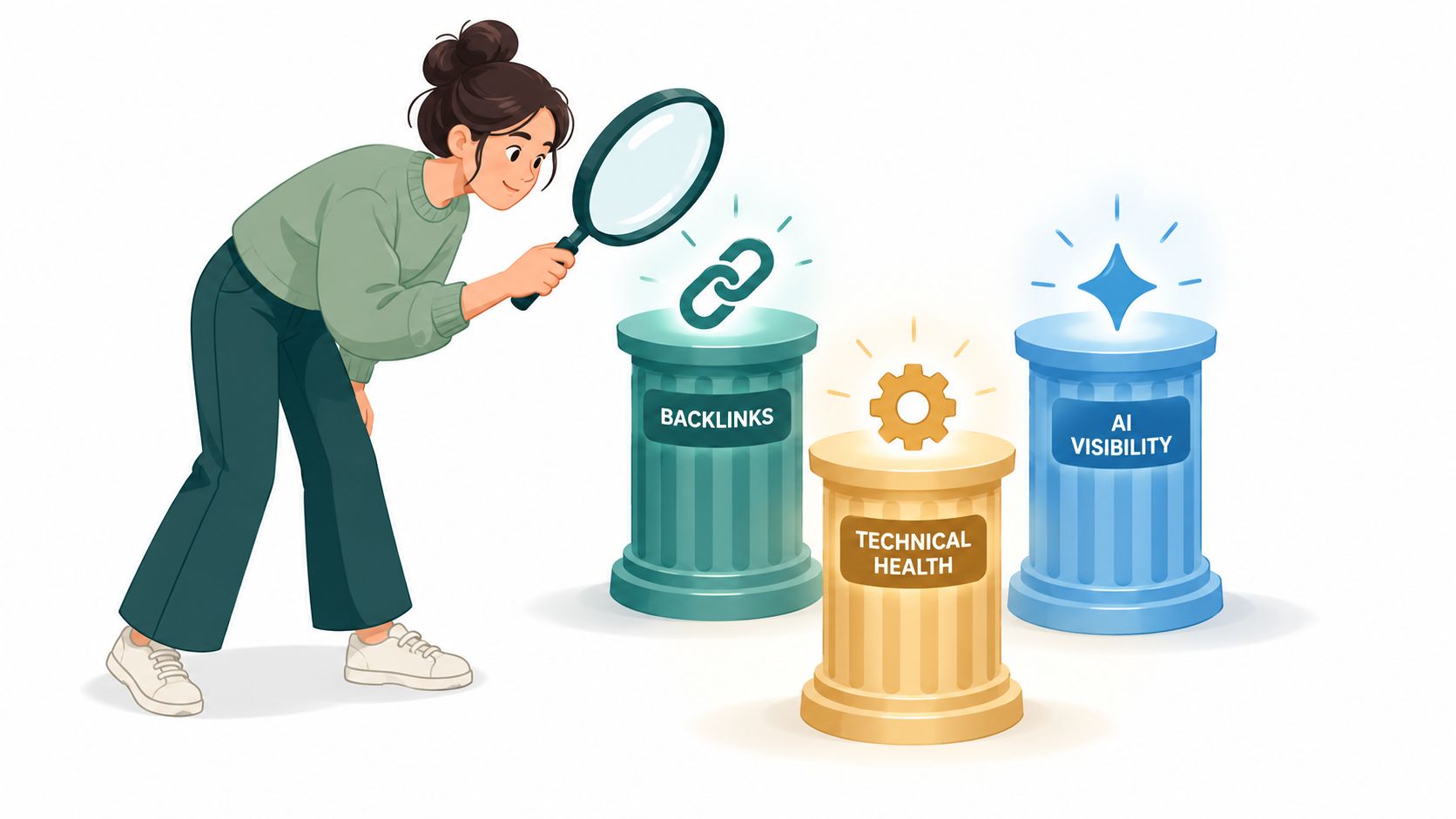
Treat these as separate intelligence tracks first. Then connect them. That is how you answer the key intelligence question: why this competitor is visible, and whether that visibility is durable.
Evaluate authority beyond a single score
A domain authority metric helps with triage. It does not explain why a competitor keeps winning. Examine which pages attract links, how closely referring sites match the topic, whether the mention is editorial, what anchor language appears repeatedly, and whether link equity reaches commercial pages or stays trapped in blog content and old studies.
Context matters more than totals.
Track link acquisition by page type and business purpose. If a competitor keeps earning references to comparison pages, implementation guides, or category pages, that usually signals trust close to conversion. If its links concentrate on an outdated report, the domain may look strong while the pages that matter commercially remain weak. Separate durable editorial mentions from links your team could reproduce quickly through directories, profiles, or low-friction placements.
A practical worksheet for how to analyze backlinks for SEO should include:
- Relevance: Does the referring site reach the same buyer, user, or adjacent problem space?
- Quality: Is the mention editorial, useful, and earned in context?
- Destination: Which page gets the link, and what job does that page do?
- Pattern: Do links reinforce a topic cluster, or are they scattered with no strategic focus?
- Replicability: Can your team earn a comparable mention through original data, expertise, partnerships, or a stronger resource?
Use the same logic on commercial comparison terms. In a query such as best gorgias alternative, a page can outperform with solid review coverage, relevant citations, and strong product-page support even without the highest headline authority score.
Audit the technical foundation
Technical review is not about admiring a rival's stack. It is about finding the friction that helps or hurts visibility.
Crawl the templates you can access. Check rendered output, indexable category and product paths, internal linking depth, canonical signals, duplicate templates, mobile usability, structured data, page experience signals, and whether important content depends too heavily on JavaScript. Then compare those findings against the pages that rank. A polished site can still lose if its page type misses intent. A messy site can still win if it is trusted and highly relevant.
The useful output is specific. Identify the blocker you can remove, the implementation pattern worth testing, or the weakness that makes a competitor's position less stable than it appears.
Add answer-level visibility
Classic rank tracking misses a growing part of competitive pressure. Some brands now influence demand through AI answers even when they are not the strongest organic result. That is why competitor analysis needs a separate view for answer-engine visibility, not just blue-link rankings.
Pew Research Center's analysis found that users clicked a traditional organic result 8% of the time when an AI Overview appeared, compared with 15% when it didn't. That shift changes what visibility means. In some SERPs, the competitor shaping the answer may matter as much as the competitor holding position one.
Track recurring prompts by intent and date. Record which brands appear, which pages or domains get cited, what attributes the answer repeats, whether the cited source also ranks organically, and whether the mention appears to drive visits or just awareness. Here, the distinction between SERP rivals and direct market competitors becomes clearer. A publisher, forum, documentation hub, or review site can become the dominant source in AI responses without selling the same product.
That pattern matters because AI visibility can reinforce every other signal. Strong backlinks increase citation likelihood. Clean technical implementation makes pages easier to parse. Clear comparison content gives answer systems reusable language. If a competitor keeps surfacing across all three layers, links, technical access, and AI mentions, you are not looking at a random win. You are looking at a repeatable visibility system.
Conducting a Strategic Keyword Gap Analysis
Keyword gap analysis becomes useful when it explains a business opportunity, not when it produces the longest list of missing terms. Start with a defined competitor set and a consistent query universe. Compare your site with direct rivals, then separately inspect SERP competitors that win visibility without selling the same offer.
Build the gap in stages
First, collect ranking coverage for each domain. Separate branded and non-branded demand, informational, commercial, and transactional intent, and queries by geography or device where those differences affect the result. Then map each query to the ranking URL, page type, SERP features, content format, and the likely business outcome.
Next, classify the gap:
- Missing: A relevant competitor page ranks, but your site has no suitable response.
- Underperforming: You have a relevant page, but its position, structure, internal links, or authority is weak.
- Misaligned: Your page targets the phrase but doesn't satisfy the searcher's actual task.
- Defensible: A competitor ranks because it has a product capability, proof point, or distribution advantage you can't reproduce quickly.
- Stale: The competitor's page is visible but incomplete, outdated, or poorly maintained, creating a realistic improvement path.
Inspect the result page manually before assigning an action. Note whether searchers expect a guide, category page, calculator, review, comparison, definition, or product demonstration. Compare the pages that earn prominent features for clarity, evidence, first-hand expertise, information architecture, and conversion relevance. Word count alone won't tell you why a page wins.
Turn observations into a decision table
| Keyword/Topic | Competitor Status | User Intent | Action Required |
|---|---|---|---|
| Topic where a rival ranks and your site has no relevant page | Missing coverage | Informational or commercial research | Create the format that best answers the visible task, then connect it to a relevant next step |
| Query where your existing page ranks below a useful rival | Underperforming | Commercial investigation | Refresh intent alignment, evidence, internal links, and technical delivery before creating a new URL |
| Topic dominated by a publisher or marketplace | SERP competition | Comparison or discovery | Study the format and pursue a differentiated page, partnership, or third-party visibility route |
| Query tied to a competitor's unique feature | Defensible rival advantage | Transactional | Improve positioning or product capability instead of copying surface-level content |
| Competitor page with weak coverage and strong visibility | Potential opening | Any intent | Produce a clearer, more complete answer and support it with relevant authority |
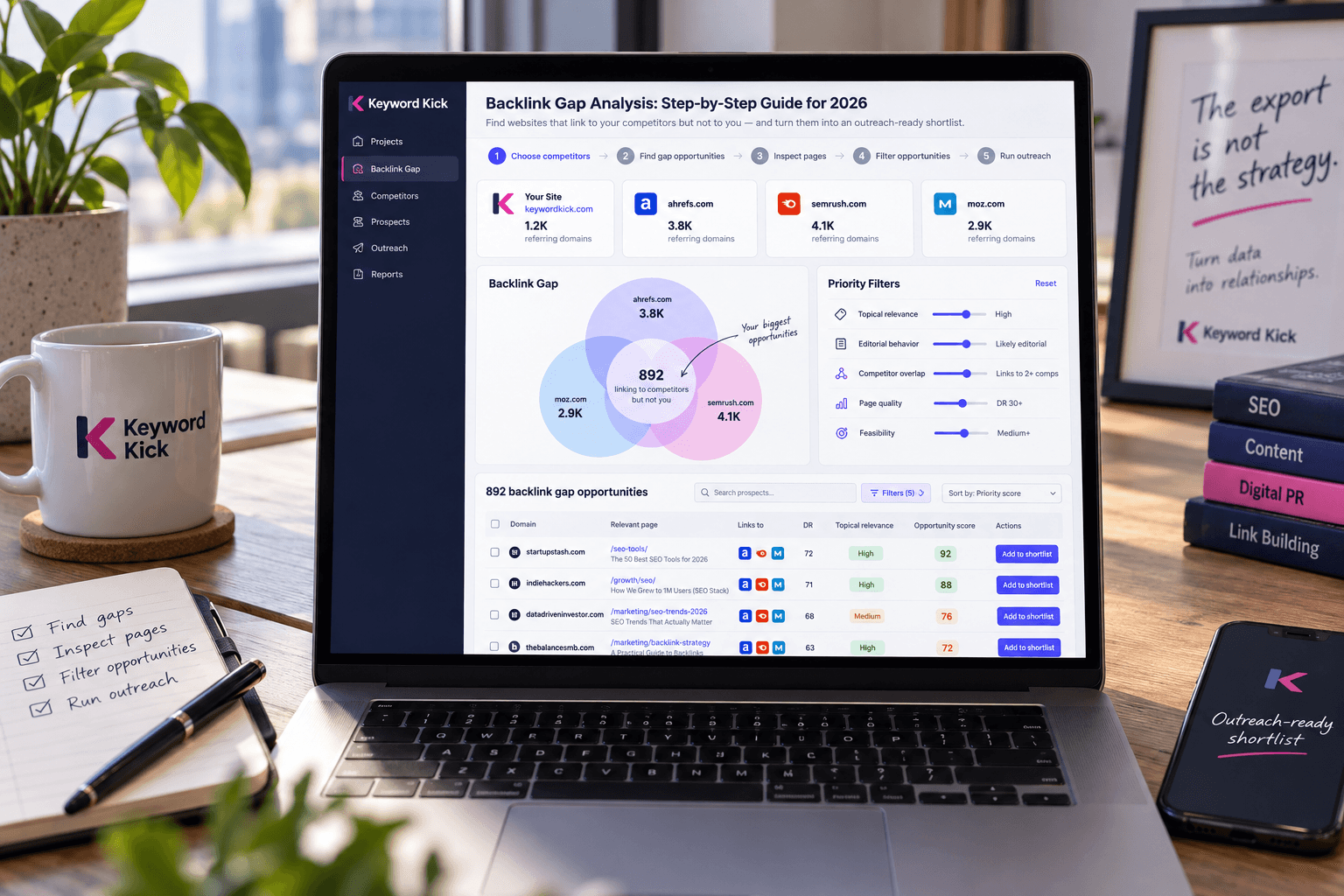
A practical Digital Skyrocket's content gap analysis guide can help structure the collection process. For larger sets, use a keyword gap analysis tool to compare coverage, then validate the highest-value rows manually.
Prioritize relevance, attainable visibility, conversion contribution, and strategic fit. A high-volume term with entrenched competitors may deserve monitoring, while a narrower query tied to a high-margin service may deserve immediate production.
Turning Data into a Prioritized Action Backlog
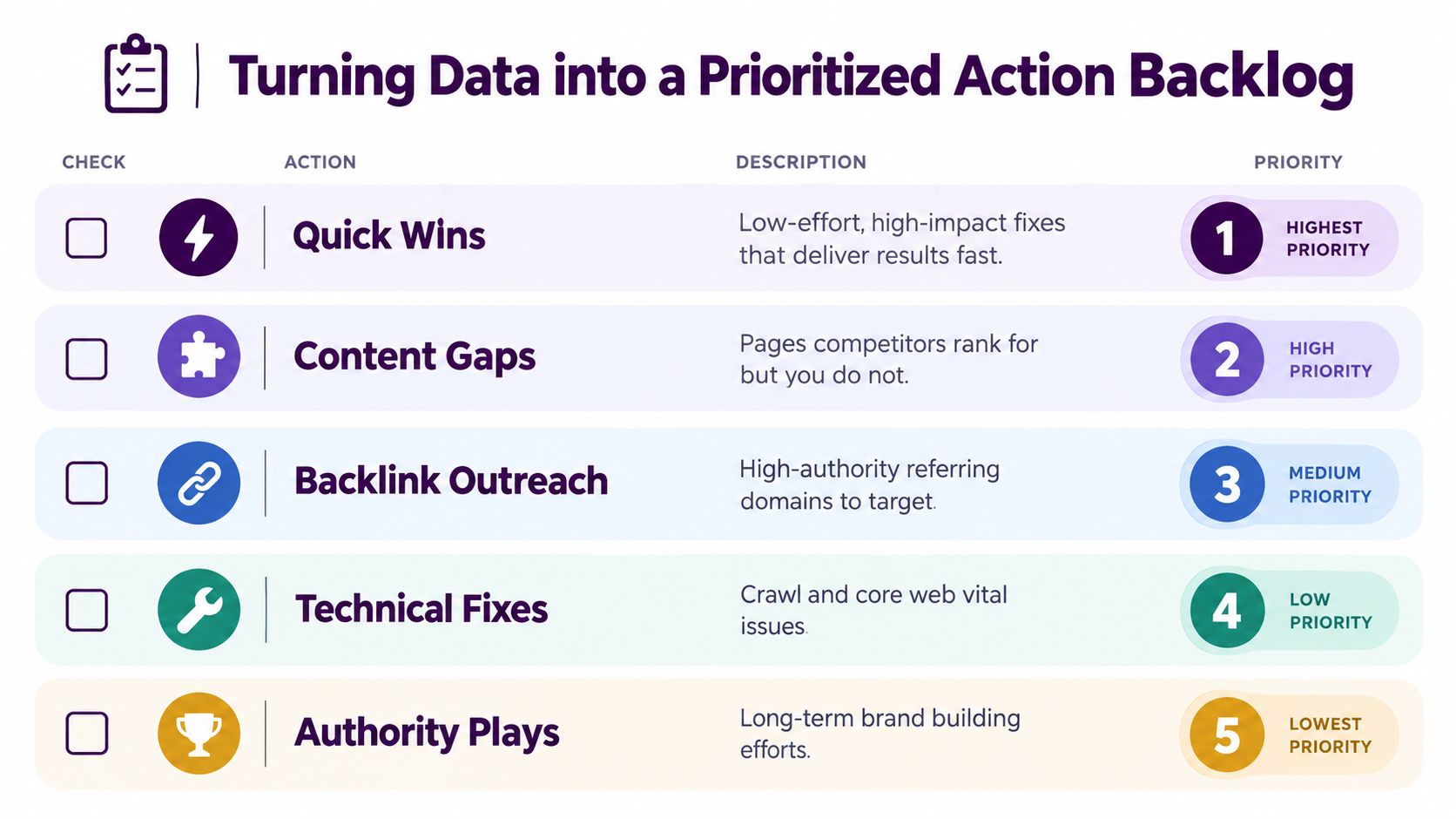
The hardest part of competitor analysis isn't finding gaps. It's refusing to treat every gap as a project. A useful backlog converts observations into owned actions with a clear reason, confidence level, expected outcome, and review date.
Score opportunities for decisions
Use a simple scoring model with four dimensions:
- Attainable impact: Could the change influence qualified visibility, conversions, assisted revenue, customer retention, or another defined goal?
- Confidence: How strong is the evidence across rankings, customer feedback, technical inspection, and first-party data?
- Effort: How much design, development, editorial, outreach, or product work is required?
- Strategic fit: Does the opportunity reinforce your positioning and capabilities, or would it pull the team into an unwinnable comparison?
Don't let search volume replace judgment. Competitor research should connect with conversion rate, sales objections, support tickets, margin, inventory, and operational feasibility. The largest content gap often isn't the most valuable opportunity if it attracts weak-fit visitors or requires a proposition you can't credibly deliver.
Write backlog items people can execute
A weak task says, “Improve competitor content.” A useful task says, “Rewrite the comparison page for commercial intent, add evidence for the three recurring buyer objections, link it from the relevant category pages, assign it to the content lead, and review qualified organic conversions after publication.”
Every item should contain:
| Field | What to record |
|---|---|
| Evidence | The competitor observation and first-party signal supporting the action |
| Owner | One person or team accountable for completion |
| Scope | The page, template, campaign, or technical issue involved |
| Expected outcome | The metric or behavior that should change |
| Confidence | How strongly the evidence supports the recommendation |
| Review date | When the team will assess the result and update the decision |
Group the work into quick wins, content gaps, backlink outreach, technical fixes, and authority plays. This prevents a long-term brand initiative from competing directly with a broken internal-link path or an important page blocked by implementation friction.
A backlog is successful when the next action is obvious, not when the spreadsheet is impressive.
Building an Ongoing Competitor Monitoring System
A competitor analysis becomes valuable when the team can detect change without restarting the entire project. Set a fixed observation protocol first. Use the same query set, locations, devices, crawl settings, date windows, competitor definitions, and inclusion rules each time, and preserve raw observations with timestamps.
Separate monitoring into three rhythms:
- Daily anomaly detection: Flag major changes in rankings, indexability, SERP features, newly visible domains, and unusual backlink activity.
- Weekly interpretation: Investigate material changes, compare them with site releases or market events, and decide whether they require a backlog item.
- Monthly or quarterly strategy review: Revisit competitor classification, positioning, structural forces, priority scores, and unanswered KIQs.
A monitoring record should answer more than “who moved?” It should show whether a competitor gained coverage on a valuable intent, launched a new page type, changed its conversion path, earned relevant third-party mentions, or appeared in recurring AI answers. Track outcome, capability, and activity separately. A ranking change is an outcome signal. A new content hub is an activity signal. A product feature, distribution relationship, or stronger proof library is a capability signal.
Use anomaly alerts to reduce manual checking, but don't automate interpretation blindly. Competitive-intelligence guidance warns against excessive collection, siloed intelligence, inconsistent reports, and overreliance on AI-generated conclusions, while recommending explicit benchmarks such as win rate, market share, and growth rate (the competitive-intelligence guidance and benchmark discussion). Report uncertainty when data doesn't establish exact market share.
Market structure also changes how you interpret rivals. Economic research cited in the same guidance found that most variation in competitive conduct occurred in monopoly and duopoly settings, while entry beyond three firms added little effect. In practice, compare the leading incumbent with the strongest emerging challenger, not only with the average visible domain.
Keep the final operating loop simple: ask a KIQ, collect standardized evidence, explain the change, create or update a backlog item, assign ownership, and review the outcome. Keyword Kick can support that workflow by bringing competitor visibility, keyword coverage, content performance, traffic trends, authority signals, backlink profiles, ranking positions, and SERP-feature appearances into one workspace.
Keyword Kick connects competitor analysis with rank tracking, backlink and technical signals, keyword gaps, content gaps, and prioritized recommendations, so your team can move from unexplained changes to owned actions. Visit Keyword Kick to turn ongoing competitor monitoring into a clearer SEO growth workflow.