You're probably looking at three tabs right now. A rank tracker says a target term moved up. Google Search Console shows impressions rising on a different page than expected. GA4 isn't showing the traffic lift you thought you'd see. That's normal in modern SEO, and it's exactly why keyword ranking can't be treated as a single number anymore.
Teams get stuck when they ask, “What's our rank?” The better question is, “How visible are we for the searches that matter, and which page is earning that visibility?” Once you frame keyword ranking that way, the work gets cleaner. You stop chasing vanity movement and start tying rankings to clicks, sessions, and business outcomes.
What Keyword Ranking Means in 2026
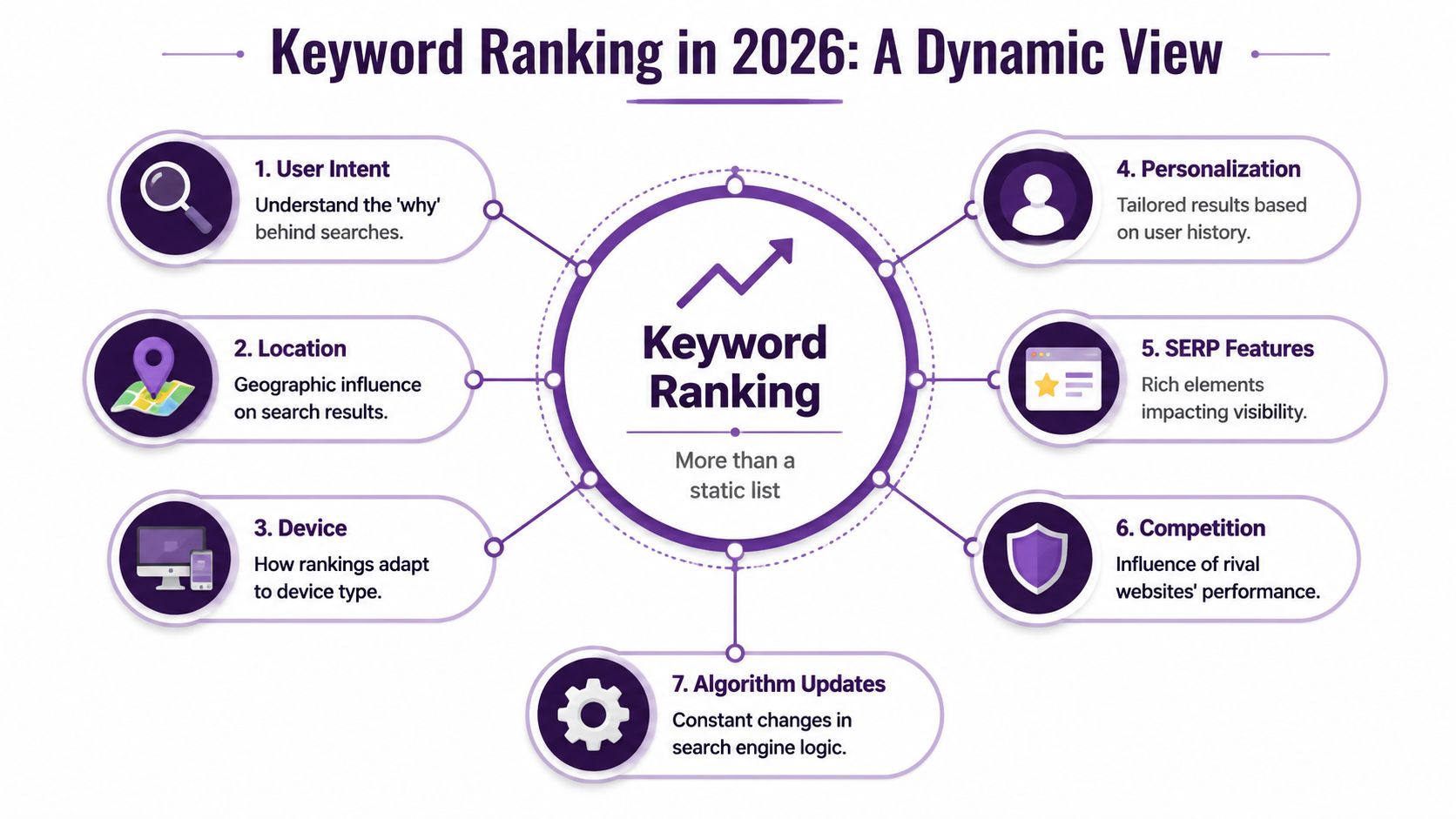
Think of old-school ranking like a library catalog. One book had one place on one shelf, and everyone saw the same result. Modern keyword ranking works more like a recommendation engine. The result set changes based on context, intent, location, device, and the shape of the search results page itself.
That shift matters because a “ranking” is no longer a fixed universal truth. It's a directional signal. Useful, yes. Complete on its own, no.
Why a single position number can mislead
A page might rank well on desktop in one city and look weaker on mobile elsewhere. A term can also trigger different layouts depending on intent. Informational searches might surface AI summaries, People Also Ask, and video blocks. Local queries can push map results into prime screen space. In both cases, the raw rank number tells only part of the story.
That's why good teams track visibility patterns, not just headline positions. If you're new to the process, this beginner's guide to keyword rank monitoring is a useful grounding resource.
Practical rule: Treat keyword ranking as a visibility signal tied to a query, a page, a location, and a SERP layout. If one of those changes, the meaning of the rank changes too.
Why modern rank tracking is so data-heavy
The scale behind ranking data is massive. Ahrefs operates a database containing 28.7 billion keywords, and Semrush maintains over 28.3 billion keywords across 142 countries according to this industry summary. That scale explains why modern SEO tools can identify opportunities that a manual Google search never will.
A practitioner takeaway matters more than the headline number. Ranking data only becomes useful when you can segment it by market, page, and intent. Otherwise, you're staring at movement without context.
Here's the mindset I push with new team members:
Track the page, not just the term: A keyword gain on the wrong URL can hide a structural problem.
Watch the SERP shape: Position one under a crowded results page can be less valuable than position three on a cleaner one.
Look for consistency: One-day movement is noise. Repeated direction across related terms is signal.
Decoding Your SERP and Ranking Reports
Open any ranking report and you'll see the temptation immediately. Position, change, previous position, maybe visibility. Clean columns. Easy sorting. The problem is that users never see your spreadsheet. They see a search results page crowded with modules that compete for attention.
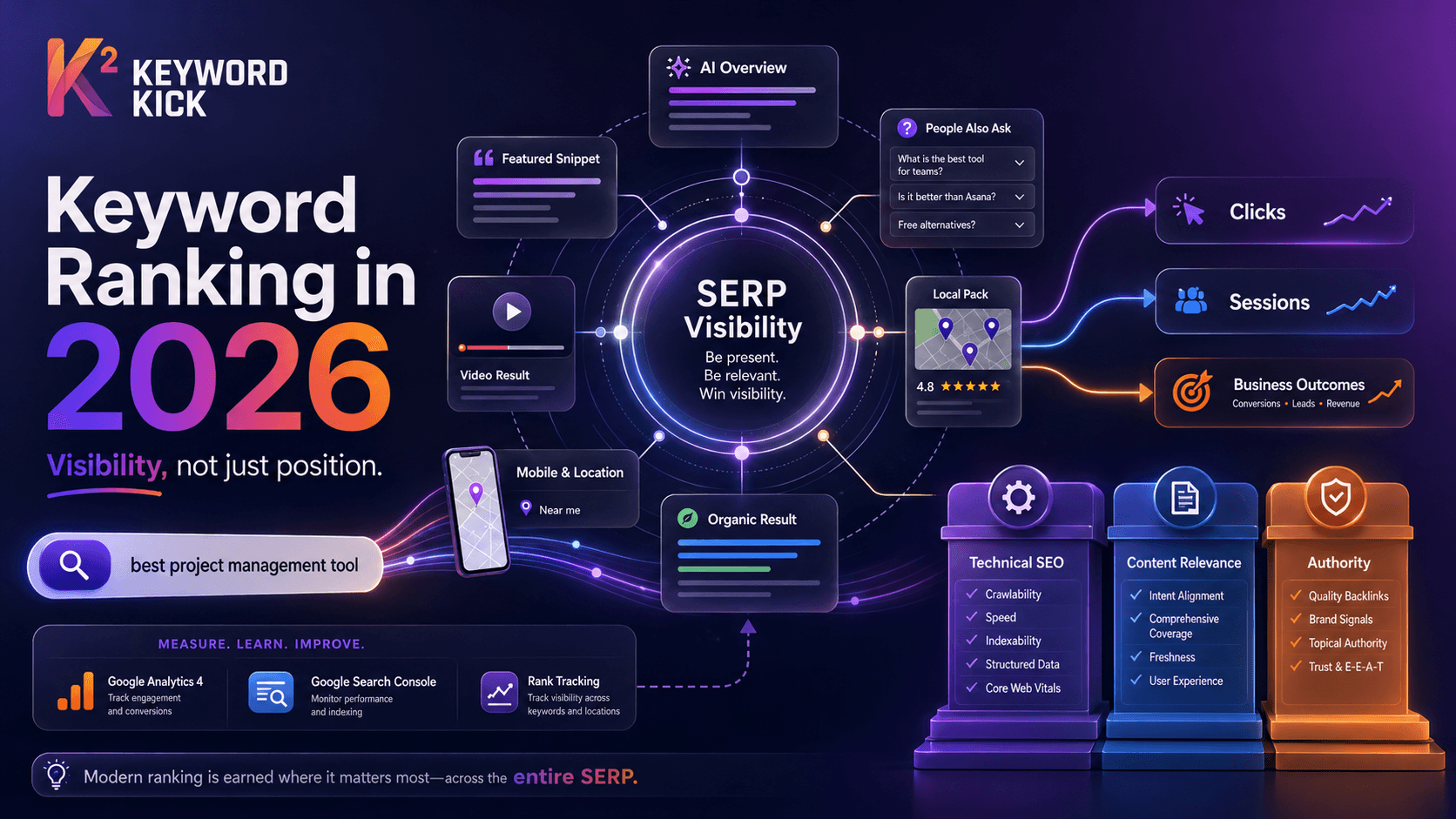
A modern SERP isn't a list of ten blue links. It's a layered interface.
What to read on the results page
When I review a target keyword, I check the page itself before I trust the report. I want to know what stands above the organic results and what interrupts them.
A practical SERP read usually includes:
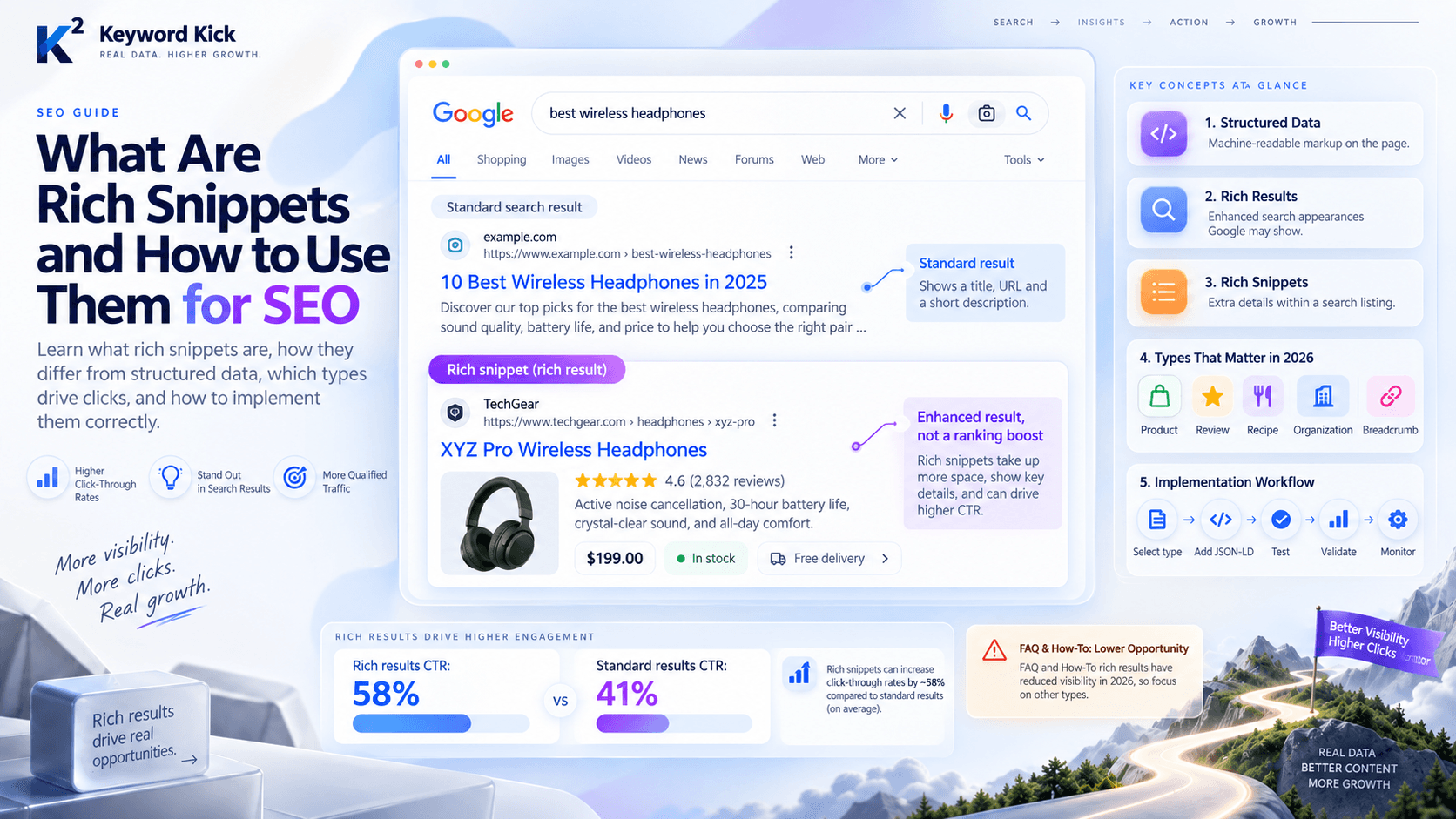
AI summaries: These can absorb attention before the user reaches classic organic listings.
Featured snippets: These often satisfy quick informational intent fast.
People Also Ask boxes: These expand the topic and siphon clicks into related questions.
Video or image results: These change what “visibility” means for the query.
Local packs: These can dominate local-intent searches even when your organic page ranks well.
The implication is simple. Ranking number one doesn't always mean owning the query.
Why report interpretation changed
The biggest shift is that AI-generated SERPs changed ranking stability itself. Advanced Web Ranking now tracks rankings across both SEO and AI search, which shows how rankings are being measured differently as AI overviews displace traditional results, as noted on Advanced Web Ranking.
That means a report needs two readings. First, where your page appears. Second, whether that appearance still earns attention.
If the SERP answers the question before the click, your ranking may improve while your traffic doesn't.
That's why I don't treat all position gains as wins. A gain on a query now dominated by AI or rich features may have less traffic value than a smaller gain on a cleaner commercial SERP.
A strong workflow is to pair rank reports with a feature view. If your tool supports it, use SERP feature segmentation. If you need a framework for that analysis, this guide to strategic SERP feature tracking is worth reviewing.
A simple way to classify rankings
SERP condition | What the rank means |
|---|---|
Clean organic layout | Position is closer to true visibility |
Feature-heavy informational SERP | Position may overstate click potential |
AI-heavy result page | Position needs AI visibility context |
Local-intent query | Organic rank may matter less than map presence |
That table won't replace analysis, but it does stop a common mistake. Don't celebrate rank changes before you understand the screen users actually saw.
Connecting Rankings to Traffic and Goals
A rank change matters only when it changes behavior. That's the bridge many teams miss. They watch rankings in one tool, clicks in Google Search Console, and conversions in GA4, but they never connect the sequence.
The job is to build a cause-and-effect chain. Did the ranking move? Did impressions and clicks move with it? Did the landing page generate useful sessions and conversions after that?

The workflow I use with teams
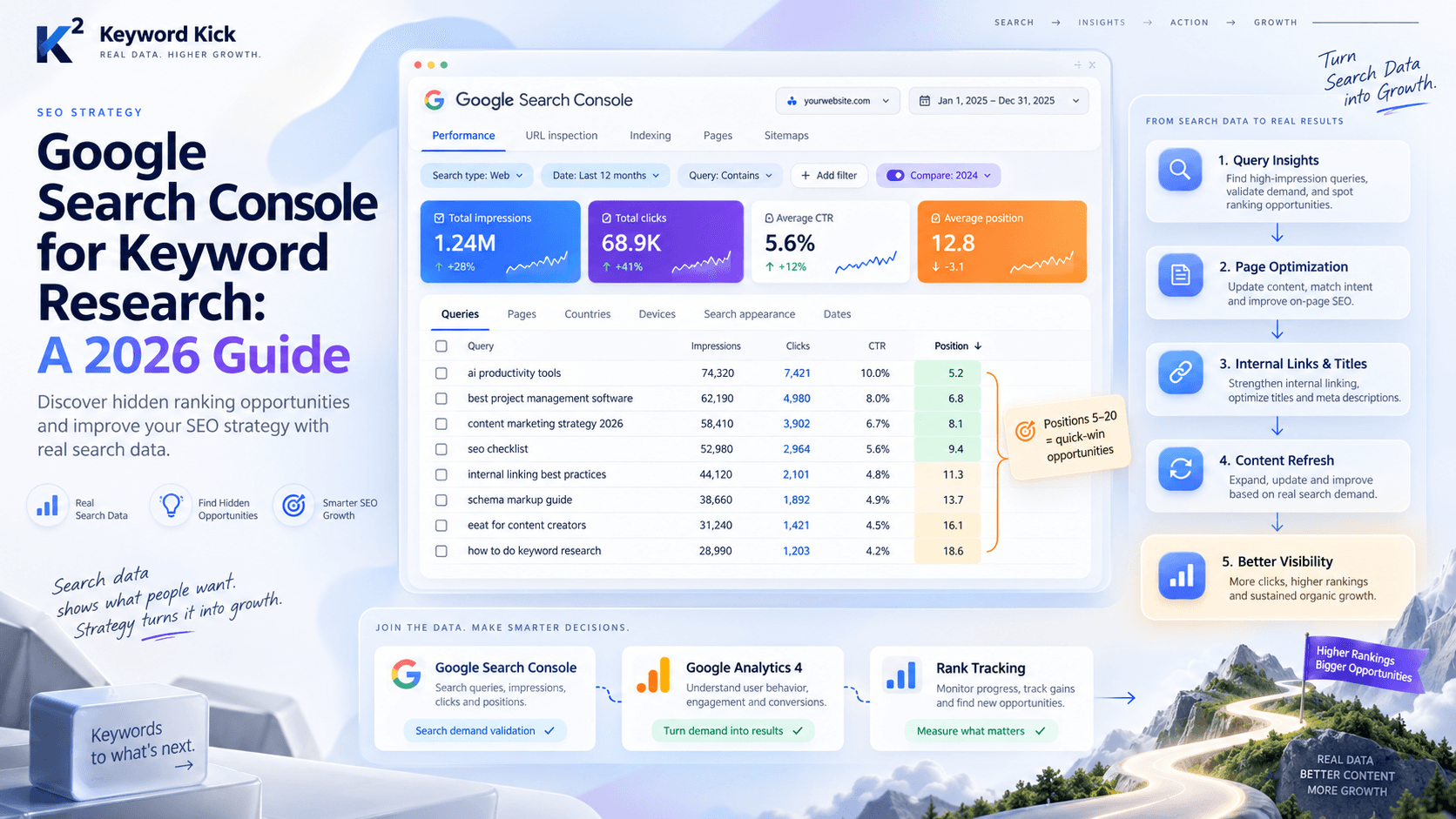
Start with the keyword tracker. Find a meaningful movement, ideally on a page tied to a real business topic. Then validate that movement in Search Console by checking whether impressions and clicks changed for the same page and query range. Finally, open GA4 and inspect the landing page's organic sessions, engagement quality, and conversion contribution.
In plain terms, the sequence looks like this:
Check the ranking event: A term or cluster moves up or down.
Verify search response in GSC: Impressions, clicks, and page-query alignment confirm whether Google exposed the page more often.
Measure site impact in GA4: Sessions and conversions show whether the new visibility brought useful traffic.
If one of those links breaks, the diagnosis changes. A ranking gain without more impressions can mean low actual exposure. More impressions without more clicks can mean weak snippet appeal or a crowded SERP. More clicks without conversions can mean the page attracted the wrong intent.
What to compare side by side
Here's a simple operating view for weekly reviews:
Rank tracker: Position movement by keyword cluster and landing page
Google Search Console: Impressions, clicks, average position, and which URL ranked
GA4: Organic landing-page sessions, engagement, and conversion paths
That's the minimum viable reporting stack if you want ranking analysis to influence business decisions.
Field note: The most useful SEO report usually isn't the one with the most charts. It's the one that makes it obvious which page to fix next and why.
How this exposes false positives
A team might think a keyword win drove growth when the traffic originated from a different query family. Or they may think a page is underperforming because GA4 traffic is flat, when Search Console shows impressions are rising but clicks are being suppressed by the SERP layout.
This is also where cannibalization starts to reveal itself. If ranking data says one page improved but Search Console shows another URL earning the actual impressions, you're not looking at clean growth. You're looking at confused page targeting.
For teams building this reporting discipline, a practical companion is this guide on improving organic traffic in 2026. The core idea is the same. Rankings matter, but only when they connect cleanly to traffic quality and outcomes.
The Three Levers That Improve Keyword Rankings
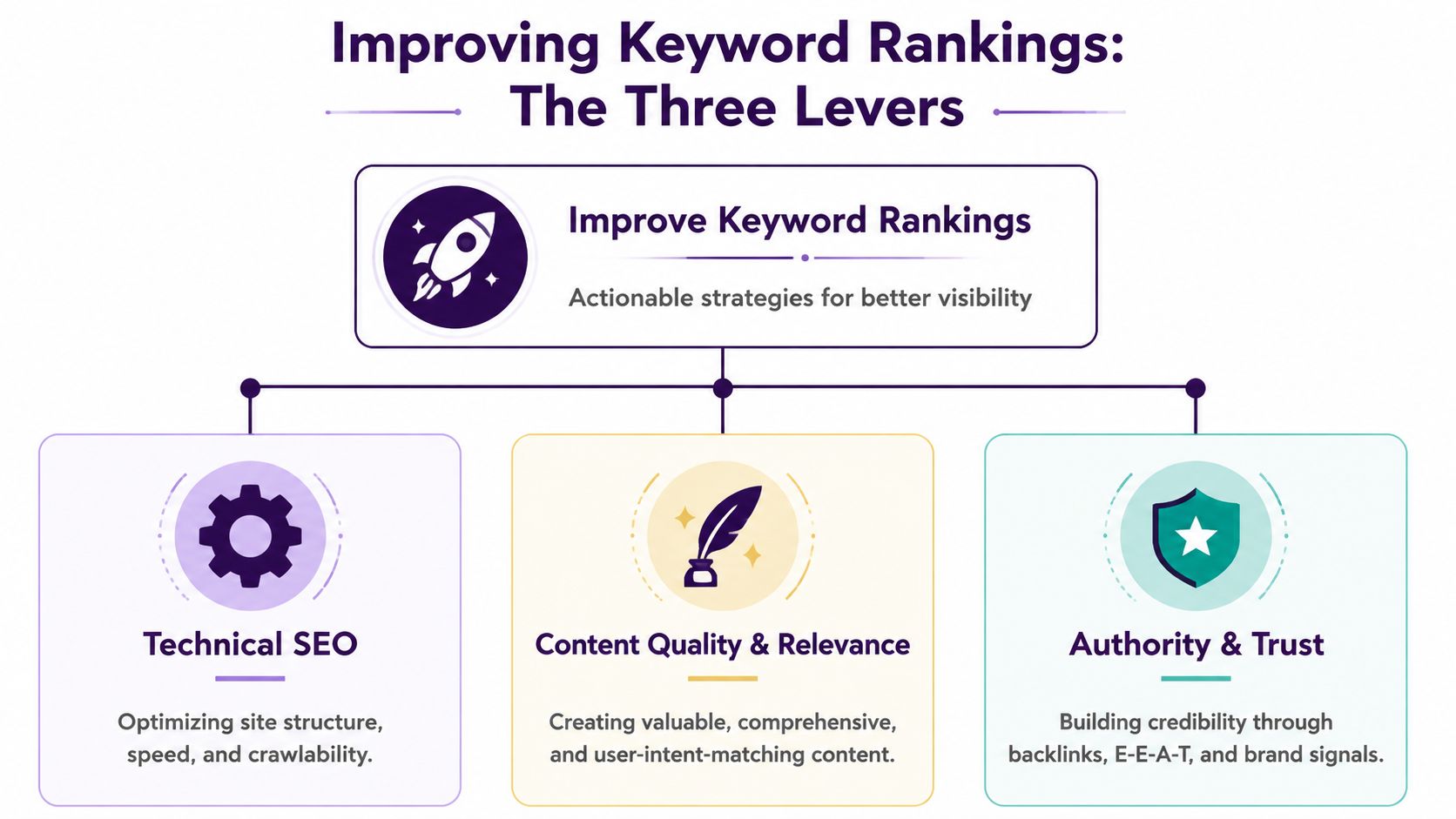
Most ranking advice turns into a giant checklist. That's not how I diagnose sites. I group the work into three levers: technical SEO health, content relevance and quality, and authority. Almost every ranking problem sits under one of those buckets.
Technical health
Technical SEO decides whether your content can be crawled, rendered, and understood cleanly. It's not glamorous, but it removes the friction that blocks everything else.
Google's ranking systems prioritize meaning, relevance, and quality. Relevance is the most basic signal, but Google also states that quality content is the number one ranking factor once a site is technically sound enough to be crawled, and page experience signals like Core Web Vitals are essential prerequisites, according to this ranking factors review.
That's the key trade-off. Teams love content work because it's visible. But if the page loads poorly, renders badly on mobile, or has crawl issues, content improvements often underperform.
Focus technical work on:
Crawlability: Make sure important pages are discoverable and indexable.
Page experience: Improve speed, mobile usability, and rendering stability.
Site structure: Clean URL hierarchy, internal linking, and schema help search engines interpret content accurately.
Content relevance and quality
Many teams tend to overcomplicate matters. Content should match the search intent, cover the topic with enough depth, and make the next step obvious for the user.
What works:
Clear keyword placement in the title, headings, and body
Strong alignment between the query and the page's primary purpose
First-hand experience, examples, and original framing
What doesn't:
Thin pages targeting broad terms with no clear angle
Generic copy that could sit on any website
One page trying to rank for several unrelated intents
Better content usually isn't longer. It's clearer, sharper, and better aligned with the reason the search happened.
If you need to build authority over time, link earning still matters. One practical route for legitimate discovery is getting listed in relevant, maintained resources such as curated dofollow directories, but only when the listing is selective and topically sensible. Random directory submissions still waste time.
Authority and trust
Authority is the lever that often separates “good enough” pages from pages that hold rankings. Strong pages on weak domains can struggle, especially on competitive terms. Authority also supports faster indexing, stronger trust signals, and better resilience when competitors update their content.
I treat authority work as a mix of:
Authority element | What to check |
|---|---|
Backlinks | Are relevant sites linking to the right pages |
Internal authority flow | Do strong pages support priority URLs |
Trust signals | Does the content look credible and focused |
Topical consistency | Does the site stay coherent within its subject area |
If a page isn't ranking, don't guess. Ask which lever is weak. Technical friction, weak intent match, or low authority usually explains the problem faster than a long ranking-factor list ever will.
A Prioritized Framework for Ranking Growth
Teams often don't fail because they lack ideas. They fail because they work in the wrong order. They rewrite pages before fixing crawl issues. They publish new content before cleaning up existing page conflicts. They chase broad new keywords while easy wins sit untouched.
A better workflow starts with what initiates movement fastest, then compounds from there.
Start with foundational fixes
Technical issues come first because they affect every page. If search engines can't crawl, render, or interpret your site cleanly, later work gets diluted.
That first pass usually includes indexability checks, internal linking gaps, broken page relationships, and obvious page experience problems. Keep it practical. Fix the issues that affect important templates and priority pages first.
Then work the near-win set
The next layer is the set of pages already within reach. These are terms where your site has some relevance and some visibility, but not enough to break through consistently.
I usually review this group by asking:
Is the right page ranking? If not, fix the page mapping first.
Does the page match the live intent? If not, revise structure, angle, or format.
Is the snippet competitive? Tighten the title and description so the result earns the click it deserves.
This is also where trend awareness matters. Keyword trends include consistent trends, seasonal spikes, and rising opportunities, and acting quickly on rising topics can drive significant traffic while regular updates help maintain relevance and ranking, as explained in Keyword.com's guide to keyword trends.
Upgrade existing pages before creating new ones
Most sites have under-optimized assets that can do more with better targeting. Before drafting a new article, inspect what's already published.
A useful content refresh may involve:
Sharpening intent match: Rewrite introductions, headings, and sections so the page answers the actual query better.
Expanding weak sections: Add missing subtopics, examples, FAQs, or supporting media.
Clarifying the conversion path: Make the next action fit the search intent instead of forcing a generic CTA.
A content update beats a new article when the existing page already has relevance, links, or history attached to it.
Build net-new content only where a gap is real
New content should fill a strategic hole, not satisfy a publishing calendar. Use trend analysis, competitor reviews, and internal business priorities to decide where a new asset belongs.
In verticals where AI search is changing discovery behavior, format and intent matter even more. For example, teams in property marketing can learn from guides on optimizing real estate for AI search, because those workflows force clearer intent targeting and stronger entity context.
Here's the order I'd hand to a new SEO manager:
Fix technical blockers on important pages.
Improve existing pages already showing ranking traction.
Resolve page targeting issues and weak intent alignment.
Publish new content only after the earlier layers are under control.
That sequence keeps the work focused and stops SEO from turning into scattered activity.
Unify Signals and Actions with One Platform
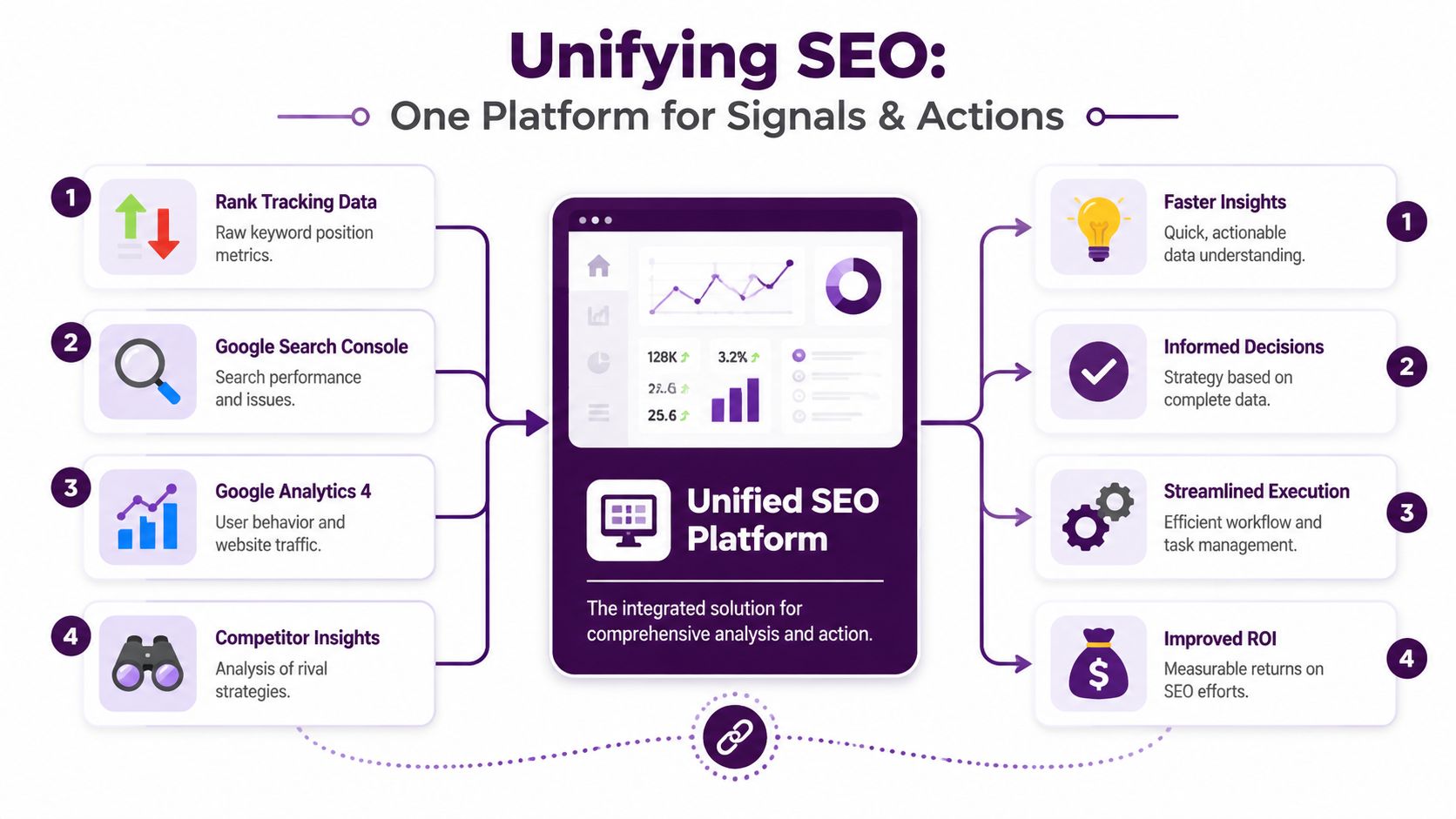
Fragmented SEO stacks create slow decisions. One tool shows rank changes. Another shows query data. GA4 shows traffic. A crawler flags technical issues. A backlink tool lives in a separate tab. By the time someone pieces the story together, the opportunity is already stale.
The biggest cost isn't just time. It's misdiagnosis.
Where disconnected tools break down
A common example is cannibalization. One page appears to be gaining traction in the rank tracker, but Search Console shows a different URL collecting impressions for the same query family. GA4 then reports flat performance because neither page has a strong enough hold on intent to convert well.
This is hard to catch when every signal sits in a different interface. Keyword ranking cannibalization is often ignored, and data shows 40% of lower-ranking keywords in positions 5 to 20 are ranking for unintended pages, according to Umbrex's keyword rankings analysis. That's exactly the kind of issue a unified workspace should surface early.
What a unified setup changes
When rank tracking, Search Console, GA4, technical audits, and backlink signals live together, the workflow becomes simpler:
You spot the right page faster: No manual reconciliation across exports.
You diagnose ranking drops with context: Was it a technical issue, an intent mismatch, or a SERP change?
You prioritize work based on impact: The team can act on the pages most likely to move visibility and traffic.
An integrated platform can help. Keyword Kick is one example. It connects rank tracking, GA4, Google Search Console, backlink analysis, and technical SEO signals in one workspace, then uses its K² AI Agent to surface actions like pages to optimize, ranking losses to investigate, and cannibalization to resolve.
The best SEO systems don't just collect metrics. They reduce the delay between signal, diagnosis, and action.
That's what modern keyword ranking work demands. Not more dashboards. Cleaner decisions.
If you want a simpler way to connect rankings, Search Console, GA4, technical issues, and next-step recommendations, take a look at Keyword Kick. It's built for teams that need one workspace to understand what's moving visibility and what to do next.