Search generated 43.8% of all web traffic across 35,000 websites in a March 2025 analysis cited in industry reporting on the state of SEO agencies. That scale is why an SEO consultation shouldn't be treated as a rankings promise. It's a decision tool. You prepare evidence, test each recommendation against it, and decide what deserves time and money.
What an SEO Consultation Delivers
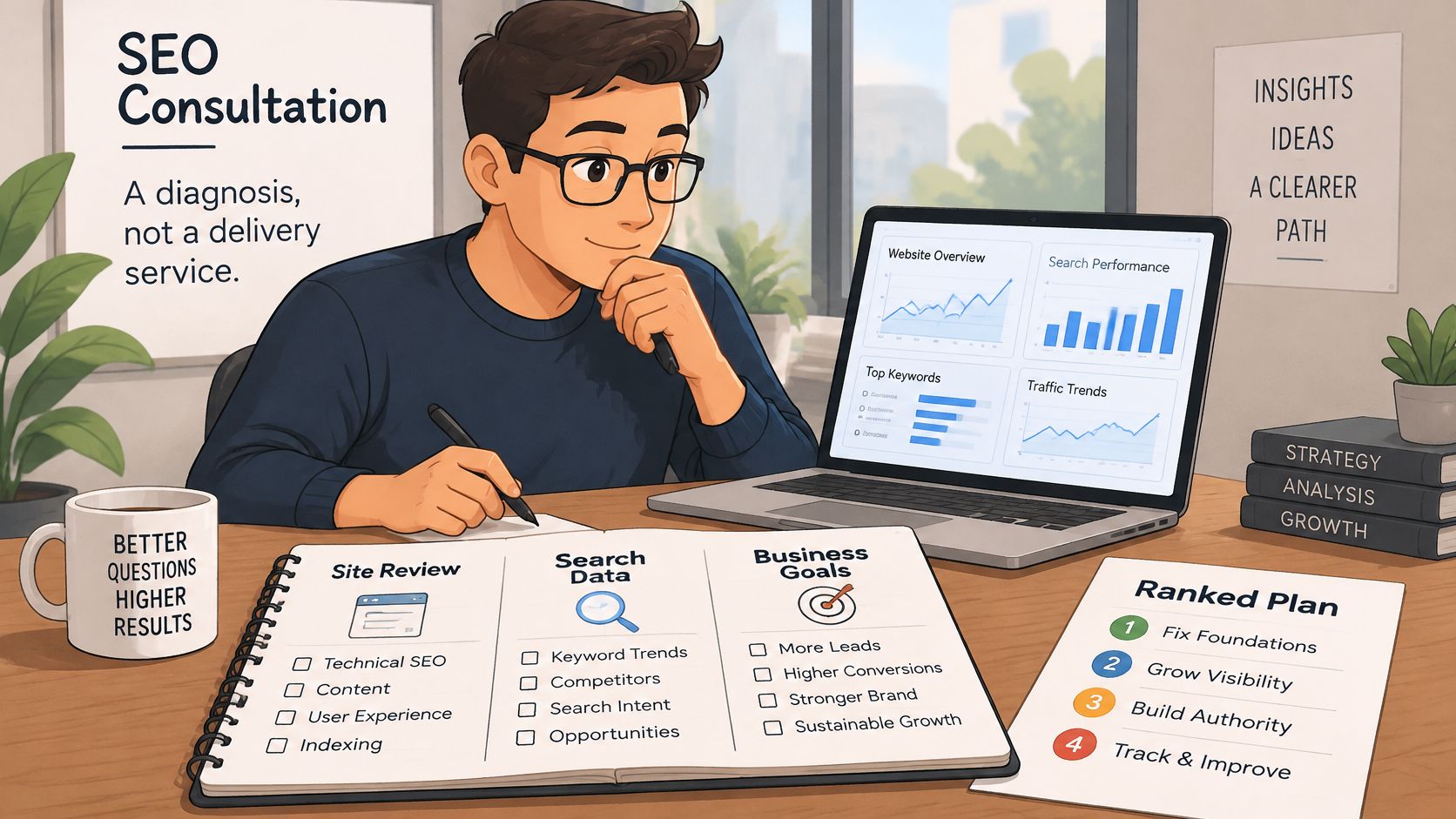
Say a service business has steady traffic but few inquiries. An SEO consultation works like a doctor's visit. The consultant gathers symptoms, reads the tests, explains the likely cause, and agrees on treatment with you. The consultant doesn't take over your site by default.
You should leave with four things.
- Diagnosis: What limits visibility, clicks, or conversions, and where the evidence sits.
- Prioritized actions: A ranked list, not an undifferentiated audit dump.
- Measurement plan: Baselines for clicks, conversions, and revenue by landing page.
- Named owners: A person responsible for each action and date.
No honest provider can guarantee a ranking position or a traffic figure. Rankings depend on competitors, search demand, and changes you don't control.
Careful selection matters because supply is huge. IBISWorld's U.S. SEO and Internet Marketing Consultants industry report counted approximately 363,000 businesses in 2025, increasing at a 21.9% compound annual growth rate between 2020 and 2025, with an estimated 2025 market size of $119.4 billion. A crowded market can't be judged by promises alone.
What to Prepare Before the First Session
A consultant can only diagnose what they can see. Gather material in three buckets before the first call. Performance data shows what searchers see and click, site data shows how pages are built and reached, and business context shows which pages earn money.
Materials to Gather Before the First Session
| Material | What It Shows | Where to Get It | Time Range |
|---|---|---|---|
| Search Console performance export | Queries, pages, impressions, clicks and average position | Search Console, Performance report, Export | Full 16 months available |
| GA4 landing page report | Sessions, engagement and conversions by landing page | GA4, Reports, Engagement, Landing page | Last 12 months |
| Full URL list | Indexable, redirected and error URLs across the site | CMS export or XML sitemap | Current snapshot |
| Existing crawl or site audit | Broken links, redirect chains, title and meta issues | Previous crawler or audit tool export | Most recent crawl |
| Competitor list | Domains to compare visibility and content against | Your rank tracking data or a manual shortlist | Current |
| Commercial priorities | Products, services or pages that earn revenue | Sales or finance team | Current quarter |
| Change log | Migrations, redesigns, template or plugin changes, and known update dates | Development and marketing records | Last 24 months |
Export Search Console for the full period it keeps, because you can't recover older data later. Share read-only access, not screenshots. Screenshots hide filters and date ranges, so nobody can check your work.
Write down one primary goal with a target metric, such as qualified leads or revenue per category. If traffic dropped, the change log matters most, since migrations and template changes explain many sudden moves. A site with only a few hundred pages can skip a crawl export for the first call. Use an SEO audit checklist for 2026 to spot obvious gaps before you send anything.
How a Consultation Runs From Kickoff to Roadmap
A clear process protects both sides. You know what you're buying, and the consultant knows which decision the work must support.
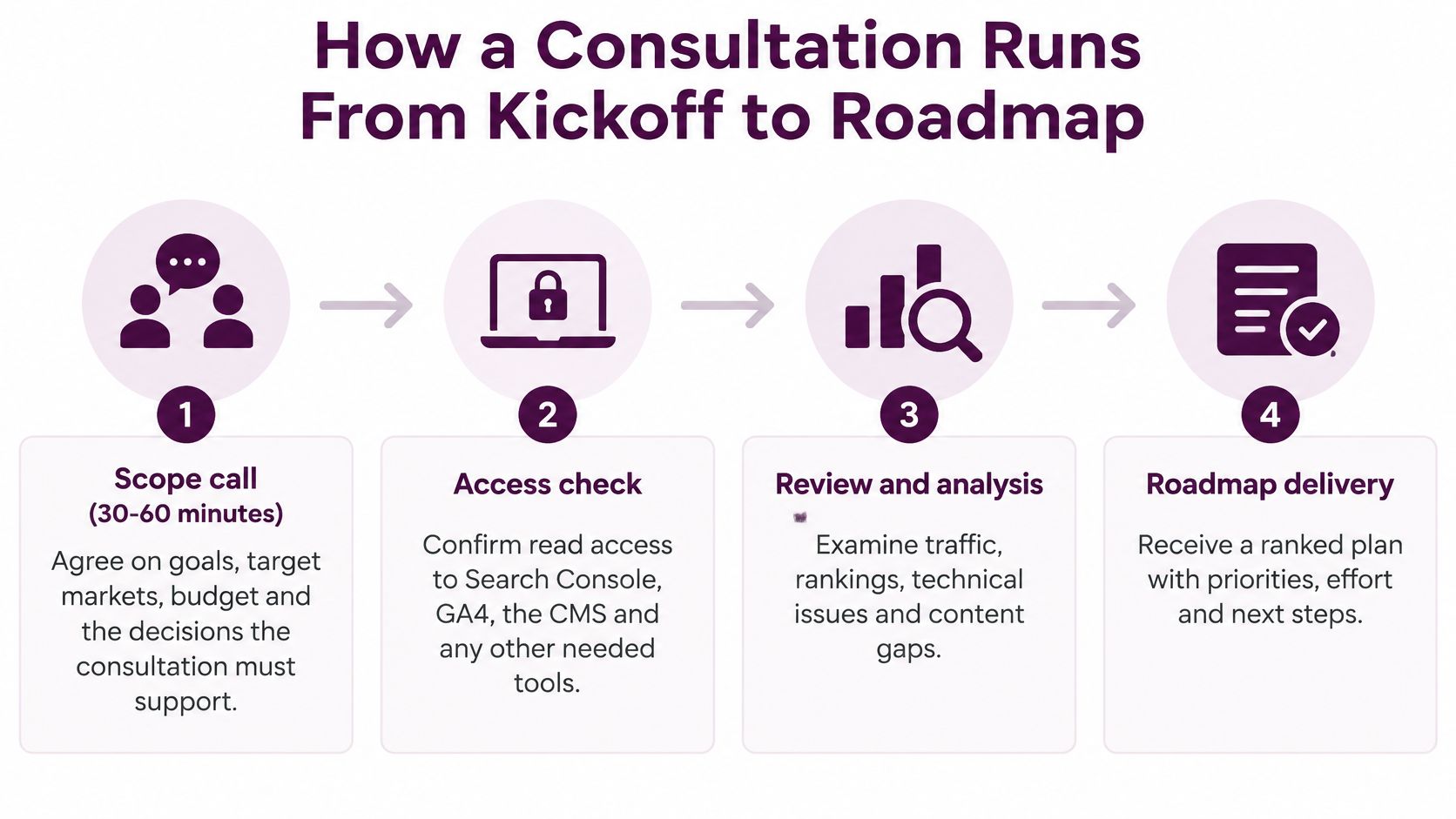
- Scope call, 30 to 60 minutes. Agree on goals, target markets, budget, and the decisions ahead. Don't end the call without a written goal in plain language.
- Access check. Confirm read access to Search Console, GA4, the CMS, and crawl data. You should receive a short list of anything missing, not discover gaps at delivery.
- Diagnosis. The consultant reviews crawlability and indexing, template performance, content coverage, internal links, backlinks, and conversion paths. Ask which templates were checked, because one broken category template can affect hundreds of pages.
- Opportunity sizing. Each issue gets an estimate of affected clicks or revenue, using current positions and search volume. You should see the assumptions, so you can challenge them.
- Prioritized roadmap. Actions are ranked by likely impact and effort, with owners and a suggested order. If everything is marked urgent, nothing's been prioritized.
- Readout and checkpoint. The consultant walks through findings, answers objections, and sets a review date four to eight weeks out. Leave with a named owner for the first three actions.
For a mid-size site, diagnosis and roadmap usually take one to three weeks. Very large sites take longer, mainly because crawl data and template checks expand. A faster promise isn't better if it skips the evidence.
Handing Technical SEO Fixes to seopaslaugos.io
Diagnosis and delivery are different jobs. Once a consultation finds indexing gaps, pages competing for the same query, or weak commercial pages, someone still has to fix them, track the result, and keep going. Some consultants stop at the roadmap. Others carry it into the work. seopaslaugos.io, led by Mantas Tamošaitis, an SEO consultant from Lithuania, covers both.
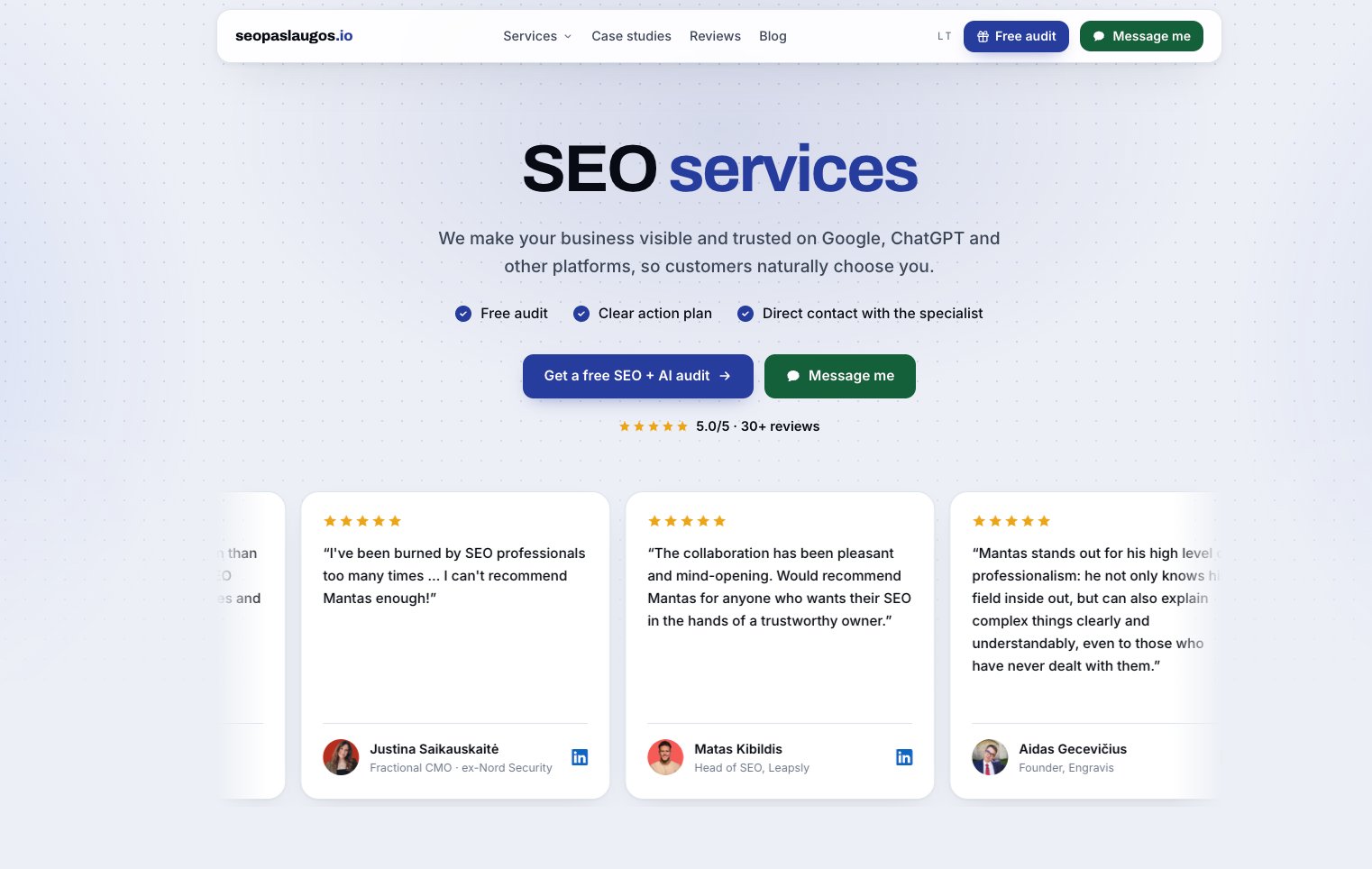
The service covers technical SEO for crawlability, indexing, and cannibalisation control, on-page work for service, city, category, and product pages built around purchase intent, and off-page backlinks and brand mentions. It also handles local SEO through Google Business Profiles and city pages, visibility in AI answers such as ChatGPT, Gemini, and Perplexity, and reporting on calls, enquiries, and sales. For an initial discussion of fit, its page on SEO consultation sets out the starting point.
Two features matter when you’re judging fit. First, reporting centers on calls, enquiries, and sales, not traffic or rankings alone, and you work directly with the specialist rather than through an account manager. Second, service businesses can choose a no-retainer partnership, paying an agreed share only on deals confirmed at a monthly review, alongside the standard monthly model of working on your existing site.
Choose this route if your main constraint is execution capacity, especially for local services or online stores where technical fixes must connect to inquiries and orders. Ask first which template, indexing, and tracking problems they’d tackle, in what order, and how each change will show up in call and sales reporting. If you already have developers and writers, you may only need periodic review instead.
Questions to Ask Any SEO Consultant
Use these questions as a filter on the first call and again at the readout. The answer matters more than the question. A strong consultant names data sources, a diagnosis order, and a measurement method. A weak one answers with promises.
Questions to Ask and How to Read the Answers
| Question | Strong Answer Sounds Like | Red Flag |
|---|---|---|
| What will you check first, and why? | Names specific data sources and a diagnosis order | Promises a result before seeing data |
| How will you measure success? | Clicks, conversions and revenue by landing page, with a baseline | Only rankings, with no baseline or date |
| Which of our pages should change first, and why? | Ranks pages by impact and effort, with reasons | Gives the same list to every client |
| Who does the work, and who is accountable? | Separates consultant tasks from your team's tasks, with names | Says we handle everything with no detail |
| How do you handle AI Overviews and AI search? | Separates AI visibility, referral sessions and assisted conversions | Guarantees traffic from AI answers |
| What would make you say SEO is not the fix? | Names conditions where other channels or fixes come first | Never recommends stopping any work |
| Can you show past work and your method? | Case data with baselines, time windows and caveats | Screenshots only, with no method |
Send the questions in writing before the call so the consultant can prepare. Ask the same questions of two or three providers and compare specificity, not confidence. Listen for trade-offs, too.
A consultant who says a page should be left alone, or that paid search, pricing, or a broken checkout comes first, is usually more trustworthy than one who has a fix for everything.
Treat case studies carefully. They're useful only with a starting baseline, a time window, and other factors that changed during the work.
What Consultations Cost and How They Are Billed
Three billing models cover most engagements. Hourly billing suits a focused question or short review. Per-project pricing suits a defined audit with a fixed deliverable. A monthly retainer suits ongoing monitoring and implementation support.
For benchmarks, Ahrefs' provider survey as reported on SEO costs found that in 2024, SEO consultants charged an average of $171.18 per hour, compared with $98.90 for agencies and $71.59 for freelancers. Ahrefs' survey of 439 SEO service providers found the most common per-project SEO fee in 2024 was $2,501 to $5,000. In 2024, 78.2% of 439 surveyed SEO service providers offered monthly retainers, according to Ahrefs' survey summarized in an SEO consulting cost guide.
Those are 2024 figures, so confirm current rates before budgeting. Ask what the price includes, such as crawl access, implementation help, reporting, and a follow-up call, and cap the scope in writing. Before you sign, compare SEO audit costs against what is included.
Don't compare hourly rates alone. Compare cost per actionable recommendation. A $3,000 audit that yields ten prioritized actions costs $300 per action. A $1,000 retainer that yields two actions costs $500 per action, even though the headline price looks lower.
Technical and AI Search Claims That Need Scrutiny
Technical advice sounds precise, which makes it easy to accept without checking. Ask for the data type behind every claim.
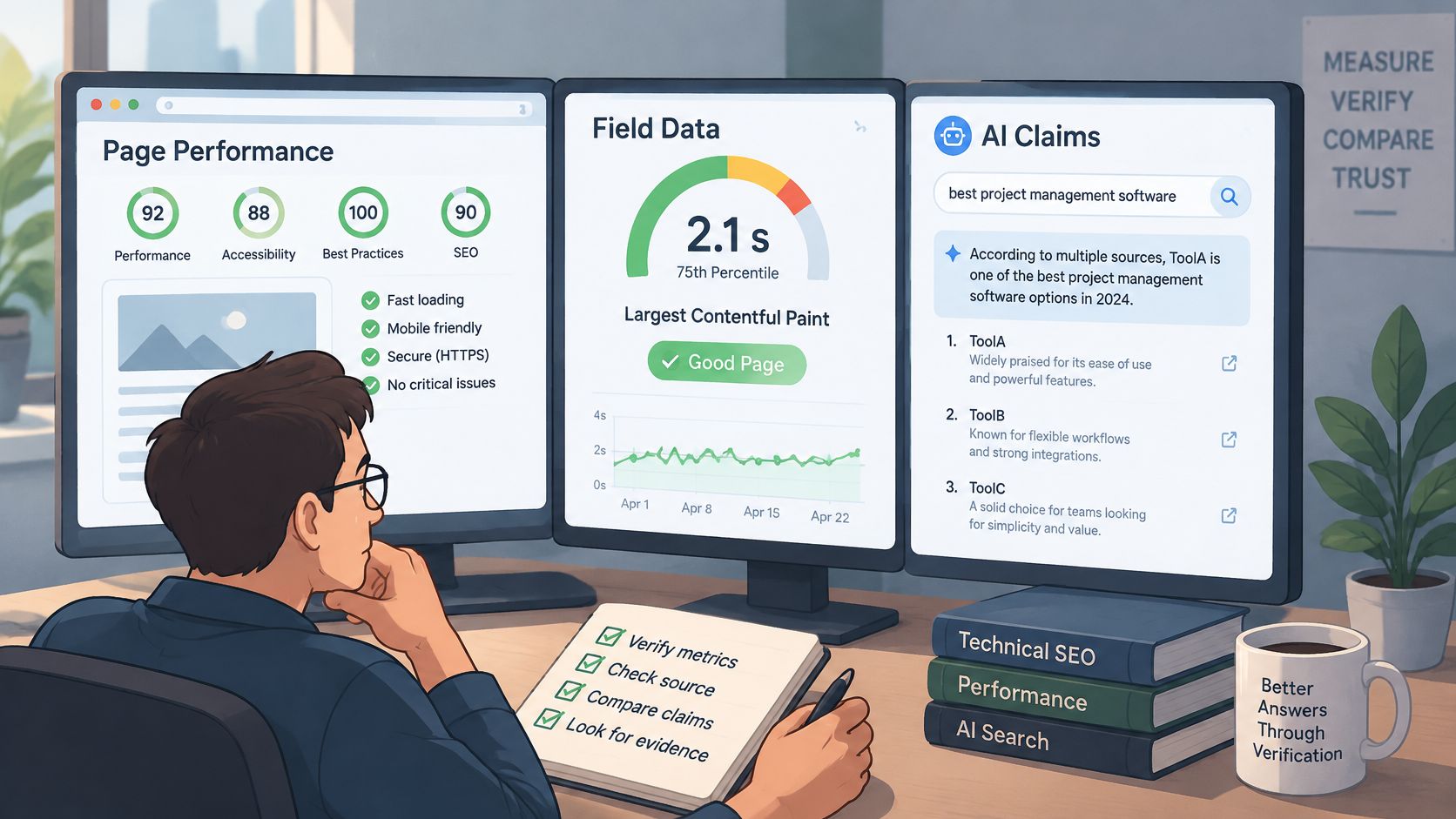
Check Performance With Field Data
Core Web Vitals should be judged on field data at the 75th percentile, not only lab tests. Google's Search Console page experience guidance classifies a page experience as "Good" when Largest Contentful Paint is at most 2.5 seconds, Interaction to Next Paint is at most 200 milliseconds, and Cumulative Layout Shift is at most 0.1.
Ask the consultant to map each failure to a cause. Slow server response, render-blocking resources, or oversized hero media can raise loading time, while heavy main-thread JavaScript can delay interactions. Rank fixes by traffic and conversions on the affected template, not by the worst single URL.
For large sites, ask whether the crawl plan removes duplicate, faceted, soft-error, or obsolete URLs. Wasted crawling can dilute attention from important, changing pages, so sitemaps, canonical URLs, internal links, and response codes need to agree.
Separate AI Visibility From AI Traffic
Apply the same scrutiny to AI search. In UserMaven's study of 150 B2B SaaS websites, AI referrals represented just 0.88% of sessions, although they were detected on 96% of sites. AI visibility can matter before it becomes a large channel, but that figure doesn't support claims of immediate traffic replacement.
Volatility is the other problem. A 2025 Semrush analysis of AI Overviews reported AI Overviews appeared for 6.49% of tracked queries in January, rose to 24.61% in July, and fell to 15.69% by November. Treat any large AI traffic claim as unproven until the consultant shows referral sessions, assisted conversions, and branded search changes side by side.
How to Judge Recommendations and Choose Next Steps
Score every recommendation before you approve work. Six criteria are enough, and they fit on one page your team can review in a single sitting.
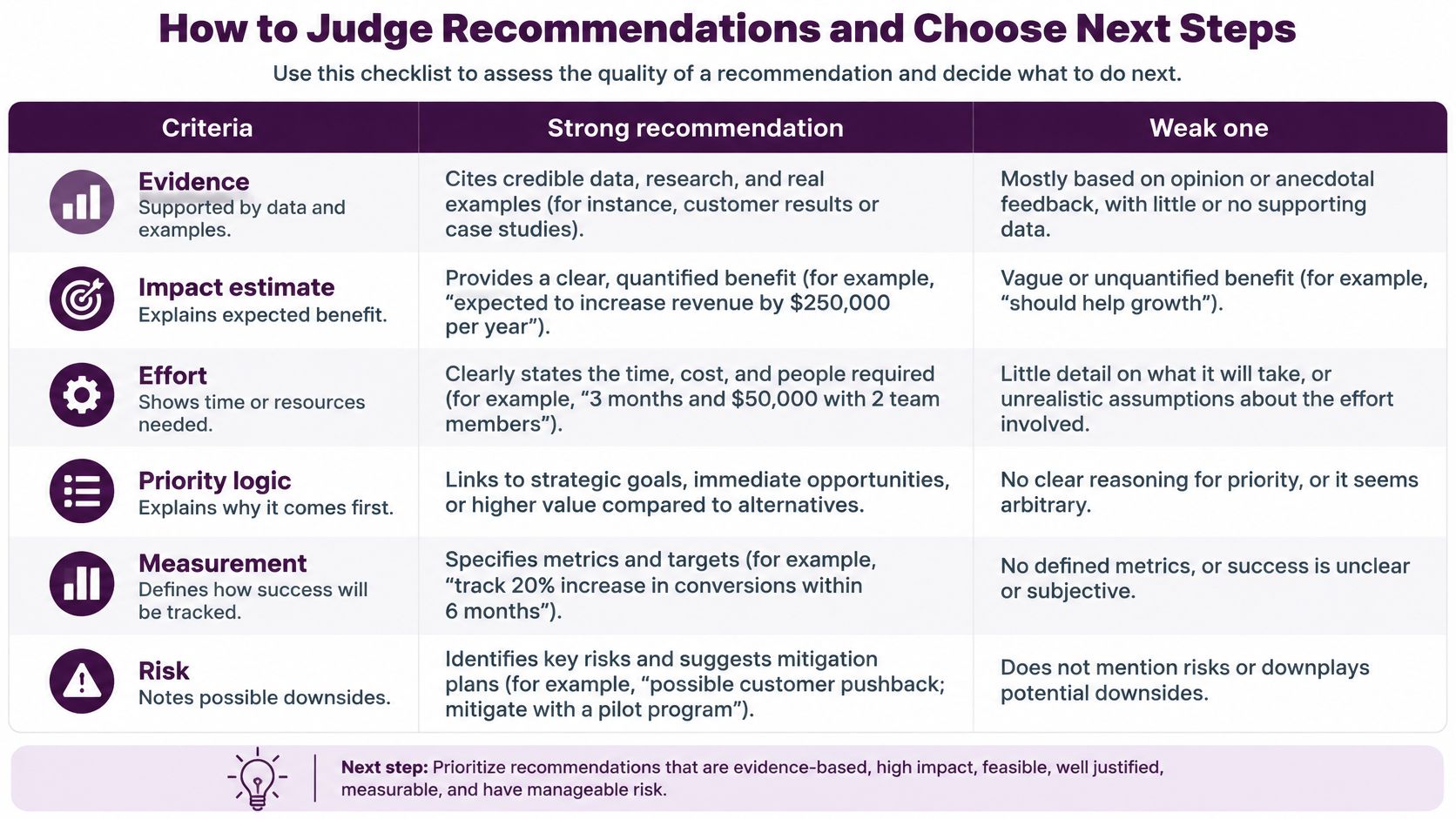
Criteria for Judging SEO Recommendations
| Criterion | Strong Recommendation | Weak Recommendation |
|---|---|---|
| Evidence | Cites your query, page or log data | Generic best practice with no site data |
| Impact estimate | Gives an expected click or revenue range with its assumptions | Says it will improve rankings, with no figure |
| Effort | States owner, hours and dependencies | No effort estimate |
| Priority logic | Ranks by impact and difficulty | Long list with no order |
| Measurement | Names the metric, baseline and review date | No success measure |
| Risk | Notes what could break, such as redirects or indexing | Ignores side effects |
Say an online furniture store receives a 40-item list. Applying the criteria, 22 items cite no site data, nine lack an effort estimate, and six sit on the category template that drives most organic sales. The owner approves those six first, assigns a named owner to each, and sets a six-week checkpoint. The rest go back for evidence or get dropped.
Use a well-structured audit as your format benchmark. Our site audit results are a categorized list of issues ranked by SEO impact and implementation difficulty, and each issue includes an explanation, affected URLs, and actionable guidance. SEO managers can also schedule recurring site audits to monitor technical health over time. If a small team can't act on a list within one quarter, it has no real priority yet. Send it back for a shorter version. You can turn that scoring into actionable SEO insights with Keyword Kick instead of maintaining a separate spreadsheet.
Decide With Three Rules
- Accept the full roadmap if every item has evidence, an owner, and a metric.
- Accept only the top priorities if some items lack evidence.
- Defer the engagement if a data gap, such as missing GA4 conversions, blocks reliable measurement.
Before signing, confirm owners, dates, success metrics, and the review date in writing. Start with the first two or three actions, log the date each change went live, and rerun the same Search Console export four to eight weeks later. Judge early signals such as crawl activity, indexing, and click-through rate, because rankings often take weeks to months to move.
Ready to test a consultant's recommendations against your own data? Connect Search Console and GA4 in Keyword Kick, run a categorized site audit ranked by impact and difficulty, and bring that evidence to your first session. Start on the free plan, score the roadmap you're given, and approve only the actions with a baseline, an owner, and a review date.