You publish two thoughtful articles on the same subject. Both are well researched, internally linked, and technically sound. Yet neither becomes the page your team expected. One ranks for a while, then the other replaces it. Clicks split between them, conversions land on different URLs, and the page that best matches the commercial objective remains invisible.
That pattern often points to SEO keyword cannibalization. The issue is not that two pages contain the same phrase. The critical question is whether they compete to satisfy the same search intent, or whether they cover different needs within the same topic.
Understanding SEO Keyword Cannibalization
Keyword cannibalization occurs when multiple pages on one domain pursue the same query and appear interchangeable to searchers. Clicks, links, conversions, and ranking signals can then spread across competing URLs rather than reinforcing the page best suited to the query. Search Engine Journal describes the issue as a long-standing on-page SEO problem, not a Google penalty.
A software company might have a product category page for “project management software” and an older article comparing project management tools. The category page supports commercial evaluation, while the comparison article may serve research or selection. Similar titles, overlapping copy, and links from other sites can still make the pages look like competing answers. Before merging either URL, compare the intent, audience, and role each page is meant to serve.
Search results may alternate between the pages, show both, or rank them below the position a more focused result could achieve. The blog post might attract impressions while the category page earns clicks, leaving the analytics active but fragmented. That pattern can indicate harmful cannibalization, although two pages ranking for related variations can also broaden a site's visibility when they satisfy distinct needs.
The basic mechanics
Search engines evaluate URLs individually, even when those URLs belong to one domain. If several pages address the same query for the same audience in nearly identical ways, the site provides no clear candidate to own that result. External links may point to different versions, internal links may distribute prominence unevenly, and engagement signals may be split between pages.
The practical impact extends beyond rankings. A visitor seeking a product comparison may reach a short educational article, while a buyer-ready search may surface a transactional page that lacks the expected explanation. Audit the destination against the query before treating overlap as a consolidation problem.
Practical rule: Compare the pages' intended searchers, tasks, and conversion paths. Shared keywords alone do not prove cannibalization. Pages are candidates for restructuring when searchers would regard them as interchangeable answers.
The concept became prominent when keywords mapped more directly to individual URLs, particularly from the mid-2000s through roughly 2015. Redirects and canonical tags were common consolidation remedies then. Search systems now match meaning more effectively, yet same-site competition still warrants review during content audits, internal-link analysis, and decisions about whether separate pages should remain distinct.
The Hidden Costs of Competing Against Yourself
Cannibalization creates a structural problem: your site has several candidates for one job, but none receives a consistently clear signal that it should own the topic. The consequences depend on the pages involved, their intent, and the strength of the site, so the audit should focus on evidence rather than assumptions.
External links are one important consideration. If relevant websites link to several similar URLs, the references may support a topic in aggregate, but they don't necessarily strengthen the page you want ranking. Internal links can create the same problem when editors repeatedly link to different articles with similar anchor text.
User behaviour also becomes harder to interpret. A product page and an explainer can both receive organic clicks for a broad phrase, but their conversion expectations differ. If the search engine chooses the explainer for a buyer-ready query, the page may attract visitors without giving them the next step they need.
A scale problem, not just an editorial mistake
The prevalence of overlap becomes clearer on large sites. A 2026 independent study by Studio 36 Digital examined 100 high-authority sites across 10 industries and 2,500 keywords. It found that 68% of sites showed significant cannibalization, defined as 5 or more URLs ranking for a single top keyword. The reported findings are available through Search Engine Journal.
The same study reported an average of 4.7 URLs per top keyword on successful sites, while 12% achieved “excellent control,” defined as 1 to 2 URLs per keyword. One extreme example involved 59 separate URLs ranking for one keyword. These figures don't mean every overlap requires a redirect. They show why teams need a query-level process rather than occasional page-by-page checks.
| Industry sector | Average URLs per keyword | Severity level |
|---|---|---|
| News and Media | 8.2 | High overlap |
| Government and Reference | 1.3 | Low overlap |
The sector contrast is meaningful. News publishers may produce many legitimate articles around a developing topic, while reference sites often benefit from a single stable answer. The right benchmark therefore depends on the site's purpose. A news archive with several relevant stories isn't automatically broken, but a service site with several interchangeable landing pages deserves closer attention.
Treating every multi-ranking query as an emergency can waste resources. Ignoring unstable rankings, divided clicks, and the wrong page appearing can waste even more.
How to Detect Cannibalization on Your Site
Start with queries, not URLs. A page report tells you which pages receive traffic. A query report shows whether several pages are competing for the same demand.
Build the evidence set
Export query and page data from Google Search Console. Open the Performance report, set the relevant date range, and review the Queries and Pages views together. For each important query, record impressions, clicks, click-through rate, average position, and every URL that received visibility.
Group URLs by query. A spreadsheet is enough for an initial pass. Filter for queries associated with multiple URLs, then separate normal variations from clusters where the pages have the same apparent purpose. A cluster with three or more pages deserves investigation, but the count alone doesn't prove harm.
Check ranking movement. Use a rank tracker to compare the URLs over time. Alternating positions, inconsistent winners, and one URL replacing another are stronger warning signs than stable rankings for separate long-tail variants.
Review the landing page experience. Search the query yourself and compare the page Google selects with the page your business wants to promote. A commercial query that repeatedly surfaces an informational article may indicate a relevance and architecture problem even when the article receives healthy impressions.
The GSC keyword research guide can help teams structure this query-first review. For organizations that need to move Search Console data into another reporting or analysis workflow, NotFair's Search Console connector provides a way to connect that data for broader investigation.
Validate before you label
A site search such as site:example.com "target phrase" can reveal obvious duplication, but it isn't a verdict. Search results are only a starting point. Read the competing pages side by side and note their audience, format, funnel stage, product focus, and primary action.
Look for these combinations:
- Alternating URLs: Google appears uncertain about which page best answers the query.
- Fragmented clicks: Several URLs receive visibility, but no page builds a clear lead.
- Misaligned winners: An older or less commercial page ranks instead of the intended destination.
- Duplicated purpose: Titles differ, but the actual questions and answers remain substantially the same.
A useful audit output is a table with one row per query cluster, the competing URLs, the apparent intent, the preferred destination, evidence of volatility, and the proposed action. That record prevents teams from making structural changes based on a single search or a subjective feeling that two pages “look similar.”
Intent Overlap vs True Cannibalization
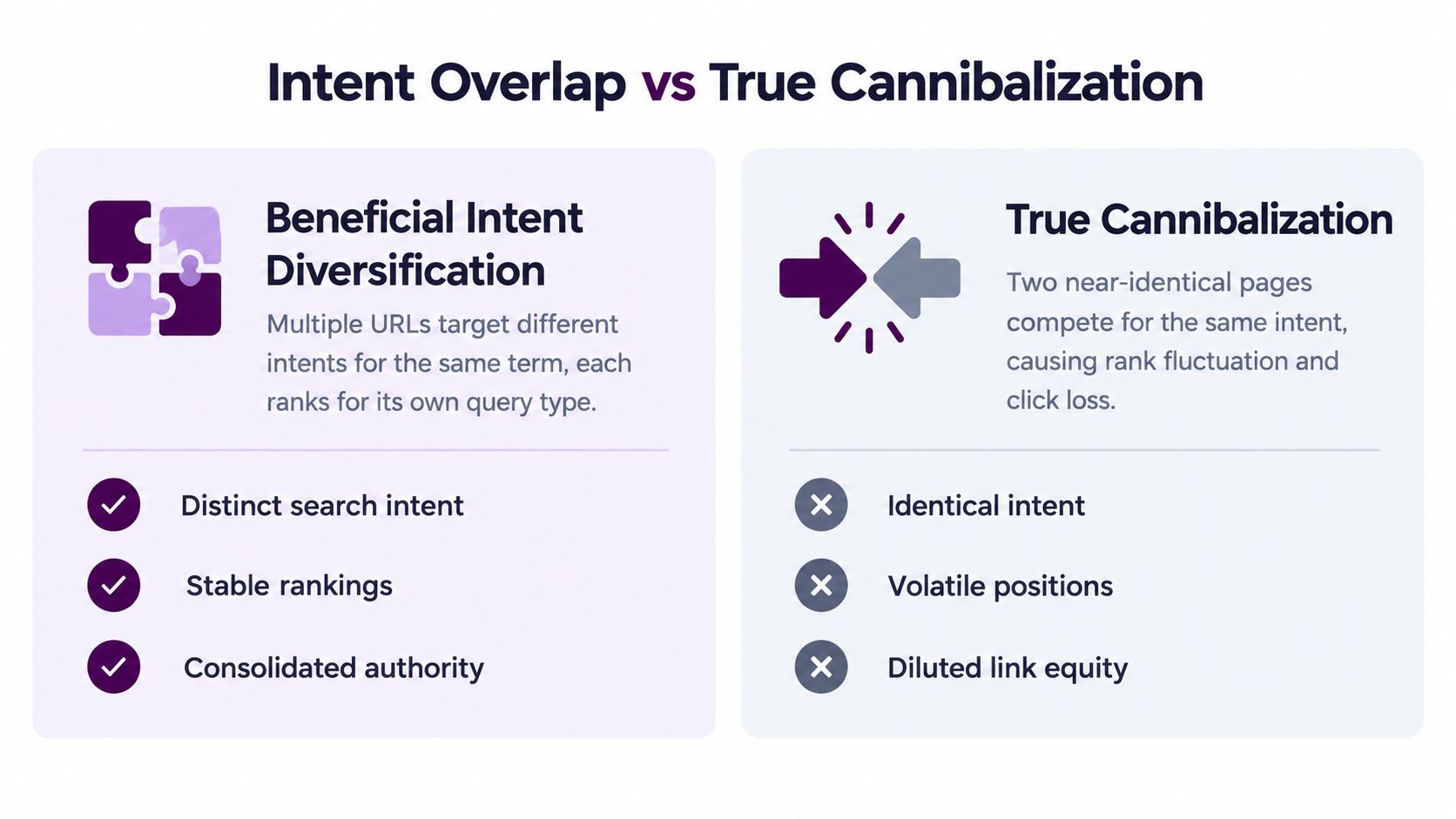
The shortcut “never target the same keyword twice” is too blunt for modern sites. A broad query can contain several sub-intents. One page might explain the concept, another might compare solutions, and a third might help an existing customer complete a task.
The distinction is not whether multiple URLs rank. The distinction is whether those URLs compete for the same searcher need.
Three outcomes to distinguish
Interchangeable pages answer the same question for the same audience in nearly the same format. If removing one would leave the user experience intact because the other page already does the same job, consolidation is likely appropriate.
Complementary but confused pages serve different purposes, but their titles, internal links, and on-page focus fail to make that difference clear. These pages may need differentiation rather than deletion. A beginner guide and an advanced implementation tutorial can coexist if their scope, language, examples, and calls to action clearly diverge.
Redundant pages add little unique value and compete for the same intent. Keeping both creates maintenance work and gives search engines no compelling reason to prefer one. In that case, merging the useful material into a stronger destination is usually more sensible than trying to preserve both URLs.
| Diagnostic question | Coexistence is more likely when... | Consolidation is more likely when... |
|---|---|---|
| Does the audience differ? | Each page serves a defined role or segment | Both pages address the same reader |
| Does the format differ? | One is a guide, comparison, tool, or product page | Both follow the same answer pattern |
| Do the SERP results differ by intent? | Each URL wins for distinct query variants | The same URL set alternates for the same query |
| Can each page earn unique links? | The pages have separate reasons to be referenced | Links point to near-duplicate information |
| Would a user miss something after a merge? | Yes, the pages provide complementary coverage | No, one page can absorb the useful material |
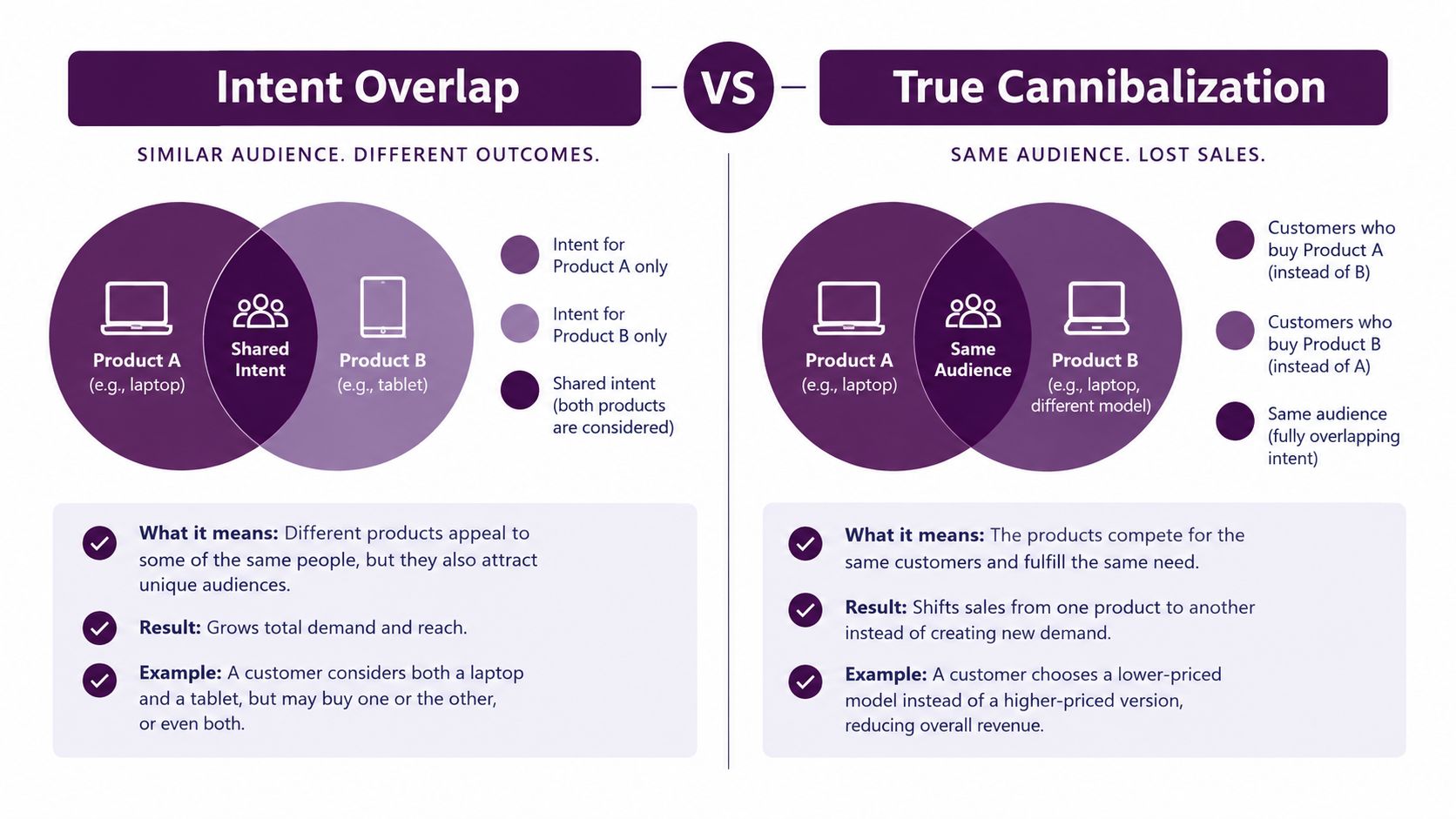
Recent guidance recommends classifying pages as interchangeable, complementary-but-confused, or redundant before merging. SEO.com makes this distinction because an indiscriminate fix can remove useful coverage rather than improve the site.
There is also a legitimate case for beneficial diversification. Ahrefs' study of multiple rankings describes situations where several URLs ranking for related terms can expand visibility and capture different search opportunities. Monitor whether pages share impressions across distinct intents, rank consistently for different variants, or repeatedly trade places for one identical need. Differentiate the first group. Restructure the second.
Prioritizing Which Pages to Fix First
A cannibalization inventory can become a long list of possible improvements. Don't start with the most dramatic cluster. Start with the cluster where clearer ownership is most likely to improve a meaningful business outcome without creating unnecessary risk.
Use three lenses:
- Business value: Give priority to queries connected to products, services, qualified leads, or important customer journeys. A duplicated informational article may be untidy, but a confused commercial destination can affect revenue quality.
- Evidence of conflict: Look for alternating URLs, a mismatched landing page, divided clicks, and strong pages competing against weaker or outdated ones. Stable multi-ranking across distinct intents should rank lower.
- Implementation effort: A pair of short articles may be easy to combine. A group of category pages with inventory rules, filters, and established internal links needs a controlled technical plan.
A practical triage model
Classify each cluster as act now, plan, or observe.
“Act now” usually means one page is clearly the intended destination, the alternatives are redundant, and the change can be tested safely. “Plan” covers valuable pages that need differentiation, template work, stakeholder input, or careful redirect mapping. “Observe” applies when the URLs rank for separate sub-intents and the overlap isn't producing a clear business or usability problem.
Don't confuse authority with quality. The URL with the most organic visits may be receiving demand because Google currently shows it, not because it is the right long-term destination. Review backlinks, content depth, conversion relevance, freshness, and user purpose before choosing the survivor.
For a broader inventory of outdated, overlapping, or underperforming assets, use a content audit that drives results as the supporting process. The immediate cannibalization fix should fit into that larger audit rather than become an isolated spreadsheet exercise.
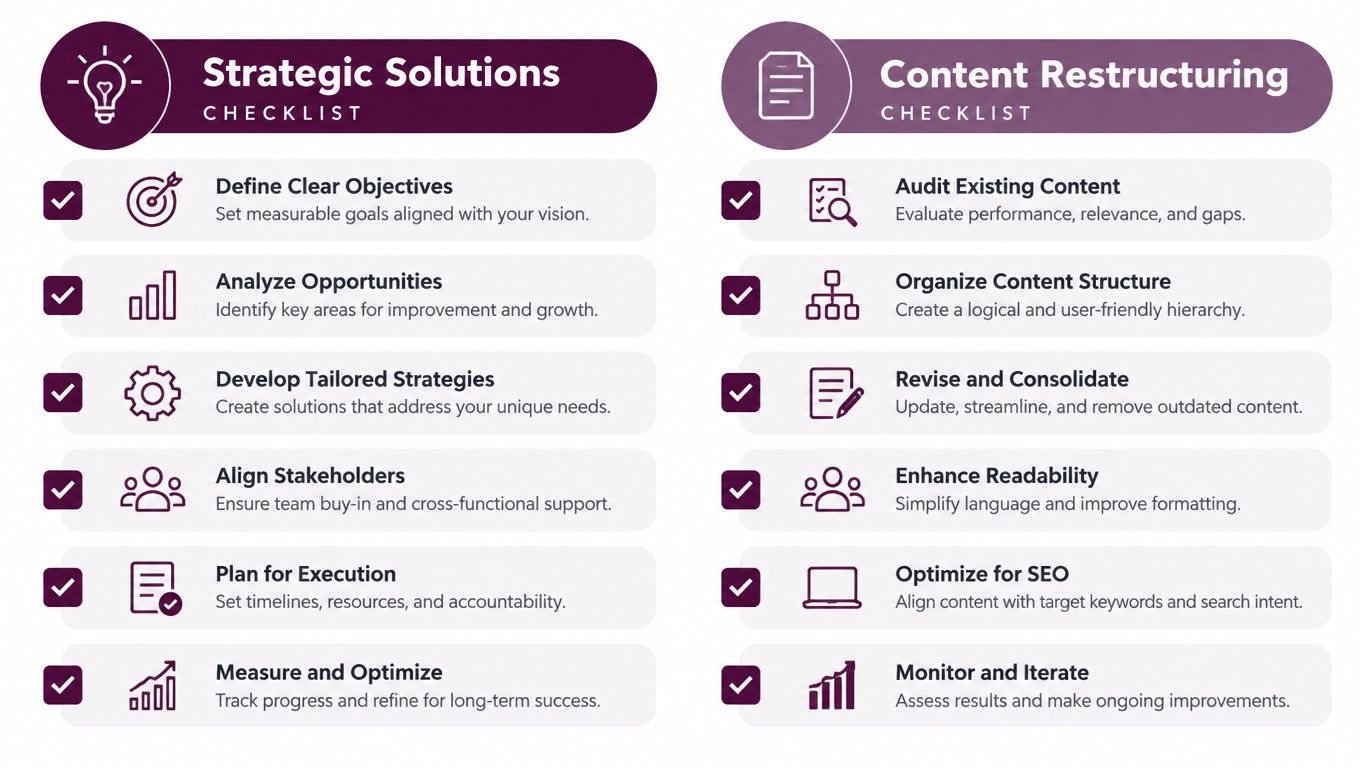
Strategic Solutions and Content Restructuring
The right fix depends on why pages overlap. Consolidation, canonicalization, internal linking, and content differentiation address different structural problems. Apply a redirect to genuinely redundant pages, but preserve separate URLs when they serve distinct audiences, tasks, or search intents. Beneficial SERP diversification should not be treated as a defect.
Consolidate pages with the same purpose
Choose the primary URL using more than its current ranking. Review backlinks, relevant organic visibility, conversion alignment, content quality, technical health, and whether the page can absorb the useful material from competing URLs. A page receiving the most traffic may only benefit from Google's current selection, so validate its long-term fit before making it the survivor.
For a true overlap, use this sequence:
- Map unique sections, examples, media, and internal links from the weaker pages.
- Expand the primary page until it fully addresses the shared intent.
- Align its title tag, headings, structured content, and calls to action around one clear purpose.
- Redirect each retired URL to the most relevant consolidated destination.
- Remove or update internal links that still point to retired pages.
- Test the redirect path, rendering, indexability, analytics, and templates before release.
A 301 redirect fits an old page with no separate purpose, where users and search engines should reach the consolidated resource permanently. It does not decide whether the content deserves to exist. If the pages answer different questions, rewrite them around their distinct jobs instead of forcing one URL to absorb both.
Use canonicalization for technical duplication
Canonical tags suit similar URLs that must remain accessible, including parameterized versions or business-required variants. They signal a preferred version, but they do not reliably resolve two editorial pages with different content and overlapping intent.
If both editorial pages are expected to rank independently, a canonical alone leaves the underlying architecture unchanged. Differentiate their purposes through audience, format, depth, or task, then adjust titles, headings, and internal links to reinforce that distinction. If no meaningful distinction exists, consolidation is the clearer structural choice.
Use internal links to clarify hierarchy
Internal links should match the role assigned to each page. Link relevant hub pages, navigation areas, and supporting articles consistently to the primary guide for the broad topic. Point to secondary resources with narrower anchors that describe their specific purpose, rather than repeating the broad target phrase across every link.
A pillar page and specialist resources can rank together when their relationship is explicit. The link structure should show which URL owns the broad subject and which URLs address defined subtopics. Teams planning a wider commercial content system can review SaaS SEO strategy for growth for a related approach to connecting content structure with acquisition planning.
Monitor the result
Record affected queries and URLs before changing the site. After deployment, monitor impressions, clicks, average position, landing-page selection, conversions, crawl errors, redirects, and internal links. Compare the revised page with the previous cluster, not only with its strongest day.
Search engines need time to process structural changes. Investigate promptly if the preferred page disappears for relevant queries, redirects lead to an unrelated destination, or users lose access to an important intent. A sound fix produces clearer page ownership and a better landing experience, not merely fewer indexed URLs.
Keyword Kick is one option for teams seeking cannibalization detection alongside Search Console, rank tracking, backlinks, and technical SEO signals. Its workflow identifies competing URLs and supports conflict-severity review, while the final decision still depends on intent assessment.
Building a Governance Model to Prevent Future Issues
Most cannibalization begins before publication. Editorial teams create a new brief because a keyword looks promising, writers produce a page that resembles an existing resource, and nobody owns the decision about which URL should serve the topic. Search Engine Land links the pattern to overlapping pages, particularly across blogs, category pages, localized pages, and product pages created without a keyword map or clear content governance.
A governance model makes that decision explicit.
Put one owner behind each topic
Maintain a content inventory with the primary query, search intent, audience, funnel stage, page type, preferred URL, supporting URLs, and status. The inventory doesn't need to be complex. It needs to be visible to strategists, writers, editors, product marketers, and developers before a new brief is approved.
A pre-publication check should answer:
- Does an existing page already satisfy this intent?
- Is the proposed page distinct in audience, format, or task?
- Which URL should receive internal links for the broad topic?
- What evidence would justify merging or differentiating the new page later?
If the new brief duplicates an existing page, update the current resource instead of automatically commissioning another article. If both pages deserve to exist, write the distinction into the brief, title, outline, internal-link plan, and conversion path.
Make the map part of production
Assign responsibility for reviewing the map, approving exceptions, and auditing clusters after publication. Content teams should also revisit pages when products, locations, categories, or customer segments change, because yesterday's clean separation can become today's overlap.
A structured site strategy with Keyword Kick can help teams connect keyword mapping with ranking data and page priorities. The operational principle is simple: every URL needs a defined job, and every broad topic needs a clear primary destination.
Prevention doesn't mean banning similar phrases. It means publishing with deliberate distinctions, reinforcing those distinctions through internal links, and consolidating only when the evidence shows that separate pages are competing for the same answer.
Review your highest-value query clusters in Google Search Console, identify the URLs that alternate or serve the wrong intent, and classify each as interchangeable, complementary, or redundant. Keyword Kick brings Search Console, rank tracking, backlink, audit, and cannibalization signals into one workspace so you can turn that diagnosis into prioritized actions. Visit Keyword Kick to map the conflicts and decide which pages should be strengthened, differentiated, or consolidated.