Introduction
"So my position went up but my traffic went down — is that good or bad?"
If you've worked with clients for more than a month, you've had this conversation. Or a version of it.
SEO metrics are genuinely confusing to people who don't live inside them daily. Impressions, CTR, domain rating, crawl budget — these aren't intuitive concepts. And when clients don't understand the numbers, they don't trust the work.
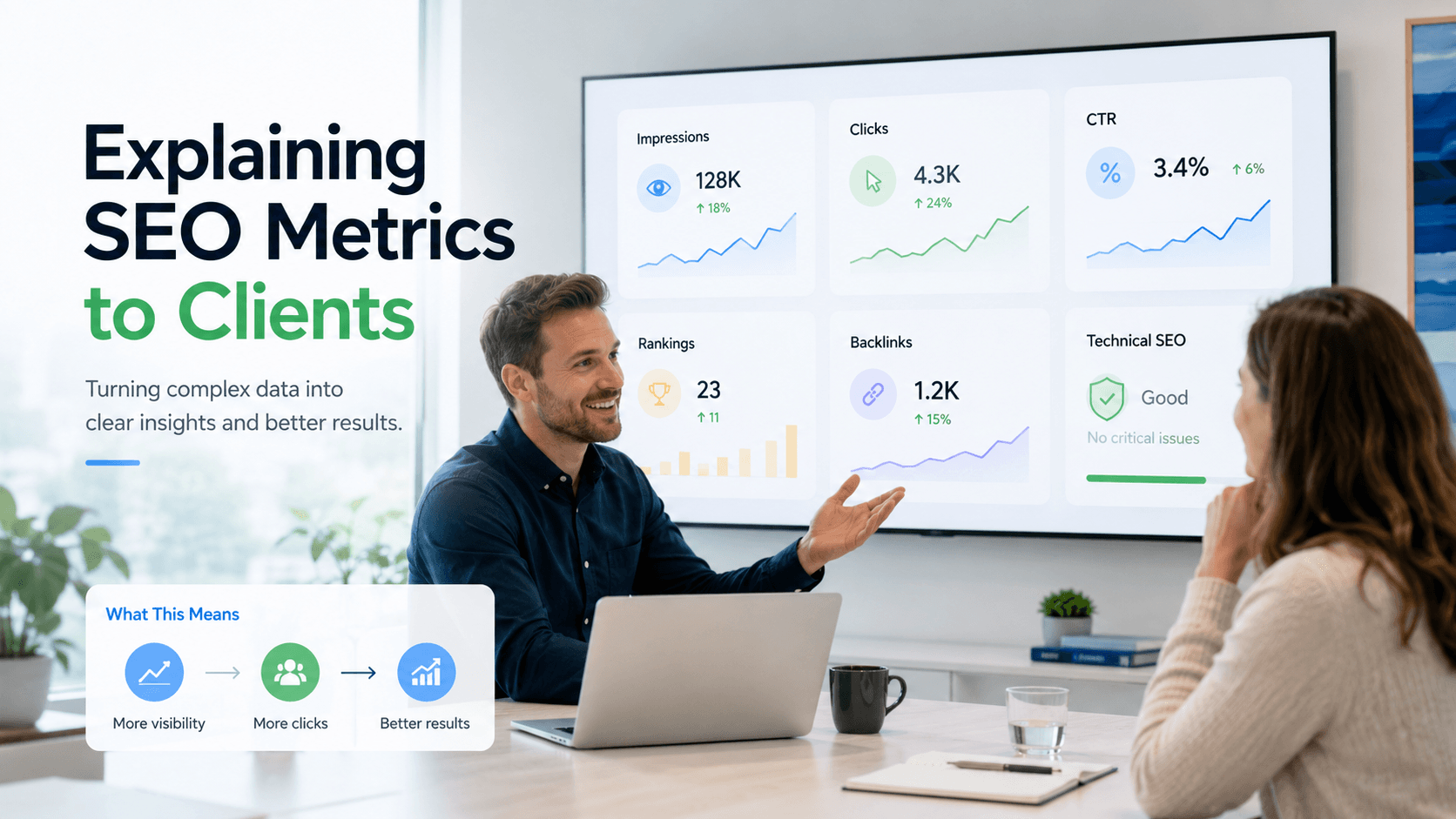
The fix isn't a glossary document. It's the right analogy at the right moment. This guide gives you a playbook of plain-language explanations, real dialogue examples, and communication habits that turn confused clients into confident ones.
Why Client Communication Is an SEO Skill
Agencies lose clients not because the SEO is bad — but because the client couldn't see that it was good.
If a client can't understand what you're measuring, they can't evaluate progress. If they can't evaluate progress, they default to gut feel — and gut feel is easily swayed by a competitor promising faster results.
Clear communication is retention strategy. The best technical SEO work in the world gets cancelled if the client doesn't understand what they're paying for.
The Core Metrics — Explained Simply
Impressions
What you might say: "Impressions are how many times your site appeared in Google search results — whether someone clicked or not. Think of it like foot traffic past a shop window. A lot of people walked by. Some stopped to look. Some came in."
Why it matters: Impressions tell you whether Google is showing your site for relevant searches. Rising impressions with flat clicks usually means your rankings are improving but your titles and descriptions need work.
Common client confusion: "Impressions went up 40% but I didn't get more customers." Correct response: "Right — impressions are visibility, not traffic. The next step is getting more of those people to click through. That's what we're working on with the title tag updates."
Clicks / Organic Traffic
What you might say: "Clicks are the people who actually walked into your shop. They saw your result, found it interesting, and visited your site. This is the number we care most about — it's real potential customers arriving."
Why it matters: Clicks are the direct output of ranking improvements and CTR optimization. This is the metric most clients instinctively understand once you frame it correctly.
Common client confusion: "Google Analytics shows different numbers than your report." This usually happens because GSC counts search clicks and GA4 counts sessions — the same visit can be counted differently. Explain: "These two tools count slightly differently, like two people counting the same crowd from different angles. We use both and look at the trend together."
Click-Through Rate (CTR)
What you might say: "CTR is what percentage of people who saw your result actually clicked it. If 1,000 people saw your listing and 30 clicked, that's 3%. Think of it as how compelling your shopfront looks — the sign, the window display, the first impression. A higher CTR means more people chose you over the other results."
Why it matters: CTR is the bridge between impressions and traffic. A low CTR at a good ranking position is a signal that the title or meta description needs work — not that the rankings themselves are failing.
Common client confusion: "We're ranking 4th but barely getting any clicks." Correct response: "Position 4 gets around 5–7% of clicks on average. But if there's a featured answer box above all results, that number drops. Let's look at what that search result page actually looks like and see where the opportunity is."
Keyword Position / Rankings
What you might say: "Your ranking position is where your site appears in the list of Google results. Position 1 is the top result. Position 10 is the last result on page 1. Page 2 starts at position 11 — and almost nobody goes to page 2. Think of Google's first page as prime high street location. Page 2 is around the corner."
Why it matters: Rankings are the most intuitive metric for clients but also the most volatile day to day. Set expectations early: rankings fluctuate. Trends over weeks matter more than today's position versus yesterday's.
Common client confusion: "I Googled our main keyword and we were position 6, but your report says position 4." Correct response: "Google personalizes results based on your location, search history, and device. The position in our report is an average across many users — it's more accurate than a single search from your own computer, which Google has already learned your preferences for."
Domain Rating (DR)
What you might say: "Domain Rating is a score out of 100 that estimates how authoritative your website is, based on who links to you from other sites. Think of it like professional reputation — a new business has no reputation yet, an established business with great reviews and press coverage has a strong one. DR is Google's rough equivalent of that reputation score."
Why it matters: DR improves slowly and signals long-term SEO health. It's a useful context metric but a poor primary KPI for monthly reporting.
Common client confusion: "Our DR is 28 and our competitor's is 54 — does that mean we can never beat them?" Correct response: "Not at all. DR is one factor, not the only one. A newer site with focused, high-quality content can outrank a higher-DR site on specific keywords. Think of it like a new restaurant beating a well-known chain on TripAdvisor for a specific dish — it happens all the time."
Backlinks
What you might say: "A backlink is when another website links to yours. Google treats these like professional recommendations — if a respected publication, industry blog, or trusted website links to you, Google sees that as a vote of confidence. The more credible the site linking to you, the stronger the vote."
Why it matters: Backlinks remain one of the strongest ranking factors, especially for competitive keywords. Clients often don't realize links are actively built — they assume it happens automatically.
Common client confusion: "Why do we need backlinks if we have good content?" Correct response: "Content is what Google reads. Backlinks are what Google trusts. You need both — like a great CV that also has strong references. The CV alone gets you in the door; the references get you the job."
Technical SEO / Site Audit Issues
What you might say: "A site audit is like a building inspection — it checks whether the foundations of your website are solid. Broken links, slow pages, pages Google can't find — these don't always show up visually on the site, but they affect how Google crawls and ranks you. Fixing them is maintenance work that keeps everything else performing properly."
Why it matters: Technical issues are often invisible to clients, which makes them easy to deprioritize. Framing them as infrastructure maintenance — rather than abstract code problems — helps clients understand why they need to be fixed.
Common client confusion: "We fixed 30 technical errors last month but rankings didn't improve. Why?" Correct response: "Technical fixes remove roadblocks — they're like clearing a blocked drain. The water flows better now, but the drain wasn't the only thing determining how much water was coming in. Rankings improve when technical health, content quality, and backlinks all work together."
Dialogue Examples for Common Client Conversations
"Why are we paying for SEO if we're still not on page 1 for [main keyword]?"
"That keyword has strong competition — the sites currently ranking have been building authority for years. What we've done is get you to page 1 for [related keyword A] and [related keyword B], which between them brought in [X] visits last month. We're building toward the main keyword — it's a longer play, but these are the foundation stones."
"My friend said we should be getting results faster."
"SEO is a compounding investment — it builds over time, unlike ads that stop the moment you stop paying. The results we're seeing now at month 3 will look different by month 6 and month 12. I can share what the typical trajectory looks like for a site starting from where yours did if that would help set expectations."
"Can you just tell me if this is working?"
"Yes. Organic traffic is up [X]% compared to three months ago. You're ranking on page 1 for [X] keywords that you weren't visible for before. And [X] of those visits turned into enquiries or purchases last month. It's working — and the momentum is building."
Communication Habits That Build Long-Term Trust
Send a brief monthly summary before the full report arrives. Three bullet points over email — what went up, what we fixed, what's coming next. Clients who hear from you proactively never need to chase you.
Translate every technical finding before sharing it. Don't send a list of crawl errors. Send: "We found and fixed 12 issues that were stopping Google from properly reading your service pages — this should help those pages rank faster."
Acknowledge when something didn't go to plan. If rankings dipped, say so early and explain why. Clients who trust your honesty in bad months stay through them.
Celebrate wins explicitly. Clients rarely notice a keyword moving from position 14 to position 6. You notice it — tell them, and tell them what it means in plain language.