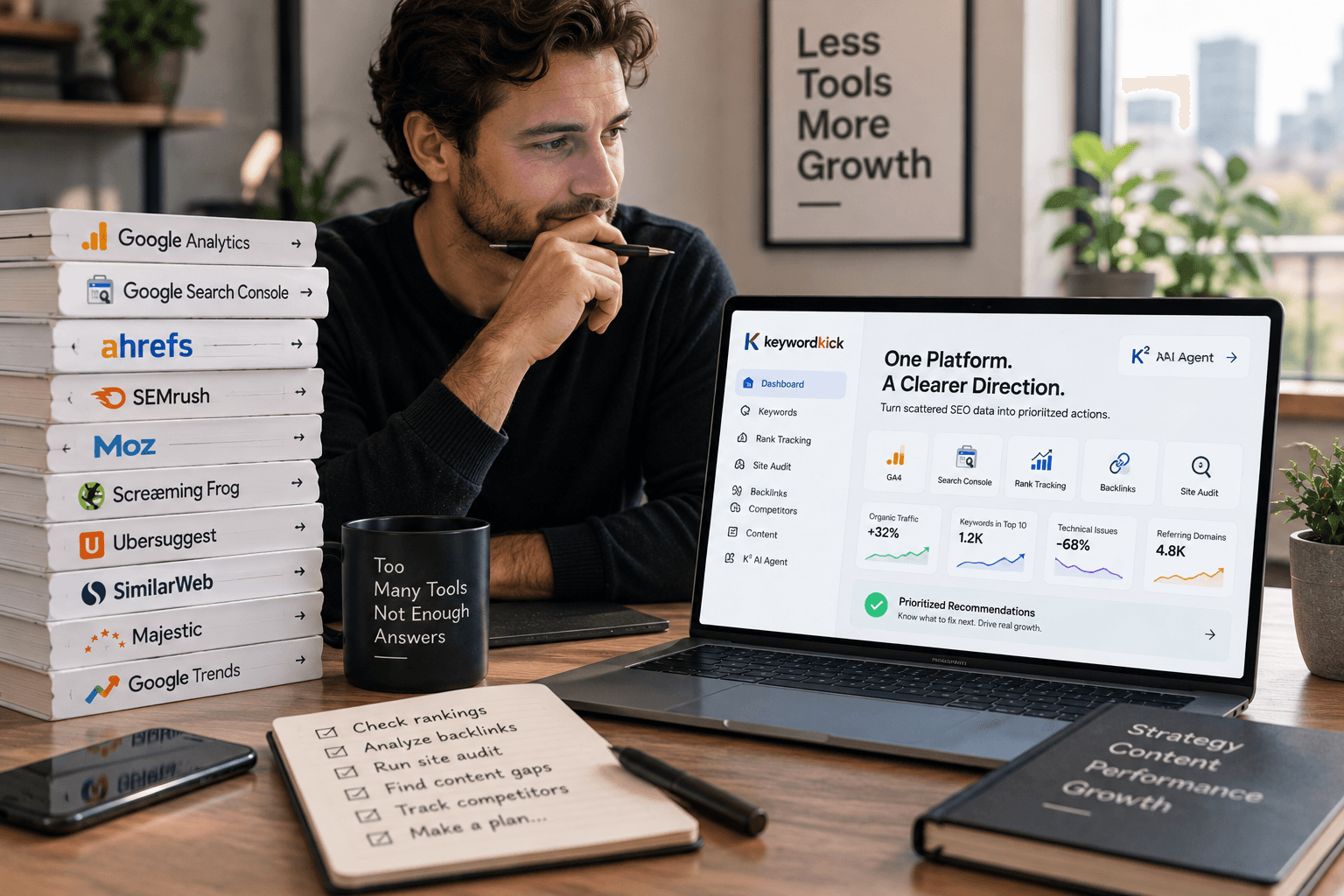
Monday starts with the same ritual. GA4 in one tab, Google Search Console in another, a crawler loading in the background, rank tracking open beside a backlink tool, and a spreadsheet waiting to become the place where everything finally makes sense.
The problem isn't lack of data. It's that SEO teams keep getting answers in pieces. One tool tells you clicks fell. Another shows rankings slipped on a handful of terms. A third flags template errors. None of them tell you what deserves action first.
That gap is why the AI search market is projected to reach $750 billion in revenue by 2028, up from $67 billion in 2025, according to AI SEO statistics compiled by Search Logistics. Teams aren't buying more charts. They're trying to collapse analysis, prioritization, and execution into one workflow.
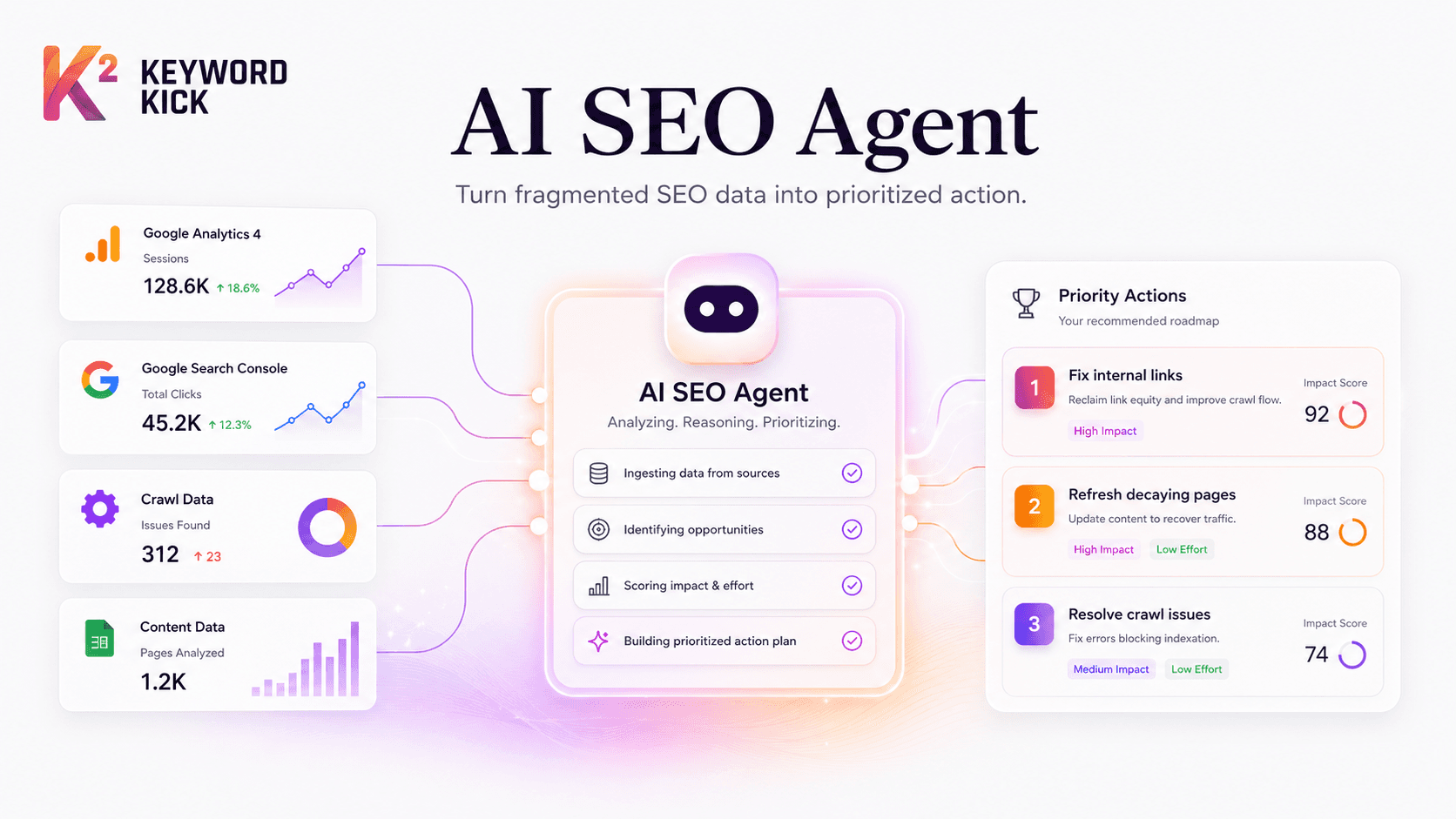
An AI SEO agent sits in that gap. It doesn't replace SEO judgment, but it changes the operating model. Instead of stitching together exports and guessing where to start, you ask a direct question and get a structured answer with context, likely causes, and next actions.
The End of Fragmented SEO Data
By 11 a.m., the team has already touched four tools and still cannot answer a simple question: what needs attention first?
That is the true cost of fragmented SEO data. Decisions slow down because evidence is scattered across systems that were never built to reason together.
A content lead sees a category slipping. The technical SEO finds crawl waste on the same templates. The growth manager notices weaker assisted conversions in GA4. Each person is right, but each person is looking through a different keyhole. The missed opportunity is not the metric. It is the delay between signal and action.
An AI SEO agent helps because it works across those inputs in one pass. It connects search performance, traffic behavior, technical findings, and page patterns, then turns them into a prioritized recommendation. The useful question changes from "What changed in Search Console?" to "Which pages lost visibility, what likely caused it, and which fix has the best payoff?"
Why fragmentation keeps slowing teams down
Traditional SEO software was built for specialists. That model still works for isolated tasks. It breaks when content, technical SEO, analytics, and growth all need to make one decision on the same day.
The friction usually shows up in a few places:
Reporting lag: rankings update in one platform, traffic in another, and the team spends time lining up date ranges before analysis even starts.
Competing priorities: title tag rewrites, internal links, template fixes, and content refreshes all look urgent because no system is weighing impact across them.
Missing context: a drop in clicks can come from lower CTR, weaker rankings, intent mismatch, cannibalization, or a page-level technical issue.
This is also why dashboards alone stopped being enough. The operational problem is interpretation. A useful framework for that shift is why data visibility is no longer enough.
I have seen this pattern repeatedly. Teams do not get stuck because they lack reports. They get stuck because someone has to translate five partial reports into one ranked action list, and that work keeps slipping behind publishing, fixes, and stakeholder requests.
The pressure is higher now because the target is changing. SEO teams are no longer working only to rank blue links. They also need content that can be cited by AI systems, surfaced in summaries, and trusted as a source. You cannot make that shift well if your evidence lives in silos and your team is still stitching together exports by hand.
Fragmented data creates reporting problems. Connected data changes how fast a team can diagnose, decide, and ship.
What an AI SEO Agent Is and Is Not
Monday morning, traffic is down on a money cluster, Search Console is showing query loss, GA4 is lagging behind, and someone is asking whether the content team, dev team, or link team owns the fix. An AI SEO agent helps answer that faster because it works across the systems where the evidence already lives and turns scattered signals into a usable recommendation.
That does not make it autonomous strategy.
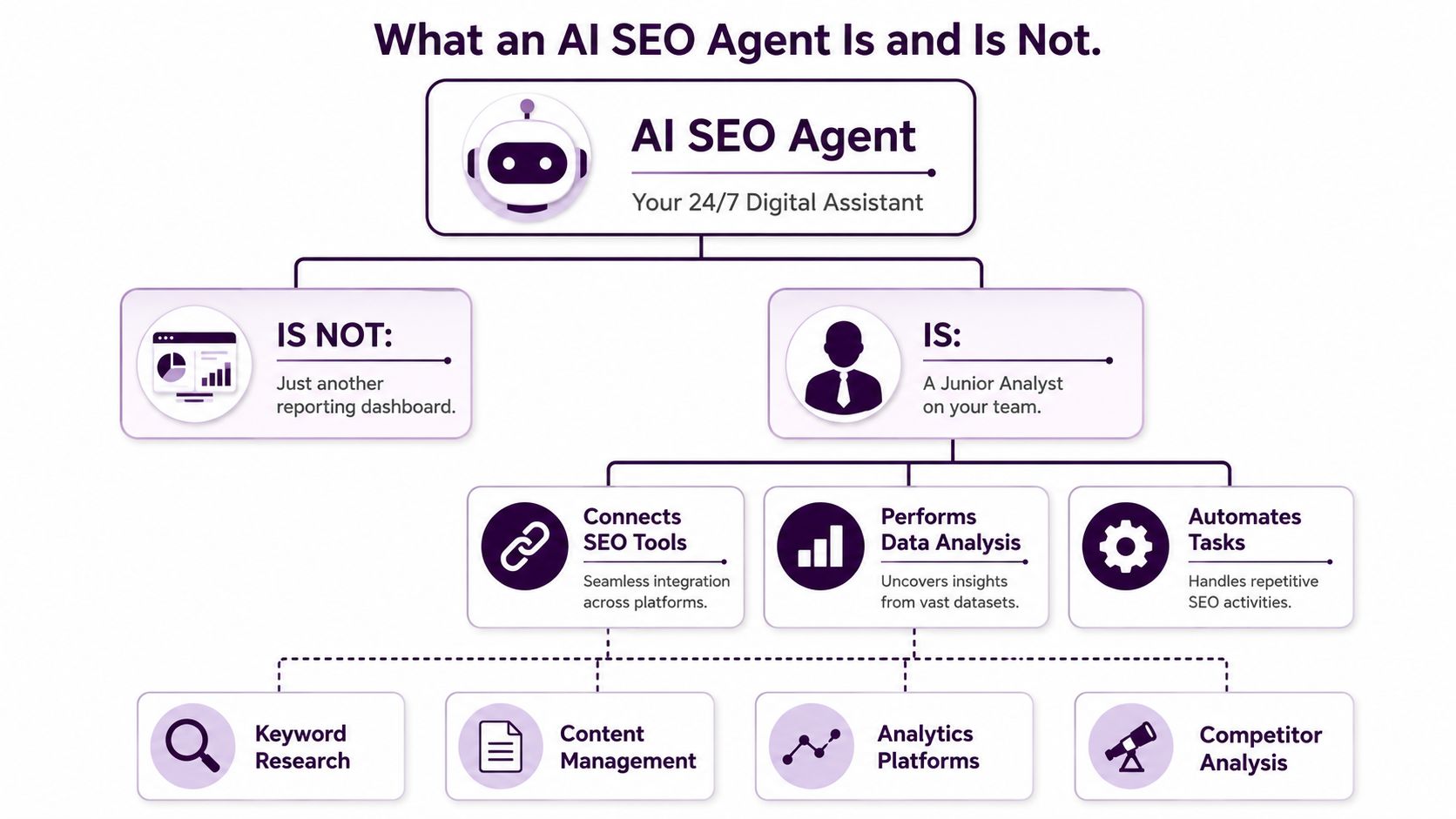
It makes it a working layer between raw SEO data and human judgment. In practice, the best agents behave less like a chatbot and more like an operator that can investigate, prepare work, and keep moving until a person approves the next step.
What it is
An AI SEO agent usually combines three functions.
Data connectors
First, it needs access. Search Console, analytics, your CMS, crawling data, page templates, and sometimes ticketing systems or content repositories.
Without those connections, the tool is producing educated guesses from a narrow slice of reality. With them, it can trace a ranking drop back to page changes, weak internal linking, content decay, technical issues, or query shifts. It can also prepare updates in bulk instead of handing your team another spreadsheet.
A reasoning layer
This is the part that matters more than the interface. The agent has to examine multiple signals, weigh likely causes, and explain the situation in plain language.
A dashboard shows that pages lost clicks. An agent should be able to say the likely loss came from intent drift, a weaker title pattern, or a competing page that now matches the query set better. That explanation still needs review, but it is far more useful than a chart and a shrug.
Action modules
Good agents do more than summarize. They draft briefs, suggest internal links, cluster pages for refreshes, create tickets, and in some setups prepare approved changes inside the CMS.
That is where teams gain time. Analysis alone still leaves a backlog. Analysis tied to execution shortens the gap between diagnosis and shipping.
What it is not
An AI SEO agent is not a ranking machine, and it is not a substitute for an SEO lead.
It will not understand brand risk, legal constraints, product nuance, or internal politics unless you give it that context. It will not reliably choose between two keyword directions when one supports pipeline and the other only grows traffic. It will also miss edge cases that a strong strategist catches fast, especially on large sites with messy templates and conflicting page intents.
It is also different from an AI writer. Copy generation is one task. SEO operations include prioritization, diagnosis, internal linking, technical QA, post-publish validation, and now a growing need to structure content so AI systems can cite it confidently. A tool that only writes blog posts is not doing that job.
Practical rule: If the tool cannot use your real performance data, explain why a change likely happened, and help your team act on that finding, it is an assistant feature, not an AI SEO agent.
Where it fits best
The strongest use case is removing analyst bottlenecks while keeping strategic control with humans.
That usually shows up in three places:
Triage: sorting signal from noise when traffic, rankings, or CTR move unexpectedly
Pattern detection: finding cannibalization, content decay, entity gaps, and weak internal link coverage across large page sets
Execution prep: turning a diagnosis into briefs, tickets, or ready-to-review edits
There is a trade-off here. The more access and action you give the agent, the more babysitting you need at the start. Teams that accept that early supervision usually get value faster because they are training the system on real standards, not generic SEO best practices.
That shift matters even more now. The job is no longer limited to winning a blue link. Content also needs to be quotable, attributable, and structured in a way that increases the odds of being cited in AI answers. The same operational discipline that helps an ecommerce team update title tags at scale can also help a media team create faceless YouTube channels with reusable research, entity coverage, and content workflows that support discovery across search and AI surfaces.
Core Capabilities and Real-World Workflows
The easiest way to judge an AI SEO agent is to stop asking what features it has and start asking what questions it can answer well.
If the answer is vague, the tool isn't ready. If it can investigate a real problem the way a strong analyst would, that's where value shows up.
Why did traffic drop last week
This is the first real test.
A useful agent doesn't just say traffic is down. It correlates page-level changes, query losses, technical signals, and competitor movement. Modern AI SEO agents can monitor 500+ on-page metrics and semantic patterns, track competitors continuously, and identify root causes within hours when traffic drops or algorithm shifts hit, according to Sedestral's analysis of agent SEO tools and autonomous optimization.
In practice, that means the agent can flag a likely chain like:
rankings slipped for a semantically important cluster
competing pages added fresher sections or stronger matching entities
your affected pages also show weaker internal link support
a template update may have degraded title formatting or crawlability
That saves the team from wasting a meeting on symptoms.
Which pages should we update first
Agents often outperform manual workflows. Humans tend to choose based on familiarity. The agent can choose based on combined opportunity.
A strong workflow looks at pages with existing traction, near-page-one terms, intent mismatch, stale copy, and weak CTR signals. Then it sorts those opportunities into a practical queue.
Three update buckets usually emerge:
Quick wins: pages already close to stronger visibility and needing modest on-page improvement.
Decay recovery: pages that previously performed well and now need freshness, structure, or intent alignment.
Support pages: assets that won't drive the most traffic alone but can strengthen internal topical coverage.
Don't ask the agent for "content ideas." Ask it to identify pages where the gap between current performance and likely upside is smallest.
What can we automate safely
At this point, teams either gain an advantage or create a mess.
The safest automation sits in structured work. Indexable notes that AI SEO agents can reach 95%+ accuracy on structured technical tasks such as keyword classification and identifying broken links, missing meta tags, or schema errors in its complete guide to SEO agents. That's exactly the kind of work you want the system handling first.
Good candidates for automation include:
Technical detection: broken links, missing metadata, schema issues, redirect anomalies.
Content hygiene: title rewrites for review, internal link suggestions, image alt coverage checks.
Segmentation: query intent grouping, page clustering, topical overlap detection.
Bad candidates for full autonomy include brand positioning, page consolidation decisions, and final editorial judgment.
How teams use agents beyond publishing
A lot of value comes after content is live. Agents are good at monitoring drift. They can watch pages that matter, detect change early, and suggest what to adjust before losses spread across a category.
This matters for teams publishing across multiple channels too. If your brand also uses search-led content to create faceless YouTube channels, the same agent logic can help identify recurring questions, map themes into clusters, and keep scripts aligned with the search language your audience uses.
That broader workflow is where AI SEO agents stop being "SEO software" and start acting like an operating layer for content performance.
How to Get Started with an AI SEO Agent
Teams frequently overcomplicate the rollout. They spend too long comparing features and not enough time setting up the inputs that make the system useful.
Start narrow. Connect the data sources that matter, define a small set of recurring questions, and test the agent on workflows where you already know the right answer. That gives you a baseline for trust.
Start with the minimum viable data stack
If Search Console and GA4 aren't connected, the agent won't have enough context to do meaningful diagnosis. Those are the bare minimum.
After that, add the systems that improve actionability:
Rank tracking for daily movement and keyword grouping
Technical crawl data for issue discovery at scale
Backlink data for authority context and link-gap analysis
CMS access if you want the agent to prepare or deploy approved changes
The best implementations don't start with full autonomy. They start with full visibility into the right signals.
Prompt for decisions, not tasks
A bad prompt is broad and vague. "Improve my SEO" tells the system nothing about scope, timeframe, or desired output.
A good prompt gives the agent constraints, context, and a decision to make. Ask for a diagnosis, a ranked list, or a comparison. That forces useful structure.
Here are prompts worth keeping in a shared team doc.
Goal | Example Prompt | Expected Output |
|---|---|---|
Find update priorities | Identify blog posts with declining organic traffic, weak CTR, and rankings close to stronger visibility. Rank them by likely upside and explain why. | A prioritized page list with reasons for each recommendation |
Spot cannibalization | Find URLs on our site that target overlapping query sets or compete for the same search intent. Show the pages involved and recommend whether to merge, reposition, or differentiate them. | A cannibalization report with page pairs and action suggestions |
Improve internal linking | Review pages in this topic cluster and identify pages that should link to each other based on semantic relevance and search intent. | Internal link opportunities with suggested source and target pages |
Diagnose category weakness | Analyze pages in this category and explain common reasons they underperform compared with competing pages. | A category-level diagnosis with recurring issues |
Refresh aging content | Find pages whose traffic trend suggests content decay and recommend what sections need updating first. | A refresh queue with page-level content recommendations |
For teams building repeatable systems, SEO automation and smarter workflows in 2026 is a useful companion read because it helps frame where agents fit inside a broader process.
Set up a review loop from day one
The fastest way to lose trust in an AI SEO agent is to let it produce work no one checks. The fix is simple. Review outputs in batches and compare them against known examples.
A lightweight operating rhythm works well:
Run weekly diagnostic prompts on a limited page set.
Review recommendations manually for logic and relevance.
Approve only low-risk actions until the system proves consistency.
Track whether recommendations changed outcomes, not just whether the agent completed tasks.
That last point matters. Activity is easy to generate. Useful SEO work is harder.
Managing Risks and the Babysit Factor
Monday morning usually exposes the gap between the demo and the practical workflow. The agent has flagged 200 pages, proposed title rewrites, suggested internal links, and marked a set of pages as thin. Some of that work is useful. Some of it is careless. A few recommendations could create new problems if someone approves them in bulk.
That is the babysit factor.
AI SEO agents are strong at repetitive analysis. They are uneven at judgment, prioritization, and brand context. Teams get the best results when they treat the agent like a fast junior analyst with broad access and inconsistent instincts. It can surface patterns across huge datasets in minutes. It still needs review before it touches strategy or publishes changes.
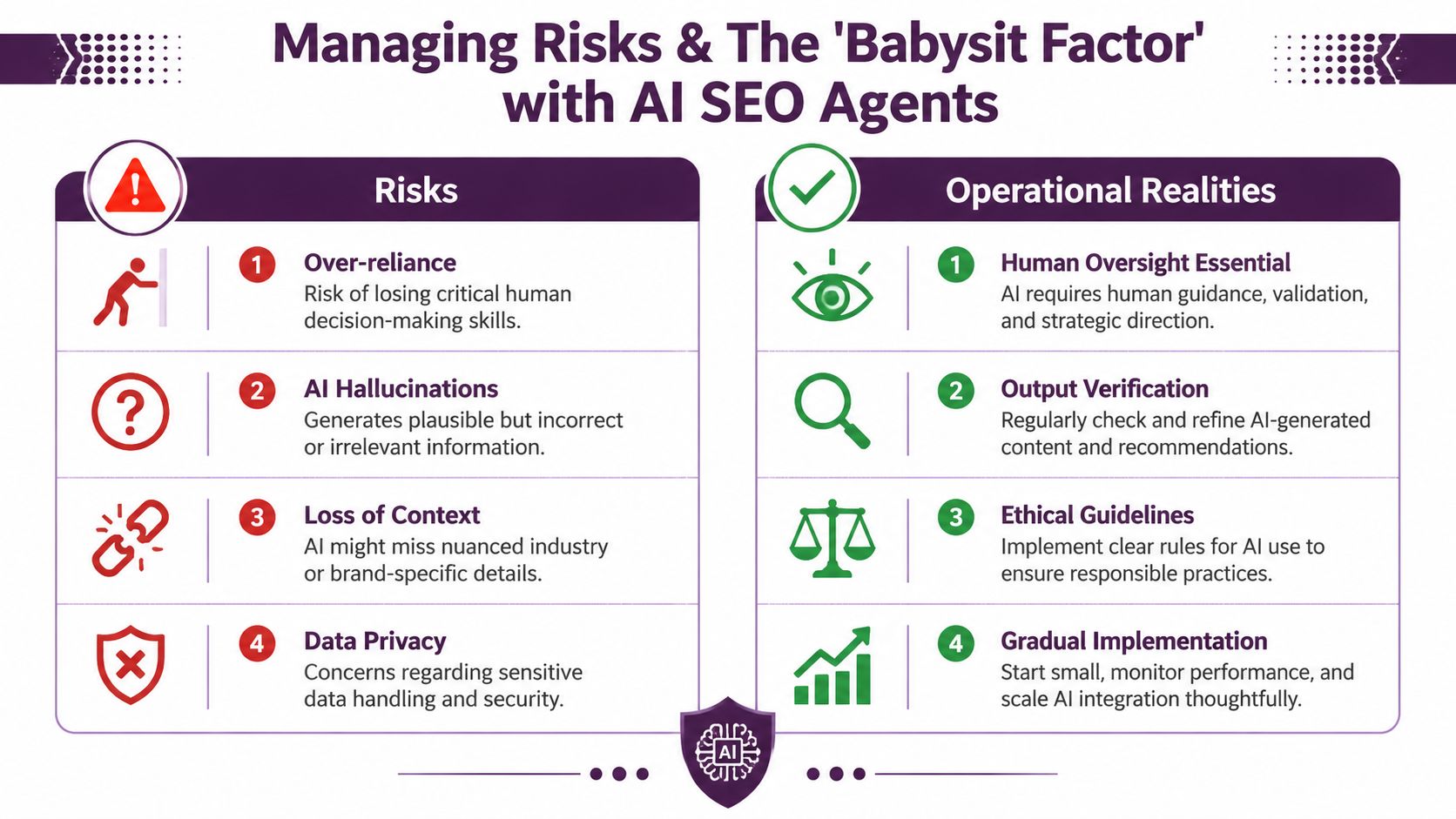
The babysit factor is operational, not theoretical
Users in a verified Reddit thread described the experience clearly. The tools can help, but they require more oversight than vendor pages imply, as seen in this discussion about whether AI SEO agents truly work.
That lines up with what happens in practice. An agent can pull the wrong comparison set, misread intent, or recommend a page change that looks reasonable in isolation and makes no sense for the business. The issue is rarely total failure. The issue is confident partial failure, which is harder to catch if no one is reviewing outputs closely.
Set clear trust boundaries
The safest rollout model is graduated autonomy. Give the agent more room only after it has earned it on specific tasks.
A practical split looks like this:
Low-risk tasks: technical issue detection, keyword clustering, metadata gap analysis, monitoring changes across page groups
Medium-risk tasks: title suggestions, internal link recommendations, schema proposals, content refresh ideas
High-risk tasks: page consolidation, keyword targeting decisions, editorial angle, brand-sensitive copy, anything tied to revenue priorities
That structure matters because AI agents handle pattern recognition better than trade-off calls. Structured tasks have cleaner inputs and clearer right answers. Strategic SEO work usually depends on context the model cannot fully see, such as sales priorities, margin, legal constraints, product timing, or brand voice.
If your team is still building that operating model, a strong guide to data-driven SEO platforms helps clarify where analysis systems should stop and where human decision-making should begin.
Measure approved outcomes
An agent processing more URLs is not progress by itself. Output volume is easy to inflate.
Track what happened after human review:
Were high-value issues found earlier?
Did approved changes improve traffic quality, conversions, or crawl efficiency?
Did the team spend less time collecting evidence and more time deciding what to do?
Did the agent reduce backlog without creating cleanup work later?
This is the difference between automation theater and useful operations.
The bigger risk is aiming at the wrong goal
There is another form of babysitting now. Teams have to supervise the objective, not just the output.
If the agent is trained only on traditional rank tracking workflows, it may keep pushing the program toward blue-link gains while search behavior shifts toward AI summaries and answer engines. BrightEdge explains in its guide to AI agents and citation optimization that AI visibility depends on being cited inside generated answers, not only on classic ranking positions. That changes what the team should monitor and what the agent should optimize for.
In practical terms, the job is no longer just "rank higher." The job is "be easy to extract, trust, and cite."
That means watching for:
citation presence in AI-generated answers
clear entity signals across the site
content structures that machines can parse quickly
evidence, specificity, and sourcing that support citation
This shift is not limited to publishing teams. Commerce teams are seeing the same pressure as AI starts shaping product discovery and on-site decision flows. The teams working on implementing AI on Shopify are dealing with a similar question. How much do you automate, and where do humans still need to review what the system is doing?
The answer for SEO is simple. Use AI SEO agents to speed up analysis and execution, but keep humans responsible for judgment, approvals, and the target itself. That is how you get real lift without letting the tool steer the strategy.
How to Choose the Right AI SEO Platform
A lot of AI SEO platforms look convincing in a demo. They surface a few opportunities, generate a content brief, and promise faster growth. The true test starts after week three, when your team is asking whether the recommendations are trustworthy, whether the system can work with your data, and how much manual checking it still needs.
As noted earlier, this category is growing fast. That usually means more vendors, more overlap, and more products that package light automation as "agentic" SEO. Choose carefully.
I use four checks.
Data depth and reliability
An AI SEO platform is only as good as the systems feeding it. If Search Console data is delayed, GA4 mapping is messy, crawl coverage is shallow, or CMS integrations break on publish, the agent will produce confident bad advice.
Check the boring parts first. How often does data refresh? Can you inspect the source behind a recommendation? Does it reconcile page, query, and conversion data cleanly? A platform that handles these basics well will usually outperform a flashier tool with weak inputs.
If your team needs a baseline for vendor evaluation, this guide to what an SEO platform is and how to choose one is a useful starting point.
Recommendation transparency
You need to see why the system suggested an action.
If a platform says "update this page" or "build content around this cluster," it should also show the supporting evidence: traffic trend, query loss, intent shift, internal link gap, weak entity coverage, or citation opportunity. Without that trail, your team cannot review the output properly, and junior marketers cannot learn from it.
This matters even more now that SEO work is shifting toward AI citations. A good platform should help your team judge whether a page is easy for answer engines to extract, verify, and cite, not just whether it might move up two ranking positions.
Actionability
Insight alone does not save time. Workflow does.
The best platforms turn analysis into work your team can ship: content briefs, technical tickets, page-level recommendations, approval queues, and change tracking. If the agent finds ten issues but your team still has to rebuild every task manually in another system, you bought an analyst, not an operator.
Look for products that fit your current process without forcing a full reset. In practice, that usually means support for review steps, clear ownership, and easy handoff between SEO, content, engineering, and analytics.
Roadmap fit
Choose for the next 12 months, not the next sales call.
Some platforms are built for rank tracking with an AI layer added on top. Others are being built around entity understanding, citation visibility, and cross-channel automation from the start. That difference shows up later, when your strategy shifts from "what helped us rank?" to "what helped us get cited, trusted, and chosen by AI systems?"
The same platform question is showing up in adjacent teams. Brands working on implementing AI on Shopify face a similar trade-off. Automation can speed up execution, but only if the system fits the revenue workflow and leaves room for human review.
Pick the platform that helps your team make repeatable decisions, supports oversight, and improves the work after the demo is over.