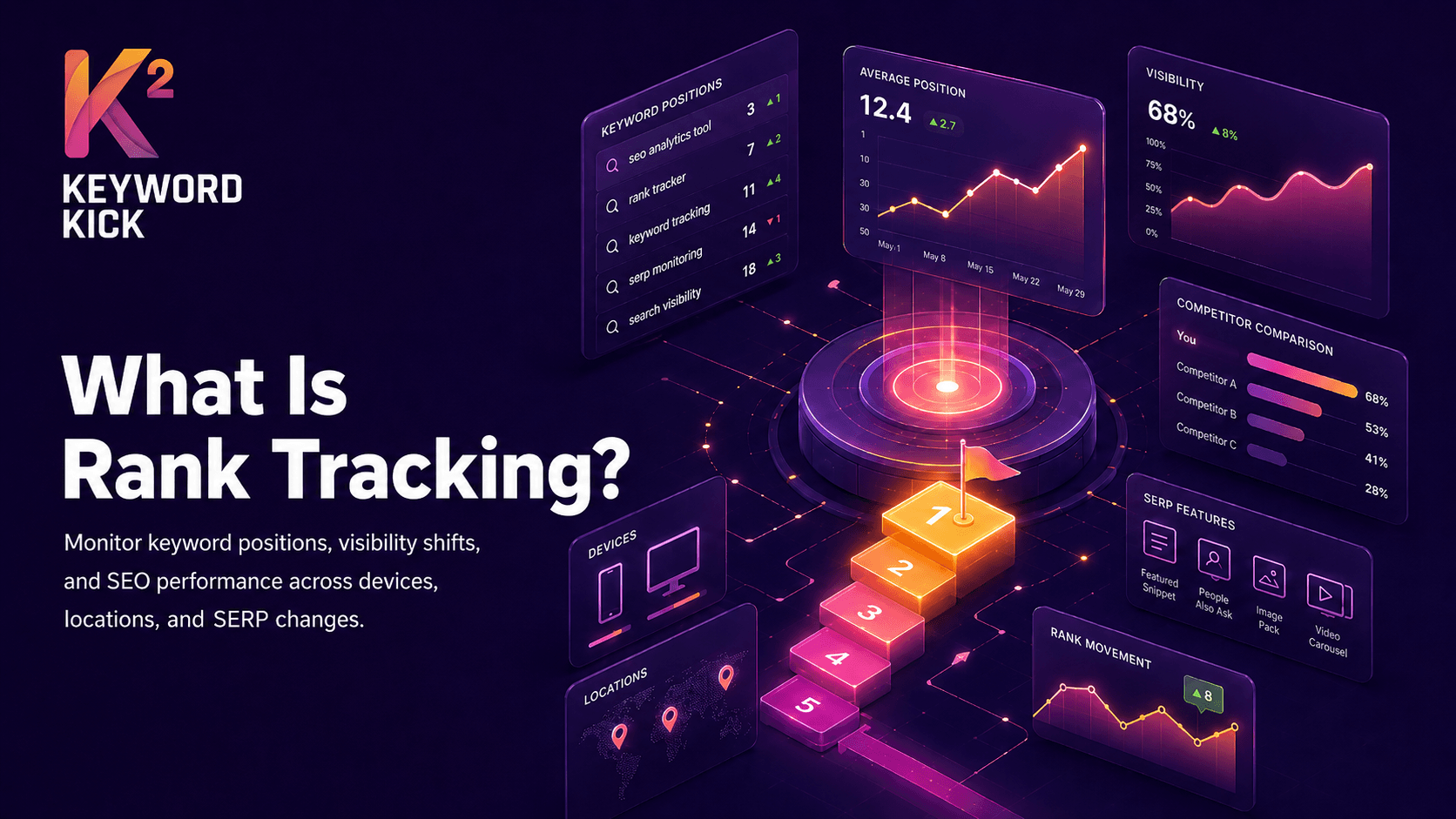

A lot of teams start asking what is an seo platform only after something goes wrong.
Traffic drops on Tuesday. By Wednesday, someone is in Google Search Console checking queries. Another person is in Google Analytics looking at landing pages. Someone else exports rankings from a separate tracker. The developer pulls a crawl report from a desktop audit tool. Then the team spends the rest of the week comparing timestamps, arguing over causes, and still isn't sure whether the problem came from a template change, a SERP shift, or pages falling out of the index.
That's the problem an SEO platform is supposed to solve. Not “give you more dashboards.” Not “bundle a few tools together.” The job is to turn scattered search data into a working decision system so you can see what changed, why it changed, and what to do next.
The SEO Data Overload Problem
When a marketing manager tells me SEO feels messy, the mess usually isn't strategy. It's operations.
The team has data, but it's split across too many places. Google Search Console shows clicks and queries. Google Analytics shows sessions and conversions. A rank tracker shows movement by keyword. A crawler shows broken canonicals, blocked pages, and redirect chains. None of those views are wrong. They're just incomplete on their own.
That becomes expensive fast because organic search still matters to most sites. Multiple 2026 SEO statistic roundups cited by Semrush say 53.3% of all website traffic comes from organic search (Semrush SEO KPI guide). If more than half your tracked visits can be influenced by SEO work, losing a week to diagnosis isn't a small process issue. It's a revenue issue.
Why fragmented tools slow good teams down
A common failure pattern looks like this:
Search Console shows the symptom: clicks declined on a set of pages.
The rank tracker shows partial context: some head terms slipped, but not enough to explain the full drop.
The crawler shows a technical clue: a template update changed canonicals or internal links.
Analytics muddies the discussion: traffic is down, but conversion rate is stable, so people disagree on urgency.
Each person has a valid piece of the story. Nobody has the whole timeline in one place.
Practical rule: If your team has to export three reports before it can answer a basic SEO question, the bottleneck isn't analysis skill. It's system design.
The reason this gets worse over time is simple. SEO now touches content, site structure, technical health, SERP features, and business reporting. A spreadsheet can hold data. It can't create shared context.
That's why the useful way to think about an SEO platform is as a command center for search performance. It collects the moving parts, lines them up, and helps a team decide what deserves attention first.
Teams running into this problem usually find that visibility alone isn't enough. What matters is whether the system helps them act on it. That's the gap explored well in Keyword Kick's piece on why data visibility is no longer enough.
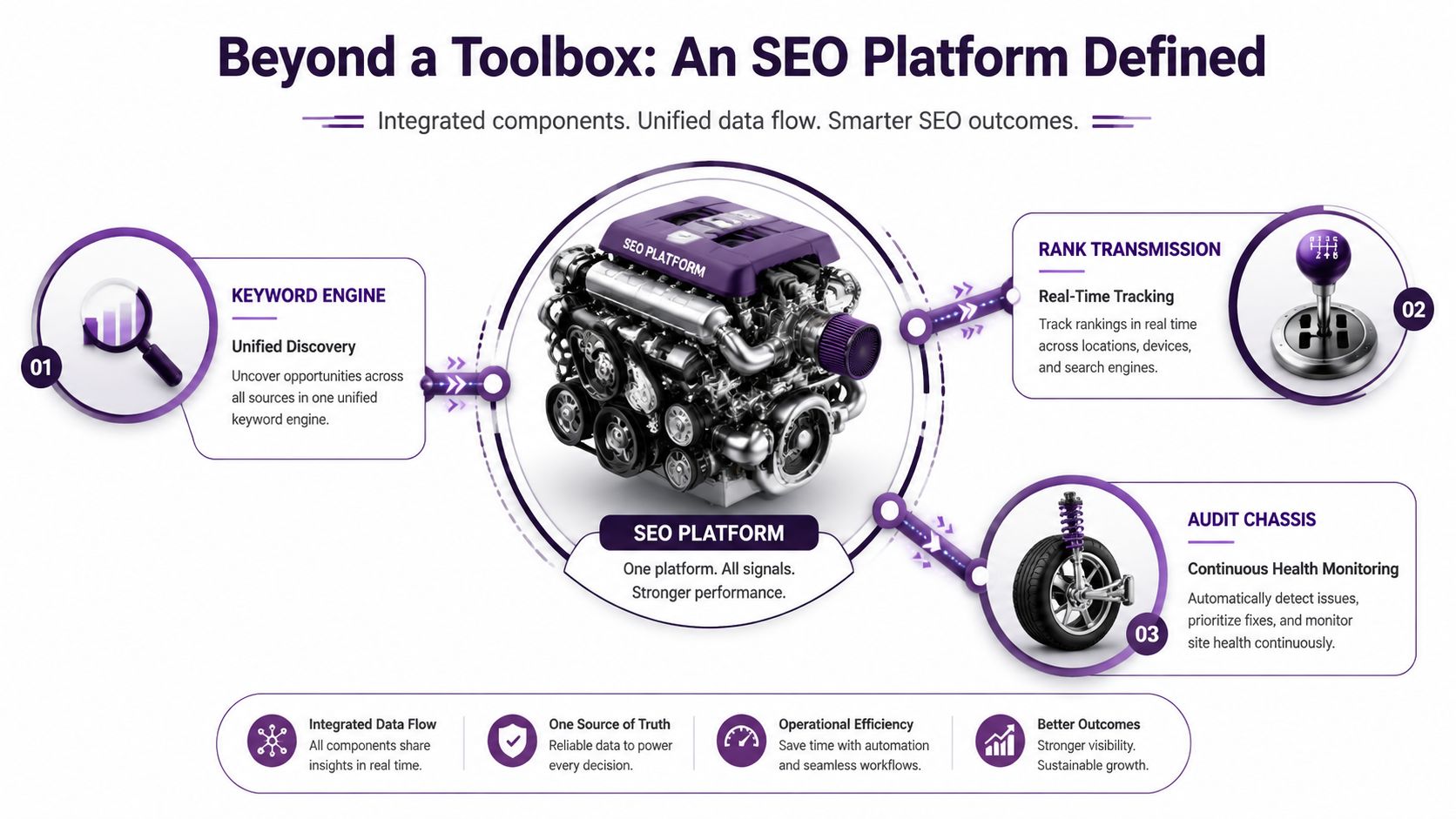
Beyond a Toolbox An SEO Platform Defined
Many buyers still evaluate platforms like they're shopping for a toolbox. Does it have keyword research? Rank tracking? Site audits? Backlink data?
That framing misses the point.
A real platform is closer to a car dashboard than a box of loose gauges. You can buy separate instruments for speed, fuel, engine temperature, and tire pressure. But if they're not wired into one system, the driver still has to interpret everything manually. A dashboard earns its keep because it gives you a usable picture of what's happening right now.
The better definition
An SEO platform is a centralized system of record for organic search. It brings together ranking data, crawl findings, analytics signals, backlink information, and workflow context so the team can make decisions from one integrated view.
That distinction matters because the true cost of scattered tools isn't just inconvenience. It's bad attribution.
If rankings fall at the same time a CMS release changes internal linking, and a competitor also gains a new SERP feature, separate tools make that hard to untangle. The team starts guessing. One person blames content. Another blames Google. A third blames engineering. Everyone has data. Nobody has confidence.
BrightEdge puts the value proposition in the right place: the value of a platform is less about having more features and more about reducing measurement fragmentation and decision latency, and a complete platform should centralize company data so teams can avoid correlating results across scattered tools and systems (BrightEdge SEO platform overview).
What a platform does that point tools do not
Point tools can be excellent. The issue isn't that standalone tools are bad. The issue is that they often leave the team doing the integration work by hand.
A platform changes the operating model:
It unifies timelines: ranking changes, crawl errors, and page edits can be viewed together.
It reduces handoffs: content, SEO, and development teams work from the same evidence.
It improves prioritization: the team can focus on pages and fixes tied to outcomes, not just alerts.
It shortens decision cycles: less exporting, less reconciliation, fewer meetings spent debating the basics.
A platform should answer “what changed?” and “what should we do next?” without forcing the team to stitch together five disconnected views first.
That's why I usually tell buyers to ignore long feature grids at first. The smarter question is whether the product reduces the time between seeing a problem and taking the right action. If it doesn't, it may be a useful tool, but it isn't functioning like a platform.
The Six Pillars of a True SEO Platform
A unified system still needs strong components underneath it. If one pillar is weak, the platform becomes a pretty reporting layer sitting on shaky data.
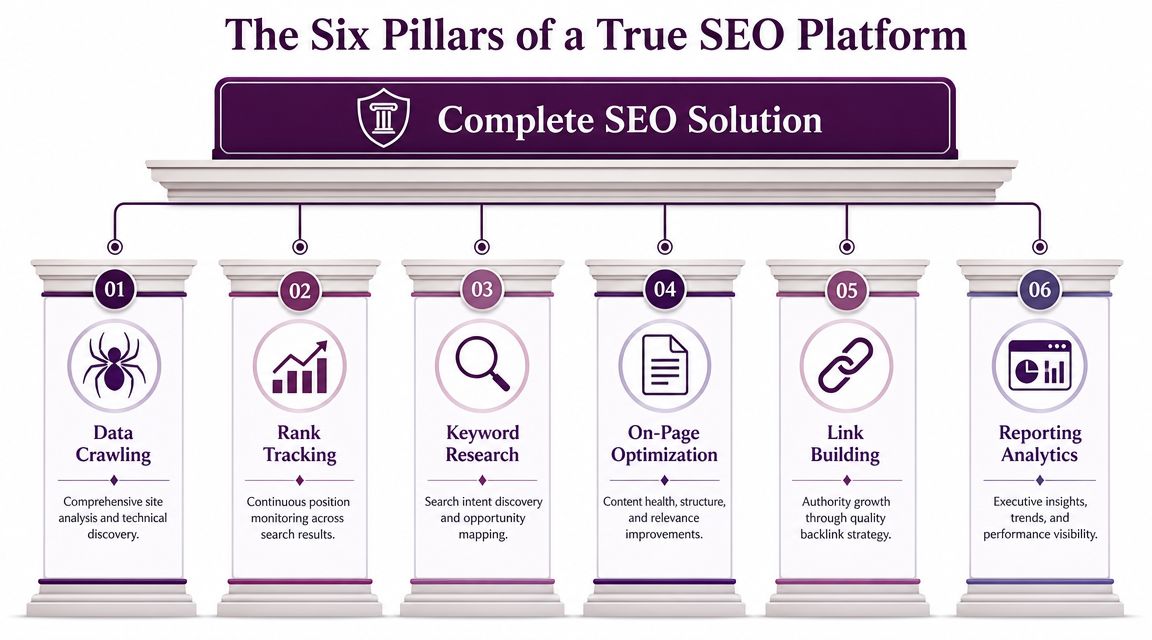
Keyword research and opportunity finding
The platform identifies demand, intent, and content gaps.
Good keyword discovery isn't just about finding phrases with volume. It helps teams understand which topics map to product pages, category pages, guides, comparisons, and support content. In practice, this is how SEO stops being a random publishing exercise and becomes a prioritization system.
The strongest platforms also connect keyword opportunities to the pages already on your site. That matters because the question isn't only “what should we target?” It's also “which existing asset is closest to winning?”
Rank tracking and SERP feature monitoring
Rank tracking is still useful, but old-school position reporting isn't enough anymore.
You need to know whether pages appear in rich results, local packs, image blocks, AI-driven elements, or other visibility surfaces that affect clicks. A page can attract attention without being the classic first blue link, so a platform should show more than raw positions.
A ranking graph with no SERP context often leads teams to the wrong conclusion. The page may not have “lost” in the way the report suggests. The layout may have changed around it.
Technical site audits
Many buyers underestimate the difference between a simple crawler and a mature platform.
Google's SEO guidance frames the work around helping search engines understand content and helping users find it. A technically mature platform should cover the full lifecycle of crawlability, rendering, indexation, structured data, and performance signals such as Core Web Vitals, because problems in those areas reduce indexation quality and can block eligibility for richer search experiences (Google Search Central SEO starter guide).
In practical terms, the platform should surface issues like:
Crawl barriers: blocked sections, poor internal linking, sitemap gaps
Rendering problems: content that bots may not see consistently
Indexation conflicts: canonicals, duplicates, noindex mistakes
Schema gaps: missing structured data where richer visibility is possible
Performance bottlenecks: slow templates, mobile friction, unstable page experience
Backlink analysis and link management
Backlink data supports authority analysis, but its primary use case is decision support.
A strong platform helps teams see which pages attract links, where authority is concentrated, where competitors are earning mentions, and where outreach should focus. It should also help separate valuable referring domains from clutter.
This is one area where some teams still supplement platform workflows with specialized utilities. For example, if your team needs raw exports or custom workflows, a developer tool for parsing backlink metrics can be useful for structured analysis outside the main SEO environment.
Competitor intelligence
Competitor tracking should do more than show who ranks above you.
Useful competitor intelligence reveals which topics they're expanding into, which pages gained visibility, where they've strengthened internal linking, and whether new SERP formats are favoring different content types. This is less about copying and more about context. A platform should help you see whether your drop is really a site issue or a market shift.
Field note: Teams often overreact to ranking volatility when the bigger story is a competitor rolling out better page templates or covering adjacent intent more effectively.
Integrated analytics and reporting
This is the layer that connects SEO to business outcomes.
A platform should tie search performance to landing pages, conversions, and executive reporting without making the team rebuild the same report every month. It should also make it easy to answer operational questions such as which pages gained impressions but not clicks, which templates are dragging down performance, and which optimizations actually moved the needle.
If reporting lives apart from the diagnostic tools, the team ends up with polished decks and weak decisions. That's backwards.
From Data to Decisions Common SEO Workflows
The easiest way to understand an SEO platform is to look at what it changes in day-to-day work.
At enterprise level, a platform functions as a centralized system of record that combines site audits, rank data, and workflow automation. When crawlability, indexation, rankings, and content changes live in separate places, it becomes much harder to tell whether a visibility drop came from a technical issue, a content update, or a SERP change (seoClarity on enterprise platform capabilities).

Weekly performance review
Without a platform, the weekly SEO meeting turns into a forensic exercise.
Someone shares a ranking loss. Someone else says overall traffic looks flat. Then Search Console reveals a dip in clicks on a few high-value pages. The call ends with three follow-ups and no answer.
With a unified platform, the team can pull one timeline and ask three direct questions:
Did rankings change?
Did anything technical break?
Did the page or template change before the drop?
That workflow matters because it turns diagnosis from debate into triage. You don't need every possible answer. You need the most likely cause quickly enough to act.
Content refresh workflow
This is one of the most practical uses of a platform for lean teams.
Start with pages that already have demand. In Google Search Console, users can go to Performance, then Search results, select Total clicks, and review the queries and pages driving traffic, as described in the Semrush KPI guide cited earlier. In a platform, that data becomes more useful when paired with rankings, page health, and page-level context.
The goal is to find pages that are close to better performance but held back by weak metadata, outdated intent match, thin coverage, or poor internal linking.
A simple refresh workflow often looks like this:
Find pages with strong impressions: these pages already have visibility potential.
Check low click-through patterns: weak titles or mismatched intent often show up here.
Review ranking clusters: if the page sits near the top results, refreshes can matter more.
Check technical health first: a content rewrite won't fix indexation or rendering problems.
Assign action by role: writer updates content, SEO adjusts targeting, developer fixes blockers.
For teams that want one workspace for those jobs, products such as Semrush, Ahrefs, seoClarity, BrightEdge, Conductor, and Keyword Kick all fit into the platform conversation in different ways. Keyword Kick, for example, connects GA4, GSC, rank tracking, backlinks, and technical SEO signals into one workspace so teams can ask practical questions like why traffic dropped or which pages to optimize first.
Technical triage across multiple sites
Agencies and multi-brand teams feel the platform advantage fastest because the operational drag multiplies with every site.
A platform lets the team standardize recurring workflows:
Automated crawls surface new issues without waiting for manual checks.
Prioritized fix lists keep engineers focused on problems that affect discoverability.
Shared annotations help explain whether a drop aligns with a release or migration.
Portfolio views let managers compare health and movement across clients or business units.
Later in the workflow, a walkthrough like this can help align non-SEO stakeholders on what the dashboards mean:
The key point is simple. A platform doesn't replace judgment. It removes the busywork that prevents good judgment from happening on time.
Evaluating and Choosing the Right SEO Platform
The market is crowded, and most demos look good for the first half hour. The hard part is choosing a platform your team will still trust after the honeymoon period.
Historically, SEO platforms evolved to consolidate data from sources such as Google Search Console, Google Analytics, rank trackers, backlink indexes, and technical crawlers into one workspace, reflecting SEO's expansion from simple on-page optimization into a multi-signal discipline (Semji on key SEO figures and platform evolution). That history gives you the right evaluation lens. You're not buying a feature bundle. You're choosing the reliability of your SEO operating system.
What to score first
Start with the questions that expose operational fit, not marketing polish.
Data freshness: How often do rankings, crawl reports, and integrations update?
Data trust: Can your team see where the data came from and validate it?
Integration depth: Does it connect cleanly to GA4, GSC, your CMS, and reporting workflows?
Usability: Can content, SEO, and leadership each get what they need without heavy training?
Scalability: Will it still work when you add markets, sites, teams, or clients?
Workflow support: Does it help assign, track, and prioritize actions, not just report on them?
The right platform should reduce the number of tabs your team needs to answer an ordinary SEO question.
If your team is still early in tool selection, it can help to review adjacent comparisons like this guide to compare blogging SEO tools. Even if your use case is broader than blogging, the comparison mindset is useful because it forces you to distinguish “helpful feature” from “must-have workflow.”
SEO Platform Evaluation Checklist
Evaluation Criterion | Why It Matters | Your Rating (1-5) |
|---|---|---|
Data accuracy and freshness | Stale or unreliable data leads to bad prioritization | |
Integration with GSC and GA4 | SEO decisions need search and business context together | |
Technical audit depth | Surface-level audits miss rendering, indexation, and template issues | |
Rank tracking and SERP context | Positions alone don't explain modern search visibility | |
Backlink and competitor visibility | Authority and market context affect prioritization | |
Reporting and workflow tools | Teams need action paths, not just exports | |
Ease of use across roles | A tool nobody uses becomes shelfware fast | |
Scalability across sites or clients | Migration pain shows up when programs grow | |
Support and onboarding | Good support shortens time to value |
What usually fails in procurement
The most common buying mistake is overvaluing breadth and undervaluing coherence.
A vendor may show dozens of modules, but if the team still has to reconcile reports manually, the platform isn't fixing the underlying problem. Another mistake is choosing for the SEO lead alone. The platform also has to work for the content manager, analyst, executive stakeholder, and sometimes engineering partner.
That's why teams evaluating enterprise-style tools often benefit from side-by-side thinking like this platform comparison for growing teams. Not because one comparison decides the answer, but because it sharpens the core question: which product will help your team move from observation to action with the least friction?
The Future Your SEO Platform and AI Search
The job of an SEO platform is getting broader.
Search visibility is no longer limited to traditional rankings in a standard results page. Brands now need to understand whether they appear in AI-mediated experiences, answer engines, and generated summaries. Conductor describes this shift by noting that modern platforms have evolved into "organic marketing and AI visibility suites" with capabilities like Share of Answer in AI Overviews and AI-ready optimization (Conductor SEO platform academy page).
That changes what buyers should expect from a platform. It still needs rankings, audits, and reporting, but it also needs to help teams track visibility where users increasingly get synthesized answers instead of clicking through a list of links.
For marketers trying to get ahead of that shift, resources like Reviews To The Top's LLM SEO insights can help frame what new measurement categories are emerging.
The practical takeaway is that platform selection is now partly a bet on adaptability. If you want a good lens on where the category is heading, Keyword Kick's view on moving from dashboard SEO to AI-guided SEO is a useful read.
Common Questions About SEO Platforms
Can I just use free Google tools instead of a paid platform
You can, especially if your site is small and your workflow is simple.
Google Search Console and Google Analytics are foundational. They give you direct visibility into performance and behavior. The limitation is that they don't function as a unified SEO operating layer by themselves. You still need to connect rankings, technical diagnostics, backlinks, competitor context, and team workflows somewhere else.
If you're running a small site, free tools may be enough for a while. If multiple people touch SEO, or if you're managing a larger content library, international site, ecommerce catalog, or client portfolio, a platform usually becomes worth it because it cuts manual analysis time.
How do SEO platforms usually charge
Pricing models vary a lot.
Most vendors charge based on some mix of projects, keywords tracked, pages crawled, users, sites, or feature access. Enterprise tools may price around contracts and support levels rather than a simple self-serve plan. The practical question isn't the sticker price alone. It's whether the platform replaces enough manual work and enough overlapping tools to justify the spend.
How long does it take to see ROI from an SEO platform
The platform itself doesn't create ROI. The workflows it enables do.
Teams usually see value in stages. First comes faster diagnosis and cleaner reporting. Then better prioritization. Then stronger execution because content, technical, and reporting work line up. SEO outcomes still depend on competition, site quality, implementation speed, and how well the team acts on the data.
A realistic expectation is this: a platform can improve clarity quickly, but meaningful organic gains still depend on doing the work.
If you're trying to replace scattered SEO tools with a single working system, Keyword Kick is built for that job. It connects GA4, Search Console, rank tracking, backlinks, and technical SEO signals into one workspace so teams can diagnose drops, prioritize pages, and act from shared data instead of stitched-together reports.