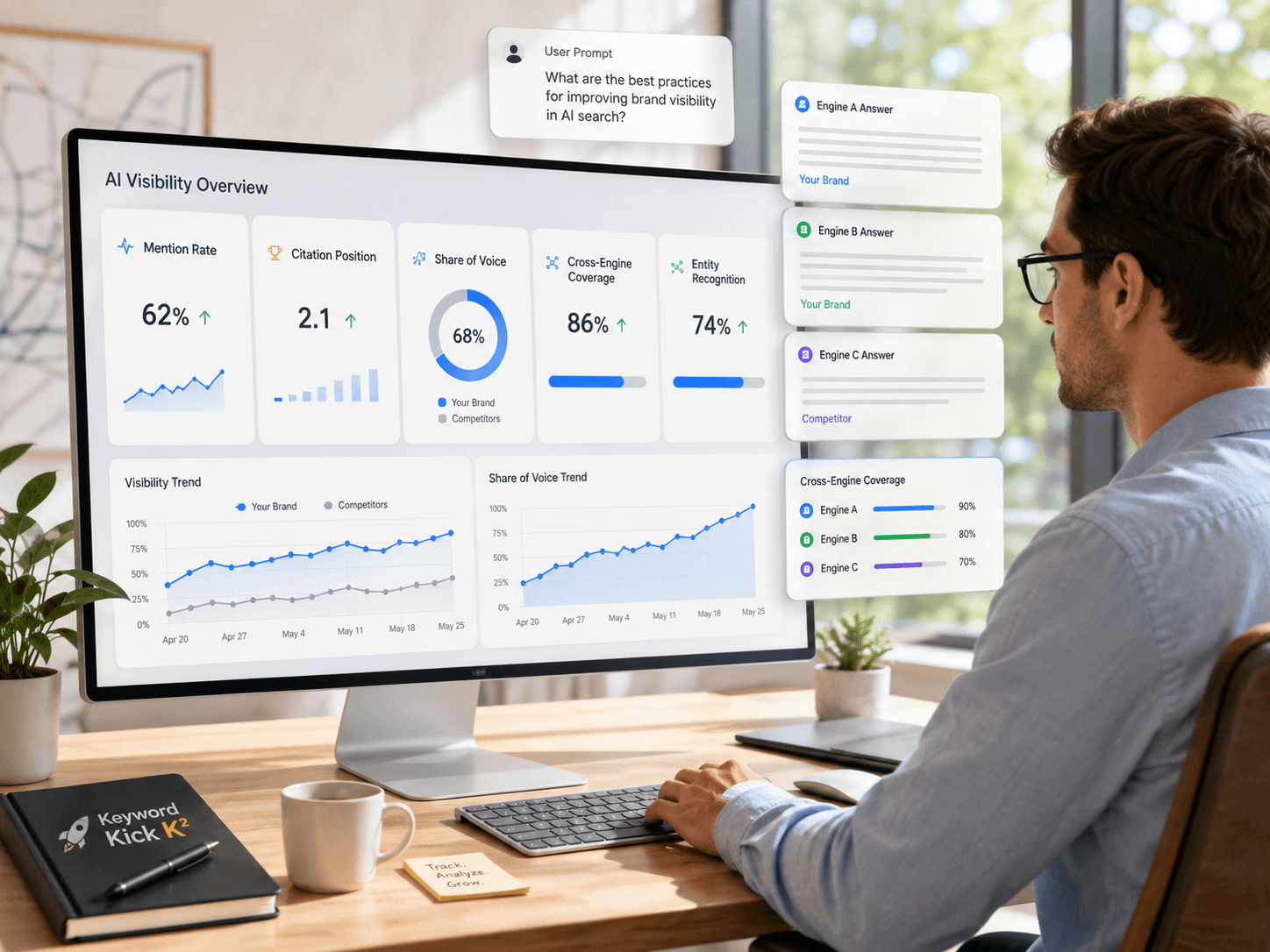
AI visibility tracking measures five signals, mention rate, citation position, share of voice, cross-engine coverage, and entity recognition, because AI-generated answers now shape visibility in ways blue-link rankings don't capture. Google AI Overviews reach 2 billion+ monthly users across 200+ countries and territories and 40 languages, so if your brand is appearing in AI answers but not in your reports, you're already missing part of the picture.
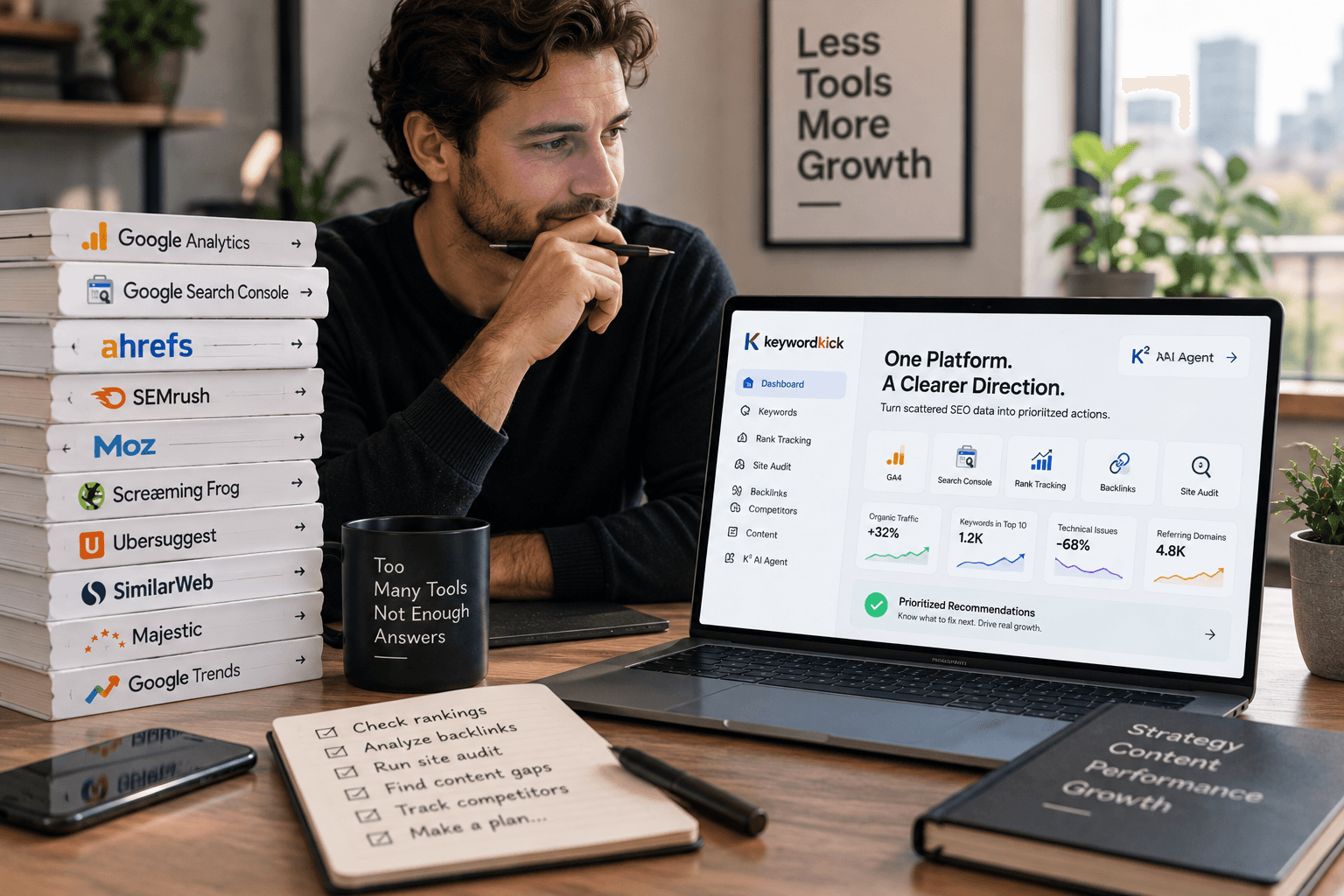
A lot of SEO teams are living this exact disconnect right now. Rankings look stable, the content team keeps publishing, and yet traffic feels flat while competitors keep turning up inside AI answers you can't easily audit or explain.
Why AI Visibility Tracking Matters Now
A brand manager opens a monthly report and sees solid ranking positions. Buyers are already asking those questions inside AI interfaces before they scan traditional results, and the brand's name is either absent or buried in a generated answer. That gap is why ai visibility tracking became a separate discipline instead of a minor reporting tweak.
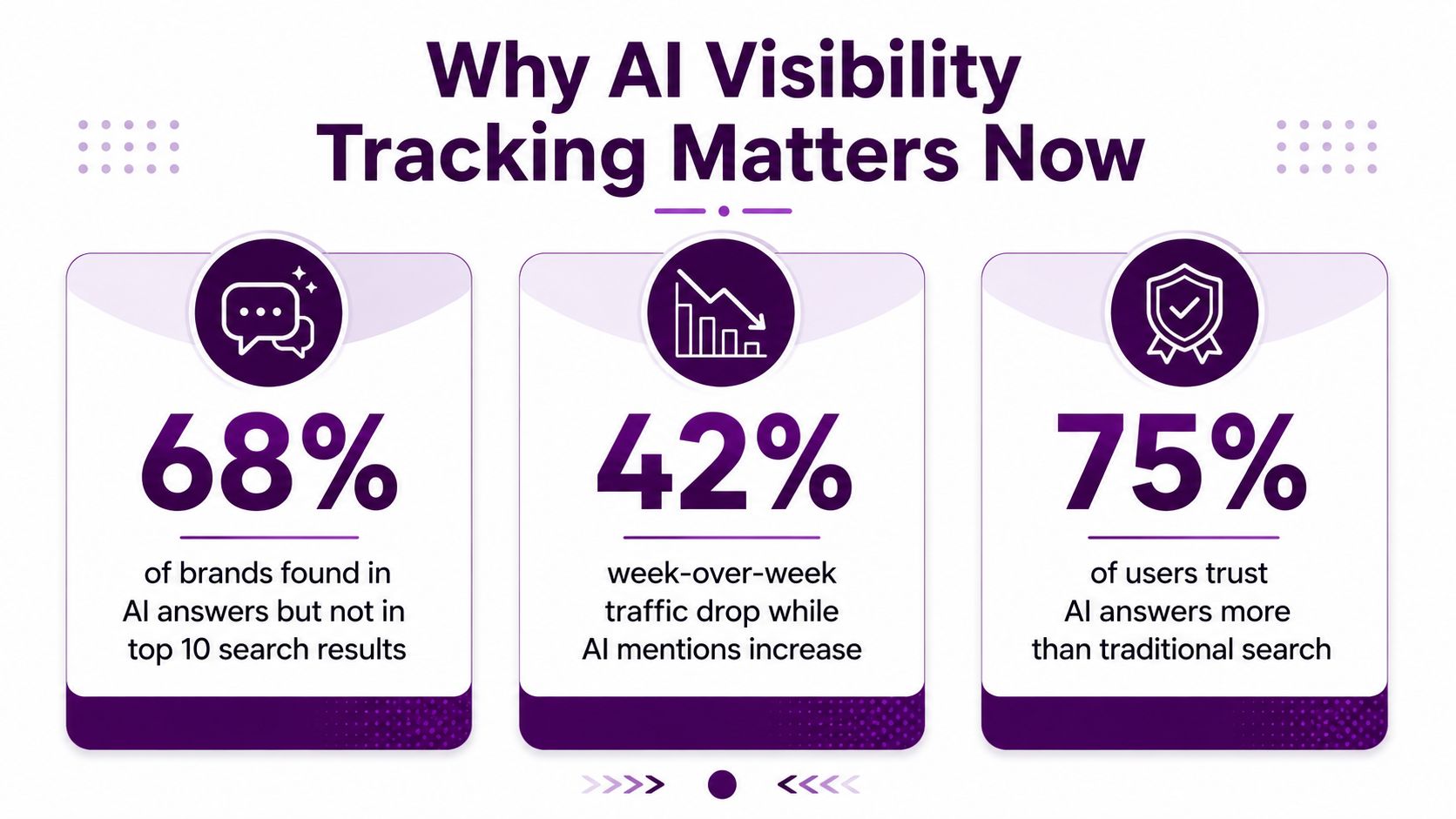
Google's AI Overviews now operate at real search scale, and the share of keywords triggering them has moved quickly. Semrush reported AI Overviews on 6.49% of keywords in January 2025, nearly 25% in July 2025, and 15.69% in November 2025, across more than 10 million keywords in its analysis, which shows the surface is volatile enough that one-off audits do not hold up over time (Relevance's summary of AI visibility statistics). If the answer layer changes that much in a few months, teams need a baseline, a cadence, and a way to compare periods instead of chasing screenshots.
Practical rule: if your report only covers rankings and clicks, it is already incomplete.
The search gap is easy to see in practice. A page can rank well, but an answer engine can still choose a competitor, paraphrase a third party, or skip the brand entirely. Outrank's discussion of AI ranking impacts from word changes is a useful reminder that small content edits can shift how an answer engine interprets a page, which makes monitoring more than a vanity exercise.
The next question is operational: what should teams measure, how do they collect it, and which changes connect to revenue instead of just more screenshots. A useful starting point is treating AI visibility as an ongoing system paired with the broader visibility framework in this overview of why data visibility is no longer enough.
What AI Visibility Tracking Actually Measures
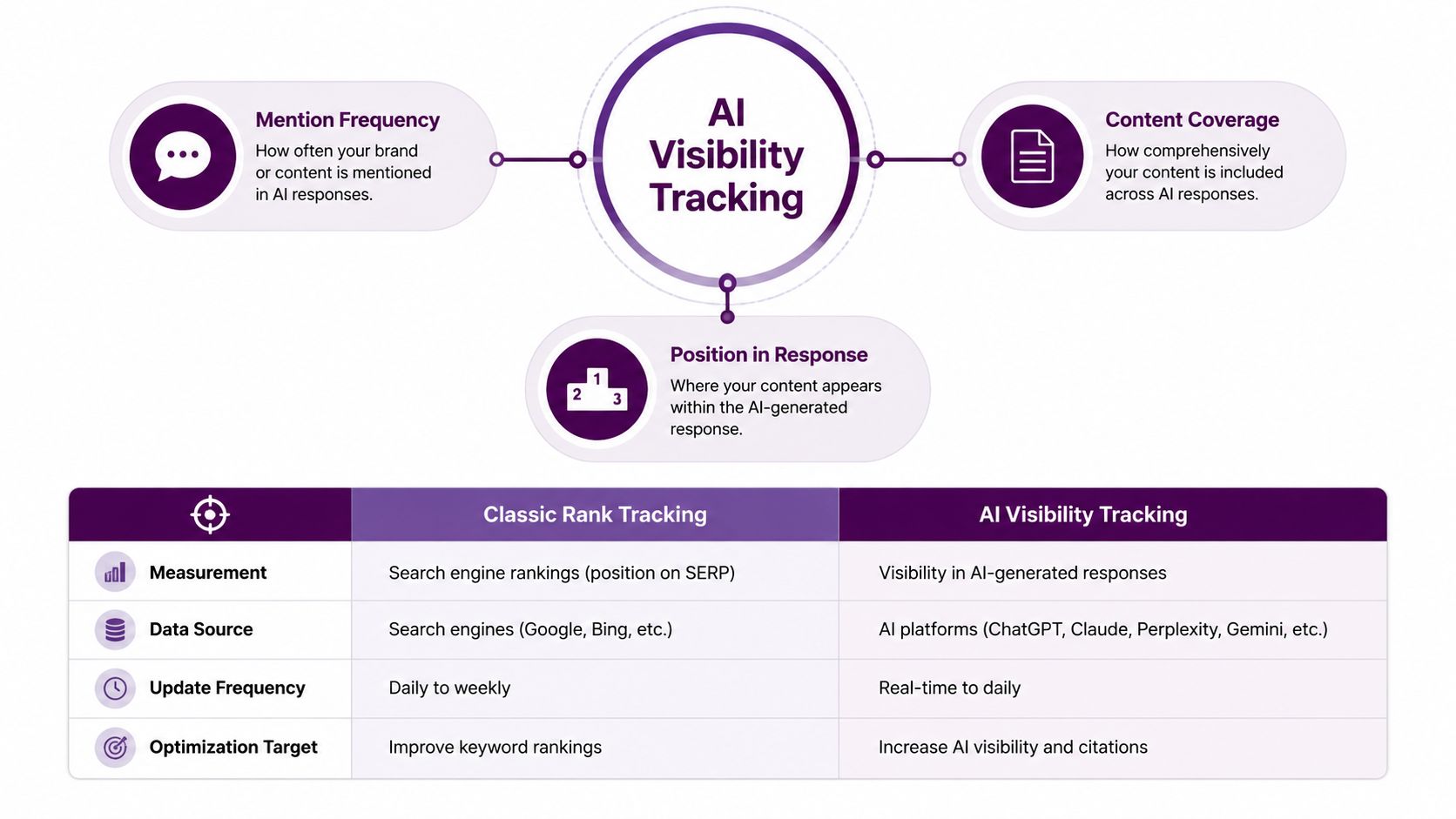
AI visibility tracking measures how often, how prominently, and in what context a brand appears inside generated answers. It does not measure where a page ranks in a list of blue links. That distinction matters because a brand can own traditional search and still lose the answer layer.
The five signals behind the score
The discipline starts with mention frequency, which counts how often a brand shows up in answers for a prompt set. It then adds citation position, because first mention and last mention don't have the same business value. A brand that appears early in a synthesized answer usually has a better shot at influence than one tucked into a footnote-like reference.
Share of voice gives the competitive view. It shows whether your brand is winning more of the relevant answer surface than peers on the same prompts. Cross-engine coverage checks whether the brand appears across multiple systems or only on one platform, and entity recognition asks a more basic question: whether the model understands the brand as a distinct entity.
A useful mental model is simple, one KPI answers one business question. If the brand appears often but in weak positions, the issue is prominence. If it appears in one engine and not another, the issue is coverage. If it's cited as a generic description rather than a recognizable brand, the issue is entity clarity.
Practical rule: mention volume without citation context creates false confidence.
The point is to stop treating AI visibility as a single number. When teams separate the signals, they can see whether they need better topic coverage, stronger entity signals, or cleaner third-party validation. That's the difference between “we show up sometimes” and “we know why we show up, where, and in what form.”
The Core KPIs That Define AI Visibility
A strong AI visibility program turns five signals into KPIs that analysts can report without guessing. The common failure mode is collapsing everything into one score too early. A composite score can help with executive reporting, yet it obscures the diagnosis unless the underlying metrics stay visible too.
A practical KPI set
KPI | What it measures | Business question it answers |
|---|---|---|
Mention rate | How often the brand appears in prompt responses | Are we showing up at all? |
Recommendation rate | How often the model actively suggests the brand | Are we being positioned as a choice? |
Prompt coverage | The share of tracked prompts where the brand appears | Which buyer questions do we own? |
Share of voice | Our presence versus competitors on the same prompts | Are we gaining or losing competitive ground? |
Model-specific visibility | Visibility by engine or model | Where are we strong, and where are we missing? |
Visibility volatility | How much visibility shifts over repeated runs | Is the answer stable enough to trust? |
The reporting logic gets sharper when each metric answers a specific question. Mention rate shows whether the brand is present. Recommendation rate shows whether the model is endorsing it. Prompt coverage shows whether the content library matches real buyer intent. Volatility matters because repeated prompt runs can produce different outputs, so a one-off result can push the team toward noise instead of signal.
Many teams also build a composite score from platform coverage, mention frequency, citations, sentiment, consistency, and share of voice. That score is useful for trend lines, provided the team knows what sits inside it. A score that rises because the brand appears more often is different from a score that rises because citations got stronger.
If you need a parallel from another channel, email deliverability work follows the same logic. The final inbox result depends on the underlying mechanics, not just the last checkpoint. CleanMyList's SPF and DKIM setup guide shows the kind of groundwork teams need before the score starts to mean much.
For day-to-day use, match the KPI to the stakeholder. Brand leaders usually care about coverage and share of voice. Content teams care about prompt gaps. Analysts care about volatility and source consistency. For a quick audit workflow, many teams pair these metrics with an internal AI visibility checker to identify which prompts need deeper review.
Data Sources, Models, and Prompt Sets
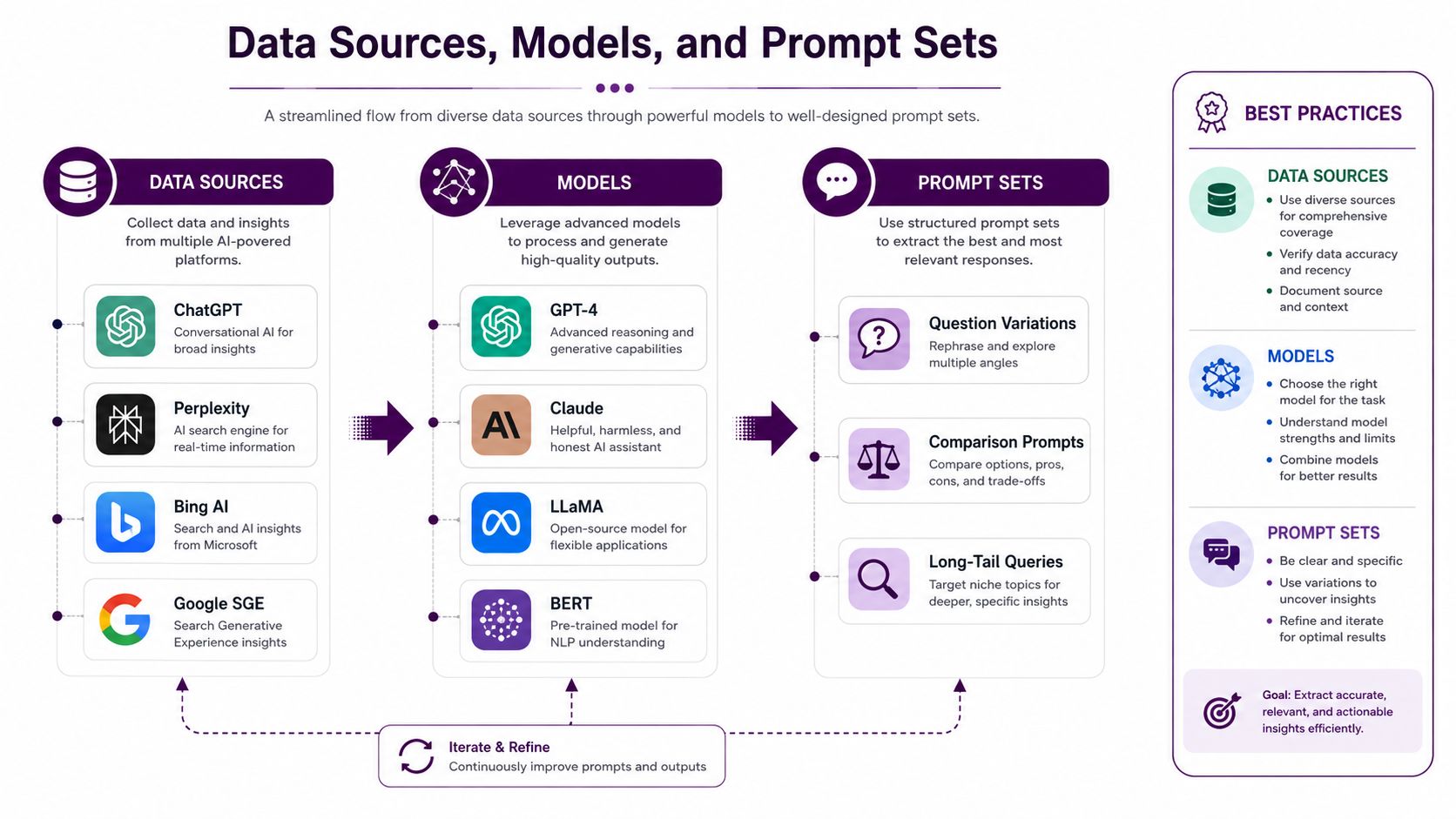
A tracking system is only as credible as the prompts it runs and the engines it monitors. The best setup doesn't try to “cover the internet.” It mirrors the actual questions buyers ask, then tests those questions across the major answer surfaces where the brand can win or lose visibility.
What to monitor
The first layer is engine coverage. Teams usually start with ChatGPT, Perplexity, Google AI Overviews, Gemini, Claude, Copilot, and other answer surfaces that matter for their audience. The point isn't to monitor every available model. It's to cover the systems where the brand's buyers already ask questions.
The second layer is prompt design. A useful library includes branded prompts, category prompts, comparison prompts, problem-aware prompts, and local prompts. Branded prompts test whether the model knows your company. Category prompts test whether it knows your space. Comparison prompts show whether competitors are getting more favorable treatment. Problem-aware and local prompts reveal whether the model can connect your brand to real buying language and market-specific intent.
Prompt hygiene matters more than volume
Prompt hygiene is the quality control layer that keeps the whole system from drifting. Use consistent wording, clear variants, and a fixed testing schedule so the results mean something over time. If one prompt says “best software for X” and another says “top X tools for enterprise teams,” the differences can come from wording instead of visibility.
Cross-engine coverage changes the interpretation of the data. A brand cited by one engine and ignored by three others has a visibility problem, but it's a different problem from a brand that appears everywhere with weak context. Entity recognition closes the loop by checking whether the system understands the brand as a distinct product, company, or service line, not just a generic phrase.
The practical takeaway is simple. Use prompts that match buying intent, track them on a repeated schedule, and compare the same set across the same engines. Anything less turns the report into a sample of noise.
Implementation Workflow and Worked Example
A rollout that holds up in practice usually follows five steps. Define the prompts tied to revenue and pipeline. Capture a baseline from the current AI answers. Map where the brand appears, where competitors appear, and where the brand is missing. Ship content and entity fixes. Run the same prompts again and compare the change against the baseline.
A workflow teams can actually repeat
Start with a narrow prompt library. A SaaS team I worked with began with three category prompts, several comparison prompts, and a few problem-aware prompts tied to buying intent. The baseline made the gap obvious. The brand was present in a few broad queries, but it was effectively absent in the prompts that matched how buyers described the problem.
The fixes were specific. The team improved entity markup, rewrote comparison pages so the product was easier to distinguish, added FAQ sections around recurring objections, and strengthened third-party citations on pages that answer engines were already pulling from. They also cleaned up content that blurred product lines, which helped the model separate the brand from category-level language.
AI visibility improves faster when the site gives models fewer reasons to guess.
That work should be treated as an answer-quality project, not a ranking project. AI systems need clear entity signals, structured explanations, and a source footprint that makes the answer easy to assemble. If the prompt set is messy or the page is vague, the model usually fills the gap with a competitor or a generic category answer.
A unified platform makes the loop usable because the work stays in one place instead of living in screenshots and ad hoc notes. The system holds the prompt set, the baseline, the re-test, and the change log together so the analyst can see whether a content update, a schema fix, or a citation addition moved the result. Keyword Kick's K² AI Agent is one example of a platform approach that sits alongside GA4, Search Console, rank tracking, backlinks, and technical SEO signals in the same workspace. That is the same operational model described in AI-powered SEO platform guide for agencies and teams, where the point is to keep the evidence in one workflow instead of scattered across tools.
Operational consistency provides the core benefit. Once prompts, baselines, and fixes are linked, teams move beyond asking if AI visibility is "up" in general terms. They can then pinpoint which specific change caused the shift. This creates a shared review cycle for SEO, content, and analytics teams. It also clarifies trade-offs, such as when a mention rate gain hasn't yet led to conversions, or when a better citation position outweighs a broader share of voice.
Connecting AI Visibility to Revenue Outcomes
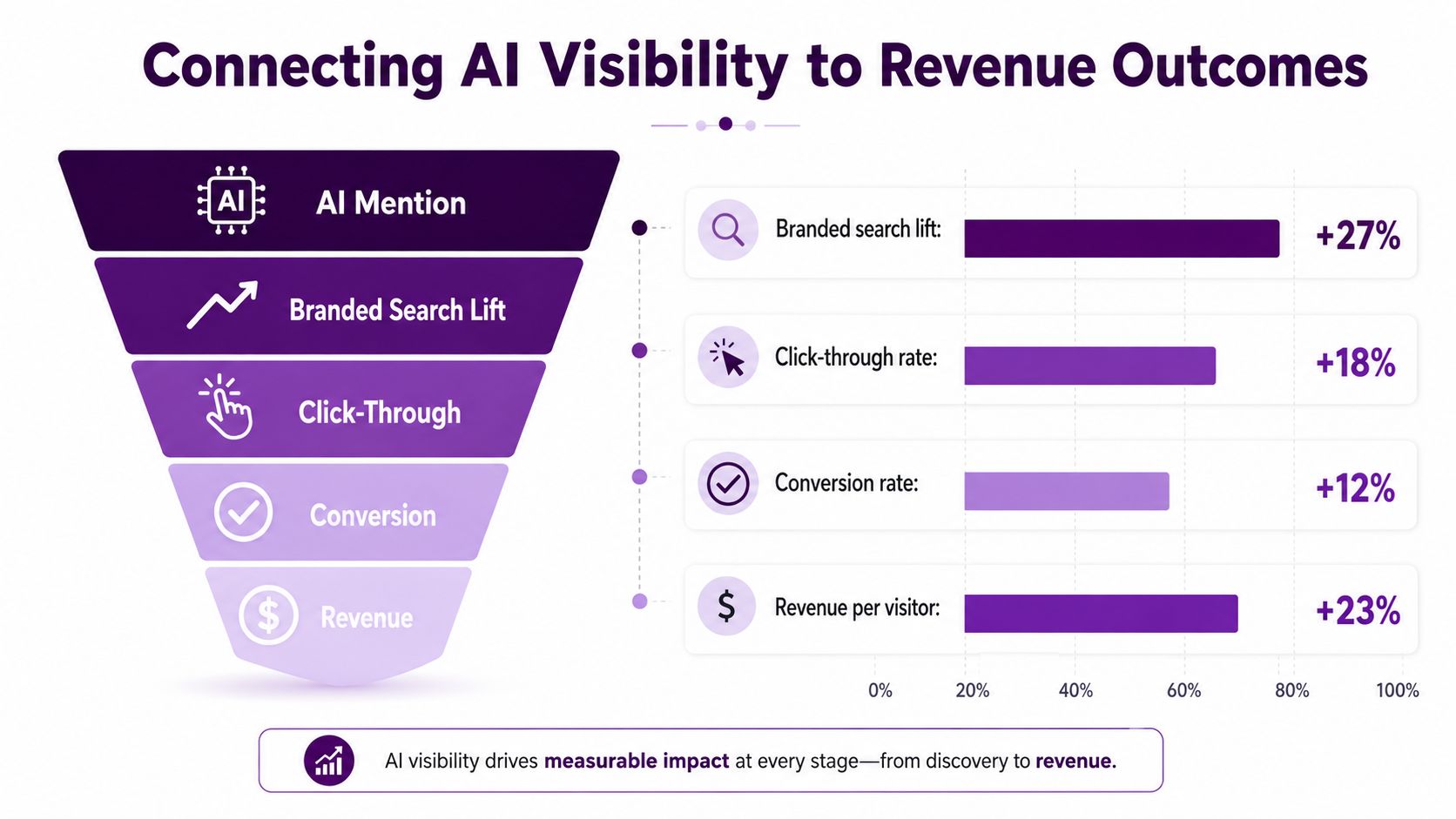
The hardest part of this work is not measurement. It's proving that the measurement matters to the business. A brand can win more mentions and still fail to move qualified traffic, so the reporting needs a bridge from AI answers to downstream behavior.
How to build the bridge
Start with branded search lift. If AI mentions increase and branded search demand follows, that's a signal worth tracking in analytics and search console data. Then check whether direct traffic and high-intent page visits rise around the same period, because those sessions often reveal whether the answer surface is warming the audience before the click.
From there, pair the visibility change with assisted conversions in GA4 and CRM data. The question isn't only whether a user clicked from an AI surface. It's whether the exposure shortened the path to conversion, increased lead quality, or reduced the number of touchpoints needed before the form fill or demo request.
The timing question matters. Some teams will see early branded demand before conversion lift. Others will see assisted conversions first. Don't force one universal lag onto every channel mix or buying cycle. Track the sequence, compare it over multiple reporting periods, and look for repeatable patterns instead of one-off spikes.
A practical readout can be as simple as this:
AI mention changes beside branded search movement.
High-intent page visits beside direct traffic shifts.
Assisted conversions beside lead volume in CRM.
Conversion path length beside the quality of inquiries.
That structure keeps the team honest. AI visibility can be a real demand signal, but it isn't revenue until the rest of the funnel confirms it.
Common Mistakes and How to Avoid Them
The fastest way to misread AI visibility is to treat it like a single vanity metric. The better approach is to inspect the failure mode first, then fix the measurement design.
Five mistakes that distort the report
Chasing mention volume only: Mentions without citation context can inflate the score. Weight the result by position and source quality so a weak reference doesn't look like a strong one.
Tracking one engine only: A single surface can make a brand look stronger than it is. Run the same prompt set across multiple systems so the reporting reflects real cross-engine coverage.
Treating ghost citations as failures: Some sources are named implicitly rather than explicitly, and that still shapes visibility. One industry source reports that 73% of AI brand mentions are ghost citations, which means raw name-match logic misses a lot of impact (Visible's AI visibility metrics overview).
Running prompts once: AI answers can shift, so one test isn't a reliable baseline. Repeat the same prompts on a schedule and compare the trend, not the screenshot.
Ignoring local variation: Multi-location brands need market-level tracking, because a city-level answer can differ from a national one. Segment prompts by geography and keep location data clean for each market.
What good operators do instead
Good teams separate the signal from the noise. They compare prompts over time, isolate the engines that matter, and use prompt design that mirrors buyer intent rather than internal keyword lists. They also know when a “missing” mention is an unbranded reference, which can still influence the buyer.
The biggest discipline shift is accepting that AI visibility isn't just a brand exercise. It's a measurement system that needs segmentation, repeated runs, and a realistic read on what can and can't be inferred from the data.
Making It Stick with a Unified SEO Platform
AI visibility tracking works when it sits inside the same operating loop as rankings, traffic, backlinks, and technical health. That's why a unified platform matters, it keeps the prompt data and the search data in one place so the team can ask plain-English questions and get prioritized next steps instead of a folder full of screenshots.
Keyword Kick's K² AI Agent is built around that kind of workflow, which is the same operating model described in this guide to an AI-powered SEO platform for agencies and teams. The useful pattern is simple, measure prompts, compare signals, ship changes, then re-measure against the same baseline.
If you want to stop stitching AI answers together by hand, visit Keyword Kick and see how K² turns search data, prompt tracking, and technical signals into one workflow. It's a practical way to connect AI visibility tracking to the same decisions you already make about rankings, traffic, and conversions.