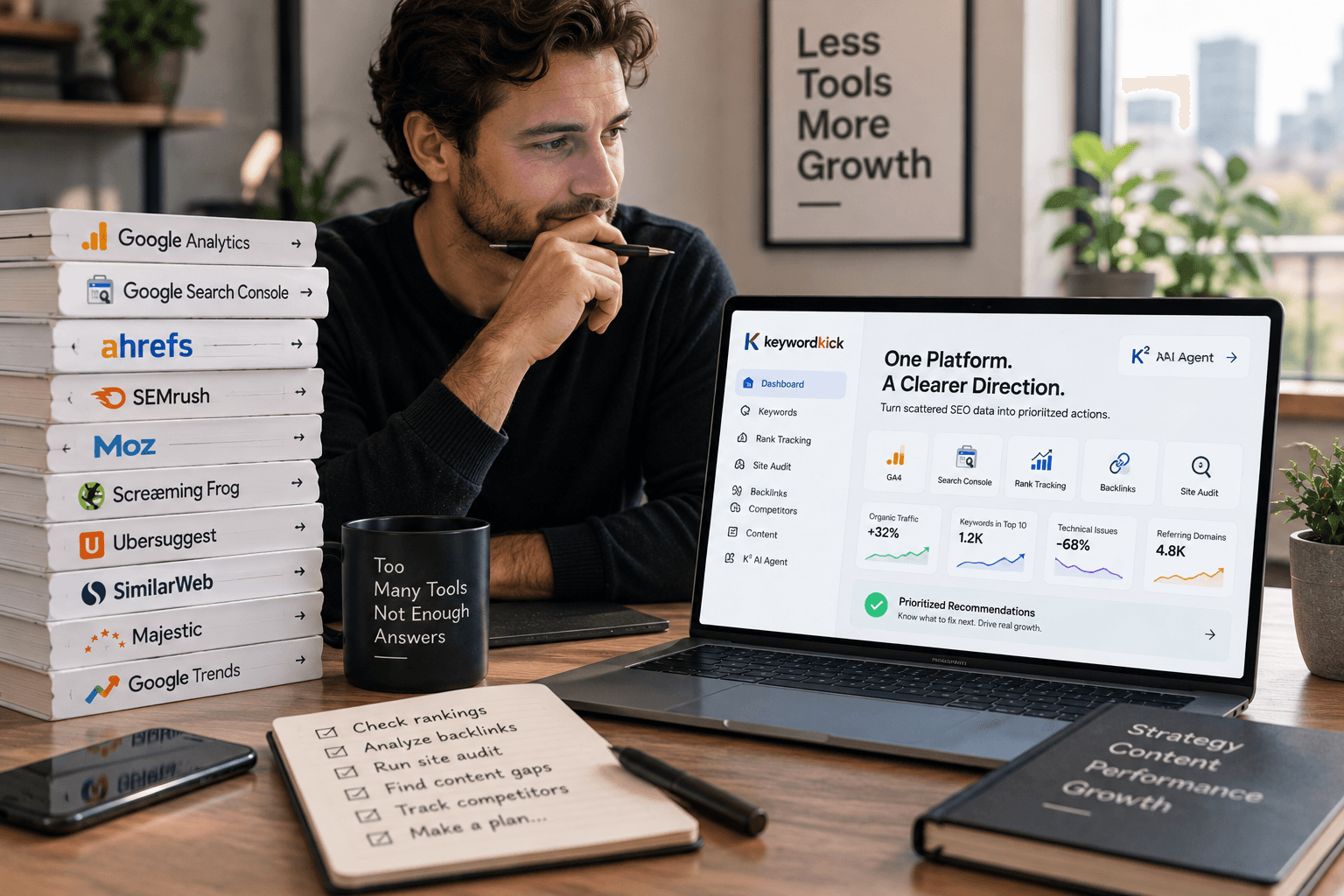

Monday morning starts with a familiar ritual. GA4 is open in one tab, Google Search Console in another, a rank tracker is refreshing somewhere else, and backlink data is trapped in a fourth dashboard. Your content team has its own spreadsheet, your technical team has a crawl export, and leadership wants one answer: what should we fix first, and is SEO producing business value?
A business SEO platform should answer that question without forcing your team to reconcile disconnected systems. The right platform connects search performance, analytics, rankings, technical health, backlinks, competitors, and content opportunities, then turns those inputs into an accountable next action. A longer feature list won't solve operational friction. A clearer decision layer will.
The Problem Most SEO Teams Are Actually Solving
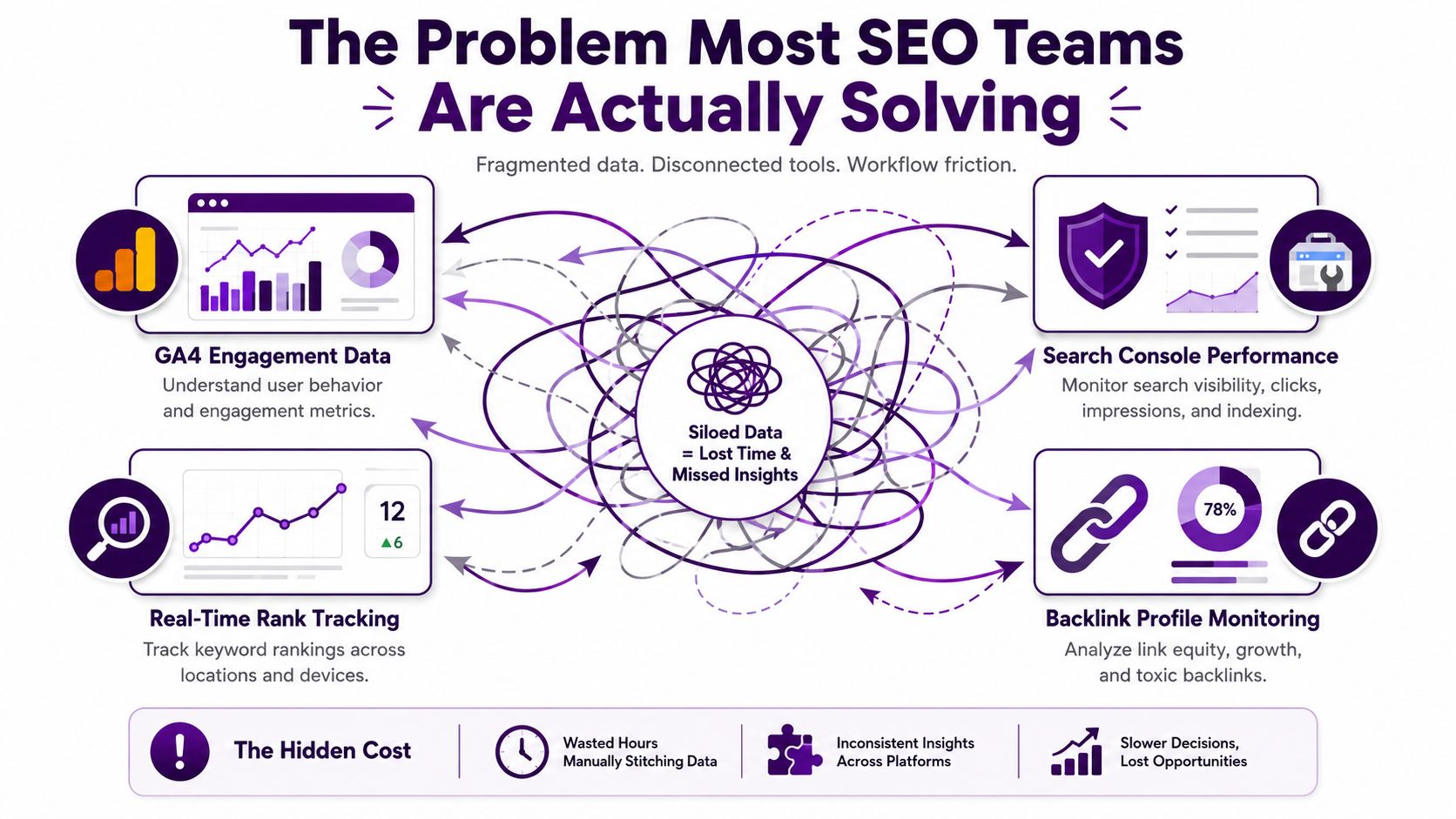
Most SEO teams don't have a data shortage. They have a workflow problem. Each tool describes one part of organic search, but the team still has to decide whether a traffic decline came from rankings, indexing, technical failures, seasonality, content decay, or a competitor taking a SERP feature.
That diagnosis becomes harder when the page identifiers don't match. GA4 commonly reports landing-page paths, while Search Console reports full URLs, so reliable reporting requires normalizing those identifiers before joining the datasets. The GA4 and Search Console reporting guidance also highlights the access requirements, including a verified Search Console property and suitable GA4 permissions.
Data isn't the deliverable
A report showing lower clicks is not a recommendation. A crawl listing thousands of warnings isn't a project plan. A rank chart without conversions tells a partial story. Your team needs to connect the evidence:
Performance: Which queries and pages lost impressions, clicks, or visibility?
Business value: Did the affected landing pages contribute to qualified leads, purchases, or assisted conversions?
Root cause: Did technical changes, content quality, intent mismatch, cannibalization, or competitors alter the result?
Ownership: Which person or team can act, and what should they do next?
A business SEO platform earns its place when those questions live in one workspace. It should let an SEO lead move from an anomaly to the affected URLs, from those URLs to the relevant query and conversion data, and from diagnosis to a prioritized task.
Practical rule: If your team still exports data to spreadsheets before it can make a routine SEO decision, the stack is fragmented even if every individual tool is capable.
The business case is clear. Google handled about 90.1% of worldwide search across desktop, mobile, tablet, and console in April 2026, compared with Bing at 5.04%, Yahoo at 1.51%, Yandex at 1.2%, DuckDuckGo at 0.7%, and Baidu at 0.46%, according to worldwide search engine usage data. That concentration makes Google visibility a central operating concern, but it also makes cross-market reporting important for teams that can't assume one market behaves like another.
What a Business SEO Platform Does and Core Features
An enterprise-grade platform isn't just several point tools under one login. It connects inputs at the page, query, competitor, and business-outcome levels, so users can move from observation to action without rebuilding context manually.
The first requirement is native GA4 and Search Console integration. The platform should preserve query, page, landing-page, device, country, engagement, and conversion context in a consistent model. If the connection only produces a decorative dashboard, it hasn't removed the spreadsheet problem.
Daily rank tracking still matters, especially for priority queries and defined markets. Google handled about 90.1% of worldwide search in April 2026, so teams need dependable monitoring of the ecosystem that drives most discovery, while still retaining visibility into other engines and markets when their audience demands it. Rank data becomes more useful when it sits beside impressions, clicks, SERP features, landing pages, and conversions.
The capabilities that replace scattered work
A scheduled site audit should identify broken links, indexability problems, metadata issues, internal-link weaknesses, performance concerns, and structured-data opportunities, then rank them by impact and ownership. For JavaScript-heavy sites, the crawler must compare initial HTML with the fully rendered DOM. Rendering-aware SEO audit guidance explains why a raw HTML shell can hide content, links, or structured data that only appear after client-side execution.
Backlink analysis should connect referring domains and links to the pages they support, not stop at a domain-level authority score. Content gap analysis should compare your pages with SERP competitors and expose missing intent coverage, weak supporting topics, and pages that compete with one another. SERP feature tracking should include formats such as featured snippets, shopping results, and AI-generated search experiences where the platform can measure them consistently.
For local businesses, a broader workflow may also need multi-location business listing management, especially when organic visibility and local discovery are managed by the same team. Agencies evaluating the wider category can also use this AI-powered SEO platform guide for agencies and teams to compare workflow requirements rather than just feature labels.
Feature | What It Does | Pain It Replaces |
|---|---|---|
Unified analytics | Joins GA4 and Search Console context | Manual exports and failed page joins |
Rank tracking | Monitors priority queries, markets, and SERP features | Separate rank and visibility reports |
Technical auditing | Finds and prioritizes crawl, indexation, and rendering issues | Periodic, disconnected crawl files |
Backlink intelligence | Connects links to target pages and opportunities | Domain-only backlink snapshots |
Content gap analysis | Maps missing topics and intent against competitors | Guesswork in editorial planning |
Action workflows | Assigns recommendations, owners, and status | Insights that never become tickets |
The SEO services market was estimated at about $108.28 billion in 2026, according to market and search-engine background coverage. That scale reflects how SEO has evolved from mid-1990s meta-tag experimentation into a function spanning technical systems, content operations, links, experience signals, semantic understanding, and AI-generated answers. A platform has to reflect that operating reality.
Your Business SEO Platform Evaluation Checklist
Feature checklists make weak buying tools because vendors describe similar capabilities in very different ways. Evaluate the platform against the work your team must complete, the data it needs, and the frequency at which decisions happen.
Score the data before the interface
Start with data-source depth and integration quality. Confirm whether the platform connects GA4, Search Console, rank data, backlinks, site crawls, CRM outcomes, and content systems directly, or whether it depends on exports. Ask how it handles URL normalization, deleted pages, redirects, multiple properties, and historical continuity.
Then test freshness. Daily rank data may be appropriate for volatile commercial queries, while technical crawls can follow a different schedule. A vendor should explain refresh timing clearly. If users can't tell whether a dashboard reflects current, delayed, or partial data, trust will erode quickly.
Scalability comes next. Don't ask only whether a platform supports your current properties. Test how it handles multiple brands, countries, locations, devices, keyword groups, user roles, and reporting views. A small team may value simplicity, while an agency needs separation between clients and an in-house enterprise team may need governance across business units.
Score the work around the data
Collaboration is more than adding users. Look for shared workspaces, ownership fields, comments, task status, approval workflows, saved segments, and permission controls. Reporting should serve both practitioners and executives, with flexible views, scheduled delivery, exports, and explanations that connect movement to action.
Pricing deserves a hard look. Compare plans by tracked keywords, crawl volume, users, properties, API access, integrations, and reporting limits. A low entry price can become expensive when growth triggers charges across several dimensions. A higher-priced platform can still be rational if it replaces manual labor and overlapping tools, but the vendor should let you model that usage before signing.
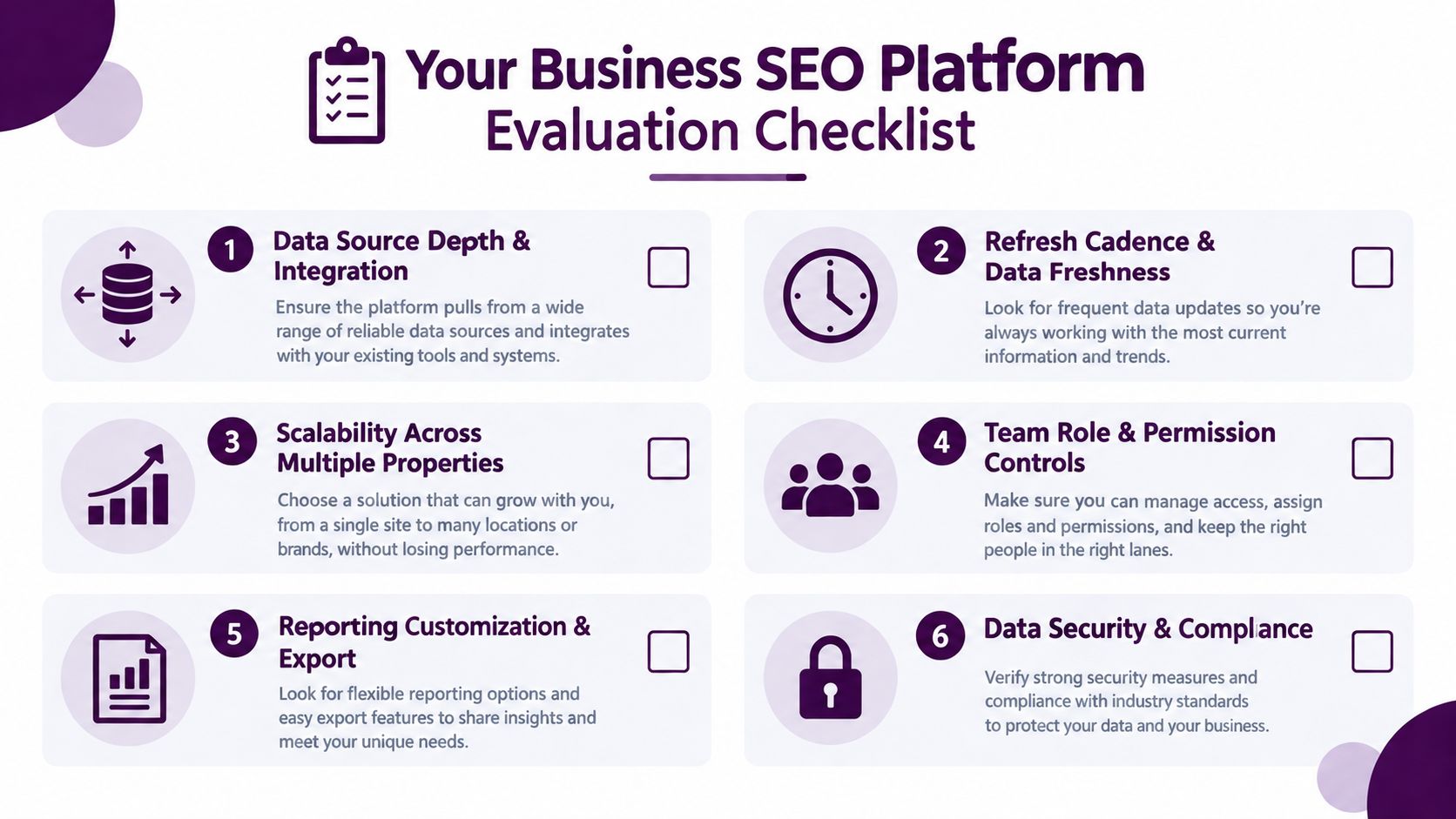
Use a simple scoring sheet, with each criterion judged against your actual workflow:
Integration depth: Can the platform answer page-level questions without exports?
Freshness: Do refresh schedules match the decisions you make?
Scale: Can the account structure grow across properties and markets?
Collaboration: Can every recommendation reach an owner?
Reporting: Can leadership see business impact without learning the interface?
Governance: Are permissions, security, and retention suitable for your organization?
For teams where ranking movement remains a daily operating signal, review the details in rank tracking for SEO teams, then test whether those rankings connect to pages, queries, and outcomes.
Implementation Roadmap From Data to Daily Action
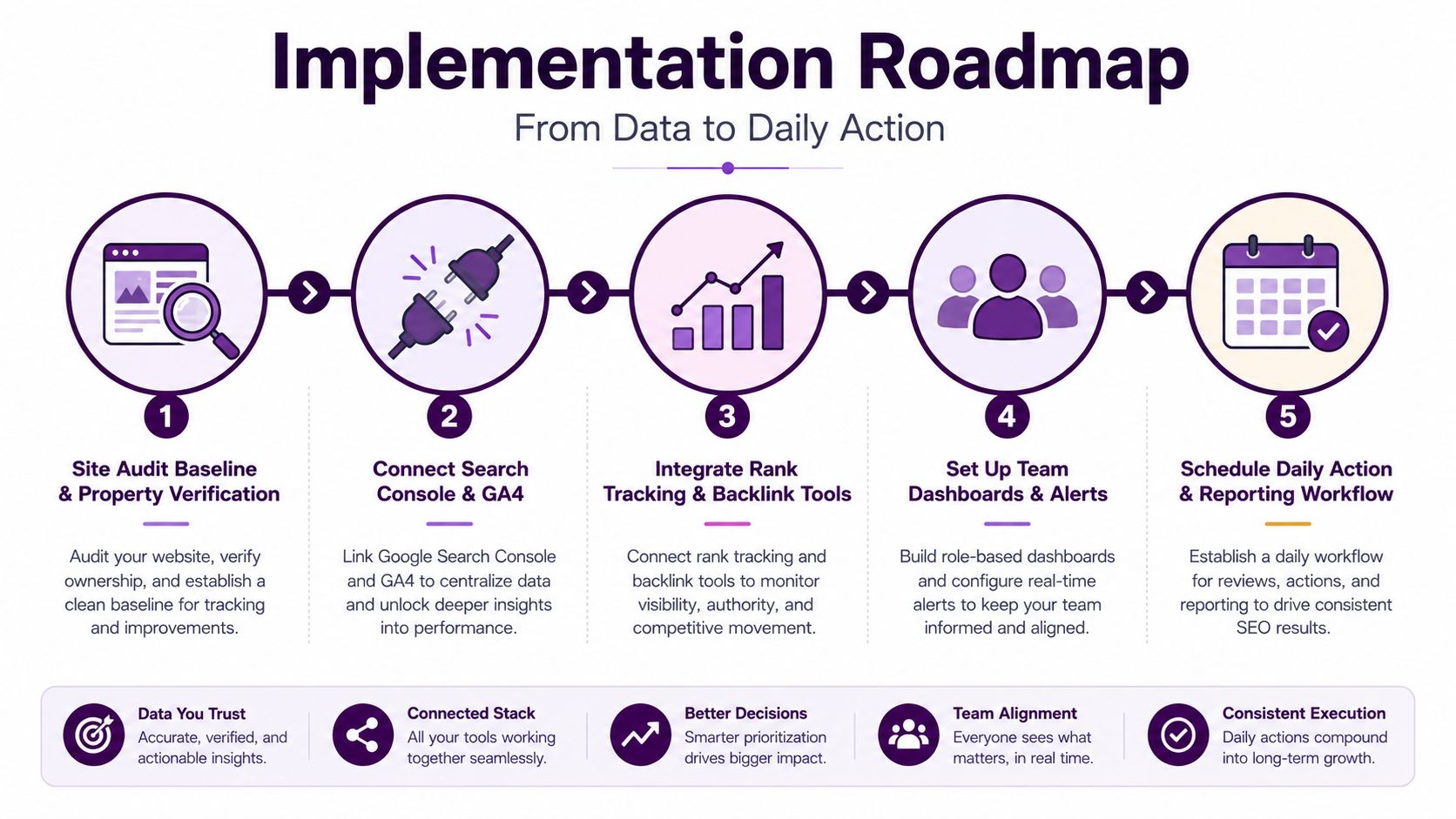
Implementation should begin with a baseline, not a presentation. Crawl the site, record the existing technical condition, verify the Search Console property, confirm GA4 access, and agree on the page and property definitions that every report will use.
The baseline should identify what the platform knows before the team starts changing things. Confirm canonical URLs, landing-page mappings, conversion definitions, keyword groups, locations, devices, and business segments. A clean foundation prevents teams from mistaking a tracking change for an SEO change.
Configure the workspace around ownership
Connect rank, backlink, keyword, competitor, and content data before distributing dashboards. Tag keywords by product, intent, market, funnel stage, and owner. Create brief templates that include the evidence a writer or technical specialist needs, rather than sending them to another collection of links.
Good implementation produces stable definitions and visible gaps. Users should know which properties are complete, which feeds are delayed, and which alerts are meaningful. Alerts shouldn't fire for every minor movement. They should identify events that deserve investigation, such as a material landing-page decline, an indexing change, a rendering failure, or a competitor entering an important SERP feature.
Give leadership a concise outcome view. Give content teams query clusters, affected pages, competitors, and internal-link opportunities. Give technical teams crawl evidence, rendered-versus-raw comparisons, severity, and ownership. Weekly standups should review the prioritized queue, not force everyone to interpret the same dashboard from scratch.
Adoption is the practical test. If people still ask for exports, maintain parallel spreadsheets, or open the old rank tracker for routine work, the rollout hasn't replaced fragmentation. Keep refining the views until the platform becomes the place where the team starts its daily SEO decisions.
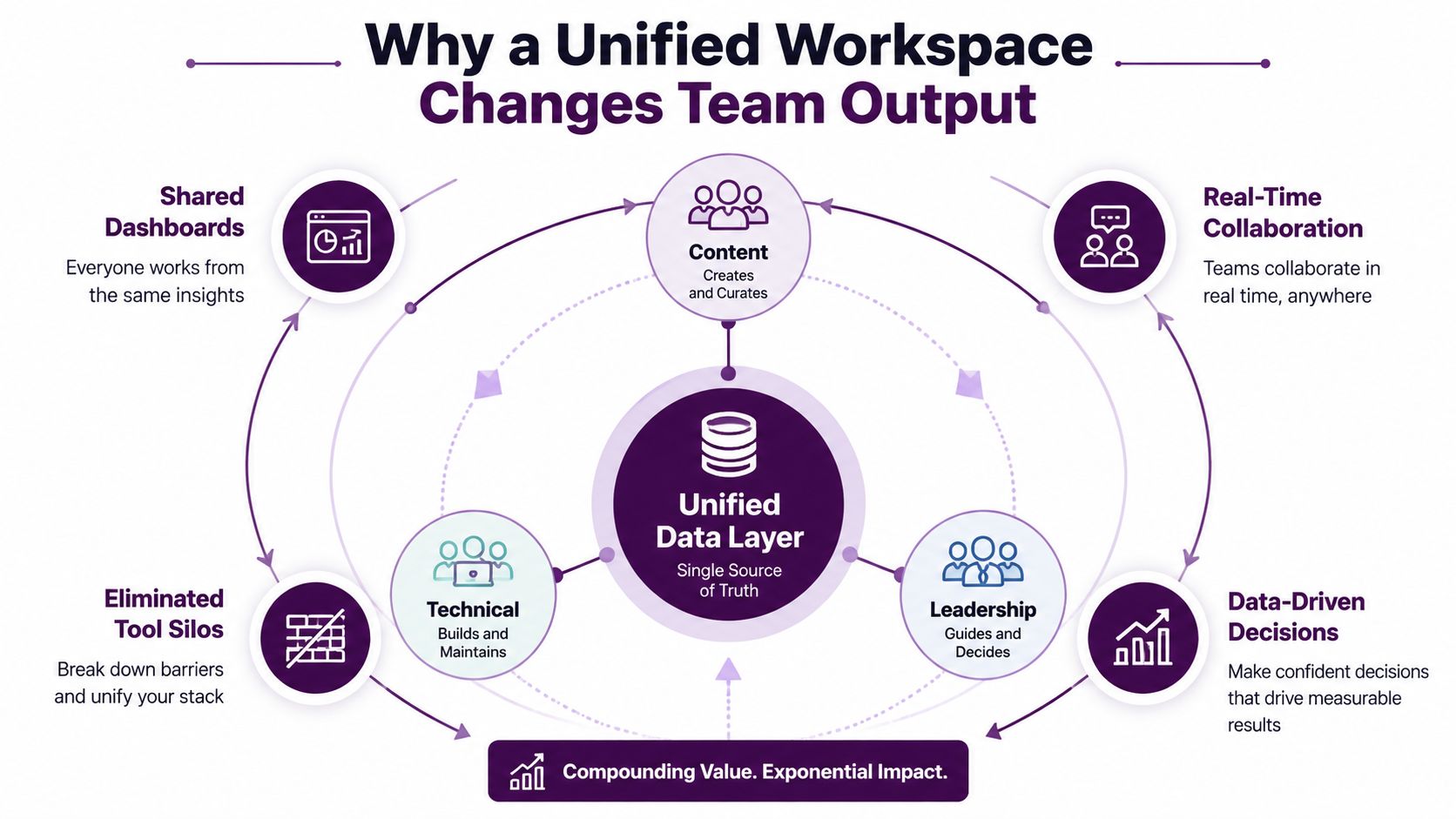
Why a Unified Workspace Changes Team Output
A unified workspace changes output because it changes the handoff. A content strategist can see that a page has impressions but weak click-through, a technical specialist can see whether rendering or internal links limit discovery, and leadership can see whether the page matters to a commercial objective. Those people stop debating whose number is correct and start deciding what to do.
Shared dashboards also reduce the cost of context switching. A content brief can combine query opportunity, competitor coverage, related pages, internal-link suggestions, backlink context, and conversion history. The writer doesn't need five screenshots, and the SEO lead doesn't need to explain why a high-volume keyword is less valuable than a lower-volume query with stronger business intent.
AI needs a complete evidence layer
AI recommendations become risky when they rely on one narrow dataset. A rank-only recommendation may prioritize a visible keyword that produces little value. A traffic-only recommendation may miss an indexing failure. A backlink-only recommendation may chase authority without identifying the pages that need support.
The useful role for AI is evidence synthesis. It should connect the query, page, technical, competitor, link, and analytics signals, explain the likely cause, and propose an action that a human can review. That doesn't remove judgment. It gives the specialist a better starting point.
Decision standard: Accept an AI recommendation only when you can trace it back to the source signals and understand why the proposed action outranks competing tasks.
A unified platform should also weigh business context. Prioritization needs more than search volume. It should consider page purpose, conversion relevance, current visibility, technical blockage, competitive difficulty, and the effort required to act. Teams exploring adjacent AI workflows may find Maxfusion AI creative platform features useful for understanding how creative production tools can fit beside, rather than replace, a search decision layer.
The result is an operating system for SEO decisions, not another reporting destination. The platform creates compounding value when every team uses the same definitions, recommendations retain their context, and completed work can be connected to subsequent performance.
Measuring Visibility When Rankings Stop Telling the Whole Story
A position-one report can look excellent while the page receives limited attention. AI Overviews, featured snippets, shopping results, local packs, and other zero-click experiences can change what users see before they reach a traditional result.
Multiple 2025 to 2026 sources describe AI Overviews appearing in roughly 13% to 19% of Google searches, with expansion through 2025, as summarized in evidence-based SEO trend coverage. The operational implication is straightforward. Rank position should remain in the report, but it can't be the report.
Build a layered visibility scorecard
Track classical rank movement alongside impressions, clicks, SERP feature presence, citation share, brand or entity coverage, and conversion-quality organic traffic. The platform should distinguish a page that ranks well but is absent from prominent search features from one that appears across several useful result formats.
Metric | What It Measures | When It Matters Most |
|---|---|---|
Rank position | Traditional placement for a tracked query | Comparing controlled keyword movement |
Impression share | Exposure within recorded search demand | Reviewing reach and demand capture |
SERP feature presence | Visibility in snippets, shopping, local, or AI experiences | Evaluating how users encounter the brand |
Citation share | Inclusion in AI-generated answers where measurable | Monitoring AI-era discoverability |
Entity coverage | Whether the brand and topics are represented accurately | Strengthening topical and brand understanding |
Conversion-quality traffic | Business value from organic visitors | Reporting contribution to revenue or leads |
The reporting layer should also separate branded and non-branded performance, compare important page groups, and connect organic visits to assisted conversions where analytics data supports that view. CFO-facing reporting becomes stronger when it answers whether visibility reached the right audience and produced meaningful actions, not merely whether a line moved upward.
For a practical approach to the newer measurement layer, use this AI visibility tracking guide for SEO teams. The priority isn't abandoning rankings. It's putting rankings in their proper place, as one signal within a broader visibility and business-impact model.
Migration and Common Pitfalls When Switching Platforms
Most migrations fail before the new dashboard is ready. The team imports every legacy keyword, connects every account, and then spends its energy arguing about why historical positions don't match. Those differences may come from locations, devices, search intent, dates, personalization, database definitions, or collection methods.
Start with parity testing. Select a representative keyword set, align locations and devices, compare reporting dates, and document differences instead of hiding them. Then map the objects that make the current workflow usable, including owners, tags, alerts, dashboards, permissions, and recurring reports.
Treat migration as governance
A migration decides which definitions become standard. Agree on URL conventions, keyword taxonomies, property names, page groups, conversion labels, and access boundaries before the account fills with exceptions. Archive historical data that no longer supports decisions, but preserve the evidence needed to interpret long-term changes.
Run the new platform beside the existing tool for a controlled reporting window. Notify stakeholders that temporary metric variance is expected, monitor data completeness each day, and migrate essential properties and integrations before custom segments. Test permissions early across agencies, brands, regions, and leadership groups.
Pitfall | Recommended Response |
|---|---|
Importing every legacy keyword | Keep the set tied to current decisions and business priorities |
Comparing unmatched rankings | Align location, device, intent, dates, and collection settings |
Recreating every old dashboard | Rebuild only reports people use to make decisions |
Connecting accounts without ownership | Assign clear owners and verify access before rollout |
Duplicate alerts | Define alert thresholds and route each issue to one owner |
Expecting total tool replacement | Retain specialist tools where the platform doesn't cover the workflow |
Ignoring attribution differences | Document analytics definitions and compare like with like |
Overbroad permissions | Apply role-based access before inviting the full organization |
The objective isn't to make old and new dashboards look identical. It's to create a trusted operating transition where differences are explainable, core workflows are preserved, and the new platform produces a clearer next action.
ROI, Use Cases, and Your Next Move
Calculate ROI from the work the platform changes, not from its feature count. Establish a baseline for reporting time, research time, issue-detection speed, organic business outcomes, recovered visibility, and the tools you can retire. Then track whether the team makes better decisions with less reconciliation.
Rankings alone rarely prove business impact. Review qualified non-brand clicks, conversion rate, organic-assisted revenue, important SERP feature presence, technical issue resolution time, and the volume of prioritized content work completed. Use controlled comparisons where possible, and annotate major site changes so the team can distinguish platform adoption from SEO impact.
Cost or Baseline Metric | Value Indicator |
|---|---|
Reporting and research hours | Time returned to strategy and implementation |
Existing tool spend | Costs removed when overlapping tools are retired |
Technical issue detection time | Faster identification and assignment of defects |
Organic visibility baseline | Improvement across priority pages and SERP features |
Conversion-quality organic traffic | Stronger qualified leads, purchases, or assisted outcomes |
Content workflow throughput | More useful briefs and completed priority updates |
Team confidence in data | Fewer reconciliation requests and duplicate reports |
The operating model differs by team. A multi-brand ecommerce organization may connect category pages, product data, schema, listings, and revenue reporting. An in-house team may use shared priorities for content, product, technical, and leadership groups. An agency may need standardized client workspaces, permissions, scheduled reports, anomaly alerts, and expert review without exposing one client's data to another.
Start with a 30-day proof of value. Connect one representative domain, define a short baseline, test five recurring decisions, and compare the time and confidence required before and after implementation. Expand only when the platform consistently turns fragmented inputs into a clearer owner, action, and measurement plan.
The right business SEO platform isn't the one with the longest feature list. It's the one that helps your team explain what changed, decide what matters, complete the work, and prove whether that work improved meaningful business outcomes.
Keyword Kick connects Google Analytics 4, Google Search Console, rank tracking, backlinks, technical audits, keyword research, competitor analysis, and SERP feature data in one workspace, with K² AI generating data-backed next actions. Visit Keyword Kick to evaluate whether its free forever plan and paid-tier trial fit your team's 30-day proof of value.