Your rankings still look fine in Google Search Console. A handful of head terms even moved up. But sessions are soft, lead volume feels uneven, and stakeholders keep asking the same question: if rankings are stable, why are results flat?
In most cases now, the answer sits above the blue links. Users are getting more of the journey handled inside AI-generated summaries, overview panels, and conversational answers. That changes what “visibility” means. It also changes what an SEO team should optimize for, report on, and prioritize week to week.
The New SEO Reality in an AI World
A familiar client conversation goes like this. “We still rank on page one for our core terms. Why are fewer people clicking?” A few years ago, that usually pointed to a SERP feature shift, weak title tags, or stronger competition. Today, the first place I look is whether AI-generated answers have started absorbing the informational part of the journey.
That's not a fringe issue anymore. McKinsey reports that about 50% of Google searches already have AI summaries, and that share is projected to exceed 75% by 2028. The same analysis says only 16% of brands currently track AI search performance systematically (McKinsey on the new front door to the internet). So many brands are still grading themselves with old scorecards while the search experience has already changed.
The practical consequence is simple. Ranking is no longer the whole result. You can “win” the classic ranking battle and still lose visibility if the AI layer summarizes the answer before the click.
Practical rule: If traffic drops while rankings hold, investigate AI visibility before assuming content decay or tracking errors.
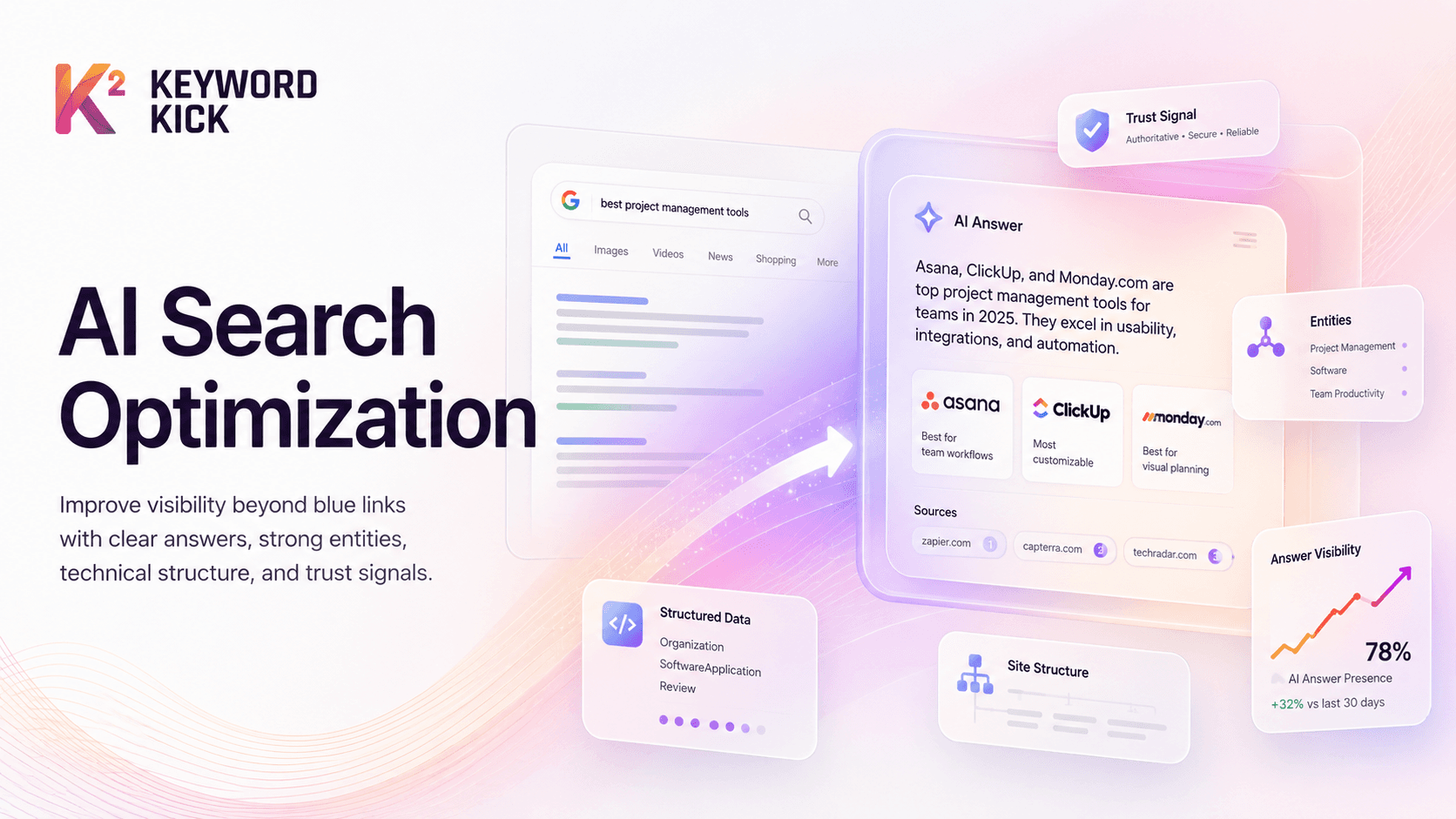
That's why AI search optimization matters. It's not a replacement for SEO. It's the work of making your brand, pages, entities, and explanations usable inside generated answers.
A useful primer if you want another practitioner's view is SEOBRO®'s guide on AI search. It lines up with what many consultants are seeing in audits now: the gap isn't always ranking loss, it's answer-layer invisibility.
Teams making this shift usually stop obsessing over “What position are we in?” and start asking better questions. Are we cited? Are we mentioned by name? Are we the source behind the answer even when the click doesn't happen? That mindset change is also why pieces like From dashboard SEO to AI-guided SEO resonate with in-house teams right now.
What AI Search Optimization Really Means
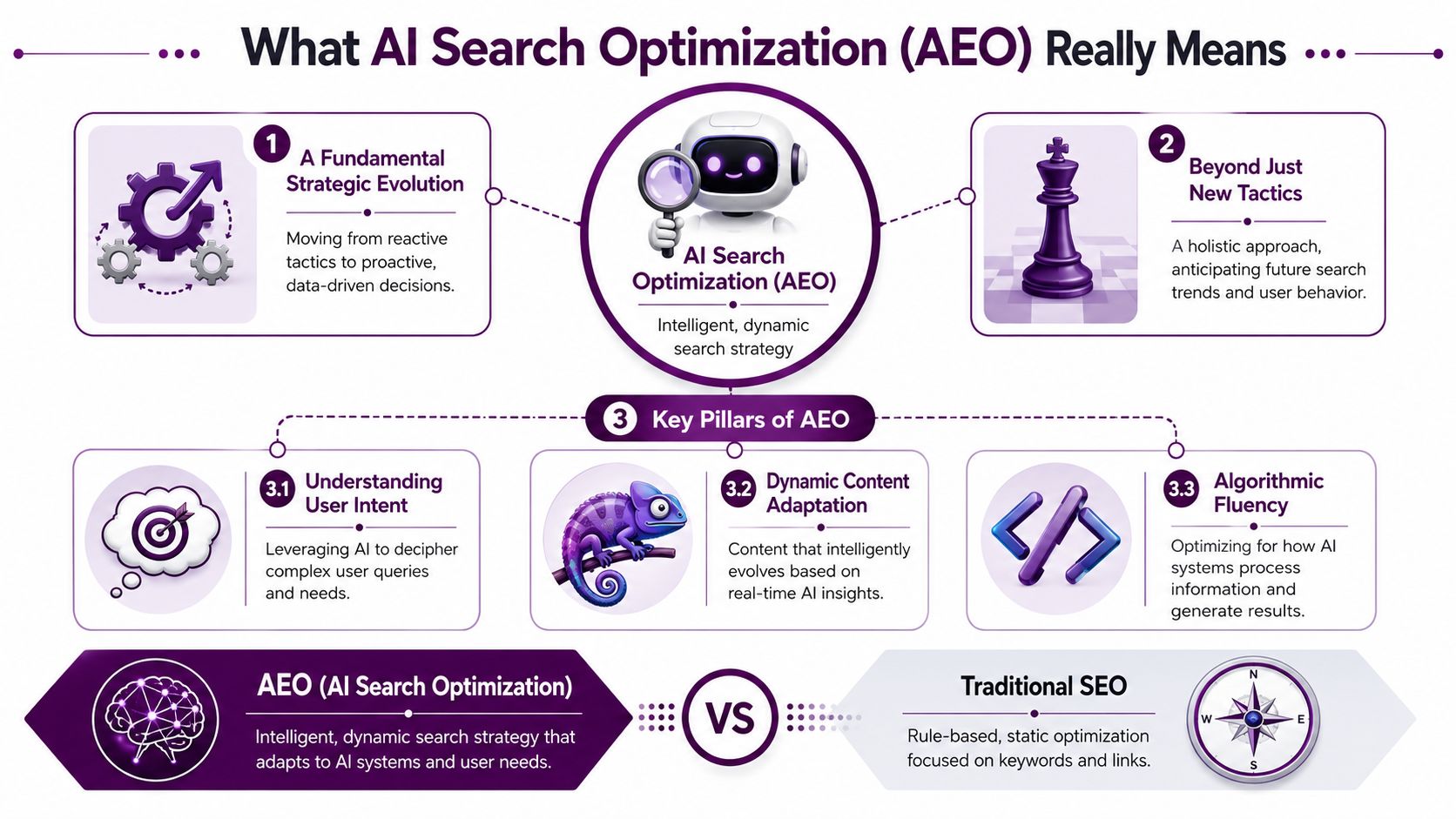
Traditional SEO was built for a search engine that matched pages to queries and ranked them in a list. AI search optimization is built for systems that read, compare, synthesize, and assemble answers from multiple sources. That's a different job.
Think of it this way. Traditional SEO is like organizing a library so the catalog returns the right shelf. AI search optimization is like briefing a sharp research assistant who has to answer the question in plain language, using the most credible material available. If your content is hard to interpret, vague on definitions, weak on structure, or inconsistent about entities, that assistant is less likely to use it.
What changes in practice
The shift isn't just about new SERP features. It changes the unit of competition. In classic SEO, the page is often the unit. In AI search, the answer fragment matters more. A system may pull one definition from your guide, one comparison from another site, and one brand mention from a third.
That means your content has to do three things well:
State meaning clearly: A paragraph should answer one thing cleanly, not bury the point in marketing language.
Establish entity relationships: Products, services, authors, brands, categories, and use cases should be easy to identify.
Earn trust fast: If the material looks thin, derivative, or hedged, it's easier for an AI system to choose another source.
The urgency is real. Semrush reports that AI search traffic increased by 527% in one year, that Google AI Overviews now reach 2 billion monthly users, and it cites a projection that traffic from AI search may surpass traditional search traffic by 2028 (Semrush AI SEO statistics).
What AI search optimization is not
It isn't a bag of hacks. It isn't “write like a robot so robots can read you.” And it isn't a separate channel that only matters to experimental teams.
Good AI search optimization makes content easier for machines to parse and easier for humans to trust.
The strongest pages usually look boring in the best way. Clear headings. Specific answers. Credible authorship. Useful examples. Tight internal context. They don't try to game the model. They give it less room to misunderstand.
Core Techniques for AI-First SEO
Tactics only work when they support understanding. If a page is technically accessible but conceptually muddy, AI systems won't use it confidently. If the page reads well but the site structure is chaotic, the same problem shows up in a different layer.
Write for intent clusters, not isolated keywords
Most content teams still start with a keyword and expand outward. For AI-first work, start with the user problem and map the intent cluster around it.
Take a software page targeting “customer support automation.” A traditional approach might build one landing page and sprinkle variants across the copy. A stronger AI-first approach breaks the topic into the questions a model is likely to associate with it: what it is, where it helps, where it fails, how it compares to live support, implementation risks, pricing model considerations, and fit by business type.
That produces content that is easier to cite because each section does a distinct job.
A simple page test
Ask these questions on any important URL:
Can a reader identify the primary answer fast: If the point only becomes clear halfway down the page, you've made extraction harder.
Does each section answer a distinct sub-question: Blended sections confuse both users and parsers.
Are comparisons explicit: “Better,” “faster,” and “smarter” are weak unless the page names what is being compared.
Use structured data where it clarifies entities
Structured data isn't decoration. It's one of the clearest ways to label what a page, object, or organization is. For AI search systems, that matters because they need help parsing page purpose, media context, and relationships between entities.
Practitioners commonly recommend marking up core entities such as LocalBusiness, Product, FAQ, Review, Service, ImageObject, and VideoObject, especially when that markup sits on a site with clean internal linking, canonicalization, and clustered architecture that avoids orphan pages and duplicate confusion (Rio SEO on optimizing for AI search).
That doesn't mean “add every schema type everywhere.” It means use the schema that matches the page's actual role.
Clean up the technical layer that models depend on
A lot of AI search work is still plain old technical SEO. Pages need to be crawlable. Templates need a clear hierarchy. Canonicals need to make sense. Internal links should reveal topic relationships instead of randomly connecting “related” posts with no semantic logic.
I often explain this to clients with a warehouse analogy. If your inventory is mislabeled, stacked in the wrong aisles, and duplicated across bins, the picker wastes time and grabs the wrong item. AI systems deal with websites the same way. Messy architecture reduces confidence.
Technical priorities that pay off
Canonical discipline: Duplicate or near-duplicate URLs split signals and make source selection harder.
Logical clustering: Parent pages, supporting articles, and commercial pages should connect in a way that reflects the topic map.
Media context: Images and videos need surrounding text that explains why they matter, not just a file dropped into the page.
Orphan prevention: Important URLs should be reachable through meaningful internal links, not only XML sitemaps.
Strengthen trust signals that make a page citable
AI systems need content they can quote, summarize, or cite with low ambiguity. That usually comes from pages with strong editorial signals.
Useful trust markers include clear author attribution, subject-matter alignment between the author and topic, recent review practices, accurate product or service naming, and concrete language instead of vague claims. If your page says “industry-leading platform” five times but never explains what problem it solves or for whom, it won't travel well into AI answers.
If a sentence can't stand on its own outside your page, it's less likely to become part of an answer.
Many AI-written pages often fail. They may be grammatical, but they often flatten nuance and remove the sharp edges that make a source worth citing.
Use LLMs as auditors, not substitutes
LLMs are useful in workflow when they help you spot coverage gaps, competing intents, unclear phrasing, or unsupported jumps in logic. They're much less useful when teams ask them to produce final pages with no expert review.
A practical workflow looks like this:
Outline from search intent
Draft with a subject expert or experienced writer
Use an LLM to check for missing subtopics, weak transitions, and answer completeness
Review claims and tighten wording
Publish with proper markup and internal links
That approach keeps the human judgment where it belongs.
If you want a second perspective on this mix of technical structure, content clarity, and answer-level optimization, Busylike's AI search expertise is a useful companion read.
How to Measure Success in an AI Search World
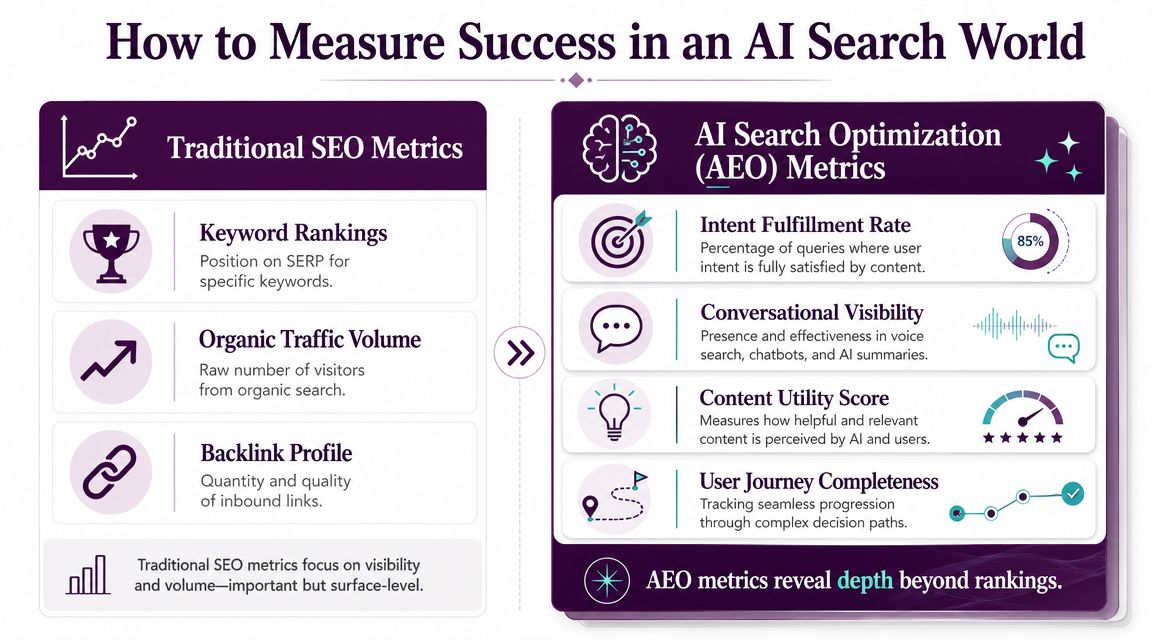
The reporting problem is where many teams get stuck. They know search behavior is changing, but their dashboards still revolve around rankings, sessions, and conversions from classic organic listings. Those numbers still matter. They just don't capture the whole picture anymore.
The right shift is from position-only measurement to visibility-and-citation measurement.
What to put on the dashboard
You need a blended view. Keep the core SEO metrics. Add AI-layer indicators that tell you whether your content is being surfaced, referenced, and associated with the right topics.
Metric Focus | Traditional SEO KPI | AI Search Optimization KPI |
|---|---|---|
Visibility | Keyword rankings | Visibility in AI overviews and generated answers |
Discovery | Organic traffic volume | Referral traffic from AI-driven surfaces |
Authority | Backlink profile | Citation frequency and brand mentions in answers |
Relevance | CTR from search results | Presence on high-intent informational prompts |
Topic ownership | Share of rankings by keyword set | Coverage of entities, subtopics, and answer formats |
User path | Landing page sessions | Assisted journeys where AI visibility starts the interaction |
How to interpret the new signals
A page that loses clicks isn't always underperforming. It may be doing more brand introduction work higher in the funnel. That doesn't make click loss irrelevant, but it does change how you diagnose it.
Look for patterns like these:
High ranking, low click growth: Possible AI summary interception.
Brand mentions rising on key topics: Authority may be improving even if direct traffic lags.
Support content cited more often than product pages: Your informational layer may be strong while commercial pages still need work.
Traffic quality changing: Fewer visits can still produce stronger downstream intent if top-of-funnel questions are being pre-qualified by AI answers.
A modern SEO report should answer two questions. Did we get the click? And if we didn't, were we still part of the answer?
That's the level of reporting clients and executives increasingly need. Otherwise, teams end up optimizing for yesterday's interface.
A Practical Roadmap for Implementation
Most organizations don't need a grand transformation plan. They need a sequence they can execute without breaking existing workflows. The easiest way to do that is in phases.
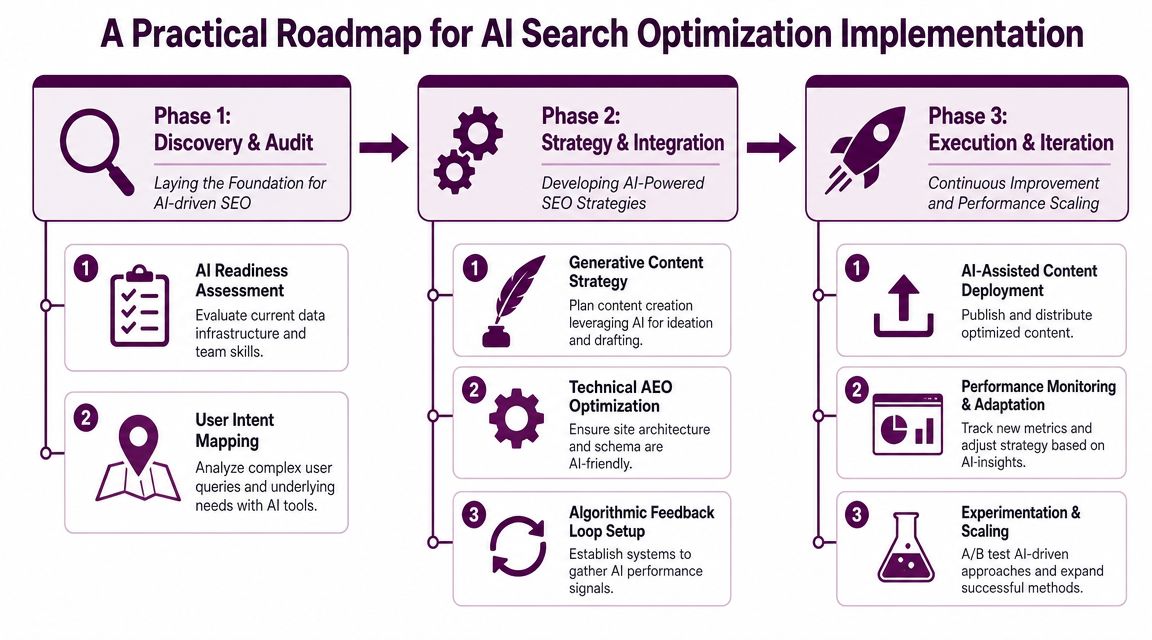
Phase 1 with a foundational audit
Start with the pages and templates that already matter. Revenue pages, category pages, core service pages, and high-traffic educational content should go first.
Google's guidance is clear that generative AI visibility still depends on crawlability, clear technical structure, and unique, valuable content, and it explicitly deprioritizes supposed hacks like unnecessary chunking or fake AI text files such as llms.txt (Google's AI optimization guide).
So the first pass should focus on the basics that still move the needle:
Template clarity: Are titles, H1s, headings, body copy, and schema aligned?
Crawl health: Can important pages be reached, rendered, and understood easily?
Internal logic: Do related pages support each other, or do they compete?
Content uniqueness: Are the key pages saying something concrete, or just repeating category boilerplate?
If your team needs tooling support for this stage, a practical starting point is reviewing AI content optimization tools for 2026 and choosing based on workflow fit rather than hype.
Phase 2 with content re-evaluation
Don't start by creating new articles. Rework the pages that already have topical relevance and existing authority.
Look for pages that have one of these problems:
They rank but don't convert: Often a sign of mismatched intent or weak answer structure.
They attract traffic but don't get cited: Usually a clarity or trust issue.
They overlap heavily with sibling pages: A source selection problem waiting to happen.
At this stage, the work is editorial. Tighten definitions. Rewrite vague intros. Add comparison sections. Break out FAQs where they clarify intent. Improve authorship signals. Add the schema that reflects the page.
Phase 3 with strategic creation
Only after cleanup should you build net-new content. The brief should start with topic relationships and user needs, not just a target phrase.
A strong AI-first brief usually includes:
Content element | What to define before writing |
|---|---|
Primary intent | What problem the page must solve |
Answer objects | Definitions, steps, comparisons, objections, FAQs |
Entity set | Brand, product, service, audience, use case, related concepts |
Citation hooks | Original framing, expert commentary, practical examples |
Internal destination | Which commercial or supporting pages this URL should connect to |
That reduces fluff and keeps the page useful at extraction level.
Phase 4 with monitoring and iteration
Once the revised pages are live, track the blended KPI set discussed earlier. Then use actual query behavior and citation patterns to choose the next updates.
Teams often overcomplicate things. You don't need a separate AI strategy meeting every week. You need a disciplined review loop. Which pages gained answer visibility. Which pages lost click share. Which entities still lack clear ownership. Which commercial pages need stronger support from informational content.
The teams that improve fastest aren't chasing hacks. They're tightening the same system repeatedly.
Integrating AI Insights into Your SEO Workflow
Strategy falls apart when the work lives in six tabs, three exports, and a spreadsheet nobody trusts. AI search optimization adds another layer of complexity unless you turn it into an operating rhythm.
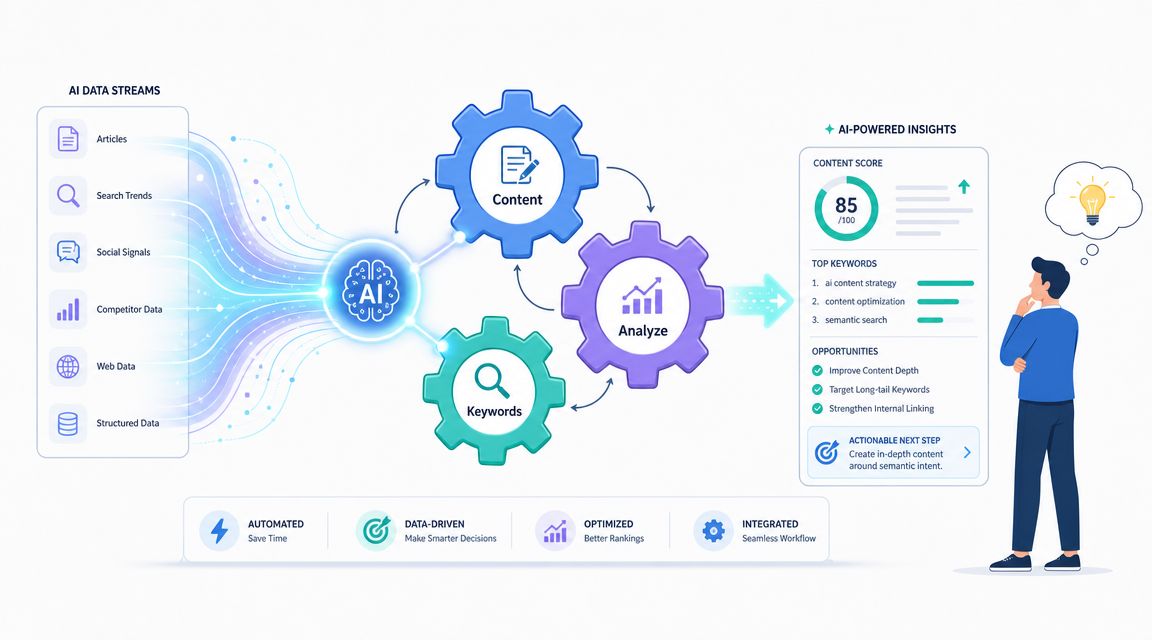
The practical workflow is simple. Pull in performance signals, identify where answer-level visibility is weak, connect that to page-level issues, then push a prioritized task list to the people who can fix it.
What a working operating model looks like
A good workflow connects four streams:
Search performance data: Rankings, impressions, clicks, query patterns.
Site quality signals: Technical issues, rendering gaps, internal linking, schema coverage.
Content intelligence: Topic gaps, overlap, weak pages, unsupported claims.
Business context: Which pages are key for pipeline, revenue, or qualified leads.
When those streams are separated, teams spend too much time diagnosing and not enough time fixing. That's why many agencies and in-house teams are moving toward systems that combine reporting and recommendations. For example, Keyword Kick connects GA4, Search Console, rank tracking, backlinks, and technical SEO signals in one workspace so teams can ask practical questions and get prioritized actions instead of piecing the answer together manually.
Questions your workflow should answer fast
The workflow is healthy when it can answer questions like these without a long analyst detour:
Which pages are visible for a topic but weak in answer quality?
Where do we have strong informational coverage but weak commercial connection?
Which URLs overlap and need consolidation?
Which topics are driving impressions without establishing brand presence?
This is also where AI automation becomes useful in the right way. Not as “publish faster.” More as “diagnose faster and prioritize better.” The broader shift is captured well in this guide to agent SEO and AI automation, especially for teams trying to reduce manual triage.
The best workflow doesn't produce more reports. It produces fewer, clearer next actions.
If you build around that principle, AI search optimization becomes manageable. It stops feeling like a separate discipline and starts functioning as the next version of sound SEO operations.
Your Future in SEO is Proactive Not Reactive
AI search optimization isn't a side project anymore. It's the update to how discoverability works. Users still need trustworthy answers. Search platforms still need crawlable, well-structured, useful content. What's changed is the layer between the query and the click.
That creates pressure, but it also creates an opening. Teams that adapt early can build authority in places competitors still aren't measuring properly. They can shape how their brand appears in generated answers instead of waiting to find out traffic has slipped after the fact.
The winning mindset is straightforward. Keep the fundamentals. Drop the gimmicks. Make your pages easier to understand, easier to trust, and easier to cite. Then measure performance based on the actual search experience, not just the old one.
If you're leading SEO inside a brand, agency, or content team, this is your chance to move from reactive reporting to active control. The firms that treat AI search as a workflow problem, not just a content problem, will be in a much stronger position over the next few years.
If you want a practical way to turn fragmented SEO data into prioritized actions, explore Keyword Kick. It brings together ranking data, GA4, Search Console, backlink signals, and technical insights so you can diagnose visibility issues faster and decide which pages to fix first.