You've probably seen this happen. A company spends weeks on a new website, gets the design right, writes copy everyone on the team likes, launches it, and then hears almost nothing from search.
No steady stream of qualified visitors. No meaningful visibility for the services that matter. Just a nice site sitting in the dark.
That's usually the moment SEO stops feeling optional.
A good beginners guide to search engine optimization should make one thing clear right away. SEO isn't about gaming Google. It's about reducing confusion. You help search engines discover your pages, understand what each page is for, and feel confident showing those pages to the right people. When that happens, traffic becomes a byproduct of clarity.
For beginners, the biggest mistake isn't doing too little. It's doing too much of the wrong work. Teams jump into blog production, backlinks, and trend chasing before they've fixed the basics. The result is motion without momentum.
What Is SEO and Why Does It Matter in 2026
SEO stands for search engine optimization. In plain language, it means improving your website so search engines can find it, understand it, and match it to relevant searches.
Google's own SEO Starter Guide frames SEO as improving a site's presence in Search and explains that sites following Google's Search Essentials are more likely to appear in results. That's the simplest useful definition for a beginner. SEO increases the chance that your pages show up when someone is looking for what you offer.
SEO is matching language to intent
A lot of new marketers think SEO starts with tools. It doesn't. It starts with understanding how real people search.
Google gives a simple example in its guidance. A person with deep topic knowledge might search for “charcuterie,” while someone newer to the topic might search for “cheese board.” Same need, different wording. That's why keyword strategy isn't just about finding popular phrases. It's about choosing language that matches the audience you want to reach.
If you run a B2B software company, your internal product terms may not match buyer language. If you sell home services, customers may search by problem, not by service category. Good SEO closes that gap.
Practical rule: If your page uses your company's vocabulary but your audience searches with everyday language, you'll struggle to rank even if the page is well written.
SEO works when pages are easy to understand
Beginners often overcomplicate this. Search engines need a few basic signals from every page:
A clear title: Tell both users and Google what the page is about.
A descriptive URL: Keep it readable and specific.
Accessible content: Use headings, helpful copy, alt text, and supporting context around images.
Strong intent match: Make sure the page answers the query behind the keyword.
This matters even more as search evolves. Traditional SEO still matters, but teams also need to think about making content AI search-ready so their pages stay understandable in newer search experiences.
If you're trying to keep up with shifts in ranking systems, it also helps to follow practical change summaries like this breakdown of Google algorithm updates in 2026 and what changed.
Understanding the Four Pillars of SEO
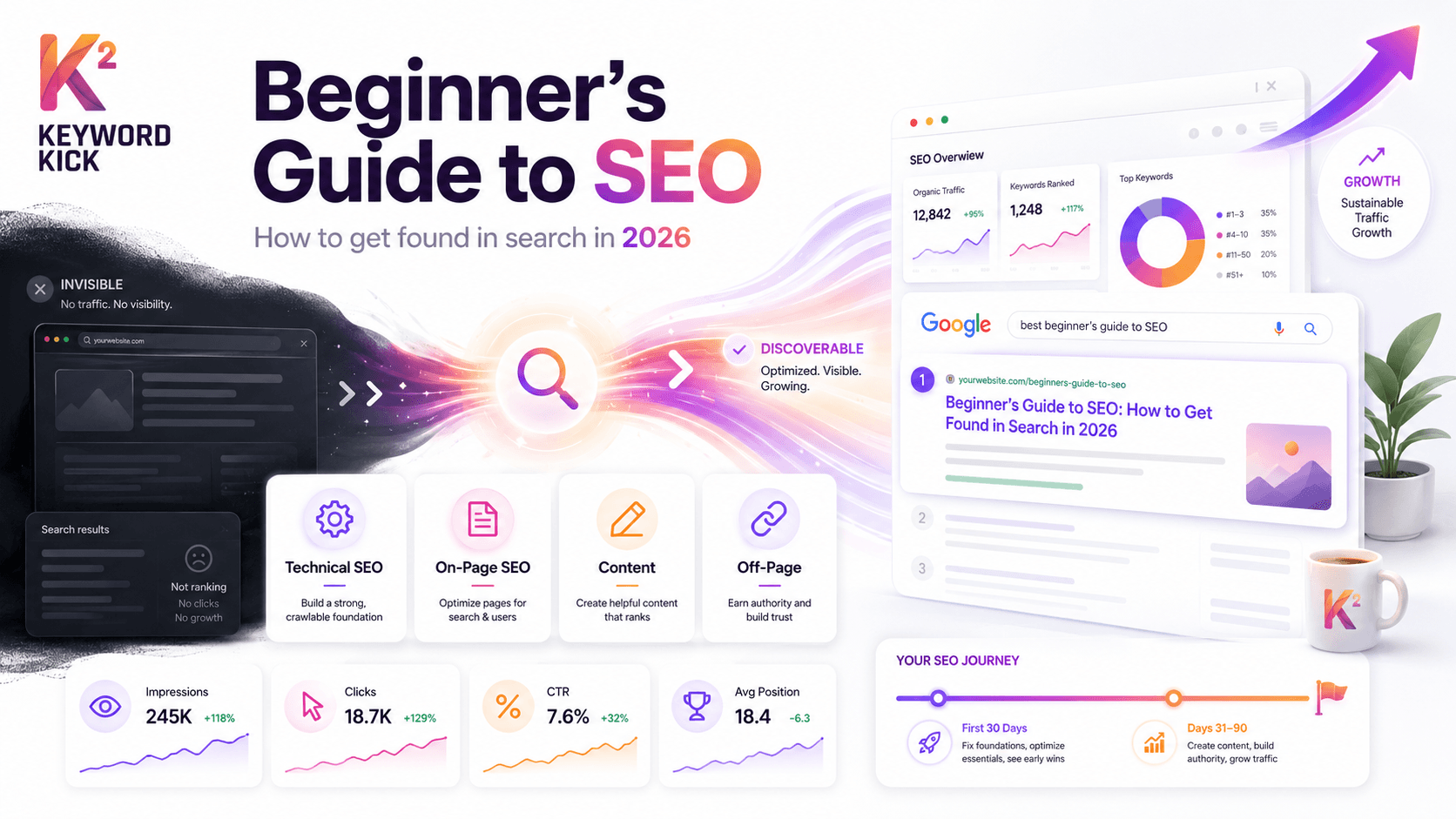
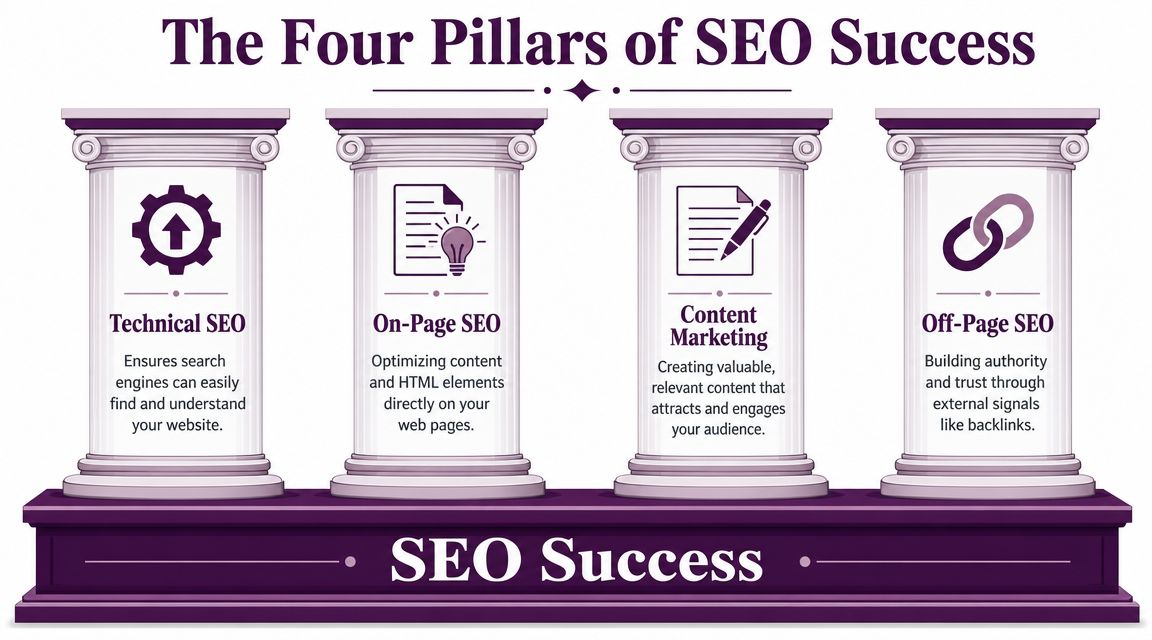
The easiest way to understand SEO is to think of your website like a house. If the foundation is weak, the rooms don't matter. If the address is unclear, visitors can't find it. If nobody recommends it, fewer people arrive.
Technical SEO
Technical SEO is the foundation.
It covers the parts of your site that help search engines crawl and interpret pages. If pages load poorly, break visually, or create friction for users, rankings become harder to earn and hold. This is why technical SEO isn't a side project. It supports everything else.
Semrush's Core Web Vitals benchmarks, cited in Moz's beginner SEO guide, give beginners concrete targets: Largest Contentful Paint should be 2.5 seconds or less, Interaction to Next Paint 200 milliseconds or less, and Cumulative Layout Shift 0.1 or less. You don't need to memorize the acronyms on day one. You do need to understand the principle. Fast, stable pages create a better experience and help search engines trust your site quality.
Content marketing
Content is the rooms inside the house.
This is what visitors came for. Your service pages, category pages, guides, FAQs, comparison pages, and support content all belong here. Strong content answers a specific need clearly and completely.
A beginner-friendly test is simple: if a user lands on the page, can they tell within a few seconds whether they're in the right place? If not, the content is probably too vague, too broad, or written around keywords instead of decisions.
On-page SEO
On-page SEO is the address and signage.
You may have a useful page, but if the title is generic, the headings are sloppy, and the URL is confusing, both users and search engines have to work harder than they should. On-page work helps define the topic and structure of each page.
A few examples of on-page signals:
Element | What it does |
|---|---|
Title tag | Sets the page's main topic in search results |
Headings | Organize the page for scanning and understanding |
URL slug | Gives clear context before someone even clicks |
Alt text | Helps explain images to users and search engines |
A well-optimized page doesn't feel optimized. It feels obvious.
Off-page SEO
Off-page SEO is the roads and recommendations leading to the house.
This includes backlinks, mentions, and other trust signals outside your site. Off-page work matters, but beginners often start here too early. If the site itself is unclear, extra links won't fix the underlying problem. You'll just send more people and more crawlers to pages that aren't ready.
That order matters. Foundation first. Then clarity. Then scale.
Actionable First Steps for SEO Beginners
You publish a page, wait a week, and nothing happens. That moment trips up a lot of new marketers because SEO work can feel invisible at first. The fix is not more activity. The fix is choosing a short list of actions that help you see what is working, improve one page enough to matter, and build a repeatable workflow instead of random busy work.
Set up the basic tracking
Before you change titles, write new pages, or chase keywords, make sure you can measure the result. SEO without tracking is like trying to improve a sales call without call recordings. You may be working hard, but you cannot tell which changes helped.
Start with three basics:
Google Search Console
Google Analytics 4
One spreadsheet or workspace to track pages, target topics, updates, and publish dates
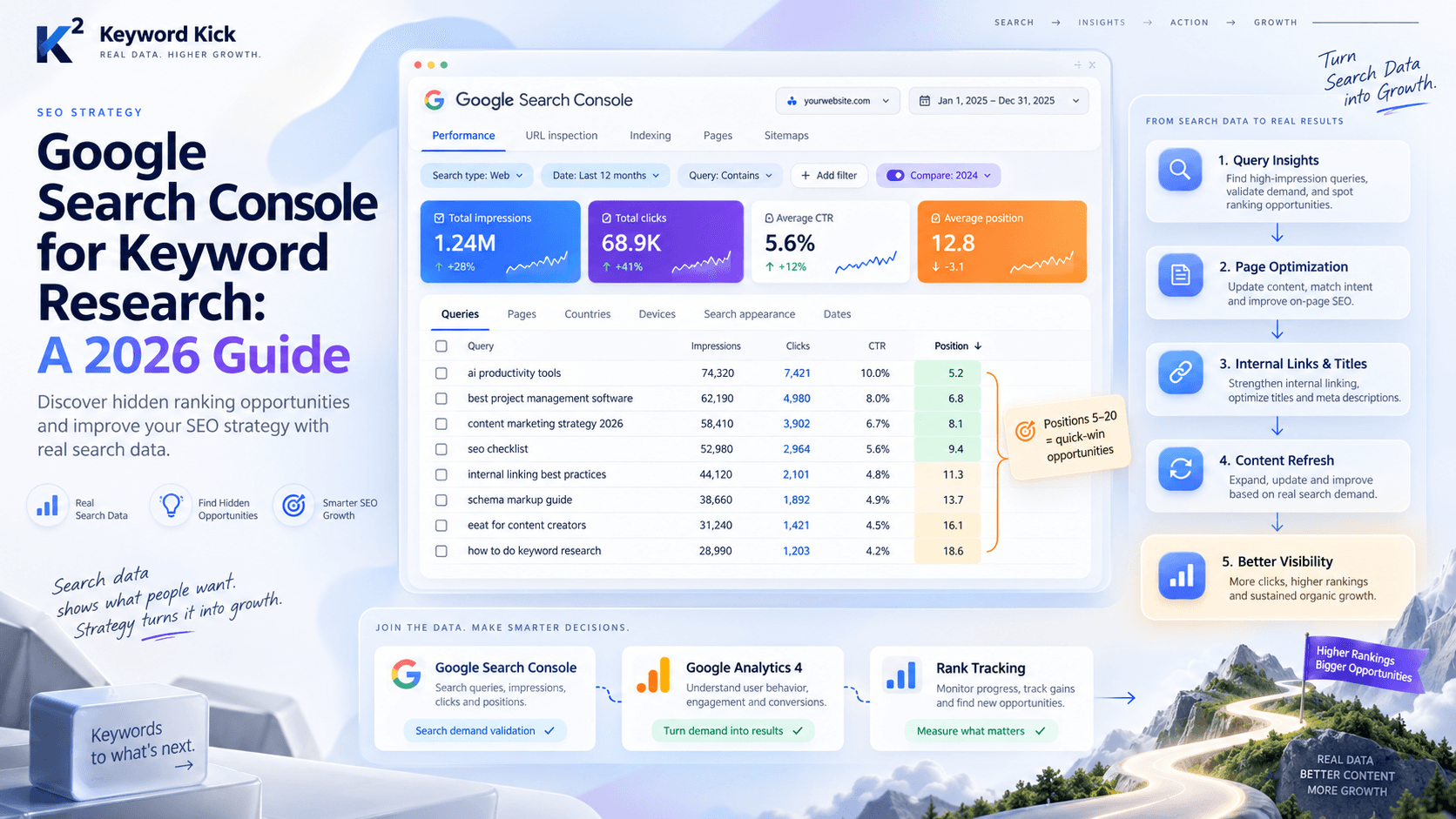
Search Console is often the fastest way for a beginner to spot early movement because it shows which queries trigger impressions, even before a page earns many clicks. That matters in the first few weeks. You are looking for signs that Google has started testing your page for relevant searches.
If you want a practical companion piece for your setup work, this SEO site audit checklist before you publish is a good reality check.
Pick one page and improve it fully
A better starting move is to choose one page that already matters to the business and make it clearly better. For many sites, that means a homepage, service page, collection page, or a blog post that is already close to the topics customers search for.
Treat that page like a storefront. A searcher should understand the offer, the topic, and the next step within seconds.
Review it in this order:
Title tag: Does it describe the page in plain language?
Main heading: Does it confirm the topic right away?
Body copy: Does it answer the underlying question behind the search?
Internal links: Does it lead visitors to the next relevant page?
Images: Do they have useful alt text and nearby context?
Now, SEO becomes practical. You are not “doing SEO” in the abstract. You are removing confusion from a page that already has a job to do.
Use a simple keyword filter
Keyword research gets confusing fast because every tool can hand you hundreds of terms. Beginners do better with a filter than with a huge list.
Use three questions:
Is this keyword closely related to what we offer?
Does it show real search demand?
Do we have a realistic chance to compete for it now?
If a keyword passes all three, it is a strong early target. If it misses on relevance, skip it even if the search volume looks attractive. Traffic that does not match the offer rarely turns into leads, sales, or useful engagement.
A local bakery should not spend its first month chasing a broad term like “desserts.” A more specific phrase tied to location, product type, or buying intent is usually the better bet. The same rule applies to B2B, ecommerce, and SaaS. Specific terms often bring fewer visits, but those visits are more likely to come from people who have a need for what the page provides.
If you want a planning framework for what to create after keyword selection, this guide to SEO content strategy for content marketers is worth reading.
Quick win test: If a keyword is specific, directly tied to your offer, and realistic for your site today, put it ahead of broader terms.
For beginners, that prioritization habit matters more than doing everything at once. It is also why teams eventually outgrow scattered notes and spreadsheets. As your list of pages, keywords, fixes, and results grows, a centralized workflow in a platform like Keyword Kick becomes useful because it keeps the work focused on the tasks most likely to move rankings, traffic, and conversions.
How to Measure SEO Success
New marketers often check rankings obsessively and ignore everything else. That's backwards. Early SEO success shows up first as visibility patterns, not headline wins.
Four metrics that matter first
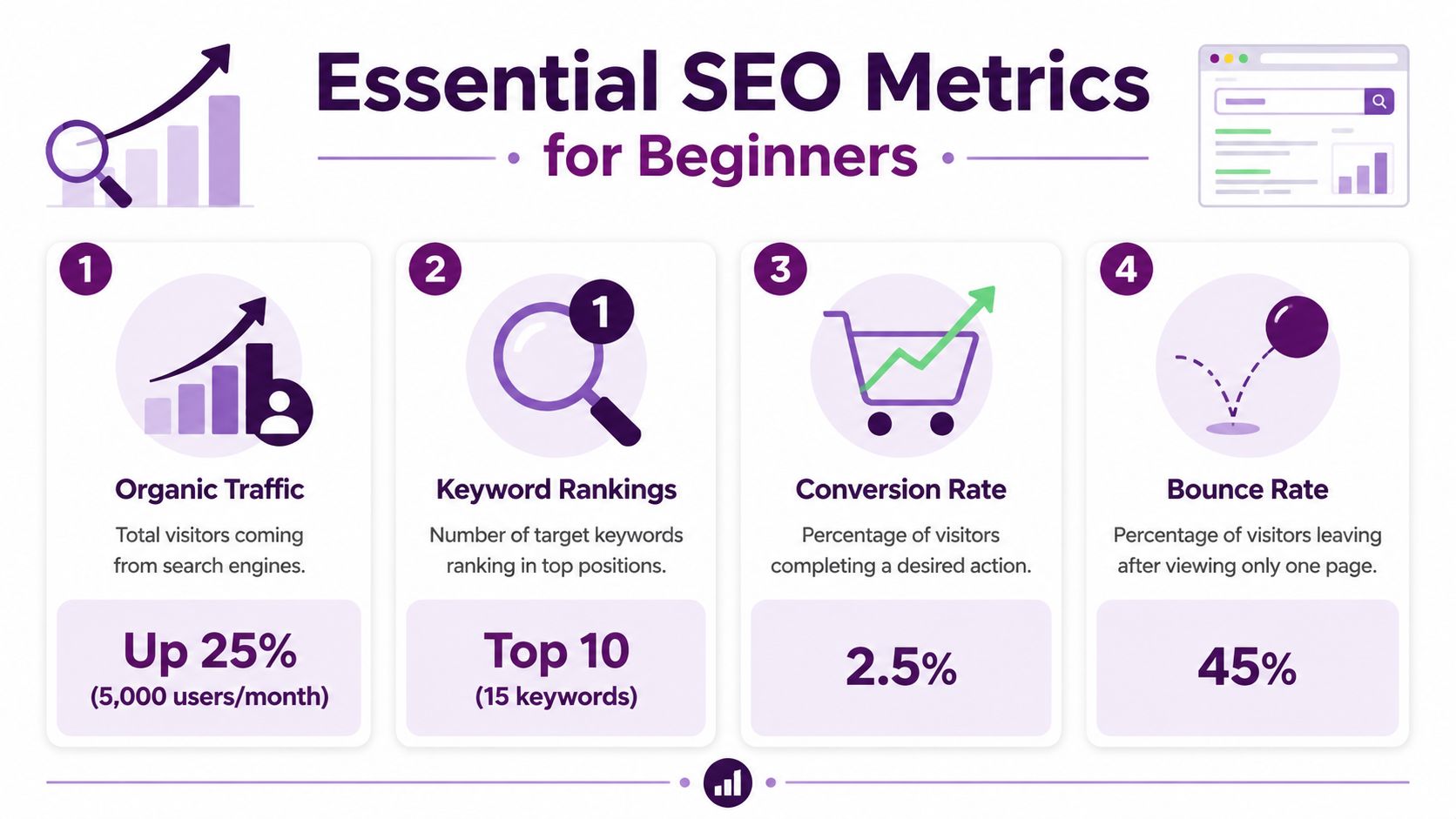
Google Search Console gives beginners enough data to judge whether their work is moving in the right direction. Focus on these four signals:
Metric | What it tells you | What a good trend means |
|---|---|---|
Impressions | How often your page appears in search | Google is showing your page more often |
Clicks | How many users visited from search | Your visibility is turning into traffic |
CTR | How often searchers click after seeing you | Your title and snippet match intent |
Average position | Rough ranking trend across queries | Your page is becoming more competitive |
Impressions matter more than beginners think. A page can gain search exposure before it earns many clicks. That's often the first sign Google has started testing your page for relevant queries.
How to read the pattern
Don't look at any metric in isolation.
If impressions rise but clicks stay flat, your page may be getting seen for more searches, but the title, snippet, or intent match may be weak. If clicks rise with stable impressions, your snippet may have improved. If average position improves but traffic stays light, you might still be ranking for lower-volume terms or less useful queries.
Use the data like a diagnosis tool:
Low impressions: indexing, targeting, or relevance may be weak
Good impressions, low CTR: rewrite titles and descriptions
Good CTR, low conversions: the page may attract the wrong audience
Ranking movement without business impact: revisit keyword choice
Search Console is less useful for celebrating and more useful for deciding what to fix next.
For beginners, that mindset changes everything. SEO measurement isn't about proving genius. It's about shortening the gap between action and insight.
Common Mistakes That Sabotage SEO Growth
A lot of SEO frustration comes from doing respectable work in the wrong order.
The problem isn't effort. The problem is sequence. Many beginner guides hand people a long list of tasks without telling them which few will create the earliest lift. That gap leads to wasted time, especially for small teams.
Publishing before fixing the basics
One of the most common traps is publishing lots of content before the site is technically and structurally ready. If pages are hard to crawl, if page intent is muddy, or if the writing doesn't clearly answer the query, more content won't solve the issue. It often hides it.
The same goes for aggressive link-building too early. Links can amplify a good page. They rarely rescue a confusing one.
According to this analysis in Kings Crest Global's beginner SEO guide, many beginner resources present broad checklists but don't clearly prioritize what matters most. It also highlights a practical pattern: beginners often overinvest in link building or publishing volume before fixing crawl access, page intent, and content clarity.
Chasing prestige keywords
Teams love big, obvious keywords because they look important. Those terms are usually broad, competitive, and vague.
A new site targeting the hardest phrases in its industry is like a local shop trying to outbid a national chain on day one. It isn't impossible forever. It's just a bad opening move.
Here's what that mistake usually looks like:
Broad targets: Trying to rank for category-defining terms too soon
Weak intent match: Writing informational content for transactional searches or the reverse
No page ownership: Multiple pages competing for the same topic
No update loop: Publishing pages and never improving them
Treating all SEO tasks as equal
This is the biggest one.
Not every SEO task deserves the same urgency. Fixing a broken title on a high-value page may matter more this week than writing two new blog posts. Clarifying a service page may beat another round of outreach. Updating alt text on a key category page may matter more than tweaking a low-traffic archive page.
A beginner-friendly rule is to ask two questions before doing any task:
Does this affect an important page?
Will this improve discoverability, clarity, or trust?
If the answer to both is no, it may be busy work.
Your First 30 and 90-Day SEO Action Plan
Most beginners don't need a giant SEO strategy deck. They need a sane order of operations.
Start with the basics, then build on proof.
First 30 days
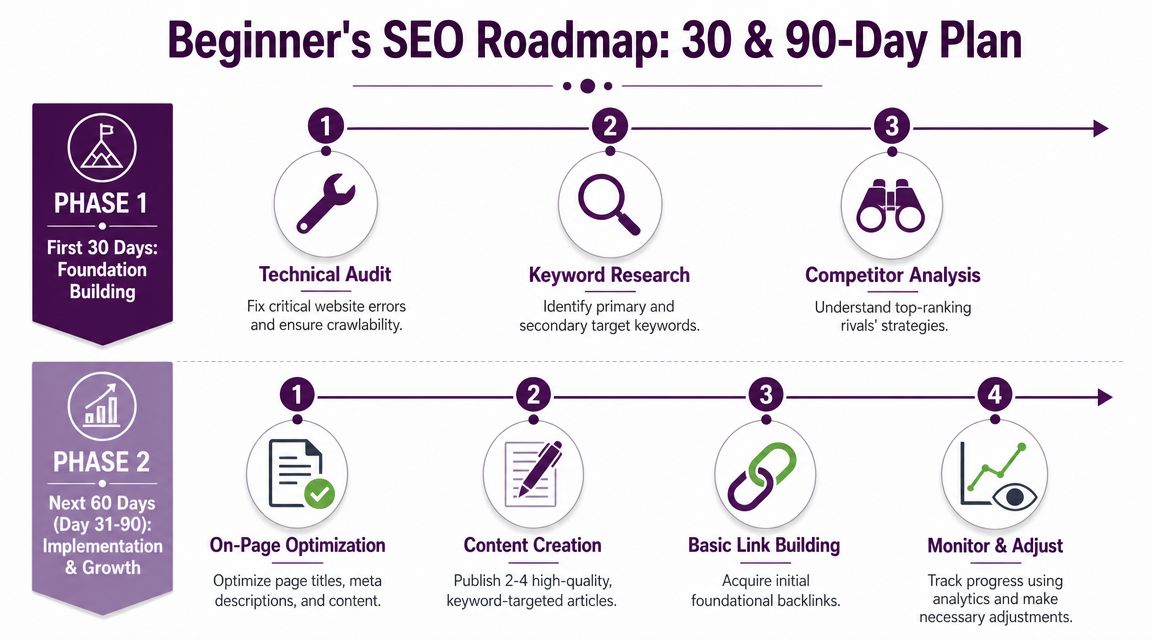
In the first month, focus on setup and correction.
Install your core tools: Connect Google Search Console and GA4.
Check crawlability and page basics: Review titles, headings, URLs, alt text, and internal links on your most important pages.
Choose a small keyword set: Prioritize intent-matched terms that are realistic for a newer site.
Improve a short list of pages: Pick a handful of pages tied directly to leads, sales, or core services.
Review technical stability: Use your performance reports to spot slow or unstable pages.
This explainer gives a helpful overview if you want to hear the logic out loud before building your routine.
Days 31 to 90
The next phase is about compounding what worked.
Create a repeatable publishing and optimization rhythm. Add a small number of new pages based on the keyword opportunities you identified earlier. Tighten internal linking. Revisit Search Console trends. Update pages that are gaining impressions but underperforming on clicks.
A simple 90-day rhythm often looks like this:
Timeframe | Priority |
|---|---|
Month 1 | Fix setup issues and improve current high-value pages |
Month 2 | Publish targeted new content and strengthen internal links |
Month 3 | Measure results, revise pages, and expand what's showing traction |
Working rule: Don't add more pages until you've learned from the ones already getting impressions.
That discipline keeps beginners from drowning in output.
Choosing Your SEO Tools and Workflow
The hardest part of SEO for many beginners isn't learning the terms. It's dealing with scattered data.
Search Console shows one view. GA4 shows another. Rank tracking sits elsewhere. Technical audit findings live in a separate tool. Backlink data is in another tab. By the time you collect everything, you've burned the time you should've spent improving pages.
Avoid tool overload
Beginners usually need tools in a few categories:
Research tools for keywords and competitors
Tracking tools for visibility and page performance
Audit tools for technical issues
Workflow tools for turning findings into action
The mistake is collecting tools before building a process. A cleaner workflow is better than a larger stack. Review your data in one place, decide what matters most, then assign the next actions.
If you're comparing options, this roundup of the best SEO tools for small business in 2026 is a useful place to start.
For beginners, the best platform usually isn't the one with the most charts. It's the one that reduces hesitation. You want something that helps connect rankings, content, technical issues, and page priorities so you can act without second-guessing every move.
If you're ready to put this beginners guide to search engine optimization into practice, Keyword Kick is a strong next step. It brings Google Search Console, GA4, rank tracking, backlinks, audits, and keyword research into one workspace, then uses the K² AI Agent to tell you what to do next. Instead of bouncing between reports, you get prioritized actions tied to actual growth opportunities. The free plan makes it easy to start without adding more complexity to your workflow.