Introduction
2026 has been one of the most volatile years in Google's recent history. Three major updates in the first four months. Significant ranking shuffles across multiple industries. Sites that had been stable for years suddenly finding themselves on page 2 — or off page 1 entirely.
If your traffic has shifted unexpectedly this year, an algorithm update is likely involved. If it hasn't, understanding what's changing now is the best way to ensure it stays that way.
This guide covers every major Google update in 2026, what each one targeted, who got hit, and — most usefully — what you should actually do about it.
2026 Google Algorithm Updates: Timeline
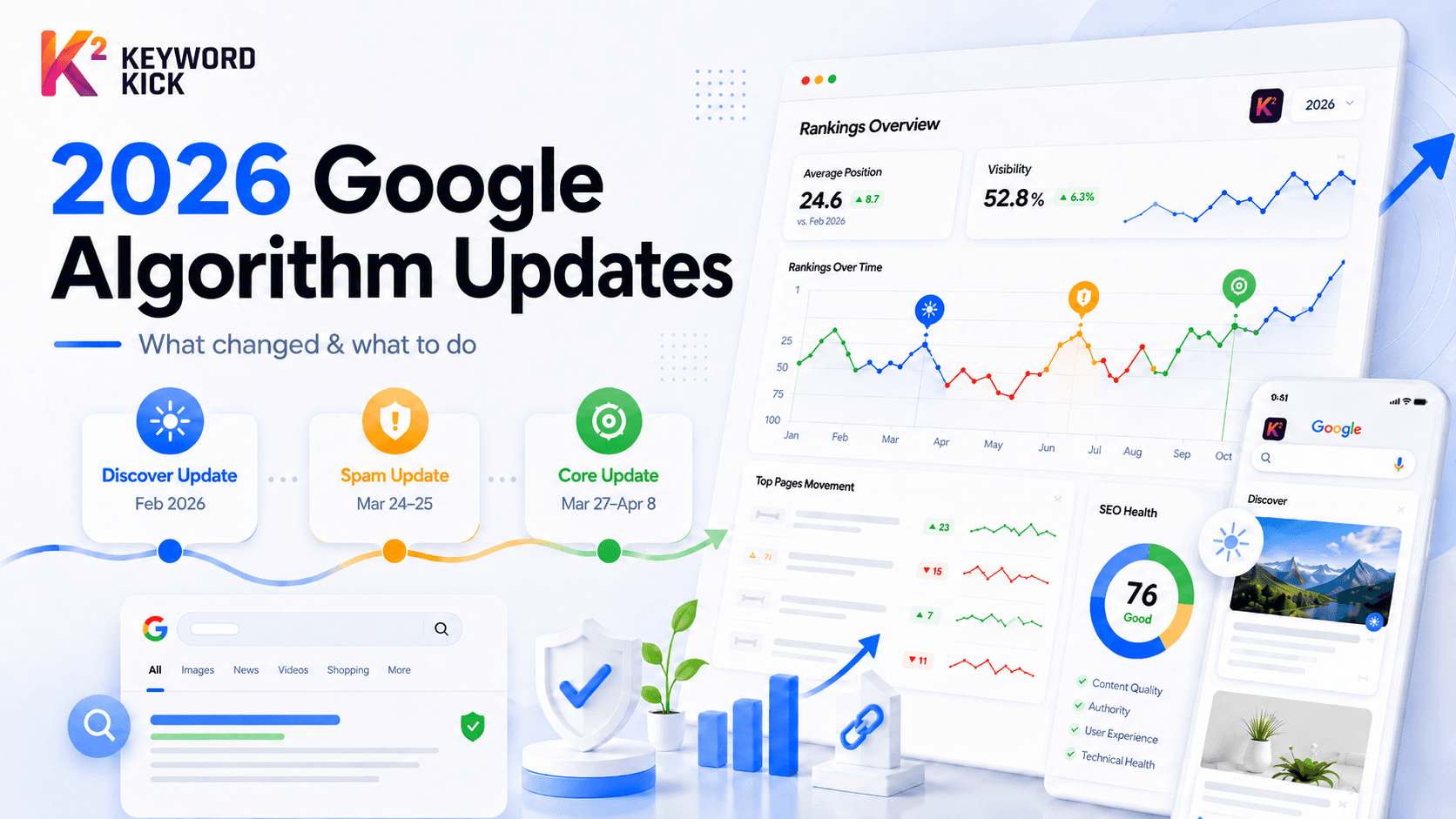
Update | Dates | Primary Focus |
|---|---|---|
February 2026 Discover Core Update | Feb 5 – Feb 26 | Google Discover; local relevance, original deep-dive content |
March 2026 Spam Update | Mar 24 – Mar 25 | AI content abuse, expired domain manipulation, site reputation abuse |
March 2026 Core Update | Mar 27 – Apr 8 | Broad quality re-evaluation — one of the most volatile on record |
Each update has a different target and a different set of winners and losers. Understanding which one affected your site determines what you do next.
February 2026 Discover Core Update (Feb 5 – Feb 26)
What it targeted
This update focused specifically on Google Discover — the content feed served to mobile users on the Google app and Chrome's new tab page. It prioritised:
Local relevance and geographic context
Original, in-depth content over aggregated summaries
Fresh, timely content from credible publishers
Who was most affected
Sites that rely on Google Discover for significant traffic — primarily news publishers, lifestyle blogs, and content-heavy e-commerce brands — saw the sharpest fluctuations. Sites with thin, templated content that previously performed well in Discover saw notable drops.
What to do if this affected you
Discover traffic is notoriously harder to diagnose than organic search traffic because Discover doesn't follow keyword targeting in the same way. The signals that matter most are topical relevance to the user, content freshness, and high-quality imagery.
If Discover traffic dropped: audit your recent content for originality and depth. Discover rewards content that tells a story or provides unique insight — not content that covers the same ground as every other site in your niche. Make sure your featured images are high resolution and compelling. Discover is a visual feed.
March 2026 Spam Update (Mar 24 – Mar 25)
What it targeted
A rapid two-day rollout — unusually fast for a Google update — that focused on three specific manipulation patterns:
Scaled AI content abuse: Sites mass-publishing AI-generated content with no meaningful human editing, fact-checking, or original analysis
Expired domain manipulation: Buying expired domains with existing authority and redirecting them to unrelated content to inherit their link equity
Site reputation abuse: Established domains hosting low-quality third-party content (sponsored posts, parasite SEO) to rank for keywords unrelated to the site's core topic
Who was most affected
Sites running large-scale AI content operations without genuine editorial oversight took the clearest hits. Niche affiliate sites built on expired authority domains also saw significant drops. Legitimate businesses that had accepted low-quality sponsored content from third parties found those pages deindexed or demoted.
What to do if this affected you
For AI content concerns: the issue isn't that the content was written with AI — it's that it lacks differentiation. Google's systems are increasingly capable of detecting content that adds no unique value to the existing pool of information on a topic. The fix is editorial depth: add original data, real examples, expert perspective, or first-hand experience to affected pages.
For expired domain issues: there's no easy fix. If the site's history is fundamentally misaligned with its current content, recovery is slow. Focus on building genuine topical authority through consistent, high-quality content rather than trying to recover from the inherited penalty.
For site reputation abuse: remove or noindex the offending third-party content. File a reconsideration request if you received a manual action. Going forward, treat any third-party content published on your domain as a reflection of your site's quality standards — because Google does.
March 2026 Core Update (Mar 27 – Apr 8)
What it targeted
The biggest update of the year so far. This was a broad quality re-evaluation — Google's most volatile core update in recent memory, with significant SERP reshuffling across virtually every industry vertical.
The central theme: Google is raising what it calls the "proof threshold" for content. It's no longer enough to cover a topic comprehensively. Content now needs to demonstrably earn its position as the definitive answer to a query — through originality, expertise, and information that can't be found anywhere else.
Three specific shifts that drove the volatility:
Information originality and "information gain" Google is explicitly rewarding content that adds something new — original research, unique data, genuine first-hand experience, or analysis that other sources don't provide. Content that aggregates existing information without adding perspective is losing visibility, regardless of technical quality.
Topical coherence over breadth Sites with deep expertise in a focused subject area are outperforming broad "authority" sites that publish thin content across many disconnected topics. A site that covers 20 related topics well is outranking a site that covers 200 tangentially related topics adequately.
Enhanced intent recognition Google's AI systems are now evaluating the context of a query — not just the keyword. A page that technically contains the right words but doesn't address the specific intent behind the search (transactional, informational, navigational) is being demoted in favour of pages that structurally match what the user actually wants to do.
Who was most affected
Broad niche sites with content spread across loosely related topics. Sites that relied on a high volume of low-effort posts to capture long-tail traffic. Sites where content quality varies significantly across the domain — strong pillar pages alongside thin supporting articles. E-commerce sites with duplicate or near-duplicate category pages.
What to do if this affected you
Start with a content audit. Identify pages that lost traffic after March 27. For each affected page, ask honestly: does this page provide something a user couldn't get from the next 5 results? If not, it needs either a meaningful upgrade or consolidation with a stronger page.
Priorities topical depth over topical breadth in your content strategy going forward. If your site covers a wide range of loosely related topics, consider narrowing the focus or clearly organizing content into topic clusters where each cluster has genuine depth.
Fix intent mismatches. Compare your ranking pages against what's currently on page 1 for their target keywords. If the format, depth, or structure of your content doesn't match what Google is serving for those queries, align it.
The Bigger Pattern: What 2026 Updates Have in Common
All three 2026 updates, despite different specific targets, reflect the same underlying direction:
Google is shifting from evaluating what you say to evaluating why you deserve to say it.
Technical quality, keyword coverage, and page speed remain necessary — but they're table stakes. The sites gaining ground in 2026 are those demonstrating genuine expertise through original content, consistent topical focus, and credible authorship signals.
This isn't a new direction — it's the acceleration of a trend that started with the Helpful Content System in 2022 and the E-E-A-T guidelines that followed. What's new is the precision with which Google's systems can now apply these evaluations at scale.
How to Know If an Update Affected Your Site
Not every traffic drop is algorithm-related. Before assuming an update hit you, rule out the obvious:
Technical issues (accidental noindex, crawl errors, server downtime) — check your site audit
Seasonality — compare year-over-year, not just month-over-month
Lost backlinks — check your backlink profile for significant losses around the same dates
Manual actions — check Google Search Console for manual action notifications
If none of the above explain the drop, and the timing aligns with an update rollout, you're likely dealing with an algorithmic impact.
In Keyword Kick:
Keyword Kick's Rank Tracking overlays known Google algorithm update dates directly on your ranking history charts. This makes it immediately visible whether a ranking drop coincides with a specific update — or whether it happened independently and has a different cause.
Use the Ranking Changes report (filter: Declined) to identify which keywords moved down and when. Sort by the drop date to cluster keywords that fell around the same update period.
What to Do Right Now: A Prioritized Action Plan
If you saw a traffic drop between Feb 5 – Feb 26 (Discover Update): Audit your Discover-sourced content for freshness and originality. Improve featured images. Increase depth on thin pieces that were previously performing in Discover.
If you saw a traffic drop around Mar 24–25 (Spam Update): Audit for AI-generated content lacking human oversight. Review third-party content published on your domain. Check for expired domain redirects in your backlink profile that might now be flagged.
If you saw a traffic drop between Mar 27 – Apr 8 (Core Update): Run a full content audit. Identify pages that lost the most traffic. Prioritize upgrading pages where you can add genuine originality and depth. Consolidate thin pages into stronger ones. Fix intent mismatches against current SERP results.
If your traffic is stable or growing: Don't change what's working. Document your current content approach so you can replicate what's performing. Add rank tracking alerts in Keyword Kick so you're notified immediately if any future update causes sudden movement — rather than discovering it weeks later.
What to Expect for the Rest of 2026
Google typically runs 4–6 core updates per year. Based on the pattern established in the first quarter, expect continued emphasis on:
Content originality and information gain
Topical authority and site focus
AI Overviews and zero-click search expansion — which will continue to reduce clicks for informational queries where Google can answer directly
E-E-A-T signals, especially for YMYL (Your Money or Your Life) verticals including health, finance, and legal
The sites that will weather the rest of 2026 well are those focused on being genuinely useful to a specific audience — not those optimizing primarily for algorithms.