You publish the page. It's well structured, on brand, and technically clean. You add internal links, tighten the title tag, and even earn a few solid backlinks. Then a competitor jumps ahead anyway.
That's the moment most SEO teams start guessing. They tweak headings, refresh copy, watch rankings for a week, and hope the problem resolves itself. Sometimes it does. More often, the rival was playing a broader game you weren't tracking in the first place.
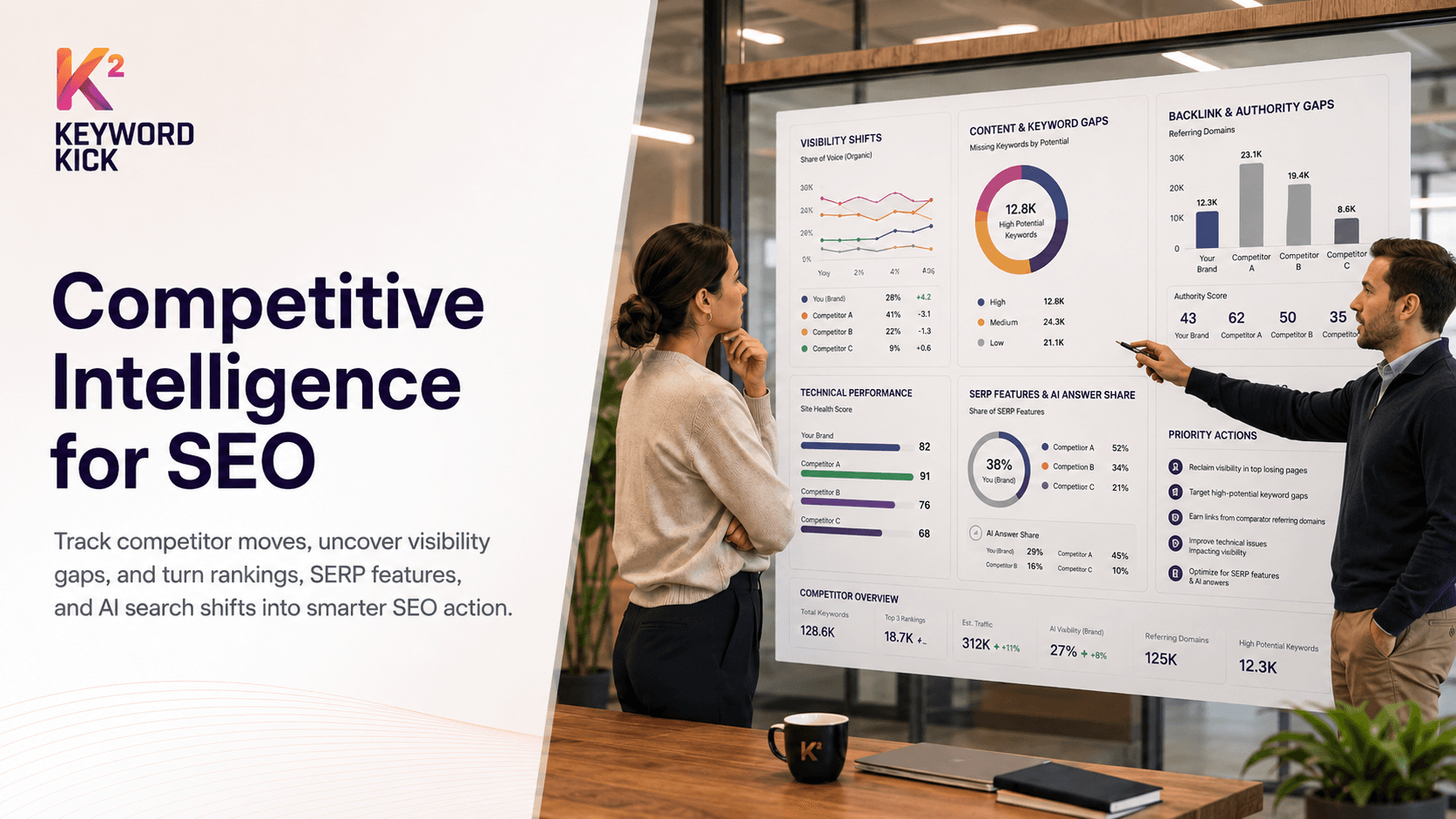
Competitive intelligence for SEO fixes that blind spot. It gives your team a working view of the market, not just a report on your own site. When you can see which topics competitors are clustering around, which SERP features they're winning, which pages they're upgrading, and where AI answer engines start citing them instead of you, SEO stops feeling like reactive maintenance and starts behaving like strategy.
Beyond Rankings Why Your SEO Feels Like a Guessing Game
A common pattern shows up in mature SEO programs. The team does a lot of things right, but performance still feels unstable. One month, a category page climbs. The next month, a competitor replaces it with a comparison page, a buying guide, and a featured snippet result. Your analytics show the loss after it happens, but they don't explain the move early enough to counter it.
That's why rankings alone aren't enough. A rank tracker can tell you that you dropped from one position to another. It usually won't tell you whether the underlying shift came from a new content cluster, a stronger internal linking pattern, ownership of SERP features, or a change in what search engines consider the best response to intent.
The bigger issue is visibility without context. If your reporting still centers on isolated keyword positions, your team is seeing the scoreboard but not the game film. That problem is exactly why data visibility alone is no longer enough for teams trying to grow in crowded search markets.
Your competitor rarely beats you with one better page. They beat you with a better system.
In practice, competitive intelligence for SEO means tracking what matters before the loss becomes obvious in traffic. Which new pages did a rival launch? Which existing pages did they expand? Which terms are they starting to dominate that connect directly to revenue? Which answer formats are replacing classic organic clicks?
Teams that don't build that habit end up treating SEO like weather. Teams that do build it start treating SEO like market surveillance.
What Is Competitive Intelligence for SEO
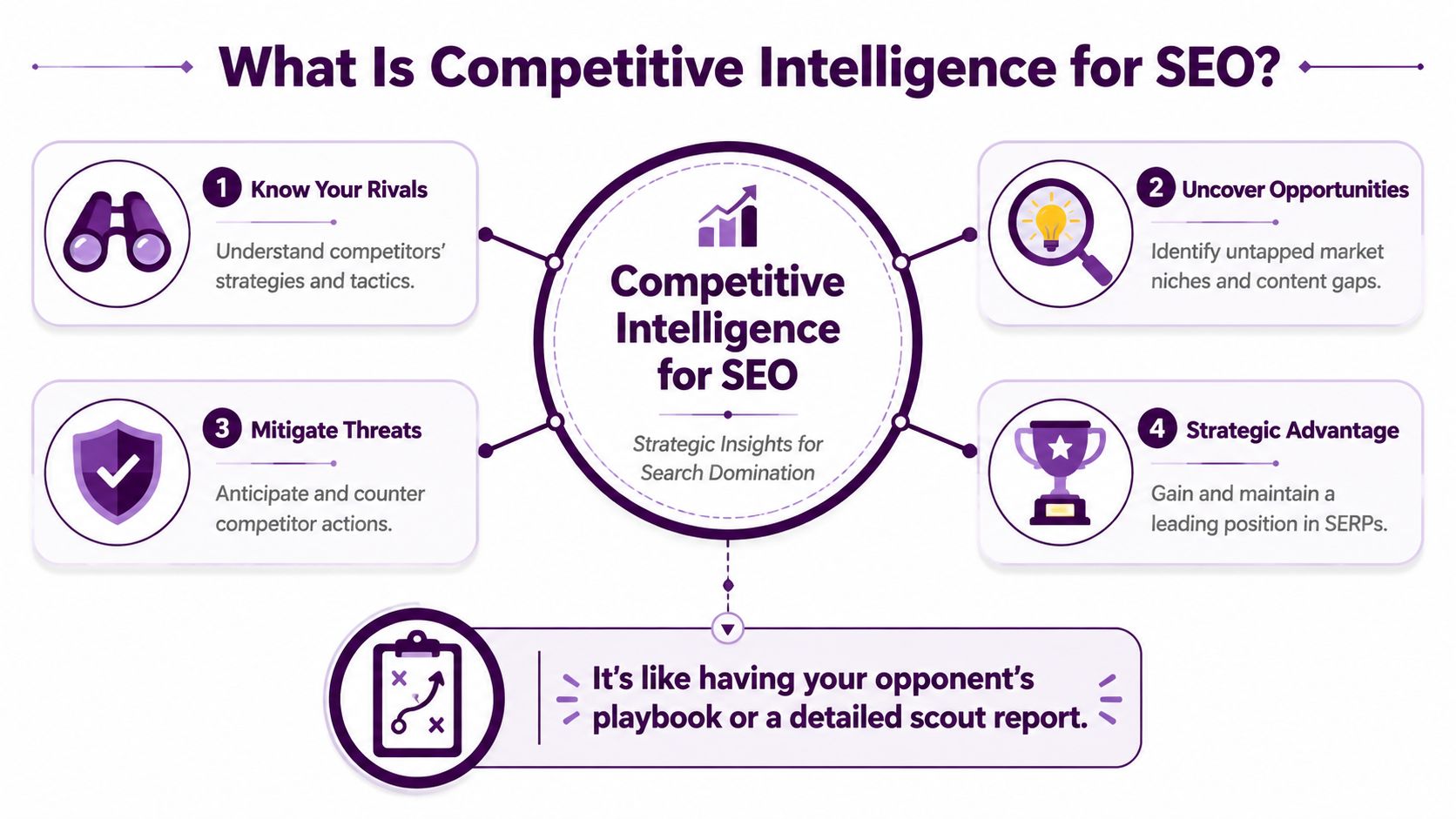
Competitive intelligence for SEO is the discipline of watching the search space closely enough to understand what competitors are doing, why it's working, and where you can counter with a stronger move.
The simplest analogy is a scout report. You want the opponent's playbook, but you also want film review, field conditions, and a sense of how the next few games are likely to unfold. In search, that means looking beyond a shortlist of rankings and understanding the full visibility pattern around a market.
A useful starting point is this guide to competitive SEO, which reflects how the practice has changed. Modern SEO intelligence has evolved from simple keyword checks to continuous market-share monitoring, tracking Share of Voice, content gaps, backlink gaps, and AI Answer Share as core metrics. It also frames the work as an ongoing loop of identify, analyze, execute, and measure, rather than a static audit (Riff Analytics).
What it includes in real work
Teams often think “competitor analysis” and picture a spreadsheet of shared keywords. That's only one slice of the job. Useful competitive intelligence for SEO usually includes:
Visibility mapping: Which domains consistently appear across your money terms, not just who you consider your business rivals.
Content pattern analysis: Which topic clusters, page formats, and search intents competitors are serving well.
Authority review: Where their backlinks come from and what that suggests about digital PR, partnerships, or linkable assets.
Search surface monitoring: Which competitors own snippets, comparison placements, and AI answer citations.
If you need a broader primer on the mechanics, this overview of competitor analysis is a practical reference point.
What competitive intelligence is not
It isn't copying headlines from the site above you.
It also isn't running one quarterly audit, producing a slide deck, and calling the problem solved. That approach breaks because search moves too fast. Pages get replaced, snippets change hands, intent shifts, and answer engines start citing different sources without waiting for your next planning cycle.
Practical rule: If your process can't tell you what changed this week, it's not intelligence. It's archive work.
The strongest teams treat CI as operating infrastructure. It supports editorial planning, technical prioritization, link acquisition, and executive reporting. That's when it starts driving business outcomes instead of just filling dashboards.
The Four Pillars of Modern SEO Intelligence
If you try to monitor everything at once, competitive intelligence becomes noise. The cleaner approach is to separate it into four pillars. Each one answers a different question about how competitors are taking visibility from you.
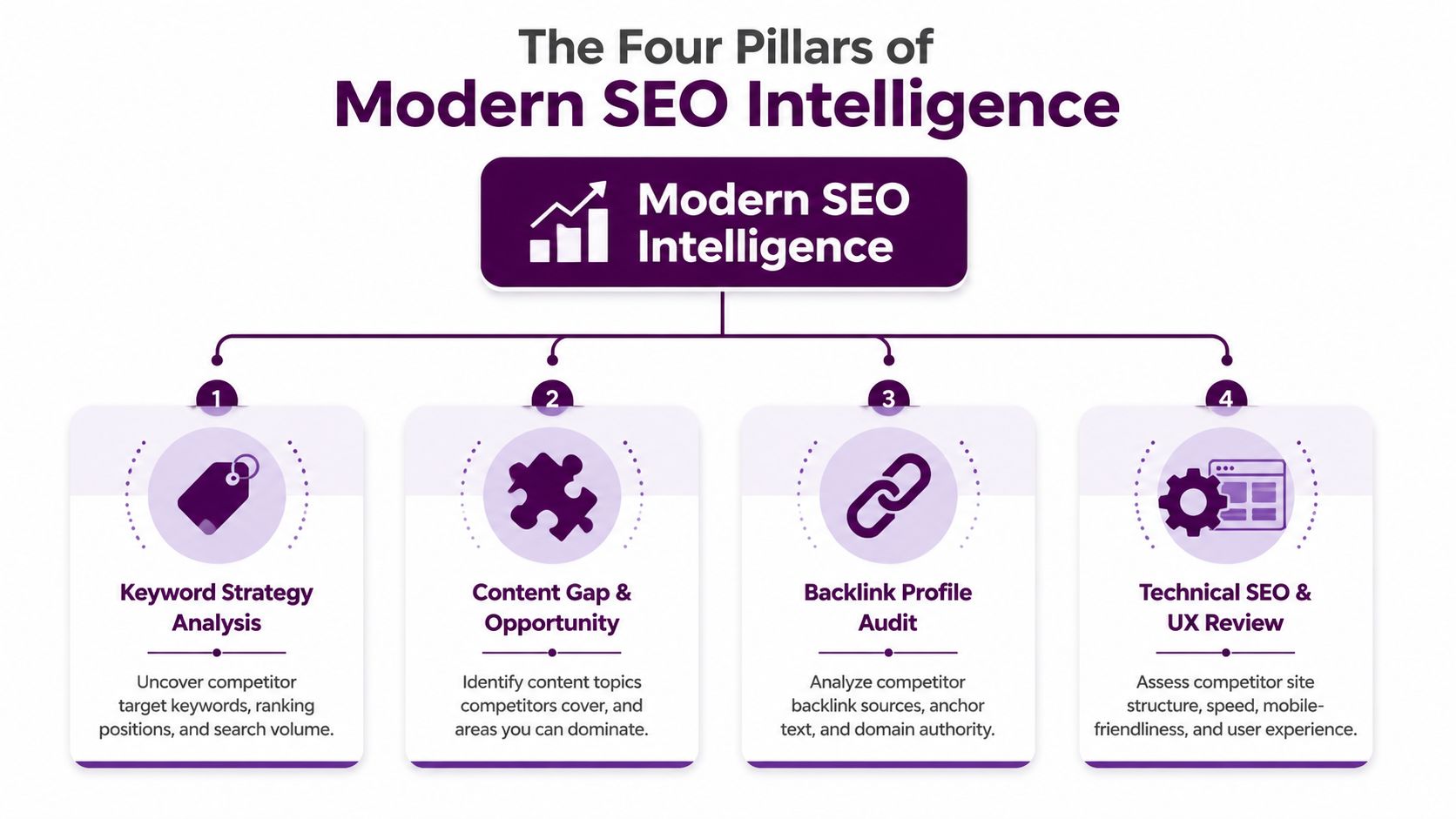
Content and keyword gaps
This pillar asks a blunt question. Where are competitors visible and you aren't?
That includes missing topics, weak subtopics, misaligned intent, and thin formats. Sometimes the gap is obvious, like a rival owning “best for beginners” or “X vs Y” terms while your site only targets product pages. Sometimes it's subtler, such as a competitor building a full topic cluster around one commercial theme while your site has one scattered article.
A strong content gap process also helps teams avoid chasing vanity terms. If a topic doesn't connect to pipeline, product discovery, or qualified demand, it shouldn't sit at the top of the roadmap. That's why many teams formalize the process with content gap reviews, not just keyword exports. This SEO content gap analysis guide is a useful model for how to structure that work.
Backlink and authority gaps
Rankings don't move on content alone. Competitors often win because they've built stronger authority around the same topic set.
Look at where their links come from, but don't stop at the domain list. Check patterns. Are they earning mentions from review sites, industry publications, partner ecosystems, or original research? Those patterns reveal how they're manufacturing trust at scale.
A backlink gap is useful when it produces action. That might mean building a better comparison asset, publishing original data, improving linkable tools, or fixing weak internal distribution so your best-linked pages support commercial URLs.
Technical performance gaps
Often, teams underinvest because technical work feels less visible than content. That's a mistake.
A technical benchmark called the Site Speed Decay Coefficient shows that for every 0.1s increase in load time over 1s, the probability of ranking in the top 3 drops by 7%, and competitors with sub-1s load times capture 24% more organic traffic. That makes technical performance a direct competitive differentiator, not a housekeeping task.
Here's the practical reading of that data. If two pages satisfy intent similarly, the faster and cleaner experience can become the deciding edge. That's especially true when your rival's templates are leaner, their mobile rendering is stronger, or their site architecture makes discovery easier for both users and crawlers.
SERP feature and AI answer share
Blue links no longer describe the whole contest. You also need to know who owns snippets, answer boxes, comparison modules, and AI-generated citations.
This pillar matters because the visible winner in search isn't always the classic organic result. A competitor can hold the answer surface while ranking below you in a traditional listing. If your reporting ignores that, your team can celebrate “stable rankings” while losing actual attention.
A compact way to manage the four pillars is below:
Pillar | Core question | Typical output |
|---|---|---|
Content and keyword gaps | What demand are we missing? | New briefs, page refreshes, cluster plans |
Backlink and authority gaps | Why do they look more credible? | Outreach targets, asset ideas, PR angles |
Technical performance gaps | Are we slower or weaker structurally? | Dev tickets, template fixes, UX improvements |
SERP feature and AI answer share | Who owns the search surface? | Snippet plans, schema work, answer-focused formatting |
A Repeatable 5 Step Competitive Intelligence Framework
The biggest mistake teams make is treating competitive intelligence as a project. It works better as a loop. You don't finish it. You keep it running.
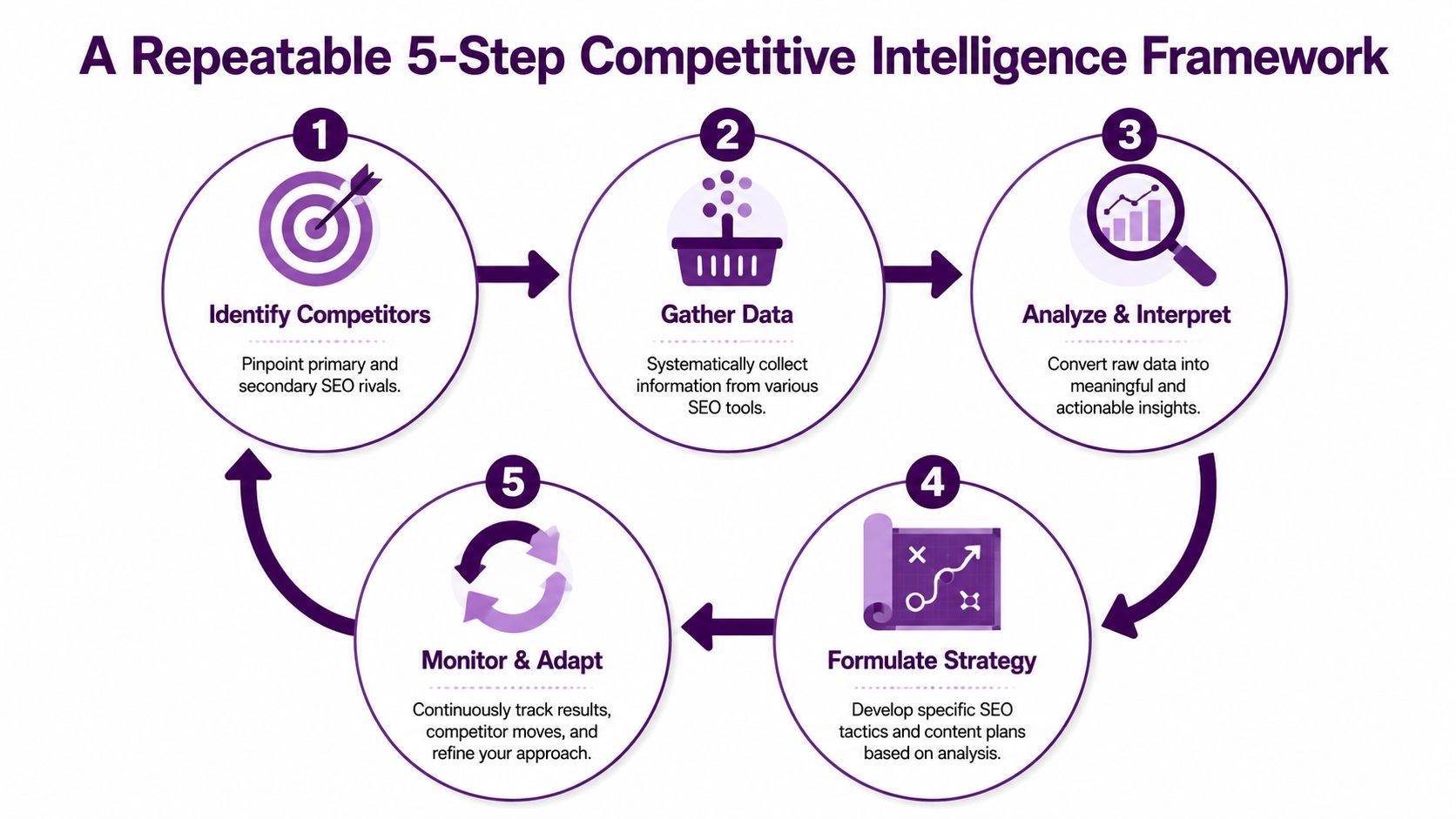
A structured model helps. This framework for structured competitive intelligence aligns well with how SEO teams can turn observation into decisions instead of isolated reports.
Step 1 Identify the real competitors
Your SEO competitors are often not your sales competitors.
A retailer may compete with publishers, marketplaces, and review sites in search. A SaaS company may compete with template libraries, glossary pages, and affiliate roundups. Start with the queries that matter to the business, then list the domains that repeatedly win across those query sets.
Use two buckets:
Primary SEO rivals for high-intent terms tied closely to revenue
Secondary SEO rivals for informational and early-stage discovery terms
This prevents a common waste of effort, benchmarking against a brand that barely overlaps with your actual search footprint.
Step 2 Run focused gap analysis
Once the competitor set is right, audit them through the four pillars. Don't try to boil the ocean. Review the pages, features, and patterns that affect important query groups first.
A practical worksheet should answer questions like these:
Which pages are new: Has a competitor launched fresh pages for comparison, alternatives, or use-case searches?
Which pages are improving: Are they expanding depth, adding FAQs, embedding richer media, or tightening internal links?
Which surfaces are shifting: Are they winning snippets or citations where they didn't appear before?
Which weaknesses are ours: Are we missing the topic entirely, serving the wrong intent, or underperforming technically?
Most “SEO surprises” stop being surprising once a team starts reviewing competitor page changes on a schedule.
Step 3 Prioritize by business value
Many programs often falter at this stage. They identify a long list of gaps and treat them as equal. They aren't equal.
A better filter is Traffic Value Potential, defined as (Search Volume × CPC × Avg. Conversion Rate). The purpose isn't to produce a perfect forecast. It's to stop giving the same priority to a low-value blog gap and a commercially important keyword cluster. The same benchmark notes that closing a gap of just 5% in high-value keywords can increase qualified leads by 9-14%.
Use an impact-versus-effort view before assigning work:
Opportunity type | Impact signal | Effort signal | Typical priority |
|---|---|---|---|
Refresh a near-ranking money page | Strong commercial intent | Usually moderate | High |
Build a missing comparison page | Clear competitor demand capture | Moderate | High |
Rework weak template UX | Broad effect across many URLs | Higher coordination | Medium to high |
Publish a speculative top-of-funnel topic | Unclear business link | Varies | Lower |
Step 4 Convert findings into deliverables
Intelligence is only useful when another team can act on it.
That means turning observations into specific outputs:
For content teams: Briefs with target intent, page angle, missing subtopics, required comparison elements, and internal link targets
For developers: Tickets tied to pages or templates with clear expected ranking impact
For outreach or PR teams: Prospect lists and linkable asset ideas based on competitor authority patterns
For leadership: A short list of market movements that affect visibility or revenue risk
If the finding can't be assigned to an owner with a deadline, it's still research, not operations.
Step 5 Monitor and iterate
This last step is what makes the whole system work. Search is dynamic, so your CI process has to watch movement, not snapshots.
Set a regular cadence for tracking page replacements, ranking changes, SERP feature ownership, and shifts in answer visibility. Then ask a narrow set of recurring questions. What changed? Why did it change? What action follows?
The teams that improve fastest don't just monitor themselves. They monitor reactions. If you publish a stronger page and a competitor updates theirs two weeks later, that response is itself useful intelligence.
From Data to Decisions How to Operationalize Insights
The reason many competitive intelligence programs stall isn't lack of data. It's fragmentation.
One person checks Google Search Console. Another lives in GA4. Rankings sit in one platform, backlinks in another, technical issues in a crawler, and competitor notes in scattered docs. By the time someone merges the pieces, the moment to act has already passed.
That setup also makes prioritization messy. Teams see dozens of issues but struggle to answer basic questions with confidence. Which pages deserve attention first? Was the drop caused by intent mismatch, technical regressions, a rival page upgrade, or a lost SERP feature? Which changes are market noise and which ones are meaningful shifts?
Build one working view of the market
Operationalizing competitive intelligence means giving the team a single environment where those signals can be read together.

That's where an integrated platform becomes useful. Keyword Kick is one example. It combines Google Analytics 4, Google Search Console, rank tracking, backlinks, technical SEO, and competitor analysis into one workspace, then uses the K² AI Agent to surface prioritized recommendations from that combined dataset. In practical terms, that helps a team ask questions like “Why did traffic drop last week?” or “Which pages should we optimize first?” without manually stitching five reports together.
Turn monitoring into an early-warning system
This matters even more because one-off audits miss fast-moving search changes. A major challenge in competitive intelligence is turning it into an early-warning system for shifts in content and AI search. As Google's AI Overviews expand, teams need to monitor citation volatility and SERP feature ownership so they can react before traffic loss becomes visible in analytics (Competitive Intelligence Alliance).
A usable operating model usually includes:
Shared dashboards: One place to compare your domain and rivals by topic, page type, and search surface
Priority alerts: Notifications for page replacements, SERP feature losses, or meaningful visibility shifts
Owner-based workflows: Content, technical, and link actions routed to the right team instead of buried in a deck
Decision logs: A record of what changed, what the team did, and what happened next
A dashboard becomes valuable when it shortens the distance between signal and action.
That's the shift. Competitive intelligence stops being something the SEO lead “does” and becomes a recurring business system the whole team can use.
Competitive SEO Intelligence in Action
The framework becomes clearer when you apply it to actual decisions.
Example one e-commerce category growth
An e-commerce team notices that several product pages are stable, but non-brand discovery is flat. Instead of rewriting category copy again, they review the SERPs and find that competitors are winning “best for beginners” and comparison-style queries with pages built for first-time buyers, not just shoppers ready to purchase.
The team maps the gap, studies the top-ranking pages, and sees a pattern. Rivals aren't just listing products. They're answering hesitations, grouping options by use case, and structuring content in a way that can win richer search features. The response isn't to clone the format. It's to build a better version with clearer recommendations, stronger filtering logic, and tighter internal links into revenue-driving product pages.
A few weeks later, the page doesn't just attract new visits. It gives the category a stronger entry point for users who weren't ready to land directly on a product grid.
Example two B2B SaaS visibility loss
A B2B SaaS company sees branded performance holding steady, but informational demand starts slipping. Manual rank checks don't show a dramatic collapse, which makes the decline harder to diagnose. A closer look reveals that a competitor is being cited more often in answer-style search experiences because their pages are structured around direct questions, concise definitions, and clean supporting examples.
The losing team had the expertise. What they lacked was packaging. Their pages buried answers under long introductions and product-led framing. Once they spotted the pattern, they rebuilt a set of key pages around explicit questions, tighter summaries, and clearer topical hierarchy.
The winning adjustment often isn't “write more.” It's “format the expertise so search systems can use it.”
The result is a better fit for both classic search and answer surfaces. More importantly, the team now has a repeatable check for future shifts instead of waiting for another unexplained decline.
Winning the Long Game with Continuous Intelligence
SEO gets easier to manage when you stop treating it like isolated page optimization and start treating it like market observation. That's what competitive intelligence for SEO really is. A continuous system for seeing where visibility is moving, why competitors are gaining ground, and which actions deserve immediate attention.
The long-term advantage comes from repetition. Identify key competitors. Analyze the gaps that matter. Prioritize by business value. Turn findings into assigned work. Monitor what changes next. Teams that run that loop consistently make fewer reactive decisions and waste less effort on low-value fixes.
There's also a business case for taking it seriously. Companies that systematically use competitive intelligence tools report 23% higher revenue growth and 18% better profit margins than those that do not, showing the value of moving from manual checks to scalable market analysis (Traject Data).
That doesn't mean every team needs more dashboards. It means they need a system that converts competitive movement into prioritized action. In search, the teams that win over time usually aren't guessing better. They're seeing more, sooner, and acting with more discipline.
If you want to build that system without stitching together disconnected tools, Keyword Kick is a practical place to start. It gives teams a single workspace for rankings, backlinks, technical SEO, competitor analysis, GA4, and Search Console data, with the K² AI Agent helping turn those signals into prioritized next steps. There's a free forever plan and a trial on paid tiers, so you can test the workflow before committing to a larger rollout.