Your ranking report shows a decline, analytics tells a different story, and the development team wants a reproducible issue before it touches the site. Meanwhile, regional marketers are asking which pages deserve attention, and finance wants to know what another software subscription will change.
That's the buying problem an enterprise SEO software platform should solve. The decision isn't which product has the longest feature list. It's which system can help your organization make defensible decisions, assign work safely, and connect completed changes to business outcomes.
Why Enterprise SEO Buying Is Different
Consider a representative buying scenario, not a documented case study. An SEO lead oversees regional websites, an agency supplies keyword reports, and developers maintain a shared commerce template. Each group can explain its own work, but nobody can confidently connect a traffic decline to the affected templates, commercial priorities, and responsible owners.
Buying a larger keyword allowance won't resolve that problem. The buyer needs a shared operating environment with consistent definitions, accessible evidence, and clear accountability.

Buy for the Operating Constraint
Use the organizational bottleneck to establish the buying category before comparing products.
| Operating constraint | Lightweight workflow may suffice when | Enterprise evaluation becomes necessary when |
|---|---|---|
| Decision ownership | The same person investigates and implements | Specialists must coordinate across departments |
| Website complexity | Changes are easy to inspect individually | Shared templates affect extensive page groups |
| Reporting | Stakeholders accept a common report | Brands and regions require distinct views |
| Accountability | Informal review is sufficient | Changes require documented ownership and approval |
The scale of this coordination problem is visible in enterprise staffing research. A compilation of enterprise SEO benchmarks reports that 66% of teams managing websites with more than 10,000 URLs employed at least six in-house SEO professionals, while 37% of enterprise organizations used decentralized SEO structures, compared with 16% of mid-market firms.
Those findings don't prove that every large website needs a unified platform. They do support evaluating how software coordinates specialists, rather than assuming the SEO lead will reconcile everyone's work manually.
Define What Different Stakeholders Need
Agencies should expect portfolio visibility without exposing client information across accounts. In-house teams should expect shared definitions and a reliable handoff to content, engineering, and analytics colleagues. Multi-brand organizations should require both local ownership and consolidated oversight.
Buying principle: Evaluate the path from evidence to an assigned decision, not just the quality of the dashboard.
My recommendation is to identify where that path currently breaks. If analysts can diagnose problems but nobody implements their recommendations, more discovery features may add little value. If teams disagree about the underlying evidence, integration and data definitions deserve priority over automation.
What an Enterprise SEO Platform Does
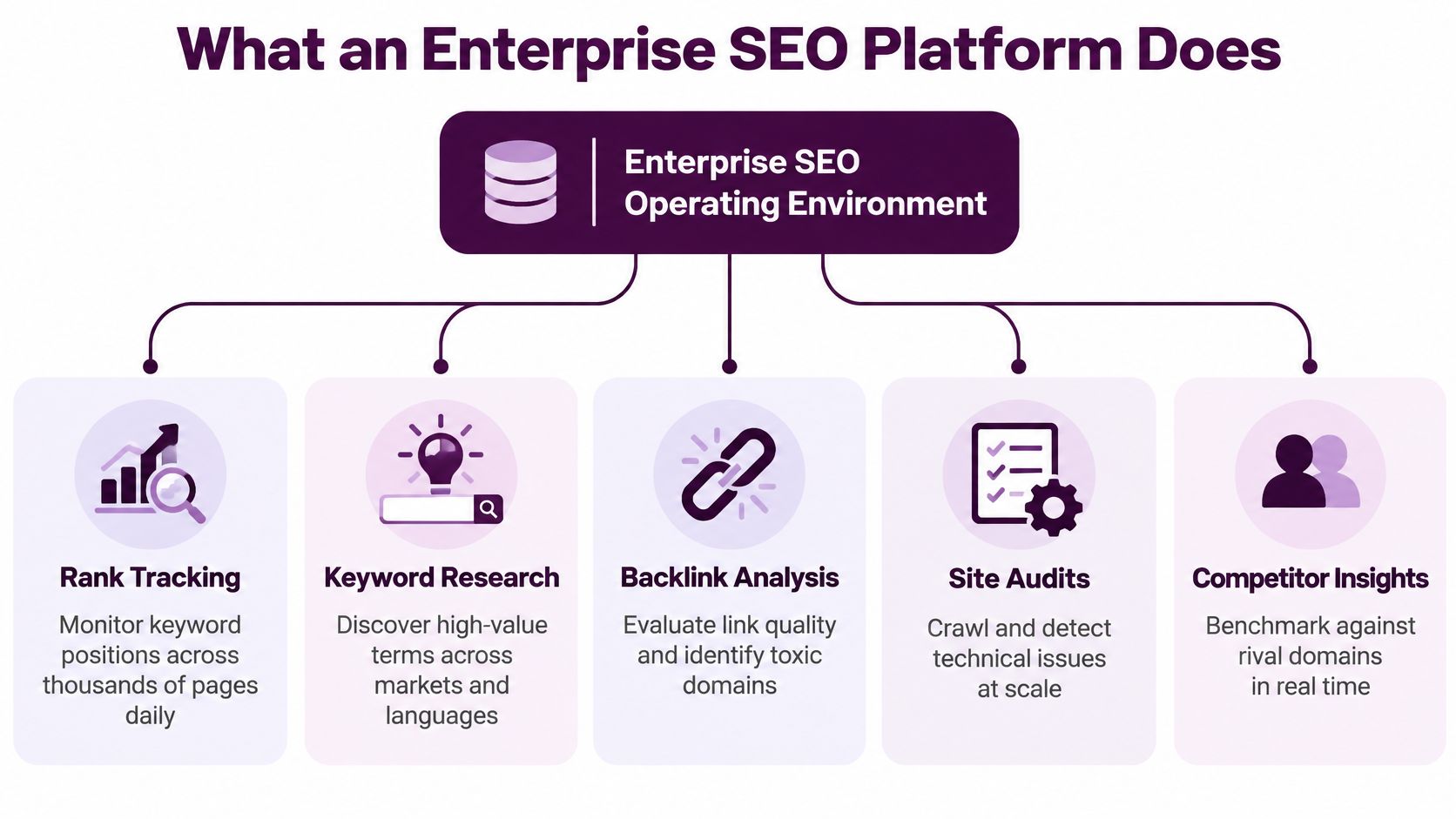
An enterprise SEO platform should connect discovery, diagnosis, prioritization, execution, and measurement in a common workspace. Rank tracking supplies visibility signals, keyword research supports demand analysis, and technical audits help investigate whether website implementation prevents intended discovery or access.
Backlink analysis, competitor intelligence, content analysis, and search engine results page monitoring should add context. Reporting should then explain what the team observed, what it changed, and what happened afterward.
From Software Collection to Operating Environment
The category emerged as organizations moved beyond spreadsheets and standalone analytics toward centralized keyword management and reporting. A historical enterprise SEO software analysis describes the category's emergence in the late 2000s and early 2010s and cites a 2010 survey of more than 10,000 marketers, in which 4% of respondents who paid for SEO software used an enterprise-level platform.
That's a historical snapshot, not a current adoption estimate. Its relevance is the underlying shift: enterprise buyers were beginning to purchase coordination and scale, rather than isolated analytical functions.
For a buyer today, the practical question is whether the product connects its capabilities:
- Discovery to relevance: Can researchers group queries by intent, market, and appropriate landing page?
- Diagnosis to evidence: Can an analyst inspect the URLs and observations behind an issue?
- Prioritization to ownership: Can a recommendation become an accountable assignment?
- Execution to measurement: Can stakeholders identify the affected pages and evaluate subsequent results?
A keyword list alone doesn't answer those questions. As a focused research exercise, BEDHEAD's resource on mattress keyword intent and volume offers a category-specific starting point for discussing demand. In a platform evaluation, ask the vendor to carry that kind of research through to page selection and an implementation brief.
Distinguish Integration From Coexistence
A product can contain an audit screen, a keyword screen, and a reporting screen without connecting their underlying records. Require a demonstration in which the same page retains its market, business category, ownership, and historical context across those views.
Treat backlink scores as investigative inputs, not instructions to remove links automatically. Likewise, treat content recommendations as hypotheses that an editor can inspect, not requirements to insert every suggested term.
The enterprise distinction is continuity of context. A specialist point solution may remain useful, but the central platform should help colleagues make decisions without rebuilding that context at every handoff.
Evaluate Platforms Against Enterprise Criteria
Start with acceptance criteria before booking demonstrations. Otherwise, vendors can lead with polished capabilities that don't address your organization's hardest constraints.
Write requirements as testable statements. “Supports international SEO” is too vague; “preserves separate query, device, country, and landing-page views for our regional reporting workflow” gives the vendor something concrete to demonstrate.
Establish Gates Before Weighted Preferences
Divide requirements into mandatory gates, weighted priorities, and optional conveniences. A failed gate should exclude a candidate unless procurement explicitly accepts the workaround and its consequences.
For weighted priorities, use qualitative ratings such as demonstrated, partially demonstrated, and unproven. Give operational necessities greater importance than presentation preferences, and record the evidence behind each rating.
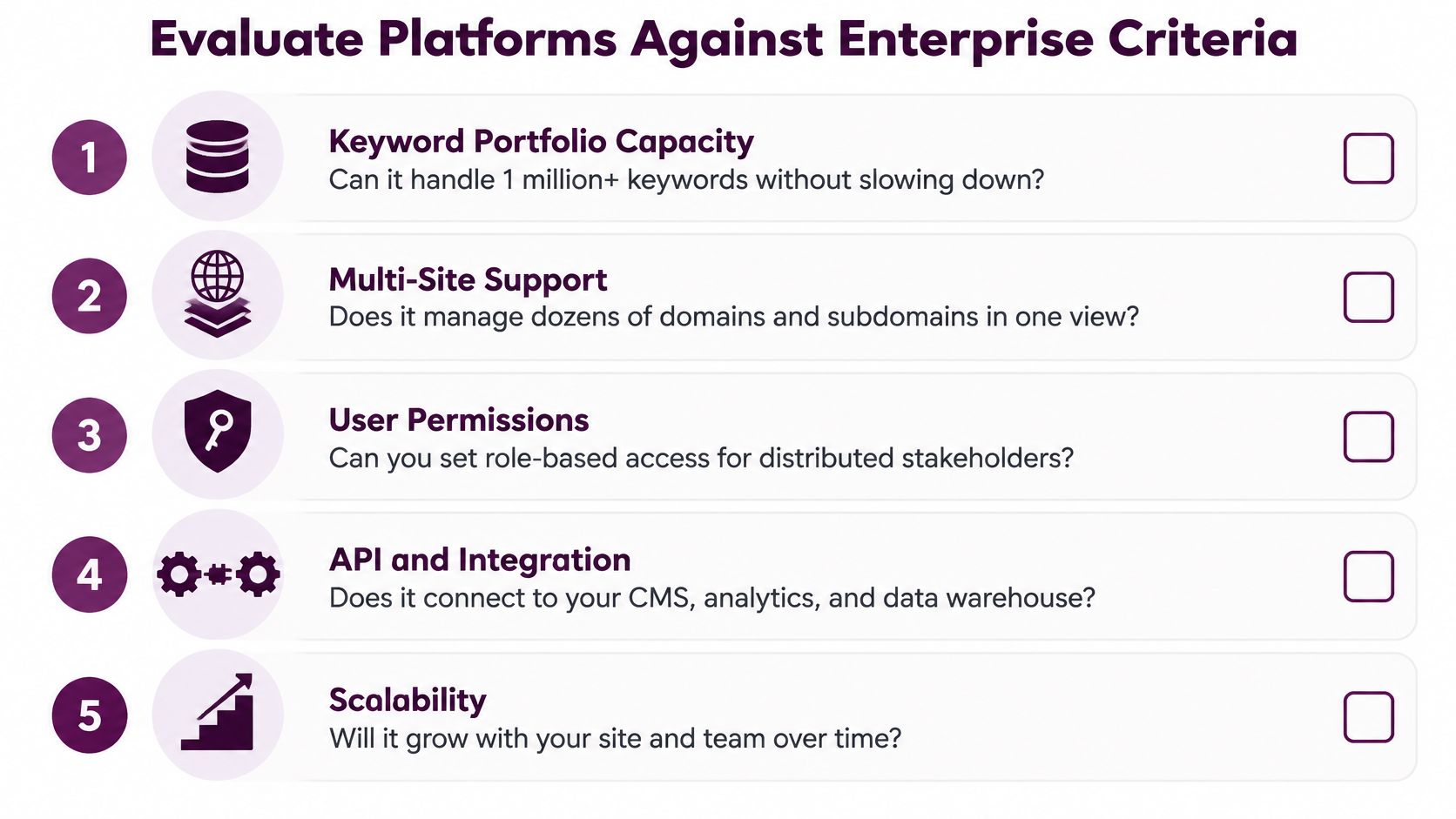
- Data coverage: Specify required markets, devices, domains, keyword groups, and page inventories. Ask vendors to identify gaps rather than presenting aggregate database size.
- Freshness and history: Request collection timestamps, refresh schedules, retention rules, and treatment of missing observations. Distinguish a newly refreshed interface from newly collected data.
- Interoperability: Test API access, export formats, integration authentication, and the fields available to downstream systems.
- Access control: Define who can view, configure, approve, export, and administer each project.
- Commercial fit: Request contractual limits for usage, storage, rendering, support, additional users, and departure assistance.
Don't award credit for a roadmap promise as though the capability exists. Record it separately, including whether your deployment depends on its delivery.
Test Decisions, Not Navigation
Give shortlisted vendors a representative question: which commercially important page group needs attention, what evidence supports that conclusion, and who should act? Ask your own analyst to repeat the investigation rather than watching only the vendor's specialist.
Then involve the intended recipient. A developer should assess whether the technical evidence is reproducible; an editor should assess whether the content assignment is usable. This reveals whether the product fits the entire workflow or merely the analyst's investigation.
When outside specialists will operate the system, assess the service model separately. Headline Marketing Agency's resource on comparing ecommerce SEO agencies can serve as a companion evaluation topic, but keep software acceptance and agency accountability as distinct procurement decisions.
A vendor-assisted success demonstrates possibility. A buyer-operated success provides stronger evidence of operational fit.
Finally, ask for an explanation of every proposed integration. Identify whether it's native, partner-maintained, export-based, or dependent on custom development. Your shortlist should reflect the maintenance work your team is willing to own, not the integrations named on a slide.
Compare Capabilities That Change Buying Decisions
The Enterprise SEO Platform Decision Matrix below compares buying requirements rather than unsupported vendor rankings. “Buyer priority” identifies the operating context in which each capability deserves particular attention, not a universal hierarchy.
| Evaluation criterion | What to verify | Why it changes the decision | Buyer priority |
|---|---|---|---|
| Unified search data | Matching rules, source lineage, shared dimensions | Determines whether analysts can reconcile signals | Fragmented analytics environments |
| Technical auditing | Issue evidence, exclusions, template grouping | Determines whether developers can reproduce findings | Large or frequently changing sites |
| JavaScript rendering | Rendered HTML, resource failures, discovered links | Tests visibility beyond original HTML | Client-rendered websites |
| Content and keyword analysis | Intent review, page mapping, competing-page detection | Connects research with editorial decisions | Content-led acquisition teams |
| Backlink intelligence | Inspectable referring pages and historical changes | Supports investigation beyond summary scores | Link-dependent research workflows |
| Competitor and SERP visibility | Market, device, feature, and query coverage | Makes comparisons relevant to the actual audience | Competitive and regional portfolios |
| Business reporting | Traceable definitions and conversion reconciliation | Supports defensible outcome reporting | Revenue-accountable teams |
| Integrations | Available fields, limits, authentication, failure handling | Exposes ongoing engineering obligations | Warehouse-centered organizations |
| Governance | Permissions, approvals, audit records, access separation | Determines whether deployment fits organizational controls | Distributed or regulated teams |
| AI-assisted prioritization | Evidence, uncertainty, review, and override options | Tests whether recommendations are usable and contestable | Teams considering automated advice |
Technical Depth Versus Broad Coverage
For JavaScript-heavy sites, ask vendors to compare original HTML with rendered output on representative templates. Google's JavaScript SEO documentation explains that Google processes JavaScript through crawling, rendering, and indexing, uses headless Chromium, and cannot render blocked pages or JavaScript resources.
The same documentation recommends consistent canonical URLs between original HTML and rendered output. Translate that guidance into acceptance tests: can the platform expose a canonical changed during execution, distinguish a blocked resource from missing content, and show internal links discovered only after rendering?
A rendering checkbox isn't enough. Ask whether analysts can inspect the evidence, adjust relevant settings, and repeat the test. Also avoid treating the platform's rendering result as proof of what Google indexed.
For buyers replacing a ranking-focused workflow, a review of accuranker alternatives can support shortlist discovery. Apply the matrix independently rather than assuming that adding more modules automatically produces enterprise readiness.
Usability Versus Configurability
A highly configurable interface may suit technical specialists but require additional training for regional marketers. A simplified interface may encourage participation while limiting the investigative detail specialists need.
Test those audiences separately. Ask an occasional user to interpret a recommendation and a specialist to challenge its underlying evidence. My preference is for progressive detail: understandable summaries with access to the observations and configuration that produced them.
Also examine saved views and shared definitions. If every user must configure the same segmentation independently, account for that work in your operating model.
Automation Versus Decision Authority
AI-generated advice should earn priority through evidence, not confident language. Ask the vendor to distinguish observed facts, inferred causes, proposed actions, and expected outcomes.
Breadth can be useful when it removes repeated data reconciliation. Specialist tools remain reasonable when a critical investigation requires deeper controls than the central platform provides. Compare both options against the cost of moving evidence and decisions between systems.
Trade-off to accept deliberately: Retaining a specialist tool is reasonable. Retaining an undocumented reconciliation process is harder to defend.
The strongest candidate isn't necessarily the product that replaces every subscription. It's the product combination your team can operate coherently, with explicit responsibility for the work that remains outside the platform.
Match Platform Choices to Real Use Cases
The following scenarios are hypothetical buying situations. They illustrate how the same capabilities deserve different priorities depending on who will use the software and what they're accountable for.
An Agency Managing Client Portfolios
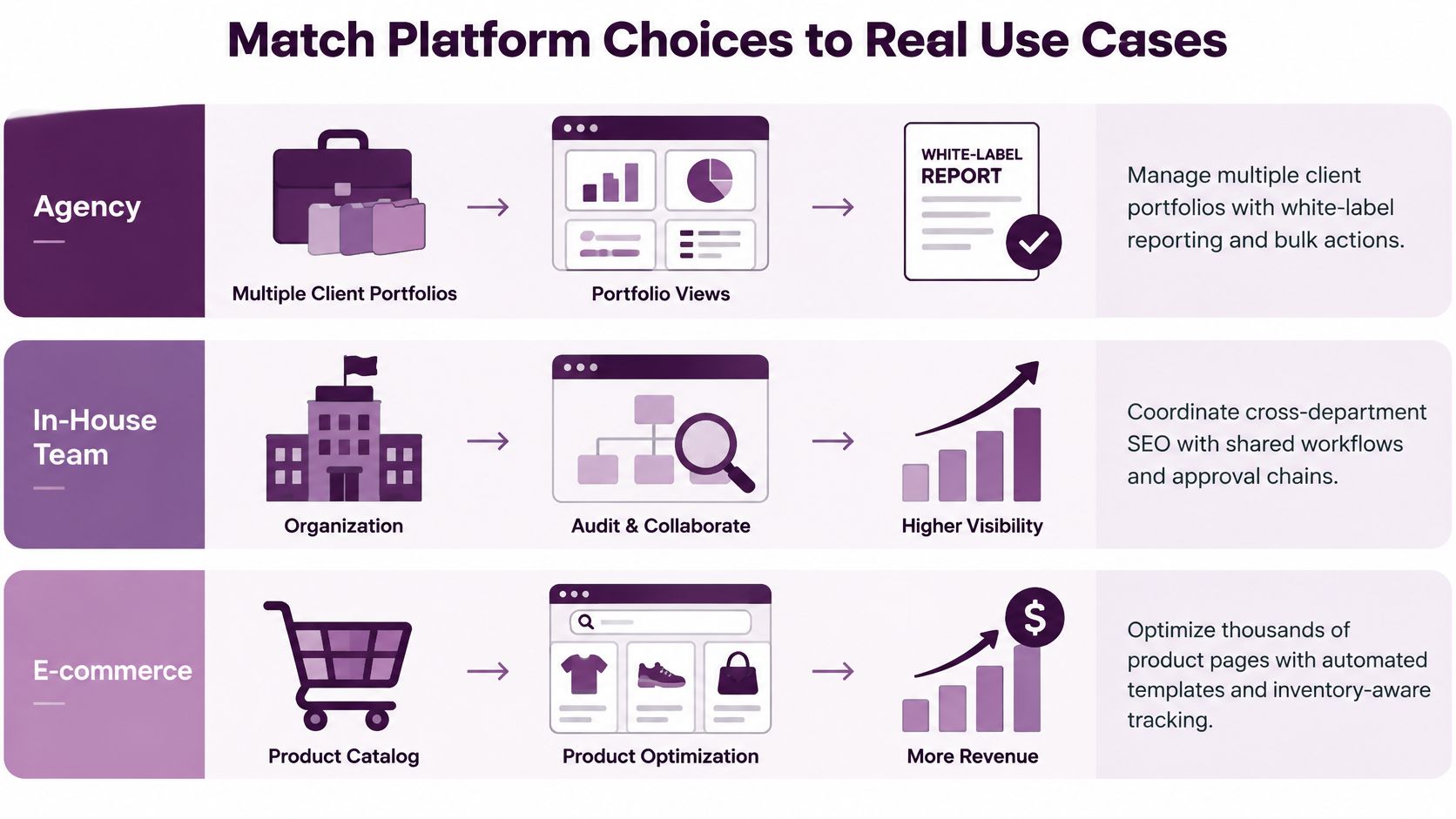
An agency director needs to identify accounts requiring intervention while account managers prepare client-specific explanations. Prioritize project separation, reusable reporting structures, configurable branding, bulk administration, and straightforward account handover.
The failure mode is a portfolio view that looks convenient but hides incompatible client definitions. Ask whether each client can retain its own conversion logic without undermining agency-level oversight.
- Shortlist question: Can an account manager produce a defensible client update without borrowing an analyst to reconcile the data?
- Acceptance test: Move a project between responsible staff and verify access, annotations, scheduled reports, and ownership.
An In-House Team Coordinating Brands and Regions
A central SEO team may define standards while regional marketers control local content. Favor local permissions, explicit exceptions, shared taxonomy, and visibility into who accepted or declined a recommendation.
For a small central team, administration effort deserves particular scrutiny. Don't choose a governance model that requires more ongoing oversight than the available staff can provide.
The failure mode is centralizing reports without clarifying decision rights. Ask who can authorize a change affecting a shared template and how regional objections are recorded.
An E-Commerce Operation With Frequent Changes
A commerce team should bring representative product, category, filter, and unavailable-item pages into the evaluation. Require grouping by template and commercial category so specialists can investigate a pattern without treating every affected URL as a separate editorial task.
The key failure mode is an undifferentiated issue queue. A long list of findings is less useful than an actionable template-level diagnosis with an accountable engineering owner.
Ask whether the proposed workflow distinguishes a deliberate merchandising decision from an accidental technical change. Product availability and commercial context should be available for review rather than inferred from an SEO metric alone.
A Technical Team Responsible for Site Reliability
A technically specialized team may reasonably prioritize reproducible crawls, extraction flexibility, rendered-page inspection, and comparison exports over broad content tooling.
Its failure mode is accepting a summary score without access to the observations underneath. Require the vendor to investigate an unfamiliar issue, not just demonstrate a prepared report.
Choose according to the bottleneck. Agencies may need administrative control, regional teams may need controlled delegation, commerce teams may need template-level triage, and technical specialists may need deeper diagnostic access.
Implement, Integrate, and Prove ROI
Treat implementation as a controlled transition, not an account-creation exercise. Begin with a data inventory covering source systems, credentials, project ownership, reporting definitions, and existing dependencies.
Assign a business owner to each priority workflow. For planning discussions, the Advisor Momentum SEO roadmap guide is a relevant companion resource; your platform rollout should still have its own acceptance criteria, responsible owners, and documented checkpoints.
Preserve What the Organization Already Relies On
Before retiring existing tools, establish what can migrate and what must remain accessible elsewhere. Don't assume exported historical data can be imported into a replacement product with the same meaning.
- Rankings and history: Confirm whether existing observations can be imported, archived, or only retained separately.
- Tags and segmentation: Map previous classifications to the new taxonomy and document changed definitions.
- Workflows and annotations: Preserve open assignments, implementation records, and useful investigation notes.
- Permissions and reports: Recreate approved access and reconcile replacement reports before withdrawing established ones.
Connect sources in controlled stages and inspect sample records. Check URL normalization, market mappings, reporting periods, and treatment of redirected pages. When selecting an SEO reporting tool, include report reconciliation and maintenance responsibility in acceptance testing.
Verify Crawling Before Expanding Coverage
Test crawl prioritization against recently changed and commercially important URLs. Review sitemap monitoring, duplicate and low-value URL detection, robots.txt interpretation, rendered-page inspection, and configurable request load.
Google's guidance for large-site crawl management identifies extremely large, changing inventories as situations where crawling may not occur as frequently as site owners want, and recommends using sitemaps for important or recently updated pages. Don't generalize that concern to every enterprise website.
Compare the platform's discovered, blocked, and excluded inventories with a known sample. Require explanations for discrepancies before scheduling wider crawls.
Govern Recommendations and Measure Outcomes
Separate detection from execution. Flagging a suspected canonical problem is different from publishing changes to medical claims, financial guidance, legal language, or product specifications.
Require supporting evidence, a human decision owner, approval where appropriate, and a retrievable change record. Establish a way to stop or reverse deployment before enabling broader automation.
Measurement should distinguish:
- Operational outcomes: Investigation effort, accepted assignments, completed changes, and rework.
- Search outcomes: Visibility, landing-page performance, and observed AI citations.
- Business outcomes: Conversions, qualified opportunities, and revenue under agreed attribution rules.
Pew Research Center's analysis of 68,879 Google searches from 900 U.S. adults in March 2025 found result clicks on 8% of searches with an AI summary, versus 15% without one. That supports separating exposure from visits, not assuming citations caused downstream revenue.
Use deployment records and suitable comparison groups where possible. Describe observed business changes cautiously, accounting for seasonality, campaigns, inventory, and other interventions rather than crediting the subscription alone.
Choose With a Practical Recommendation Framework
Choose a broad unified platform when your main constraint is coordinating evidence and decisions across teams. Retain specialist software when a critical diagnostic requirement remains unmet, provided someone owns the connection between systems.
For a smaller team, place greater weight on administration, training, and the ability to act on recommendations. For a distributed organization, prioritize delegated ownership and review controls. For a technically complex site, require successful investigations using your templates before accepting claims of scale.
Make the Shortlist Defensible
Product comparisons such as Semrush vs SE Ranking can help identify candidates, but they shouldn't replace acceptance testing. Require every finalist to address the same representative workflows and disclose unresolved dependencies.
Use a final scorecard that records:
- Operational fit: Which priority decisions can your staff complete independently?
- Time to value: What must happen before the first accepted workflow is usable?
- Change management: Who will administer the system, train colleagues, and resolve exceptions?
- Total cost of ownership: What implementation, integration, specialist-tool, and exit work remains?
- Post-purchase measurement: Which baseline and outcome records will support renewal decisions?
Negotiate Evidence Before Commitment
Ask vendors to attach pilot acceptance criteria to the commercial discussion. Document required capabilities, implementation responsibilities, export rights, support arrangements, and the treatment of unmet requirements.
If an AI-focused candidate performs well, investigate why. A recommendation that your specialists can verify and safely implement deserves more weight than an impressive explanation they can't reproduce.
The practical recommendation is to buy the least complicated operating model that meets your mandatory requirements. Define priority workflows, run a representative pilot, validate outputs against real site data, and agree on success criteria before signing. A defensible purchase leaves your organization knowing both what the platform will handle and what your team must still own.
Keyword Kick offers a unified SEO workspace that connects search, analytics, backlink, and technical signals with AI-assisted prioritization. Visit Keyword Kick to assess how its workflow fits your reporting needs, technical investigations, and priority-page decisions, then test that fit against your own site data.