The most popular advice about SEO is also the least useful: keep publishing, be patient, and the investment will eventually pay off. Patience doesn't rescue a strategy aimed at the wrong customers, and rankings don't pay invoices. SEO is worth it when it helps you acquire profitable demand, not when it makes a reporting dashboard look healthier.
The Wrong Question Most People Ask About SEO
"Is SEO worth it?" sounds like a channel question. It is a capital-allocation question: should you put your next available budget and working hours into organic search instead of another way to reach customers?
That distinction changes what you buy. A rankings project purchases visibility. A business investment needs a credible connection between that visibility and an outcome you value.
Decide what you're buying
Separate your objective into distinct categories before you approve any work:
- Visits: You need an audience you can monetize through advertising, subscriptions, or another established model.
- Qualified demand: You want inquiries from people whose needs, location, and purchasing capacity fit your offer.
- Assisted revenue: You want search content to help buyers evaluate options before they convert through another interaction.
These objectives aren't interchangeable. A publisher might reasonably prioritize readership. A specialist consultancy should care more about suitable prospects than broad reach. An e-commerce team needs to distinguish product discovery from completed purchases.
Investment rule: Define the customer action you want before choosing the keyword you want to rank for.
Your role changes the decision
An agency needs to deliver client value while protecting delivery margins. An in-house marketer needs an investment case that survives scrutiny from finance. A freelancer must decide whether SEO will attract suitable engagements, while a solo publisher must account for unpaid production time.
Write your success statement in operational language: attract inquiries for a particular service, support purchases within a profitable category, or help prospective customers resolve an objection. Then name who will verify that result.
Don't settle for “increase organic traffic.” That leaves too much room for activity that looks productive but doesn't help the business. If your team can't describe the commercial purpose of a proposed page, I wouldn't fund its production yet.
What Organic Search Actually Delivers
Organic search deserves serious consideration because of its historical contribution to website demand, not because every business needs a blog.
BrightEdge's 2014 analysis found organic search generated 51% of visits, compared with 10% from paid search and 5% from social media; business-services websites received 73% of traffic from organic search, demonstrating substantial sector variation, according to Search Engine Land's coverage of the analysis.
BrightEdge's 2019 research measured organic search at 53.3% of trackable traffic, with organic and paid search together accounting for 68%; the report also stated that B2B companies generated twice as much revenue from organic search as from any other channel, according to the BrightEdge channel research report.
Historical importance isn't a revenue forecast
Those findings establish that organic search has been a substantial acquisition channel. They don't tell you what your next content project will earn, how difficult your market will be, or whether visitors will buy your offer.
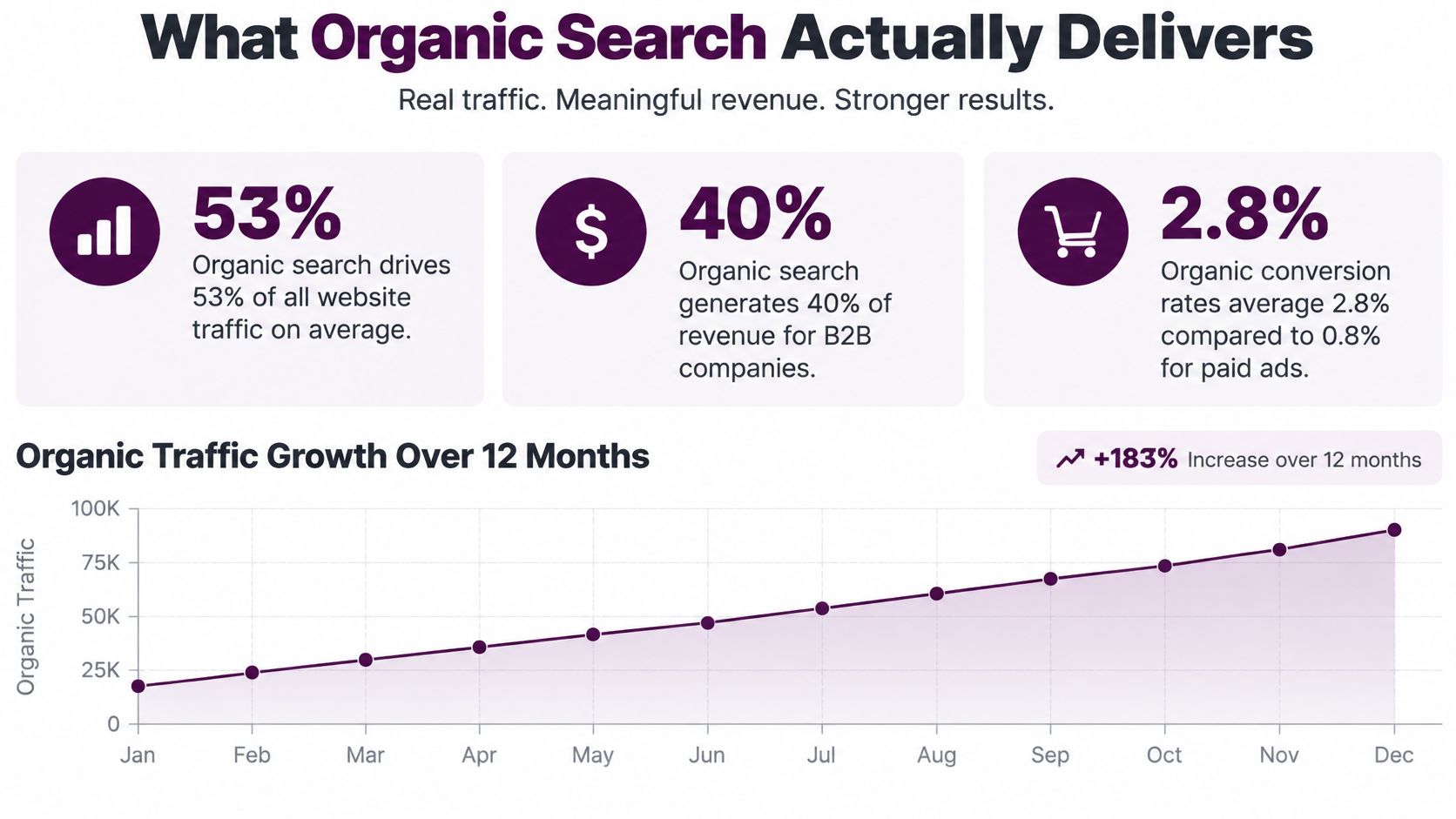
The graphic below should not be used as an investment model. Its additional revenue and growth claims aren't established by the historical research cited above.
What makes the investment different
With paid acquisition, you purchase distribution. With SEO, you invest in assets and capabilities: accessible pages, useful information, relevant links, recognizable expertise, and an understanding of customer searches.
Those assets can support subsequent work. An established product category can provide a foundation for related pages. A useful resource can continue attracting attention after publication. Customers who recognize your business may return through branded searches.
But durable doesn't mean maintenance-free. Teams still need to update information, resolve technical problems, improve offers, and respond to competitors.
My recommendation is to treat organic search as part of your acquisition mix, not as a replacement for every paid campaign. Use the historical evidence to justify investigating the opportunity. Use your own economics to decide whether to fund it.
Realistic Cost vs Return Scenarios by Audience
A monthly retainer isn't the cost of SEO. It's a supplier charge. Your actual investment includes implementation, expert input, development, measurement, and the work your team postpones to make room for it.
There's no defensible universal budget or payoff window in the evidence cited here. Rather than manufacture spending ranges, I'd compare proposals by scope, ownership, and commercial exposure.
SEO Investment Scenarios by Audience
| Audience | Typical monthly budget | Time to meaningful results | Realistic ROI shape |
|---|---|---|---|
| Agencies | Delivery staff, contractors, tools, and account management | Depends on client readiness and implementation access | Client outcomes must support retention and delivery margin |
| In-house teams | Internal salaries plus development, content, and specialist support | Depends on backlog, approvals, and existing visibility | Returns come from incremental contribution after operating costs |
| Freelancers and consultants | Cash spending plus time diverted from paid work | Depends on specialization and available demand | Suitable engagements matter more than inquiry volume |
| Bloggers and solo owners | Tools, hosting, production time, and outsourced help | Depends on audience access and monetization readiness | Revenue must justify both cash costs and unpaid labor |
Match the engagement to the constraint
Agencies: Don't sell a broad retainer when the client can't implement changes. Start with a bounded diagnostic or implementation project, identify blockers, and confirm who owns approvals. Otherwise, your team gets paid to produce recommendations that nobody uses.
In-house teams: Include engineering and merchandising in the business case. An SEO specialist can identify a product-page problem, but the return depends on someone shipping the fix. A funded implementation queue is more useful than a larger strategy document.
Freelancers and consultants: Target engagements you want to deliver. Generic educational traffic has little value if visitors need a service you don't offer or can't afford your work.
Solo owners: Treat your time as scarce capital. Establish how the site will earn money before expanding production, and avoid turning an unproven business into an expensive publishing habit.
A cheaper proposal isn't better value if it leaves the expensive implementation work with you.
Evaluate retainers for ongoing management, projects for defined problems, and internal work for tasks requiring close business knowledge. If authority building is part of the scope, review prospective backlink building sites for relevance rather than buying placements to satisfy an activity target.
Approve work you can connect to a bottleneck. Don't buy a package because its deliverable list is long.
How Long SEO Actually Takes to Pay Off
Don't accept a calendar as a substitute for a diagnosis. A supplier who promises a payoff date without examining your website, competitors, implementation capacity, and buying journey hasn't established the basis for that promise.
Time to implementation, time to visibility, and time to commercial return are different. Your reporting should keep them separate.
Diagnose the starting position
An established website with relevant pages and a specific technical obstruction presents a different task from a new business without useful content or an audience. Likewise, improving a narrowly targeted service page isn't equivalent to challenging established competitors across a national category.
Ask your provider to explain the dependencies:
- Technical readiness: Can search engines access the pages you want customers to find?
- Competitive position: What useful evidence, coverage, or reputation do competing pages offer?
- Content suitability: Does your page satisfy the task behind the search?
- Implementation capacity: Who can publish changes, and what approvals stand in the way?
- Purchase journey: What must happen after discovery before the customer commits?
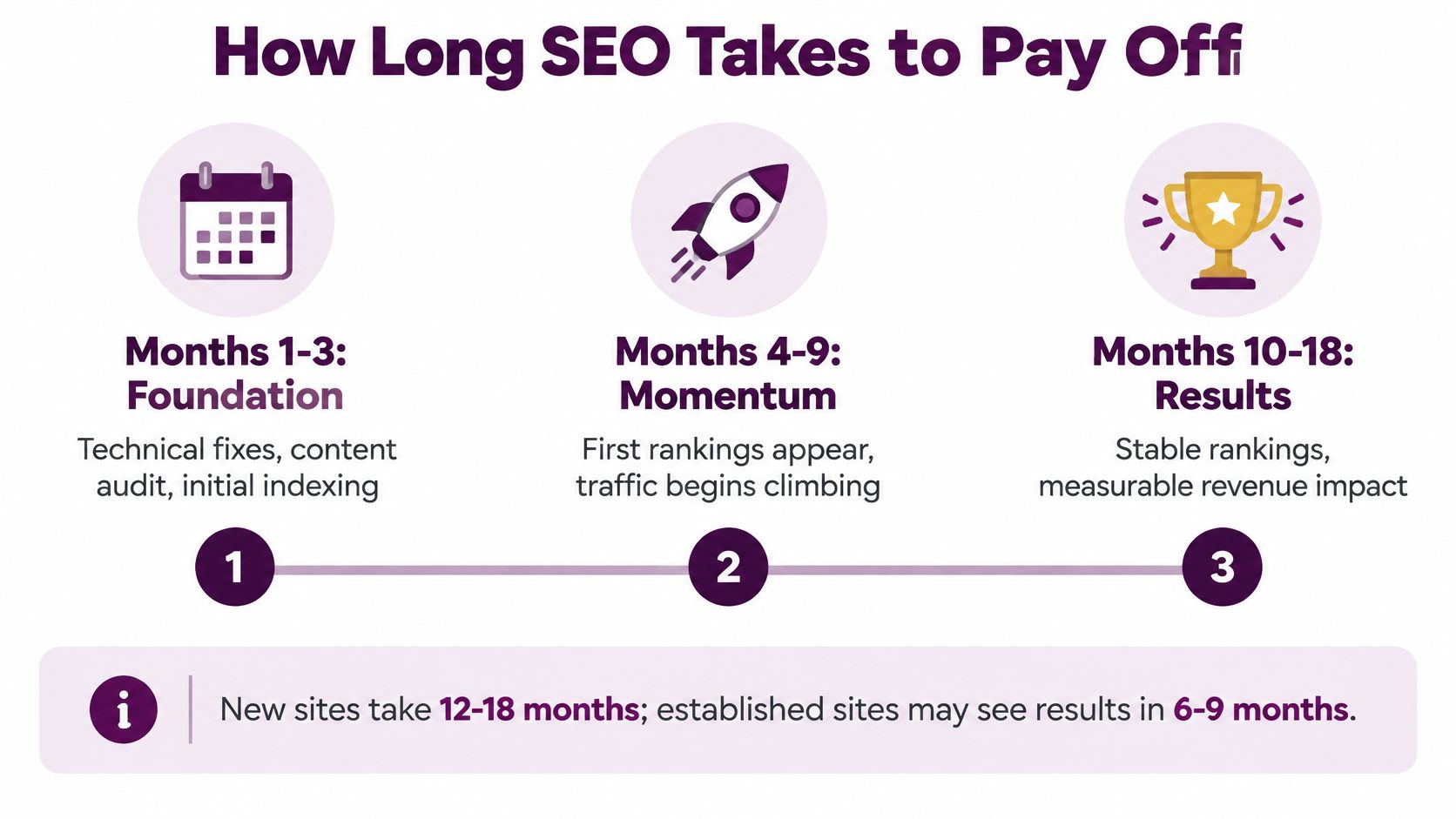
The timeline graphic illustrates a sequence, not a validated schedule. Its calendar windows shouldn't be treated as promises for a new or established website.
Set evidence gates instead of waiting indefinitely
Require confirmation that the agreed changes shipped. Then check whether the intended pages are accessible, indexed, and appearing for relevant searches. Only after that should you judge changes in customer behavior and business results.
An earlier ranking improvement doesn't establish profitability. Equally, an unfinished development ticket tells you nothing about whether the proposed optimization would have worked.
Stop-loss principle: Continue funding a plausible strategy with observable progress. Don't continue funding an unexplained absence of progress.
At each review, ask what changed, what the team learned, and what decision follows. If the answer is always “SEO takes time,” ask for a revised diagnosis.
Patience is justified when you can identify the remaining obstacle and the work needed to remove it. It isn't justified merely because you've already spent money.
Measuring SEO Success When Clicks Disappear
AI-generated answers make the old traffic-first investment case less reliable. You can't assume that greater search visibility will produce a corresponding increase in website visits.
A Pew Research Center browsing study of 900 U.S. adults covering 68,879 Google searches found traditional-result clicks on 8% of visits with an AI Overview versus 15% without one, while links inside AI Overviews received clicks on approximately 1% of visits, as described in the research discussing AI Overviews and browsing behavior.
That comparison doesn't forecast your website's losses or establish the effect for every query. It does give you a concrete reason to stop treating impressions as a proxy for acquired customers.
Build a measurement chain
Connect Google Search Console's query and page data with Google Analytics 4 events, rank tracking, and your CRM or transaction records. Keep their limitations visible: a ranking is an observation, an analytics conversion depends on tracking definitions, and a CRM outcome depends on sales-team data quality.
Use an SEO reporting tool to bring those views together, but define the business events before building the dashboard.
- Qualified leads: Record whether inquiries match your services, geography, and buying requirements.
- Assisted conversions: Examine whether organic content appeared in recorded journeys before another channel received conversion credit.
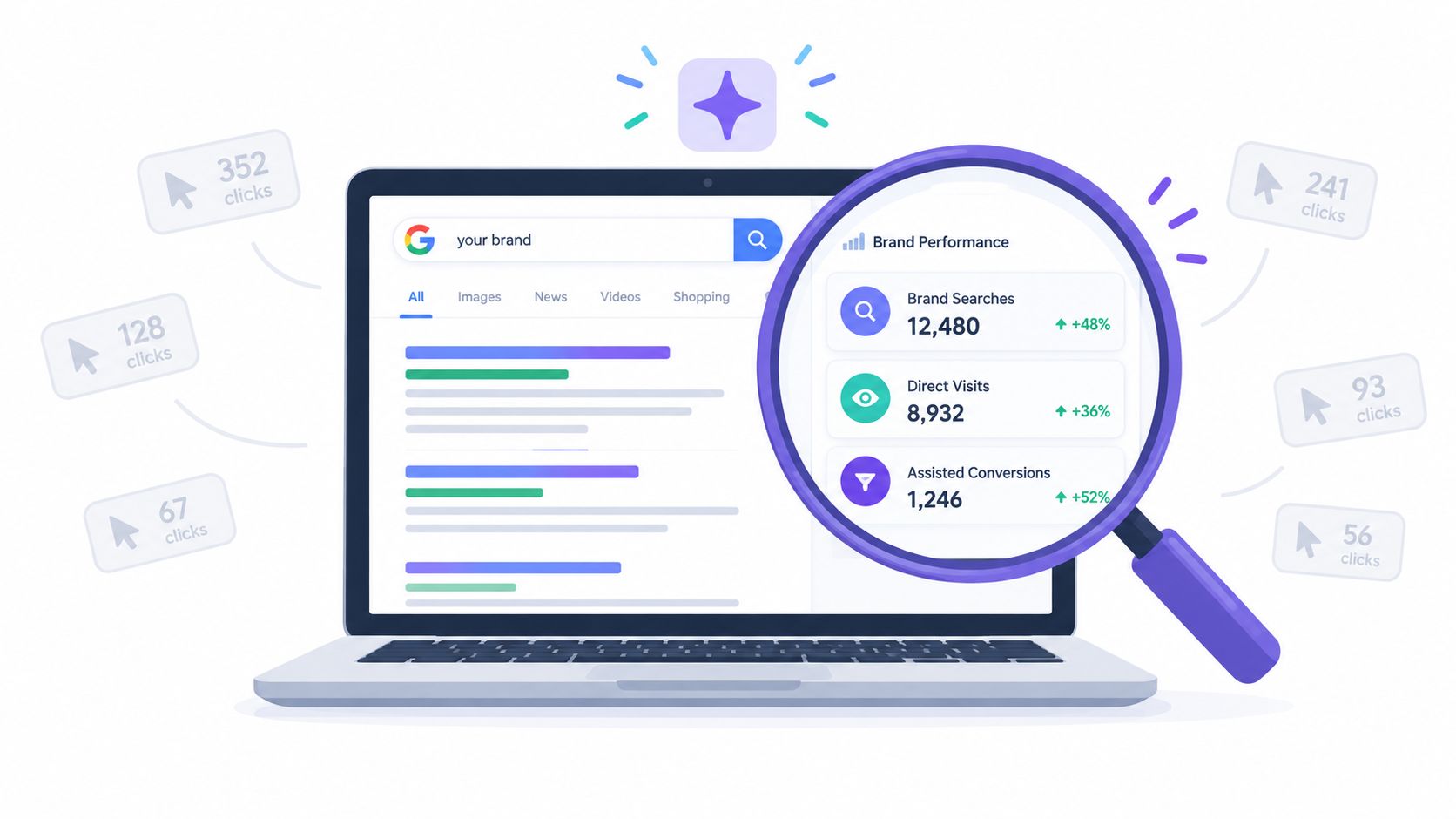
- Branded search lift: Monitor changes in searches for your business while accounting for advertising, publicity, and other activity.
- Product discovery: Track movement from search landing pages into relevant products or categories.
- Email signups: Evaluate subsequent engagement and customer outcomes, not just form submissions.
- Conversion by intent: Separate informational research from comparison, local-service, and purchase-oriented searches.
Don't replace traffic vanity with attribution vanity
Rising impressions alongside falling sessions can still accompany valuable exposure. But you can't label that exposure profitable without supporting evidence.
Compare related signals and investigate disagreements. If branded searches increase while qualified inquiries remain unchanged, you have a question to investigate, not a success story to publish. If fewer visitors produce better commercial outcomes, assess the economics rather than declaring failure because sessions declined.
Assisted revenue needs disciplined interpretation. Don't add every channel's claimed contribution together or give SEO full credit for a buyer who encountered several campaigns. Use attribution to guide decisions, then test whether changing the investment improves the business.
When SEO Is a Bad Investment
Some businesses should decline an SEO proposal. Others should postpone it until they've fixed the conditions that would prevent the work from paying off.
I'd rather see you fund a channel suited to your situation than sustain an organic program because competitors have one.
Situations where I'd redirect the budget
- A short-lived offer: If the opportunity will disappear before you can establish useful visibility, test paid distribution, partner promotions, or an existing email audience instead.
- An unvalidated product: If you don't know who buys or why, prioritize customer interviews, direct selling, and focused acquisition tests. Don't commission a content library around assumptions.
- Little relevant search demand: If customers discover the category through professional networks or demonstrations, pursue those routes. SEO can't capture demand you haven't established exists.
- A broken conversion path: Fix unclear services, unusable forms, missing contact details, or a confusing checkout before paying to attract more visitors.
- A resource mismatch: Don't spread a constrained budget across broad national terms against well-established competitors. Narrow the target or choose a more accessible channel.
The graphic offers a simplified comparison, not a rulebook. In particular, a local business doesn't need online checkout to benefit from search; calls, appointment requests, and physical visits can be legitimate outcomes.
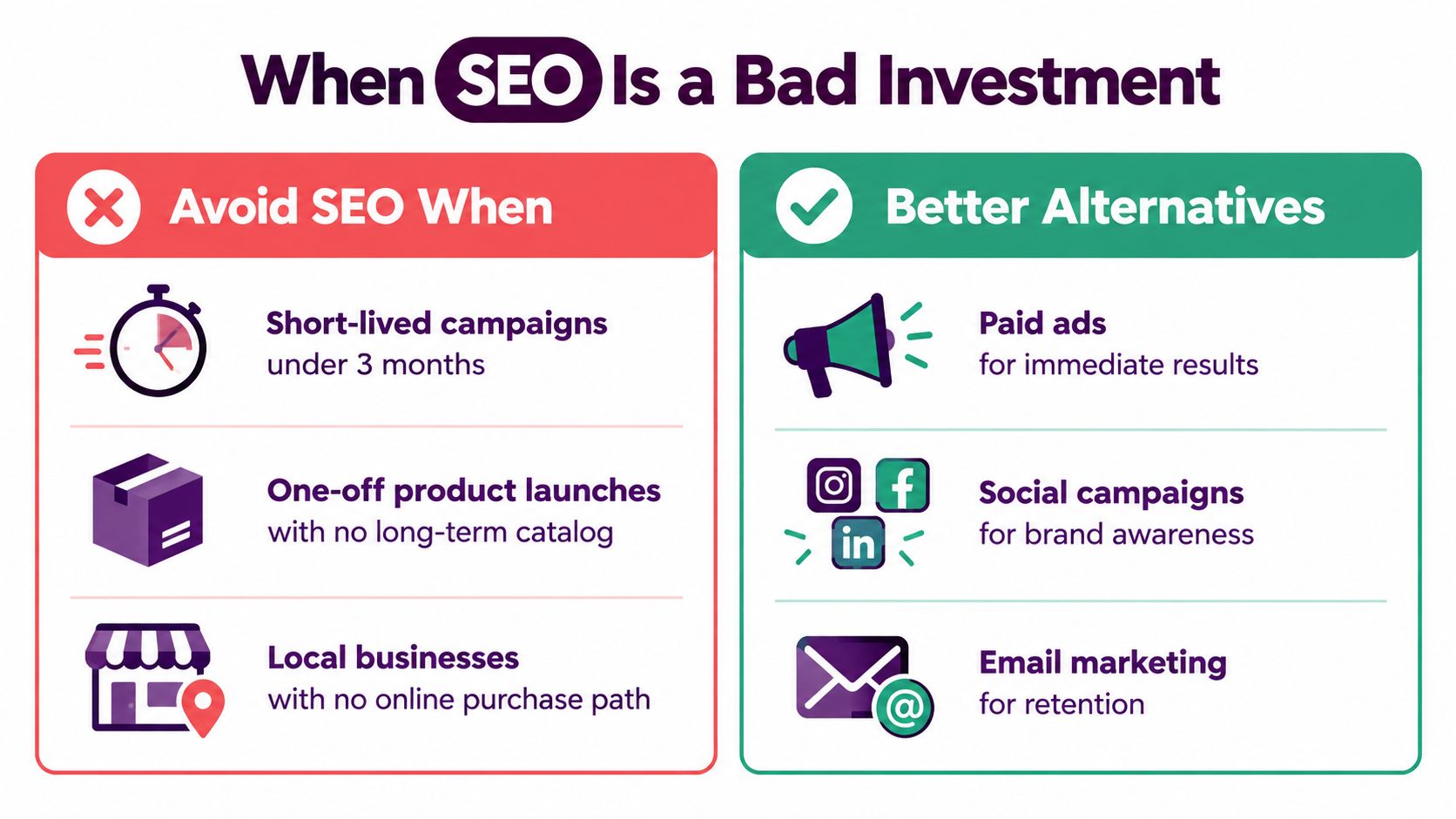
Choose the alternative for a reason
Paid acquisition is worth considering when you need to test an offer with controlled distribution. Partnerships make sense when another organization already reaches your intended customers. Lifecycle marketing deserves attention when you have existing customer relationships but weak follow-up.
For a local provider, community relationships, referrals, and offline visibility may warrant investment alongside a modest search presence. These aren't consolation prizes for businesses that can't afford SEO.
Not investing now doesn't mean abandoning search permanently. Maintain accurate business information and usable pages while addressing the constraint. Reconsider a larger program when you can explain why its economics have changed.
A Decision Framework Before You Spend
Before approving a proposal, ask questions that force a choice. Treat an unsupported answer as unresolved, not as permission to proceed.
Establish the investment case
- Do customers search for what you sell? Inspect actual search results and your available query data. Identify the customer task, not just an attractive phrase.
- Can you satisfy that intent? Confirm access to expertise, product details, useful evidence, and someone who can implement the pages.
- Can you measure a worthwhile outcome? Define the event and how you'll verify its quality. For service businesses, connect inquiry tracking with appointment and sales records.
- Can you sustain the work through an uncertain payoff period? Protect operational cash needs. Don't fund SEO with money the business needs back immediately.
- Is search the strongest available use of the budget? Compare the proposed work with improvements to retention, referrals, paid acquisition, and conversion.
For practice owners assessing the wider marketing operation, Leaping Lemur Media's marketing help for practice owners is a relevant service resource to consider. Evaluate any proposed search work against the practice's appointment process and patient-acquisition priorities, not in isolation.
Turn the answers into a spending decision
Invest substantially when demand, delivery capacity, measurement, and financial runway are all credible. Expand spending in response to evidence rather than approving an open-ended publishing commitment.
Invest conservatively when the opportunity looks sound but important assumptions remain untested. Choose a tightly scoped opportunity and specify what would justify expansion.
Optimize what you have when useful pages already exist but implementation or conversion problems remain. Don't add production volume to avoid fixing the existing experience.
Don't invest yet when relevant demand is absent, the offer is unproven, or the required spending would threaten operations.
Use the keyword ROI calculation guide to structure the commercial assessment. Populate it with your own margins and observed customer behavior, and label uncertain inputs as assumptions.
The Honest Bottom Line on SEO
SEO is worth it for a business that can serve searchable demand profitably and execute the necessary work. It isn't worth it as a recurring purchase of rankings, reports, or content without a commercial purpose.
The strongest investment case isn't “our competitors are doing SEO.” It's “we've identified a customer need, we can satisfy it better, and we know how we'll assess the result.” That case gives a strategist something concrete to prioritize and a business owner something meaningful to challenge.
Use the framework as a readiness check
Review your answers without turning them into a simplistic score. Positive answers don't cancel a critical weakness: a healthy budget won't fix absent demand, and strong demand won't rescue an unusable buying process.
- Proceed confidently: Your evidence supports the opportunity, the team can execute, and the business can tolerate uncertainty.
- Run a bounded test: The commercial logic is plausible, but you still need to validate a material assumption.
- Hold the budget: You can't yet explain who the work will attract or how the business will benefit.
My recommendation is to approve the next defensible piece of work, not an abstract promise of long-term growth. Give it an owner, a business objective, and explicit review criteria.
Keep the program when the evidence supports continued investment. Change the approach when the diagnosis changes. Stop when the opportunity no longer justifies the cost.
You don't owe SEO a permanent place in your budget. Your team needs to show why it belongs there, just as it would for any other investment.
Keyword Kick brings Google Search Console, Google Analytics 4, rankings, backlinks, and technical SEO signals into a shared workspace, with its K² AI Agent providing prioritized recommendations. Visit the platform to connect your search data, investigate where performance is breaking down, and choose the next optimization to evaluate against your business goals.