There's no universal ideal blog length: most general SEO posts fall around 1,000–1,500 words, but the right length is the shortest complete answer for the query and audience. Treat that range as a starting point, not a requirement to stretch a simple explanation or compress a complex guide.
The familiar advice to make every article longer than competing pages confuses an editorial input with a business result. Before approving a word count, decide what the reader needs to accomplish and what success means for your team. An article built to earn citations needs a different editorial brief from one designed to help a buyer make a decision.
Why Blog Length Is Not a Ranking Rule
A writer proposes a direct explanation. An editor asks for an exhaustive guide because competing articles look substantial. Both have a reasonable concern, but neither can settle the disagreement by counting words.
Suppose the draft explains how to export a report. Adding a history of reporting software delays the procedure; cutting the troubleshooting instructions leaves readers stranded when their export fails. Useful depth means including what the task requires, not maximizing or minimizing the document.
Publishing practices have nevertheless shifted toward longer articles. Wix's summary of Orbit Media's longitudinal survey reports that average post length increased from 808 words in 2014 to roughly 1,333 in 2025, while the share below 500 words fell from nearly 20% to 6%.
Separate publishing trends from ranking requirements
Those figures describe what surveyed bloggers published. They don't establish that adding words caused better rankings, or that a short article can't meet a searcher's needs. Search engines don't impose an official minimum word count, and length alone doesn't establish relevance or quality.
Think of an article as a toolkit. Extra tools help when the job requires them; otherwise, they make the kit heavier without making the work easier.
Editorial rule: Approve additional length only when you can name the reader problem it solves.
That rule protects against opposite mistakes. Padding asks readers to spend attention without receiving new information, while arbitrary compression removes qualifications, evidence, or instructions they may need.
The editorial decision should therefore connect task, proof, and outcome. Identify what the reader must accomplish, what evidence makes the answer dependable, and what action would count as success for the business. Word count becomes a practical constraint after those decisions, not a substitute for them.
Define Blog Length by Reader Task
A search query arrives with a task, not a preferred article size. Someone seeking a definition needs understanding; someone comparing services needs decision criteria; someone trying to access an account needs a destination rather than an essay.
Use informational, navigational, commercial, and transactional intent as working categories, then make them specific. “Understand the concept” is still too broad if the audience includes both first-time readers and experienced practitioners. A beginner may need terminology explained, while an expert may need only a procedure and its exceptions.
Distinguish answer distance from total length
First-answer distance is the amount of content a reader encounters before receiving something useful. It's separate from total length: a thorough guide can answer the central question immediately and reserve supporting detail for readers who need it.
The distinction resembles planning a journey. An unfamiliar traveler may need directions, landmarks, and alternatives; a regular commuter may need only notice of a changed route. Don't make both readers follow the same explanation.
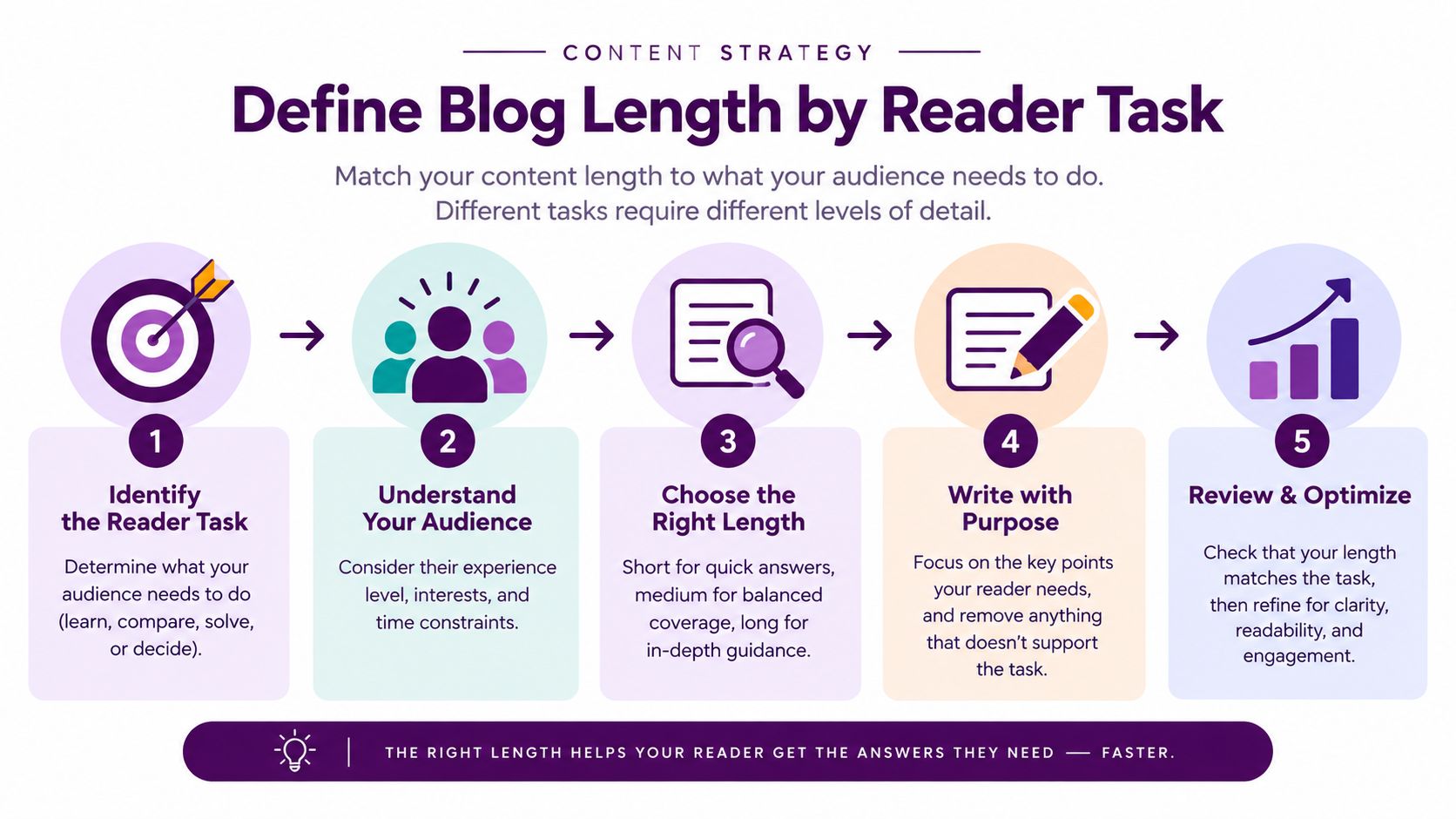
Build the brief around indispensable information:
- Knowledge: What must readers understand before the answer makes sense?
- Decision: Which criteria or trade-offs must they evaluate?
- Action: What instructions, prerequisites, or warnings let them proceed?
- Completion: What would remain unresolved if the article ended here?
Formatting deserves a separate decision. A PubMed-indexed readability study found the highest comprehension with two- or four-line segments, compared with one- or eight-line segments. That's evidence about text presentation, not a universal paragraph prescription across devices.
When planning presentation, Read More Info's different blog layout options provide a resource for considering alternatives to an uninterrupted text column. Preview your chosen layout on mobile rather than assuming desktop spacing will translate.
Before drafting, use the guide to prioritizing SEO keywords to connect topic selection with the task you intend to serve. Then stop expanding when another paragraph adds no necessary knowledge, decision support, or actionable instruction.
Choose Length by Content Type
A news update and a reference guide shouldn't share a mandatory word count. Their readers need different deliverables: one needs to understand what changed, while the other needs dependable material to consult repeatedly.
For a broad benchmark, Jasper's discussion of an analysis covering 11.8 million Google first-page results reports an average result length of about 1,447 words. That makes roughly 1,400–1,500 words a useful planning baseline for many SEO-focused articles, not evidence of an optimal length for every format.
Blog Length by Content Type
The ranges below are editorial starting points, not measured performance thresholds for each content type. Use them to estimate effort before inspecting the actual search results.
| Content Type | Primary Reader Task | Planning Range | Why More Length May Be Needed |
|---|---|---|---|
| Concise answer | Resolve a narrow question | Shorter than the general baseline when complete | Necessary distinctions or exceptions |
| News or announcement | Understand a change and its implications | Brief, bounded by the update | Impact, eligibility, or required action |
| Listicle | Evaluate relevant options | Around 1,000–1,500 words | Meaningful criteria for each inclusion |
| Standard how-to | Complete a process | Around 1,500–2,500 words | Prerequisites, verification, troubleshooting |
| Comparison | Choose between alternatives | Around 1,500–2,500 words | Evidence, use cases, and trade-offs |
| Thought leadership | Assess an argument | Determined by the claim and supporting proof | Counterarguments and original analysis |
| Pillar guide or reference | Understand and revisit a broad subject | 3,000+ words only when justified | Substantial evidence and distinct subtopics |
These choices also depend on audience familiarity. An expert comparison can skip introductory definitions but may require deeper evidence. A beginner tutorial may spend more space explaining prerequisites even when the procedure itself is straightforward.
Budget for the deliverable
For a listicle, allocate space to selection criteria before expanding individual entries. For a comparison, reserve enough room to explain who should choose each alternative. For a tutorial, protect the instructions and checks that let readers confirm they've succeeded.
A reference resource deserves more space only when its coverage warrants it. Calling a page an ultimate guide doesn't justify adding loosely related material, and dividing a small idea into many headings doesn't create depth.
Once you've selected the format, consult maxijournal.com's blog post writing advice as a companion resource during drafting. Keep the acceptance test specific: the finished article must deliver the promised answer, comparison, procedure, or argument. Reaching the planned length is secondary.
Match Blog Length to Search Intent
Inspect the search results before assigning a final draft target. The useful question isn't how long every ranking page is, but which pages address the same reader need as yours.
A results page can contain different formats and purposes. Exclude pages whose audience or task differs substantially before calculating a median or average length. Otherwise, you risk blending a product page, a definition, and a broad guide into a benchmark that describes none of them well.
Build a coverage map
Start by writing the query's expected outcome in plain language. If that's unclear, use this explanation of how to match search intent to sharpen the distinction between topic relevance and task completion.
Then inspect relevant competitors for distinct information needs:
- Core answer: Identify the conclusion or procedure readers expect.
- Supporting evidence: Record definitions, examples, sources, and comparisons needed to trust it.
- Objections and exceptions: Note circumstances that change the recommendation.
- Useful assets: Identify tables, checklists, diagrams, or templates that serve the task.
- Next action: Decide what readers should be able to do after reading.
Treat this as route planning. Mark the destinations readers need to reach before adding alternate roads. Repeated claims across competitor pages aren't automatically separate requirements.
Translate coverage into a provisional budget
Arrange the outline into an answer-first opening, supporting explanation, optional depth, and an actionable ending. Give each section a provisional word allowance based on its work, and attach the evidence it needs before drafting.
Longer formats can be reasonable, but the evidence requires restraint. A summary of Orbit Media's 2025 survey reports that 39% of bloggers publishing posts of 2,000 words or more described strong results, compared with a 21% overall benchmark, although only 9% published at that length.
That's an association based on self-reported results, not proof that length caused success. Research investment, promotion, experience, and topic selection could also matter.
Set the stopping condition before drafting: every essential question is answered, every consequential claim has support, and every remaining section would serve a different task.
Your resulting brief should contain a scope, evidence list, and flexible budget. It shouldn't instruct the writer merely to exceed competitors.
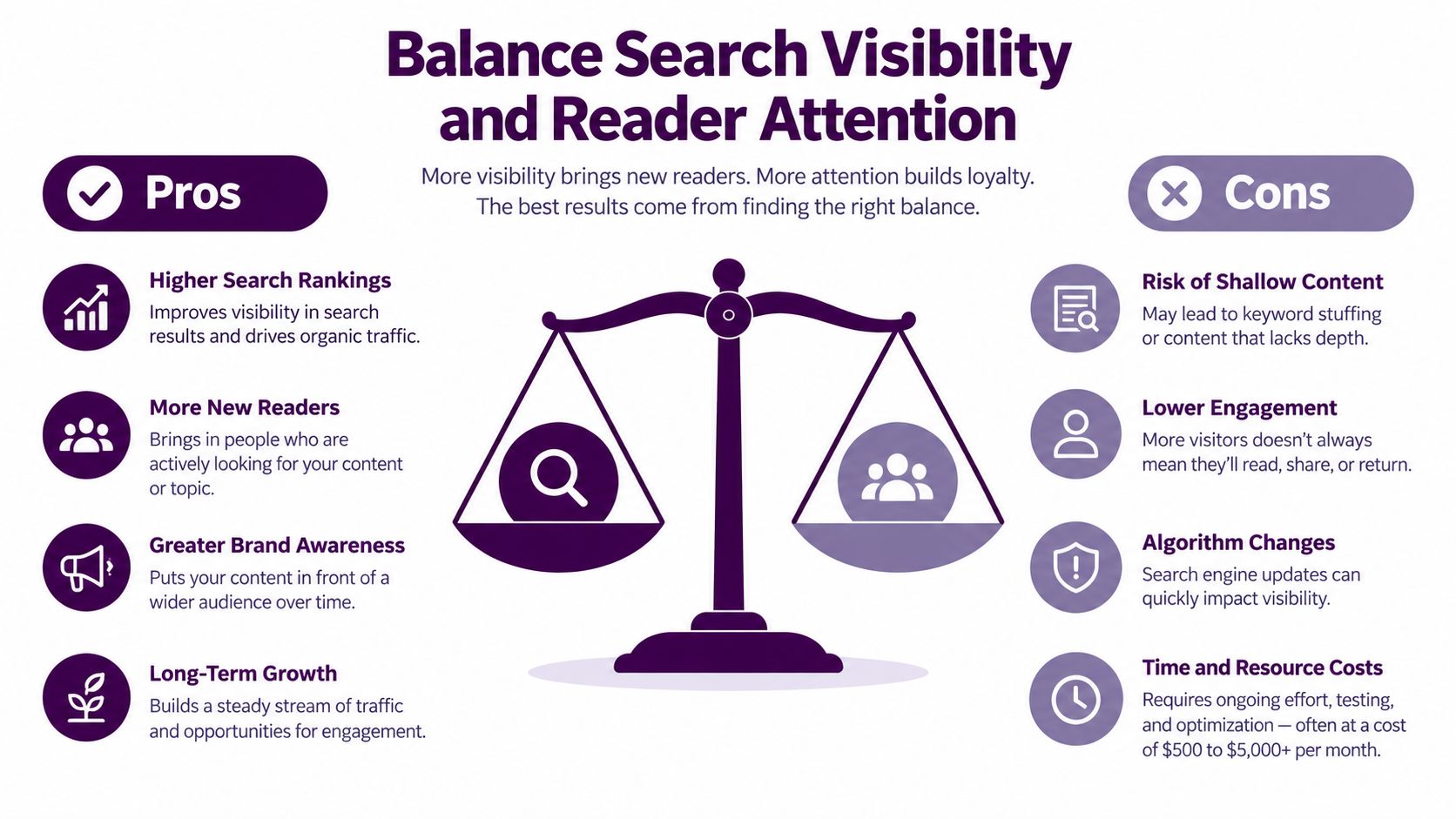
Balance Search Visibility and Reader Attention
Backlinks, sharing, organic traffic, and conversions are different outcomes. Don't select an article length using evidence about one and assume it will improve all the others.
The content study summarized by Increv reports that posts exceeding 3,000 words earned 77.2% more backlinks than posts below 1,000 words, while 1,000–2,000-word articles were the stronger range for social sharing. These findings support distinguishing objectives, not promising a lift from extending a draft.
Invest in reasons to cite the page
For link acquisition, ask what another publisher could use: original research, a clear explanation of a difficult concept, a practical tool, or a well-supported reference table. Additional space can accommodate those assets, but the asset is the investment, not the extra wording.
For social distribution, an editor might prioritize an understandable argument that readers can explain to colleagues. For ordinary informational SEO, prioritize complete query coverage. For conversion, examine the uncertainty a visitor must resolve before taking the desired action.
These are planning judgments rather than guaranteed performance effects. Select the intended outcome before choosing how much editorial effort to allocate.
Protect access to the answer
A detailed article shouldn't require readers to consume every paragraph. Use descriptive headings, place qualifications beside the claims they modify, and put optional background after the material required to act.
- On mobile: Check whether headings and paragraph breaks make the next useful section easy to locate.
- For comparisons: Keep criteria consistent so readers can evaluate alternatives without reconstructing your argument.
- For evidence-heavy material: Place sources near claims and separate interpretation from observed findings.
- For conversion: Position the next step where the reader has enough information to judge it.
Investment test: If an expansion adds no evidence, usable asset, decision criterion, or necessary instruction, reconsider it.
A longer session isn't automatically a better experience. A reader may finish a narrow task quickly, while another may spend longer because the explanation is confusing. Interpret attention alongside completion and business outcomes rather than treating time spent as the verdict.
See How Length Changes by Intent
Consider a hypothetical editorial program about content audits. The topic stays constant, but the required article changes with the reader's starting knowledge and intended action.
A definition, comparison, tutorial, and reference guide shouldn't be the same draft at different sizes. Each needs a distinct promise and a different allocation of space.
A definition versus a comparison
For “What is a content audit?”, assume the reader is unfamiliar with the concept. The first useful answer is a direct definition followed by its purpose, a simple example, and a distinction from related activities. Use a compact budget: most space belongs to explanation, not implementation detail.
Success would mean readers understand whether an audit is relevant to their situation. A qualified visit to a procedural resource could be a useful next-step signal.
For “Content audit spreadsheet versus audit software,” assume the reader already understands the task. Lead with a conditional recommendation, then compare setup effort, collaboration, data handling, maintenance, and limitations. Give the largest share of the budget to fair criteria and evidence, not repeated introductions.
A tutorial versus a reference guide
For “How to run a content audit,” the reader needs executable instructions. Begin with the expected output and prerequisites, then explain inventory, evaluation, prioritization, and verification. Reserve substantial space for the stages where a reader could otherwise make an irreversible or poorly supported decision.
A content audit guide has a broader reference purpose. It may justify separate treatment of methodology, governance, recurring reviews, difficult exceptions, and supporting templates.
| Format | Budget Priority | Outcome to Evaluate |
|---|---|---|
| Definition | Clear explanation and boundaries | Understanding and appropriate next step |
| Comparison | Consistent criteria and evidence | Confident selection |
| Tutorial | Instructions and verification | Successful task completion |
| Reference guide | Coverage, evidence, and navigation | Repeat use and relevant citations |
These are illustrative editorial plans, not performance predictions. Choose a narrower or broader budget according to what remains unresolved.
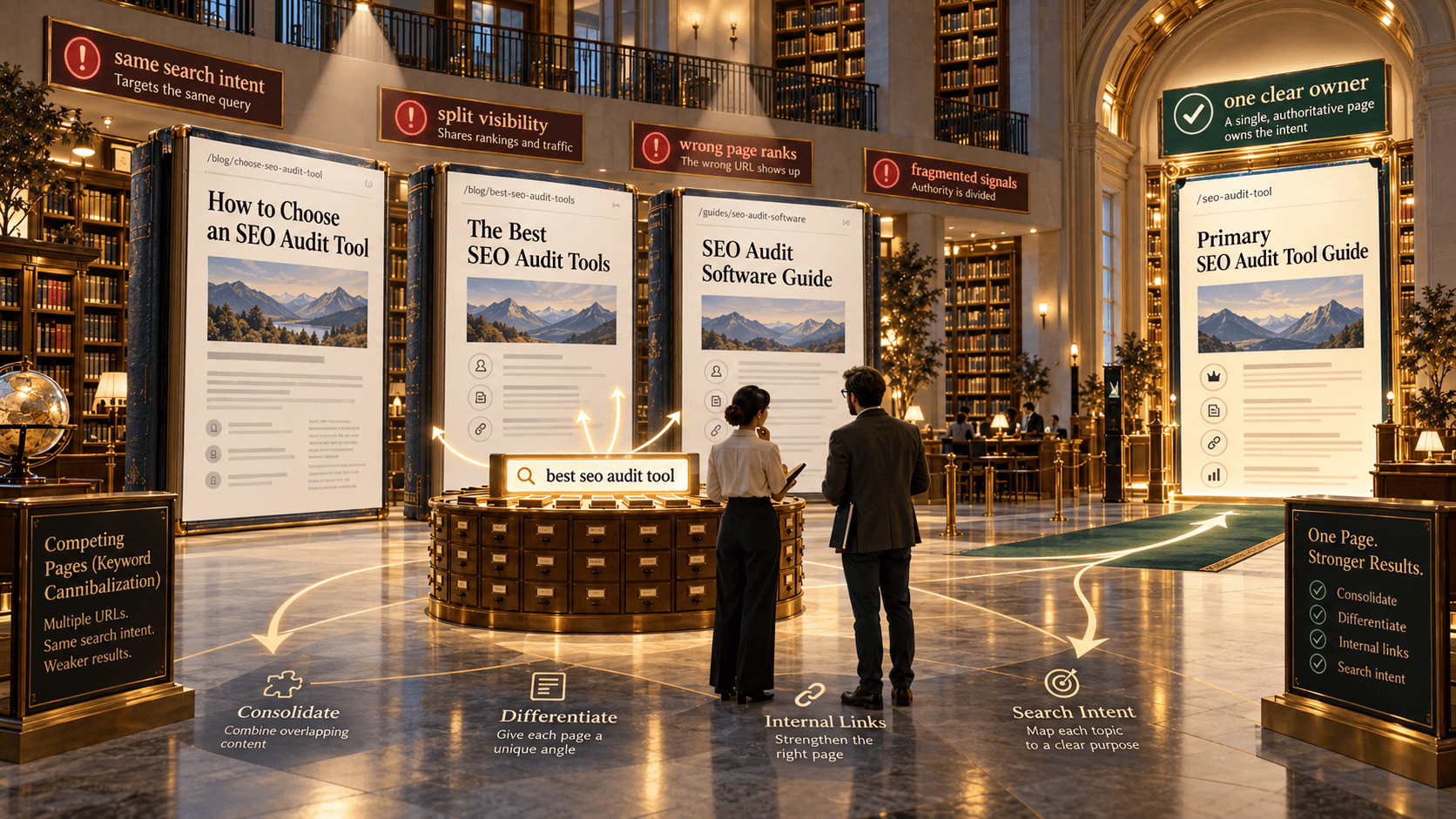
Before commissioning every format, identify the distinct search need each would serve. If the proposed comparison and guide would answer the same query, consider consolidation rather than publishing near-duplicates that may compete for the same need.
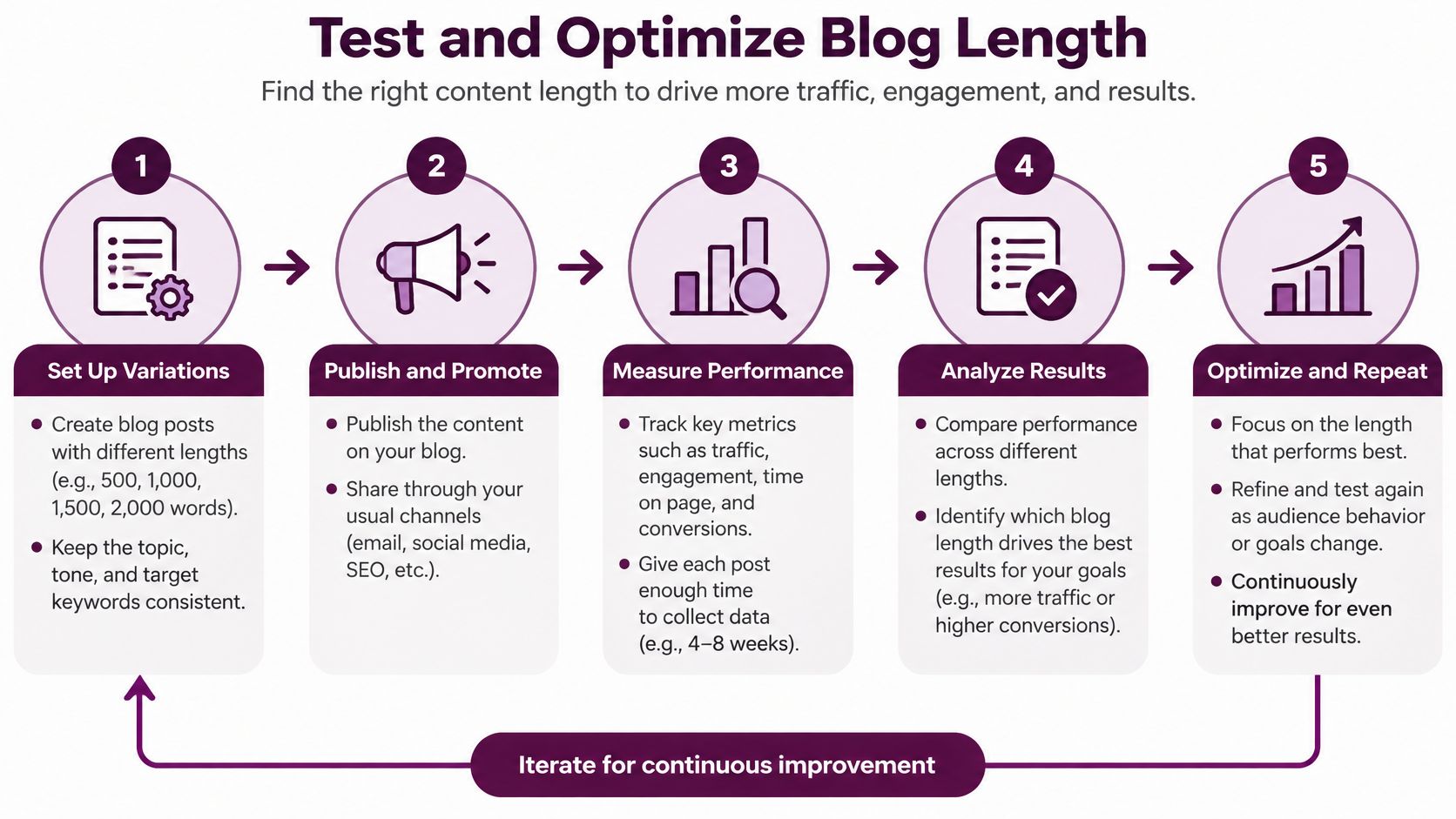
Test and Optimize Blog Length
Treat the initial length as a hypothesis. Before publication, record the query class, audience knowledge, content format, intended business outcome, and reason for the chosen scope.
Make the hypothesis specific enough to evaluate. For example, you might expect a comparison table near the opening to help readers reach a decision, or a troubleshooting subsection to help them complete a procedure. Neither hypothesis requires assuming that a longer article is better.
Measure the intended job
Use Google Search Console to review search visibility and query performance, and Google Analytics to examine configured engagement and conversion signals. Combine those observations with a manual review of answer placement and device-specific presentation.
Group pages by comparable intent rather than pooling the entire blog:
- Search acquisition: Review impressions, organic clicks, query relevance, and ranking changes.
- Reader progress: Examine engaged sessions, scroll behavior, and movement toward useful next steps.
- Business contribution: Evaluate conversions or assisted conversions where your measurement setup supports them.
- Citation value: Track newly acquired referring domains when earning links is an explicit objective.
Don't assume standard analytics reveals whether someone returned to search or completed an off-site task. Those questions may require usability testing, reader feedback, or additional instrumentation.
Revise a defined variable
Compare pages with similar audiences and purposes, while accounting for device, topic, freshness, format, and promotion. A news update and an evergreen tutorial aren't useful controls for each other.
Avoid rewriting after every short-lived fluctuation. Wait until the page has enough relevant observations to support a decision, then choose a focused revision: move the answer higher, remove repetitive background, improve a decision table, or expand an unresolved subsection.
A successful revision improves the intended outcome. A higher word count is merely a description of the edit.
Document the change, its rationale, and what happened afterward. Even then, distinguish association from causation when other conditions changed during the same period.
Use the SEO tips for long-term traffic to place these revisions within broader maintenance work. Length testing shouldn't distract from relevance, technical accessibility, or keeping the underlying information accurate.
Make the Final Length Decision
When someone asks, “How long should a blog be?”, the approval decision should begin with the reader's task and end with a measurable outcome. Choose the format, inspect relevant search results, map indispensable information, and approve the shortest structure that completes the job with sufficient evidence.
Add detail when readers need steps, comparisons, exceptions, examples, or proof. Remove material that merely restates the introduction, repeats another section, or answers a question better handled by a separate resource.
Use a publication checklist
Before approving the draft, check:
- Intent match: Does the article address the actual task behind the query?
- Answer visibility: Can readers find something useful before encountering optional context?
- Information density: Does each section contribute a distinct answer, instruction, or piece of evidence?
- Mobile readability: Have you reviewed the rendered page rather than only the document?
- Useful assets: Do tables, examples, or diagrams help readers understand or act?
- Internal links: Do related resources extend the task without forcing unnecessary detours?
- Measurement alignment: Will your reporting show whether the article achieved its purpose?
The general informational baseline remains a reasonable place to begin, not a standard every post must meet. Deeper formats should earn their additional space through identifiable reader needs.
An editor's final question should be more demanding than whether the writer reached the target: What would the reader lose if we removed this section? If the answer is nothing important, cut it. If removal would weaken a decision, hide a risk, or prevent completion, keep it and make it easy to find.
Keyword Kick brings keyword research, competitor analysis, rank tracking, backlinks, and connected analytics into a shared SEO workspace. Visit Keyword Kick to examine your content opportunities and prioritize which pages need stronger coverage, a clearer answer, or a more focused scope.