
You publish a strong article. It's accurate, well structured, and better written than half the pages ranking above it. Then nothing happens. Impressions stay weak, clicks barely move, and a competitor keeps showing up for adjacent topics your team never mapped.
That pattern usually isn't a writing problem. It's a coverage problem.
SEO content gap analysis is how you stop guessing what to publish next. Done properly, it isn't a vanity exercise where you export a giant keyword list and call it research. It's a competitive planning process that shows where your site is absent, where your pages are thin, and which missing topics deserve effort because they align with business intent.
Why Some Content Ranks and Yours Does Not
A lot of content underperforms for a simple reason. It was created in isolation.
Teams often build from internal ideas, sales questions, or a rough keyword list. That can produce useful content, but it rarely produces complete market coverage. Search results don't reward effort alone. They reward relevance, intent fit, and topical completeness against competing pages already earning visibility.
That's why SEO content gap analysis matters so much. The first organic Google result gets 27.6% of all clicks, according to Backlinko's analysis cited by seoClarity's explanation of content gaps. If your pages sit outside those top positions, being “pretty good” doesn't help much. You need a process that identifies the missing topics, terms, and intent patterns preventing your site from competing for those high-click positions.
The real problem isn't one bad page
Most ranking issues aren't isolated to a single article. They come from one of these broader failures:
Coverage failure means competitors publish on topics your site never addressed.
Intent failure means you wrote an informational article for a query Google treats as commercial.
Structure failure means you split one topic across multiple weak pages instead of building one authoritative asset.
Prioritization failure means the team spends time on interesting terms instead of useful ones.
A solid gap analysis catches all four.
Practical rule: Don't treat content gap analysis as a content brainstorming task. Treat it as market reconnaissance.
That change in mindset matters. Once you compare your keyword footprint against close SERP competitors, content planning becomes less emotional. You stop asking, “What should we write next?” and start asking, “Where is demand proven, where are we missing, and what format gives us the best chance to win?”
For service businesses, that often means aligning topic selection with actual commercial pathways, not just traffic opportunity. If you need a concrete example of how that thinking fits a lead-generation model, this professional services SEO blueprint is a useful companion because it frames SEO around buyer needs rather than content volume.
Gathering Your Raw Materials for Analysis
Bad input produces bad gap analysis. If your source data is sloppy, your conclusions will be sloppy too.
The modern workflow became tightly linked to keyword research platforms in the 2010s and early 2020s, and mature processes recommend comparing at least 90 days of GA4 data so you don't mistake a temporary dip for a real content problem, as outlined in Semrush's content gap workflow. That detail sounds small, but it changes decisions. Teams often rush to create new pages when the better move is updating an existing one that only had a short-term decline.
Your own site data comes first
Before you compare yourself to competitors, get clear on your current footprint.
Google Search Console tells you where your site already appears in search, even when rankings are weak. That matters because not every “gap” requires a net-new page. Sometimes the site already has relevance and just needs a stronger page, better internal links, or tighter intent targeting. If your setup is messy or incomplete, use this Google Search Console setup guide before you trust any conclusions.
GA4 adds business context. Search Console shows visibility. GA4 shows what happens after the click. When I review gap opportunities, I care less about raw topic breadth than whether the existing content type contributes to actual outcomes. If older service pages assist conversions and blog posts don't, that should shape how you prioritize future gaps.
A quick working checklist helps:
Pull organic landing pages: Identify pages that already attract search visits.
Review decline over a meaningful window: Use a longer comparison period so short-term volatility doesn't distort the picture.
Note pages with weak engagement or weak business value: Those may need repositioning, not expansion.
Map existing page types: Separate guides, category pages, service pages, tools, and support content.
Competitor selection is where many teams go wrong
Don't default to the biggest brand in the category.
For SEO content gap analysis, your best competitors are the sites repeatedly appearing for the topics you want to own. Sometimes that's a direct business competitor. Sometimes it's a publisher, marketplace, or software review site. If they dominate the SERP you care about, they belong in the analysis.
Use a short list. Close competitors produce cleaner insight than an oversized comparison set. You want overlap, not chaos.
If the domains don't compete with you on the same search intent, their keyword set will flood your export with noise.
Keyword research is still necessary
Competitor gap tools are powerful, but they're not a substitute for understanding audience language. You still need a working keyword universe that reflects how buyers search at different stages.
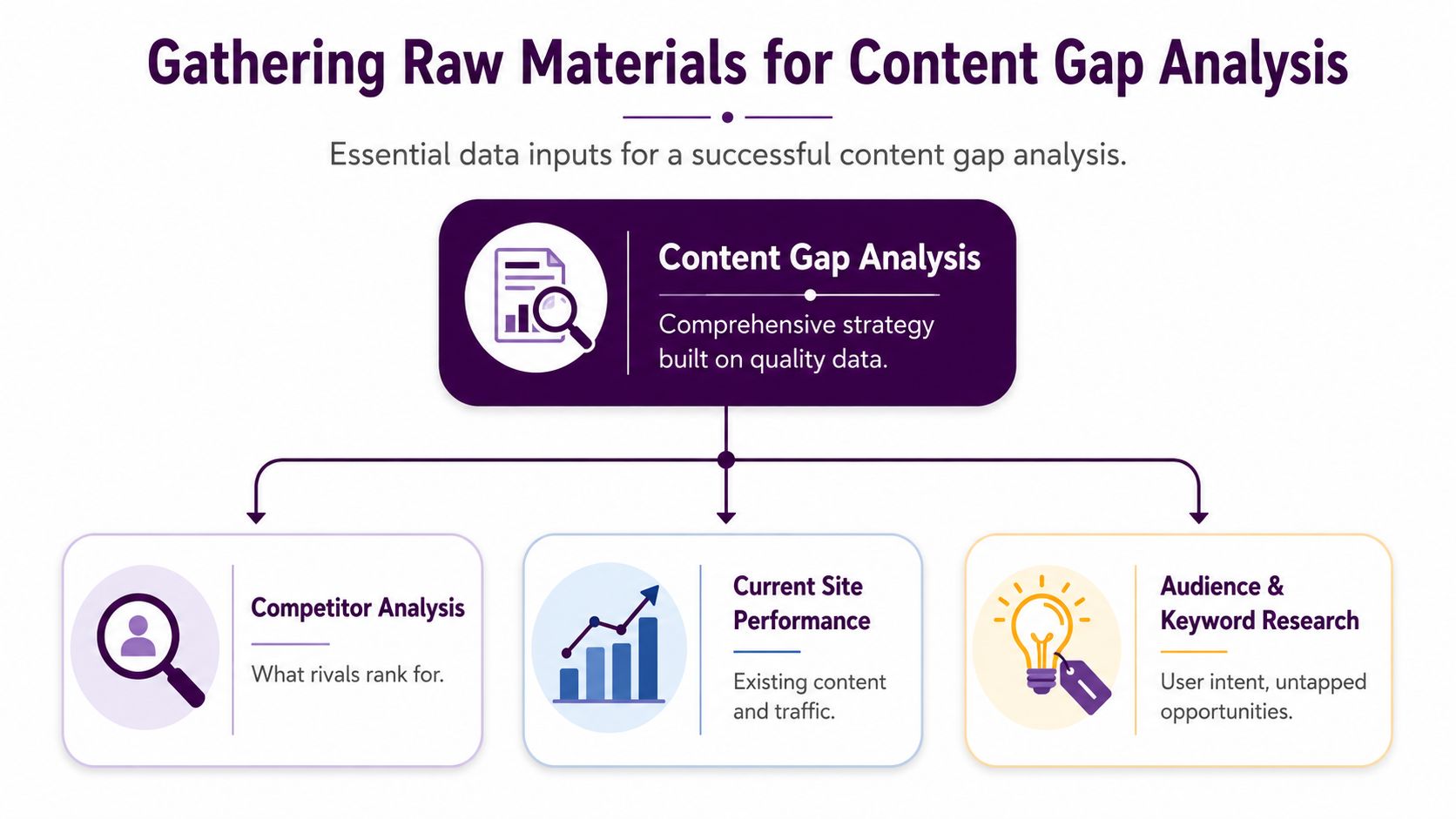
That means combining three views:
Data source | What it tells you | Why it matters |
|---|---|---|
Search Console | Queries you already touch | Reveals near-miss opportunities |
Competitor domains | Topics others win that you don't | Exposes missing coverage |
Keyword research tools | Broader phrasing and parent topics | Helps cluster demand into pages |
Templates can save time if your team needs process discipline. A practical guide for SEO content gaps can help standardize how you capture competitors, page types, and prioritization notes before the spreadsheet gets unwieldy.
Executing the Core Content Gap Workflow
This is the part teams tend to overcomplicate. The mechanical workflow is simple. The filtering is where judgment matters.
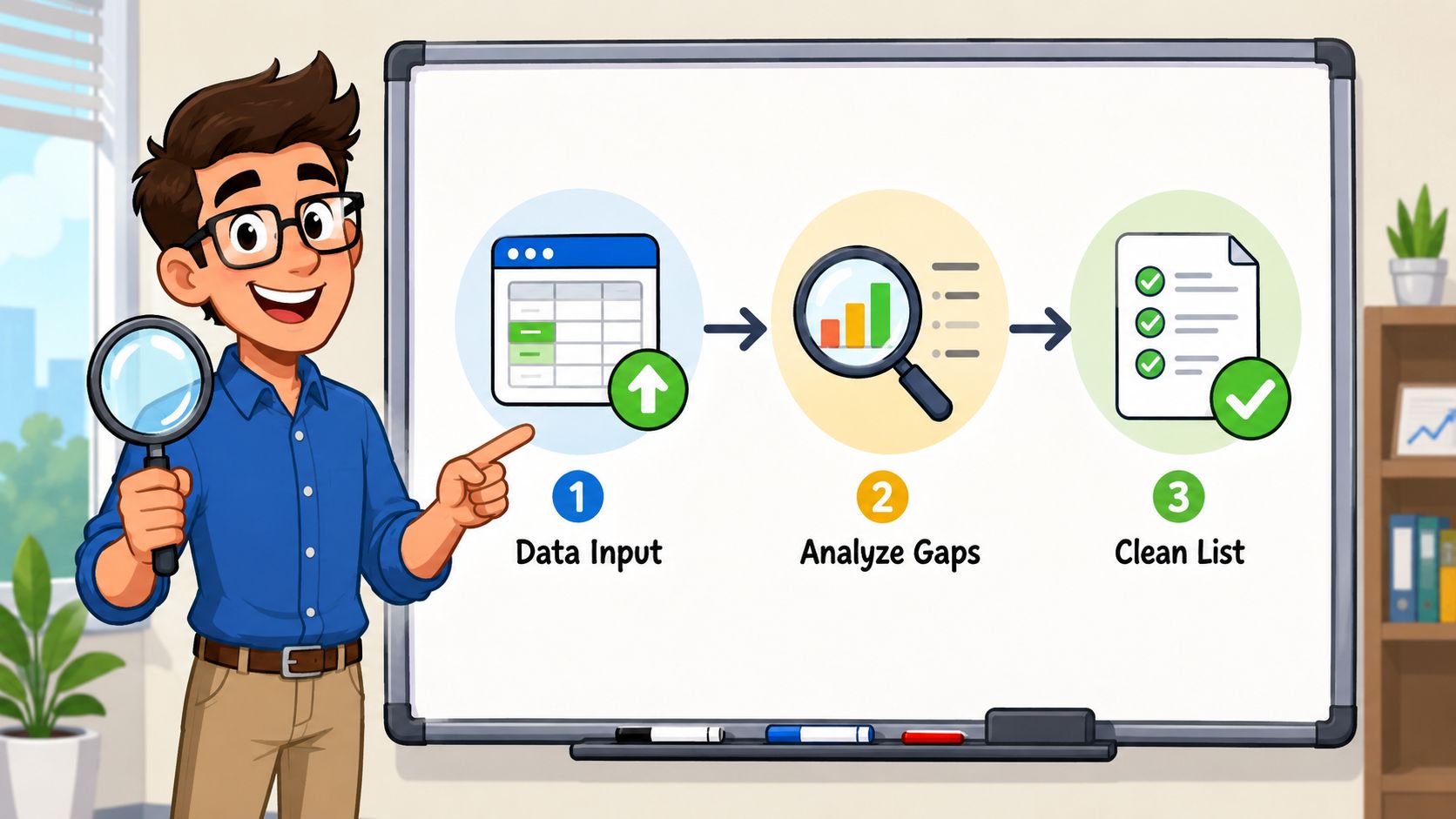
Start with a keyword gap or content gap tool. Compare your domain against close competitors, not an aspirational list of giant publishers. A rigorous workflow should compare 1 to 3 close competitors at the keyword level, then filter aggressively. Ahrefs recommends keeping only queries with at least 20 monthly searches and using main positions only to avoid alternative SERP-feature rankings, because unfiltered exports can exceed 100,000 keywords, as explained in Ahrefs' content gap process.
Run the comparison at the keyword level
The output usually includes some version of these categories:
Missing keywords where competitors rank and you don't
Untapped keywords where at least one competitor ranks and you don't
Weak keywords where you rank, but competitors perform better
Shared keywords where everyone competes
For gap analysis, start with missing and untapped. Weak keywords are useful later when you shift from topic discovery to page improvement.
If your team wants a primer on the tooling side, this walkthrough of a keyword gap analysis tool for hidden SEO opportunities is a good reference.
Apply filters before you interpret anything
Raw exports are not strategy. They're noise mixed with signal.
Use a first-pass filter set like this:
Remove branded terms
Competitor brand names, product names, and navigational queries almost never belong in your content roadmap unless you have a deliberate comparison strategy.Exclude irrelevant adjacent topics
Gap tools surface semantic neighbors, not just true opportunities. If you sell legal services, you may still see educational, news, or glossary terms with weak commercial value.Keep only terms with enough search activity
A minimum threshold keeps the export manageable and strips out edge-case phrases.Use main positions only
This prevents false positives caused by odd SERP features or temporary ranking artifacts.
Clean the list with page logic, not just keyword logic
A common mistake is treating every keyword as a future article.
That creates duplication fast. One cluster of related terms might belong on a single page. Another might require a service page supported by a guide. A third may look attractive in a spreadsheet but fail the reality check once you inspect the SERP.
Use this review lens:
Question | If yes | If no |
|---|---|---|
Does this query map to an existing page? | Improve or consolidate | Consider a new page |
Do multiple keywords share the same intent? | Cluster them together | Keep separate |
Is the SERP dominated by a different page type? | Match that format | Don't force your preferred format |
Working advice: If you can't explain what page should rank for a keyword, it isn't prioritized yet.
Don't stop at exports
The first pass should leave you with a smaller, cleaner set of opportunities. Not perfect. Just workable.
At this stage, I usually split the output into three buckets:
Create new content for topics with no suitable page on the site
Upgrade existing content where a page exists but misses important subtopics or intent cues
Ignore for now when the keyword is off-strategy, too broad, or mismatched to what the business sells
That last bucket is healthy. Good SEO content gap analysis isn't about capturing every visible term. It's about choosing the right absences to fix.
Prioritizing Gaps for Maximum SEO Impact
A giant gap list feels productive. It usually isn't.
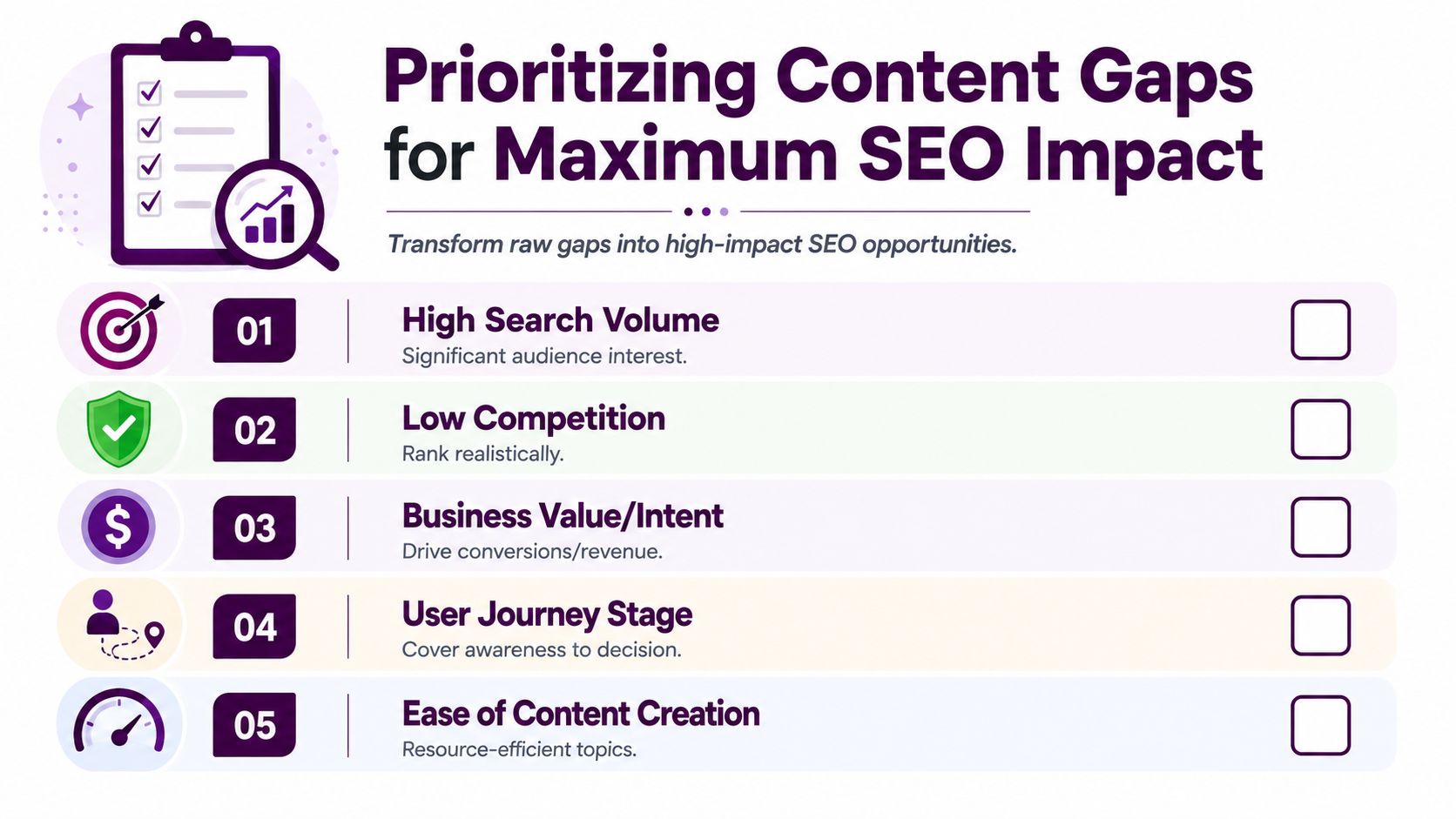
A common pitfall is to sort by search volume, pick the top terms, and assume they've prioritized. That produces a queue full of broad informational topics, unclear ownership, and pages that may never support pipeline. Real prioritization happens when you convert keywords into page-level decisions and pressure-test each one against the live SERP.
Expert workflows recommend clustering raw gaps into parent topics and validating the right page type before publishing, which helps avoid cannibalization and forces a clearer decision about whether the topic belongs in a guide, landing page, or support article, as described in Respona's content gap prioritization approach.
Use four filters before anything enters production
I use a four-part decision framework. It keeps the team from chasing terms that look promising only inside a tool.
Business relevance
Ask the blunt question first. Does this topic attract someone you want?
A term can be topically related and still be commercially weak. That doesn't make it useless, but it changes priority. If the business needs lead-generating content, a loosely related educational term shouldn't outrank a service-adjacent cluster with clear buyer intent.
Search intent fit
Look at the actual SERP. Not the keyword label in your tool.
If Google ranks buying guides, category pages, and service pages, don't assign the term to a blog post because your editorial calendar prefers articles. Intent mismatch is one of the fastest ways to waste content production hours.
Competitive reality
Often, many keyword lists collapse. Can your site credibly win the page type and depth required?
You're not looking for easy shortcuts. You're looking for reasonable fights. Sometimes the opportunity is a top-of-funnel guide where competitors are thin. Sometimes it's a commercial page where everyone ranking has outdated copy. Sometimes the right move is to defer the topic until the site has stronger authority.
Strategic value
Some topics are quick wins. Others are foundation pieces that support internal linking, authority, and later conversions.
A mature roadmap needs both. If the whole plan is short-term, the site stays shallow. If the whole plan is long-term, the business waits too long for visible returns.
Convert keywords into cluster decisions
This is the pivot from spreadsheet work to actual SEO planning.
Instead of evaluating each query alone, group related terms under a likely page target. That cluster then gets a simple decision record.
Cluster | Likely page type | Main reason to prioritize |
|---|---|---|
Service-adjacent commercial terms | Landing or service page | High buyer alignment |
Broad educational topic with strong overlap | Guide | Authority and internal linking |
Specific support questions | Support article | Captures long-tail intent and assists conversions |
The best prioritization document doesn't just say what keywords are missing. It says what page should exist, why it should exist, and why now.
What to deprioritize quickly
You can speed up planning by rejecting weak candidates early.
Loose relevance: The query touches your industry but not your offer.
Format conflict: The SERP wants a page type your site shouldn't create.
Cannibalization risk: The site already has a page that should own the topic.
Limited benefit: Even if the page ranks, it won't support meaningful traffic quality or business goals.
That last point gets overlooked. High-traffic topics can be expensive distractions if they pull your team away from terms tied to actual decision-making.
From Prioritized Topic to Actionable Content Brief
Once a topic cluster survives prioritization, the next step is to turn it into something a writer or strategist can execute without guesswork.
Many content teams lose momentum at this point. They finish the audit, agree on target topics, then hand off a vague note like “write an article around these keywords.” That's not a brief. That's a liability.
A stronger process starts with intent-specific analysis. Advanced teams don't just identify missing keywords. They filter by informational, commercial, and transactional intent so they can focus on opportunities more likely to drive revenue, especially when competitors rank with weak or outdated pages, as noted in Nightwatch's guidance on content gap analysis.
Start with SERP validation
Open the current search results for the parent topic and inspect what ranks.
Look for patterns such as:
Page type: Is Google rewarding blog posts, landing pages, comparison pages, or support docs?
Angle: Are results broad and educational, or specific and solution-oriented?
Depth: Do the pages answer one question or cover a complete decision journey?
Freshness signals: Are ranking pages current, or is the SERP vulnerable to a better update?
If you skip this step, the brief may target the right phrase with the wrong asset.
A keyword doesn't tell you what to create. The SERP does.
Build the brief around the page, not the phrase
A useful brief should answer five operational questions.
Who is this for
Define the audience segment clearly. A page aimed at first-time researchers should not read like one built for buyers comparing vendors.
What page is this
Name the format. Guide, service page, landing page, comparison article, support content. This single choice shapes structure, calls to action, and supporting evidence.
Which keyword cluster belongs here
Include the parent topic and related supporting terms, but keep them grouped naturally. The point is to define semantic coverage, not force awkward repetition.
What must this page cover
List the essential subtopics shown by the SERP and any gaps competitors are missing. If several ranking pages cover the same basics, your edge may come from clearer examples, stronger framing, or more practical detail.
How does it connect internally
A page should rarely stand alone. Add likely internal links from related guides, service pages, or category pages. If your team needs a refresher on tightening pages after the brief stage, this resource on content optimization is useful for turning an adequate draft into a stronger ranking candidate.
A simple brief framework
You don't need a complicated template. You need one that eliminates ambiguity.
Primary topic and intent
Recommended page type
Target audience
Existing page to update or new page to create
Core subtopics to include
Competitor weaknesses to outperform
Internal links to add
Conversion path or next action
That's enough to keep the writer aligned with both user intent and SEO strategy.
Automate the Analysis and Focus on Strategy with Keyword Kick
A typical content gap project starts with good intent and ends with three exports, a half-cleaned spreadsheet, and a team that still does not know what to publish next.
That bottleneck matters. Manual analysis usually breaks down after the data pull. Teams can gather keywords from Search Console, GA4, and competitor tools, but they lose time during the filtering step. Duplicate terms stay in the sheet. Informational queries crowd out commercial ones. Low-value gaps get mixed in with update opportunities that could drive revenue faster.

Automation helps by reducing repetitive work, not by replacing judgment. The goal is not a bigger keyword list. The goal is a shorter list with clearer decisions attached to it.
That is the same reason teams adopt broader AI tools for spreadsheet automation. Faster sorting, filtering, grouping, and summarizing creates time for the work that changes outcomes: checking intent, choosing the right page type, and deciding whether a topic deserves a net-new page or an update to an existing asset.
For SEO content gap analysis, useful automation should help answer four questions quickly:
Which gaps show clear commercial or product-adjacent intent?
Which topics map to pages that already exist and need improvement?
Which competitor wins are coming from weak pages you can realistically beat?
Which opportunities deserve a brief now, and which ones should be ignored?
Keyword Kick is useful because it pushes the workflow past discovery. It helps teams move from noisy keyword comparisons to a prioritized action plan. That means less time cleaning exports and more time validating opportunities, assigning formats, and building briefs that writers can execute without guesswork.
If your process still ends at a spreadsheet, you are stopping too early. If you want a faster way to turn scattered SEO inputs into a ranked list of actions, try Keyword Kick. It is built for teams that need clearer decisions on what to optimize, what to create, and what to leave alone.