Monday starts with a rankings dip, a Slack thread about traffic, an alert from Search Console, and a technical audit full of issues that may or may not matter. By 10 a.m., the team has already opened five tabs, pulled three exports, and started arguing about cause versus correlation.
That's the main SEO bottleneck now. It isn't access to data. It's the work of stitching fragmented signals into a decision you can trust.
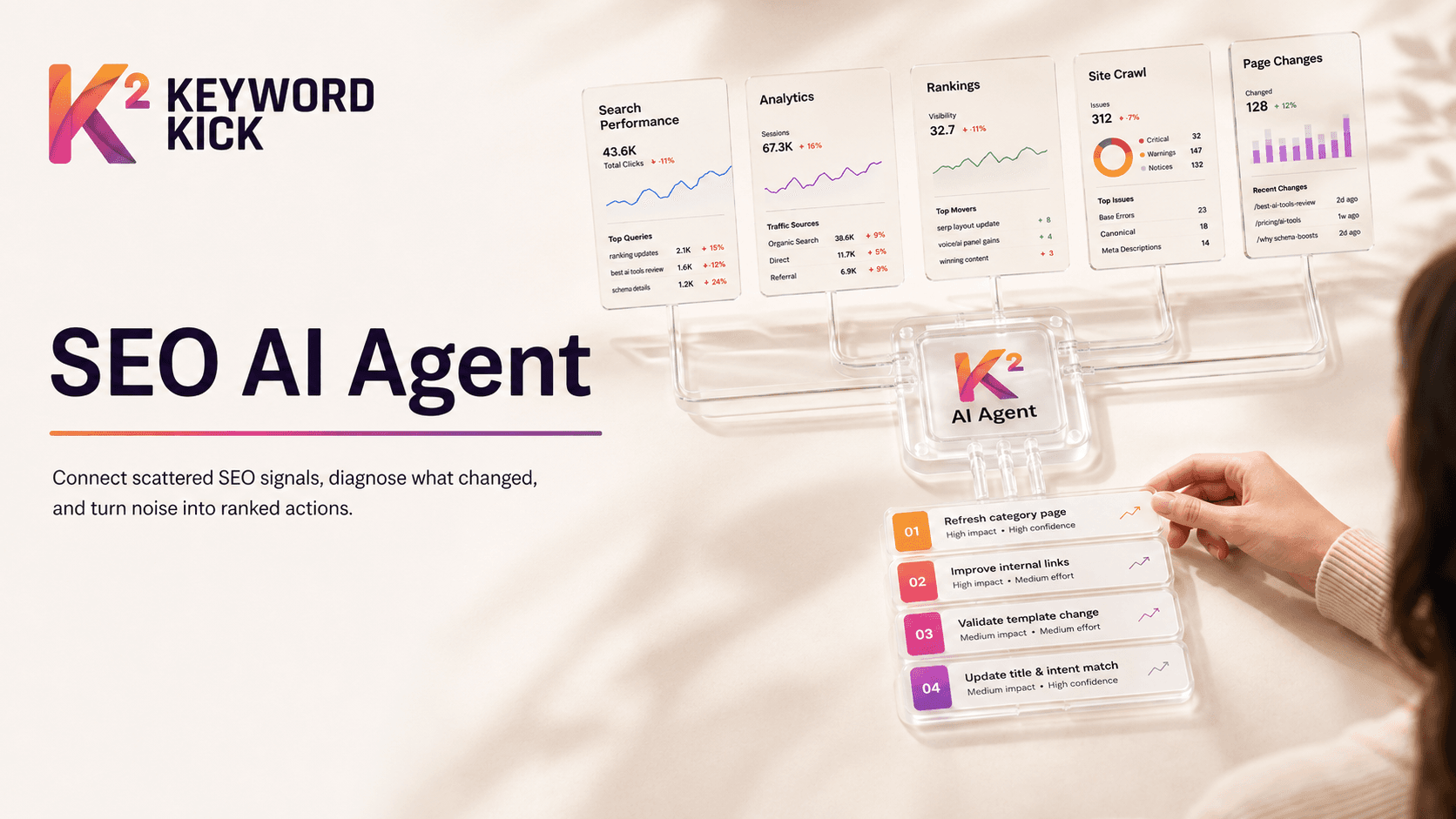
A good SEO AI agent exists for that exact moment. Not as another dashboard, and not as a chatbot that writes generic recommendations, but as a system that can connect your data sources, inspect what changed, and turn noise into a ranked action list. If it works well, it feels less like software and more like a 24/7 junior analyst who never gets tired of comparing URLs, queries, SERPs, and site changes.
The hype is easy to find. The harder question is operational. How do you deploy an SEO AI agent in a way that improves rankings, content performance, and conversion outcomes, instead of just speeding up busywork? That's where many organizations need help.
The End of SEO Data Overload
Most SEO teams don't struggle because they lack tools. They struggle because every tool sees only part of the story.
Search Console might show a drop in impressions on a category page. GA4 shows weaker organic sessions. Your rank tracker shows movement on a cluster of terms. A crawler flags internal linking issues. Someone on the dev team mentions a template update from last week. None of those inputs are wrong. They're just incomplete on their own.
Why the old workflow breaks
The traditional workflow asks a human to be the integration layer. You pull reports, compare date ranges, scan page groups, open SERPs, and try to reconstruct what happened. That's slow, and it pushes strategy work to the end of the process.
This is why data visibility alone no longer solves the SEO workflow problem. Seeing more charts doesn't reduce the time it takes to decide what matters.
The practical failure point in modern SEO is rarely missing data. It's delayed synthesis.
An SEO AI agent changes that operating model. Instead of giving you isolated reports, it can ingest multiple signals together and evaluate relationships between them. A useful agent doesn't just say “traffic is down.” It says “traffic is down on these URLs, driven by these queries, likely connected to these ranking losses and this site change.”
What better looks like
The gain isn't convenience. It's faster diagnosis and tighter prioritization.
A mature setup usually does three things well:
Connects first-party and SEO data: Search Console, analytics, rank tracking, crawl results, and page-level metadata live in one decision layer.
Flags meaningful changes: It identifies anomalies that deserve investigation instead of dumping every fluctuation into an alert feed.
Suggests next actions: It moves from reporting to action, such as refreshing a page, improving internal links, or validating a technical issue.
That's the threshold. If the system can't help your team decide what to do next, it isn't really solving overload. It's just packaging it differently.
What Is an SEO AI Agent Really
An SEO AI agent is not just an AI writer with SEO prompts. It's also not a keyword tool with a chatbot interface. Those tools still depend on a human to define the task, gather the context, and decide the next step.
An SEO AI agent is an autonomous system that can analyze, plan, execute, and iterate across SEO workflows using live data and connected tools.
A useful analogy
Think about the difference between a calculator and an accountant.
A calculator gives you an answer to a narrow input. An accountant looks at the numbers, identifies what matters, and recommends a course of action. Most traditional SEO software acts like the calculator. An SEO AI agent is trying to behave more like the accountant.
That doesn't make it a replacement for senior judgment. It makes it a force multiplier for teams that already know what good SEO looks like.
The three traits that define the category
A real agent needs more than language generation. It needs operating capability.
Autonomous analysis: It can review data across tools without waiting for a person to manually export and merge everything.
Multi-step execution: It can move from one task to another logically, such as finding a ranking opportunity, checking the live SERP, comparing competitors, and drafting an action plan.
Closed-loop iteration: It can monitor what happens after a change and trigger follow-up work if performance drops or intent shifts.
This broader shift matters because agentic systems are becoming infrastructure, not experiments. The AI agent market is projected to grow from $5.1 billion in 2024 to $47.1 billion by 2033 according to Datagrid's marketing AI agent statistics roundup.
What an agent should do that a writing tool can't
A writing tool helps with output. An agent helps with outcomes.
For example, if a page is ranking just outside stronger visibility, the agent should be able to identify the opportunity, inspect the SERP, compare competing content, and propose changes tied to that URL. That's different from asking a model to “write an SEO article about X.”
Practical rule: If the system can only generate text, it's not an SEO agent. It's a content assistant.
That distinction matters in deployment. Teams often buy “AI for SEO” and end up with faster drafting but no improvement in diagnosis, prioritization, or post-publication monitoring. The value of an SEO AI agent comes from connected reasoning, not from text generation alone.
The Anatomy of an SEO AI Agent
A working SEO AI agent usually has three layers. If one is weak, the system becomes unreliable fast.
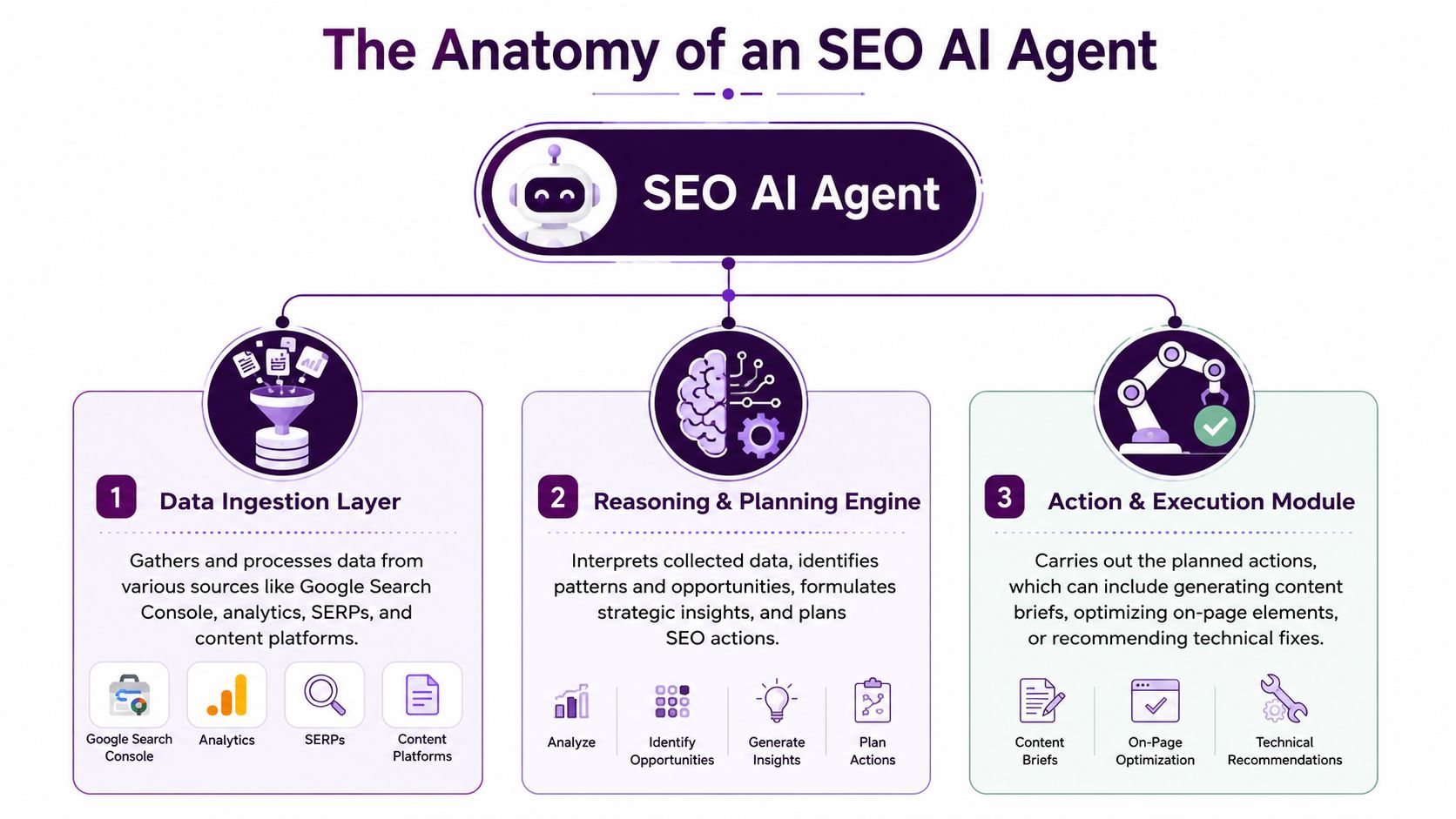
Data ingestion layer
This is the foundation. The agent needs access to the systems your team already trusts.
That usually means Google Search Console, GA4, rank tracking tools, crawl data, backlink data, content inventories, and sometimes CMS data. If the agent can't pull clean inputs from those sources, everything downstream gets shaky. A model can sound confident while operating on partial context, which is dangerous in SEO.
Good ingestion also means the data is current enough to support decisions. Static exports break the promise of an agentic workflow because they force the team back into manual reconciliation.
Reasoning and planning engine
This is often considered the primary layer, but it's only useful if the data connections exist.
The reasoning engine, usually powered by an LLM, interprets signals, identifies anomalies, and decides which task should happen next. In a capable setup, it isn't just summarizing data. It's orchestrating a workflow.
Effective SEO AI agents integrate LLMs with API-driven tools like GSC and Ahrefs to execute multi-step workflows, including identifying striking-distance keywords, scraping competitor content, and generating an action plan. One technical implementation describes this as reducing analysis time from weeks to minutes in those workflows, as outlined in Keyword Kick's technical details on SEO AI agents.
Action and execution module
This is the “hands” of the system.
Once the agent identifies a task, it needs connected tools to carry it out. That might include pulling SERP data, generating a content brief, mapping keywords to URLs, recommending internal links, or pushing a draft into a CMS workflow for review.
A practical way to think about the architecture is this:
Layer | What it does | What failure looks like |
|---|---|---|
Data ingestion | Collects live SEO and site data | Recommendations based on stale or incomplete inputs |
Reasoning engine | Interprets signals and prioritizes actions | Generic summaries with no clear next step |
Execution module | Performs the actual workflow tasks | Insights that still require heavy manual handoff |
Why the architecture matters in practice
When teams say an SEO AI agent “didn't work,” the problem usually sits in one of these layers.
Sometimes the model is fine, but the data connections are thin. Sometimes the integrations exist, but the workflows aren't allowed to execute beyond reporting. Sometimes the system can act, but there are no guardrails on what it should touch.
The point isn't to buy the smartest model. It's to build a reliable data to decision to action loop.
From Data to Decisions Real Agent Workflows
The easiest way to judge an SEO AI agent is to stop asking what features it has and start asking what jobs it can complete without creating more work for your team.
Diagnosing a traffic drop
A common prompt is simple: why did a high-value page lose organic performance?
A useful agent starts by checking query and page-level changes in Search Console. Then it compares those changes against ranking movements, checks whether click-through patterns shifted, reviews any known template or content edits, and looks at the current SERP to see whether intent changed or a stronger competitor entered the space.
What matters is the sequence. The agent shouldn't stop at one explanation. It should test plausible causes and return a ranked diagnosis.
For this kind of work, AI SEO agents can speed up data analysis by up to 50% by automating reconciliation across rankings, Search Console data, and site changes, according to Nightwatch's guide to AI SEO agents.
That speed matters because traffic investigations get expensive when teams manually piece together context from different systems. A structured agent workflow shortens the path from “something dropped” to “here's the likely cause and the first fix to validate.”
You can see the broader workflow logic in this guide to smarter SEO automation workflows in 2026.
Prioritizing the fastest opportunities
The second workflow is proactive instead of reactive.
Say the team wants to know which pages are closest to a meaningful lift. The agent can look for URLs already ranking near stronger positions, compare those pages against what's currently winning, and produce a list of updates with enough context to act on immediately.
That output is stronger when it includes multiple forms of evidence:
Ranking proximity: Pages that are close enough to improve with targeted edits
SERP context: Competing pages that cover missing subtopics, entities, or answer formats
On-page gaps: Weak headings, thin sections, stale examples, or missing internal links
Business fit: URLs tied to product, lead generation, or commercial intent
What a good output looks like
The best agent outputs don't read like generated summaries. They read like a competent analyst's worklog.
Check these three URLs first. Their query set is stable, but competitor pages now answer adjacent subtopics more directly. Update the body copy, expand comparison sections, and strengthen internal links from related cluster pages.
That's the standard. Clear diagnosis. Clear order of operations. Minimal fluff.
If the agent only tells you what already happened, you still need an analyst. If it tells you what to change first and why, then you're getting operational value.
Agentic SEO vs Traditional SEO Tools
Traditional SEO software gives teams a toolkit. Agentic SEO gives them a working system.
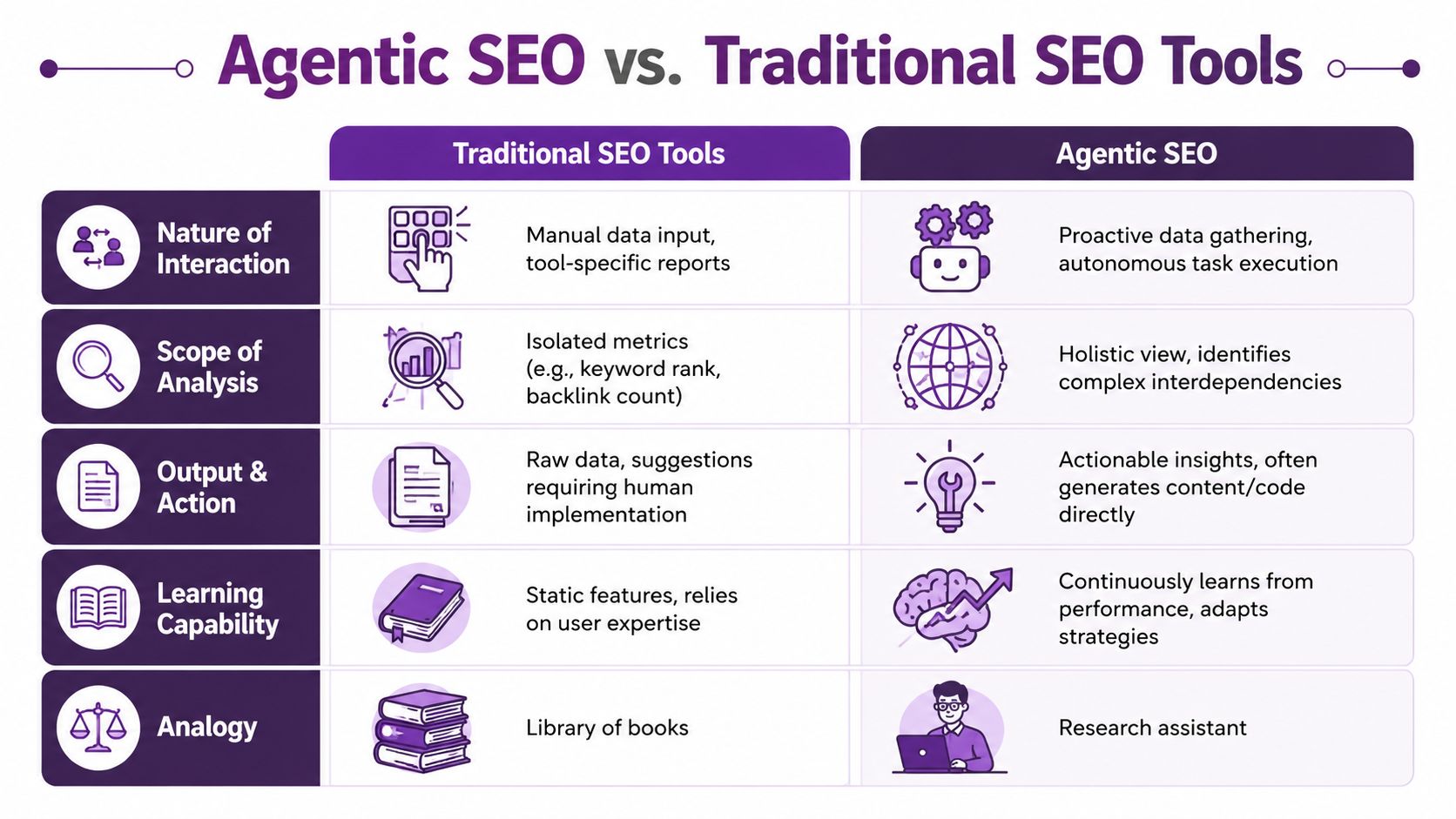
The difference is bigger than interface design. It changes where the analytical burden sits. In the old model, the human is the processor. In the agentic model, the system handles much more of the synthesis and task sequencing.
The shift in operating model
Traditional tools are still useful. Rank trackers, crawlers, backlink indexes, and analytics platforms aren't obsolete. But they usually require a person to move between them and decide what to do with the findings.
A true SEO AI agent operates more like a persistent specialist. It can analyze, recommend, and continue monitoring after the work goes live. One implementation model describes an autonomous eight-step feedback loop that spans SERP analysis, content creation, post-publication monitoring, and automatic fixes for ranking drops, effectively acting as a 24/7 specialist in Keyword Kick's article on the AI agent feedback loop.
Agentic workflows vs traditional tools
Dimension | Traditional SEO Tools | SEO AI Agent |
|---|---|---|
Core interaction | You run reports and interpret them | You ask for an outcome and the system executes supporting tasks |
Data handling | Inputs stay separated by tool | Inputs are combined into a shared decision layer |
Analysis style | Manual interpretation of isolated metrics | Connected reasoning across rankings, traffic, SERPs, and site changes |
Output | Reports, alerts, exports, suggestions | Prioritized actions, workflow execution, and follow-up monitoring |
Post-publication behavior | Usually passive unless a user checks again | Can monitor results and trigger new recommendations |
Where traditional tools still win
Traditional tools can still be better when you need raw control, specialized exports, or deep manual investigation. Senior SEOs often want direct access to source data, especially for technical debugging or stakeholder reporting.
That's why the strongest setup is rarely “agent only.” It's usually agent plus specialist tools, with the agent handling repetitive synthesis and first-pass prioritization.
A practical team doesn't replace its toolbox. It reduces the amount of manual glue work between tools.
If your workflow still depends on copy-pasting findings from one platform into another, agentic SEO is worth serious attention.
How to Choose and Deploy Your First SEO Agent
Many teams make the same mistake at the start. They evaluate the demo, not the operating model.
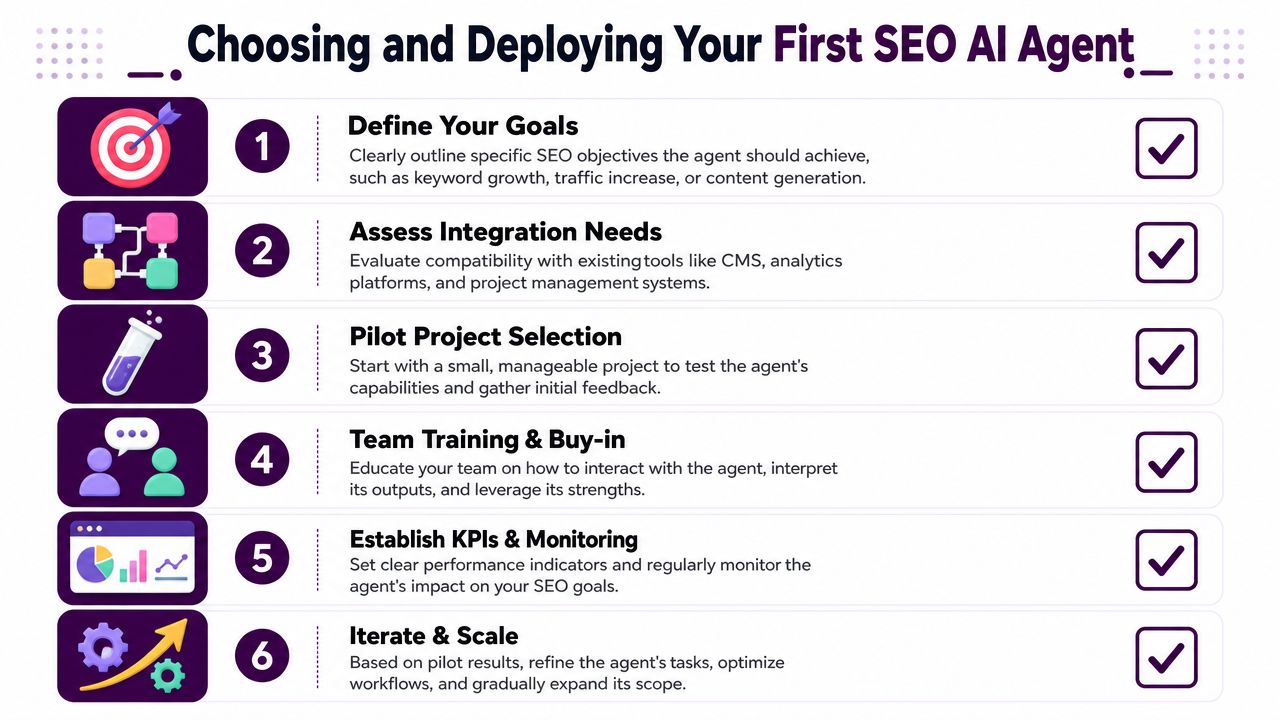
A strong SEO AI agent should fit your stack, support your workflow, and produce outputs that can be verified by a human. If it can't do that, adoption stalls fast.
What to evaluate before rollout
Start with integrations. The agent has to connect to the systems your team uses. For many organizations, that means Search Console, analytics, crawl data, ranking data, and content workflows. Without those, the recommendations will feel generic.
Then evaluate transparency. Can the system show why it made a recommendation? Can an SEO lead inspect the source pages, terms, or signals behind the output? Black-box advice is hard to trust and harder to govern.
If you're comparing platforms, this roundup of SEO automation software platforms for 2026 is a reasonable starting point for narrowing the field. Keyword Kick is one option in this category. It connects GA4, GSC, rank tracking, backlinks, and technical SEO signals in one workspace and returns prioritized actions from that combined dataset.
How to deploy without creating chaos
A clean rollout usually follows this sequence:
Choose one job first: Start with a narrow use case like content refresh prioritization, technical issue triage, or traffic drop diagnosis.
Define review thresholds: Decide what the agent can recommend automatically and what still needs human approval.
Create an owner: One person should validate outputs, collect feedback, and refine prompts, workflows, or integrations.
Document action paths: If the agent flags a problem, the team should already know who reviews it and where the task goes next.
ROI is easy to misread. Faster output is not enough. A key challenge with SEO AI agents is proving whether they improve rankings and conversions, not just workflow speed, while also ensuring the setup supports signals such as clean agent access, structured data, and depth of expertise, as explained in BrightEdge's guide for AI agents.
The KPI question most teams skip
Don't measure success only by time saved.
Track whether the agent changes the quality of decisions. Useful KPI categories include:
Decision quality: Did the team prioritize better pages, issues, or briefs?
Execution speed: Did diagnosis and handoff happen faster?
Outcome lift: Did the recommended actions improve rankings, visibility, citations, or conversions?
Error rate: How often did the agent produce a recommendation that a human rejected?
If you can't answer those questions after a pilot, you don't yet know whether the agent is helping or just staying busy.
Common Pitfalls and Best Practices for Teams
The fastest way to fail with an SEO AI agent is to treat it like a magic layer on top of a messy operation.
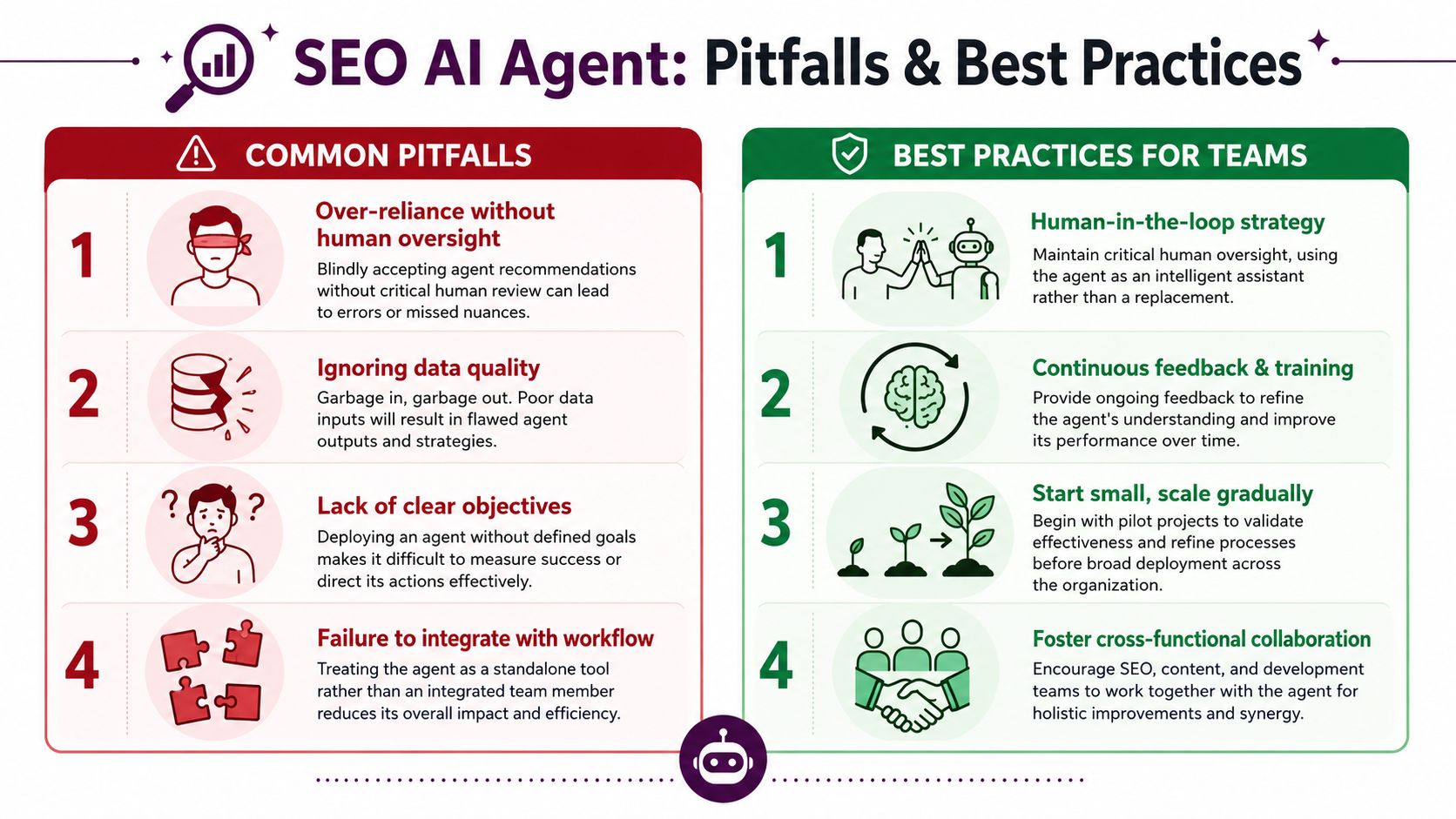
Teams get into trouble when they automate before defining goals, connect weak data sources, or accept recommendations without checking them. None of those are product problems alone. They're governance problems.
Common failure modes
One frequent issue is over-trust. The agent sounds coherent, so the team assumes it's right. But SEO work often depends on context a system may not fully understand, such as seasonality, product changes, legal constraints, or brand voice.
Another issue is poor input quality. If the data is stale, mislabeled, incomplete, or disconnected from the actual site structure, the agent's outputs will drift.
The third issue is workflow isolation. Teams buy an agent, test it in a sandbox, then never embed it into planning, content, or technical processes. It becomes a side tool instead of part of the operating rhythm.
Governance that actually works
Strong teams use agents with review structures.
Keep a human in the loop: High-impact content edits, technical recommendations, and publishing actions should still go through accountable owners.
Audit recommendations regularly: Review a sample of outputs to spot recurring mistakes, weak assumptions, or missing data.
Set domain limits: Be explicit about what the agent can analyze, suggest, and execute.
Treat feedback as training data: Rejected recommendations are useful. They help refine prompts, workflows, and guardrails.
The best use of an SEO AI agent is not replacing judgment. It's preserving judgment for the work that actually requires it.
The teams that get the most value
The most effective teams usually share three habits.
First, they start with bounded workflows instead of company-wide automation. Second, they use the agent to handle repetitive analysis, not final strategy. Third, they involve SEO, content, and development early so the recommendations can move somewhere after they're generated.
That combination is what turns an interesting AI feature into a dependable operating layer.
Frequently Asked Questions About SEO AI Agents
Will an SEO AI agent replace SEO specialists
No. It changes the job, but it doesn't erase the need for experienced people. Strategy, prioritization, editorial judgment, stakeholder management, and technical trade-offs still need human ownership. The agent is better viewed as a persistent analyst that handles repetitive synthesis.
Is an SEO AI agent mainly for content teams
No. Content is only one use case. A strong agent can also support technical triage, internal linking, refresh prioritization, competitive analysis, and anomaly detection. Teams get more value when they use it across multiple SEO workflows instead of treating it as a writing layer.
What should a team automate first
Start with a task that is repetitive, data-heavy, and easy to verify. Traffic drop diagnosis, content refresh queues, and page-level opportunity analysis are good first candidates because a human can review the output against source data.
How much oversight does it need
More at the beginning, less later if the workflows prove reliable. Early on, every important recommendation should be checked. Over time, teams can loosen controls for lower-risk tasks while keeping approvals for high-impact changes.
What about data privacy and access
That depends on the platform and your setup. In practice, teams should map exactly which systems the agent can access, who can trigger workflows, and where outputs are stored. Access control matters as much as model quality.
How do I know if the agent is actually working
Look past speed. The useful test is whether the agent improves prioritization and outcomes. If rankings, citations, or conversions don't improve, then a faster workflow may still be wasted motion. You want better decisions, not just quicker reports.
Is this more important because search is changing
Yes. As search expands beyond classic blue-link ranking into AI-mediated discovery and citation, teams need systems that can monitor more signals and respond faster. That doesn't mean every team needs full autonomy. It means many teams need better connected workflows than they have now.
Keyword Kick helps teams operationalize this model by connecting fragmented search data into one workspace and turning it into prioritized actions. If you want to see how an SEO AI agent can answer questions like “Why did traffic drop?” or “Which pages should we optimize first?”, explore Keyword Kick.