You've probably felt this already. The site keeps growing, the content calendar keeps moving, and the SEO results don't reflect the effort. You publish, refresh a few titles, fix the obvious broken links, and still end up with flat traffic, stale leads, and a content library that's harder to manage every quarter.
That's usually the point where teams say they need an audit. What they often mean is a spreadsheet of URLs and a cleanup pass. That's not enough.
A strong SEO content audit is an operating system for decisions. It tells you which pages deserve protection, which ones need a relaunch, which ones are competing against each other, and which ones shouldn't exist anymore. Beyond that, it connects those decisions to business outcomes, not just rankings. If a page drives visibility but never supports commercial discovery, lead capture, or assisted conversions, it shouldn't receive the same priority as a page that does.
Beyond a Simple Content Checklist
Most content audits fail before analysis starts. They treat the site like a storage closet. Inventory the URLs, mark thin pages, note a few metadata issues, and move on. That approach creates activity, not progress.
A modern SEO content audit has to answer harder questions. Which pages are protecting revenue? Which pages are losing relevance? Which pages still rank but no longer help the business? Which topics are visible in search but absent from AI-driven discovery? Those are strategy questions, not maintenance tasks.
Why the old audit model breaks down
The old model assumes that if you improve page quality in a general sense, performance will follow. Sometimes it does. Often it doesn't, because the core issue sits elsewhere:
Topic overlap: Two or three URLs target the same intent and dilute each other.
Business mismatch: A page attracts informational traffic but has no path into a meaningful next step.
Search evolution: The query still matters, but the results page now favors different structures, fresher coverage, or clearer expertise signals.
AI discovery gaps: A page can still rank in classic search and be ignored in AI-generated responses.
One of the biggest blind spots right now is AI Visibility. Search Engine Land notes that AI overviews are now answering 30 to 40% of queries in major markets and that newer audit frameworks include an AI Visibility tab to track prompts where competitors appear but the brand doesn't (Search Engine Land on AI visibility and gap analysis). That changes the audit brief. Ranking alone no longer describes discoverability.
Practical rule: If your audit only asks “Does this page rank?” you're auditing for yesterday's search environment.
What a strategic audit actually does
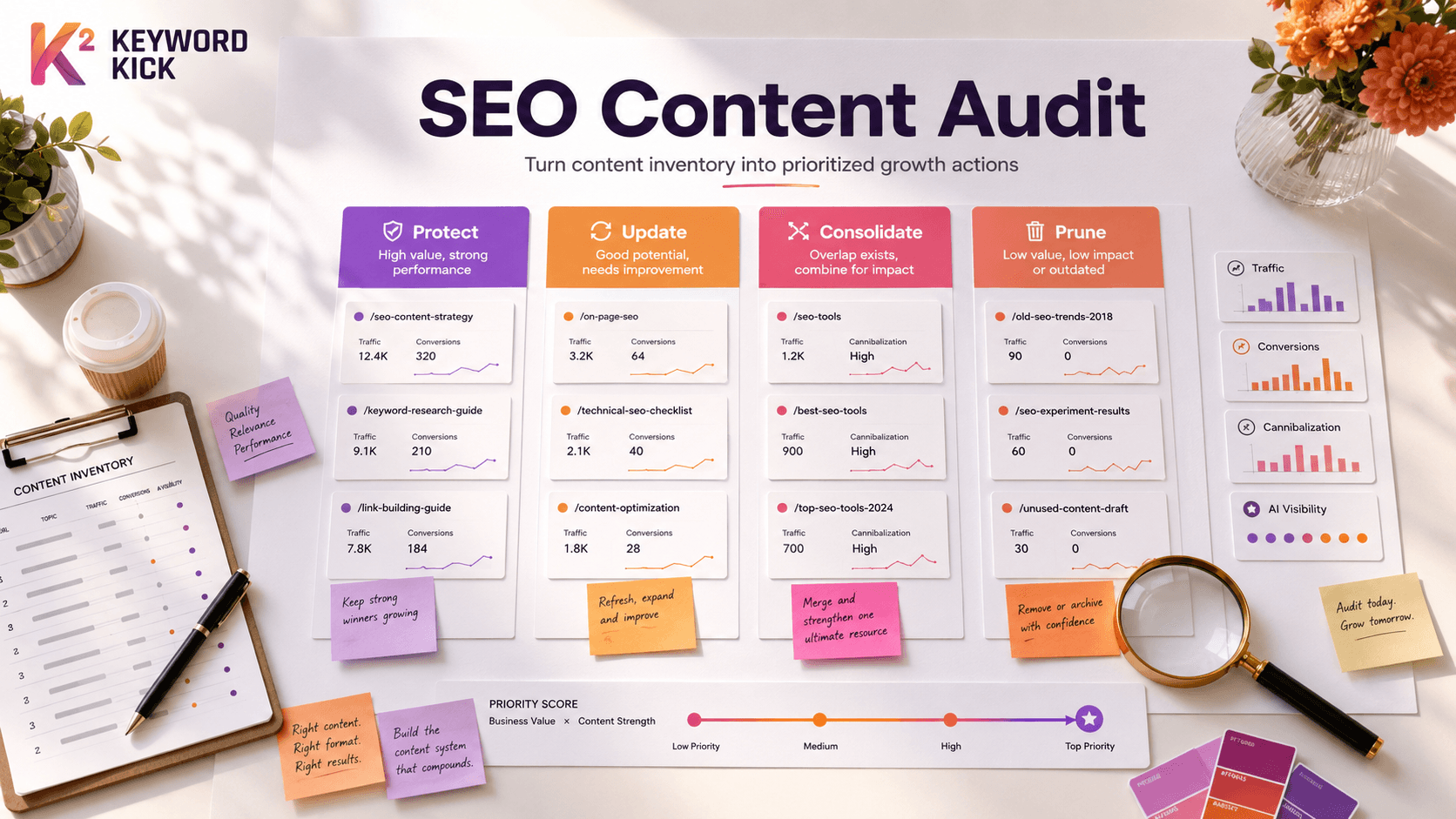
A useful audit classifies pages into actions, not observations. It forces a call on each important URL:
Protect: The page is valuable and needs monitoring, not reinvention.
Update: The topic still matters, but the page has drifted.
Consolidate: Multiple pages are splitting authority and intent.
Prune: The page adds noise, confusion, or maintenance burden.
That's where junior SEOs often get stuck. They gather too much data, then hesitate to make hard calls. Senior work starts when the evidence is clear enough to choose.
Treat the audit as a growth process. You're defending visibility, reclaiming lost value, and reallocating effort toward pages that can influence pipeline, sales conversations, or qualified traffic. That's a different mindset from “let's tidy up the blog.”
Setting Goals and Gathering Your Data
If the audit goal is vague, the analysis will be vague too. “Improve SEO” isn't a goal. It's a wish. A workable audit starts with one primary business question.
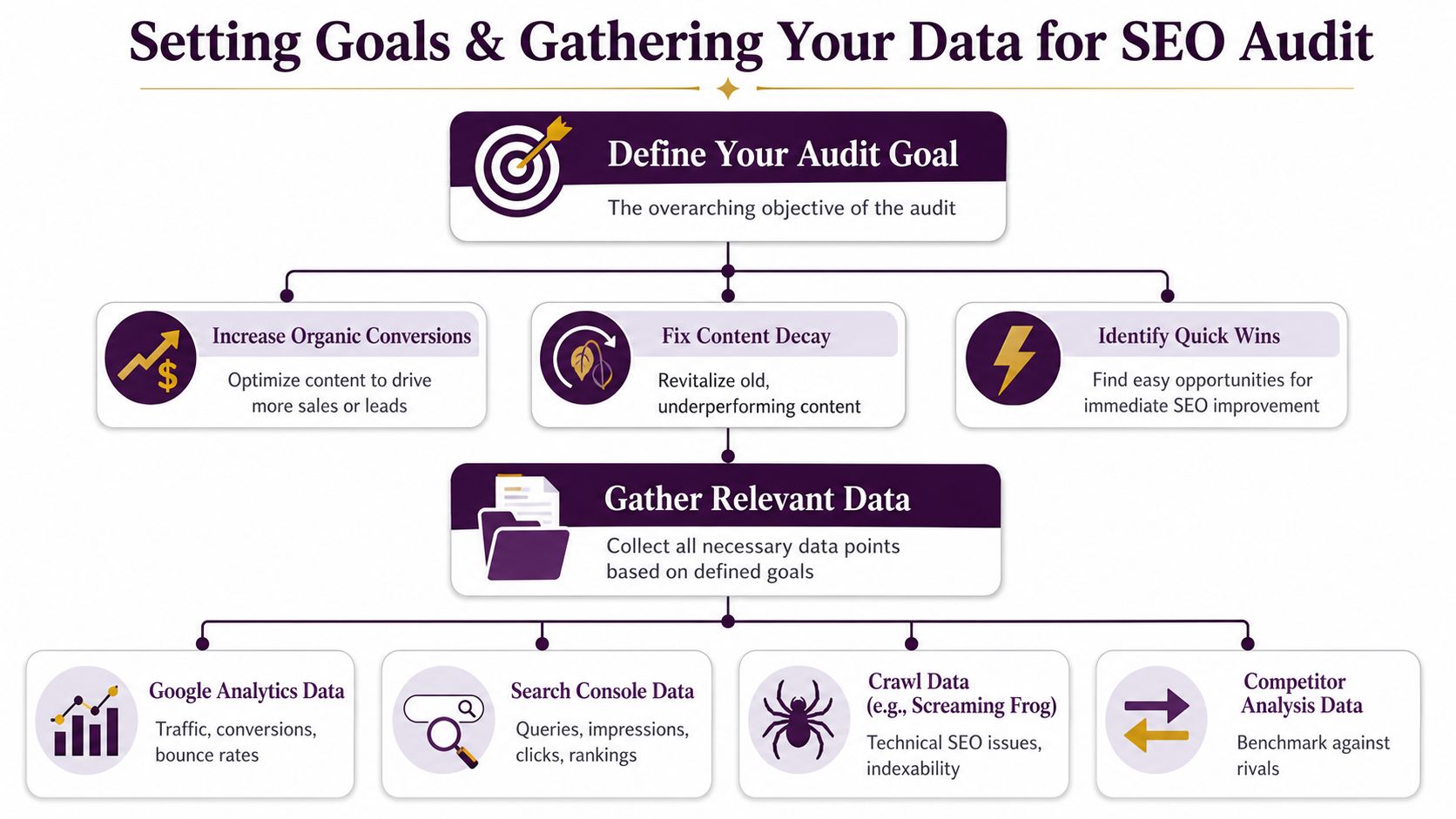
That question is usually one of three things. You need to recover declining performance, increase organic conversions, or find quick wins sitting just outside stronger visibility. The goal determines what data matters and what can wait.
Start with the audit objective
Use a single lead objective for the first pass:
Recover decaying content: Best for mature sites that published heavily and now suspect older assets are slipping.
Improve conversion contribution: Best for teams with solid traffic but weak commercial impact.
Surface low-effort gains: Best when stakeholders want movement quickly and you need early wins.
This sounds simple, but it fixes a common problem. Teams often mix every objective into one audit and create a giant backlog with no order. Pick the main lens first. You can still capture secondary findings while reviewing URLs.
Teams that produce a strong content strategy that converts usually make this decision early. They don't separate keyword targeting from business outcomes. They define what the content should do before they judge whether it's performing.
Pull the minimum viable dataset
You need one workspace where every important signal sits at the URL level. Fragmented tabs create fragmented decisions.
At minimum, collect:
From Google Analytics 4: Organic sessions, landing pages, and conversions tied to those pages.
From Google Search Console: Clicks, impressions, average position, and CTR by page.
From your crawler: Indexable URLs, duplicate signals, broken internal links, canonicals, metadata, and other technical flags.
From rank tracking and backlink tools: Primary keyword positions, trend direction, and link support for important pages.
A practical walkthrough for aligning these metrics lives in this guide to measuring SEO performance. It's useful when you need the reporting side to stay consistent after the audit work starts.
Why the lookback window matters
Many initial audits falter at this juncture. Comparing a short recent window and declaring a page a loser is an inexperienced approach. The better strategy is to establish whether the decline is real.
A common benchmark defines content decay as a traffic drop of 30% or more, and the recommended protocol is to export organic traffic, pageviews, and conversion data for at least the last 12 months so you can separate real decline from seasonality (J-A-B on content decay benchmarks and audit workflow).
That changes how you interpret the sheet. A seasonal page isn't decaying. A once-strong evergreen page with a sustained drop probably is.
Build one master sheet before you judge anything
The master sheet is where audits become useful. Every URL should have enough context to answer four questions:
Is it visible?
Do users engage with it?
Does it contribute to conversions?
Is it maintainable?
If you can't answer those four at the URL level, you're not ready to classify pages yet.
In practice, this is also why unified platforms matter. When the analyst has to jump between GA4, GSC, crawling exports, backlink tabs, and rank tracking snapshots, momentum dies. Decision quality drops because context is always missing at the moment a call needs to be made.
The Complete SEO Content Audit Checklist
A content audit gets expensive when every weak page looks equally urgent. The job here is to separate pages that deserve effort from pages that only create noise. Good auditors do that by judging each URL on business impact, recovery potential, and maintenance cost, then assigning a clear action.

Which pages are bleeding performance
Start with URLs that used to matter.
A drop in clicks matters. A drop in leads or assisted conversions matters more. If a page still earns impressions but no longer earns action, the problem usually sits in one of three places: weaker intent match, a weaker SERP presentation, or content that no longer clears the quality bar against current competitors.
Review each declining page across four lenses:
Visibility: impressions, clicks, average position, CTR
Engagement: bounce patterns, scroll depth, time on page, return visits
Conversion contribution: form fills, demo requests, assisted conversions, revenue influence
Maintainability: broken elements, outdated claims, thin sections, formatting debt, internal link gaps
That last lens gets skipped too often. I have seen teams protect pages because they still bring traffic, even when updating them takes twice the effort of a cleaner replacement. Maintenance cost affects ROI. Treat it that way.
Look for combinations like these:
High impressions, weak clicks: the page is eligible to rank, but the title, meta description, or search intent match is weak
Traffic holds, conversions drop: the topic still attracts visitors, but the page no longer supports the next business step
Rankings slip on an evergreen topic: the demand is still there, but competitors now offer fresher, clearer coverage
Useful topic, messy page: broken links, duplicate sections, or poor structure make the asset harder to improve and harder to trust
Which pages are close to a breakthrough
Some of the best audit wins come from pages that are already near page one. Search Engine Journal recommends checking pages ranking just outside top positions because they often respond well to focused improvements in content depth, on-page targeting, and internal linking (Search Engine Journal on SEO content audit opportunities).
These URLs already have signals in place. They do not need random edits. They need a sharper answer to the query.
A practical review usually focuses on:
missing subtopics that stronger competitors cover
weak internal links from relevant hub or revenue pages
titles and headings that target the topic broadly but miss the actual search intent
outdated examples, screenshots, product details, or proof points
weak calls to action on pages with clear commercial potential
A dedicated content gap analysis workflow helps here because page-two URLs rarely improve from surface-level cleanup. They improve when the page starts satisfying the full topic better than the current top results.
One caution. Do not treat every page in striking distance as a high-priority update. If the keyword has low business value, the win may still be a distraction.
Where you're competing against yourself
Cannibalization subtly drains authority. On larger sites, it usually comes from good intentions: multiple teams publish around the same topic, categories expand, and no one consolidates overlapping assets.
Check for these patterns:
Similar slugs or overlapping title tags
Multiple URLs getting impressions for the same query family
Several pages ranking modestly with no clear winner
Internal links pointing to different pages for the same intent
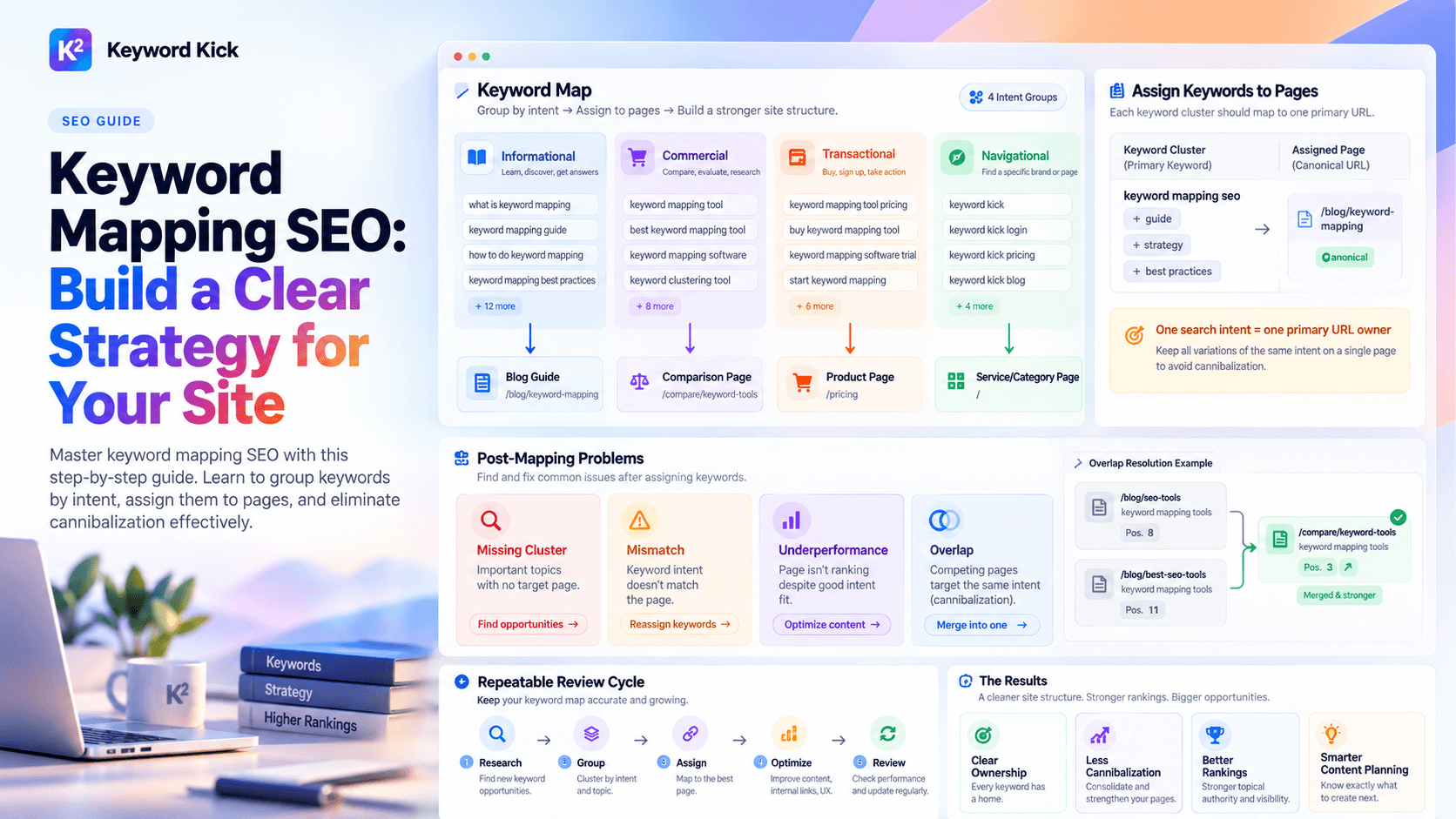
The fix is not always a merge. First decide whether the pages serve the same search purpose. If they do, keep the strongest survivor and fold useful sections from the weaker URL into it. If they target different stages of intent, keep both and sharpen the distinction. A blog post and a product page can share terms without being true cannibalization problems.
This is one reason unified platforms are useful in real audits. If query overlap, conversion data, and crawl signals live in separate tools, analysts miss the pattern and teams keep updating the wrong page.
What the crawler reveals that metrics don't
Performance reports show outcomes. Crawl data explains a lot of the friction behind those outcomes.
Search Engine Land outlines content audit work that includes inventory, performance review, and technical checks such as duplicate pages, broken links, and indexing issues that can limit stronger content from performing as expected (Search Engine Land on content audit process and technical checks).
Add these checks to every serious content review:
Duplicate or near-duplicate pages: common on older CMS builds, faceted archives, and repeated local templates
Thin pages: short content is not the problem by itself. Low-value content that fails to satisfy intent is
Broken internal links: these interrupt user paths and waste authority you could route to higher-value pages
Indexation and canonical issues: strong content cannot perform well if search engines are being sent mixed signals
Structured data and trust signals: missing authorship, sourcing, reviews, or schema can weaken pages that otherwise deserve to rank
Mobile and page experience problems: friction on high-intent pages hurts both SEO performance and conversion rate
Technical defects do not always justify a rewrite. Sometimes the right move is a light repair pass, then reassess before assigning editorial hours.
What to do with each finding
Every URL should leave the audit with an action, an owner, and a reason. Without that, the checklist becomes a document people admire and ignore.
Finding | Likely meaning | Typical action |
|---|---|---|
Traffic and conversions are stable | Page still contributes and does not need heavy intervention | Keep and monitor |
Rankings drift, topic still matters | The page has lost relevance or freshness | Update and relaunch |
Multiple pages overlap on intent | Authority and internal links are split | Consolidate and redirect |
No meaningful role in search or business | The page costs more to maintain than it returns | Prune carefully |
The trade-off is simple. A page can be worth saving because it has revenue potential, not because it exists. That distinction is what turns an audit from a content inventory into an operating plan.
A Prioritization Framework That Drives Revenue
An audit without prioritization becomes a guilt document. It tells you everything that's wrong and nothing about what to do first.
The right way to prioritize isn't “highest traffic first” or “lowest quality first.” Both can mislead you. High-traffic pages may already be close to peak performance. Low-quality pages may never matter enough to justify the effort. The pages worth acting on sit at the intersection of demand, content quality, commercial relevance, and realistic execution.
Score pages for business value, not just visibility
A revenue-focused audit scores pages across demand, intent fit, content strength, and business contribution, with pages scoring 15+ treated as assets and pages under 9 considered candidates for consolidation or deindexing (Search and Systems on revenue-focused content audit scoring).
That model is useful because it solves a stubborn reporting problem. SEO teams often show rankings moving while stakeholders ask a fair question: did any of this help the business? This scoring system gives you a cleaner answer.
Here's a practical matrix you can use.
Revenue-Focused Prioritization Matrix
URL | Organic Potential | Content Strength | Business Value | Total Score | Action |
|---|---|---|---|---|---|
/blog/example-topic | High | Medium | High | 15+ | Keep & Protect or Update & Relaunch |
/blog/overlapping-topic-a | Medium | Low | Low | Under 9 | Consolidate & Merge |
/blog/overlapping-topic-b | Medium | Medium | Low | Under 9 | Consolidate into stronger survivor |
/resources/legacy-post | Low | Low | Low | Under 9 | Prune & Redirect if appropriate |
/service/high-intent-page | High | High | High | 15+ | Protect and strengthen internal linking |
The table matters less than the discipline behind it. Every score should come from evidence, not instinct.
How to think about each dimension
Use plain judgment, but keep it consistent.
Organic Potential: Is there real search demand and a plausible path to stronger visibility?
Content Strength: Does the page satisfy intent, show clear expertise, and hold up against current competitors?
Business Value: Does it assist lead capture, support product discovery, or influence qualified traffic?
Intent Fit: Is the page the right format and angle for the query family it targets?
Notice what's not here. Vanity metrics. A page with decent visits but weak business value can't outrank a page that meaningfully supports revenue.
Decision shortcut: If a page looks healthy in SEO tools but weak in business contribution, it may be a visibility asset, not a growth asset. Treat it accordingly.
Turn scores into action buckets
I like four buckets because they force clarity:
Keep and Protect
Strong pages with durable value. Watch them, improve internal support, and avoid unnecessary rewrites.Update and Relaunch
Good topics, underperforming execution. Best candidates for refreshed examples, tighter structure, improved intent match, and stronger conversion paths.Consolidate and Merge
Overlapping assets where one strong page should replace several weaker ones.Prune and Redirect
Legacy pages with little search value, little business value, and no strategic role.
The trade-off is important. Every hour spent reviving a weak, low-value page is an hour not spent improving a page with real commercial upside. Strong prioritization protects the team from busywork disguised as SEO.
Putting It All Together Sample Workflows
The easiest way to understand a content audit is to walk through the fixes that matter most. Two patterns show up constantly on large sites: cannibalization and content decay. If you can handle both cleanly, you can run a serious audit.

Workflow one for cannibalization
You find two blog posts targeting the same intent. Neither ranks as strongly as it should. Both earn some impressions. Internal links point to both. The team has emotional attachment to each because both took effort.
Ignore the attachment. Pick a winner.
Start with these questions:
Which page has the better historical performance?
Which page has stronger link support or stronger internal linking?
Which page matches the intent more cleanly?
Which URL would you rather keep long term?
Once the survivor is clear, pull the useful content from the weaker page into the stronger one. Don't paste blindly. Keep only the sections that improve depth, examples, or clarity. Then place a 301 redirect from the weaker URL to the survivor.
Reducing cannibalization can materially improve outcomes. Screaming Frog notes that when audits identify and merge pages competing for the same query, the consolidated page typically sees a 20 to 40% increase in ranking position within 3 to 6 months (Screaming Frog on keyword cannibalization gains).
A practical way to operationalize that work is to standardize the steps in your workflow stack. This SEO automation guide is useful for turning repetitive classification and follow-up tasks into repeatable processes.
Don't merge pages because they look similar to you. Merge pages because they compete for the same search purpose.
Workflow two for a decaying high-value post
The second pattern is more subtle. You have a page that used to matter. It still has some authority. It may even sit near page one. But it's slipping, and the decline affects a topic that supports the business.
This is not a rewrite-from-scratch situation. It's a structured refresh.
A practical refresh sequence looks like this:
Replace outdated proof points: Update old references and examples with current information where needed.
Expand for current intent: Add sections competitors cover if they answer the same search need better than your current draft does.
Improve trust signals: Strengthen author attribution, sourcing, product knowledge, and practical specificity.
Fix internal friction: Repair broken internal or external links, improve contextual links from related pages, and tighten heading logic.
Recheck the conversion path: Make sure the page still leads readers to the next sensible action.
This kind of page often responds well because the underlying topic already has history. You're not inventing demand. You're restoring fit.
What good execution looks like
In both workflows, the common pattern is simple. One clear action, one owner, one follow-up window, and one success metric tied to the reason the page mattered in the first place.
That's how the audit becomes usable. It stops being a giant document and becomes a sequence of high-confidence decisions.
From One-Time Project to Continuous System
A familiar pattern plays out after a big audit. The team clears a backlog, updates a batch of pages, merges a few duplicates, and then shifts back to new content. Six months later, the same problems return, except now key pages have slipped further and the recovery work costs more.
The fix is operational, not editorial. Treat the audit as a recurring decision system with a set review rhythm, clear ownership, and a record of what each action changed.
Build a review rhythm around strategic pages
Quarterly reviews are a practical cadence for pages that influence revenue. That usually means commercial pages, high-intent guides, comparison content, and any asset that consistently brings in qualified organic visits. Those pages can subtly lose value through intent shifts, outdated proof, weaker SERP presentation, or stronger competitor coverage.
Other pages can sit on a lighter schedule. A support article that ranks steadily and serves a narrow need may only need a periodic check. A page tied to pipeline, product discovery, or a core topic cluster deserves closer attention.
The point is not to review everything equally. The point is to protect the pages where small ranking losses have business consequences.
Measure after action, not just after publication
Publishing an update tells you nothing by itself. The useful signal comes after Google recrawls the page and users interact with the revised version.
Track the result by action type. For refreshed pages, look for stronger impressions, better click-through rate, more qualified sessions, and healthier conversion paths. For merged pages, confirm that the surviving URL now captures the target intent and that internal links support it. For pruned pages, check for broken journeys, orphaned references, and any decline in adjacent pages that used to rely on that content.
Keep those outcomes in the audit record.
Teams that document what happened after each decision get better faster. They stop arguing in theory and start seeing patterns. Which refreshes recover traffic. Which merges consolidate value cleanly. Which page types rarely justify another round of work.
The audit should reduce uncertainty in the next review cycle. If priorities stay the same because nobody learned from the last set of actions, the audit produced paperwork, not strategy.
The long-term goal is a system that catches decay early, protects pages that influence revenue, and routes limited SEO time toward work with a clear business case.
If you want to run that system without stitching exports together by hand, Keyword Kick gives you one workspace for GA4, Google Search Console, rankings, backlinks, and technical SEO signals, then turns that data into prioritized actions. That matters because continuous audits fail when evidence lives in five separate tools and nobody can connect a traffic drop to a revenue impact quickly enough to act.