You probably have the same starter spreadsheet. A few hundred keywords exported from a tool, a handful of competitor terms, some notes from sales, and no real agreement on what should be built first.
That's where most keyword strategies break. Not at research, but at operations.
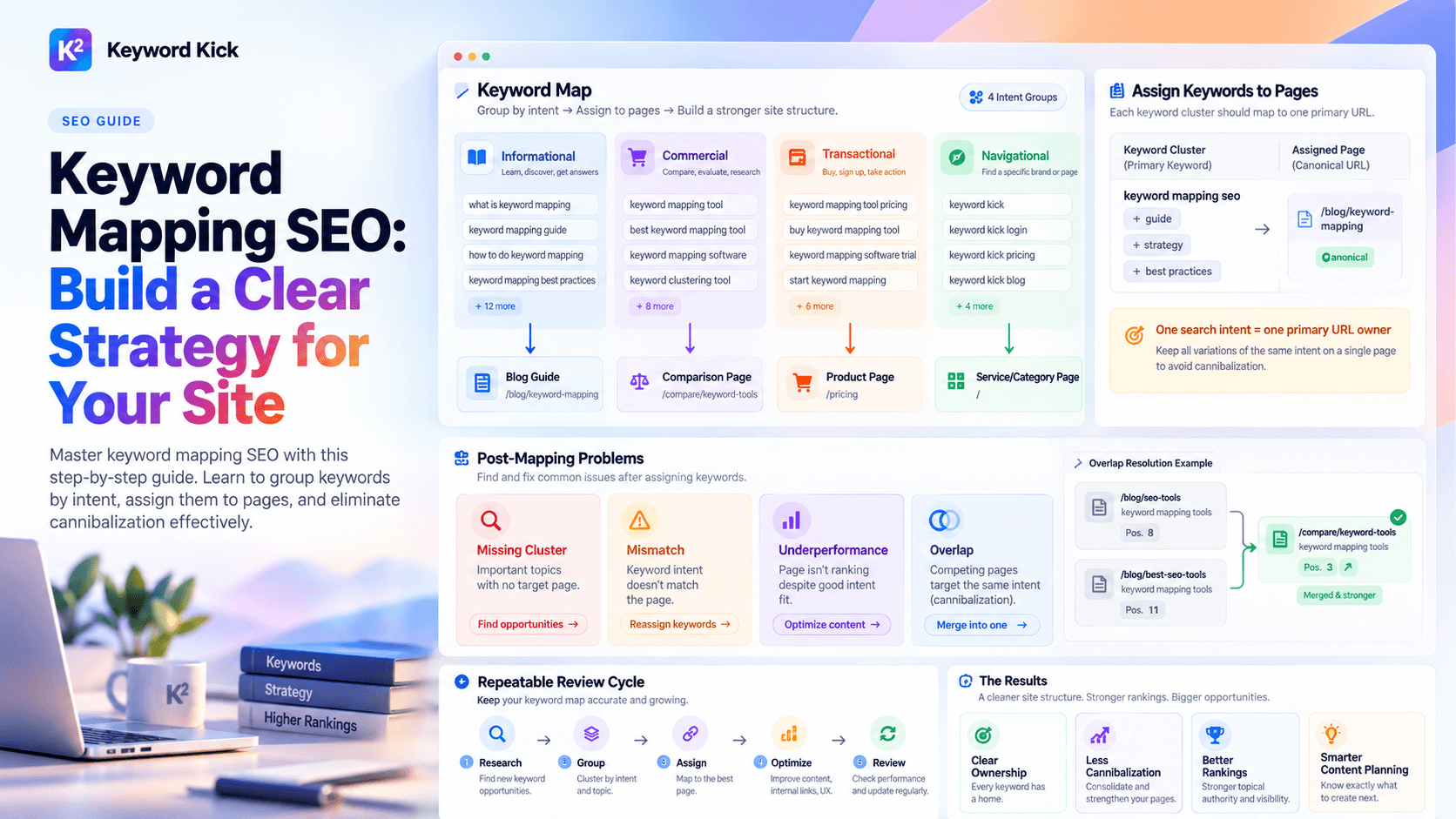
A workable SEO keyword strategy isn't a giant list. It's a system for deciding what matters, assigning each query to the right page, publishing in the right order, and measuring whether that work helped the business. If you skip that system, you get the familiar mess: blog posts chasing traffic with no commercial value, service pages competing with articles, and reporting that celebrates impressions while pipeline stays flat.
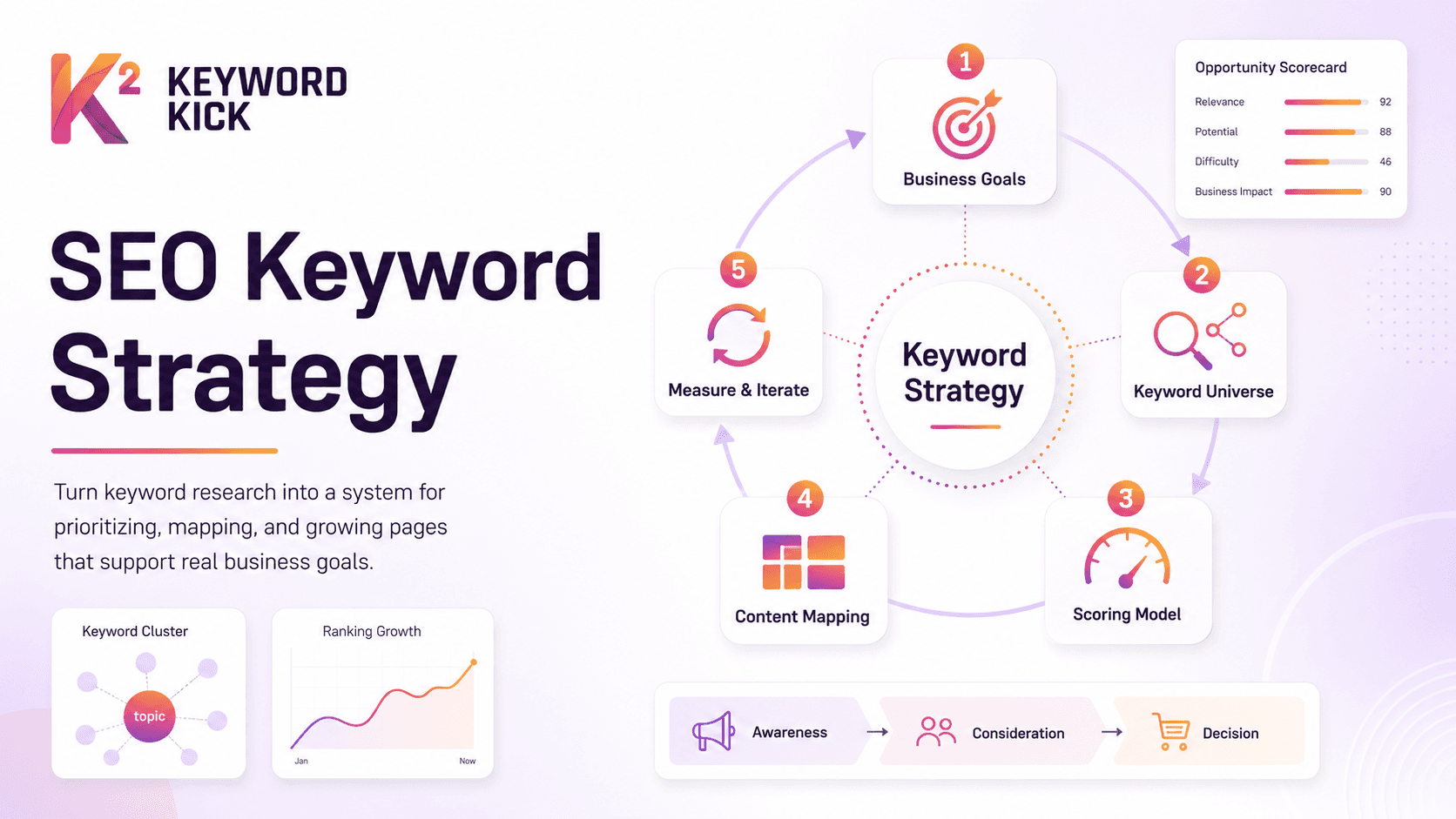
The fix is simple, but it requires discipline. Start with goals. Build a useful keyword universe from real demand and real audience language. Score opportunities instead of arguing about them. Map each cluster to one page and one funnel stage. Then track what changed over time and adjust.
Aligning Keywords with Business Goals
The fastest way to waste an SEO budget is to ask, “What keywords have volume?” before asking, “What are we trying to grow?”
A profitable SEO keyword strategy starts with the business model. If leadership cares about demos, qualified leads, product trials, or revenue, then keyword selection has to reflect that. Traffic matters, but traffic is only a proxy. A page that attracts the wrong visitors can look successful in a dashboard and still do nothing for the company.
Start with the KPI, not the keyword list
New teams often reverse the order. They build a list first, then try to justify it later. That's how you end up publishing articles that rank for broad queries but never support sales conversations.
A better sequence looks like this:
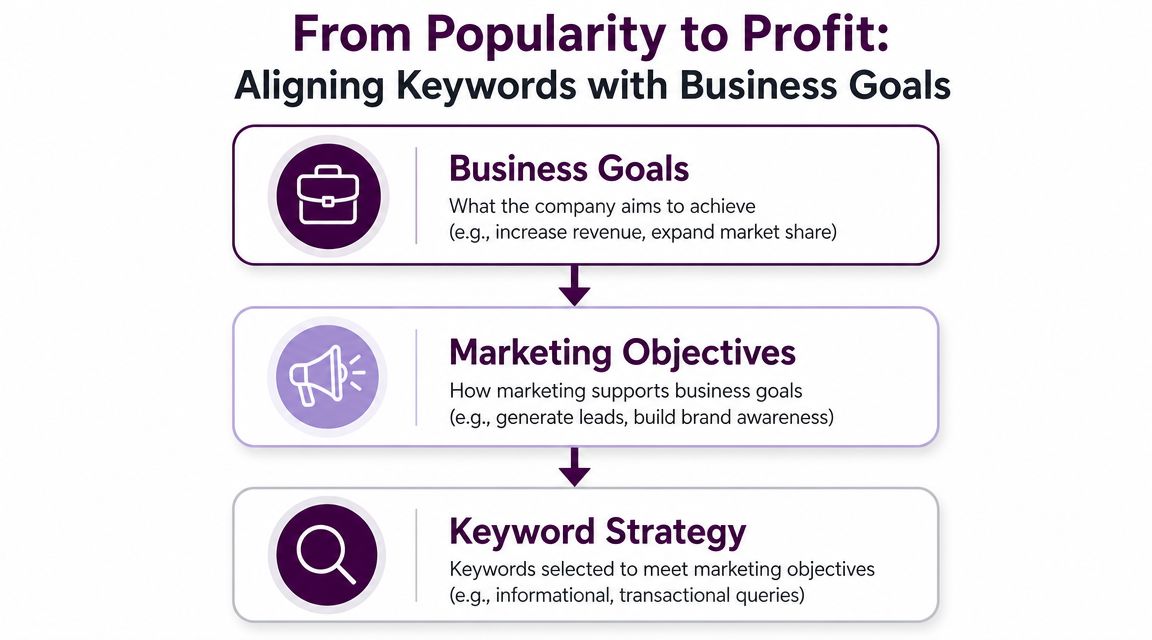
Pick the business outcome. Revenue, qualified pipeline, trial starts, booked calls, product signups, or customer acquisition.
Define the marketing job. Brand awareness, education, lead generation, comparison content, or bottom-funnel conversion support.
Choose keyword types that match that job. Informational terms for awareness. Commercial investigation terms for evaluation. Transactional terms for decision-stage pages.
When teams do this well, arguments become easier to resolve. A keyword with decent search volume but weak business fit loses to a lower-volume query with strong buyer intent.
Practical rule: If you can't explain how a keyword could contribute to a real business KPI, it doesn't belong near the top of your roadmap.
Traffic for vanity versus traffic for revenue
The distinction sounds obvious. In practice, teams still get trapped by big numbers.
Broad informational terms can help. They build visibility, links, brand familiarity, and topic coverage. But they only work when they connect to a larger funnel. If there's no path from that traffic to the product, the content program becomes a publishing treadmill.
That's why I prefer a portfolio approach:
Awareness keywords support reach and education.
Consideration keywords help prospects compare approaches, tools, or methods.
Decision keywords capture users who are closer to action.
This is also where restraint matters. Guidance cited in SEO strategy coverage says businesses that optimize for relevant keywords can see a 50% increase in organic traffic and notes that HubSpot advises new sites to focus on 10 to 20 keywords maximum, targeting terms with 100 to 1,000 monthly searches and difficulty below 40 for early prioritization (SEO strategy statistics coverage). That framework is useful because it forces focus. New programs don't need more ideas. They need fewer, better bets.
Fit your keyword strategy to where search is going
Business alignment also means acknowledging that a ranking alone isn't always the prize anymore. Some queries now lead to zero-click behavior, AI summaries, or fast answer boxes. If your team is still selecting keywords as if every impression leads to a blue-link click, the model is dated.
That's why it helps to understand the future of search beyond SEO. The point isn't to abandon classic SEO. It's to choose keywords that can still create visibility, clicks, or citations in a SERP that gives users more answers before they land on your site.
Building Your Keyword Universe
Most keyword lists are too shallow in one direction and too bloated in another. They're shallow because they over-rely on one tool. They're bloated because they collect terms without deciding whether those terms reflect real customer language, real demand, or real intent.
A useful keyword universe comes from multiple inputs. Tool data matters, but your best opportunities often sit in the gap between what keyword databases show and what your audience is already telling you.
Mine your own data first
Before you touch competitor exports, open Google Search Console and GA4.
SE Ranking recommends using GSC to find valuable queries not yet matched by existing pages and using GA4 site-search terms to generate new seed keywords in advanced keyword research workflows (advanced keyword research guidance). That's one of the highest-value habits in SEO because it starts from observed behavior, not guesswork.
In GSC, look for three buckets:
Queries with impressions but weak clicks. These often indicate mismatched titles, poor page alignment, or an unclear angle.
Queries where a page ranks but doesn't fully satisfy intent. That may call for a rewrite, expansion, or a separate supporting page.
Queries with no clear destination page. Those are content gap signals.
In GA4, site search can be even more revealing. Users often type the exact language they expect to find on your site. That language is gold because it reflects how your market frames the problem.
Users rarely speak in the neat category labels marketing teams invent. They describe tasks, frustrations, comparisons, and edge cases.
Build from striking-distance terms and missing coverage
If I'm training a new SEO on workflow, I tell them to split discovery into two lanes.
The first lane is striking distance. Find terms where the site already has some relevance. Those terms are often faster to improve because search engines already associate the page or domain with the topic.
The second lane is missing coverage. These are themes the audience clearly cares about, but the site has no page that deserves to rank.
A simple workflow:
Export GSC query and page data.
Group related queries by shared intent.
Mark whether each group has a strong existing page, a weak page, or no page.
Prioritize the groups that have both business relevance and weak existing coverage.
If someone on your team is new to this process, a basic walkthrough like Keyword Kick's keyword research guide for first rankings is a practical starting point.
Use competitors carefully
Competitor analysis is useful, but it's easy to misuse. Too many teams treat competitor keywords like a shopping list. That creates copycat strategies and bloated calendars.
Use competitors for pattern recognition instead:
Which pages drive their visibility
Which topics they've covered thoroughly
Which commercial terms they own
Which audience questions they haven't answered well
That last point matters most. You're looking for whitespace, not homework to copy.
Pull language from the market, not just SEO tools
Tools are good at returning known queries. They're worse at showing fresh phrasing, support pain points, or niche terms with unclear volume.
That's where forums, review sites, support transcripts, and sales call notes help. You're listening for repeated wording around:
Pain such as migration trouble, setup friction, or cost concerns
Desired outcome such as speed, clarity, automation, or control
Comparison language such as “vs,” “alternative,” “better for,” or “works with”
Don't ignore low-volume or even zero-volume terms if they cluster around an important job to be done. One phrase may look small. A well-built cluster around that phrase can still earn meaningful traffic because the page satisfies a family of related searches.
Prioritizing Keywords with a Scoring Model
Here, strategy stops being subjective.
Without a scoring model, keyword prioritization turns into a room full of opinions. Sales wants bottom-funnel terms. Content wants educational topics. Leadership wants the biggest volumes. SEO wants quick wins. Everyone has a point, and nobody has a common filter.
A scoring model gives the team one.
Score the opportunity, not just the popularity
Modern keyword strategy has shifted from single-term targeting to cluster-based planning, and the guidance referenced by the University of Georgia emphasizes balancing visibility with realistic ranking potential by focusing on terms with 100 to 1,000 monthly searches and difficulty under 40 for new sites (keyword research guidance). That's a useful baseline, but volume and difficulty alone still aren't enough.
I use four lenses:
Factor | What it asks | Why it matters |
|---|---|---|
Volume | Is there enough demand to justify the work? | Prevents building pages nobody is looking for |
Difficulty | Can this site realistically compete? | Stops teams from chasing impossible terms too early |
Intent | Does the query match awareness, evaluation, or buying behavior? | Protects page-level relevance |
Business value | If we win this term, does it support revenue or acquisition? | Keeps SEO tied to outcomes |
The simplest scoring model is a weighted judgment system. You don't need fake precision. You need consistency.
A practical scorecard
Use a spreadsheet and assign a score for intent and business value. Keep monthly volume and difficulty as observed inputs from your toolset. Then create a final priority score based on your internal weighting.
Here's a sample.
Sample Keyword Prioritization Scorecard
Keyword | Monthly Volume | Difficulty (0-100) | Intent Score (1-3) | Business Value (1-3) | Final Priority Score |
|---|---|---|---|---|---|
seo keyword strategy | 1,000 | 38 | 2 | 3 | High |
keyword mapping template | 300 | 24 | 2 | 2 | Medium |
best seo platform for agencies | 500 | 35 | 3 | 3 | Very High |
what is keyword cannibalization | 700 | 31 | 1 | 2 | Medium |
rank tracking software comparison | 400 | 37 | 3 | 3 | Very High |
This table is intentionally simple. I'd rather have a model the team uses than a complicated framework everyone ignores.
What usually gets scored badly
Weak priority candidates usually fall into one of these traps:
Broad and detached. High visibility potential, weak connection to the offer.
Too hard for the current site. The term may be valuable, but the domain doesn't yet have the authority or supporting cluster.
Bad page fit. Informational query, commercial page. Or transactional query, blog article.
Overlapped intent. The term is already partially owned by another page, which creates internal competition.
A keyword isn't “good” in isolation. It's good only if your site can serve the intent, win the click, and benefit from the visit.
Use clusters in the scoring step
One more trade-off matters here. Teams often score keywords one by one, then publish one-off pages. That's how content calendars become fragmented.
A better approach is to score the cluster head term and then assess whether the surrounding subtopics strengthen the business case. If a high-value commercial page can be supported by multiple related informational and comparative pages, that cluster deserves more attention than a lone keyword with similar volume.
That's what turns a keyword list into an operating system. You stop asking, “Should we target this phrase?” and start asking, “Is this the right cluster to build next?”
Mapping Keywords to Content and Funnel Stages
A keyword strategy fails in production when multiple pages chase the same intent or when content gets published with no structural role. One page answers the basics. Another page covers nearly the same idea with slightly different wording. A service page competes with a blog post. Rankings wobble, and nobody is sure which URL should win.
That's a mapping problem.
Assign one intent to one canonical page
Evidence-based SEO guidance increasingly treats keyword mapping as a structural decision. Keywords should be assigned to single canonical pages, clusters should be built around topic pillars, and overlapping pages should be consolidated to avoid cannibalization (keyword research and cannibalization guidance).
That means each page needs a job.
Not a vague topic. A job.
A page should either define, compare, persuade, convert, or support. If two pages are trying to do the same job for the same searcher, one of them is probably unnecessary.
For teams that need a shared framework, a keyword mapping glossary entry can help establish the language before content planning starts.
Use the pillar and cluster model
The pillar-cluster model works because it mirrors how people research. Users don't move through a topic in a straight line. They branch. They ask follow-up questions. They compare methods. They look for proof.
A clean structure looks like this:
Pillar page anchors the broad topic and targets the main intent.
Cluster pages cover subtopics, comparisons, use cases, or adjacent questions.
Internal links connect supporting pages back to the pillar and laterally to related content.
Think of the pillar as the hub in an airport. The cluster pages are the gates. If the hub is weak or the routes are unclear, travelers miss connections.
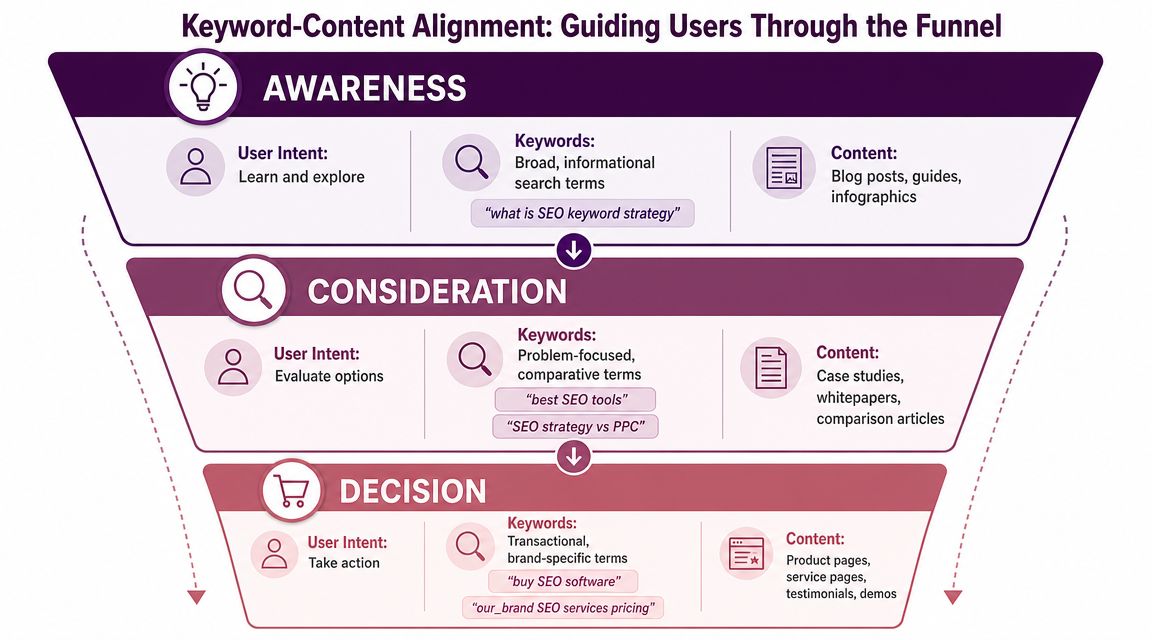
Map by funnel stage, not just by topic
Topic grouping is only half the job. The other half is matching content type to decision stage.
Funnel stage | Keyword intent | Best content format |
|---|---|---|
Awareness | Informational, educational, definitional | Blog posts, explainers, guides |
Consideration | Comparative, problem-solving, solution research | Comparison pages, workflow content, alternatives pages |
Decision | Transactional, brand-specific, action-oriented | Service pages, product pages, pricing pages, demos |
Format mismatch is one of the most common reasons pages underperform. A user searching for a comparison query usually doesn't want a general explainer. A user searching for a broad educational term usually isn't ready for a hard-sell landing page.
If a page doesn't match the searcher's stage, it won't matter how well the keyword is placed on the page.
Consolidate before you create
When I audit content libraries, I often find teams publishing new pages to solve problems that already exist on the site. Usually the better move is consolidation.
Before you brief a new page, ask:
Do we already have a URL that partly covers this intent?
Would updating and expanding that page be stronger than creating a new one?
Could two weak pages become one stronger canonical page?
This step saves time and usually improves performance. Search engines prefer clarity. So do users.
Technical SEO and On-Page Keyword Integration
A keyword strategy doesn't become real until it reaches the page.
Teams either send strong relevance signals or sabotage good planning with messy execution. The old mistake was keyword stuffing. The newer mistake is being so cautious that the page barely signals what it's about.
The target is clear relevance, natural language, and strong page structure.
Put the target keyword where it matters
Every primary page should have one primary keyword set. That doesn't mean repeating the same phrase mechanically. It means making the topic unmistakable.
Use the primary term or close variation in these places:
Title tag when it reads naturally and reflects the main intent
H1 so the page topic is explicit
Opening paragraph to confirm relevance quickly
Subheadings where they help organize the page
Meta description to improve click appeal, even if it isn't a direct ranking factor
Internal anchor text from related pages, using natural variation rather than exact-match repetition every time
If the phrase feels forced, rewrite the sentence. Relevance should sound like a competent writer, not a checklist.
Optimize for retrieval, not density
The page's job is to answer the query better than competing pages. That requires more than placement.
Good on-page integration usually includes:
Clear definitions early for broad or educational terms.
Direct answers to common questions pulled from SERP behavior, support conversations, and customer language.
Logical heading structure so the page can be scanned by both users and search systems.
Supporting entities and related terms that make the topic complete.
Internal links to connected pages in the same cluster.
This is also why technical quality matters. A page can have the right keyword targeting and still underperform if crawling, rendering, internal linking, or duplication issues get in the way. For teams working on large product catalogs or category-heavy sites, this guide to technical SEO for eCommerce stores is useful because it shows how structural issues can affect discoverability and page relevance at scale.
Adjust for AI Overviews and zero-click behavior
A modern keyword strategy also has to account for AI Overviews and zero-click results. Guidance on intent-first research recommends checking whether AI Overviews appear for a target query and prioritizing content that is definition-rich and question-driven to improve visibility in those environments (AI Overview-focused keyword research guidance).
That changes execution in practical ways.
For queries likely to trigger summarized results, pages should be:
Definition-rich with concise explanations near the top
Question-driven with direct answers under clear subheads
Well-structured so key points are easy to extract
Specific rather than padded with generic filler
The mindset shift is important. You're not only optimizing to rank. You're optimizing to be understood, extracted, and cited.
Measuring Performance and Iterating Your Strategy
A keyword plan isn't finished when the content goes live. That's when the useful part starts.
The teams that get durable SEO results don't treat keyword strategy as a research project. They run it as a loop. Publish, observe, diagnose, adjust, repeat.
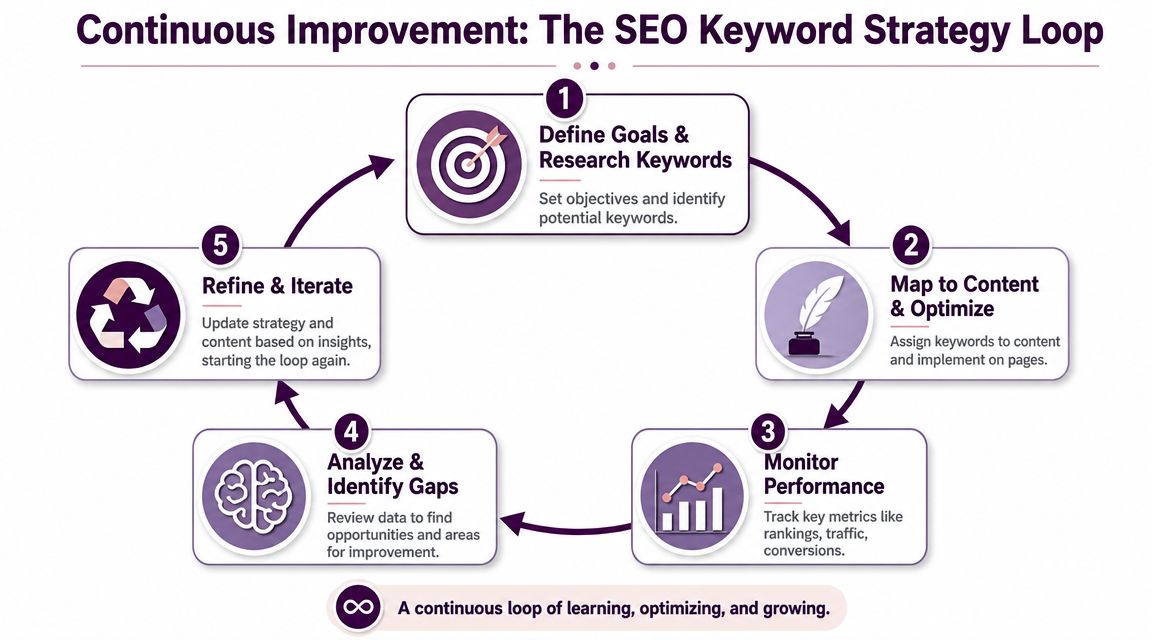
Info-Tech's SEO framework recommends auditing current target terms, mapping each URL to a primary keyword set, recording the current rank, title, H1, and meta description, then reassessing performance after 3 to 6 months so optimization decisions are tied to measurable rank changes rather than assumptions (effective SEO strategy framework).
Measure by keyword group and page outcome
Don't just watch rankings in isolation. Look at each keyword cluster and ask:
Did the target page gain visibility?
Did click-through improve?
Did the page drive leads, signups, or other conversions?
Did another page on the site start competing for the same intent?
That last question catches cannibalization early.
For larger teams, a review of enterprise rank tracker options from MyMentions can help you think through what matters in rank monitoring beyond simple position checks. If someone on your team is still fuzzy on the basics, this explainer on what rank tracking means in practice is a good reference.
Rankings are a diagnostic signal. They are not the final business outcome.
Turn monthly reporting into action
A useful monthly review should end with decisions, not screenshots.
Keep it simple:
Double down on clusters where rankings, clicks, and conversion signals are moving in the right direction.
Improve pages that gained impressions but underperformed on clicks or engagement.
Consolidate overlapping pages when intent has become fragmented.
Deprioritize keywords that looked attractive on paper but aren't supporting the business after a fair test window.
That's the operating system. Not a giant spreadsheet. A repeatable rhythm.
If you want a faster way to turn scattered search data into clear next actions, Keyword Kick is built for that job. It brings together Google Search Console, GA4, rank tracking, backlinks, technical SEO, and competitive data so you can see which pages to optimize, which keyword clusters deserve attention, and what's driving growth.