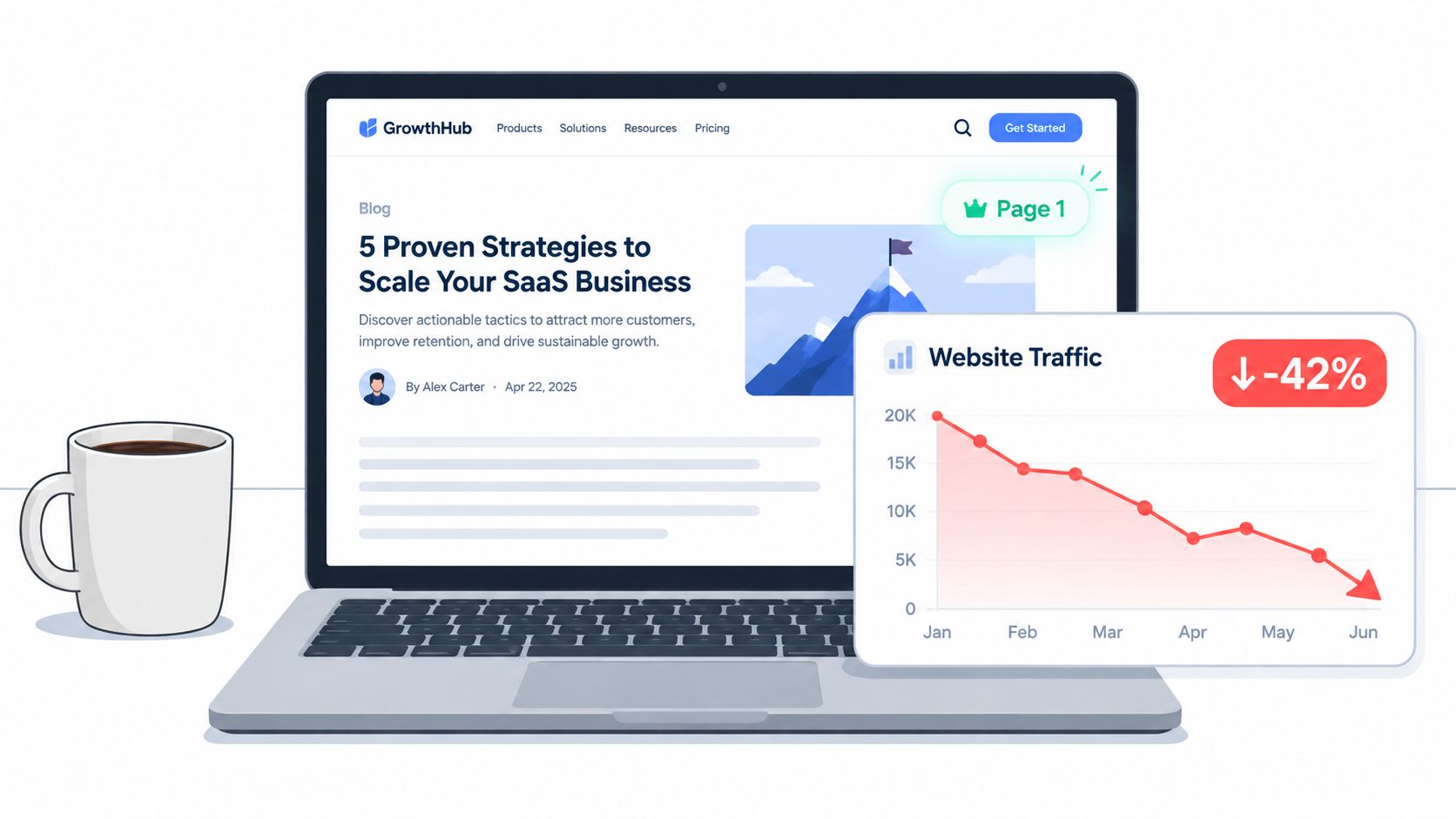
A B2B SaaS page can hold a stable page-one position while the impressions keep producing fewer visits. The content hasn't necessarily become less useful, and the ranking report may not show a problem. The search experience changed around it. An AI Overview, featured snippet, People Also Ask panel, or knowledge panel may answer the user's question before the traditional result gets a chance to earn a click.
That creates a difficult reporting question. If search engines increasingly resolve questions on their own pages, should your team keep optimizing only for rankings and sessions, or should it also measure whether search and AI systems cite your brand as an answer source?
The Search Result That Never Sent You a Click
A page targeting “what is answer engine optimization” can rank on page one, match the searcher's intent, and still generate fewer visits than expected. The reason may be visible before the first traditional result: an AI Overview, a featured snippet, a People Also Ask panel, or related SERP features can answer the question immediately.
The searcher may need only a short definition. They do not have to open several pages, compare sources, or read a full guide. The results page has compressed the research process into an answer surface.
This pattern is known as zero-click search. In 2024, 58.5% of U.S. Google searches and 59.7% of EU Google searches ended without a click to an external page, according to SparkToro's zero-click search analysis. Across 1,000 Google searches, the analysis found only 360 U.S. clicks and 374 EU clicks reached the open web.
The strategic shift: Rankings still matter, but they cannot show whether an AI system or search feature used your brand as an answer source.
The page itself may still supply a featured snippet or inform a generated response. The measurement question has expanded: teams need to track citation and answer visibility, not just rankings and sessions.
That practice is called Answer Engine Optimization, or AEO. It helps search engines and AI systems extract, understand, summarize, and cite a brand's content in direct answers. For a practical explanation of the surrounding zero-click environment, read this guide to zero-click search and visibility.
What Answer Engine Optimization Actually Means
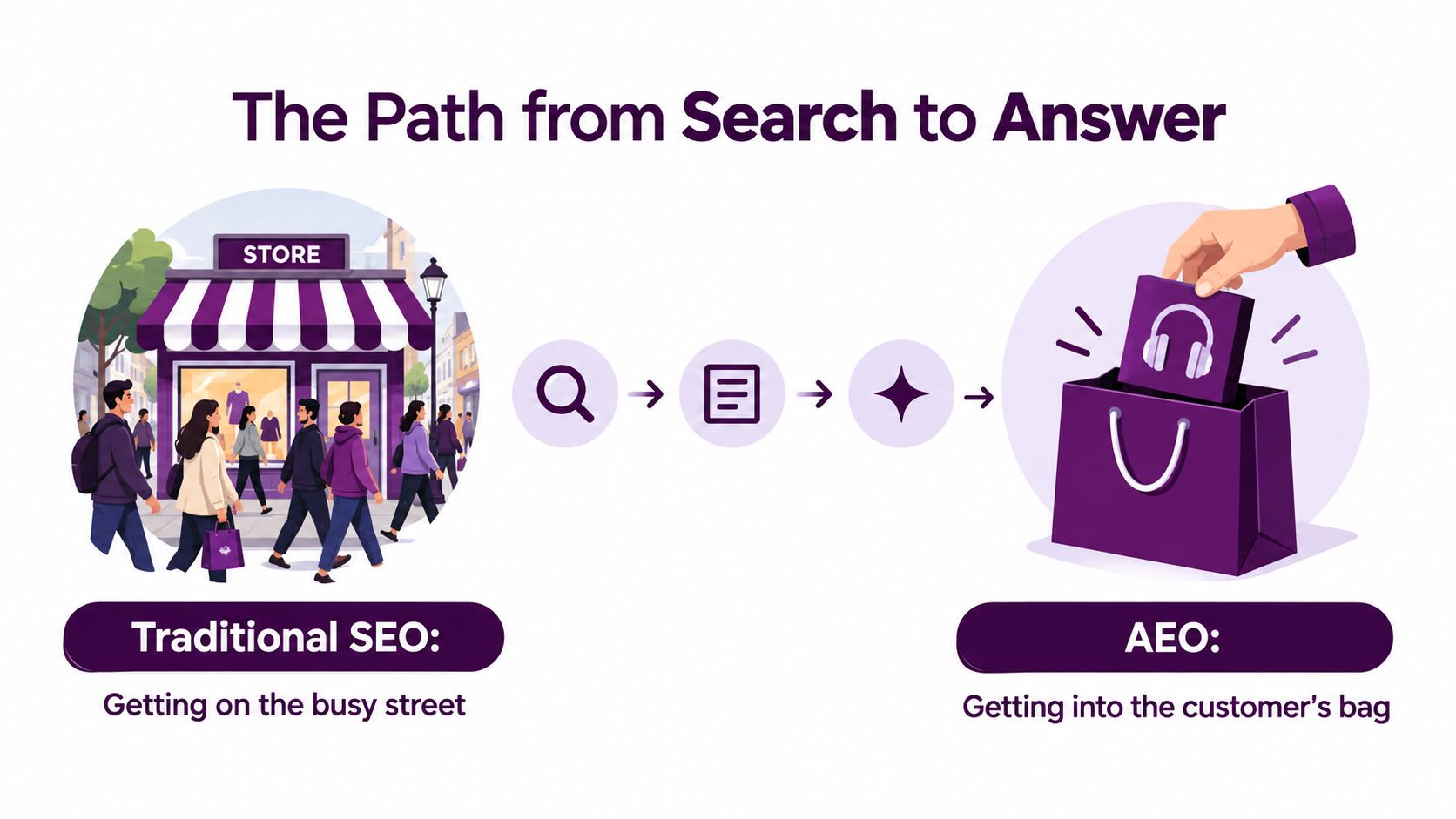
Answer Engine Optimization is the practice of structuring content so search engines, voice assistants, and AI-powered answer systems can extract it, trust it, and present it as a direct response. Traditional SEO tries to place your page on a busy digital street. AEO tries to get the useful part of your expertise placed directly in the customer's shopping bag at the moment of decision.
The analogy clarifies the difference:
- Traditional SEO: Get the store visible, accessible, and attractive enough for someone to walk in.
- AEO: Make the product easy to identify, select, and recommend at checkout.
- Strong search strategy: Do both, because a direct answer can create recognition while a well-ranked page supports deeper evaluation.
AEO content usually has several properties:
- Extractable language: The answer appears in a concise, self-contained passage.
- Clear question matching: Headings and copy reflect the questions people ask.
- Machine-readable structure: Lists, tables, headings, and structured data clarify relationships.
- Citable evidence: Claims connect to trustworthy sources, original research, or clearly identified expertise.
- Entity clarity: The page makes it obvious which organization, product, concept, or person it discusses.
Why AEO emerged
AEO didn't appear from nowhere. Google introduced the Knowledge Graph in 2012, moved further toward intent and meaning with Hummingbird in 2013, launched featured snippets in 2014, and expanded natural-language understanding through RankBrain in 2015 and BERT in 2019. By 2024, AI Overviews had brought answer-first search to a broad audience. This historical sequence is documented in the history of AEO from featured snippets to AI Overviews.
Those milestones changed the job of a search system. It no longer needs only to match a phrase to a page. It can identify entities, interpret intent, select passages, and synthesize an answer. AEO is the content and measurement discipline that responds to that shift.
AEO therefore sits on top of SEO foundations, rather than replacing them. Crawlability, useful content, internal linking, technical performance, and authority still matter. The additional layer asks whether each important section can stand alone as a reliable answer and whether your team can verify when systems use it.
For a second perspective on the definition and strategic context, this AEO guide by Up North Media is a useful reference. The important distinction is simple: SEO helps people find your page, while AEO helps answer systems understand and cite what your page knows.
How AEO Differs from Traditional SEO
AEO and traditional SEO share the same quality foundations, but they optimize for different moments in the user's journey. SEO asks, “Can this page rank and earn a visit?” AEO asks, “Can this fact be selected, summarized, and attributed inside an answer?”
| Dimension | Traditional SEO | Answer Engine Optimization |
|---|---|---|
| User intent | Keywords connected to navigation, research, and transactions | Full questions, conversational language, and answer-seeking intent |
| Content format | Complete pages designed to support a visit | Extractable definitions, answer blocks, tables, FAQs, and concise sections |
| Success metrics | Rankings, impressions, sessions, and click-through rate | Answer inclusion, citation frequency, visibility, sentiment, and assisted outcomes |
| Ranking signals | Relevance, crawlability, links, and page experience | Those fundamentals plus entity clarity, structured data, source corroboration, and answer structure |
| Optimization unit | Primarily the page | The page, section, and individual claim |
| User outcome | The user opens a result and continues research | The user may see the brand without opening a page, then return later or click for depth |
A page can perform well in both systems. For example, a comparison article might target a valuable query, use descriptive headings, earn authoritative links, and still present each comparison criterion in a compact table. The SEO structure supports discovery. The AEO structure makes the facts easier to retrieve.
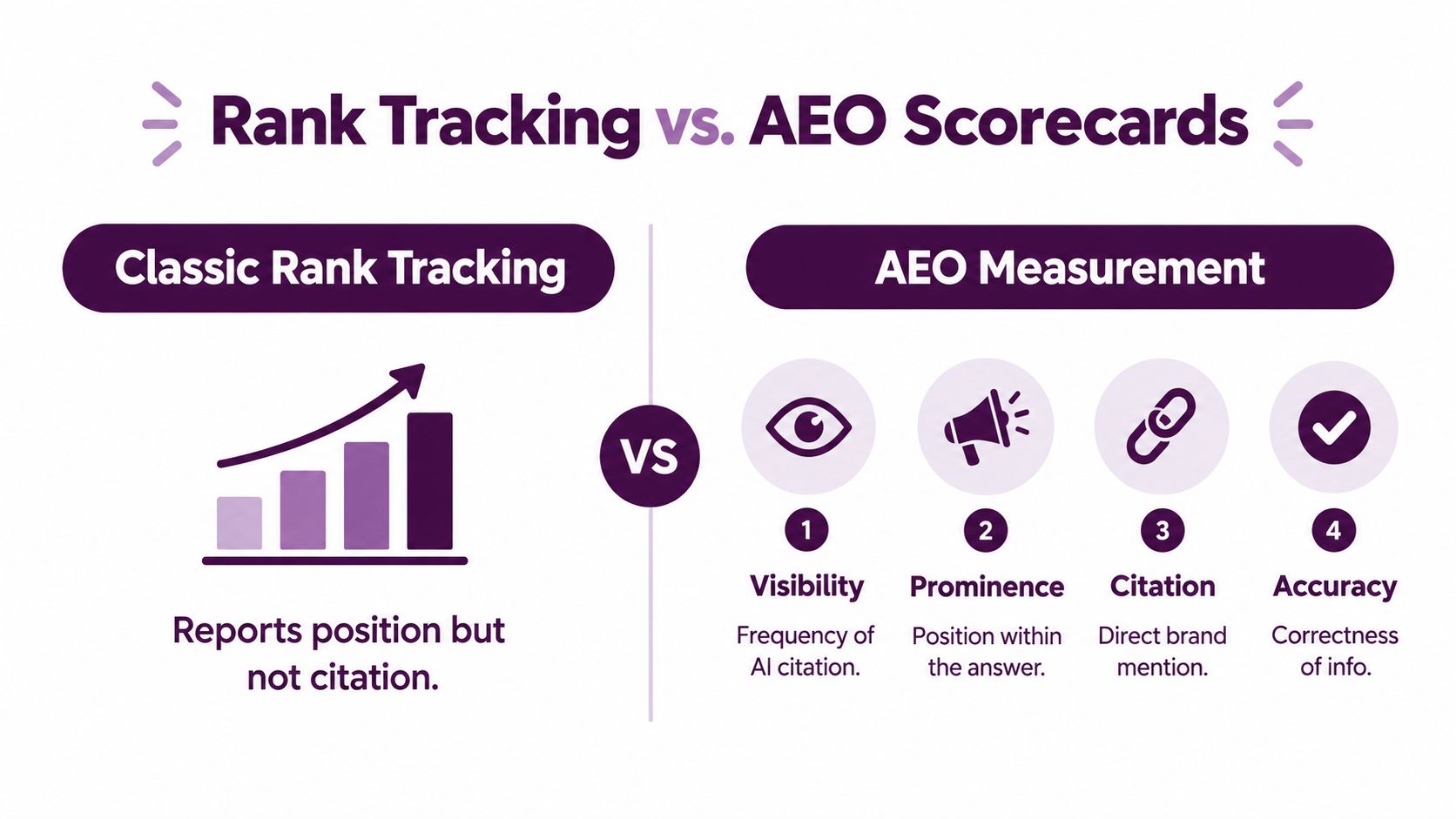
The metrics require more care. A position report can tell you where a URL appears among traditional results, but it can't by itself show whether an AI Overview named the company, whether a generated answer described it accurately, or whether a competitor received the citation.
What carries over
Keep the fundamentals that make content accessible and trustworthy:
- Clear topical focus: One page should have a coherent purpose.
- Useful information: A concise answer still needs to be correct and relevant.
- Technical accessibility: Search and AI systems need to reach and parse the content.
- Authority signals: First-hand knowledge, credible authorship, and corroboration remain important.
- Internal context: Links and logical site architecture help systems understand relationships.
What changes
The editorial unit becomes smaller. Instead of asking whether a page is thorough in the abstract, review whether every important claim has a clear subject, a defensible meaning, and enough context to be cited without distortion.
That is why AEO isn't a replacement for SEO. It's a new layer of optimization for interfaces where visibility can exist without a website visit.
Core Tactics That Win Direct Answers
AEO tactics work best as a connected system. A concise answer without context may be too weak to trust. Schema without useful content won't create expertise. A question-led page with unsupported claims may be readable but difficult for an answer system to verify.
Lead with a tight answer block
Put the direct response immediately below a question-style heading. A paragraph of roughly 40 to 60 words can define the concept, state the recommendation, or summarize the decision before the supporting explanation begins. This format gives a system a clean passage to extract while giving readers an answer without a long preamble.
For a SaaS pricing page, the heading might be “What does usage-based pricing mean?” The opening should define the model plainly, then explain billing conditions, limits, and examples. The concrete outcome to aim for is featured-snippet or direct-answer visibility, not merely a longer page.
Add structured data where it fits
Use relevant schema to label the page's meaning. FAQPage schema can clarify genuine question-and-answer content, while HowTo schema can describe a real sequence of steps. Article, Product, Organization, and BreadcrumbList markup may also provide useful context when the page supports those types.
Schema doesn't replace editorial clarity. It reinforces it by giving machines a declared structure to compare with the visible page. Validate the implementation and keep the markup aligned with what users can see.
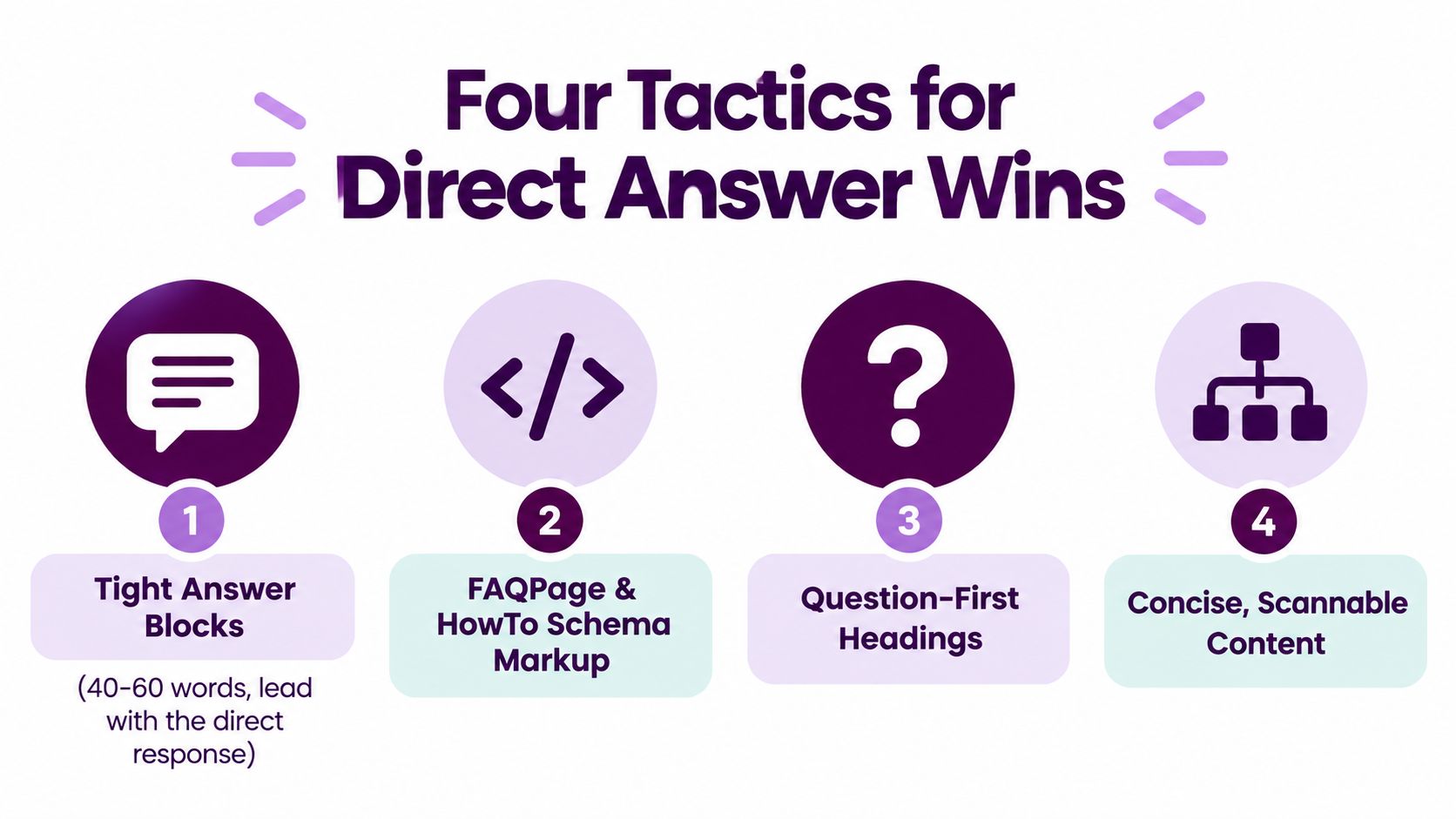
Frame the content around real questions
Question-first headings match the way people use conversational search and voice assistants. Instead of hiding an answer under “Our approach,” use a heading such as “How does implementation work?” Then answer that question before adding detail.
A page targeting spoken queries needs particularly direct phrasing. This explanation of voice search optimization offers useful context on the relationship between conversational queries and answer-focused content. The result to aim for is selection as a voice or assistant answer, where clarity matters more than clever phrasing.
Source the claims a system may repeat
An AI system needs a reason to trust a statement. Link important factual claims to original research, official documentation, or clearly identified subject-matter expertise. If your company publishes original data, describe how it was collected and define what it does and doesn't prove. If an expert contributes a view, identify the person and their relevant experience without turning opinion into fact.
These elements compound. A well-structured answer block, matching schema, question alignment, and credible sourcing give an answer engine several reasons to select the passage. To understand how featured snippets fit into this environment, explore how featured snippets work in current search results.
Why the Numbers Now Demand an Answer Strategy
A buyer can see a brand's answer without visiting its website. In 2024, 58.5% of U.S. Google searches and 59.7% of EU Google searches ended without an external click, according to the SparkToro 2024 study cited above. The result is a measurement gap: a ranking shows where a page appeared, but not whether the search engine answered the question using that page.
Answer placement changes the value of a visit. Independent studies summarized in 2026 report an average 35.1% CTR for featured snippets, falling to 23.4% when the snippet fully satisfies the query. The same source reports that SERPs with snippets can reduce total organic CTR by about 5.3 percentage points compared with pages without snippets. These figures come from the 2026 zero-click search statistics analysis.
| Metric | Value | Source / Year |
|---|---|---|
| U.S. Google searches ending without a click | 58.5% | SparkToro, 2024 |
| EU Google searches ending without a click | 59.7% | SparkToro, 2024 |
| Open-web clicks across 1,000 U.S. searches | 360 | SparkToro, 2024 |
| Open-web clicks across 1,000 EU searches | 374 | SparkToro, 2024 |
| Average featured-snippet CTR | 35.1% | Searchlab summary, 2026 |
| CTR when the snippet fully answers the query | 23.4% | Searchlab summary, 2026 |
| Organic CTR difference reported for SERPs with snippets | 5.3 percentage points | Searchlab summary, 2026 |
These figures make AEO a measurement problem before it becomes a formatting problem. A team tracking sessions alone may call a page unsuccessful even when it supplies a visible answer. A ranking report may also miss a competitor's citation above the client's result.
Why citation matters even when traffic stays modest
A related 2026 analysis found that AI referral traffic represented 1.08% of total website traffic across 10 major industries, as reported by Seeqly's AEO measurement analysis. That share is small, yet it does not measure whether AI systems mention, cite, or accurately describe a brand before a user visits. AI visibility can influence which companies users encounter, remember, compare, and later search directly.
For teams building a broader organic acquisition system, a composable DXP traffic strategy shows how several visibility channels can work together. AEO should sit within that system with its own scorecard, separating citation presence from clicks and making clear what traffic data can prove.
Measuring AEO Visibility Beyond Rankings
A ranking report can show where a URL appeared for a query at a given time. It cannot show whether an AI system selected that page as evidence, described the brand correctly, or gave a competitor the most prominent reference. AEO measurement therefore starts with a visibility record, then uses content changes to improve the results.
Build a scorecard around four signals.
Visibility
Track how often the brand appears across a defined set of questions. Include AI Overviews, featured snippets, People Also Ask results, and other direct-answer surfaces relevant to the market. For each observation, record the query, engine, date, answer type, cited URL, and competing brands. This creates a repeatable baseline instead of relying on occasional screenshots.
Position and prominence
A citation's location affects how much attention it receives. A source named near the beginning of an answer may shape interpretation more strongly than one listed among several references. Record where the brand appears, whether its page supports the central answer or a minor detail, and whether the answer presents it as a primary source.
Sentiment and accuracy
Read the generated wording, not only the citation. An engine can mention a company while confusing its product category, pricing model, audience, or capabilities. Classify each description as favorable, neutral, unfavorable, incomplete, or factually wrong. Accuracy matters because a visible citation can still create a poor impression or require correction.
Citation share and off-page mentions
Compare the brand's share of relevant answers with competitors using the same query set over time. Also monitor third-party references, since AI systems may draw descriptions from sources beyond the company website. The scorecard should keep citation presence, prominence, sentiment, accuracy, and referral behavior separate. Combining them into one traffic number hides where the actual problem sits.
Use manual audits for a small priority set, platform-specific monitoring for repeatable checks, and analytics for referral behavior. Test relevant prompts across Google AI Overviews, ChatGPT, Perplexity, and Gemini where access and tracking allow. This guide to AI visibility tracking for SEO teams explains how teams can build that monitoring layer.
Measurement principle: Make the citation footprint visible first. Once the team knows which questions it owns, which competitors displace it, and where descriptions fail, it can prioritize content and entity fixes with evidence rather than assumptions.
A 30/60/90 Plan for Agencies and In-House Teams
AEO implementation works better as a staged operating plan than as a mass rewrite. Start with evidence, apply changes to valuable question sets, then report what changed in answer visibility and business behavior.
Days 1 through 30
Build the baseline before editing content.
- Inventory questions: Pull questions from sales conversations, support tickets, Search Console queries, product documentation, and customer interviews.
- Map answer ownership: For each priority query, record the current snippet, AI Overview, People Also Ask result, cited sources, and brand mentions.
- Instrument visibility: Create a tracker with engine, query, answer type, citation, prominence, sentiment, accuracy, and date.
- Prioritize pages: Select definition, comparison, product, pricing, and implementation pages with clear business relevance.
- Deploy appropriate schema: Add and validate relevant markup on the highest-value pages, not indiscriminately across the site.
For an agency, turn this into a client-facing baseline report with screenshots, competitor citations, and a prioritized backlog. For an in-house team, use the first stakeholder review to agree on ownership between SEO, content, product marketing, PR, analytics, and development.
Days 31 through 60
Move from diagnosis to controlled production. Rewrite priority sections so the opening passage answers the implied question directly. Add tables where users compare attributes, build genuine FAQ content, clarify product and organization entities, and connect claims to authoritative evidence.
Avoid publishing a large volume of lightly edited pages. A small set of precise, well-supported pages gives the team clearer feedback than an untracked content surge. Writers should also preserve the human reading experience. AEO formatting should make the answer easier to find, not make the page sound like a database export.
Days 61 through 90
Review citation inclusion, prominence, sentiment, accuracy, qualified referrals, and assisted conversions. Compare the new observations with the baseline, then investigate pages that improved in one dimension but declined in another.
Agencies can present a recurring scorecard and a next-quarter test plan. In-house teams can add the metrics to the regular organic growth review, brief sales on how buyers may encounter the brand through answers, and retrain writers using examples from the team's own query set.
The first-week checklist
Agency teams
- Assign one owner for the visibility baseline.
- Select a shared set of client questions.
- Capture current citations and competitor presence.
- Review the highest-value pages with a technical SEO specialist.
- Deliver a short findings report with owners and deadlines.
In-house teams
- Name one accountable lead across SEO and content.
- Ask sales and support for recurring customer questions.
- Choose a small group of commercial and informational queries.
- Audit how the brand is described across answer systems.
- Schedule the first cross-functional review before production begins.
Making Answer Engine Optimization a Standing Discipline
AEO shouldn't be a one-time content campaign. It should become a recurring practice with a named owner, a monthly citation review, and a quarterly audit of answer quality, entity accuracy, and source coverage.
The common mistake is treating AEO as a rewrite brief. Rewriting matters, but teams won't know what to rewrite until they can see the citation footprint. They also need to manage the information beyond their own domain, including how third-party sources describe the brand and whether answer systems repeat outdated or incomplete claims.
Use this checklist on Monday morning:
- Instrument answer visibility across priority queries and engines.
- Standardize direct answer blocks for definitions, comparisons, and processes.
- Ship appropriate schema on every important money page.
- Train writers on question framing and citable evidence.
- Review AI citations monthly for visibility, prominence, sentiment, and accuracy.
The answer to “what is answer engine optimization?” is therefore broader than “write concise answers.” AEO is a measurement-led discipline for becoming visible, understandable, and citable wherever search systems deliver answers.
Keyword Kick helps agencies and in-house teams connect rankings, Search Console, Analytics, backlinks, technical signals, and SERP features in one workspace, so they can prioritize the search improvements most likely to matter. Visit Keyword Kick to turn scattered visibility data into a clear action plan for your AEO and SEO programs.