
You can tell a page is semantically “complete” and still feel stuck when it won't move. The brief is familiar, the topic is covered from multiple angles, and the article even answers the follow-up questions, but the query sits on page 2 while a thinner competitor keeps stealing the click.
That gap usually isn't a writing problem. It's a semantic SEO strategy problem, where the page says one thing clearly to humans, but the site architecture doesn't help search engines understand the full topic, the right intent, or which URL deserves the ranking. Modern search is built around context, entities, and relationships, not just repeated phrases, and Google's move toward intent-based understanding has made that difference harder to ignore, especially as algorithmic systems have become more capable of processing language at scale. SE Ranking's explainer frames semantic SEO as optimizing for a topic rather than a single keyword, and notes that Google's MUM update processes information 1,000 times more efficiently than previous models, which is a strong signal for why broad contextual coverage matters now (SE Ranking).
The frustrating part is that many teams do the visible work and still miss the invisible work. They publish related articles, add FAQs, sprinkle in schema, then wonder why impressions rise but clicks lag, or why rankings bounce between two URLs that seem to answer the same query.
What follows is the practical version of semantic SEO, the one that treats it as a measurement and prioritization problem, not a content trend. If you're deciding what to build first, what to leave out, and how to prove the work is worth the spend, this is the framework that holds up in client work.
Why a Page 2 Ranking Still Feels Like Failure
A page can look finished and still perform like it's missing the point. The article covers the head term, answers the obvious questions, includes related phrases, and maybe even has a few well-placed FAQs, yet the rankings hover just outside visibility and the clicks don't follow. That's the classic symptom of a page that is topically broad enough to earn impressions, but not structured tightly enough to win the searcher's confidence or the engine's interpretation.
I've seen this pattern on content teams that assumed “more semantic coverage” would fix the problem. They added supporting sections, expanded internal links, and kept drafting new posts around the same theme, but the site still split authority across multiple URLs and never gave Google a clean reason to prefer one page. The result was usually unstable positions, especially around commercial queries where intent matters more than word count.
Practical rule: if a page keeps landing on page 2 after multiple content improvements, treat it as a topic architecture issue before you treat it as a copywriting issue.
That shift in thinking matters because semantic SEO isn't just about writing more context. Industry explainers describe it as optimizing for a topic rather than a single keyword, using related phrases, topic clusters, internal links, and structured data to help search engines interpret meaning and relationships (SE Ranking). In other words, the gap between your draft and your rank is often the gap between what you wrote and how your site teaches the engine to interpret it.
A useful way to think about it is simple. A strong page can still fail if the surrounding cluster is weak, the intent is split, or another URL on your site is competing for the same searcher. That's why semantic SEO keeps turning into a site-level issue instead of a page-level one.
The rest of the work is less about “adding more content” and more about building the right map, the right hierarchy, and the right measurement system so the page has somewhere to live.
What Semantic SEO Means in 2026
A page can be well written and still miss the mark if it only speaks in keywords. Semantic SEO starts from a different assumption, search engines are trying to resolve meaning, not just match wording. If a user searches for Apple, iOS, Cupertino, or iPhone, the engine has to sort out which concept network the query belongs to before it can decide which page deserves visibility.
That shift matters because ranking now depends on how clearly a site defines a topic, the entities inside it, and the intent behind the query. Search teams at SE Ranking describe semantic SEO as topic-based optimization rather than single-keyword optimization, and that framing still holds up in practice (SE Ranking). The useful takeaway is simple, a page earns more reach when it helps the engine interpret the subject with less ambiguity.
Keyword targeting versus topic targeting
A keyword-targeted page is built to win one phrase. A topic-targeted page is built to own the meaning space around that phrase, including the related queries that searchers use before and after the primary term.
That changes the work. Keyword targeting pushes you toward tight repetition and narrow matching. Topic targeting pushes you toward clearer headings, stronger internal relationships, and content that answers the task behind the query instead of just repeating the query itself.
If you still want a bridge from older SEO vocabulary, latent semantic indexing for SEO is useful background, but only as a historical reference point, not as a description of how modern search systems work. The concept helps explain why related terms can matter even when they do not match the exact query.
The Primary Unit of Competition Is the Cluster
A single URL rarely wins a topic by itself. The page performs better when it sits inside a cluster, where a hub page, supporting articles, internal links, and structured data all point search engines toward the same subject. That is why semantic SEO keeps turning into a site architecture issue, because the engine is reading the relationships between pages, not just the page in isolation (SE Ranking).
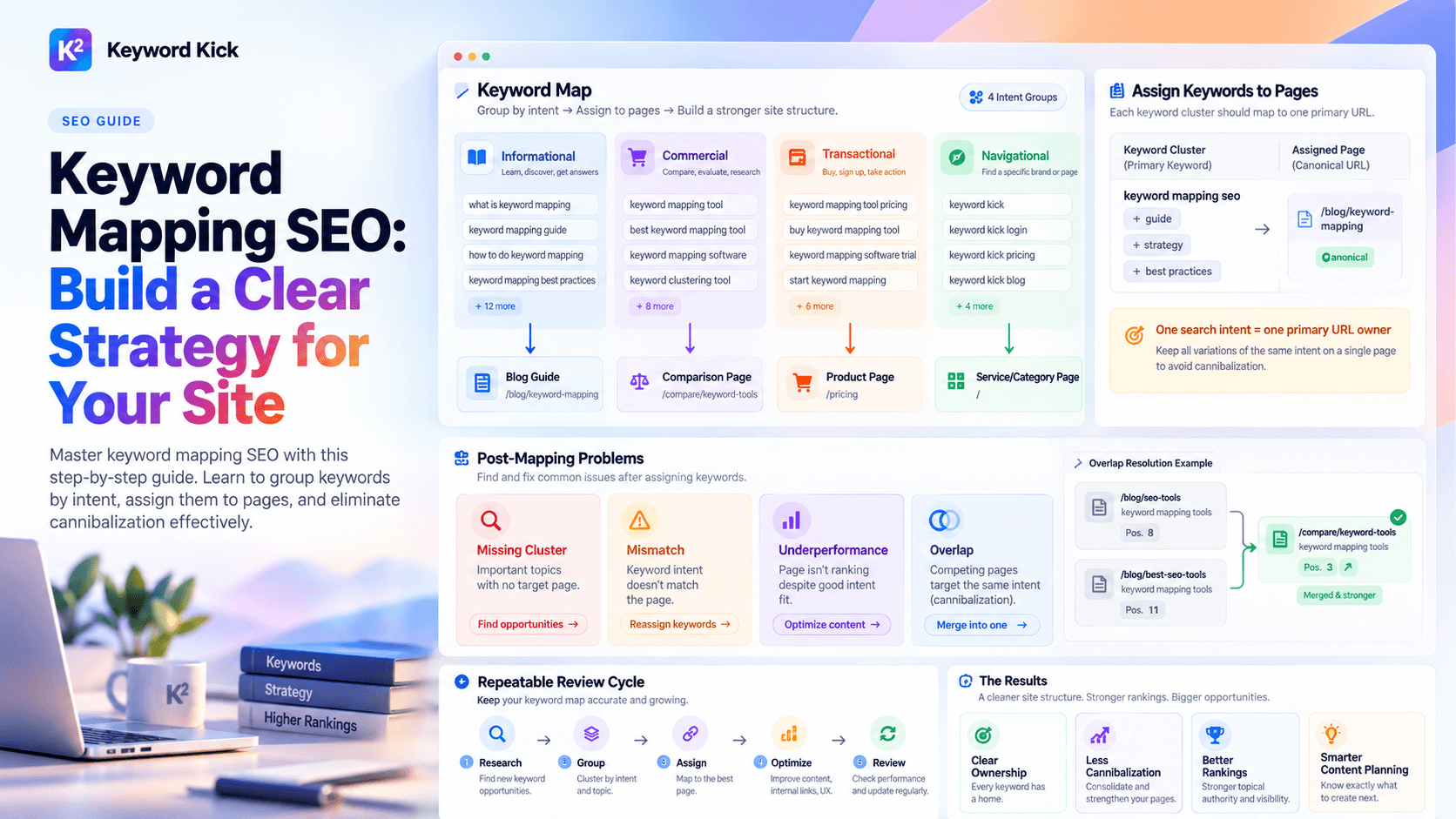
A cluster also changes how you judge success. If one article ranks but the supporting pages never surface, the site may still be underbuilt. If two URLs compete for the same intent, the cluster can dilute itself and make the stronger page harder to identify. That is the trade-off many teams miss when they keep expanding content without a clear map.
Semantic SEO is a measurement problem
Treating semantic SEO as a measurement problem changes the decisions you make. The goal is not to keep adding related terms until the copy feels complete. The goal is to know when a topic expansion improves rankings, when it creates cannibalization, and when it just adds weight without changing search performance.
That is where cluster-level auditing matters. You look at which URLs own which intents, how internal links distribute authority, and whether the current structure gives Google a clean answer about which page deserves to rank. If the site keeps producing overlapping pages with similar intent, the issue is usually not missing content, it is missing prioritization.
In practice, semantic depth only helps when it makes the topic easier to resolve. Past that point, more expansion can blur intent, bloat the site, and spread authority across too many pages.
The Six Building Blocks of a Semantic SEO Strategy
A semantic SEO strategy only works when the site gives search engines a clear set of signals to interpret. In practice, that means six parts have to work together. If one is missing, the page can still rank, but the result is usually less stable, harder to scale, and easier to misread by both users and crawlers.
Entities
Entities are the named things in a topic space, brands, products, people, locations, concepts, and attributes. When a page signals those entities clearly, search engines have less ambiguity to resolve. For a CRM page, that means the page should make it obvious whether it is about pricing, features, implementation, or a comparison against a named competitor.
Intent
Intent decides whether the page matches the searcher's task. “Best CRM” and “CRM pricing” sit in different intent buckets, even if they belong to the same category. If one URL tries to satisfy both at once, it often ends up weak on both, which is where rankings and conversions both start to slip.
Content models
Hub-and-spoke structure still earns its place because it gives the topic a readable shape. A hub page sets the main theme, while supporting pages handle narrower subtopics that deserve their own URLs. Guidance on semantic SEO often points to topic clusters and content hubs because they help search engines understand hierarchy and relationships, not just topical coverage. A practical content gap analysis for SEO also helps decide which subtopics deserve a page and which would only add noise.
Structured data
Schema turns content into machine-readable signals. The best use cases are straightforward, product, recipe, event, or service pages where structured data can support interpretation and may help with rich results. It does not replace strong page copy, but it gives the engine a cleaner map of what the page contains.
Internal linking
Internal links are the connective tissue of the cluster. The hub should link to the right spokes, the spokes should link back, and the anchors should describe the destination clearly. Descriptive anchors matter more than clever wording, because the goal is clarity, not branding.
Technical signals
If a page cannot be crawled, rendered, canonicalized, or indexed cleanly, the semantic work does not matter much. Technical SEO still carries the content to the index. A strong cluster with broken canonicals or orphaned URLs will underperform even if the content plan is sound.
Component | Core Job | Most Common Mistake |
|---|---|---|
Entities | Clarify what the page is about | Mentioning related terms without defining the core entity |
Intent | Match the searcher's task | Combining incompatible intents on one URL |
Content models | Organize the topic into a structure | Publishing isolated articles with no hub |
Structured data | Help machines interpret the page | Adding schema without visible contextual content |
Internal linking | Connect the cluster | Linking only to the homepage or broad category pages |
Technical signals | Make the page discoverable and indexable | Ignoring canonicalization, rendering, or orphaned content |
The cleanest strategy is usually the least flashy one. It gives the engine a stable topic, a clear intent, a structured cluster, and a crawlable path through the site.
Mapping a Real Topic Graph From Scratch
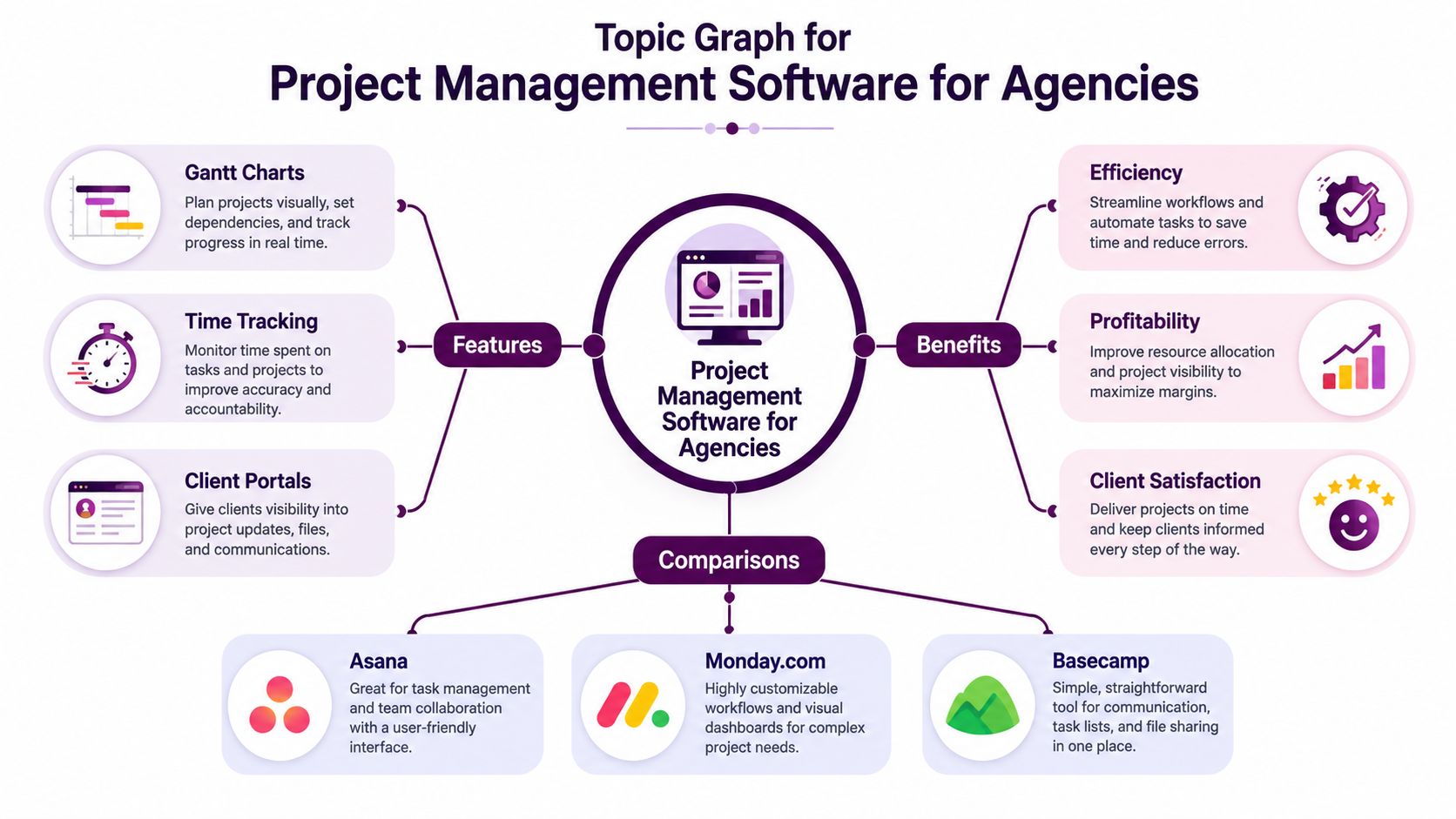
A real topic graph starts with one commercial entity and then traces the relationships around it. For project management software for agencies, the primary entity is obvious, but the supporting entities tell you what buyers care about, things like pricing models, integrations, team size, client collaboration, and reporting.
Start with the entity, not the keyword list
A keyword list gives you phrases. A topic graph gives you a structure. The first one might include “project management tool,” “agency workflow software,” and “client portal software.” The second one asks which of those are central, which are supporting, and which belong on separate pages because they answer a different intent.
That distinction matters because semantic expansion can create a mess if you don't assign each entity a job. I've seen teams build five articles around one commercial topic, only to discover later that all five were competing for the same comparison query and none of them had a distinct angle.
Define the intent lanes
For a commercial topic like this, the intent lanes usually split into definition, comparison, pricing, implementation, and evaluation. A buyer in discovery mode wants to know what the software does. A buyer closer to purchase wants to compare tools, integrations, and pricing. Those are not interchangeable signals, even when the keyword footprint looks similar.
Useful filter: if two pages would make the same searcher feel “this answers my question,” they probably belong in the same page or the same cluster hierarchy, not on separate URLs.
That's where the ceiling appears. Adding more supporting entities helps until it starts fragmenting the intent. After that point, semantic depth turns into noise. The page no longer feels thorough, it feels scattered.
For teams building this out, a content gap workflow helps find what the cluster is missing and what it already covers. This guide is a good companion reference for that planning step: SEO content gap analysis for 2026.
The goal isn't to collect every related term. The goal is to assign each entity to the right place so the graph is coherent, the user path is obvious, and the site doesn't start fighting itself.
A Prioritized 90-Day Semantic SEO Roadmap
The quickest way to waste semantic SEO effort is to start by writing more pages. A better sequence is to audit the cluster, decide what deserves expansion, and only then build the pages that have a real chance of improving visibility.
Days 1 to 30, audit the topic map
Start by pulling a topical map from Search Console, Analytics, rank tracking, and your existing content inventory. Look for three things first, gaps in coverage, overlapping pages, and URLs that earn impressions but no clicks. Those are usually the fastest signals that the cluster is misaligned.
At this stage, teams should also inspect which pages are already establishing authority and which ones are thin supporting assets that never earned a place in the cluster. Expert frameworks recommend prioritizing high-traffic pages without rich results, commercial pages, and entity-establishing pages because they're the most likely to gain visibility from schema and stronger contextual relevance (Search Engines Daily).
Days 31 to 60, build the missing structure
Once the audit is clear, build the pages that close the biggest structural gaps. That usually means a hub page, a few high-value spokes, a schema update on relevant URLs, and internal links that remove orphaned or underconnected pages. If two URLs are answering the same query cluster, consolidate or differentiate them before adding anything new.
This is also the point where one platform can save time by joining the data. Keyword Kick is one option that connects Google Analytics 4, Google Search Console, rank tracking, backlinks, and technical signals in one workspace, so the K² AI Agent can surface the pages that deserve work first instead of forcing you to switch tabs.
Days 61 to 90, measure what the cluster changed
The measurement phase should track the cluster, not just the page. That means watching whether the topic has more visibility, whether the right pages are earning the clicks, and whether internal links are pushing authority in the intended direction. It also means checking whether the new pages created duplicate intent or whether they clarified the cluster.
If a page was added only because it “felt semantically relevant,” and no one can explain its role in the cluster, it usually belongs in a note, not on the site.
That 90-day plan keeps the work defensible. It gives you a reason for each new URL, a place for each supporting entity, and a measurement model that shows whether the expansion helped.
When Semantic Depth Becomes Over-Optimization
More entities, more links, and more schema can absolutely help. They can also make the site harder to understand.
Duplicate intent
The cleanest sign of duplicate intent is when two URLs keep appearing for the same query cluster and swapping positions. Search Console and rank trackers usually make that visible fast. If both pages are trying to own the same searcher task, one of them is diluting the other.
Maintenance debt
Every new supporting page adds a maintenance burden. It needs updates, internal links, accuracy checks, and protection from drift when the topic changes. That cost is easy to ignore in the planning stage and hard to reverse once the site has grown around it.
Metric theatre
This is the trap where impressions rise, rankings look healthier, and the revenue line doesn't move. The content may be semantically broader, but the intent is too fuzzy or too split to convert. That's why semantic SEO has to be judged on more than visibility alone.
A practical diagnostic helps here. If a Search Console export shows multiple pages for the same query cluster, with no clear winner, the site is carrying too much overlap. If the content team can't explain why each page exists in one sentence, the cluster is overbuilt.
Broad coverage is not the same as useful coverage.
The discipline is restraint. Semantic depth should make the topic clearer, not louder. Once the page starts answering too many subtly different intents at once, it usually needs pruning, consolidation, or a better cluster boundary.
Measuring Semantic SEO the Right Way
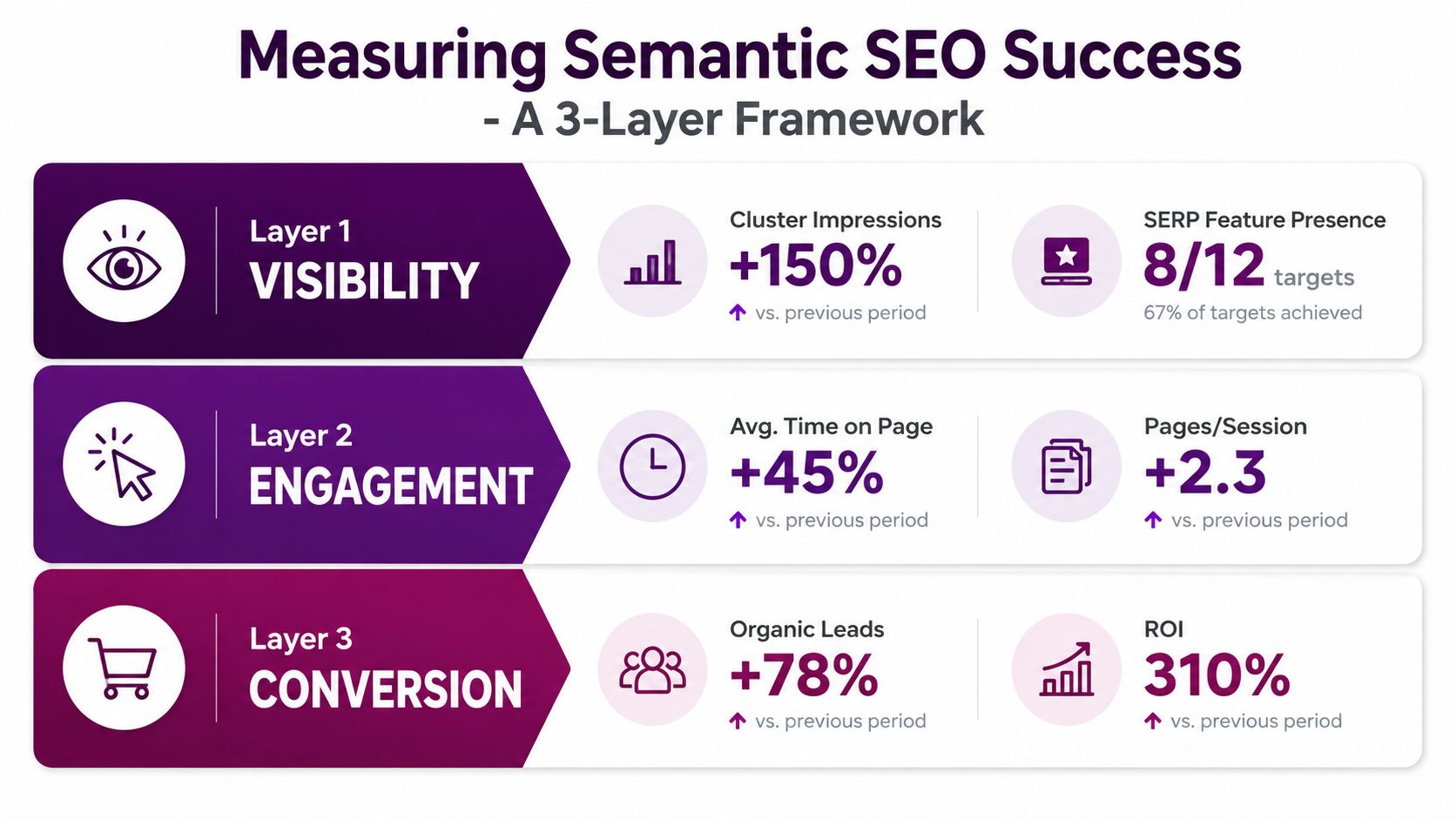
A page-level rank report can look fine while the cluster still underperforms. Semantic SEO work changes how a topic behaves across search results, not just how one URL moves on a chart.
Visibility metrics
Start with cluster-level impressions, SERP feature capture, and share of voice for the topic. Those signals show whether search engines are connecting the pages into a clearer topical unit and surfacing them across the query variations that matter. If the cluster starts showing up for more relevant query patterns, the structure is usually doing its job.
Engagement metrics
The middle layer answers a simpler question, do searchers stay with the content once they arrive? CTR by intent bucket helps separate pages that should attract curiosity from pages that should win comparison or decision traffic. Scroll depth on hub pages also shows whether users are moving into the right supporting assets or stalling before they reach them.
Conversion metrics
The bottom layer is where the business case gets real. Track assisted conversions, organic pipeline, or the downstream outcome that matters to your team. A stronger semantic cluster should make qualified traffic easier to identify and move, not just easier to attract.
A topic-level dashboard is the cleanest way to judge that mix of signals. Join Search Console, Analytics, rank tracking, and backlink data so the cluster can be reviewed as one unit instead of a pile of disconnected URLs. If you also need visibility into AI surfaces, AI visibility tracking is useful for adding that layer into the same measurement model.
A simple workflow keeps the reporting usable:
Visibility: compare cluster impressions and SERP feature presence across the core pages.
Engagement: split CTR and on-page behavior by intent bucket, not by URL alone.
Conversion: attribute leads or revenue to the full cluster when multiple pages help the journey.
Measured at the cluster level, semantic SEO becomes easier to defend. You can show why one URL was consolidated, why another was expanded, and whether the work changed search behavior instead of just adding more content.
If you're trying to turn semantic SEO from theory into a plan, Keyword Kick can help you audit cluster coverage, spot cannibalization, and connect Search Console, Analytics, rank tracking, and technical signals in one workflow. Visit Keyword Kick if you want a clearer view of which topics deserve expansion first and which pages are already competing with each other.