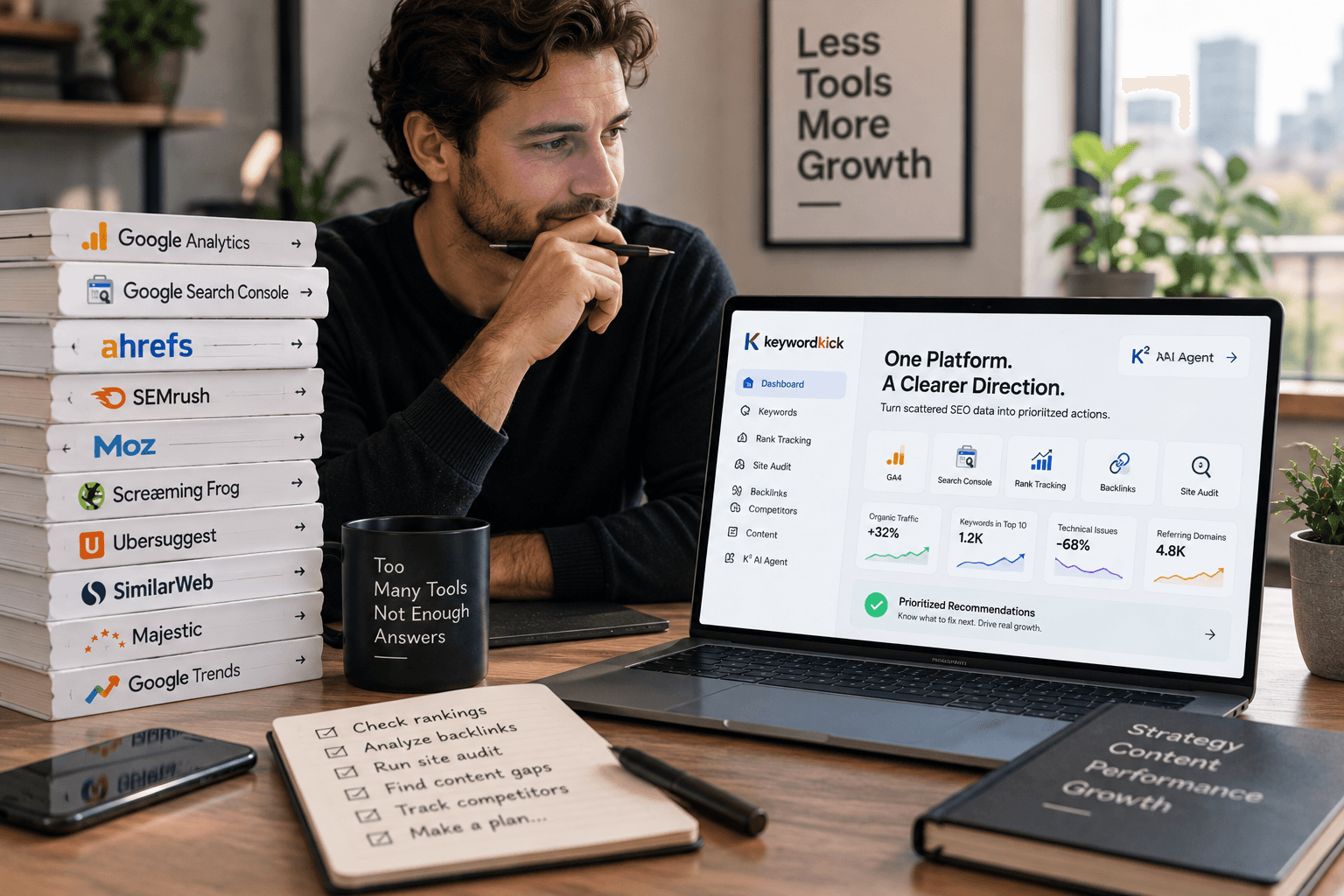
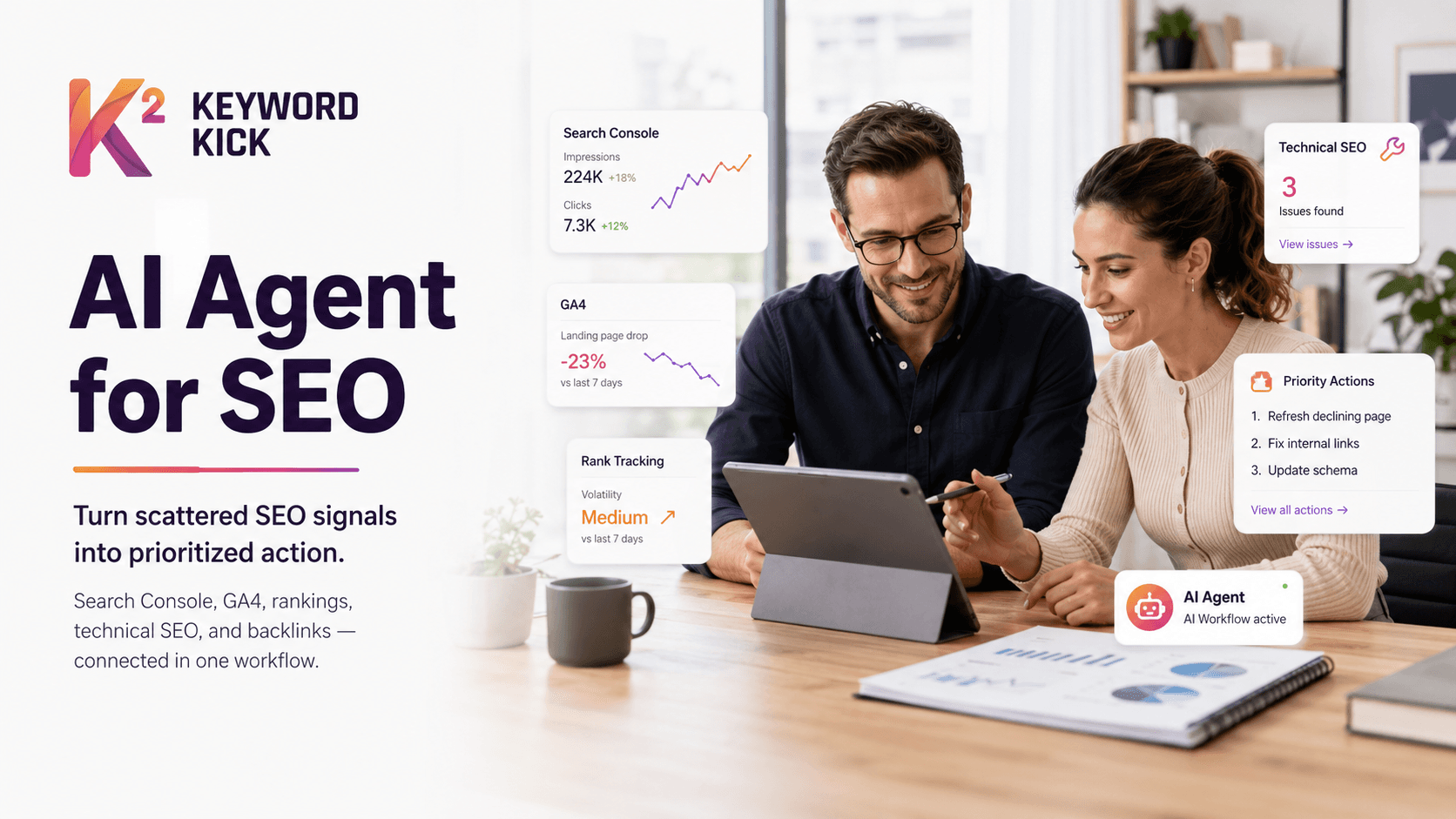
You're probably looking at the same problem most SEO teams face right now. Search Console shows query shifts. GA4 shows landing page drops. Rank tracking flags volatility. Technical crawlers surface issues. Backlink tools add another queue. Nothing is missing except the one thing that matters most: a clear answer on what to do next.
That's why the phrase AI agent for SEO matters. Not because teams need another writer or another dashboard. They need a working layer that can connect fragmented inputs, spot what changed, and turn analysis into a ranked action list.
Your SEO Workflow Is Overwhelmed Here Is the Fix
Most SEO operations aren't short on data. They're short on coordination.
A typical week now includes checking Search Console for falling queries, GA4 for landing page behavior, a rank tracker for movement, and a crawler for technical regressions. Then someone has to reconcile all of it manually. That process is slow, easy to derail, and usually shaped by whichever signal someone saw first.
The result is familiar. Teams spend too much time validating problems and not enough time fixing them. One person says the issue is intent mismatch. Another says internal linking. A third says SERP changes. Everyone may be partly right, but the workflow still breaks because the inputs live in separate systems.
What changes the model is not “more AI.” It's an agent layer that sits across the stack and translates scattered evidence into ordered action.
According to a 2026 SEO AI adoption roundup, 86.07% of SEO professionals have already added AI to their strategy. The same source reports 68% of marketers say AI improved ROI and that teams using it were able to publish 47% more content per month. That doesn't just point to faster drafting. It points to faster execution across the workflow.
Why the old stack creates decision lag
Classic SEO tooling was built in categories:
Analytics tools show behavior after the fact.
Rank trackers show movement, but not always the cause.
Auditing tools show issues, but often without business context.
Content tools help create assets, but not always prioritize them.
That architecture made sense when SEO work was more linear. It doesn't fit a world where visibility shifts across organic results, AI answers, and changing SERP layouts.
The bottleneck in SEO usually isn't finding issues. It's deciding which issue deserves action first.
If you're reviewing your current stack, it helps to look beyond SEO-specific vendors and study how broader essential marketing automation platforms approach orchestration, triggers, and workflow design. SEO is moving in the same direction. Less dashboard hopping, more coordinated execution.
What the fix looks like in practice
An AI agent for SEO should reduce noise in three ways:
It unifies evidence from the tools you already use.
It prioritizes actions instead of dumping alerts into another queue.
It shortens response time between detection and implementation.
That last point matters most. SEO teams don't usually lose momentum because they lack ideas. They lose it because too many possible fixes compete for attention at once.
What Exactly Is an AI Agent for SEO
An AI agent for SEO is not an AI writer with a new label. It's not a rules-based automation that sends weekly alerts either. A real agent acts more like an orchestration layer that pulls from multiple systems, interprets signals together, and decides what should happen next.
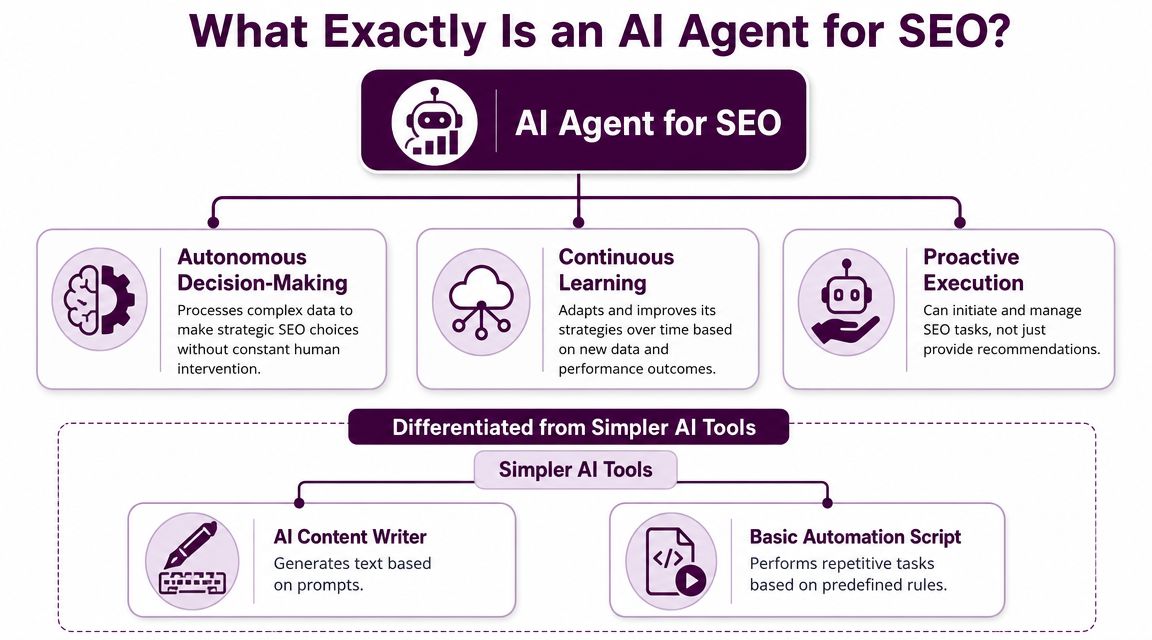
The easiest way to think about it is this: a content generator waits for prompts. An SEO agent works from a goal.
If the goal is “recover visibility on declining category pages,” the agent should be able to review query-level impressions and clicks, compare rankings, inspect technical friction, and suggest the highest-impact sequence of fixes. That's a different class of software.
The orchestration layer is the real product
A technically robust AI SEO agent is described as an orchestration layer that pulls from Google Search Console, analytics, rank trackers, and technical signals to prioritize actions, with data fusion as the main advantage in recommending the highest-impact fix first, as explained in this guide to AI SEO agents.
That phrase, data fusion, is the key distinction.
Most SEO tools answer narrow questions:
What rankings changed?
Which pages have errors?
What keywords are relevant?
Which backlinks were gained or lost?
An agent is supposed to answer a harder question: what should the team do first, and why?
What separates an agent from simpler tools
Here's the practical difference inside a real workflow:
An AI content writer generates text from a prompt.
A basic script follows preset rules, such as exporting reports or flagging missing tags.
An AI agent for SEO connects data sources, weighs competing signals, and produces recommendations tied to likely impact.
That doesn't mean every agent should edit your site automatically. It means the system should have enough context to move beyond generic suggestions.
Practical rule: If a tool can't explain why Page A should be fixed before Page B using your own data, it's not functioning like an SEO agent. It's still a point solution.
This distinction also matters outside pure SEO software. Tools built for structured web interaction and automation, such as Scrapfly's AI browser agent, show how agents can traverse dynamic pages and collect context from environments that traditional scripts struggle with. For SEO teams, that kind of agent behavior becomes useful when monitoring rendered elements, competitor changes, or repeatable research tasks.
The best analogy is an always-on strategist
A good agent behaves like a tireless junior strategist with instant access to every dashboard and no patience limit for repetitive analysis. It watches the same systems your team watches, but it does so continuously and in parallel.
That doesn't make it smarter than an experienced SEO lead. It makes it better at handling volume, recurrence, and cross-tool correlation.
What it still lacks is business judgment. It can identify a likely intent mismatch. It can't fully understand whether rewriting that page would weaken positioning, conflict with brand voice, or create legal review overhead. That's why the strongest setups use the agent to compress decisions, not replace strategic ownership.
How AI Agents Analyze and Prioritize SEO Tasks
The most useful AI agent for SEO follows a repeatable operating loop. It ingests live data, detects patterns, ranks opportunities, and then either recommends or executes the next step. The value isn't one isolated output. It's the continuity of the loop.
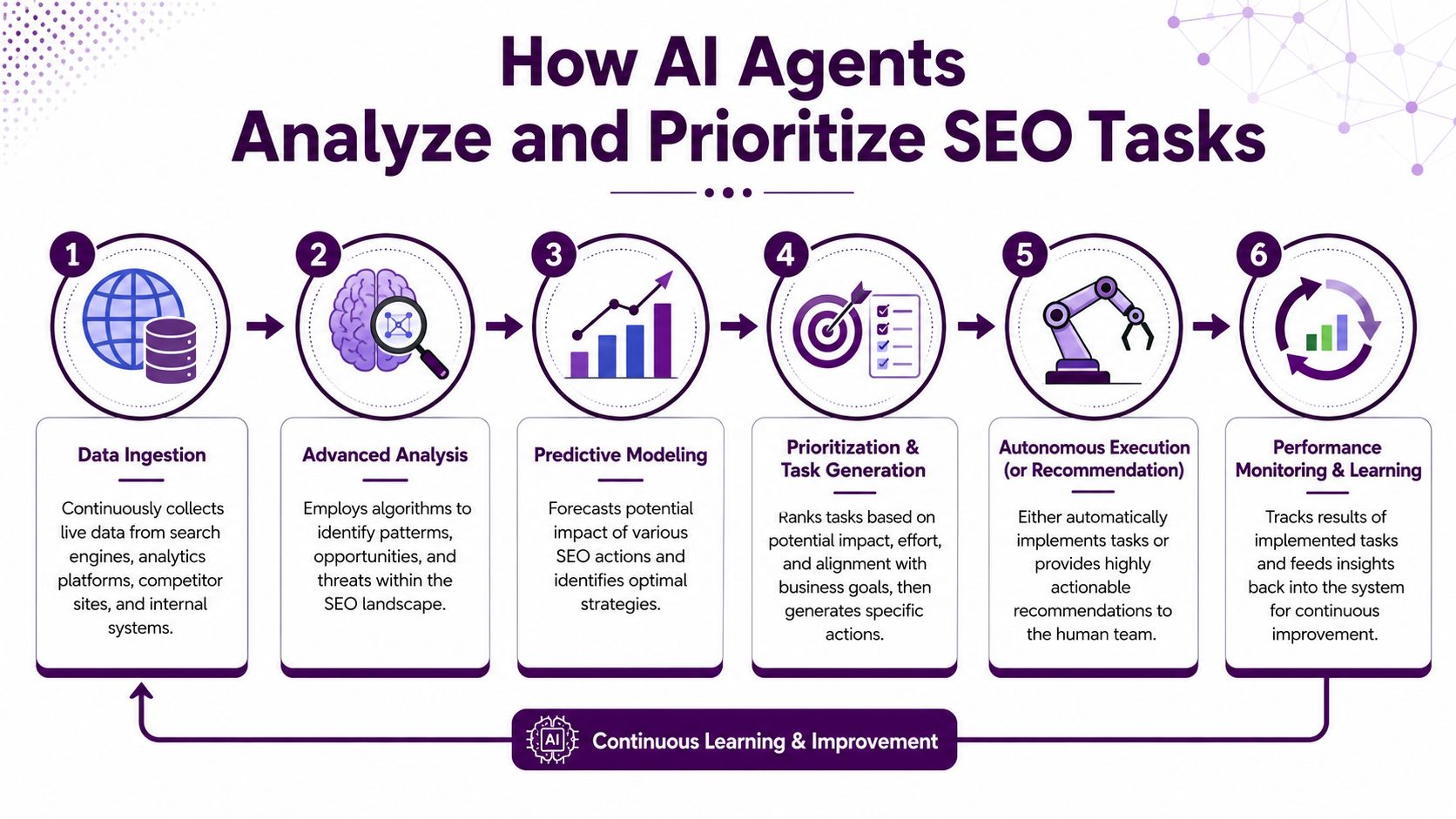
Step one is ingestion, not ideation
The workflow starts by pulling from first-party and operational sources. In practice that often means Search Console, GA4, rank tracking, crawl outputs, and page-level metadata.
From there, the agent looks for patterns that matter operationally:
Decaying pages that still have impressions but weaker engagement or rankings
Cannibalization signals where multiple URLs compete for overlapping queries
Intent mismatch where pages earn visibility but underperform on clicks
Technical blockers that suppress otherwise strong pages
Competitive movement that changes what “good enough” looks like in the SERP
Many teams continue to operate manually. They export reports, compare tabs, and build hypotheses from scattered evidence. It works, but it doesn't scale well.
The market has moved past single-task helpers
A useful signal of category maturity came from a 2026 evaluation of AI SEO agents, where researchers tested 10 tools and measured how many stages of the SEO content pipeline they could automate without manual intervention. The top result automated 6 out of 6 stages, while Surfer SEO and Semrush each automated 3 out of 6. That matters because it shows the shift from isolated task support to multi-step orchestration.
That shift changes expectations. Teams no longer just ask whether a tool can draft content or cluster keywords. They ask whether it can continue from diagnosis into planning, optimization, monitoring, and follow-up.
Prioritization is where agents earn their keep
Analysis alone isn't the hard part anymore. Prioritization is.
A solid agent should rank actions based on a mix of factors such as business relevance, likely SEO impact, implementation difficulty, and confidence in the signal. It should help answer questions like:
Which pages deserve a refresh now
Which technical issues are blocking growth versus creating noise
Which internal linking opportunities are worth implementing first
Which declining pages should be rewritten versus left alone
If you're adapting your workflow for AI-driven discovery, this guide to AI search optimization is a useful companion because it pushes the thinking beyond old keyword-only processes.
For teams that need to pull and structure external page data inside these workflows, LLM Scrape API is relevant because it supports the kind of extraction work agents often need when comparing competitors, SERP content, or page structures at scale.
Good SEO agents don't remove judgment. They remove the time wasted before judgment starts.
Recommendation mode versus execution mode
The final stage is the handoff. Some agents stop at recommendations. Others can create tickets, draft edits, suggest schema, or prepare publish-ready changes.
That's where teams need to be careful. An agent that can generate a task is useful. An agent that can change a high-value template without review can also create expensive mistakes. The right operating model depends on page risk, technical complexity, and how much trust your team has built in the recommendations over time.
Concrete Use Cases and Automated Workflows
The easiest way to judge an AI agent for SEO is to stop thinking about features and start looking at recurring workflows. If the agent can reduce friction inside repeatable work, it has value. If it only produces more reports, it doesn't.
Continuous technical monitoring
Traditional technical SEO often runs on audit cycles. Someone crawls the site, exports issues, triages them, and creates a backlog. That's still useful, but it leaves long gaps between detection and action.
An agent-based workflow changes the rhythm. Instead of waiting for a full review, the system can keep checking for template changes, internal linking regressions, metadata gaps, crawl anomalies, and pages whose technical state no longer matches performance potential.
That doesn't mean it should rewrite your entire site architecture on its own. It means it should keep surfacing the subset of issues that affect visibility and performance.
Content refresh and decay recovery
This is one of the strongest practical use cases.
A good agent can watch pages that still earn impressions but have weaker click performance, slipping rankings, outdated structure, or thinner topic coverage than current SERP leaders. That lets the team refresh what already has signal instead of defaulting to net-new content every time.
Typical outputs include:
Refresh candidates based on weakening performance patterns
Outline gaps against competing pages
Metadata and heading updates where snippets underperform
Internal linking suggestions from stronger adjacent pages
Generative-search readiness
For AI-era search, extractability matters almost as much as rankings. Search Engine Land recommends optimizing pages with semantic HTML structure, clear crawl controls in robots.txt where appropriate, and structured data such as FAQPage and HowTo so AI systems can parse and reuse content more effectively, as covered in this technical SEO guidance for generative search.
In practical terms, an agent can flag pages that are hard for machines to parse cleanly:
Weak semantic structure using generic containers where better HTML patterns would clarify content
Missing schema opportunities on pages that naturally support FAQPage or HowTo
Boilerplate-heavy layouts that bury the useful answer
Crawler access conflicts that limit the right bots from ingesting content
If a page ranks but isn't easy to extract, you may still lose visibility in AI-driven answer experiences.
Manual SEO versus continuous agent workflow
Phase | Manual Workflow (Typical) | AI Agent Workflow (Continuous) |
|---|---|---|
Scoping | Team chooses pages during a quarterly review | Agent keeps scanning pages and surfaces candidates as signals change |
Data gathering | Analyst exports Search Console, analytics, rankings, and crawl data separately | Agent pulls connected data into one working view |
Diagnosis | Team compares reports manually and debates likely cause | Agent correlates changes and proposes likely causes |
Task creation | Spreadsheet or ticket backlog built after the audit | Prioritized action list generated continuously |
Implementation prep | SEO writes requirements for content, dev, or editorial teams | Agent drafts edits, recommendations, or issue summaries |
Follow-up | Results checked in the next review cycle | Agent monitors outcomes and reprioritizes based on fresh data |
For teams comparing broader process design, this breakdown of SEO automation workflows in 2026 pairs well with an agent-based model because it shows where automation helps and where human review still matters.
Competitive monitoring without spreadsheet sprawl
One of the least glamorous but most useful roles for an agent is watching the market around your pages. That includes detecting new competitors, spotting SERP format changes, and flagging when your content no longer covers the topic as completely or as clearly as what's now ranking.
Agents operate more like operations infrastructure than like “AI content tools”. They don't just generate assets. They keep the team oriented toward the next best move.
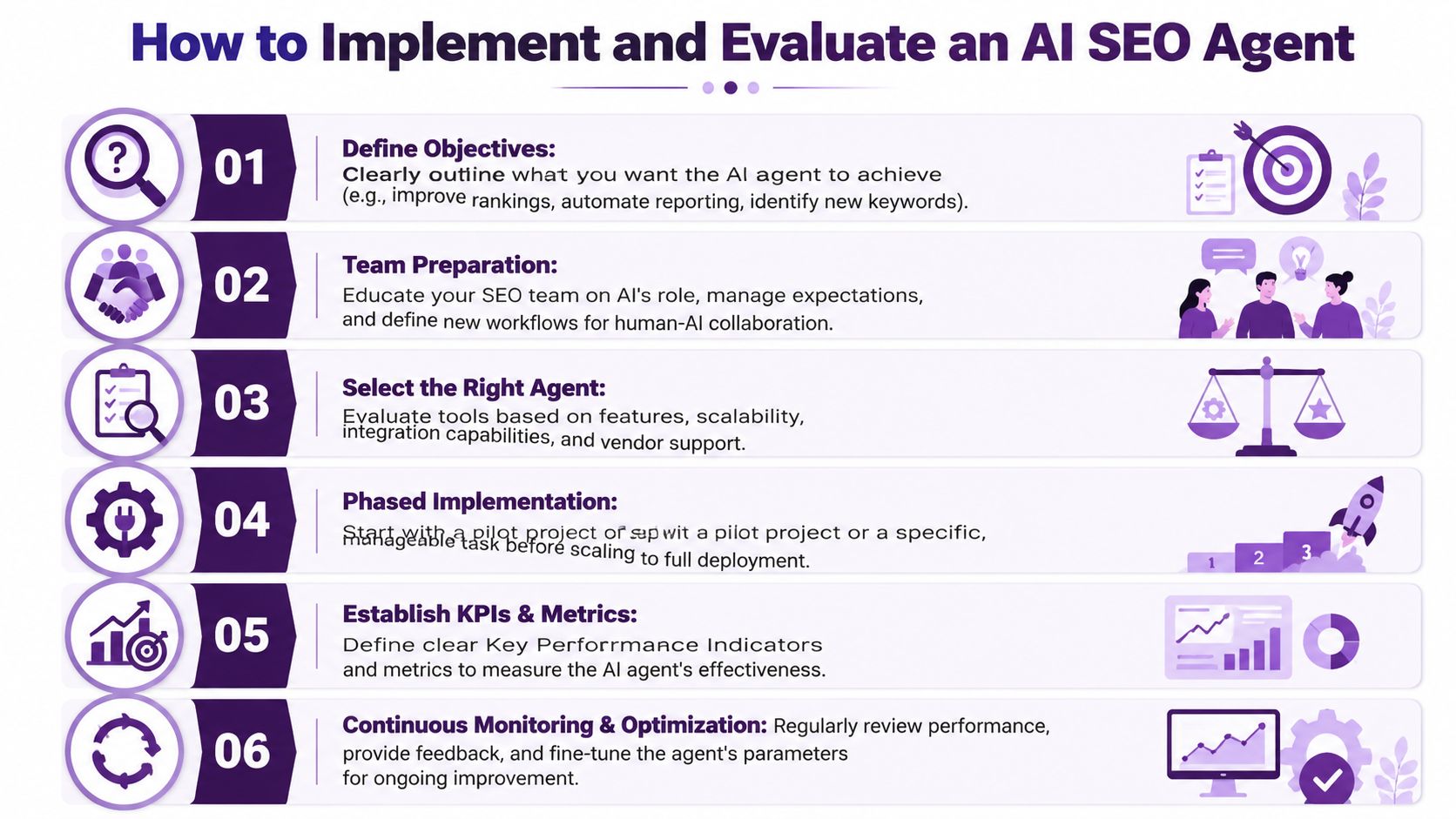
How to Implement and Evaluate an AI SEO Agent
Adopting an AI agent for SEO usually fails for one reason. Teams buy for capability and implement without operating rules.
The tool may be powerful, but if it isn't connected to the right data, tied to clear objectives, and constrained by approval logic, it turns into another source of output nobody fully trusts.
Start with integrations that improve judgment
The first implementation decision is simple. Connect the systems that reveal real performance first.
That usually means:
Google Search Console for query and page visibility signals
GA4 or analytics for user behavior and landing page context
Rank tracking for movement over time
Technical signals from audits or crawlers
Backlink and competitor inputs if your workflow depends on authority and gap analysis
An agent without first-party data tends to fall back on generic advice. An agent with live site data can produce recommendations your team can evaluate.
If you're assessing tools, one option in this category is Keyword Kick, which connects rankings, backlinks, Search Console, analytics, and technical SEO signals into a single workspace so teams can ask what changed and what to do next.
Use semi-autonomy, not blind autonomy
A major implementation question is whether the agent should analyze only, or also act. Recent guidance frames the best practice as a semi-autonomous model where the agent prioritizes issues and drafts fixes, while humans keep final approval for high-impact changes, as explained in this guide to AI SEO agent governance.
That model is the most practical for many teams.
Use direct execution carefully on low-risk tasks. Keep human approval for anything that affects core templates, revenue pages, legal content, or broad internal linking changes.
A workable governance model
Set explicit rules before launch:
Define safe actions
Examples include drafting title updates, suggesting internal links, or preparing content refresh recommendations.Define approval-required actions
Template changes, large-scale page edits, schema injections, and changes to high-value pages should require review.Create an audit trail
Every recommendation should show the input signals, proposed fix, and action status.Plan rollback paths
If an agent-assisted change underperforms, the team needs a clean way to revert and learn.
Teams trust agents faster when they can inspect the reasoning, not just the recommendation.
Measure the right outcomes
The weak way to evaluate an SEO agent is asking whether it “saved time.” It probably did, but that alone won't justify continued use.
A better evaluation model includes:
Decision speed. How quickly the team moves from issue detection to approved action.
Backlog quality. Whether the queue contains fewer low-value tasks and more high-confidence work.
Workflow consistency. Whether monitoring, prioritization, and follow-up happen continuously instead of sporadically.
Outcome attribution. Which recommendations led to measurable improvements relative to the previous baseline.
This last part is still messy across the market. There isn't a universal standard for proving incremental lift from agent-led SEO work. That's why implementation should start with a narrow pilot. Pick one workflow, one section of the site, and one approval model. Then expand after the team sees how the system behaves under real conditions.
Best Practices for Adopting AI in Your SEO Team
The strongest way to frame an AI agent for SEO is not “automation replaces labor.” It's decision compression.
That means the agent reduces a messy field of possible actions into a shorter, ranked list that humans can evaluate quickly. The team still owns judgment, trade-offs, brand fit, and execution quality. The agent shortens the path to those decisions.

That framing is consistent with recent coverage that describes the best use case for AI agents as decision compression, not pure automation, where the system narrows many SEO possibilities into a short ranked action list so humans can validate intent, brand fit, and technical feasibility, as discussed in this overview of AI SEO agents.
What teams should do first
Most organizations get better results when they adopt agents in stages.
Start with monitoring and prioritization
Let the agent prove it can spot useful patterns before you give it execution authority.Connect first-party data early
Search Console and analytics usually improve recommendation quality more than generic keyword databases alone.Use human approval on high-impact pages
Homepage templates, category pages, and revenue-driving content need review even if the recommendation looks sensible.Treat recommendations as hypotheses
Good agents improve triage. They don't eliminate the need to test assumptions.
What doesn't work well
Some patterns fail quickly.
One is using an agent as a content volume machine while leaving data disconnected. That creates more pages, but not better prioritization. Another is expecting full autonomy before the team has governance, rollback rules, or shared confidence in the outputs.
A third mistake is assuming every workflow should be automated. Some shouldn't. Query intent interpretation, editorial positioning, and politically sensitive page decisions still need human context.
The team model that usually wins
The most effective setup usually looks like this:
The agent watches the environment continuously.
The SEO lead reviews the ranked opportunities.
Content, technical, and growth teams execute with context.
Performance gets monitored and folded back into the next cycle.
If your current stack keeps producing more tasks than clarity, it's worth understanding why most AI SEO tools fail. In practice, they usually fail because they generate outputs without enough connected context to prioritize correctly.
The goal isn't to let software run SEO alone. The goal is to stop asking humans to spend their best hours stitching together evidence from five separate systems.
An AI agent for SEO is useful when it changes the operating model. It should reduce tool switching, tighten prioritization, and help the team act sooner with better context. If it only drafts copy faster, you bought a writing tool, not an agent.
Keyword Kick helps SEO teams turn disconnected search data into prioritized actions. If you want a platform built around that operating model, explore Keyword Kick and see how its K² AI Agent connects Search Console, analytics, rankings, backlinks, and technical signals into a clearer workflow.