You publish content every month, track rankings, and still watch the same competitors appear for searches you didn't even plan around. That usually isn't a writing problem. It's a visibility problem.
A keyword gap analysis tool helps you answer the question junior teams ask all the time: Why are they showing up and we're not? The useful answer isn't "they have better SEO." It's usually more specific. They target terms you missed, they support those terms with the right page type, and they connect content to commercial intent better than you do.
The mistake I see most often is stopping at the exported keyword list. A raw gap report feels productive, but it rarely tells you what to work on first. Actual value appears when you combine competitor keyword data with GA4, Google Search Console, and conversion signals so you can separate interesting rankings from useful revenue opportunities.
Your Competitors Are Ranking for Keywords You Missed
A familiar scenario: your team publishes a solid guide, optimizes the title, adds internal links, and waits. Then a competitor with fewer pages outranks you for adjacent queries you never targeted. They aren't winning because they found secret keywords. They're winning because they mapped the topic more completely.
A keyword gap analysis tool makes competitive strategy practical instead of theoretical. You plug in your domain and a few competitors, then the tool shows which terms they rank for that you don't, where you rank but underperform, and where your content map has holes. It turns vague competitive frustration into a concrete to-do list.
One fast way to spot the early signs of those gaps is to look at query patterns before you even open a full platform. If you're validating real search phrasing and competitive overlap, Google Autosuggest competition analysis is a useful companion resource because it helps you see how competitors are intersecting around actual search suggestions, not just your brainstorming doc.
What the missed keyword usually means
A missed keyword isn't always "write a new blog post." Sometimes it means:
You need a category page because searchers want products, not education.
You need a comparison page because the SERP is full of decision-stage searches.
You need to expand an existing article because your competitor covers subtopics your page ignores.
You need stronger internal links so Google can connect your authority to the right page.
The gap is rarely just a keyword gap. It's usually a page type, intent, or prioritization gap.
When you frame it that way, the tool stops being a spying device and starts acting like an inventory check for your search presence. You aren't just asking what competitors rank for. You're asking what demand exists in the market that your site still doesn't serve.
What Is a Keyword Gap Analysis and Why It Matters
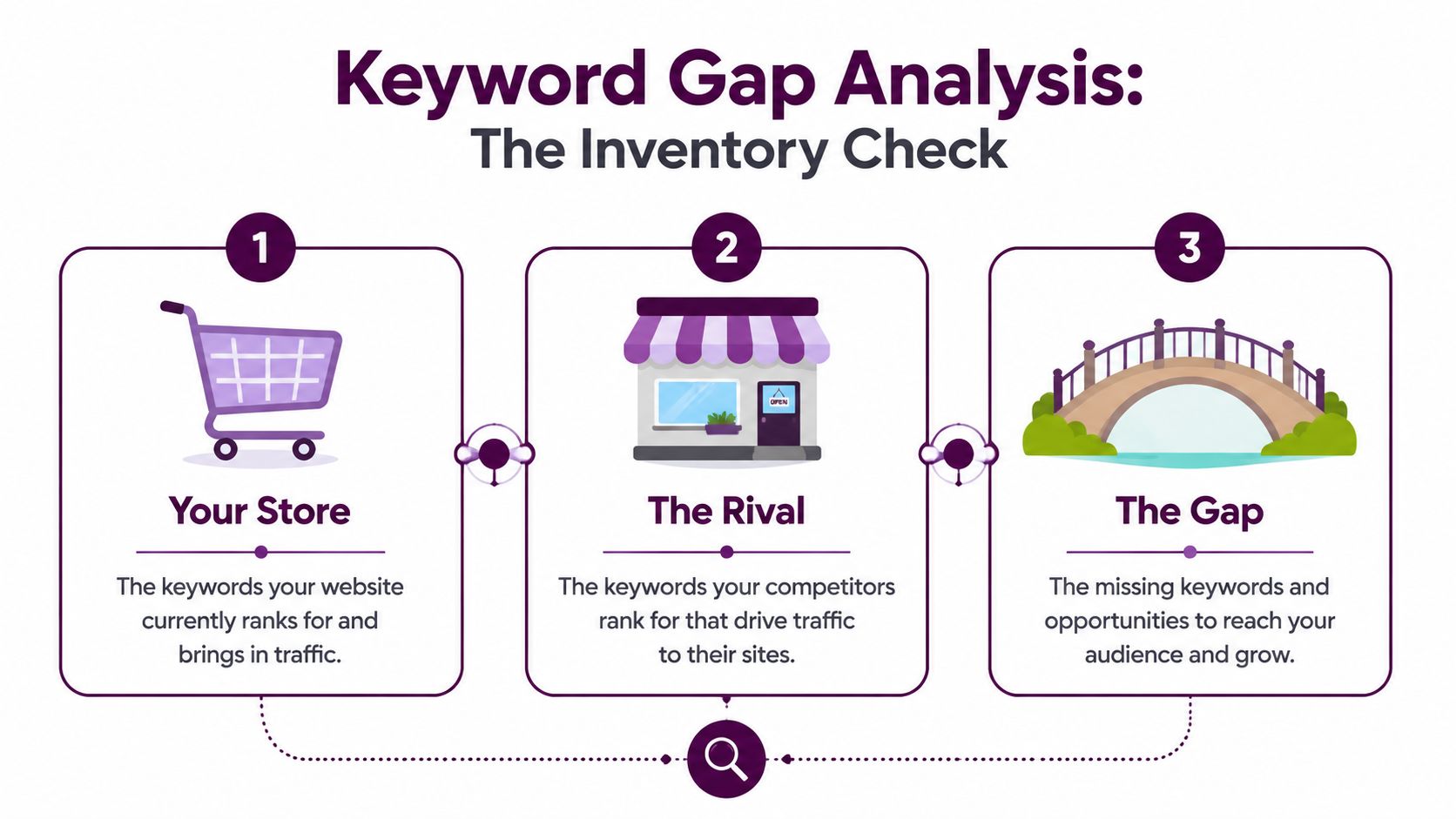
Think of a keyword gap analysis like comparing your grocery store shelves with a rival store across town. You both sell to the same neighborhood. If customers keep buying products from them that you don't stock, your problem isn't awareness. Your inventory is incomplete.
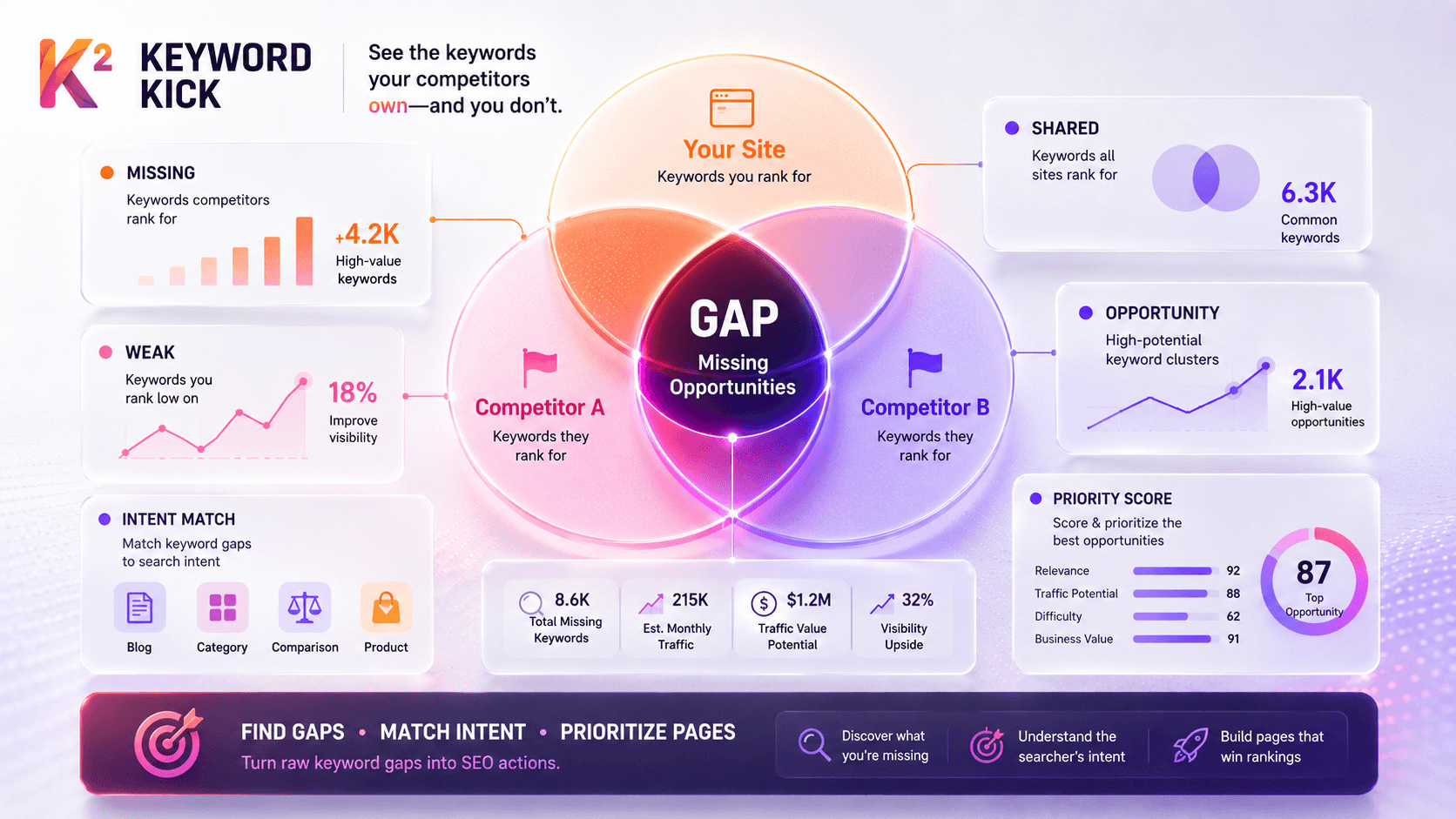
A keyword gap analysis compares your ranking keywords against competitor rankings to find three useful things: where you overlap, where you're weaker, and where you're absent. In SEO terms, the most valuable segment is often the keywords competitors already prove can drive visibility in your market.
The simple way to think about it
If you're new to this process, break it down into three questions:
What do we both rank for?
These keywords show direct competition and reveal whether your page quality or authority is lagging.What do they rank for that we don't?
These are your missing or untapped opportunities. They're often the clearest signal that your site lacks a page or topic cluster.Where do we rank, but poorly?
These weak positions are usually faster wins than launching from zero because you already have some relevance.
A good walkthrough like Riff Analytics' guide to keyword gaps can help if you want another lens on how teams use this process to move from comparison to action.
Why it matters beyond keyword discovery
The point isn't to collect more keywords. The point is to find proven demand. If three close competitors rank for a term and your site doesn't, that signal is stronger than a random keyword export from a brainstorming tool.
That matters because SEO teams waste a lot of time creating content no one asked for. Gap analysis reduces that risk. It shows where the market has already voted.
A verified finding from Semrush's keyword gap analysis research states that businesses conducting regular keyword gap analyses saw a 20-30% increase in organic traffic within six months, primarily by targeting missing keywords where competitors ranked in the top 10 but they did not.
Practical rule: don't treat every missing keyword as a new article. First decide whether the gap belongs to an existing page, a new commercial page, or a supporting cluster.
When teams understand that distinction early, they stop stuffing keywords into blog posts that can never rank because the SERP wants product, category, or comparison pages instead.
Essential Features of a Powerful Keyword Gap Tool
Not every keyword gap analysis tool deserves a place in your workflow. Some generate giant lists and call it a day. Others help you decide what to do next. That difference matters more than the size of the export.
Compare features that change decisions
A useful tool should let you compare your domain against multiple competitors at the same time. One rival rarely tells the full story. You need to see overlap with direct competitors, niche specialists, and the site that's a step ahead of you in organic maturity.
You also need segmentation that makes the output usable. At minimum, the tool should separate keywords into categories such as shared, missing, weak, strong, untapped, and unique. Without those buckets, your team spends too much time cleaning data before you can even think strategically.
Here are the features that affect execution:
Multiple domain comparison: You need a market view, not a one-opponent duel.
Fresh ranking data: Old snapshots can send teams after pages that no longer matter.
Keyword filters: Difficulty, intent, position, and SERP features should narrow the list fast.
Traffic and value signals: Volume alone doesn't help if the keyword never converts.
Export flexibility: CSV exports still matter because prioritization usually happens outside the tool at some stage.
The trade-off between breadth and actionability
Some tools are built for broad competitive research. Others are better for small sites chasing easier wins. Verified product data from Mangools' keyword gap analysis tool overview notes that some tools specialize in low-hanging fruit, and 70% of such gaps have volumes of 100-1,000 monthly searches, often convertible with 5-10x ROI for smaller sites.
That matters because the "best" tool depends on what you're trying to do. A large publisher may want huge databases and deep filtering. A smaller e-commerce team might get more value from a tool that quickly surfaces realistic, low-competition gaps.
A giant keyword database is helpful. A smaller, cleaner list tied to business relevance is often better.
The next decision point is integration. A standalone keyword gap analysis tool gives you rankings. A connected platform gives you context. If the tool can pair competitor gaps with your performance signals, you spend less time guessing which opportunities are worth the team's time. For example, Keyword Kick's competitor analysis feature compares keyword positions against selected competitors to show visibility gaps and overlaps, which becomes more useful when that comparison sits alongside broader SEO signals.
If you're evaluating tools, ask one blunt question: Will this help my team pick the next page to improve, or just give us another spreadsheet? That question eliminates a lot of shiny dashboards.
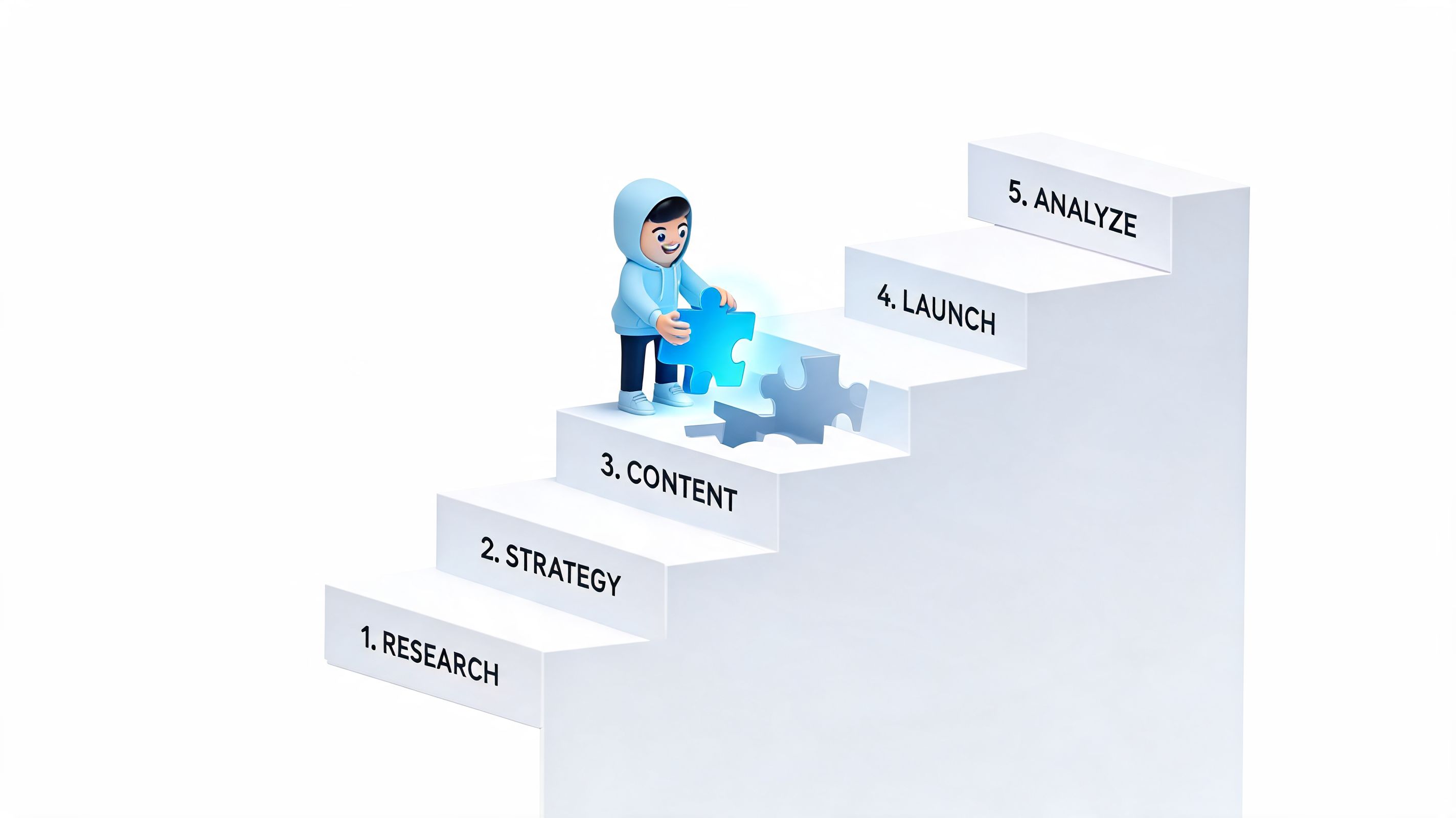
Your Step-by-Step Keyword Gap Analysis Workflow
The first run of a keyword gap analysis tool usually overwhelms people. That's normal. The output can be huge, and most of it won't matter. A clean workflow prevents that flood of data from turning into paralysis.
Pick the right competitors
Start with three types of competitors, not just the brand your sales team complains about.
Direct business competitors: They sell the same thing to the same audience.
SERP competitors: They appear for the searches you care about, even if their business model differs.
Aspirational competitors: They're ahead of you in organic coverage and show what mature topic depth looks like.
A junior team member often picks the biggest brand in the category and stops there. That creates noisy data. The better choice is the set of domains with the most meaningful overlap in your product areas or content themes.
Run the comparison with filters early
Once you've chosen the domains, load them into the keyword gap analysis tool and compare at the domain or subfolder level, depending on your goal. Whole-domain analysis works for broad strategy. Subfolder comparisons are better when you need answers for blogs, category pages, or a product line.
Apply filters before you export. A lot of messy analysis starts at this point.
Use filters like:
Position ranges to find terms where competitors are already visible.
Difficulty or competitiveness to avoid impossible battles when your site is still growing.
Intent filters to separate informational ideas from transactional opportunities.
Brand exclusions so you don't waste time chasing competitor brand queries.
If you need a refresher on the broader research setup around this process, Keyword Kick's keyword research guide is a useful reference point for structuring the analysis before you start sorting terms.
Export the data like you're preparing for triage
Don't export everything into one sheet and call it done. Split the output into working tabs or views.
A practical setup looks like this:
Missing keywords for pages you don't have.
Weak keywords for pages you already have but need to improve.
Commercial terms with clear product, service, or category intent.
Editorial opportunities for guides, comparisons, and support content.
Noise for branded terms, irrelevant topics, and obvious dead ends.
If you can't explain why a keyword belongs in the export, it probably shouldn't be in the export.
Read the first screen before touching the spreadsheet
Many marketers export their data too soon. Stay in the interface for a few minutes and look at patterns first.
Check whether competitors dominate with category pages, blog posts, tools, or comparison pages. Look for topic clusters instead of isolated terms. If one competitor owns a whole subject area and your site only has one weak article on it, you don't have a keyword problem. You have a content architecture problem.
That observation changes your next move. Instead of optimizing one page, you may need a hub page, supporting articles, and internal links that reinforce the topic.
Organize around pages, not terms
Once the export is cleaned, map keywords to specific URLs or planned URLs. This is the point where junior teams often improve. They stop talking about "going after keywords" and start talking about "updating this category page" or "building a comparison page for this cluster."
That's the right mindset. Search performance improves when pages solve intent clearly. Keywords are signals. Pages do the work.
From Data to Action How to Interpret and Prioritize
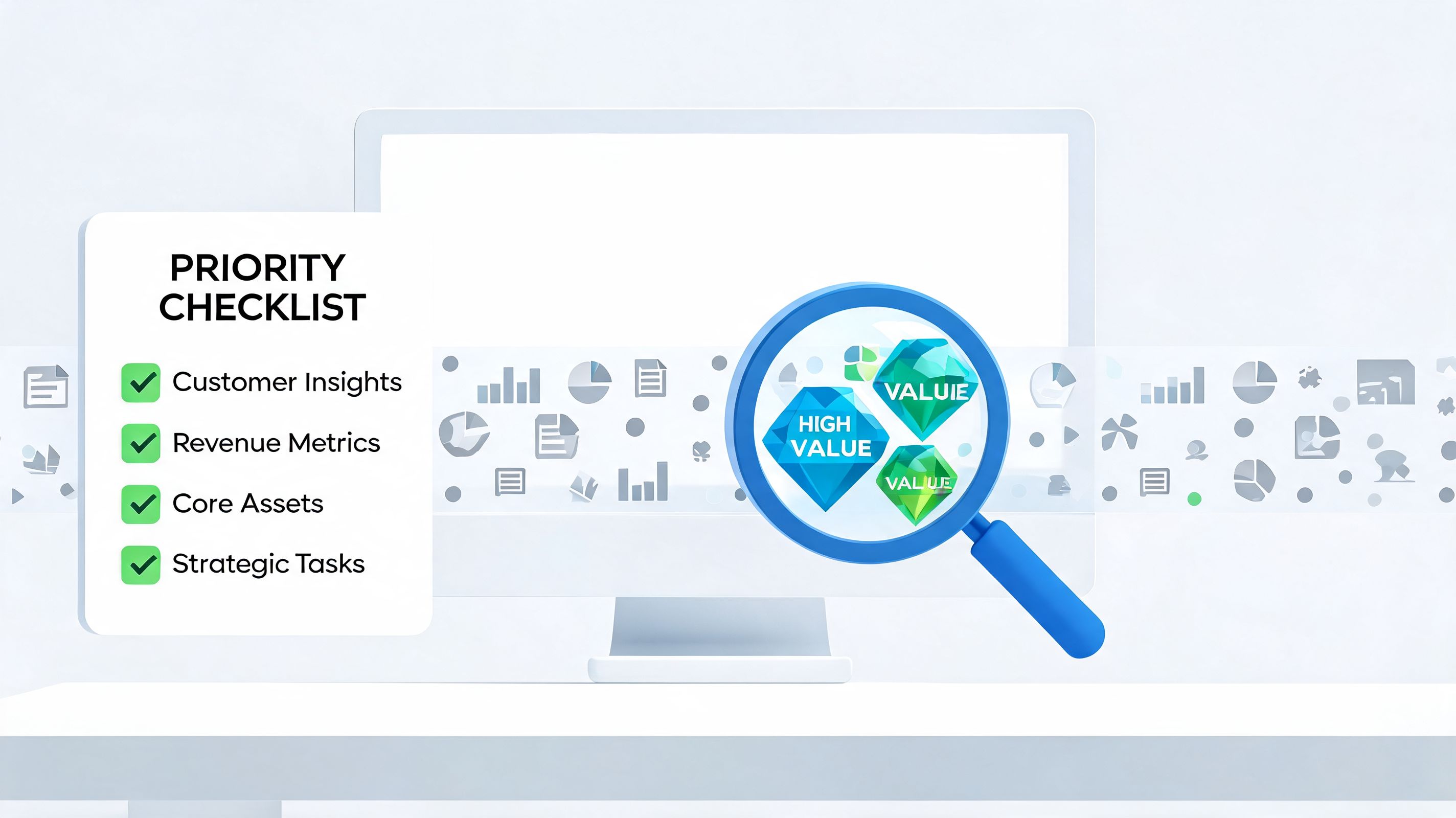
A keyword gap report with hundreds of rows isn't strategy. It's raw material. The useful work starts when you decide which gaps deserve content, which deserve optimization, and which deserve no action at all.
Read each gap type the right way
Different labels imply different actions. Treating them all the same is how teams waste months.
Gap Type | What It Means | Primary Action |
|---|---|---|
Missing | Competitors rank and your site doesn't | Decide whether you need a new page or a major expansion of an existing page |
Weak | You rank, but competitors rank better | Improve the existing page, align intent, strengthen internal links, and upgrade content depth |
Untapped | At least one competitor ranks and you don't | Validate relevance, then test whether the topic belongs in your roadmap |
Shared | You all rank for it | Look at page quality and SERP fit to gain position |
Strong | You outrank competitors | Protect the page and defend the topic cluster |
Unique | Only you rank | Keep the edge, but confirm the topic still matters to the business |
A lot of SEO value sits in the weak bucket because you're not starting from zero. Verified analysis from Similarweb's keyword gap feature page notes that sites addressing weak keywords, such as improving from position 15 to the top 10, can capture 150-300% more organic traffic within 90 days.
Add business context before you prioritize
Efficient growth and time management are determined at this stage.
A keyword might look attractive in a gap tool because the volume is healthy and a competitor ranks well. But if visitors landing on that topic don't convert, don't engage, or don't move deeper into the site, the opportunity may be low value. Verified analysis from the LowFruits research supplied in the brief found that 68% of SEO practitioners struggle with data silos, and unified analysis can show that 42% of raw gap opportunities are low-value without conversion context. I won't relink that source here because it appears later where it belongs most, but the lesson matters now.
Use this review order:
Check GSC first: Do you already get impressions for the topic? If yes, that often means optimization beats net-new content.
Check GA4 second: Which related pages drive engaged sessions, assisted conversions, or other meaningful outcomes?
Check page type third: Does the SERP reward guides, category pages, product pages, or comparison content?
Check internal linking last: Can you strengthen the right page with links from existing authority pages?
Rankings without conversion context create busywork. The best opportunities sit where search demand and business value intersect.
Build a simple scoring model
You don't need a fancy dashboard to prioritize well. A practical scoring model can be as simple as rating each opportunity on four dimensions:
Relevance to the business
Likelihood of ranking with your current authority
Intent quality
Connection to revenue or lead generation
That model beats chasing search volume alone. It also helps when content and SEO teams disagree. The score turns the conversation from opinion into criteria.
For deeper workflows around turning topic gaps into page decisions, Keyword Kick's content gap analysis guide is a useful companion resource because it frames the work around actions instead of exports.
What gets worked first
If I were training a junior SEO on prioritization, I'd usually put work in this order:
Existing pages with weak positions and commercial intent
Missing keywords that clearly map to revenue pages
Supporting informational content that helps those money pages rank
Broad top-of-funnel ideas only if the site already converts well from organic
That sequence keeps the roadmap tied to outcomes. It also prevents the common trap of publishing a lot of content that looks impressive in a calendar and does very little for the business.
Common Pitfalls That Waste Time and Budget
The most expensive mistake with a keyword gap analysis tool isn't using the wrong filter. It's acting on the output without checking whether the opportunity is worth winning.
Chasing volume and ignoring intent
A gap report often tempts teams to sort by search volume and start writing. That's how you end up with content that ranks for curiosity clicks but never supports pipeline, sales, or qualified traffic.
If a keyword belongs to a product comparison SERP and you publish a generic educational article, the page probably won't win. If the SERP is dominated by category pages and you send a blog post into that fight, you're solving the wrong problem.
Treating all missing keywords as equal
They aren't equal. Some belong to your offer. Some belong to an adjacent audience. Some belong to a competitor's brand gravity, not your realistic roadmap.
A practical filter is simple: if the keyword doesn't connect to a product, service, audience pain point, or a supporting step in the buyer journey, it doesn't deserve immediate attention.
A missing keyword is not automatically an opportunity. It's only an opportunity if winning it helps the business.
Ignoring SERP features and AI visibility
This is getting more costly. Verified analysis from TrySight's content gap analysis coverage states that focusing only on traditional keyword gaps misses up to 30% of traffic potential from SERP features, and that AI Overviews captured 15.4% of Google queries by late 2025.
That creates a new kind of gap. You may "rank" in the classic sense and still lose attention to featured snippets, People Also Ask boxes, video carousels, or AI-generated answers. A basic keyword list won't show that clearly unless your workflow accounts for it.
Running the analysis once and forgetting it
Competitor visibility changes. Product lines change. Search behavior changes. Your site changes too.
One-off gap analysis tends to produce one burst of content and then stale assumptions. Teams get better results when they revisit gaps regularly, compare against current rankings, and recheck whether the terms they targeted improved the metrics that matter.
If the analysis isn't recurring, the roadmap goes stale faster than expected.
Case Study Turning Gaps into 30 Percent Traffic Growth
A mid-sized e-commerce site came into a review with a complaint I hear often: "We're publishing, but competitors keep taking the high-intent searches." The first look at their content suggested they had enough pages. The second look showed the problem. Their pages covered topics, but not the terms that lined up with purchase intent.

They ran a keyword gap analysis against close e-commerce competitors and found a large set of missing and weak keywords around category-level transactional searches. The raw export looked promising, but the team didn't stop there. They matched the gaps against GA4 landing page performance, GSC query data, and their rank tracking.
That extra layer changed the plan. Verified research from LowFruits on keyword gap analysis notes that 68% of SEO practitioners struggle with data silos, and that unified analysis can reveal 42% of raw gap opportunities are low-value without conversion context. That was exactly the issue here. A big chunk of the export looked attractive in SEO terms but had little connection to sales.
What they changed
They didn't launch a giant content campaign. They made a short, focused set of changes:
Built one new category page around a cluster of missed transactional terms.
Reworked two existing articles so they supported decision-stage searches instead of broad informational intent.
Improved internal links from editorial content into the category page.
Tracked the target cluster in rank monitoring and checked GSC for early movement.
After one quarter, the site recorded a 30% lift in qualified organic traffic. That result fits the range supported by the earlier Semrush finding about regular keyword gap analysis. The important part wasn't the number by itself. It was where the lift came from. They stopped pursuing every gap and focused on the pages closest to revenue.
A short walkthrough can help if you want to see another explanation of how teams apply this in practice:
The lesson is simple. A keyword gap analysis tool is valuable, but only after you connect it to the rest of your performance data. Rankings tell you where competitors are visible. GA4, GSC, and conversion metrics tell you whether that visibility is worth chasing.
If you want to work this way without stitching together separate exports every week, Keyword Kick gives teams one place to connect keyword gaps with GA4, GSC, rank tracking, backlinks, and technical SEO signals so you can prioritize the opportunities most likely to drive real business results.