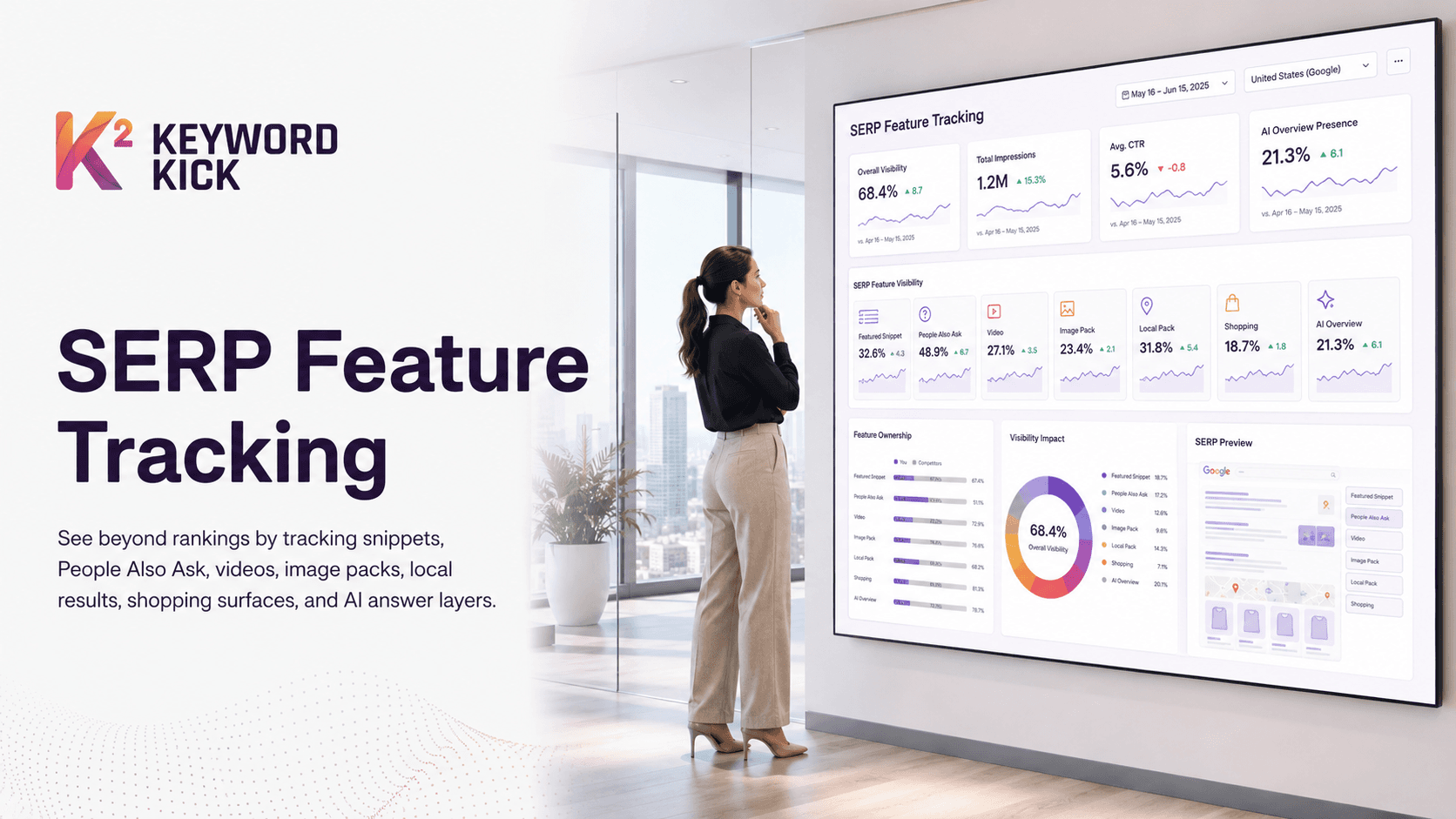
You're probably looking at a keyword set where rankings seem fine on paper, yet traffic doesn't match. A page sits near the top of Google, impressions hold steady, but clicks soften and conversions don't move. That gap is where most basic SEO reporting breaks down.
The issue usually isn't that rank tracking is useless. It's that rank tracking by itself no longer describes what the searcher sees. Modern search results are crowded with answer modules, People Also Ask boxes, videos, image packs, local results, shopping surfaces, and AI-generated layers that reshape click behavior before a user ever reaches the classic organic listings.
SERP feature tracking fixes that blind spot. Done well, it becomes an operating system for visibility analysis, content prioritization, and competitive decision-making. Done poorly, it turns into a noisy dashboard full of vanity metrics.
Why Rank Tracking Alone Is No Longer Enough
A top ranking can still underperform.
That's the reality many teams run into after a content push or technical cleanup. They improve average positions, celebrate movement into the top results, then discover that the traffic curve doesn't rise in parallel. The missing variable is the page layout itself.
In 2024, Semrush reported that only 1.53% of Google search results appeared without any SERP features, based on Sensor data from October 2024. That means 98.47% of results included at least one enhanced element such as featured snippets, images, videos, or People Also Ask, according to Semrush's SERP features guide.
Rank tells you position, not visibility
If your page ranks third but Google places a featured snippet, a video block, and a People Also Ask module above it, your “third-place” result may sit much lower on the screen than your reporting suggests. In practical terms, you didn't just lose aesthetics. You lost attention.
That's why visibility reviews need to move beyond blue-link logic. Teams that still judge performance by raw position often misread three common situations:
High rank, weak CTR: A page ranks well but sits under more compelling SERP modules.
Flat rank, lower traffic: Competitors haven't outranked you in the classic sense, but they've captured richer placements.
Rising impressions, stalled sessions: Google is surfacing your query more often while giving users answers directly on the results page.
The real unit of analysis is share of SERP
The smarter question isn't “What rank are we?” It's “How much of the results page do we control, and which features absorb the clicks for this query?”
That shift changes how you diagnose losses. It also changes how you investigate competitors. A publisher that looks weaker in standard rank reports may still dominate the query because it owns the snippet, appears in PAA, and supports the result with video or imagery.
For agency teams and in-house marketers, competitive intelligence for SEO proves more useful than plain rank tables. You're not only identifying who outranks you. You're identifying who captures the SERP surfaces that users interact with first.
Practical rule: If reporting stops at rank position, you're measuring placement, not actual search visibility.
Which SERP Features Actually Drive Growth
Most SERP feature guides make the same mistake. They list everything Google can show, then leave you with a long checklist that isn't tied to revenue, lead quality, or channel strategy.
That approach creates busywork. Strategic SERP feature tracking starts by deciding which features matter for your business model.
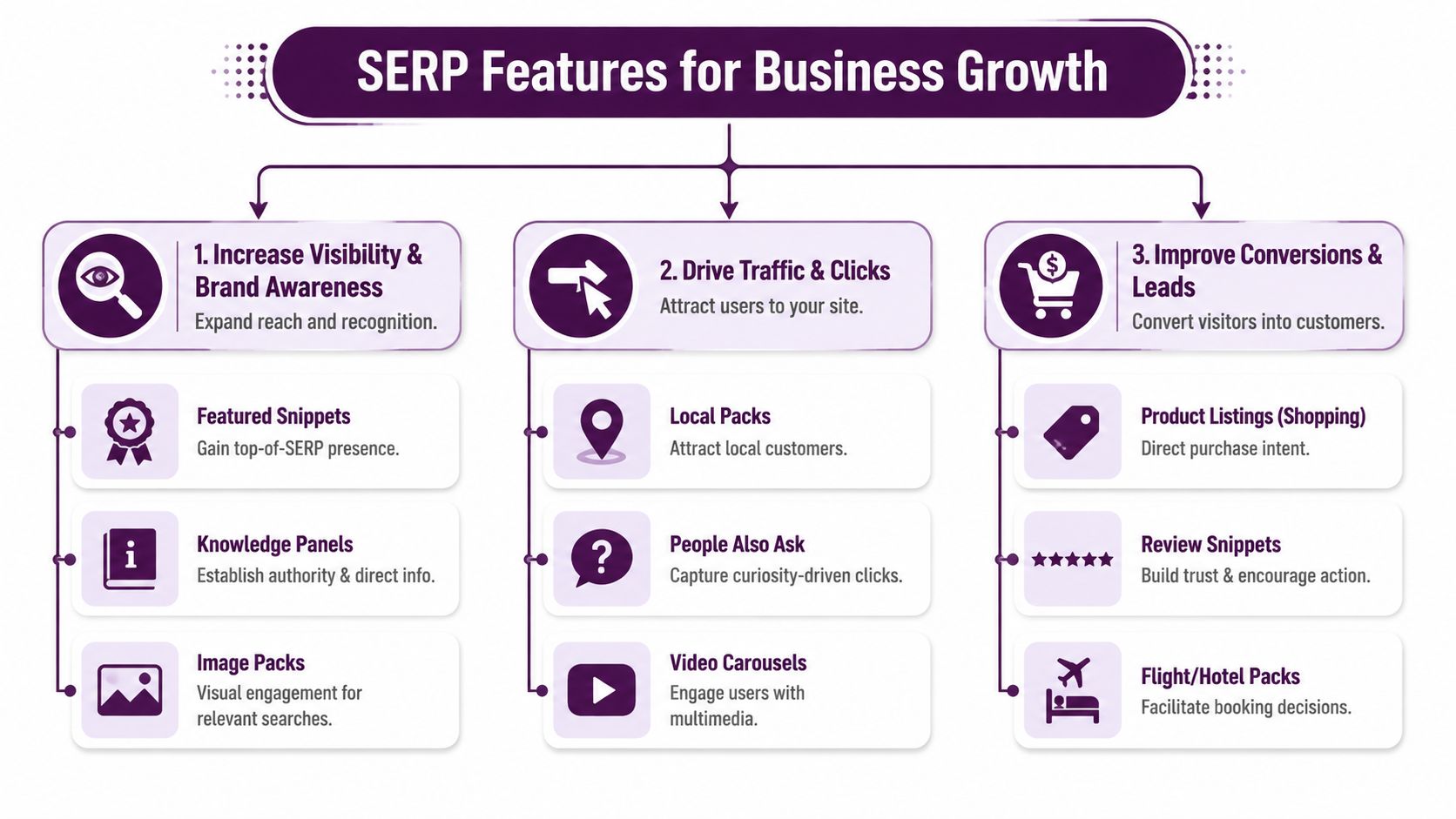
A large-scale STAT Search Analytics study analyzed 40,000 keywords and found that several SERP features dominated Google results in 2023, including People Also Ask on 78.85% of SERPs, Videos on 52.84%, Carousels on 51.65%, and Images on 37.81%, as reported in STAT's analysis of top SERP features.
Match features to business goals
The prevalence data matters because it shows these elements aren't edge cases. But prevalence alone doesn't tell you what to track first.
Use a business-goal lens instead.
Business type | Features worth prioritizing | Why they matter |
|---|---|---|
E-commerce | Shopping surfaces, product listings, review snippets, image-driven results | These align with transactional intent and product comparison behavior |
Lead generation | Featured snippets, People Also Ask, local packs, review-rich results | These help win early trust and capture high-intent informational or local demand |
Media or content sites | Featured snippets, videos, image packs, PAA | These can expand reach across informational queries and widen entry points |
Local businesses | Local pack, map-based visibility, review-enhanced listings | These often influence calls, visits, and location-based conversions more than standard rankings |
What to ignore, at least for now
Many teams overtrack because tools make it easy. That doesn't mean they should.
If you run a B2B SaaS site with no physical presence, local pack visibility may matter for branded or office-related searches, but it probably doesn't deserve daily monitoring across your whole non-brand set. If you sell complex services and don't produce video, obsessing over every video carousel may create more reporting than action.
A cleaner prioritization method looks like this:
Start with commercial impact: Track the features that appear on queries tied to pipeline, revenue, or qualified leads.
Favor repeatable wins: If your team can realistically influence snippets, PAA, images, or product data, those deserve attention before harder-to-control surfaces.
Separate strategic from informational features: Some elements shape awareness. Others affect conversion paths. Don't mix them in one score.
The strongest tracking setups don't monitor every feature equally. They monitor the few features that can change traffic, click quality, or conversion intent for the keyword groups that matter.
For a quick reference on the feature types themselves, Keyword Kick's SERP features glossary is useful as a taxonomy. The operational work starts after that. You still need to decide which ones are commercially relevant.
A practical prioritization model
Pick two or three feature categories per primary business goal.
For example:
E-commerce growth: product-oriented surfaces, reviews, image-heavy results
Lead gen growth: featured snippets, PAA, local visibility
Content authority: snippets, video, image packs
That narrower scope makes reporting cleaner. More importantly, it gives your team a realistic optimization backlog instead of an encyclopedia.
Selecting and Configuring Your Tracking Tools
Tool choice matters less than most vendors claim. Configuration matters more.
A weak setup in an expensive platform still produces junk data. A well-configured setup in a simpler system can drive solid decisions if it captures the right features, locations, devices, and competitors.

What the tool must do
At minimum, your tracking system should let you answer five operational questions:
Which features appear for this keyword?
Do we own any of them?
Which competitor owns them when we don't?
How has that changed over time?
Can we segment this by device, location, and keyword group?
If a platform can't answer those cleanly, it won't support serious SERP feature tracking.
Here's what to look for during evaluation:
Historical SERP feature data: You need to see when a feature appeared, disappeared, or changed ownership.
Competitor-level feature ownership: Not just who ranks, but who wins the snippet, PAA visibility, or visual placement.
Filtering by feature type: You should be able to isolate one feature class quickly.
Location and device controls: Mobile and local differences can change the whole picture.
Alerting: Not generic alerts. Specific notifications for feature gains, losses, or sudden SERP layout changes.
Export or API access: If your team builds internal reporting, this becomes important fast.
Standalone tracker or integrated platform
A dedicated SERP analytics platform can offer deeper feature-level detail. The trade-off is workflow fragmentation. Your rank tracking, Search Console data, analytics, technical findings, and competitor research may all live in separate places.
An integrated platform can reduce that friction. For example, Keyword Kick's guide to setting up a rank tracking campaign shows the practical setup sequence many teams already need. Keyword Kick is one option if you want rank tracking, SERP feature monitoring, GA4, GSC, backlinks, and technical signals in one workspace rather than split across several tools.
Configuration mistakes that create bad data
Most bad reporting comes from setup errors, not platform limitations.
Common ones include:
Tracking too many low-value keywords: That inflates dashboards without improving decisions.
Ignoring location settings: A feature can exist in one region and disappear in another.
Mixing branded and non-branded queries: This blurs ownership patterns.
Using one competitor list for every segment: Your true SERP competitors differ by intent and feature type.
Good tools don't remove judgment. They make your judgment visible in the data.
Building Your Scalable Tracking Framework
A scalable framework should feel boring in the best way. It should be repeatable, easy to audit, and hard to derail when the keyword set expands.
The biggest mistake I see is teams starting with the tool instead of the operating model. They import a huge keyword list, switch on every feature, and hope useful patterns emerge. Usually they get noise.
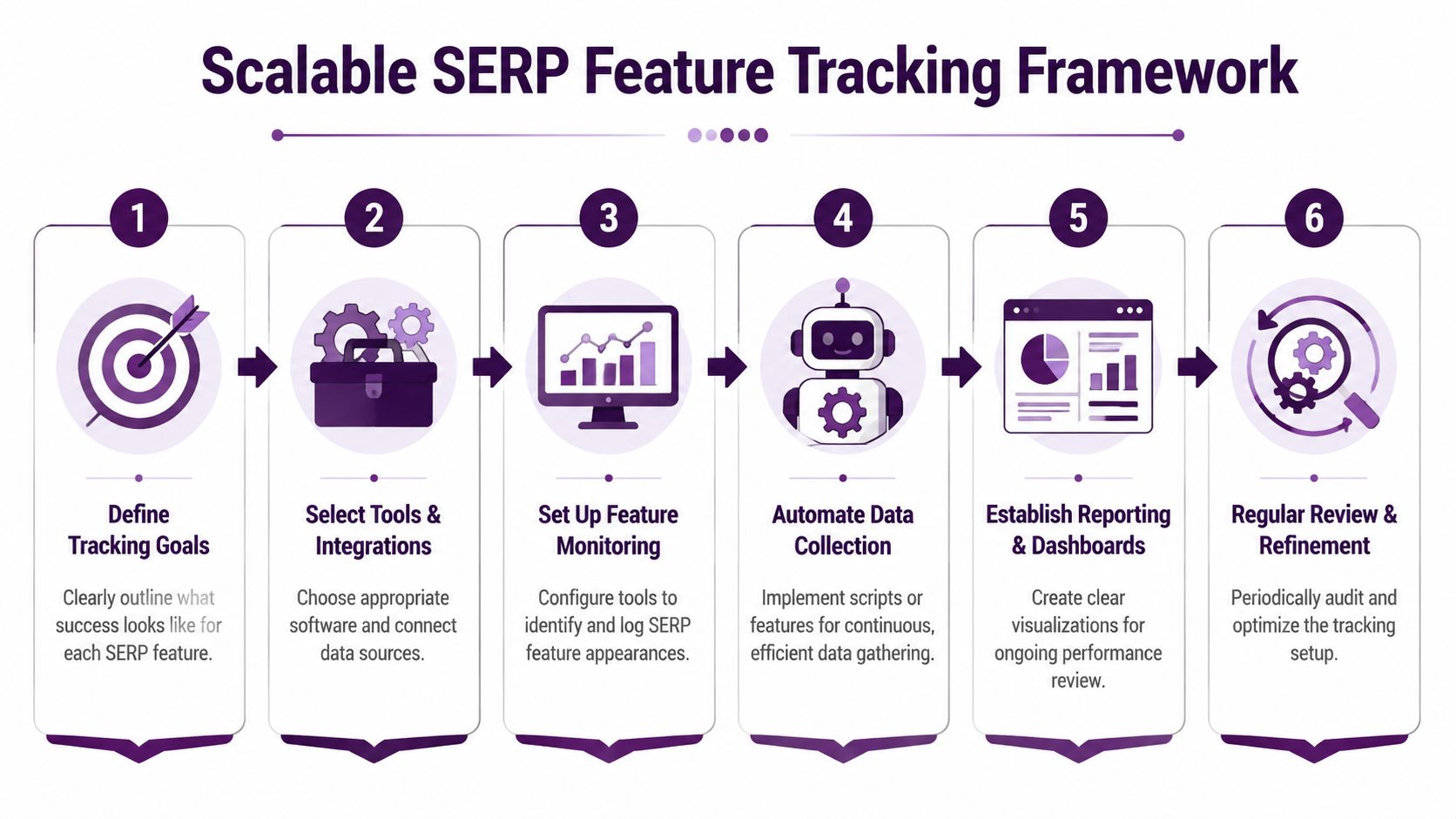
GrowByData highlights an issue many teams miss: most guidance explains what SERP features are but not which features are worth monitoring for specific business goals, even though Google result pages can contain 20+ feature types and commercial queries are often dominated by a smaller set of click-intercepting surfaces such as AI Overviews, Shopping Ads, Merchant Listings, and People Also Ask, as discussed in GrowByData's guide to tracking SERP features.
Build segments before you track
Start with keyword segmentation. Not broad topic clusters alone, but business-relevant segments.
Useful segmentation layers include:
Intent: informational, commercial, transactional, local
Value: high-priority revenue terms, supporting terms, exploratory content terms
Ownership state: already own feature, feature exists but unowned, no feature currently present
Content type: product pages, service pages, blog content, location pages, help content
That structure helps you avoid treating every keyword the same.
Don't ask your platform to tell you what matters. Decide what matters first, then track it.
Use different monitoring frequencies
Not every keyword needs the same cadence.
Daily checks make sense for high-competition, high-volatility terms where feature turnover affects revenue or lead flow. Weekly monitoring is usually enough for more stable informational or long-tail sets. The point isn't to collect more snapshots. It's to collect enough data to notice meaningful change without drowning in status updates.
A simple working model:
Keyword group | Tracking frequency | Reason |
|---|---|---|
Core commercial terms | Daily | Features can shift quickly and affect high-value traffic |
Important supporting queries | Several times per week or weekly | Enough to spot ownership changes without excess noise |
Long-tail informational terms | Weekly | Patterns matter more than day-to-day fluctuation |
Configure alerts around events, not vanity
Alerting is useful only when it triggers action.
Good alerts include:
Feature lost on a priority keyword
Competitor wins a feature you previously owned
A target feature appears for a keyword that didn't show it before
A new competitor repeatedly captures the same feature cluster
Bad alerts include “rank changed by one position” across the whole account.
Include competitive context from day one
A framework without competitor tracking usually leads to false conclusions. If you lose CTR, you need to know whether Google changed the layout, a direct competitor captured the richer result, or a publisher entered the SERP with a format you don't currently support.
Track both traditional competitors and search competitors. They're often different. A software brand may compete commercially with one set of companies and lose informational snippets to publishers, forums, or documentation sites.
Analyzing SERP Data to Find Opportunities
Tracking data becomes useful only when it connects to performance data. A SERP feature report on its own tells you what changed. It doesn't tell you whether the change mattered.
That's why the analysis layer should combine feature ownership with Google Search Console and GA4. Search Console shows impressions, clicks, and CTR trends. GA4 helps you connect those shifts to sessions and downstream business behavior.
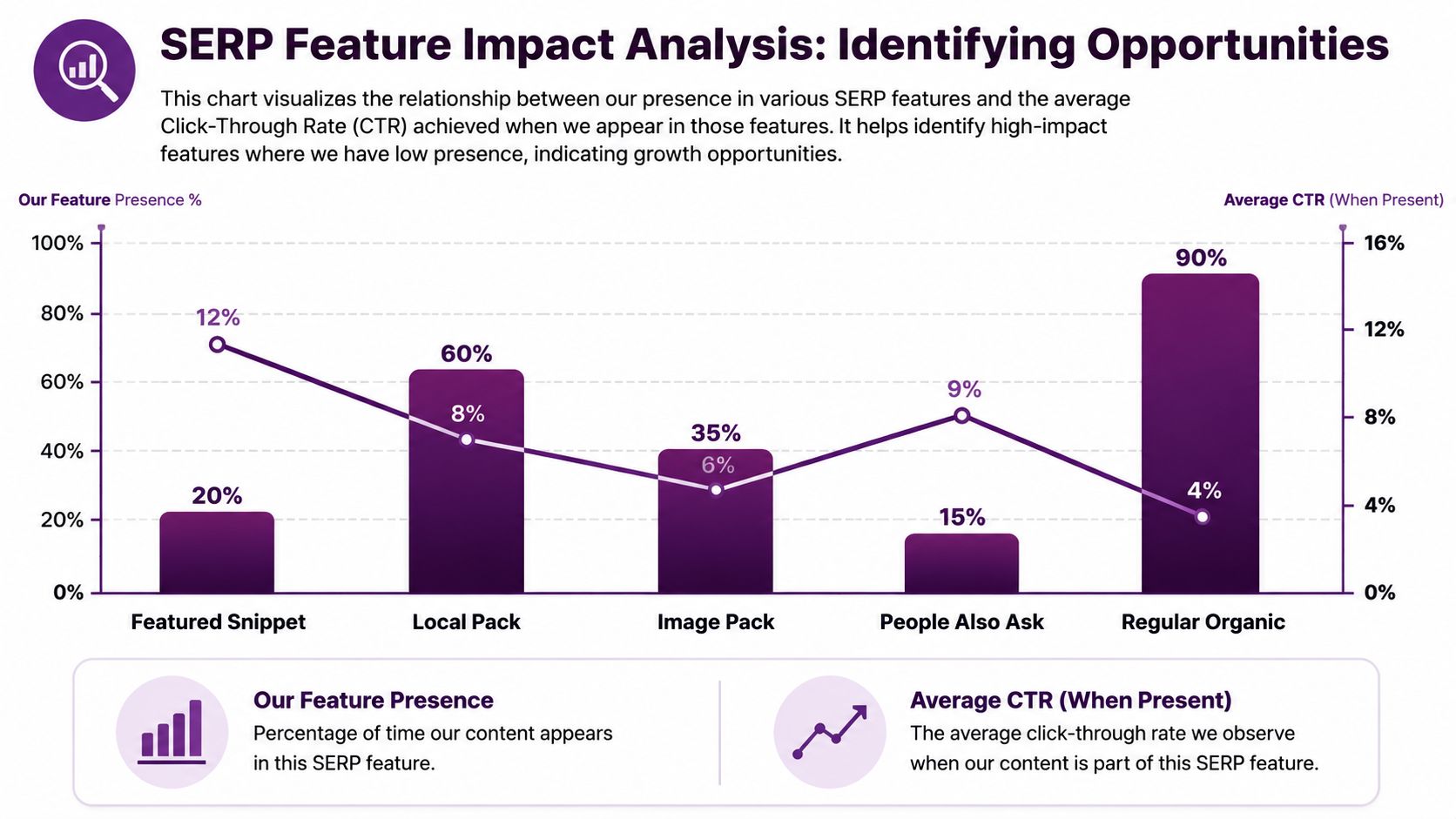
Benchmark data from independent research indicates that organic CTR drops from an average of 15% to approximately 8% when an AI Overview appears above organic results, representing a 47% reduction in potential traffic. That's why tracking systems need to capture not just whether a feature exists, but also its pixel depth and format type.
What to compare in your reports
For each target keyword group, review these elements together:
Feature presence: what appeared on the SERP
Feature ownership: whether you owned the feature
Rank movement: whether classic positions changed
CTR change: whether the click pattern shifted
Landing page behavior: whether traffic quality changed after the SERP shift
At this point, the diagnosis gets more accurate.
If rankings stayed flat but CTR dropped, the likely explanation is often a layout change. If CTR rose with no major rank gain, a newly won feature may be doing the work. If impressions rise while clicks don't, a more zero-click or answer-heavy result layout may be intercepting demand.
Look for gaps, not just losses
A lot of teams use SERP feature tracking defensively. They watch for decline. That's useful, but it misses the better use case, which is opportunity discovery.
Three patterns usually deserve action first:
Feature exists, nobody strong owns it consistently
This is common with snippets and PAA-style questions where the field rotates.You rank on page one but don't appear in the richer layer
That often means the content is relevant enough, but the format or markup is weak.A competitor wins the feature with a clearly better presentation
The content might not be deeper. It may be structured more effectively.
The most valuable opportunity often isn't “rank higher.” It's “earn the click before ranking improvements arrive.”
Practical analysis examples
If a buying-intent query suddenly shows more visual results and your product pages have thin imagery, that points toward image and product presentation work. If an informational cluster repeatedly triggers People Also Ask and your content answers the topic only in long-form prose, that points toward restructuring with clear question-and-answer sections.
If AI Overviews appear on a query set and CTR declines while rank remains stable, don't force a rank-only interpretation. Treat it as a visibility shift. In that case, above-the-fold analysis matters more than average position.
Prioritizing Optimizations and Experiments
The final step is where most SERP tracking programs either become useful or collapse into reporting theater.
You already know which features appear. You know which ones you own, which competitors control, and where CTR patterns changed. The remaining question is simple: what gets worked on first?
A practical prioritization model follows a five-step opportunity mapping process. Start by scoping the feature environment, then identify target features by segmenting keywords into dynamic tags, then automate tracking, add competitive context, and finally measure performance over time by correlating rank changes with feature ownership shifts. This approach has been associated with a 10.5% increase in CTR for optimized content.
Turn analysis into a backlog
I prefer to sort opportunities into three buckets:
Quick wins
These are keywords where the page already ranks well and the feature is realistically attainable with formatting or on-page changes.
Examples include:
rewriting an answer block so it directly addresses a query
adding cleaner subheadings for list-style extraction
tightening a product summary so the page is easier to parse
improving image relevance and placement on a page already ranking well
These tasks are usually the first place to look because they don't require a new content program.
Competitive gaps
These are feature losses where a competitor owns the element, but their implementation isn't especially strong.
Look for pages where competitors win because they have:
cleaner answer formatting
better Q&A structure
stronger review presentation
more complete product information
a better-aligned page type for the query
You don't need to copy the exact layout. You need to understand why Google chose that result format and remove obvious weaknesses in your own page.
Larger experiments
Some opportunities require a broader content or technical investment.
Examples:
launching video assets for topics where video repeatedly appears
improving structured data coverage where rich presentation depends on markup
building dedicated location pages to support local visibility
expanding product feed quality for product-oriented results
splitting mixed-intent pages into clearer page types
These projects take longer, so they should compete for resources based on business value, not novelty.
What works and what doesn't
Some optimizations tend to produce useful movement. Others waste time.
What tends to work:
Clear answer formatting: Especially for snippet-style opportunities.
Question-led subheadings: Useful when a query family repeatedly triggers PAA behavior.
Tight alignment between intent and page type: Service pages for service intent, product pages for product intent, not one generic page trying to do both.
Structured data where relevant: Helpful for helping search engines interpret page elements tied to richer result types.
Visual improvement on visual SERPs: Better images and stronger product presentation matter when Google leans visual.
What usually doesn't work:
Tracking every feature equally
Chasing exotic features with no business value
Using one generic template across all query types
Measuring success only by rank gain
Ignoring competitor format advantages
A strong SERP feature program doesn't create more dashboards. It creates a shorter, sharper list of actions.
A simple decision filter
Before adding any task to the backlog, ask:
Does this keyword cluster matter to revenue, leads, or strategic visibility?
Is the feature prominent enough to affect clicks?
Can our current page realistically win it with revision?
If not, is the upside large enough to justify a bigger experiment?
Will we be able to measure the result against feature ownership and CTR?
If the answer to most of those is no, skip it.
That discipline matters more than adding another report. The point of SERP feature tracking isn't to admire the complexity of Google's results pages. It's to identify the feature layers that change business outcomes, then build a repeatable system for winning them.
Keyword Kick fits well for teams that want to connect SERP feature tracking with rank data, GA4, Search Console, competitor insights, backlinks, and technical SEO in one workspace. If your current process lives across spreadsheets and disconnected tools, Keyword Kick is worth evaluating as a way to turn fragmented search data into a clearer optimization backlog.