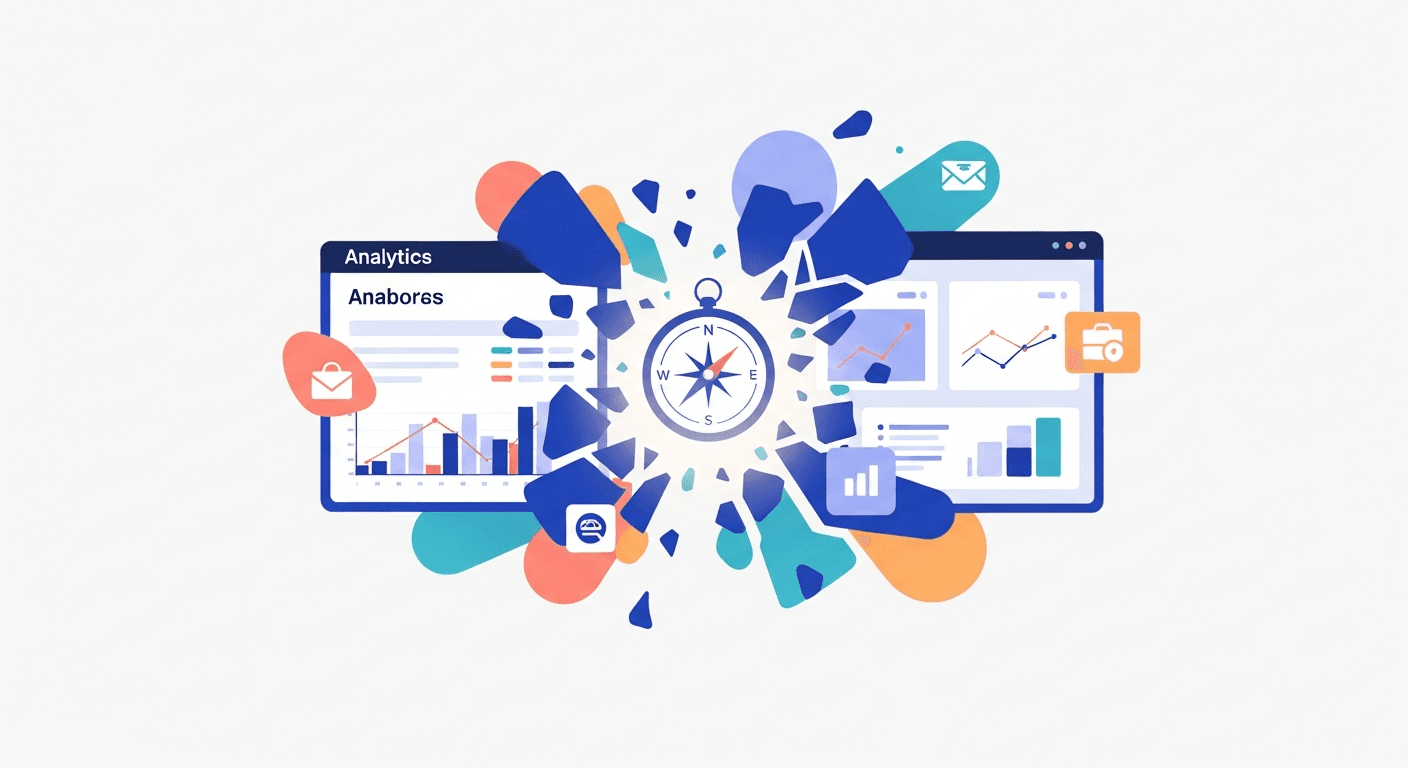
The Death of the SEO Dashboard
For more than a decade, SEO has been managed through dashboards. Rank trackers. Traffic graphs. Visibility scores. Crawl error panels.
The interface became the discipline. But something has quietly changed.
The bottleneck in SEO is no longer access to data. It is decision paralysis. And dashboards are part of the problem.
Dashboards Solved Yesterday's Problem
In the early days of search, data was scarce. Google Analytics was primitive. Search Console was limited. Competitive intelligence was expensive.
SEO platforms created visibility where none existed. They democratized data. That was their breakthrough.
But today, SEO teams are not data-starved. They are signal-overloaded.
A modern SEO stack can generate thousands of keyword data points, hundreds of technical warnings, competitive gap analyses, content decay indicators, and backlink toxicity signals.
The issue is no longer what is happening. It is what matters most.
The Cognitive Ceiling of Dashboards
Dashboards are optimized for visualization. They are not optimized for prioritization.
Cognitive load theory — widely studied in educational psychology — shows that when working memory is overwhelmed, decision quality declines. More information does not equal better judgment.
When an SEO lead must interpret 12 performance charts, 40 technical alerts, and 200 keyword movements before deciding what to do this week, the system is imposing friction.
McKinsey's research on AI adoption consistently highlights a similar constraint: organizations struggle not because of insufficient analytics, but because they fail to translate insight into operational decisions.
The problem is not visibility. The problem is synthesis.
SEO Has Become a Knowledge-Work Bottleneck
Harvard Business Review has written extensively about how AI is reshaping knowledge work. The most valuable AI systems are not those that generate reports — but those that structure decisions.
SEO is pure knowledge work. It requires pattern recognition, opportunity evaluation, impact estimation, and cross-functional alignment.
Yet most SEO tools stop at reporting. They show. They do not guide. This is the structural weakness of the dashboard era.
Visualization Is Not Strategy
A ranking drop appears on a chart. A crawl anomaly surfaces in an audit. A competitor gains visibility in a report.
The dashboard tells you what happened. It does not tell you: Should you fix this now? Is this strategically material? What is the opportunity cost? What compounds over the next quarter?
Those decisions are left to humans. Two teams can look at identical dashboards and take completely different actions. Prioritization becomes political. Execution velocity slows. Dashboards amplify interpretation variance. They do not reduce it.
The Rise of AI-Guided Systems
Across enterprise software, a shift is underway. Gartner describes the emergence of "decision intelligence" — systems that combine analytics, AI, and workflow to support structured decision-making.
Analytics platforms answer: What is happening? Decision systems answer: What should we do?
SEO is now entering that transition. The next generation of platforms will not compete on the volume of data they collect. They will compete on the clarity of action they recommend.
An AI SEO platform should evaluate multi-variable signals simultaneously, estimate impact potential, rank opportunities, and translate insights into structured execution pathways. That is categorically different from a dashboard.
The Organizational Impact
When prioritization improves: Meetings shorten. Internal alignment strengthens. Time-to-execution compresses. Opportunity cost decreases.
Stanford's AI Index Report highlights how AI adoption is increasingly focused on augmentation — enhancing expert decision-making rather than replacing it.
Experts do not need more graphs. They need decision support. The future SEO team will likely be smaller, more strategic, and AI-augmented. Not dashboard-driven.
Dashboards Won't Disappear. But They Will Recede.
Dashboards are not useless. They remain valuable for monitoring trends, validating hypotheses, and reporting to stakeholders.
But they will move down the stack. From primary interface to secondary reference. The primary layer will become AI-guided SEO systems — systems that reduce cognitive overload, transform SEO intelligence into direction, and compress analysis into action.
The dashboard era was about visibility. The next era is about velocity. SEO is no longer a data-access problem. It is a prioritization problem. And prioritization cannot scale through human interpretation alone.
The teams that outperform in the next five years will not be those with the most charts. They will be those with the clearest action pathways.