
Most advice about skyscraper technique SEO is stale. It treats the method like a word-count contest, as if a longer post automatically earns links and rankings. That shortcut worked when the field was less crowded. It doesn't describe how strong campaigns get built now.
Even the modern commentary around the tactic has shifted. Current guidance frames the method as a content-quality and search-intent exercise, not a simple “longer is better” play, and notes that Brian Dean himself says the bar is much higher than when he introduced it in 2013, as discussed in this 2026-oriented breakdown of the skyscraper technique.
That matters because junior teams often fail in the same way. They find a ranking article, add more headings, publish a bigger version, then wonder why nobody links to it. The problem usually isn't effort. It's that the replacement page isn't meaningfully better for the person searching, reading, or deciding whether to reference it.
Modern skyscraper technique SEO still works when you treat it like a system for identifying proven demand, building a stronger asset, and promoting it with precision. It stops working when you reduce it to “write the longer post.”
The Skyscraper Technique SEO Isn't What You Think
The classic advice says: find a decent article, make yours longer, send outreach emails. That formula leaves out the hard part. People link to resources that solve the problem better, not pages that merely add more paragraphs.
Search engines have also gotten better at recognizing usefulness. A stronger page today usually wins because it improves intent match, clarity, examples, design, and trust signals. In many competitive SERPs, the weaker article isn't weak because it's short. It's weak because it's outdated, hard to scan, thin on practical detail, or built for keywords instead of readers.
Why the old playbook breaks
The original idea still has merit. The lazy interpretation doesn't.
A lot of teams make one of these mistakes:
They confuse length with value. A longer article often adds repetition, not better answers.
They target the wrong source page. If the original URL has weak demand or low-quality links, rebuilding it won't create momentum.
They ignore maintenance. A page that's better on publish day can become average once competitors refresh.
The skyscraper technique still uses the same logic. The execution standard changed.
What better looks like now
A modern skyscraper asset usually improves multiple layers at once:
Dimension | Weak version | Stronger version |
|---|---|---|
Intent match | Broad, vague advice | Tight answers for the actual query |
Freshness | Old examples and stale screenshots | Updated references and current context |
UX | Dense blocks of text | Clear structure, visuals, and fast scanning |
Practicality | Generic statements | Templates, checklists, and specific workflows |
If you're training a junior SEO, this is the mindset to reinforce early. Don't ask, “Can we make this longer?” Ask, “Why would a publisher replace or add a link to this version instead?”
That question produces better targets, better briefs, and better outreach.
Understanding the Core Skyscraper Framework
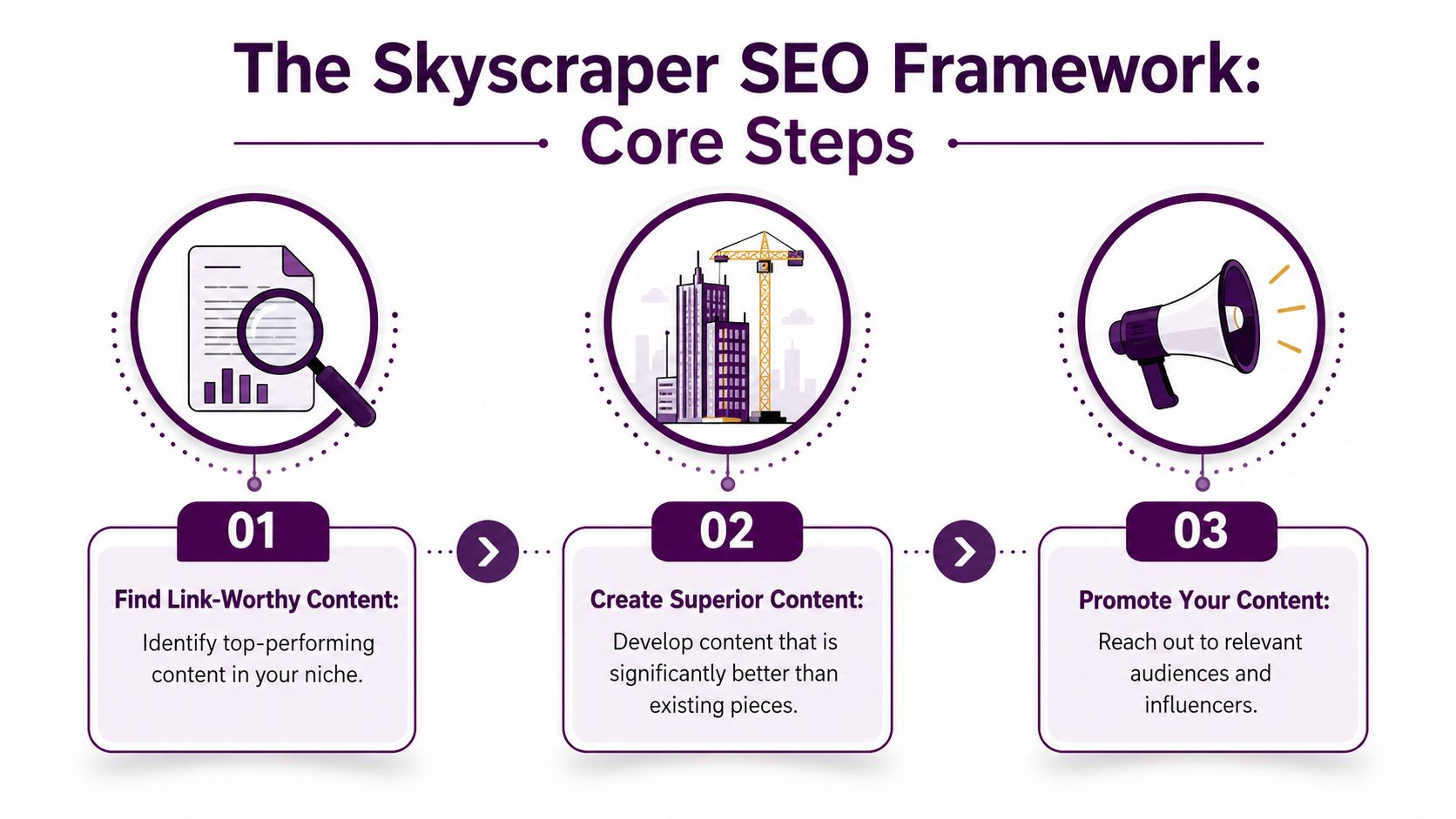
The skyscraper technique became popular in the mid-2010s as a simple three-step link-building workflow: identify pages with strong backlink profiles, create a substantially better version, and outreach to sites already linking to the original. Ahrefs makes the first step more concrete by recommending pages with at least 50 referring domains as a starting point for “skyscraper-worthy” content in its guide to the skyscraper technique.
Step one is proof of demand
You aren't brainstorming topics from scratch. You're looking for a page that already proved two things:
Other sites considered it worth linking to.
Searchers cared enough about the topic for it to gain visibility.
That first screen matters more than is generally assumed. Without link demand, you may build a great resource that nobody references. Without search demand, you may earn links to a page with limited long-term value.
Step two is replacement quality
The second step gets oversimplified all the time. “Create something better” doesn't mean adding fluff or inflating the word count. It means building the page someone wishes existed when they found the original.
That can include:
Better coverage of missing subtopics
Cleaner structure for fast scanning
Stronger examples that make abstract advice usable
Updated framing that reflects the current SERP and buyer behavior
Practical rule: If a reader lands on your page and still needs another tab to finish the task, your asset probably isn't superior yet.
Step three is targeted promotion
The outreach step works because you're not pitching random publishers. You're contacting pages that already linked to a related resource. That's a relevance signal built into the process.
Still, not every linker is worth contacting. A page with thousands of low-intent mentions from scraped lists, dead resource pages, or junk directories isn't a good prospect pool. Precision beats volume here.
The framework in one view
Step | What you do | What you're validating |
|---|---|---|
Find | Locate a page with strong referring domains | Link-worthiness and demand |
Build | Create a meaningfully stronger asset | Replacement potential |
Promote | Reach out to relevant linking pages | Likelihood of link adoption |
That's the whole model. Simple on paper. Much harder in practice, because each step depends on judgment, not just exports and filters.
How to Pinpoint Your First Skyscraper Opportunity
Most skyscraper campaigns fail before writing starts. The team chooses the wrong URL to attack. They pick a page because it ranks, or because it looks beatable, but they skip the checks that tell you whether the topic is worth the effort.
The highest-probability path is to start from the SERP or a competitor's top pages, filter by backlinks or referring domains and organic traffic, and then build your outreach list from the exact pages linking to the competitor rather than emailing whole domains. Operational guidance also warns against weak-demand topics, thin “just longer” content, and neglected refresh cycles, while recommending updates every 6 to 12 months to keep skyscraper assets competitive in this practical workflow for the SEO skyscraper technique.

Start with pages, not domains
Junior SEOs often export a competitor's whole backlink profile and call it research. That's too noisy. You want specific pages that combine visibility and link demand.
A practical discovery workflow looks like this:
Pull a competitor's top-performing content.
Filter for URLs with meaningful referring domains and real organic presence.
Open the page and inspect it manually.
Ask whether the page still deserves its links.
Good targets often show one or more weaknesses:
Stale framing that ignores current search intent
Weak UX such as cluttered layout or poor mobile readability
Thin utility with no examples, templates, or actionable depth
Missed subtopics that appear repeatedly across competing pages
What to look for in the SERP
The SERP tells you whether a skyscraper campaign has room to work. If the top results are all current, well-designed, and highly useful, the gap may be too small. If several ranking pages feel dated or incomplete, the opening is clearer.
Use a quick audit grid:
Signal | Why it matters | What to do |
|---|---|---|
Strong backlinks | Confirms publishers link to this topic | Keep investigating |
Consistent organic visibility | Suggests durable demand | Prioritize |
Outdated page | Creates a freshness angle | Mark as opportunity |
Weak experience | Creates a UX angle | Add to content brief |
This is also where content gap work improves your hit rate. If you want a more systematic way to identify missing subtopics before drafting, the 2026 guide to SEO content gap analysis is a useful companion process.
Build a shortlist, not a single bet
Don't lock onto one target too early. Build a short pipeline and compare opportunities against each other.
I usually evaluate candidates on three questions:
Does the topic have staying power? Avoid fads unless there's a specific strategic reason to chase them.
Can we create a page that's obviously better? If the answer is “maybe slightly,” skip it.
Will the link pool contain real editorial prospects? Forums, low-value directories, and junk pages inflate counts without improving outcomes.
A page with a smaller but cleaner opportunity set often beats a flashy target with a bloated backlink profile.
The manual trap
Classic skyscraper research used to mean jumping between rank trackers, backlink tools, spreadsheets, and outreach tabs. That still works, but it's slow and easy to mess up. Teams lose momentum because each handoff creates another opportunity for bad filtering.
The better habit is to treat opportunity discovery like a repeatable triage process. Pull candidates, inspect page-level signals, score replacement potential, and only then move one into production.
That discipline saves far more time than trying to salvage a weak target after content is already in draft.
Creating Content That's Genuinely Superior
The upside of skyscraper technique SEO appears when the content gap is real and the outreach list is strong. In Backlinko's original case study, the campaign reported +110% traffic, and the outreach process started with 160 high-quality referring pages after prospect cleanup, as described in Backlinko's skyscraper technique case study and guide. That result is useful for one reason. It shows the method can work at a high level when the asset is materially better and the promotion is selective.

The wrong takeaway is “write a longer article.” The right takeaway is “build the page publishers and searchers would rather reference.”
Better content has multiple edges
A superior skyscraper page usually wins on several dimensions at the same time. If you only improve one, the replacement case is weak.
Consider this comparison:
Area | Marginal upgrade | Real upgrade |
|---|---|---|
Freshness | New intro | Updated framing, examples, and references |
Depth | More headings | Better coverage of missing questions |
Design | Prettier banner | Easier reading and navigation |
Utility | Generic advice | Assets people can apply immediately |
Content teams need a stronger brief. “Make it better” isn't a brief. A useful brief names the exact weaknesses in the target page and the exact improvements your version must deliver.
Audit the target before you write
Use the existing page as raw material for a gap analysis.
Check for:
Missing subtopics that appear on competing pages but not the target
Weak examples that explain concepts without showing execution
Poor readability caused by giant paragraphs, vague headings, or no visual breaks
No original utility such as templates, comparisons, workflows, or decision criteria
If you need a more structured optimization framework once the draft is underway, the content optimization resources from Keyword Kick are a useful reference point for turning a decent draft into a stronger search asset.
“Superior” means a reader can complete the task faster, with fewer questions, and with more confidence.
Build for the linker and the reader
A lot of teams optimize only for the reader, then wonder why outreach underperforms. Others optimize only for linkability, then publish pages that rank poorly because they don't satisfy intent. Strong skyscraper assets do both.
That usually means including elements such as:
Clear framing early so visitors know they're on the right page
Scan-friendly structure for editors evaluating whether to cite you
Practical examples that make your page easier to reference
Maintenance readiness so the asset can be refreshed without a full rewrite
What doesn't count as better
Some upgrades feel productive but don't move the page forward:
Rewriting the competitor's structure with similar points.
Adding generic FAQs no one asked.
Padding the article to hit an arbitrary word count.
Using stock visuals that don't clarify anything.
Those moves create more content, not a stronger asset.
The best skyscraper pages feel inevitable. Once published, they make the old result seem incomplete.
Mastering Promotion and Precision Outreach
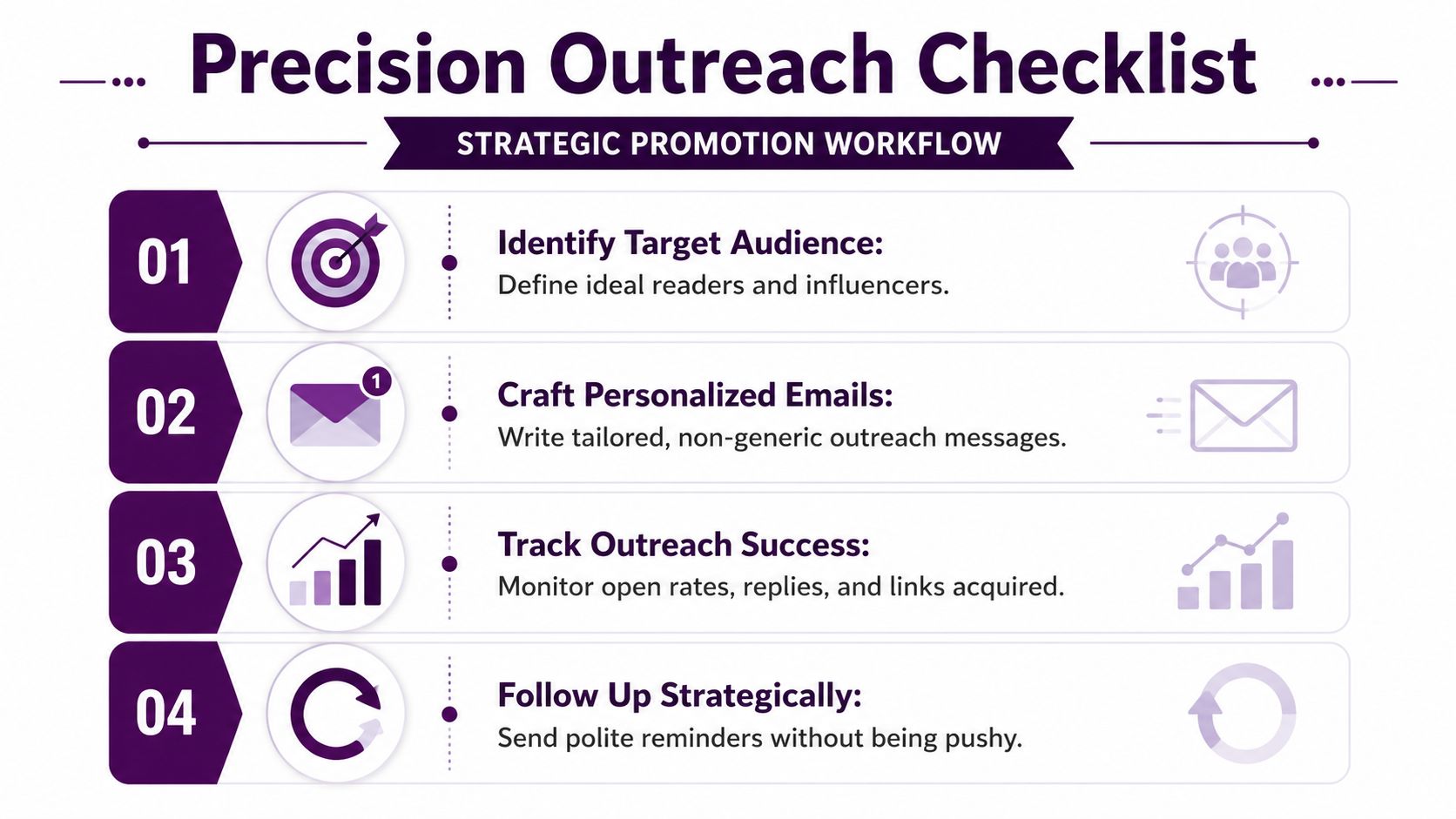
Most outreach problems start with list quality. Teams pull a huge backlink export, blast everyone with the same message, and call the low reply rate a deliverability issue. Usually it isn't. The list was bad, the pitch was lazy, or both.
Precision outreach works better because it respects context. You're not contacting every site in a domain-level export. You're identifying pages that linked to a related resource and deciding whether your replacement gives that editor a good reason to update, add, or swap a citation.
Clean the prospect list first
This is the least glamorous step and one of the most important. A raw export often includes:
Forums that won't update references
Directories with little editorial value
Scraped pages that copied the original link
Dead resource lists no one maintains
Trim those before outreach starts. You want editors, site owners, resource curators, and writers with a real chance of revising a page.
A practical review process is simple:
Prospect type | Keep or cut | Reason |
|---|---|---|
Editorial article | Keep | Real contextual linking opportunity |
Maintained resource page | Keep | High replacement potential |
Forum thread | Cut | Low control and weak editorial value |
Low-quality directory | Cut | Minimal strategic value |
Write for relevance, not cleverness
Most outreach emails fail because they sound like outreach emails. They open with flattery, hide the ask, and never explain why the recipient should care.
A better pitch has three parts:
A specific reference to the page you checked.
A short explanation of what your resource adds.
A direct, low-pressure ask.
Example structure:
Saw your page linking to a resource on [topic]. We recently published an updated version that goes deeper on [specific gap], includes [specific utility], and may be useful if you refresh that section. If it's helpful, happy to send the link.
That works because it's about their page, not your campaign.
Prioritize outreach in waves
Don't send every email at once. Work in batches based on relevance and editorial fit. Start with the strongest prospects first. Those are usually the pages where your improvement is easiest to understand.
Good first-wave prospects include:
Pages discussing the exact subtopic your asset improves
Roundups and resource lists that regularly update links
Articles where the existing linked page is clearly outdated
Publishers whose audience closely matches your page's intent
For broader context on how this fits into a wider off-page strategy, the Keyword Kick guide to link-building strategies is a solid supporting resource.
Outreach rule: If your email would still make sense without mentioning the recipient's page, it isn't personalized enough.
Follow up without sounding automated
A single follow-up is often reasonable when the fit is strong. Keep it short. Reference the earlier message, restate the relevance, and move on if there's no response.
What you shouldn't do:
Send multiple nudges in a short span
Pretend there's urgency when there isn't
Ask for a link before proving value
Pitch a page that only marginally improves on the original
Good outreach feels editorial. Bad outreach feels transactional.
Scaling Your Efforts and Measuring Real Impact
A skyscraper campaign becomes useful when it stops being a one-off experiment and turns into an operating model. That means measuring outcomes after launch, reviewing what changed, and feeding those lessons into the next cycle.
The clearest signals to watch are straightforward:
New referring domains to the target page
Keyword movement for the page's core search intent
Organic traffic trends tied to the asset
Engagement and conversion behavior if the page serves a business goal
What success looks like in practice
Don't judge the campaign only by published content or sent emails. Judge it by whether the page earned stronger visibility and real editorial links over time.
A useful post-campaign review asks:
Question | Why it matters |
|---|---|
Did the page attract relevant new links? | Validates the outreach and asset quality |
Did rankings improve for the target topic? | Confirms search usefulness |
Did the page hold up after publication? | Reveals whether refreshes are needed |
Should this topic become a repeatable template? | Helps scale the method |
The common failure patterns
Most weak campaigns fall into a few buckets:
They target a fad topic. Interest fades before the asset compounds.
They make only marginal improvements. Outreach has no convincing story.
They run inconsistent promotion. A great page doesn't earn links by itself.
They skip maintenance. The page loses its edge as the SERP evolves.
Teams working across startup content programs often pair skyscraper campaigns with broader startup growth tactics so linkable assets support larger acquisition goals instead of sitting in an SEO silo.
The payoff comes from repetition. Build a shortlist process. Create better briefs. Tighten outreach standards. Review results. Refresh pages that deserve another push. That's how skyscraper technique SEO becomes scalable instead of nostalgic.
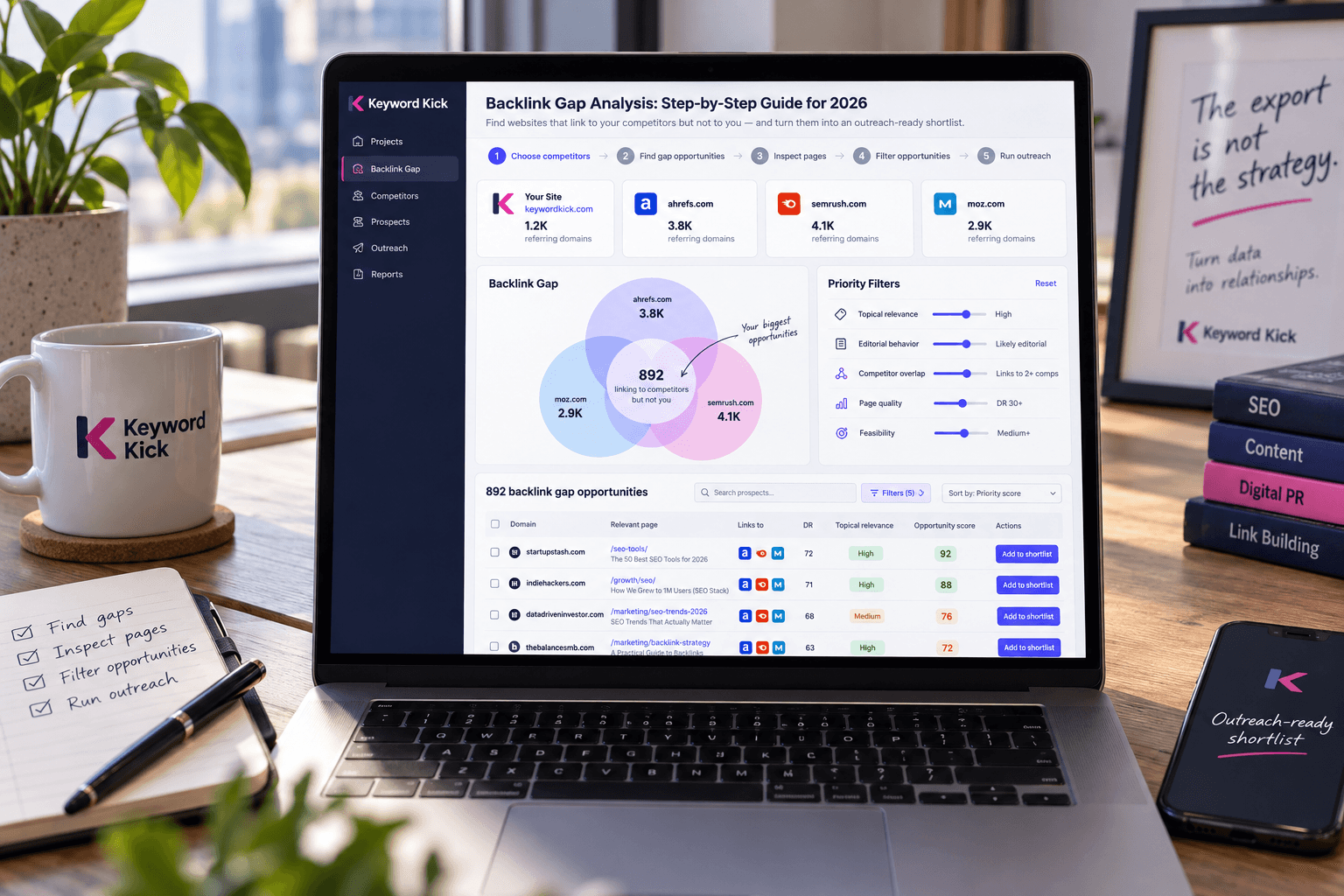
Keyword Kick helps teams run this workflow with less fragmentation. Instead of piecing together ranking data, backlinks, GA4, GSC, and technical signals across separate tools, Keyword Kick brings them into one workspace and uses its K² AI Agent to turn the data into clear next actions. If you're building a repeatable skyscraper process, it's a practical way to spot opportunities faster, prioritize the right pages, and track what moves visibility.