You've got a spreadsheet called “Q1 Blog Calendar” packed with headlines, owners, and publish dates. It looks organized until someone asks which page owns a query, where the reader should go next, or whether a new article overlaps with something already live. Then the team starts opening briefs one by one, while similar pages compete for the same search demand and useful content sits without internal links.
A calendar tells you when content ships. A working content map tells you why each URL exists, who it serves, what intent it targets, how it connects to surrounding pages, and what success looks like. That difference matters when you're trying to turn scattered publishing into a search system.
When a Content Calendar Stops Being Enough
An SEO lead can spot the problem before the traffic report confirms it. Three articles target variations of “best CRM software,” yet none has a defined page owner. A recent guide earns impressions without internal links pointing to it. The calendar records an author and deadline, but it does not show whether the reader is researching a problem, comparing vendors, or ready to sign up.
A publication calendar manages production logistics. A working content map connects topics, formats, buyer stages, search intent, and internal architecture so each URL has a job. It also records where links should point, which funnel stage the page serves, and whether the format can answer the query clearly for AI search. Without those relationships, publishing becomes a sequence of isolated bets.
Practical rule: If an editor cannot identify the page's dominant intent, funnel stage, and next internal-link destination from the row itself, the map is not ready for production.
The problem often starts when teams commission new content before auditing existing pages. An unmapped library can hide rankings, backlinks, conversions, and historical relevance. It can also produce overlapping URLs, diluted intent targeting, and orphaned pages.
Start with an audit. Then define core themes, group keywords by intent, assign funnel stages, and set internal-link directions. Add an AI-search readiness field for answer structure, supporting evidence, and entities that need clear coverage. Review the map on a 90-day cadence, using ranking movement, organic clicks, conversions, internal-link coverage, and page-level engagement to decide what to refresh. This workflow supports page-level clusters, as described in SEO Clarity's content mapping guidance.
Visual planning still helps teams explain a journey or campaign structure. They can plan visuals with starryai, but the visual should support the operational map, not replace it. A polished diagram is useful only when the row also tells the writer, editor, and analyst what to do next.
What a Content Map Is
A content map is an execution-ready spreadsheet or database where each row represents one URL or planned asset. It connects keyword research, audience needs, funnel position, production requirements, internal linking, and measurement in one working document.
A basic URL list may show a title, author, status, and publication date. That supports calendar coordination, yet it leaves editors without enough information to prevent cannibalization or brief a page correctly. A stronger row includes these fields:
Target keyword: The primary query the URL is designed to serve.
Secondary keywords: Related terms that strengthen the same page instead of creating competing URLs.
Search intent: Informational, commercial, transactional, or navigational.
Funnel stage: TOFU, MOFU, or BOFU, based on the reader's position in the buying journey.
Persona: The audience segment, role, use case, or problem being addressed.
Content type: Guide, comparison, product page, glossary entry, calculator, review, or another suitable format.
Word count target: A planning guardrail informed by the topic and competing pages, rather than a rigid publishing rule.
Internal link targets: Pages this asset should strengthen.
Internal link sources: Existing pages that should link into the asset.
On-page goal: Rank, capture a lead, support a parent page, answer a question, or move a reader toward a commercial action.
AI-search readiness: Entity coverage, answer-first sections, FAQs, citations, and extractable tables or media.
Assign each asset one dominant intent. A page may serve several audiences, but one primary search job keeps the brief focused and gives post-launch evaluation a clear standard.
Standard Calendar Column | Content Map Addition |
|---|---|
Working title | Primary keyword and page purpose |
Author | Owner, reviewer, and subject-matter input |
Publish date | Cluster position and publishing order |
Content status | Refresh, merge, create, or retire decision |
Content format | Format matched to search intent |
Notes | Funnel stage, persona, CTA, and AI-search fields |
URL | Canonical owner page and link direction |
The map functions as the single source of truth across research, briefs, writing, linking, publishing, and review. It also records the decisions a visual calendar usually hides: which URL owns an intent, where internal authority should flow, what an AI system can extract, and when the page needs another review.
A useful workflow moves from keyword research and intent grouping to pillar pages, cluster pages, and supporting articles. Recurring gap analysis then identifies missing subtopics, while a 90-day refresh cadence creates a defined point for reviewing rankings, organic clicks, conversions, internal-link coverage, and page-level engagement. The process is outlined in IntelliMinds' SEO content mapping workflow.
The Two Axes That Make a Map Useful
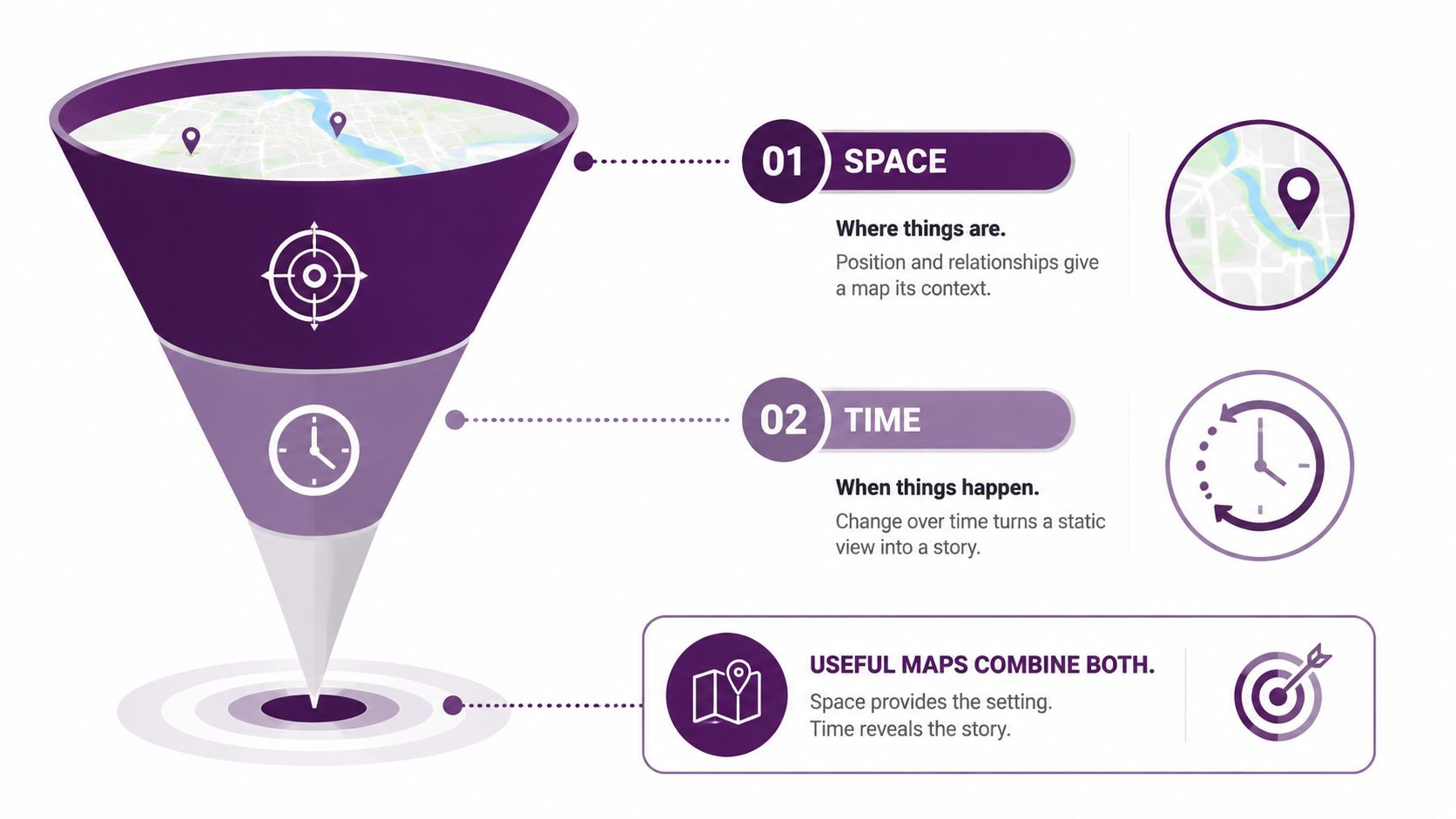
A content map becomes operational when every asset has a defined search intent and funnel stage. Topic and persona still belong in the brief, but these two fields determine the page format, internal-link direction, CTA, and review criteria.
Search intent describes the visitor's immediate job:
Informational: Learn through a guide, how-to, or glossary entry.
Commercial: Compare options through a review, comparison post, or best-of list.
Transactional: Take action through a product page, pricing page, calculator, or signup flow.
Navigational: Reach a known brand, hub, or login destination.
Funnel stage adds the reader's decision position:
TOFU: Becoming aware of a problem or category.
MOFU: Evaluating approaches, vendors, or solutions.
BOFU: Close to a decision and looking for proof, fit, or a clear next step.
Record the axes separately. “Commercial MOFU” gives an editor a usable production brief. It points toward an evaluation format, links to relevant alternatives or proof, and a CTA that helps the reader assess options. A page can serve several audiences, but one dominant intent keeps its purpose clear and gives post-launch analysis a consistent standard.
A working intent and funnel matrix
Search intent | TOFU | MOFU | BOFU |
|---|---|---|---|
Informational | Beginner guide or glossary entry, measured by qualified discovery | Educational comparison guide, measured by engaged progression | Implementation or objection guide, measured by assisted conversion |
Commercial | Category explainer or introductory alternatives page | Comparison post, review, or buyer's guide | Product comparison, proof page, or sales-support asset |
Transactional | Calculator or low-friction interactive tool for a curious visitor | Demo explainer or solution-fit page | Pricing, signup, or product page |
Navigational | Branded resource hub | Brand or solution directory | Login, contact, or direct conversion destination |
The matrix catches briefs that a calendar hides. An informational MOFU page needs explanation and links to competing approaches. A transactional TOFU calculator should reduce friction and capture a lightweight conversion event. Shared subject matter does not make these pages interchangeable.
The map should also record each URL's job: ranking for a target query, supporting a pillar, directing internal authority, or converting an existing visitor. Add funnel stage, CTA, link direction, and AI-search readiness to the working fields, then review rankings, organic clicks, conversions, engagement, and internal-link coverage on a 90-day refresh cycle. A traffic-only goal produces weak CTAs and unfocused performance reviews.
How to Build Your First Content Map
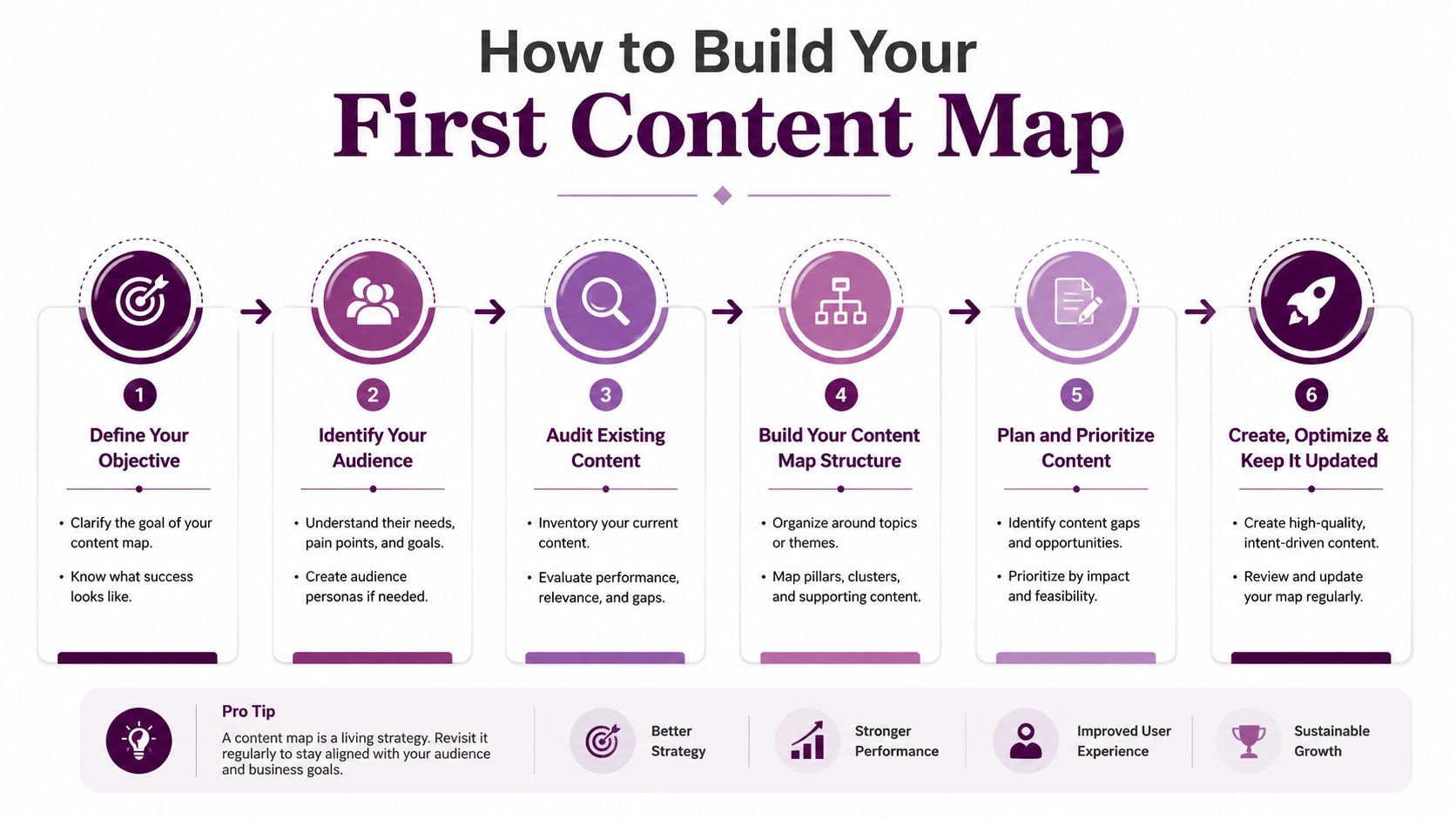
Start with the site you have, not the content you wish you had. A practical content map follows a four-step operating model: audit existing assets, overlay personas and journey stages, identify breaks, and research the missing topics, as explained in Frase's analysis of content maps and AI visibility.
Move one, audit every existing asset
Export indexed URLs from Google Search Console and your CMS. Add the page's primary query, clicks, impressions, conversions, last update date, current owner, and existing internal links. The point isn't to produce a perfect dataset on the first pass. It's to find pages that already matter, pages that overlap, and pages nobody owns.
Flag pages with strong visibility but weak conversion paths. Mark outdated pages for refresh, near-duplicates for consolidation, and URLs with no meaningful internal links as orphan risks. Do not delete a page solely because it underperforms. First check whether it has a distinct intent, useful backlinks, or a role in a cluster.
Move two, classify keywords by intent and stage
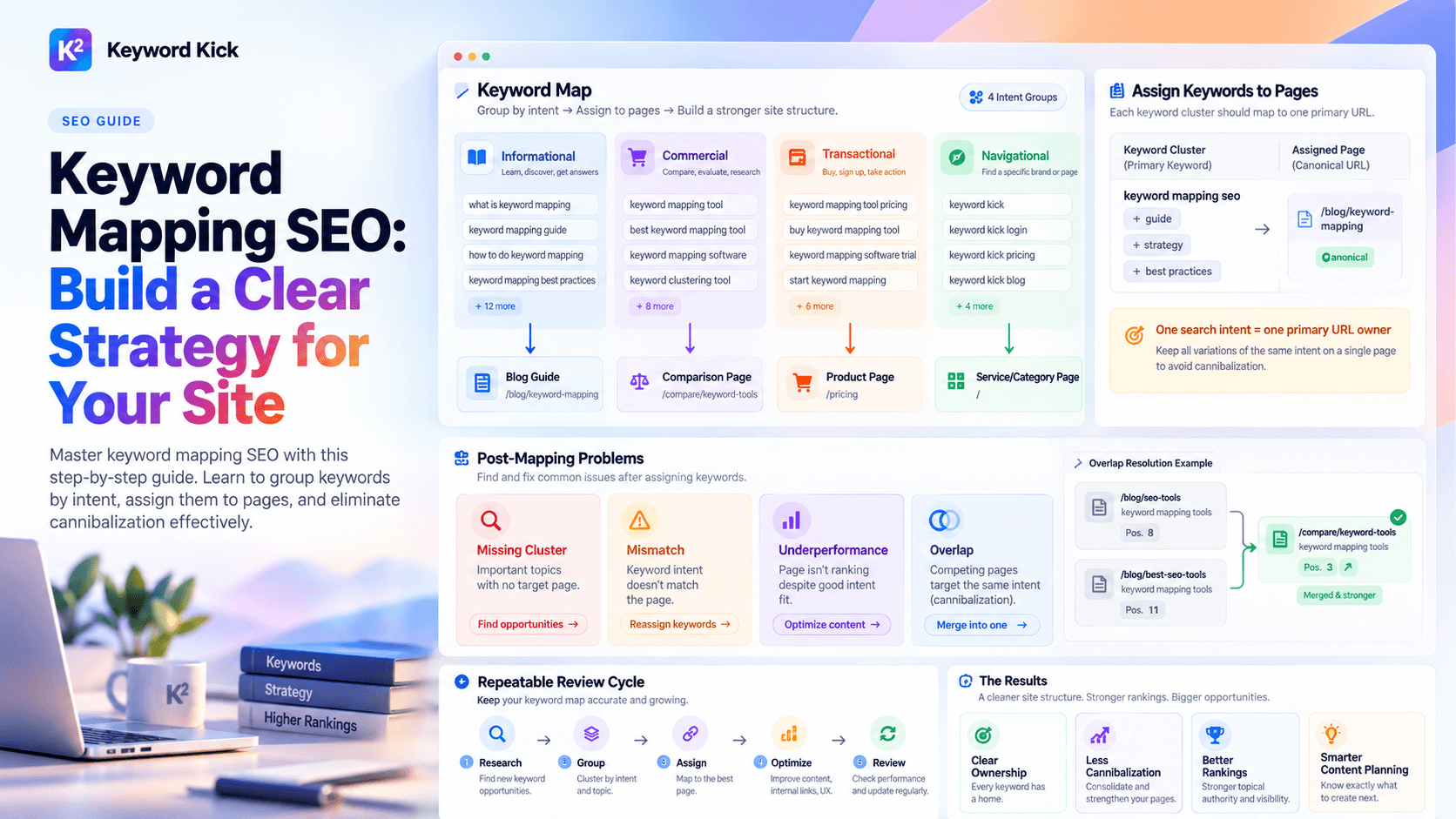
Group the remaining keyword set into informational, commercial, transactional, and navigational buckets. Then assign TOFU, MOFU, or BOFU based on the reader's likely decision state.
Use the SERP to validate the classification. If search results consistently favor product pages, a broad educational article probably won't satisfy the dominant intent. If the results mix formats, record the uncertainty and test one clear page purpose rather than forcing several intents into one URL.
For broader optimization context, Keyword Kick's content optimization resource can sit alongside your keyword research and on-page review process.
Move three, assign the cluster architecture
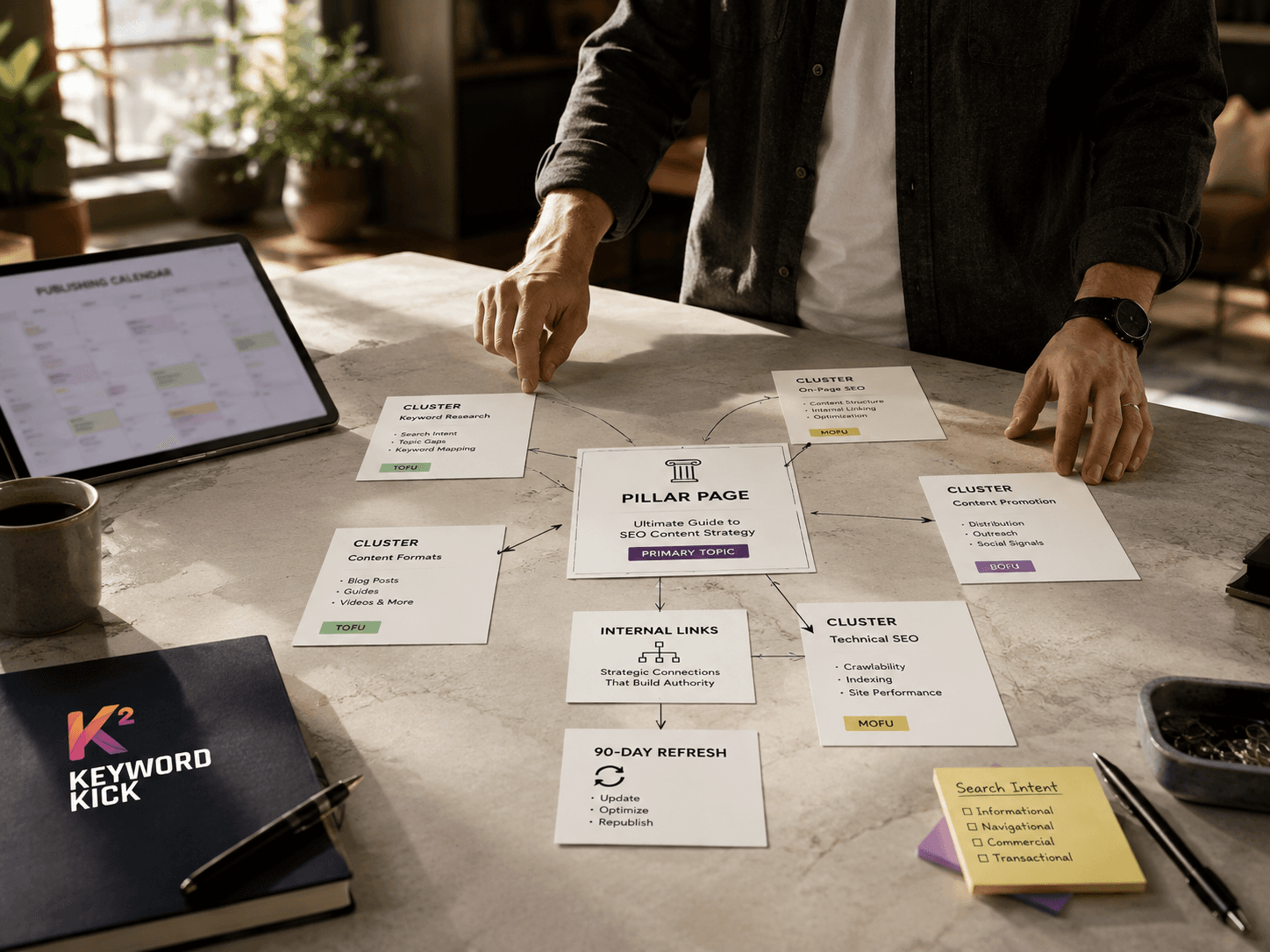
Choose one canonical pillar page for each major theme. Assign supporting pages beneath it, then give every row a working title, target keyword, secondary keywords, content type, word count target, owner, and CTA.
The pillar should provide the broadest useful explanation and link to focused spokes. A supporting page should answer a narrower question and link back to its pillar where that relationship helps the reader. Don't create spokes merely to fill a quota. Each one needs a distinct search need that the pillar can't satisfy fully.
Move four, lock link direction before publishing
Record both sides of the relationship:
Upward link: Supporting page to canonical pillar.
Sideways link: One relevant spoke to another related spoke.
Inbound source: Existing pages that should link to the new URL.
Destination rationale: The reader problem solved by the target page.
Finish with a QA pass. Flag orphans, merge duplicate intent, confirm one canonical owner per topic, check that each planned URL has an owner, and connect the final map to the content brief. A map that isn't used during writing becomes a planning artifact instead of an execution system.
Two Content Map Examples Compared
A flat archive can look productive while making every important decision harder. Take one niche targeting “content map example.” The first setup contains 30 standalone posts, with only title, date, and author recorded. Three near-duplicate URLs target the phrase, no page owns the main intent, and links between related articles are inconsistent.
Editors cannot tell which URL deserves an update, which page should answer the core query, or what readers should open next. Search engines face the same ambiguity. The pages compete for relevance instead of building a clear topic structure.
The second setup gives “content map example” to one supporting page under a broader pillar. Four neighboring spokes address related search needs. Each row also records search intent, funnel stage, target word count, internal-link source, destination, owner, CTA, and AI-search readiness. The pillar points to its spokes, the example page links back to the pillar, and relevant spokes exchange contextual links where the reader benefits.
That structure still cannot guarantee rankings. It does reduce duplicate intent, clarify page roles, and give the team a repeatable publishing and optimization path. Complete the core pillar before expanding the cluster, then review gaps and declining pages on a recurring 90-day cycle. Track organic clicks, impressions, ranking queries, assisted conversions, and internal-link engagement after publication so the map supports decisions rather than merely documenting them.
Field | Flat Blog Archive | Hub-and-Spoke Map |
|---|---|---|
Topic ownership | Several overlapping URLs | One canonical owner per intent |
Primary structure | Publication sequence | Pillar, spokes, and link direction |
Keyword field | Often absent or broad | Primary and secondary keywords |
Search intent | Usually omitted | Informational, commercial, navigational, or transactional |
Funnel data | Not recorded | TOFU, MOFU, or BOFU |
Internal links | Added inconsistently | Sources and destinations assigned |
Page goal | Usually “publish” | Rank, support, capture, or convert |
AI-search readiness | Not assessed | Extractable answers, entities, and citation needs recorded |
Maintenance | Reactive | Scheduled refresh and merge decisions |
Accountability | Author-focused | Owner assigned to every row |
A useful side-by-side template should show the flat archive as a diagnostic, then present the hub-and-spoke version as the production sheet. Keep the fields visible so an editor can understand a page's role without opening another document.
Audit the existing library before commissioning more articles. This SEO content audit guide can help identify pages to refresh, merge, or connect.
Adapting the Map for AI Search in 2026
A page can rank well yet remain invisible when an AI system answers the query without sending a click. Classic maps focus on URLs, keywords, and organic positions. A production map for AI search also records the entities, questions, evidence, and relationships that make a page easy to interpret and cite.
Add entity coherence, micro-intent, citation, and extractability fields to every relevant row. Record the primary entity, supporting entities, and the structured data type that fits the asset, such as Organization, Product, HowTo, or FAQ. Break broad keywords into the exact questions a buyer, customer, or researcher might ask aloud.
Useful fields include:
Micro-intent prompt: The specific question the page answers.
Answer-first subheading: A concise response placed before detailed explanation.
Source citations: Verifiable references supporting factual statements.
Quotable evidence: Carefully sourced facts that retain their context when extracted.
Embed-ready media: Tables, charts, or video timestamps that present information clearly.
Freshness score: A review field showing whether claims need validation.
Entity relationships: Products, problems, categories, integrations, and organizations connected on the page.
Internal-link direction: The pillar or supporting page this URL should strengthen, and the relevant destination pages.
AI-search readiness: Whether the page has direct answers, clear entities, useful evidence, and citation-worthy sections.
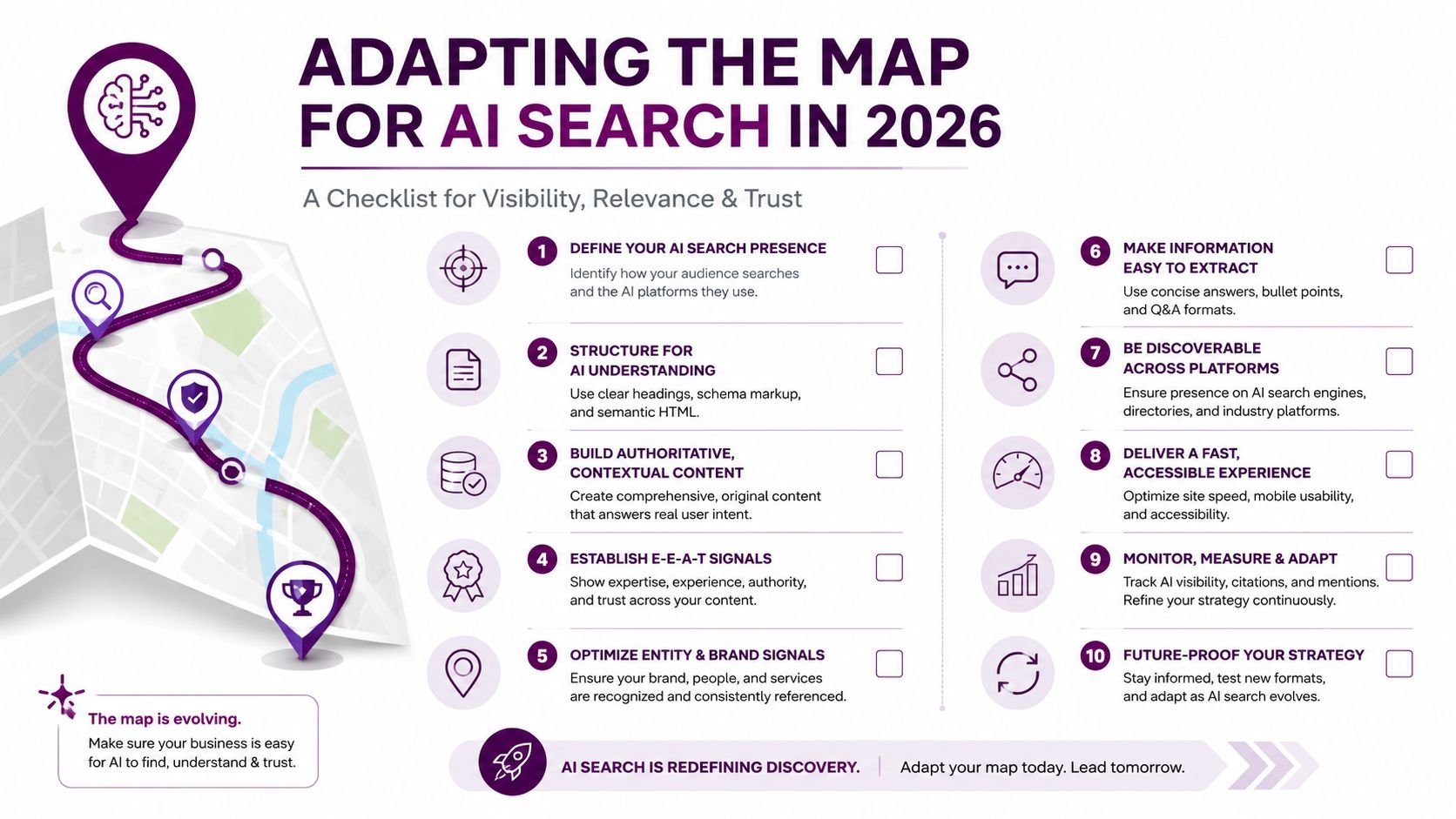
Recent 2026 coverage emphasizes intent mapping, entity coherence, micro-intents, and tightly connected content clusters. It also separates classic Search Console visibility from LLM visibility and supports hub-and-spoke structures over breadth-heavy archives. The Digital Elevator's content marketing trends analysis recommends recording the canonical owner, supporting cluster pages, internal-link direction, and AI-search readiness in modern maps: The Digital Elevator's content marketing trends analysis.
For B2B teams, Big Moves Marketing on Google AI Overviews offers broader context on how AI Overviews affect discovery and the buyer journey.
AI readiness does not justify thin copy. Keep a clear opening, useful detail, readable formatting, and a human path toward the next action. Extractable answers should support the page, not replace evidence, judgment, or conversion intent.
Publishing Order and Metrics That Prove It Works
Publishing order should reflect the map's architecture. Release the pillar first, then complete its supporting cluster before filling the calendar with unrelated topics. A practical cadence is one supporting page every 7 to 10 days. Each article should link contextually to the pillar and to a relevant sibling, creating deliberate paths for users and crawlers.
Set a 90-day refresh cycle. Re-score every row for intent match, SERP drift, internal-link coverage, freshness, and AI-search inclusion. The review should result in a clear action: update, merge, expand, retarget, or retire the page.
Track these signals consistently:
KPI | What to Measure | Source | Review Threshold |
|---|---|---|---|
Indexed URL count | Planned URLs that search engines have indexed | Google Search Console and CMS | Investigate missing URLs before commissioning more content |
Clicks per query cluster | Organic clicks grouped by mapped pillar and spokes | Google Search Console | Review clusters with weak or declining demand capture |
Average position for primary keyword | Ranking movement for each canonical target | Rank tracker and Search Console | Flag pages below position 15 after 60 days |
Internal link coverage ratio | Mapped pages receiving planned contextual links | Crawl tool and content map | Flag orphaned pages or incomplete link paths |
Assisted conversions | Conversions involving mapped pages before conversion | Analytics and CRM | Review pages that attract qualified visits but lack a suitable CTA |
Flag a cluster when fewer than 60% of its supporting URLs are live. The architecture may be too incomplete to judge. Flag a page below position 15 after 60 days for diagnosis, not an automatic rewrite. Check intent, competition, internal links, indexing, content quality, and entity coverage before changing its target.
Use this practical guide to measuring SEO performance to connect reporting with business outcomes, including conversions and qualified demand, rather than rankings alone.
A working map changes team decisions. Writers use it to keep pages focused, editors use it to prevent overlap, developers use it to support site architecture, and analysts use it to choose the next update or publication.
Keyword Kick connects Search Console, analytics, rankings, backlinks, content gaps, and technical SEO signals in one workspace. Agencies, in-house teams, and content marketers can use it to assign owners, monitor link paths, and prioritize refresh decisions through a monitored SEO workflow. Visit Keyword Kick to apply the map to ongoing optimization.