Your store probably has this problem right now. Paid campaigns are doing the heavy lifting, product pages exist but don't rank well, and every SEO task feels urgent. One person wants more blog content. Another wants schema. Your developer is stuck fixing crawl issues. Your merchandiser wants better category copy. Nobody is sure what moves revenue first.
That's where most ecommerce SEO programs stall. Not because teams lack ideas, but because they lack a decision system.
Good ecommerce SEO marketing isn't a pile of disconnected tasks. It's a prioritization discipline. You need to know which pages deserve attention first, which technical problems are suppressing visibility, and which content updates are most likely to turn search demand into orders.
What Is Ecommerce SEO Marketing and Why It Matters
Ecommerce SEO marketing is the work of making your store more visible in search at the exact moment buyers are comparing options, checking specs, and deciding where to purchase. That sounds simple, but the important part is intent. Organic search visitors often arrive with a product, category, or use case already in mind.
For online stores, that matters because SEO isn't just a top-of-funnel channel. Recent industry data reports that 23.6% of ecommerce orders come from organic search traffic, and the average conversion rate for SEO traffic on ecommerce sites is 1.6%, compared with 1.3% from PPC advertising, according to Seoprofy's ecommerce marketing statistics roundup.
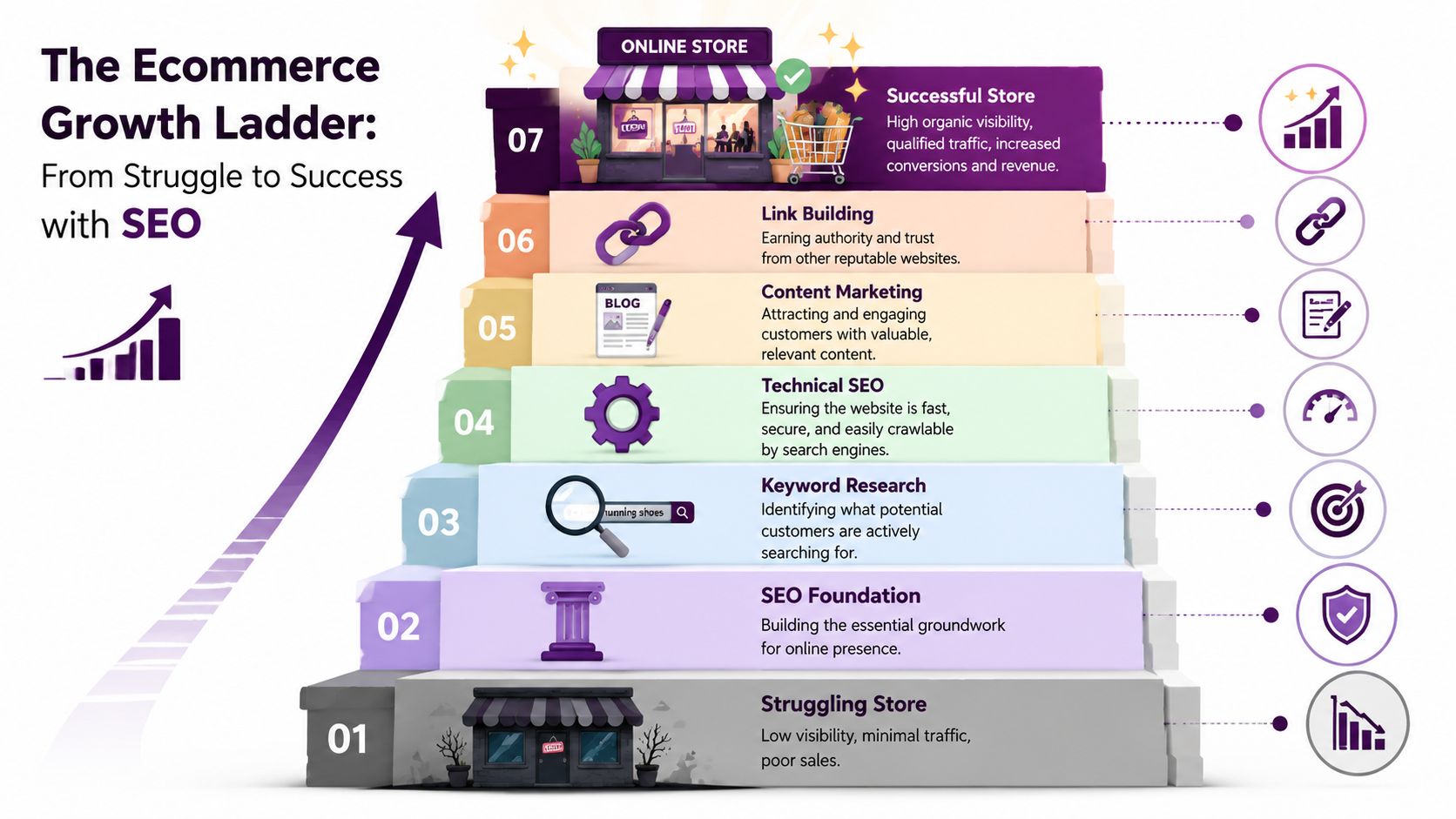
That's the commercial case. The operational case is just as strong. SEO keeps working across thousands of products and categories once the system is built properly. Paid media is like renting shelf space. SEO is building your own storefront on the main road.
The three pillars that actually matter
Ecommerce SEO is often overcomplicated. In practice, it comes down to three pillars:
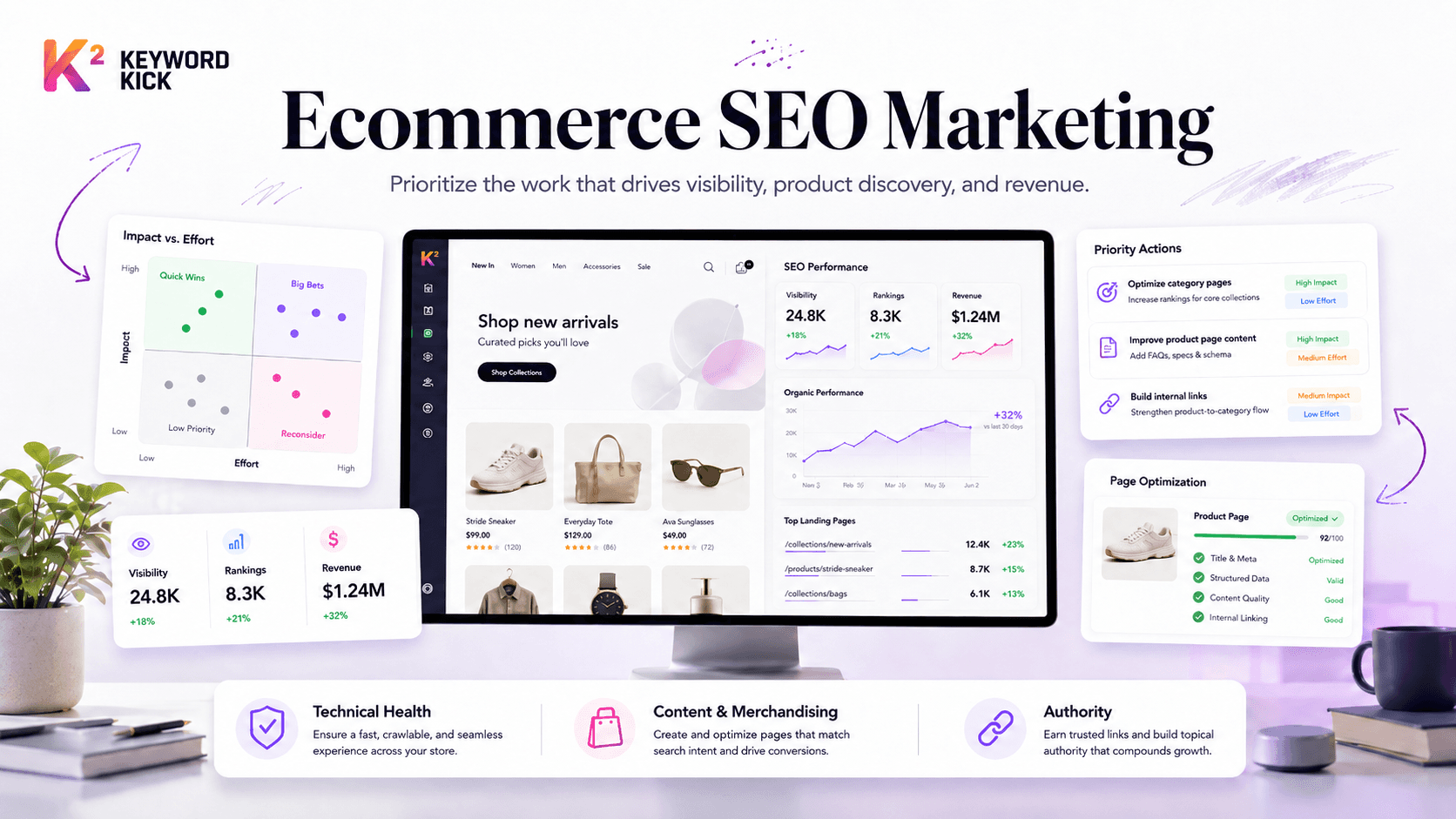
Technical health. Can search engines crawl, render, index, and understand the pages you want to rank?
Content and merchandising. Do category and product pages answer buyer questions well enough to win the click and the sale?
Authority. Does your store earn enough trust, relevance, and link equity to compete in the search results?
If one pillar is weak, the rest underperform. A beautifully written product page won't matter if Google can't crawl it efficiently. Strong backlinks won't save a category page that says almost nothing useful. Fast pages alone won't produce orders if the product content feels interchangeable with every marketplace listing.
Visibility is broader than rankings
Rankings still matter, but they aren't the whole picture anymore. What matters is how often your store appears across the search journey, for which queries, and with what presentation.
That's why teams should understand what is SERP tracking before they make SEO decisions. It helps you monitor not just blue-link positions, but how your products and categories show up across changing search result layouts.
Practical rule: If an SEO task can't be tied to better discovery, better product-page experience, or better conversion from organic traffic, it probably doesn't belong at the top of your list.
A useful mental model is this: technical SEO gets your store into the building, content gets you onto the shelf, and merchandising gets the product into the cart.
Fixing Your Technical Foundation for Maximum Visibility
An ecommerce site with weak technical SEO is like a warehouse with bad aisle labels, locked doors, and duplicate inventory scattered across side rooms. Search engines can still enter, but they waste time, miss key products, and index pages that shouldn't exist.
That waste is expensive. Not always in cash, but in lost visibility.
Start with crawlability and mobile usability
On large catalogs, the first job is reducing friction for search crawlers. That means checking whether key category and product pages are accessible through clean internal links, whether important pages are indexable, and whether duplicate or parameter-heavy URLs are competing with the pages you want ranked.
Mobile experience is part of that foundation, not a separate project. Search behavior is mobile-heavy, and ecommerce teams need to understand how Google evaluates the mobile version of their stores. If your team needs a practical refresher, this guide to understanding mobile first indexing is worth reviewing.
Page experience also affects whether your store feels usable enough to convert the traffic you earn. Consequently, Core Web Vitals becomes less of a developer-only metric and more of a revenue issue. A good primer is this explanation of Core Web Vitals for SEOs in 2026.
The faceted navigation problem
At this point, many stores create their own SEO ceiling.
Existing articles mention technical basics, but often stop short of explaining how merchants should decide which filters should be indexable versus noindexed, and how to measure whether faceted pages are creating value or index bloat. This is a major issue, as the common advice to create SEO-friendly filter URLs can backfire by generating massive duplicate inventories and wasting crawl budget, as discussed by Underground Ecom.
A filtered URL should exist for SEO only if it serves distinct search demand and creates a page that is useful. “Black running shoes” might deserve an indexable landing page if your catalog depth supports it. “Black running shoes sorted by newest with size and brand combinations” usually does not.
What to fix first
When auditing a store, prioritize technical issues in this order:
Indexation mistakes. Important pages blocked, canonicalized away, or left orphaned.
Duplicate URL patterns. Facets, parameters, pagination variants, and session-driven duplicates.
Internal linking gaps. Products that rely on search or filters to be discovered.
Performance bottlenecks. Heavy templates, oversized scripts, and unstable mobile rendering.
Bad technical SEO doesn't always look like a crash. It often looks like a plateau.
The trade-off is simple. More crawlable URLs are not always better. More indexable URLs are often worse. Strong ecommerce SEO teams learn to say no to page creation that adds clutter without adding demand.
Optimizing Product and Category Pages That Convert
Many ecommerce teams still treat product and category pages as containers for inventory. That's a mistake. These are usually your highest-intent SEO assets, and they should be built like sales pages with search demand attached.
A major underserved angle in ecommerce SEO marketing is SEO for product-led conversion, not just rankings. A major opportunity is often not more traffic, but better merchandising of the traffic already arriving. This means prioritizing pages with commercial intent, using reviews and user-generated content to increase trust, and aligning content to buyer questions like sizing and compatibility rather than generic product keywords, as noted by Shawn the SEO Geek.
What strong product pages include
A product page has to do two jobs at once. It has to be understandable to search engines and persuasive to buyers.
The pages that usually perform best include:
Unique product copy that explains who the product is for, what problem it solves, and where it fits versus similar items
Structured specs that answer concrete pre-purchase questions
Reviews and user-generated content that reduce uncertainty
Trust signals such as shipping, returns, compatibility details, care instructions, or warranty information
Useful media that helps the buyer confirm the choice, not just admire the product
A thin manufacturer description rarely does enough. If the same wording appears on dozens of retailer sites, your page has no real search or conversion advantage.
Category pages need merchandising logic
A category page shouldn't be a product grid with a token paragraph at the bottom. It should help users narrow the field.
That means stronger intros, clearer subcategory links, filter logic that matches real shopping behavior, and content that addresses category-level intent. If someone lands on “men's waterproof hiking boots,” they may still need help understanding insulation, weight, ankle support, and terrain use.
For teams refining page copy, Keyword Kick's on-page SEO learning hub is a useful reference for the mechanics. The bigger issue, though, is commercial relevance.
A better way to prioritize pages
Don't spread optimization effort evenly across the catalog. Focus on pages that combine these three traits:
Page type | Why it matters | Common mistake |
|---|---|---|
Best-selling products | Demand and revenue already exist | Leaving generic manufacturer copy in place |
Core categories | They shape topic relevance and internal link flow | Publishing thin copy that doesn't help shoppers |
Comparison-heavy products | Buyers need reassurance and detail | Ignoring sizing, compatibility, and use-case questions |
A category page should feel like a knowledgeable store associate. It should narrow choices, not just display them.
If your organic traffic is decent but revenue from SEO feels underwhelming, product and category page quality is usually where the gap shows up first.
Designing a Scalable Site Architecture with Internal Links
Store architecture decides whether your catalog feels organized or buried. The easiest analogy is a supermarket. If the entrance, aisles, shelf labels, and signs all make sense, people find products quickly. If they don't, shoppers wander. Search crawlers do the same thing.
A scalable ecommerce structure usually follows a simple path: homepage to category, category to subcategory, subcategory to product. That pattern gives both users and search engines a clear map of how pages relate.
What the hierarchy needs to do
Search crawlers follow internal links to understand how pages relate, so linking from top-level categories to subcategories and products helps search engines classify products within a broader topical tree. Adding breadcrumb navigation and consistent, keyword-relevant URLs reinforces that hierarchy, which can reduce orphaned pages and improve indexation efficiency for large catalogs, according to Victorious.
That has three practical implications:
Keep important pages shallow. Your highest-value categories and products shouldn't be buried behind too many clicks.
Use breadcrumbs consistently. They reinforce page relationships and give users an easy route back up the hierarchy.
Link laterally where useful. Related products, adjacent subcategories, and buying guides can strengthen relevance and discovery.
Internal links are not decoration
A lot of stores treat internal links as optional UX extras. They're not. They're one of the main ways you tell search engines which pages matter and how topics connect.
Here's what tends to work:
Category to subcategory links that reflect real shopper paths
Subcategory to product links that don't depend only on JavaScript-heavy interactions
Related links between complementary products or collections
Editorial-to-commercial links from guides into category and product pages
What doesn't work is random cross-linking. If every page links everywhere, nothing is emphasized.
The architecture test
Ask three questions:
Can a new visitor understand the catalog path without using site search?
Can a crawler discover important products without relying on filters?
Can you tell, from the URL and breadcrumb alone, where a page sits in the catalog?
If the answer is no, your architecture is probably diluting both relevance and crawl efficiency.
Winning Rich Results with Structured Data and SERP Features
Search visibility now happens on the results page itself. That changes how ecommerce teams should think about SEO. Ranking is still useful, but presentation often determines whether a shopper notices your listing at all.
Why SERP features matter more now
In 2025, an estimated 58–60% of Google searches were zero-click searches, meaning users got the answer directly in the search results. People Also Ask boxes also appear in about 64.9% of searches, based on SEO Sherpa's SEO statistics roundup. For ecommerce brands, that means Google often shapes the comparison process before the click.
If your pages only compete for traditional blue links, you're leaving visibility on the table. Rich snippets, product details, review information, and other enhanced displays can help your listings stand out during that pre-click evaluation.
Structured data is the translation layer
Structured data tells search engines what a page contains in a format they can process more directly. On ecommerce pages, that usually means clarifying product information, availability, reviews, and other page elements that can support richer search displays.
If your team needs the implementation basics, this schema markup guide from Keyword Kick is a practical starting point.
What matters strategically is matching markup to page purpose:
Product pages should clearly communicate the item and its attributes
Category and collection pages should support broader relevance and clean page understanding
FAQ-style support content can help address pre-purchase questions that feed SERP refinement behavior
What wins and what fails
Teams often expect schema to fix weak pages. It won't.
Structured data works best when the page already has strong product information, clear specifications, and real buyer-oriented content. Marking up a thin page usually just makes a thin page easier for Google to classify.
Field note: Think of schema as labeling the package, not improving the product inside it.
The win is broader than click-through rate. In a search environment shaped by zero-click behavior, structured data helps your store show up with more context, more credibility, and better odds of being chosen when the buyer does click.
Measuring Success and Creating a Prioritized Action Plan
Most ecommerce teams don't suffer from a lack of SEO data. They suffer from too many disconnected dashboards.
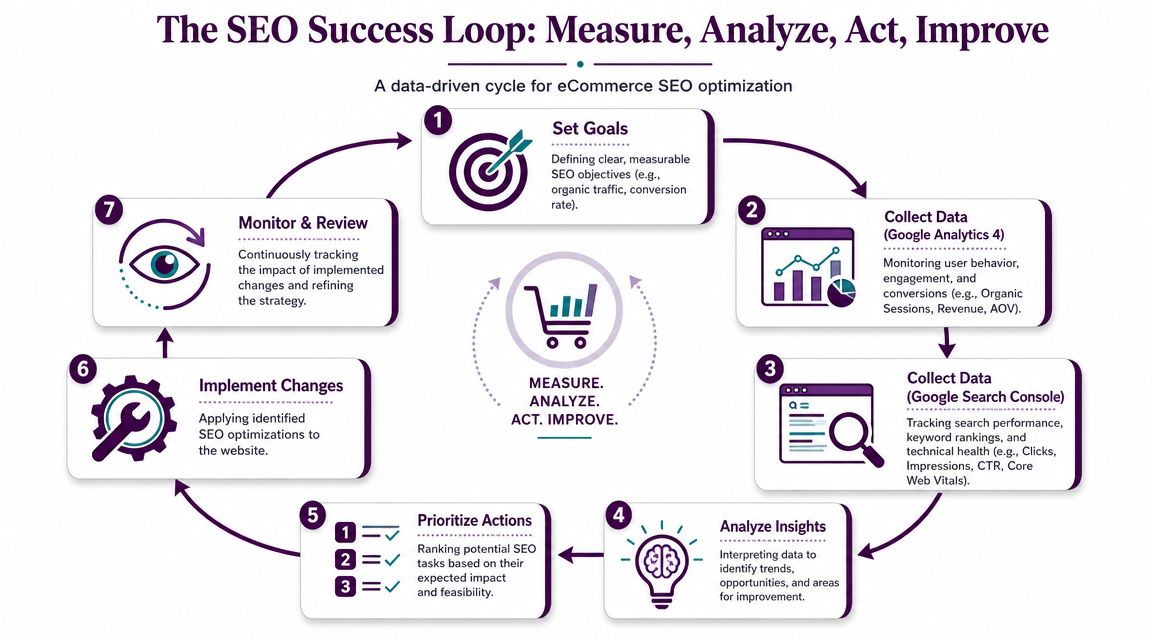
GA4 shows landing-page performance and revenue contribution. Google Search Console shows clicks, impressions, and query visibility. Rank trackers show movement across target terms. Technical crawlers surface site issues. Backlink tools show authority gaps. Useful on their own, messy together.
Measure what changes decisions
A senior ecommerce SEO process starts by tying metrics to actions.
For measurement discipline, it helps to keep a short list:
Organic revenue and transactions from GA4, because traffic without sales is an incomplete win
Landing-page performance to spot which category and product pages deserve optimization first
Query-level visibility and CTR in Search Console, especially for commercial terms
Ranking trends for key category, product, and comparison searches
Technical issue patterns that affect indexation, rendering, or usability
For teams that want a clean business-language refresher on KPI selection, this guide to understanding ecommerce performance indicators is useful.
Use an impact-versus-effort filter
Don't run SEO from a backlog alone. Run it from a queue of decisions.
A practical framework looks like this:
Priority bucket | What belongs here | Typical examples |
|---|---|---|
High impact, low effort | Fix soon | Rewriting thin category intros, improving title tags, repairing broken internal links |
High impact, high effort | Plan carefully | Faceted navigation cleanup, template-level product page upgrades |
Low impact, low effort | Batch later | Minor metadata cleanup on low-value pages |
Low impact, high effort | Usually avoid | Building pages with weak demand and unclear commercial value |
This keeps teams from spending a sprint on tasks that are technically satisfying but commercially minor.
Build a decision loop
The strongest ecommerce SEO programs repeat the same loop:
Find the pages where organic visibility and commercial intent overlap.
Diagnose the bottleneck. Is it crawlability, weak page quality, poor internal links, or weak SERP presentation?
Estimate likely impact based on business importance, not SEO neatness.
Ship the fix.
Review outcomes and adjust.
A good SEO plan doesn't ask, "What can we optimize?" It asks, "What should earn attention first?"
Fragmented tooling often slows teams down. Agencies and in-house teams need one place to connect rankings, revenue, technical issues, and page-level opportunity so prioritization becomes faster and less political.
Your Ecommerce SEO Implementation Checklist and FAQ
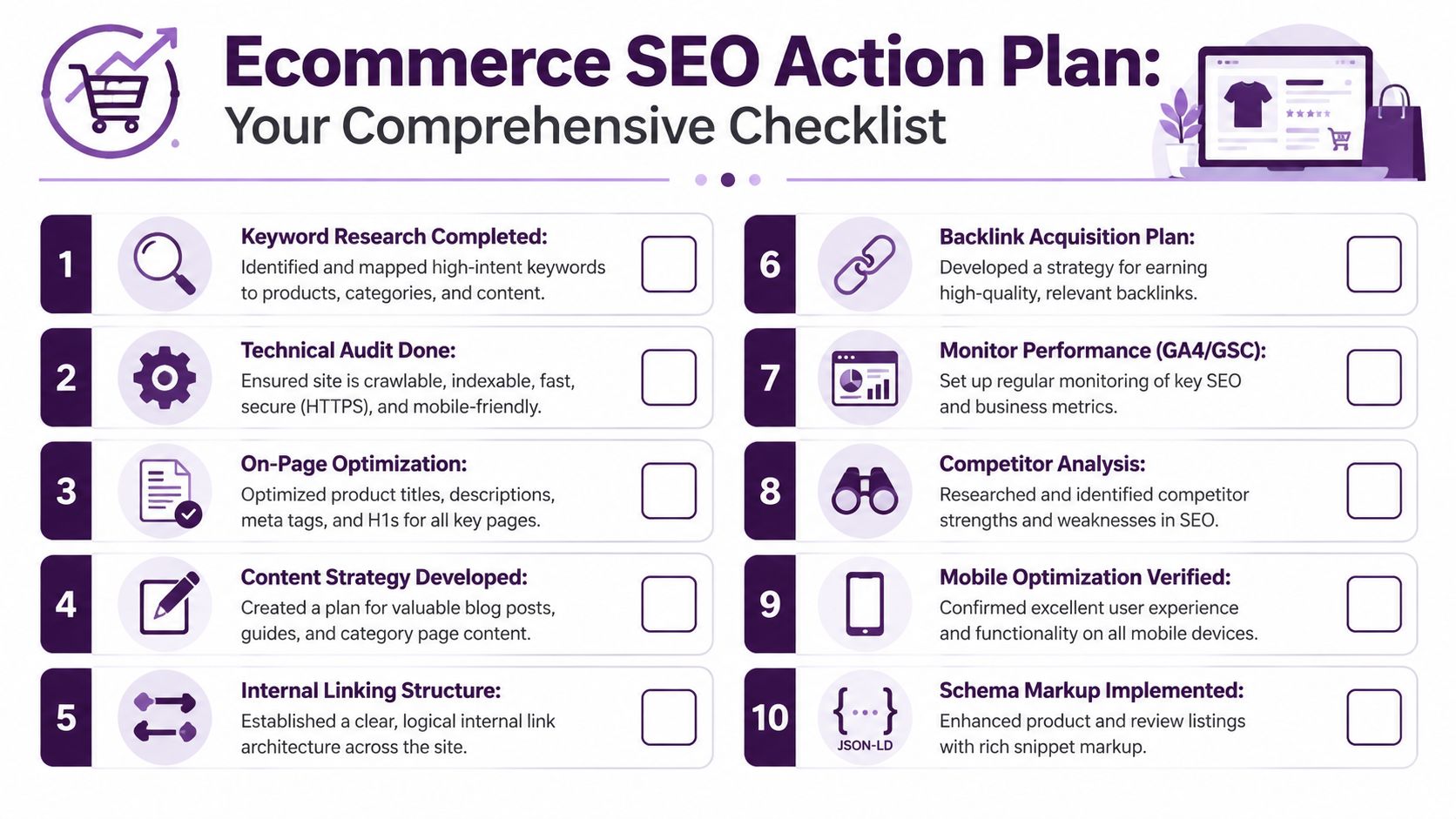
A useful ecommerce SEO plan should fit on one page. If it can't, the team usually ends up doing too much at once.
The checklist below is built for execution. It maps common actions to the kind of capability teams need in a platform that connects search data, technical findings, and page priorities in one workspace.
Ecommerce SEO implementation checklist
Action Item | Area | Keyword Kick Capability |
|---|---|---|
Map commercial keywords to category and product pages | Strategy | Keyword research and keyword mapping |
Identify pages with strong intent but weak visibility | Prioritization | Rank tracking plus page-level opportunity analysis |
Audit crawl waste and duplicate URL patterns | Technical SEO | Site audit and technical issue detection |
Review faceted navigation rules | Technical SEO | Crawl analysis and indexation diagnostics |
Improve title tags, headings, and core page copy | On-page SEO | On-page analysis and optimization workflows |
Strengthen product details, specs, and buyer-question coverage | Conversion-focused content | Content analysis tied to landing-page performance |
Add and verify internal links from category to product paths | Site architecture | Internal linking insights from crawl data |
Find pages that should win SERP enhancements | SERP visibility | SERP feature tracking and schema opportunity analysis |
Compare competitor coverage by topic and page type | Competitive analysis | Competitor gap analysis |
Monitor post-launch performance by page and query | Measurement | GA4, GSC, and rank tracking integrations |
The checklist in working order
Treat this as a sequence, not a pile.
Start with page targeting. Pick the category and product pages where search intent and business value overlap.
Remove technical friction next. Fix issues that stop those pages from being crawled, indexed, or rendered properly.
Upgrade the page experience. Improve copy, trust signals, specs, and internal links.
Expand SERP visibility. Support eligible pages with structured data and better snippet presentation.
Measure at page level. Watch rankings, clicks, landing-page behavior, and organic revenue contribution together.
What often fails is reversing that order. Teams publish more content before cleaning indexation. They add schema to thin pages. They chase blog traffic while core category pages underperform.
FAQ
How long does ecommerce SEO take to show results
It depends on the store's starting point, the competitiveness of the market, and how much technical debt exists. Technical fixes can change crawl and indexation behavior sooner. Content and authority improvements usually take longer. The practical answer is to look for early movement in visibility and page-level engagement before expecting broader revenue impact.
Should I focus on blogging or product pages first
For most stores, product and category pages come first. Those pages sit closest to purchase intent. Blog content can help when it supports discovery, education, and internal linking, but it shouldn't distract from the pages that sell inventory.
What is the biggest ecommerce SEO mistake
Trying to optimize everything equally. Large stores need prioritization. If your team gives the same attention to low-value pages, faceted clutter, and top revenue categories, the program slows down and results get diluted.
How do I know which pages to optimize first
Choose pages where three things meet: meaningful search demand, clear commercial intent, and realistic ranking opportunity. Then check whether the bottleneck is technical, content-related, or architectural. The page with the loudest problem isn't always the page with the biggest upside.
The best ecommerce SEO teams don't win by doing more tasks. They win by sequencing the right tasks on the right pages.
Keyword Kick helps agencies, ecommerce brands, and in-house teams turn scattered SEO data into a prioritized action plan. Instead of jumping between GA4, Google Search Console, rank trackers, backlink tools, and crawl reports, you can use Keyword Kick to connect those signals, see what's hurting visibility, and decide which pages to optimize first with more confidence.